
The OZAH Series Slurry Pump is a heavy-duty cantilever centrifugal pump designed for transporting abrasive, solids-laden slurry throughout demanding mining and mineral processing operations. In a typical crushing and beneficiation plant, crushers first reduce large raw ore into smaller pieces, after which the material enters grinding and classification circuits where water is added to form slurry. At this stage, the slurry pump plays an important role in moving the ground ore-water mixture between process equipment, supplying hydrocyclones for particle classification, circulating slurry through grinding circuits, and transferring material to downstream flotation, concentrate handling, and tailings disposal systems. Unlike conventional water pumps, the OZAH is specifically constructed to handle the continuous passage of abrasive mineral particles, including high-concentration slurry and lower-concentration slurry requiring higher discharge head. Its heavy-duty double-casing construction, thick replaceable wear components, and large-diameter, low-speed impeller are designed to withstand the erosion and mechanical loading associated with these operating conditions.
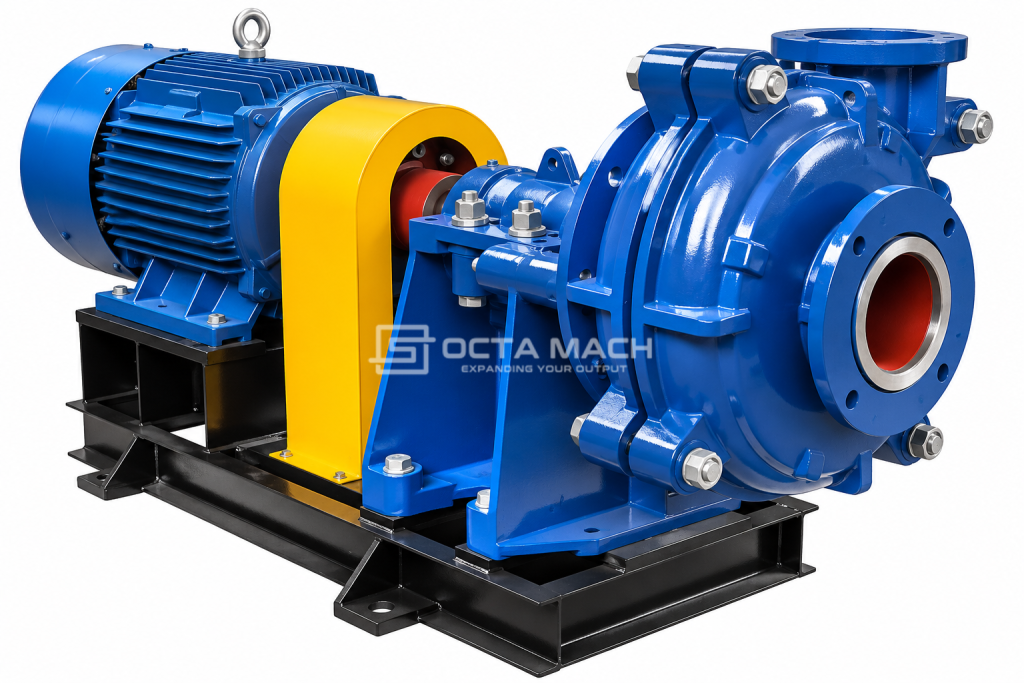
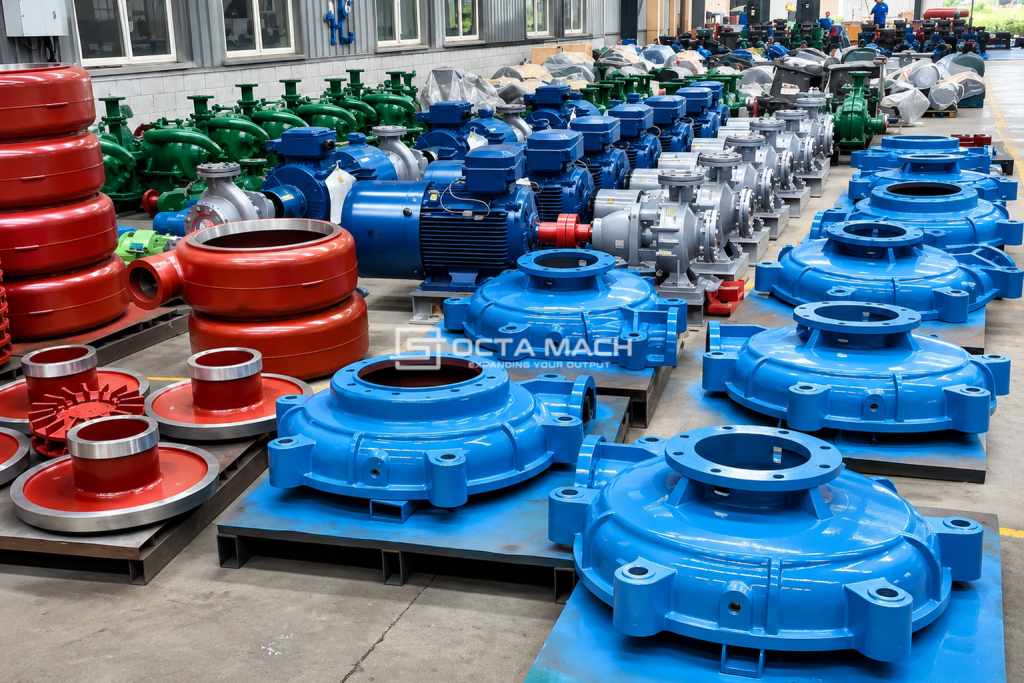
One of the distinguishing features of the OZAH series is its replaceable wet-end construction, which includes the impeller, casing liners, and front and rear wear plates. These components are available in A05 high-chrome alloy and R55 natural rubber, with additional A49 alloy and silicon carbide material options for applications involving specific combinations of abrasion, corrosion, and temperature. The large, open internal flow passages are designed to reduce slurry velocity inside the pump, while the low-speed impeller helps limit abrasive wear on critical hydraulic components. Combined with a heavy-duty bearing support, configurable shaft sealing, and a maintenance-friendly casing design, the OZAH series provides a practical pumping solution for mill circulation, hydrocyclone feeding, flotation circuits, and tailings transportation in crushing and mineral processing plants.
OZAH Series Slurry Pump Specifications
The OZAH Series Slurry Pump is available in multiple sizes and configurations to meet different slurry transportation requirements. Our current product range covers flow rates from 3.6 to 648 m³/h, heads from 5 to 69 m, and rotational speeds from 500 to 3,800 r/min, with motor power options ranging from 1.5 to 180 kW. Inlet diameters range from 38 to 203 mm, while outlet diameters range from 25 to 152 mm. Depending on the selected model, NPSHr ranges from 2 to 7.5 m, with pump efficiencies of 20% to 75%. The following table presents the available specifications and operating parameters of the OZAH series.
| Parameter | Catalogue Specifications |
| Pump Type | Heavy-Duty Cantilever Centrifugal Slurry Pump |
| Casing Construction | Double Casing, Through-Bolt Design |
| Inlet Diameter | 38–203 mm |
| Outlet Diameter | 25–152 mm |
| Capacity | 3.6–648 m³/h |
| Head | 5–69 m |
| Rotational Speed | 500–3,800 r/min |
| NPSHr | 2–7.5 m |
| Efficiency | 20–73% |
| Motor Power | 1.5–180 kW |
| Standard Wear Materials | A05 High Chrome Alloy, R55 Natural Rubber |
| Optional Materials | A49 Alloy, High-Temperature Sintered SiC, CN3-SiC |
| Shaft Sealing | Packing Seal, Mechanical Seal |
| Bearing Lubrication | Grease or Oil |
| Discharge Orientation | Eight Installation Positions |
Note: The ranges above are compiled from the OZAH model entries in the supplied catalogue. Separate OZHH and OZM model data are excluded. These figures represent different listed model configurations, not the operating range of one pump. Final performance must be checked against the selected model’s performance curve.
How Does the OZAH Slurry Pump Work?
The OZAH Series operates through centrifugal force generated by its rotating impeller. As the impeller rotates, it accelerates the incoming slurry from the center toward the outer edge, creating the pressure difference required to maintain continuous flow through the pump.
The pumping process consists of four main stages:
- Slurry Inlet: The solid-liquid mixture enters through the suction inlet and flows toward the center of the rotating impeller.
- Centrifugal Acceleration: The rotating impeller vanes transfer mechanical energy to the slurry, increasing its velocity and directing it toward the outer circumference of the impeller.
- Pressure Conversion: As the slurry enters the casing, the flow passage guides the mixture toward the discharge outlet while converting part of its velocity energy into pressure energy.
- Discharge and Transportation: The pressurized slurry leaves through the discharge connection and enters the downstream pipeline for further processing.、
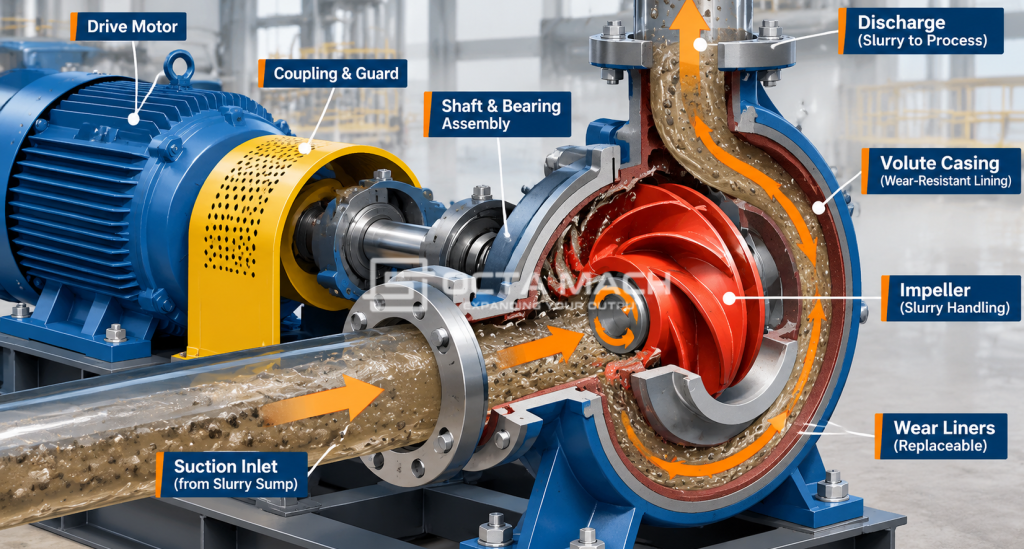
The actual operating point depends on the relationship between pump performance and system resistance. Slurry concentration, particle size, pipeline length, friction losses, elevation changes, and suction conditions all influence the required flow rate and discharge head. These factors must be considered together when configuring the pump for a specific mineral processing circuit.
Selected OZAH Slurry Pump Models and Performance Data
The OZAH slurry pump series covers a range of pump sizes and operating conditions to accommodate different flow rate and head requirements. The following table presents three representative models with outlet diameters of 38 mm, 51 mm, and 152 mm, together with their corresponding hydraulic performance and motor specifications.
| Model | Inlet / Outlet Diameter (mm) | Capacity (m³/h) | Head (m) | Speed (r/min) | NPSHr (m) | Efficiency (%) | Shaft Power (kW) | Motor Power (kW) |
| OZAH(R)38-10.8/19.3-4 | 51 / 38 | 10.8 | 19.3 | 1,800 | 3.0 | 23 | 2.47 | 4 |
| OZAH(R)51-61.2/28-15 | 76 / 51 | 61.2 | 28 | 1,900 | 4.2 | 56 | 8.33 | 15 |
| OZAH(R)152-648/40.5-110 | 203 / 152 | 648 | 40.5 | 1,000 | 7.5 | 70 | 99.3 | 110 |
Weight and Overall Dimensions
The weight and overall dimensions of each model are listed below. These specifications are relevant to equipment transportation, foundation design, installation space, and maintenance access.
| Model | Weight (kg) | Overall Dimensions (L × W × H, mm) |
| OZAH(R)38-10.8/19.3-4 | 104 | 592 × 410 × 381 |
| OZAH(R)51-61.2/28-15 | 191 | 768 × 476 × 464 |
| OZAH(R)152-648/40.5-110 | 1,473 | 1,302 × 1,102 × 917 |
Performance Data and Pump Selection
The performance values shown above correspond to specific pump configurations and operating points. They should not be treated as interchangeable operating conditions. Changes in rotational speed or impeller configuration can affect flow rate, head, efficiency, and shaft power.
The listed values represent selected operating points rather than complete Q-H performance curves for every model. Before final selection, the required duty point should be checked against the performance curve for the exact pump configuration.
Pump selection should also account for the properties of the slurry, including solids concentration, particle size, density, viscosity, operating temperature, and corrosive or abrasive characteristics. The inlet conditions, required flow rate, discharge head, NPSH requirements, and wetted-part material compatibility should all be considered to ensure the selected pump is suitable for the intended operating environment.
OZAH Slurry Pump Structure and Components
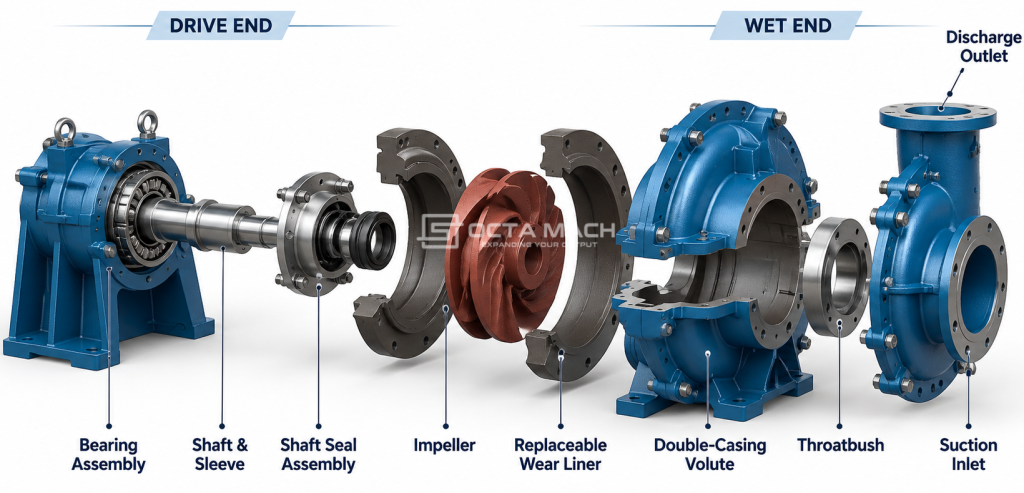
The OZAH Series uses a double-casing construction with a heavy-duty support structure. Its internal components are designed around the areas most exposed to abrasive slurry, allowing worn parts to be replaced without treating the entire pump assembly as a consumable unit.
Double Casing and Through-Bolt Construction
The pump casing adopts a vertically split, through-bolt design. The casing is connected to the support bracket by bolts, providing access to the internal wear components during maintenance.
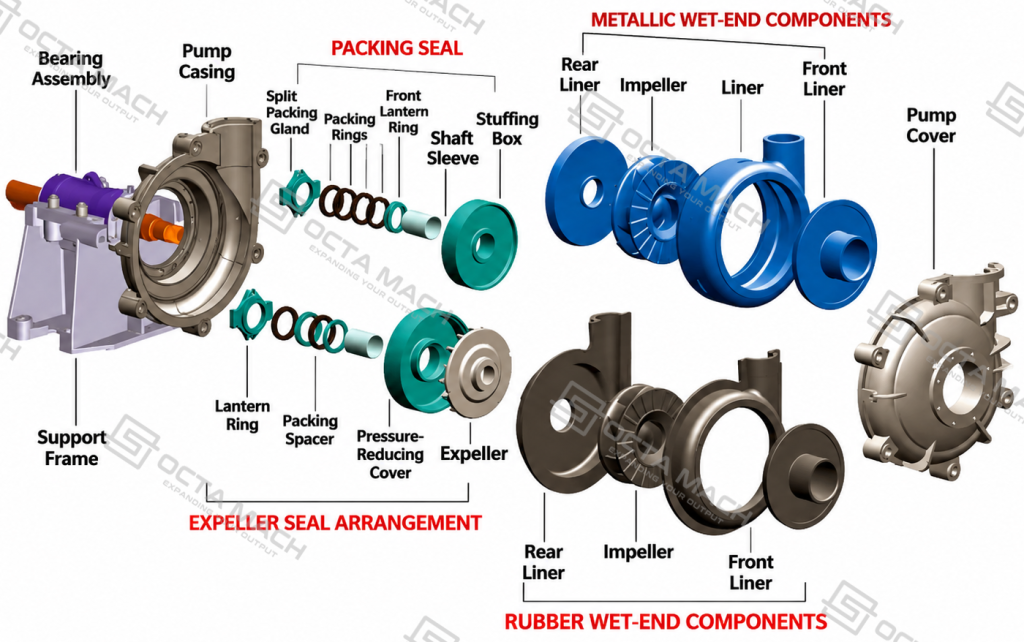
The replaceable wet-end components include:
- Impeller
- Casing liner
- Front wear plate
- Rear wear plate
The outer casing and replaceable internal components serve different functions. The casing provides the structural enclosure, while the internal liners and impeller are exposed directly to the moving slurry.
This arrangement makes it possible to select different wear materials for the main flow components according to the process medium.
Large-Diameter, Low-Speed Impeller
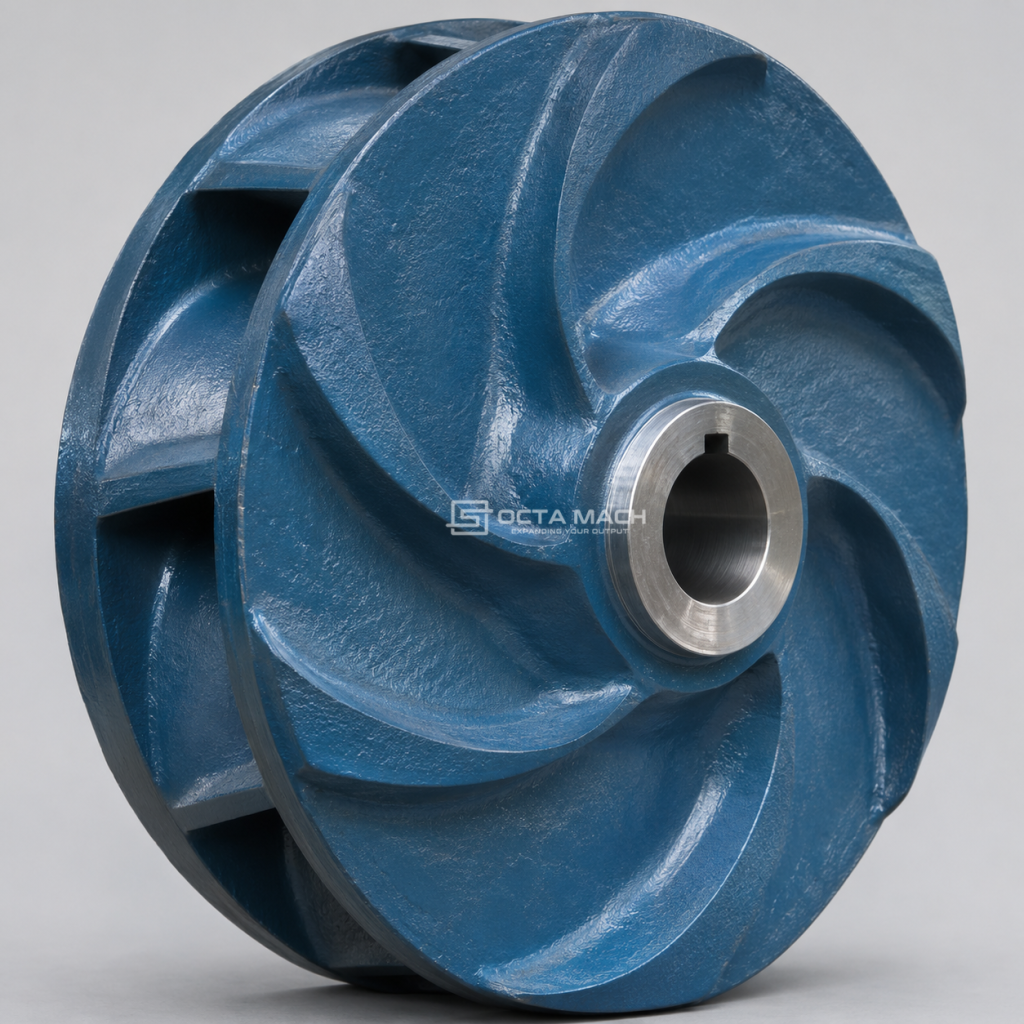
The OZAH design uses a large-diameter impeller operating at relatively low rotational speed for heavy-duty slurry transportation.
In abrasive service, particle velocity and impact direction influence how quickly the impeller and casing surfaces wear. A large, low-speed impeller helps limit internal flow velocities and reduces the severity of abrasive interaction under suitable operating conditions.
The impeller also incorporates back vanes on its front and rear shrouds. According to the product catalogue, these vanes are designed to reduce leakage and support longer pump service life.
Large Internal Flow Passages
The pump features large, open internal passages intended to reduce internal flow velocity and limit wear in the wet end.
Passage geometry is particularly important when slurry contains suspended solids that may settle or accumulate under unsuitable flow conditions. The required pump capacity must therefore be selected together with the pipeline diameter, slurry properties, and minimum transport velocity.
Shaft and Bearing Assembly
The OZAH uses a short shaft-overhang arrangement to reduce shaft deflection. This helps limit additional loading on the bearing and shaft-sealing components.
Its cartridge-style bearing assembly can be serviced in a clean maintenance environment without dismantling the main pump casing. Grease and oil lubrication arrangements are both listed in the catalogue.
The bearing assembly and shaft design are important considerations when a pump operates continuously under abrasive conditions, particularly where unplanned maintenance can interrupt the mineral-processing circuit.
Eight-Position Discharge Connection
The discharge outlet can be rotated into eight different installation positions.
This arrangement gives greater flexibility when matching the pump to existing pipework, equipment foundations, and available installation space. The final outlet direction should be confirmed against the plant layout before the installation drawing is approved.
Wear-Resistant Material Options for Different Slurry Conditions
The material of the impeller, casing liner, and other wetted components has a direct influence on wear resistance and chemical compatibility.
The OZAH Series offers several wear-resistant material options to suit different slurry conditions. A05 high-chrome alloy and R55 natural rubber are the standard configurations for wet-end components, while A49 alloy, high-temperature sintered silicon carbide (SiC), and CN3-SiC are available for more specific applications. These materials provide different levels of abrasion resistance, corrosion resistance, and temperature tolerance, allowing the impeller and other slurry-contact components to be selected according to particle characteristics, slurry chemistry, and operating conditions.
| Material | Main Properties | Recommended Operating Conditions |
| A05 High Chrome Alloy | Heat-treated hardness of HRC 58–62; strong abrasion resistance | Neutral or mildly alkaline slurry with relatively low corrosivity |
| A49 FGD Alloy | Combines wear resistance with improved acid resistance; wear resistance is stated to be comparable to A05 | Flue gas desulfurization systems and slurry with pH ≥ 3.5, subject to chemical compatibility |
| R55 Natural Rubber | High elasticity, toughness, and resistance to cutting, tearing, and abrasion | Fine slurry and slurry containing fine sand particles |
| High-Temperature Sintered SiC | High hardness, chemical stability, and low density of 2.65 g/cm³ | Abrasive and corrosive applications requiring ceramic wear components |
| CN3-SiC | Catalogue-described high-hardness infiltrated silicon carbide material | Large or hard mineral particles and specific severe wear/corrosion conditions; catalogue temperature limit ≤180°C |
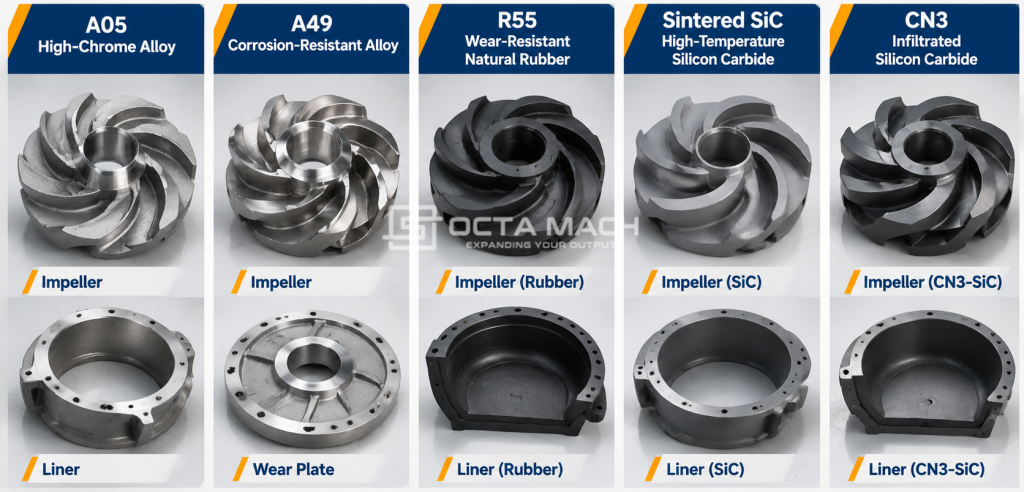
A05 High Chrome Alloy
A05 is the conventional metal wear material listed for the OZAH series. Its heat-treated hardness reaches HRC 58–62, providing resistance to abrasive wear during slurry transportation.
It is suitable for mining, coal washing, and tailings applications where the slurry is neutral or mildly alkaline and does not contain strongly corrosive chemicals.
A05 should not be selected for acidic service without further material compatibility verification.
A49 Alloy for Flue Gas Desulfurization
A49 is designed for flue gas desulfurization applications where abrasion and chemical corrosion occur together.
Its material characteristics combine high-chrome alloy wear resistance with improved acid resistance. The catalogue identifies it for absorption tower circulation pumps and slurry transfer duties, including slurry with pH ≥ 3.5.
For final selection, pH should not be considered in isolation. Chloride concentration, temperature, and the presence of other chemical species also need to be reviewed.
R55 Wear-Resistant Natural Rubber
R55 is a natural rubber material with high elasticity and toughness. The product catalogue describes its production using a liquid-phase mixing process intended to preserve the physical properties of the finished rubber.
Its main characteristics include:
- Resistance to cutting and tearing.
- Good elasticity and wear resistance.
- Low elastic modulus.
- Suitability for fine slurry containing fine sand particles.
- Noise reduction through its flexible material properties.
R55 is an option for applications where impact absorption and fine-particle abrasion resistance are important. Particle sharpness and size should be checked before specifying rubber-lined wet-end components.
High-Temperature Sintered Silicon Carbide
SiC ceramic components provide high hardness, chemical stability, and resistance to abrasion and corrosion.
The supplied catalogue gives a density of 2.65 g/cm³ and describes resistance to most inorganic acids, organic acids, and alkalis, with hydrofluoric acid and hot concentrated alkali identified as exceptions.
The catalogue also provides comparative wear-resistance figures against Cr15Mo3 and Cr30. However, because the test conditions and evaluation method are not specified, these comparative figures should not be treated as universal service-life guarantees.
CN3-SiC for Severe Operating Conditions
CN3-SiC is listed as a special silicon carbide material with an infiltrated high-hardness surface layer.
The catalogue specifies a temperature resistance of up to 180°C and a stated pH application range of 1–14 for this material option.
It is intended for applications involving hard or large mineral particles combined with demanding wear and corrosion conditions.
The 180°C figure applies to the catalogue’s CN3-SiC material description. It should not be interpreted as the maximum operating temperature of every OZAH pump configuration. The complete pump, sealing arrangement, and other wetted materials must be checked separately.
Shaft Sealing and Drive Arrangements
Mechanical Seal Configuration
The OZAH Series comes standard with a balanced, single-end-face, cartridge-type mechanical seal installed at the shaft end behind the impeller. This design provides reliable sealing performance during abrasive slurry transportation while helping control leakage.
Both single and double cartridge-type mechanical seals are available, with packing seals offered as an alternative. The sealing system is suitable for mineral slurry, coal slurry, desulfurization slurry, lithium battery slurry, and acidic or alkaline wastewater.
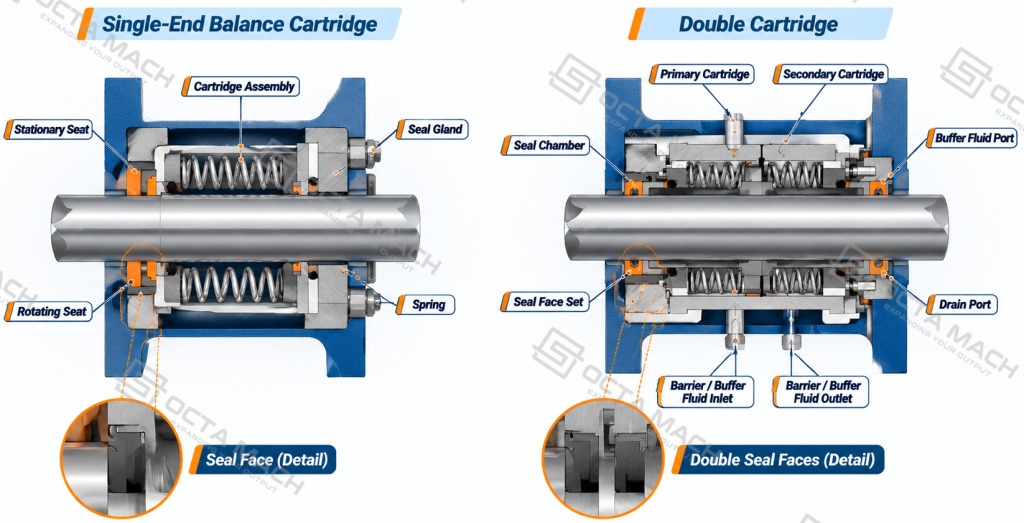
The specified application range includes pH 1–14 and chloride ion concentrations up to 60,000 ppm. For double mechanical seals, the sealing liquid type, supply method, and auxiliary piping requirements should be confirmed according to the operating conditions.
Drive Arrangements
The OZAH Series offers multiple drive arrangements to accommodate different motor positions, installation layouts, and operating requirements. These configurations provide flexibility in pump and motor positioning, allowing the equipment to fit different foundation spaces and plant layouts.
The appropriate drive arrangement is selected according to the pump model, required operating speed, and site installation conditions.
Applications in Crushing and Mineral Processing
The OZAH Series is intended for industrial slurry transportation where solid particles create additional wear on the pump’s internal components. Its applications include several stages of mineral processing and related industrial operations.
Grinding Circuit and Hydrocyclone Feed
After crushing and grinding, mineral particles are mixed with process water to form slurry. This mixture must be transferred from the grinding circuit to classification equipment.
OZAH pumps are listed for cyclone-feed duties associated with grinding circuits. In these applications, pump capacity and head must account for the required feed pressure, slurry density, particle distribution, and pipeline resistance.
The material of the impeller and casing liner should also be matched to the abrasiveness of the ground ore.
Tailings and Concentrate Transportation
Tailings and concentrate pumping are important parts of mineral-processing operations.
During tailings transfer, the pump handles slurry containing residual mineral particles and process water. The wear rate depends on the particle size distribution, solid concentration, and pipeline conditions.
For concentrate transportation, the selected pump must provide the required flow and head while accommodating the slurry’s actual density and chemical composition.
Flotation and Mixing Systems
Flotation circuits require slurry transfer between processing equipment and different stages of mineral separation.
The OZAH catalogue lists flotation pumps and mixing duties among its applications. Material compatibility and seal configuration should be checked against the actual process medium, particularly where flotation chemicals are present.
Coal Washing and Power Generation
Coal preparation plants handle coal slurry and fine mineral particles during washing and separation.
The OZAH series is also listed for power-generation applications, including desulfurization circulation, limestone slurry supply, gypsum discharge, and related slurry-transfer duties.
For FGD applications, A49 alloy is one of the catalogue’s specified material options.
Steelmaking, Chemical Processing, and Dredging
The catalogue also identifies applications in steel smelting, including blast furnace slag-flushing water and wet desulfurization systems.
In chemical plants, the material selection should account for the specific acid or alkaline medium, operating temperature, and corrosion conditions. A49 and silicon carbide options may be considered where their documented compatibility matches the process.
River dredging and other abrasive slurry-transfer applications are also included in the product overview.
OZAH Slurry Pump Selection Guide
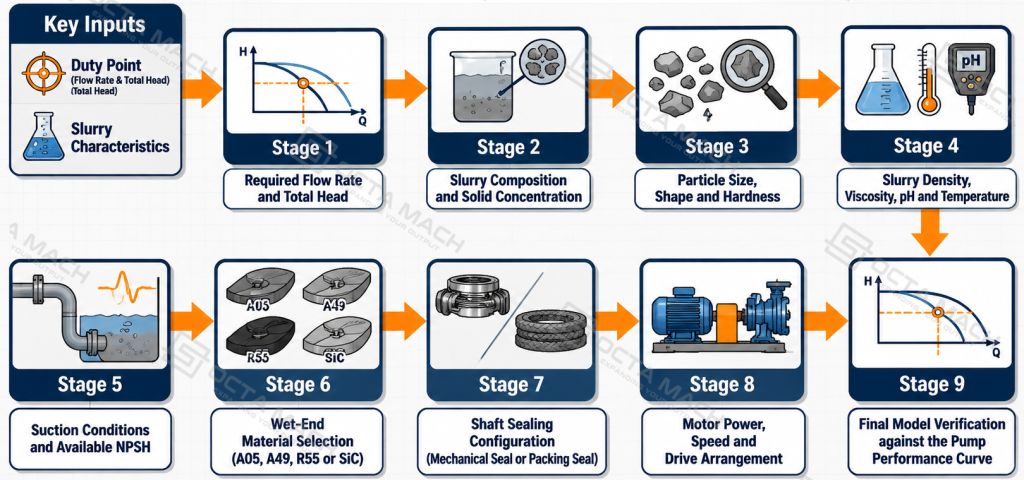
Selecting the right OZAH slurry pump requires matching its hydraulic performance, material configuration, and sealing arrangement to the actual operating conditions. The following factors should be considered:
1. Flow Rate and Head
Determine the required pumping capacity (m³/h) and total head (m), taking into account the pipeline layout, elevation differences, and system pressure requirements.
2. Slurry Characteristics
Provide the slurry composition, solid concentration, particle size and hardness, density, viscosity, pH, corrosiveness, and operating temperature. These properties directly affect pump material selection and wear performance.
3. Installation and Operating Conditions
Confirm the suction pressure, available NPSH, ambient temperature, installation altitude, and maximum system pressure to ensure the selected pump meets the site requirements.
4. Materials and Sealing
Choose suitable wet-end materials, such as A05, A49, R55, or SiC, according to the abrasive and corrosive properties of the slurry. Specify the required mechanical or packing seal, including auxiliary sealing arrangements where necessary.
5. Motor and Drive Requirements
Confirm the required motor power, operating speed, electrical specifications, and drive arrangement based on the selected pump model and installation conditions.
Providing these details allows the OZAH pump configuration to be matched more accurately to the process requirements, helping achieve reliable slurry transportation and appropriate wear performance.
Why Choose OCTA MACH for OZAH Slurry Pumps?
OCTA MACH provides OZAH slurry pump supply and technical support for mining and mineral processing applications. We assist customers in selecting suitable pump models, wear materials, sealing systems, and drive configurations based on flow rate, head, slurry properties, and site operating conditions.
Our supply scope can include the pump, supporting motor, base, coupling, coupling guard, anchor bolts, product documentation, installation drawings, and packing list. Related spare parts can also be arranged according to the selected model and project requirements.
From technical specification confirmation and equipment selection to spare parts coordination and export arrangements, OCTA MACH focuses on providing suitable equipment and practical support for each project. Our experience in mining and crushing equipment supply helps us understand the equipment requirements of different processing stages and coordinate solutions that match customers’ actual operating needs.
FAQ
How Long Does an OZAH Slurry Pump Last?
There is no universal service-life figure specified in the OZAH catalogue. Actual wear life depends on particle size, hardness, concentration, slurry chemistry, impeller speed, material selection, and operating conditions. Replaceable wet-end components allow worn parts to be renewed without automatically replacing the complete pump.
Does the OZAH Catalogue Specify the Maximum Solid Particle Size?
No universal maximum particle diameter is provided in the supplied catalogue. The allowable particle size depends on the selected pump size, impeller passage, and wet-end configuration. The maximum particle diameter and particle-size distribution should be supplied during model selection.
Does the 180°C Temperature Rating Apply to Every OZAH Pump?
No. The catalogue associates the ≤180°C temperature rating with its CN3-SiC material description. The temperature limits of the complete pump depend on the selected wetted materials, shaft seal, auxiliary system, and other components.
What Information Is Required to Select an OZAH Slurry Pump?
The main requirements are flow rate, total head, slurry density, solids concentration, particle size, viscosity, pH, chemical composition, temperature, inlet pressure, NPSH conditions, and motor requirements. The selected model should then be checked against its corresponding performance curve.