
An Agitation Vat is a vertical fabricated-steel conditioning tank designed to prepare ore pulp before flotation and other downstream separation processes. The unit integrates a cylindrical tank body, top-mounted motor and transmission, vertical agitator shaft, impeller, structural supports, and feed and discharge connections. During operation, the rotating impeller generates continuous slurry circulation, keeps mineral particles in suspension, promotes uniform reagent dispersion, and stabilizes solids concentration throughout the effective working volume.The XB series provides effective volumes from 0.26 to 30 m³, agitator diameters from 240 to 850 mm, and installed motor powers from 1.1 to 22 kW. It is suitable for flotation conditioning, ore-pulp mixing, reagent preparation and other mineral-processing duties.
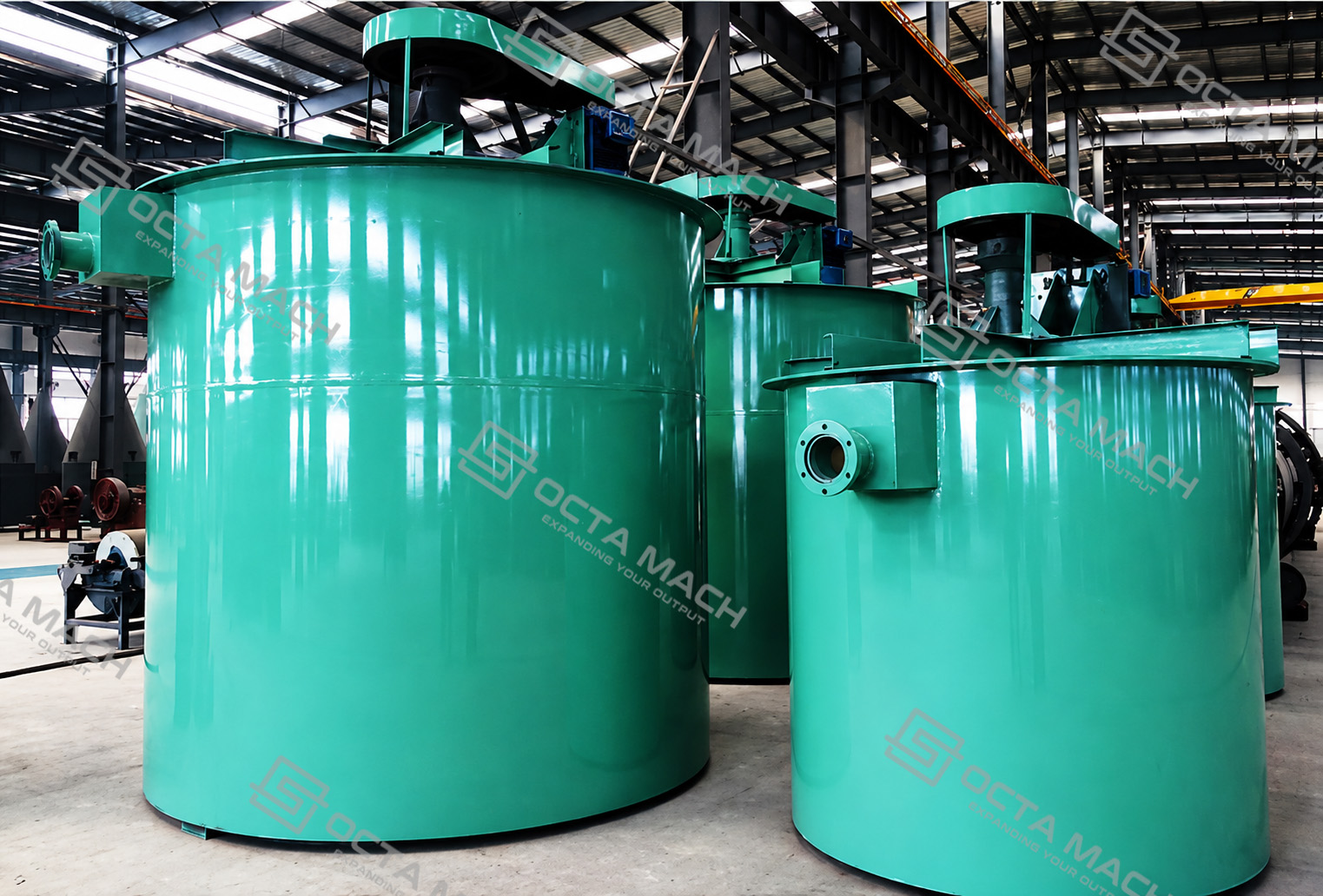
Octa Mach supports each project with application-based model selection, slurry-retention-time review, process-interface coordination, installation guidance, spare-parts planning and technical documentation, helping customers match the agitation duty more accurately to the actual ore properties and plant layout.
Main Operating Range
| Parameter | Published Range |
| Equipment type | Vertical Agitation Vat |
| Model range | XB-750 to XB-3500 |
| Tank internal diameter | 750–3,500 mm |
| Tank depth | 750–3,500 mm |
| Effective volume | 0.26–30 m³ |
| Agitator diameter | 240–850 mm |
| Agitator speed | 200–530 r/min |
| Motor power | 1.1–22 kW |
| Equipment weight | 228–7,110 kg |
| Main duty | Ore-pulp mixing and flotation conditioning |
XB Agitation Vat Technical Parameters
The XB series Agitation Vat is designed for continuous ore-pulp mixing, solids suspension and reagent conditioning in mineral-processing circuits. Standard models provide effective working volumes from 0.26 to 30 m³, with tank diameters from 750 to 3,500 mm and installed motor powers from 1.1 to 22 kW.
| Model | Tank Diameter (mm) | Tank Depth (mm) | Effective Volume (m³) | Agitator Diameter (mm) | Speed (r/min) | Motor Model | Power (kW) | Weight (kg) |
| XB-750 | 750 | 750 | 0.26 | 240 | 530 | Y90S-4 | 1.1 | 228 |
| XB-1000 | 1,000 | 1,000 | 0.58 | 240 | 530 | Y90L-4 | 1.5 | 436 |
| XB-1200 | 1,200 | 1,200 | 1.14 | 400 | 320 | Y100L2-4 | 3 | 765 |
| XB-1500 | 1,500 | 1,500 | 2.2 | 400 | 320 | Y100L2-4 | 3 | 1,083 |
| XB-2000 | 2,000 | 2,000 | 5.46 | 550 | 230 | Y132M2-6 | 5.5 | 1,671 |
| XB-2500 | 2,500 | 2,500 | 11.2 | 650 | 200 | Y160L-6 | 11 | 3,438 |
| XB-3000 | 3,000 | 3,000 | 19.1 | 700 | 210 | Y225S-8 | 18.5 | 4,613 |
| XB-3500 | 3,500 | 3,500 | 30 | 850 | 230 | Y225M-8 | 22 | 7,110 |
Parameter Notes:
- Effective volume refers to the available working volume under the specified operating condition, rather than the total geometric tank volume.
- Agitator diameter and speed are matched to the standard slurry-mixing duty of each model.
- Larger tanks use lower nominal rotational speeds and larger impellers to circulate a greater slurry volume.
- Published motor power is intended for preliminary model comparison and should not be treated as suitable for every slurry condition.
Model Selection Guide
| Process Requirement | Initial Model Direction |
| Laboratory or small pilot duty | XB-750 to XB-1000 |
| Small continuous conditioning duty | XB-1200 to XB-1500 |
| Medium slurry-conditioning duty | XB-2000 |
| Larger flotation feed preparation | XB-2500 |
| High-volume mineral-processing circuit | XB-3000 to XB-3500 |
The model ranges above are preliminary. Final selection must be checked against actual slurry flow, solids percentage, particle settling rate, residence time and plant layout.
Agitation Vat Working Principle
The motor drives the vertical shaft and impeller through the transmission assembly. Impeller rotation creates circulating flow inside the tank, drawing slurry downward near the shaft and returning it upward along the tank wall.
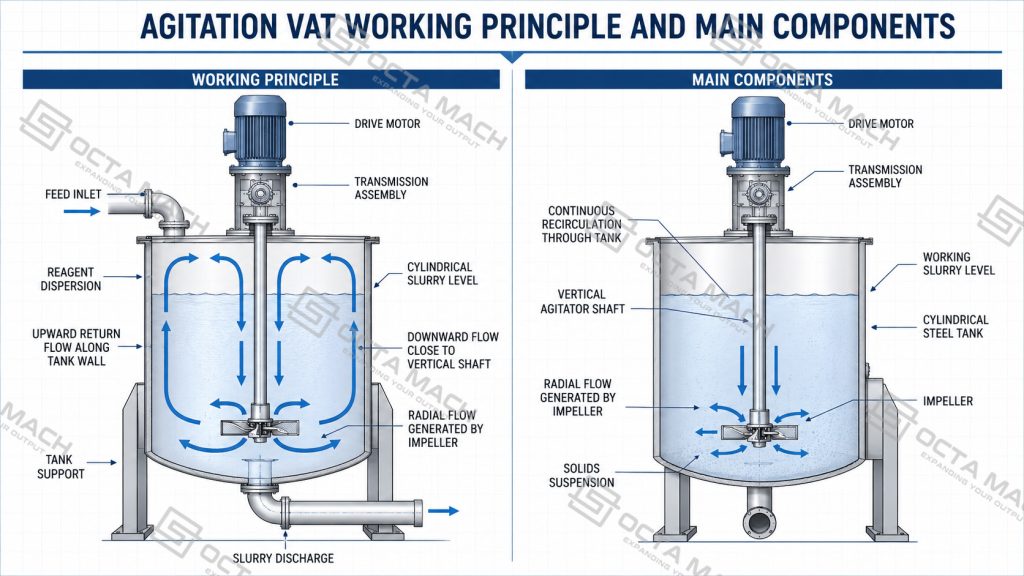
This circulation performs three main functions:
- Slurry mixing — reduces concentration differences across the tank.
- Solids suspension — limits settling of mineral particles.
- Reagent dispersion — improves contact between flotation chemicals and mineral surfaces.
The operating objective is controlled mixing rather than maximum rotational speed. Excessive agitation can increase power demand, accelerate wear and create unnecessary air entrainment.
Main Functions
An Agitation Vat does more than keep slurry moving. Its primary duty is to maintain a controlled circulation pattern that keeps mineral particles suspended, distributes reagents and stabilizes the feed condition before flotation or another separation stage.
| Process Function | Effect in the Mineral Circuit |
| Ore-pulp homogenization | Stabilizes slurry concentration before downstream treatment |
| Solids suspension | Reduces particle settlement in the tank |
| Reagent dispersion | Distributes collectors, depressants, activators and pH modifiers |
| Flotation conditioning | Provides contact time before slurry enters flotation cells |
| Process buffering | Reduces short-term fluctuations in upstream slurry feed |
| Continuous slurry transfer | Supports stable feed to the next processing stage |
Operating Note:
The required mixing intensity depends on slurry density, solids concentration, particle size, settling tendency, reagent type and conditioning time. Higher speed does not automatically improve performance; excessive agitation may increase power consumption, wear and unwanted air entrainment.
Agitation Vat for Flotation Conditioning
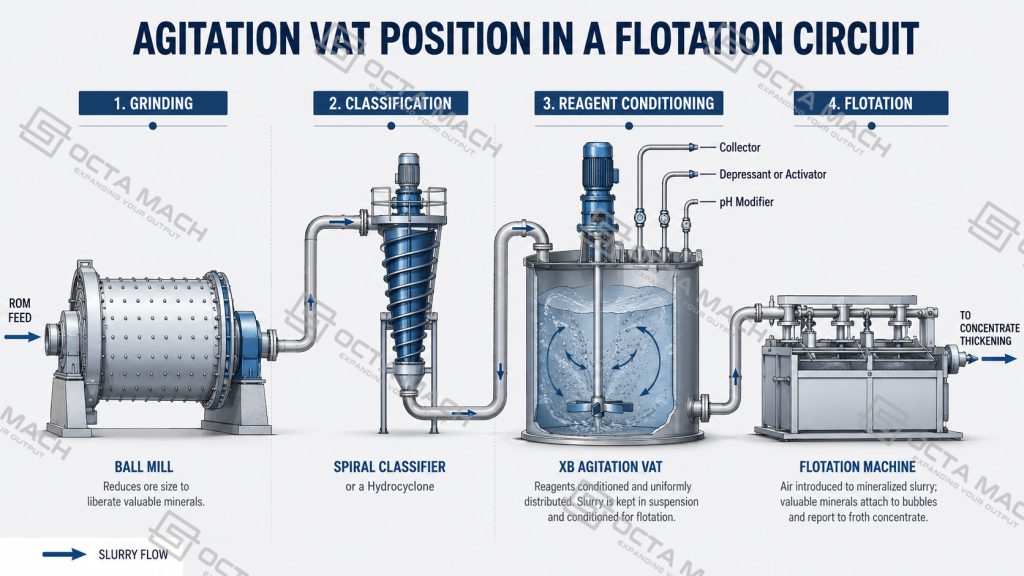
A flotation conditioning tank is normally installed between grinding/classification equipment and the flotation machine. Classified slurry enters the agitation vat after the target particle-size range has been established. Inside the tank, the vertical impeller maintains continuous circulation so that mineral particles remain suspended and process reagents are distributed throughout the working volume.
Typical process position:
Grinding → Classification → Agitation Vat → Flotation Machine
| Conditioning Duty | Function in the Flotation Circuit |
|---|---|
| Slurry homogenization | Reduces differences in solids concentration and particle distribution |
| Solids suspension | Limits settling at the tank bottom and discharge area |
| Reagent dispersion | Distributes collectors, depressants, activators and pH modifiers |
| Mineral-surface conditioning | Provides contact time between reagents and mineral particles |
| Feed stabilization | Reduces short-term fluctuations before the flotation cells |
| Continuous transfer | Delivers conditioned slurry to the downstream flotation stage |
XB agitation vats can be used in copper, lead-zinc, gold-bearing sulphide and other flotation circuits. However, the required model and impeller duty must be selected according to the actual slurry flow rate, solids concentration, particle-size distribution, slurry density, reagent program and required conditioning time.
For multi-stage flotation plants, separate agitation vats may be installed before roughing, cleaning or selective flotation stages where additional reagent conditioning is required. The feed and discharge arrangement should be matched to the plant elevation, pump system and flotation-cell layout to maintain continuous slurry transfer.
Preliminary Model Selection
| Selection Input | Why It Matters |
| Required slurry flow | Determines the necessary working volume |
| Conditioning time | Controls the minimum effective tank capacity |
| Solids concentration | Influences viscosity and suspension difficulty |
| Particle size | Affects settling tendency and impeller duty |
| Slurry density | Influences torque and motor load |
| Reagent addition points | Determines mixing and dispersion requirements |
| Upstream flow variation | Defines the required operating margin |
| Downstream equipment | Confirms discharge elevation and interface arrangement |
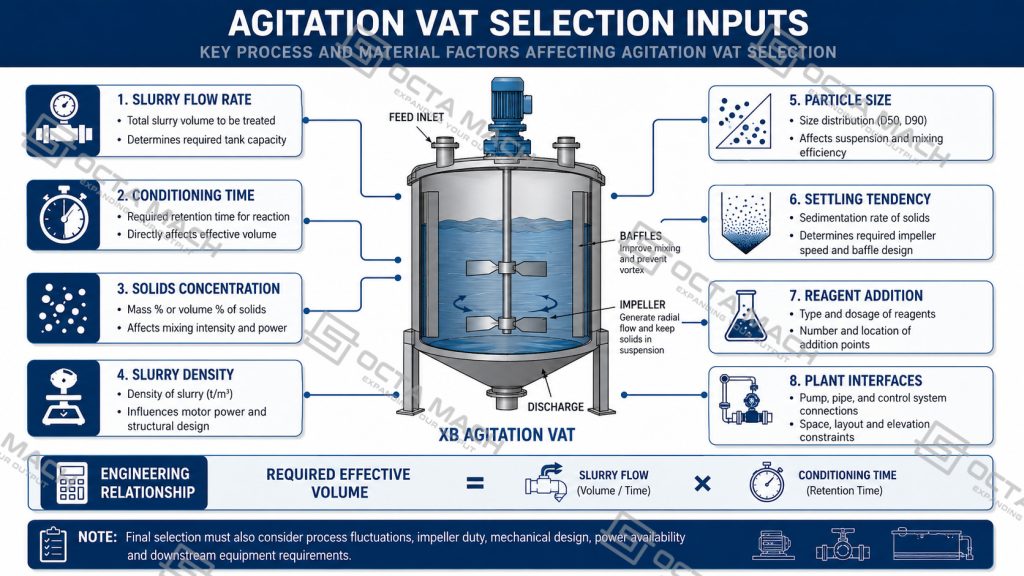
A preliminary volume estimate can be based on:
Required effective volume = slurry flow × required conditioning time.
The calculation should use consistent units and include an operating allowance for process fluctuations. Nominal tank volume alone should not be used as the final selection basis.
Main Components
An Agitation Vat consists of a cylindrical tank, top-mounted drive system, vertical shaft, impeller and supporting components. These parts work together to create controlled slurry circulation, maintain solids suspension and provide the conditioning time required before flotation or another downstream process.
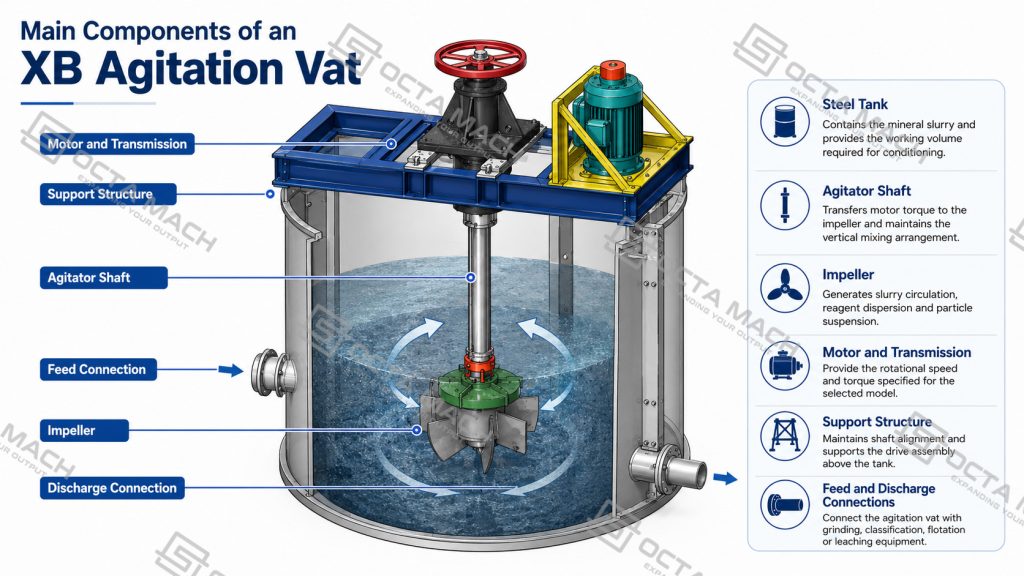
- Steel Tank:The cylindrical steel tank contains the slurry and provides the working volume for mixing and conditioning. Tank diameter, depth and connection layout influence residence time, internal circulation and solids-settling risk.
- Agitator Shaft:The vertical shaft transfers torque from the drive system to the impeller. Its length, diameter and rigidity are matched to tank depth, impeller size and slurry load to maintain alignment and reduce vibration.
- Impeller:The impeller creates the circulation required for slurry homogenization, solids suspension and reagent dispersion. Its diameter, blade geometry and speed should be selected according to slurry density, solids concentration, particle size and settling tendency.
- Motor and Transmission:The motor and transmission provide the speed and torque required for continuous agitation. Motor power should be verified against actual slurry conditions, as dense or high-solids feeds increase starting and operating load.
- Support Structure:The support structure carries the drive, shaft and upper tank assembly while maintaining shaft alignment. Adequate stiffness helps limit vibration and protects bearings, couplings and other rotating parts.
- Feed and Discharge Connections:The feed connection introduces slurry into the active mixing zone, while the discharge transfers conditioned slurry to downstream equipment. Their size, elevation and orientation should match the process flow and plant layout.
Component Selection Note
Final component configuration should be checked against:
- slurry density and solids concentration
- particle-size distribution and settling tendency
- required conditioning time
- reagent-addition arrangement
- continuous or intermittent operating duty
- feed and discharge elevations
- available installation space and maintenance access
The tank, shaft, impeller and drive system should be treated as one matched mixing assembly rather than selected independently.
Why Choose Octa Mach
Octa Mach supplies XB-series agitation vats for ore-pulp mixing, flotation conditioning and other mineral-processing duties. The equipment can be provided as a single unit or as part of a complete processing line together with flotation machines, ball mills, classifiers, pumps, thickeners and related auxiliary equipment. Different tank sizes, drive configurations and connection arrangements can be matched to the required slurry flow, conditioning time and plant layout.
FAQ
Q: How is the required Agitation Vat volume calculated?
A: Required effective volume is calculated from slurry flow multiplied by conditioning time. The result should include an operating allowance for flow fluctuations and should be checked against solids concentration, slurry density and settling tendency.
Q: What information is needed to select an XB Agitation Vat model?
A: At minimum, provide slurry flow rate, solids concentration, slurry density, particle-size distribution, required conditioning time and reagent-addition method. Plant elevation, feed and discharge connections, and downstream equipment interfaces should also be confirmed.
Q: Is a higher agitator speed always better for slurry conditioning?
A: No. Excessive speed can increase motor load, impeller wear and unwanted air entrainment without improving reagent dispersion. Impeller diameter and speed must be matched to tank volume, slurry density and particle settling characteristics.
Q: Where is an Agitation Vat installed in a flotation circuit?
A: It is normally installed after grinding and classification and before the flotation machine. The vat keeps particles suspended, disperses flotation reagents and stabilizes the slurry before it enters roughing, cleaning or selective flotation stages.