
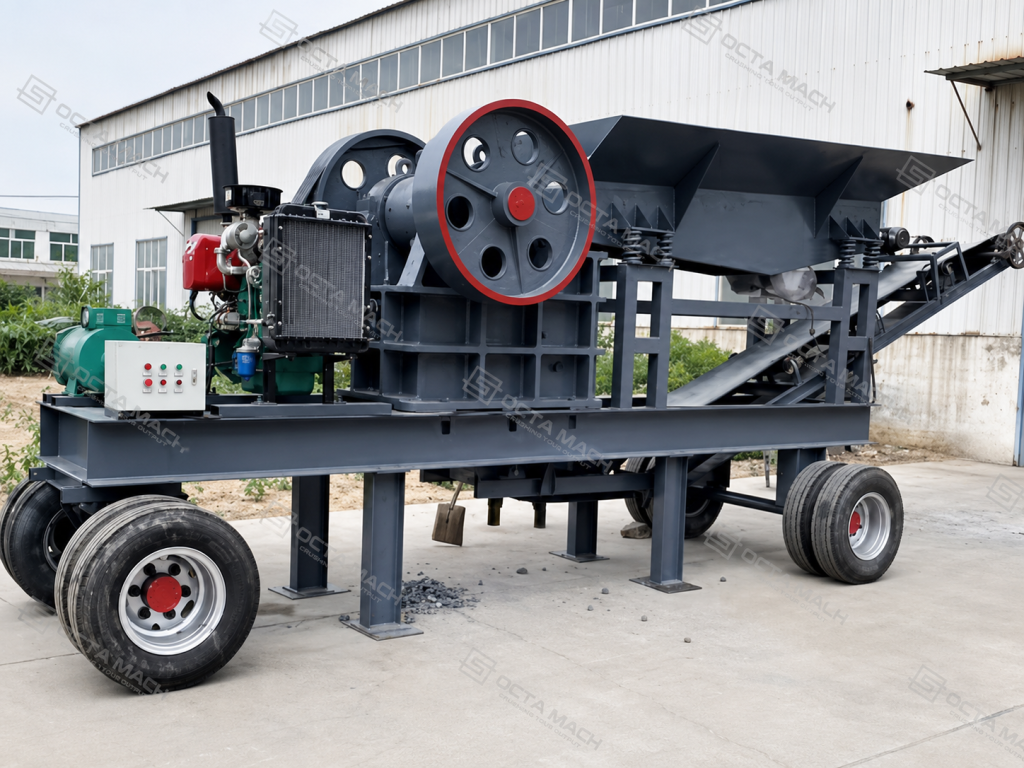
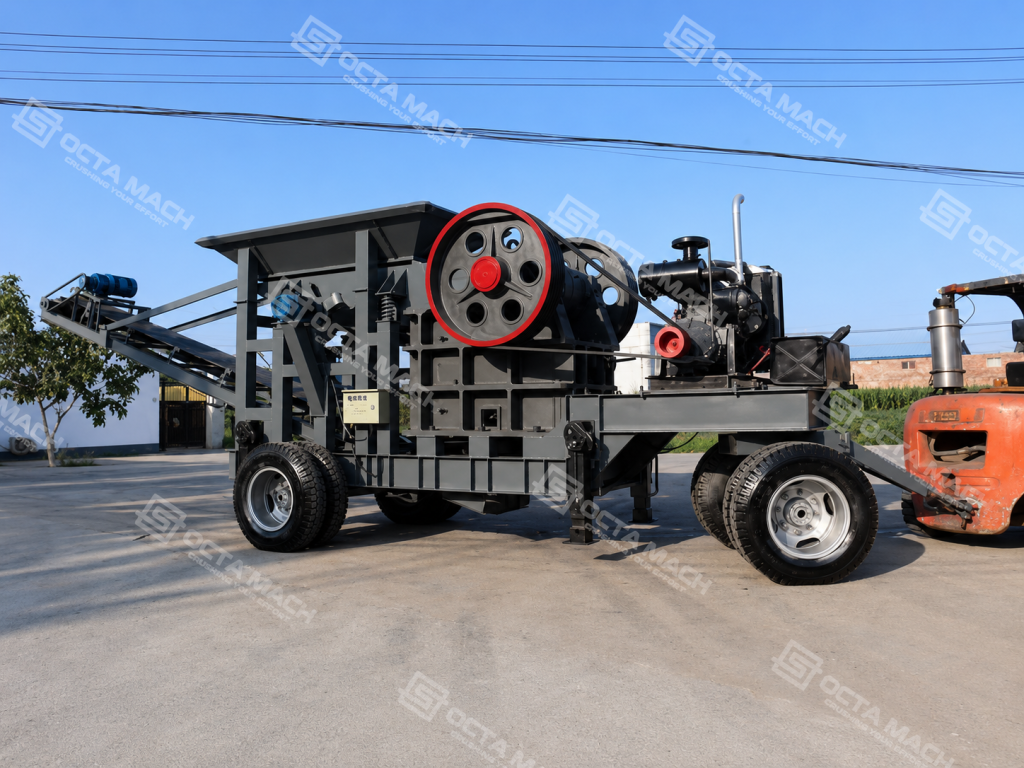
A portable stone crusher combines controlled feeding, jaw crushing and discharge conveying on a transportable chassis. It allows quarry stone, mine rock and large concrete blocks to be reduced close to the loading area instead of being transported to a distant fixed crushing plant before processing.
Octa Mach portable crushing equipment is configured around PE or PEX jaw crusher units. The available range covers maximum feed sizes from 120 to 1020 mm, discharge ranges from 10 to 300 mm, published capacities from 3 to 500 m³/h, and crusher motor powers from 11 to 160 kW.
PE models are mainly used for coarse primary crushing of large and irregular material. PEX models accept smaller feed and provide a finer jaw-crushed discharge. By matching the crusher with a suitable feeder, conveyor and portable chassis, the machine provides a continuous route from material loading to crushed-product discharge.
What Does a Portable Stone Crusher Do?
The main function of a portable crusher is to move the first crushing stage closer to the raw material.
In quarrying and mining, large rock can be reduced before it is transported to a screen, secondary crusher or stockpile. In road projects, the same machine can be moved between prepared working areas. At demolition sites, oversized concrete can be crushed before metal separation, screening or longer-distance transport.
| Project Condition | Function of the Portable Crusher |
|---|---|
| Large stone is difficult to transport | Reduces material near the loading area |
| Quarry face changes during extraction | Allows the primary crushing position to be relocated |
| Project operates for a limited period | Avoids installing a permanent crushing station for temporary work |
| Several sites share one crusher | Enables the machine to be transferred between projects |
| Downstream equipment cannot accept large feed | Produces a smaller and more manageable material size |
| Concrete blocks occupy excessive truck space | Reduces block size before transport and separation |
A portable stone crusher does not replace every machine in an aggregate plant. Its primary role is to accept large material, reduce it to a controlled discharge size and transfer it to the next operation.For projects requiring frequent self-propelled movement over uneven quarry ground, a crawler-type mobile crusher provides a more suitable mobility platform than a wheel-mounted plant.
PE and PEX Portable Jaw Crusher Selection
The current product range uses two jaw crusher series.
| Selection Point | PE Series | PEX Series |
|---|---|---|
| Main crushing duty | Coarse primary crushing | Finer jaw crushing |
| Feed condition | Large and irregular raw material | Smaller or pre-crushed material |
| Maximum feed in listed range | 1020 mm | 250 mm |
| Smallest listed discharge | 20 mm | 10 mm |
| Largest listed capacity | 500 m³/h | 60 m³/h |
| Typical use | Quarry stone, mine rock and large concrete blocks | Controlled small feed requiring finer discharge |
A portable jaw crusher fitted with a PE unit is normally selected when stone enters directly from quarry extraction, mining or demolition. PEX models are better suited to smaller material that has already been reduced or naturally falls within a controlled feed range.
Model selection should follow one practical sequence:
- Confirm the largest actual feed particle.
- Exclude models that cannot accept that particle size.
- Check the required crusher discharge.
- Compare capacity within the same model specification.
- Match the feeder and conveyor to the selected crusher.
Feed size, discharge range, capacity and motor power must be taken from the same model row.
PE Series Portable Jaw Crusher Parameters
PE jaw crushers provide large feed openings for primary crushing. The range includes compact models for smaller projects and larger machines for quarry and mining duties.
| Model | Feed Inlet Size (mm) | Max Feed Size (mm) | Discharge Size Range (mm) | Capacity (m³/h) | Motor Power (kW) |
|---|---|---|---|---|---|
| PE-250×400 | 250×400 | 210 | 20–60 | 3–13 | 15 |
| PE-400×600 | 400×600 | 340 | 40–100 | 10–35 | 30 |
| PE-500×750 | 500×750 | 425 | 50–100 | 25–60 | 55 |
| PE-600×900 | 600×900 | 500 | 65–180 | 30–85 | 55–75 |
| PE-750×1060 | 750×1060 | 630 | 80–180 | 72–150 | 90–110 |
| PE-800×1060 | 800×1060 | 680 | 100–200 | 85–143 | 90–110 |
| PE-870×1060 | 870×1060 | 750 | 170–270 | 145–235 | 90–110 |
| PE-900×1060 | 900×1060 | 780 | 200–290 | 170–250 | 90–110 |
| PE-900×1200 | 900×1200 | 780 | 95–255 | 100–240 | 110–132 |
| PE-1000×1200 | 1000×1200 | 850 | 195–280 | 190–275 | 110–132 |
| PE-1200×1500 | 1200×1500 | 1020 | 150–300 | 250–500 | 160 |
The feed inlet dimensions are not the same as the maximum permitted feed size. For example, PE-600×900 has a 600×900 mm inlet but a listed maximum feed size of 500 mm. This clearance helps irregular stone enter the chamber without repeatedly bridging at the opening.
A larger crusher is not automatically the better option. An oversized machine requires more installed power, a larger supporting chassis and correspondingly larger feeding and conveying equipment.
Two models with similar feed limits may also produce different discharge ranges. PE-900×1060 and PE-900×1200 both accept material up to 780 mm, but they are not interchangeable because their discharge and capacity ranges differ.
PEX Series Portable Jaw Crusher Parameters
PEX jaw crushers accept smaller feed and provide a narrower discharge range. They are generally selected for pre-reduced stone or applications requiring a finer jaw-crushed product.
| Model | Feed Inlet Size (mm) | Max Feed Size (mm) | Discharge Size Range (mm) | Capacity (m³/h) | Motor Power (kW) |
|---|---|---|---|---|---|
| PEX-150×500 | 150×500 | 120 | 10–40 | 3–15 | 11 |
| PEX-150×750 | 150×750 | 120 | 10–40 | 5–16 | 18.5 |
| PEX-250×750 | 250×750 | 210 | 15–50 | 8–35 | 30 |
| PEX-250×1000 | 250×1000 | 210 | 15–50 | 13–45 | 37 |
| PEX-250×1200 | 250×1200 | 210 | 15–50 | 13–50 | 37 |
| PEX-300×1300 | 300×1300 | 250 | 15–50 | 20–60 | 75 |
PEX models provide discharge ranges of 10–40 mm or 15–50 mm, but their permitted feed sizes are significantly lower than those of the larger PE crushers.
A PEX model should not replace a primary PE crusher simply because it produces a smaller discharge. Material entering the PEX chamber must already be within the stated feed-size limit.
Capacity is retained in m³/h, as specified in the available technical data. Conversion to tonnes per hour requires the bulk density of the actual material.
Published capacity is a model-selection reference. Actual production depends on material hardness, feed grading, moisture, discharge setting and feeding continuity.
How a Portable Jaw Crusher Works
Raw material is loaded into the hopper by an excavator or wheel loader. The feeder supplies the material to the jaw crusher at a controlled rate, preventing the entire hopper load from entering the crushing chamber at once.
Inside the crusher, a moving jaw repeatedly presses the material against a fixed jaw. Each compression breaks the stone into smaller pieces. The reduced material moves downward until it can pass through the adjustable discharge opening.
The crushed product then falls onto the main conveyor and is transferred to a stockpile, vibrating screen or downstream processing stage.
Material flow:
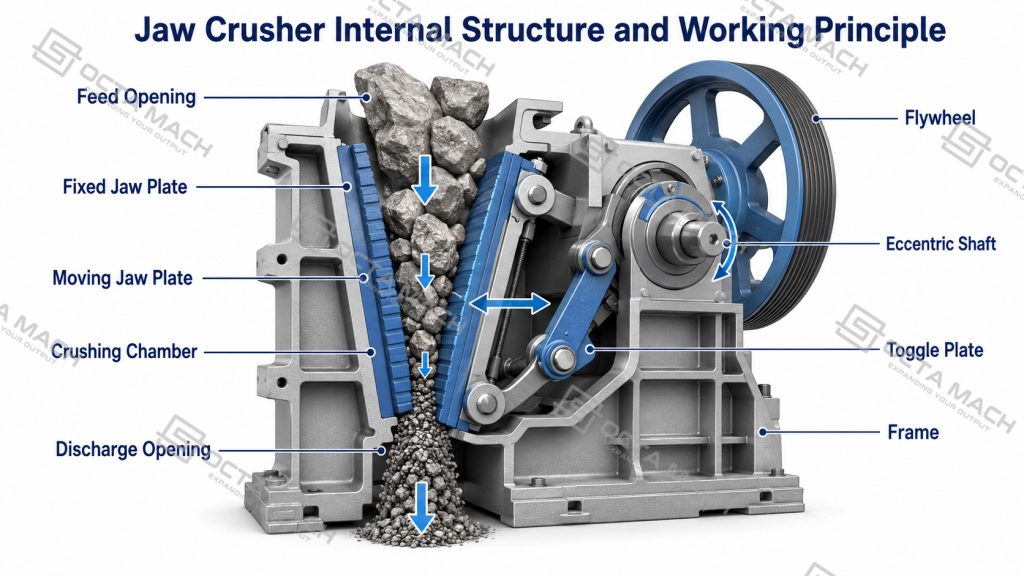
- Raw material → Hopper → Controlled feeding → Jaw crushing → Conveyor discharge
- Stable feeding keeps the crushing chamber working continuously. Sudden batches can overload the crusher, while insufficient feeding leaves part of the chamber unused.
- The conveyor must also remove crushed material without delay. A suitable jaw crusher cannot reach its expected output when material accumulates below the discharge opening.
- A portable jaw crusher performs size reduction. Where several finished aggregate sizes are required, the crushed material must pass through a vibrating screen.
Suitable Materials for Portable Stone Crushers
Portable stone crushers can process hard quarry rock, medium-hard stone and rounded natural aggregate. Crusher configuration should be selected according to the material’s hardness, abrasiveness, maximum feed size and required discharge size.
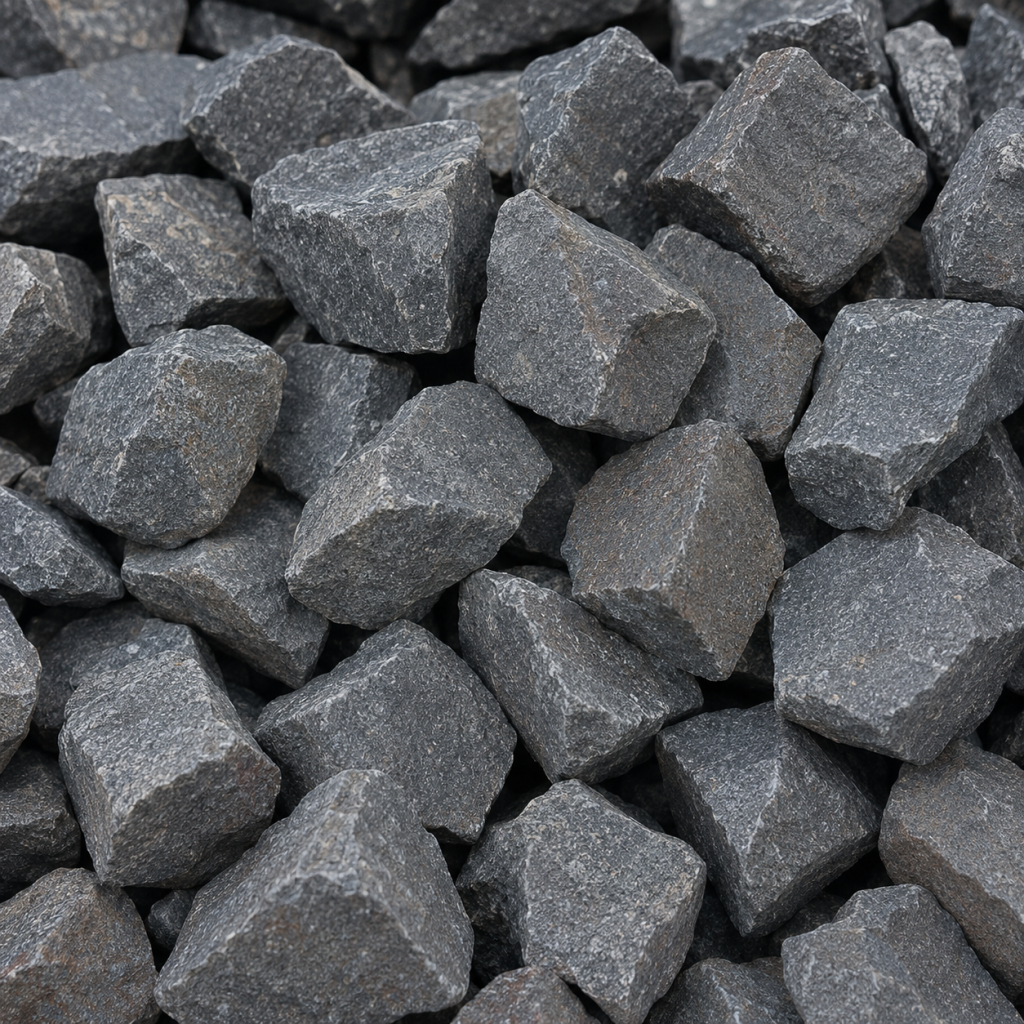
Granite
Basalt
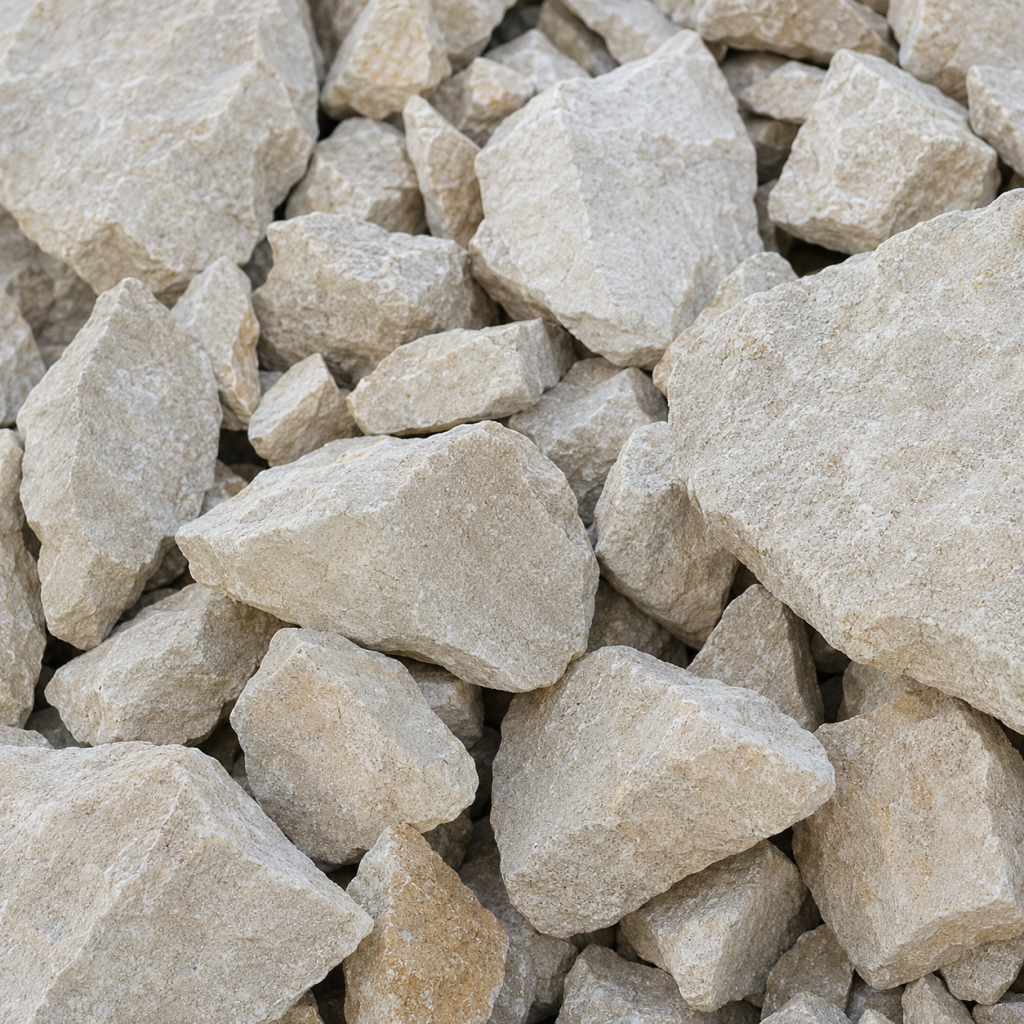
Limestone

River Stone
Granite Processing
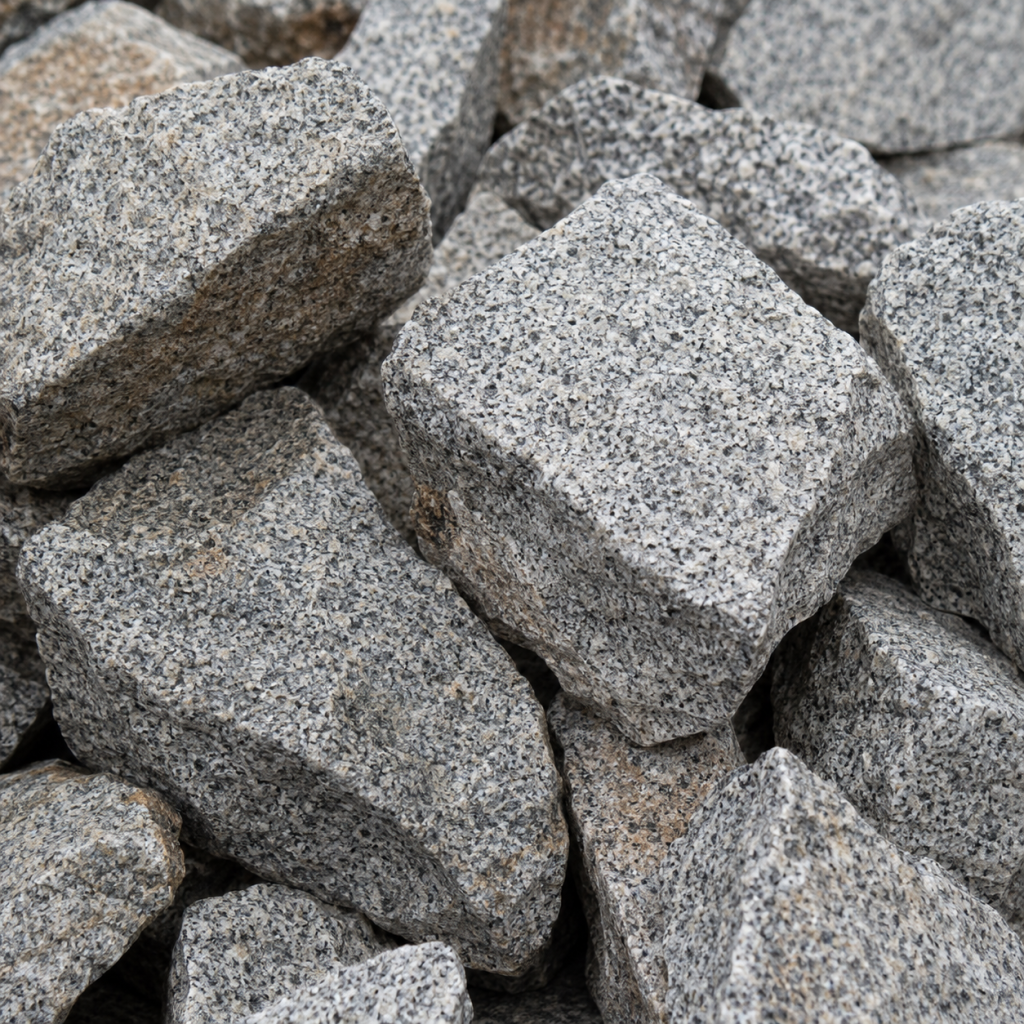
Granite is a hard and abrasive rock commonly processed for concrete aggregate, road base and railway ballast. A portable jaw crusher can reduce large granite blocks near the quarry face. Where smaller and more consistently graded aggregate is required, the jaw-crushed granite can pass through an additional cone crushing stage before final screening.
Basalt Processing
Basalt is a dense volcanic rock used for high-strength aggregate, pavement construction and railway projects. Primary reduction normally requires a robust jaw crusher with stable feeding and suitable wear-resistant jaw plates. For multi-stage production, cone crushing can be added to control the discharge size before final screening.
Limestone Processing
Limestone is generally easier to crush than granite or basalt and is widely used for road base, concrete aggregate and cement production. A portable jaw crusher can perform primary reduction directly at the quarry or project site. Depending on the required product size and particle shape, the discharge can proceed to screening or further impact crushing.
River Stone Processing
River stone is typically hard, smooth and rounded, making controlled feeding particularly important. A portable jaw crusher can reduce large pebbles before secondary crushing or screening. For graded aggregate or manufactured-sand production, cone crushing is commonly added to achieve a smaller and more consistent feed for the screening stage.
Why Choose Octa Mach Portable Stone Crusher?
Feed-Based Model Selection
Crusher selection starts with the actual maximum feed size, required discharge and capacity—not simply the largest available model.
PE and PEX Crusher Options
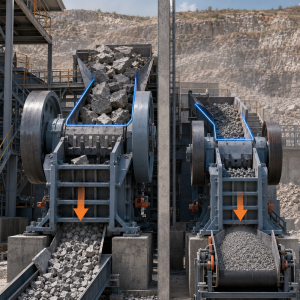
PE models handle large-feed primary crushing, while PEX models process smaller feed where a finer discharge is required.
Balanced Material Flow
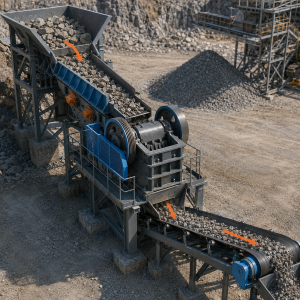
The feeder, jaw crusher and discharge conveyor are matched together to maintain stable loading and continuous material discharge.
FAQ
Q: What is a portable stone crusher used for?
A: It reduces quarry stone, mine rock and concrete blocks near the working area. Feeding, jaw crushing and discharge conveying are combined in one transportable machine.
Q: What is the difference between PE and PEX jaw crushers?
A: PE models accept larger and more irregular feed and are mainly used for primary crushing. PEX models accept smaller feed and provide a finer discharge range.
Q: Can a portable jaw crusher produce finished aggregate directly?
A: It reduces material to a controlled crusher discharge, but finished aggregate normally requires screening and may require further crushing.
Q: What should be checked when comparing a portable rock crusher for sale?
A: Compare maximum feed size, required discharge, capacity, material hardness, feeder and conveyor matching, and whether the crushed product will be stockpiled, screened or processed further.