
Rock crusher reduces blasted stone, quarry rock and mined ore to a controlled size by applying compression, impact or high-speed particle collision. Rock crushing equipment mainly includes jaw crushers, cone crushers, impact crushers, hammer crushers and vertical-shaft impact crushers, each using a different breakage mechanism for a specific crushing stage and material condition. Among them, jaw crushers accept large, irregular feed for primary reduction; cone crushers process hard and abrasive material in secondary or fine-crushing stages; impact and hammer crushers are used where the material breaks efficiently under dynamic loading; and vertical-shaft units provide final reduction and aggregate shaping. The selected crusher type affects the allowable feed range, reduction ratio, wear pattern, discharge characteristics and required downstream screening arrangement.
OctaMach supplies stationary, wheel-mounted and crawler-mounted crushing equipment for quarrying, mining and aggregate production. Each rock crusher machine is configured according to the maximum feed size, feed-size distribution, rock hardness, abrasiveness, moisture or clay content, required discharge size and process stage. The crusher is also coordinated with the receiving hopper, feeder, pre-screen, product screen and conveyors, because stable capacity depends on the complete material-flow circuit rather than the crusher alone. Jaw, cone, impact, hammer and vertical-shaft configurations can therefore be supplied as individual machines or incorporated into primary, secondary, fine-crushing and shaping systems.
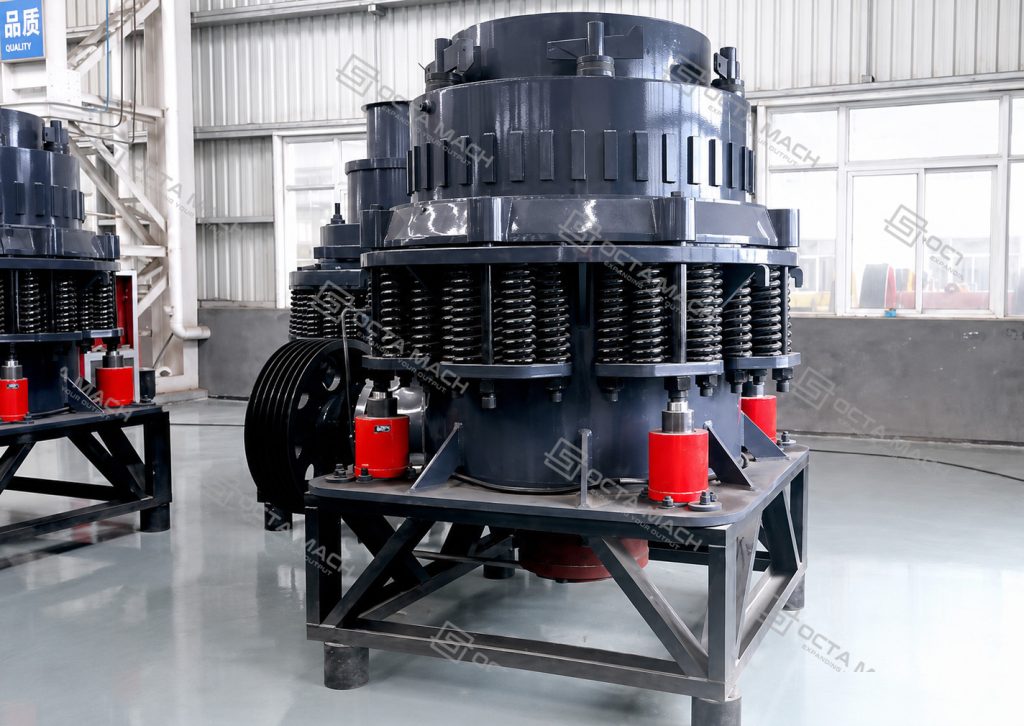
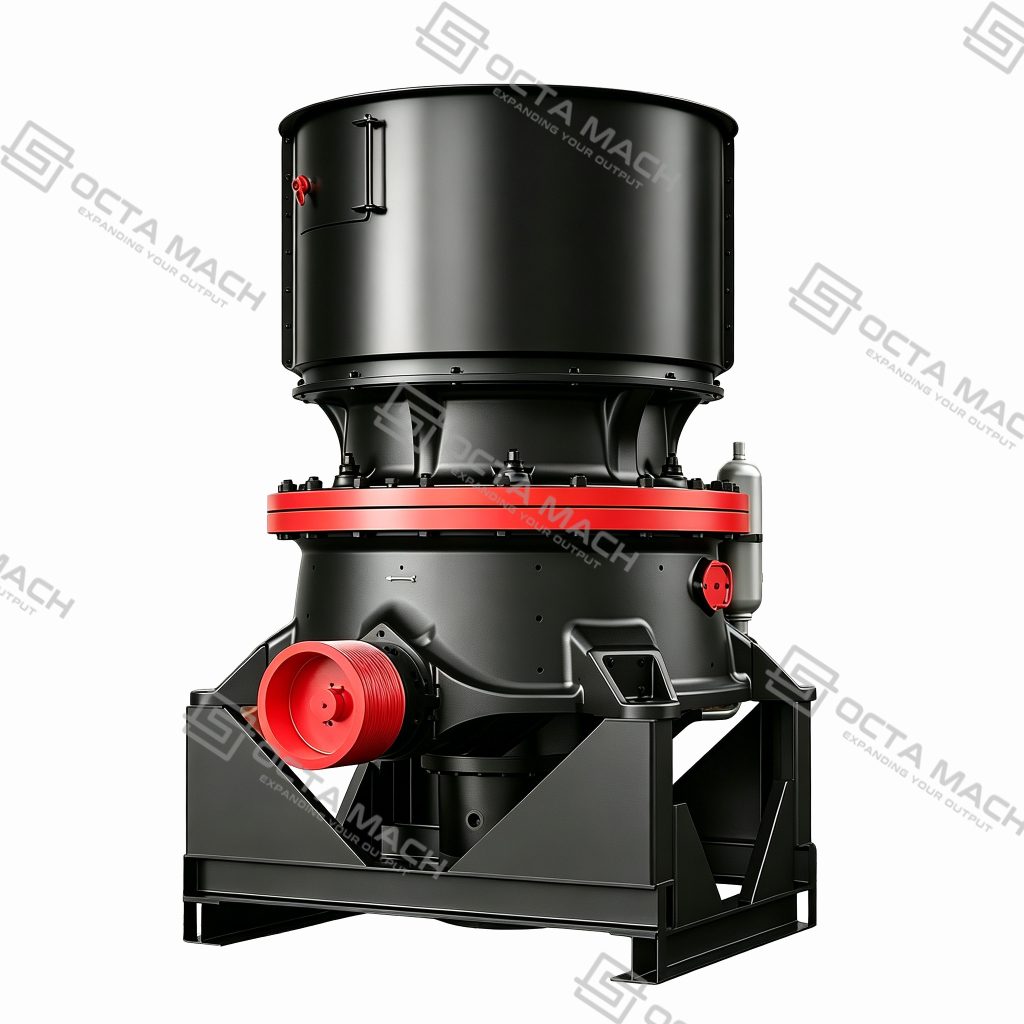
Crusher Types and Specification Range
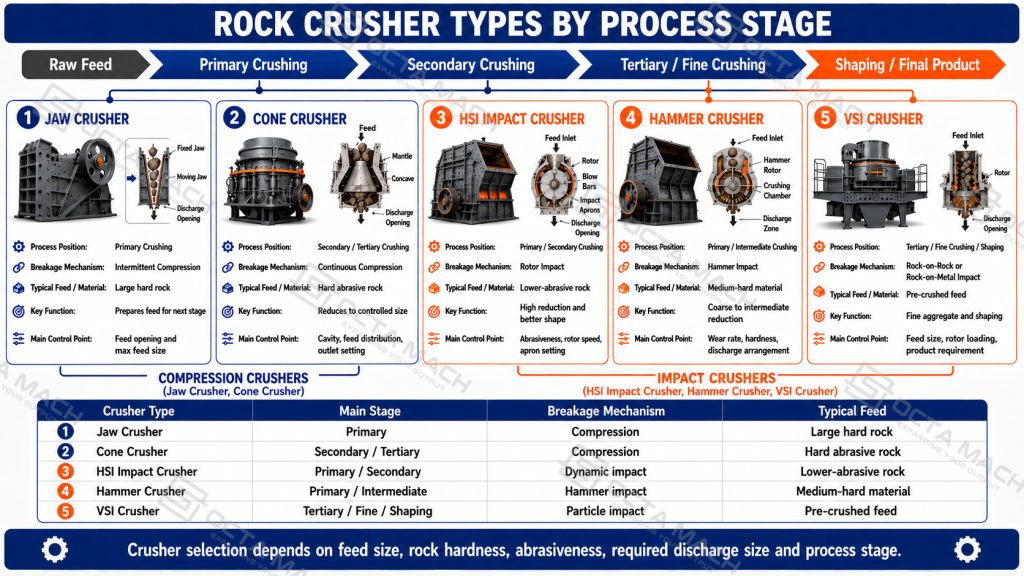
A crusher type must be selected according to the required breakage mechanism. Jaw and cone crushers use compression, while impact, hammer and vertical-shaft machines apply dynamic impact. These mechanisms produce different feed limits, wear conditions and product characteristics.
| Crusher Category | Available Series | Feed Specification | Discharge or Setting Specification | Installed Power Range | Normal Process Position |
|---|---|---|---|---|---|
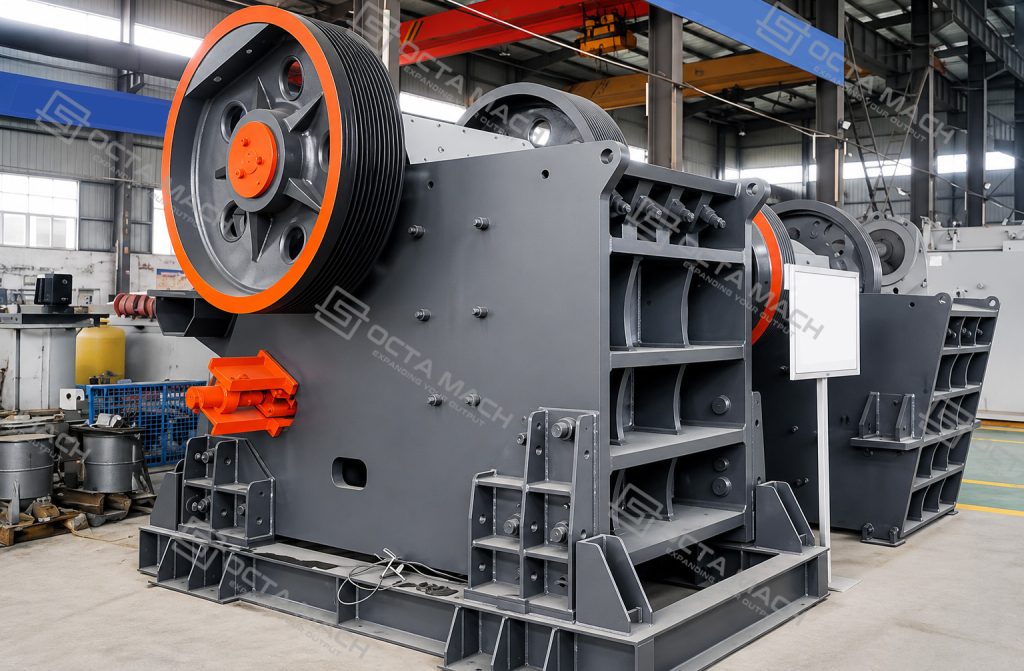
| Jaw Crusher | PE and PEX series | Feed openings from 150 × 250 to 1500 × 1800 mm; maximum feed from 120 to 1200 mm | Discharge openings from 10 to 350 mm | 5.5–280 kW | Primary or coarse crushing |
| European Jaw Crusher | C80–C200 | Feed openings from 800 × 520 to 2000 × 1500 mm; maximum feed from 460 to 1400 mm | Selected according to the required coarse-crushing duty | 75–400 kW | Primary crushing |
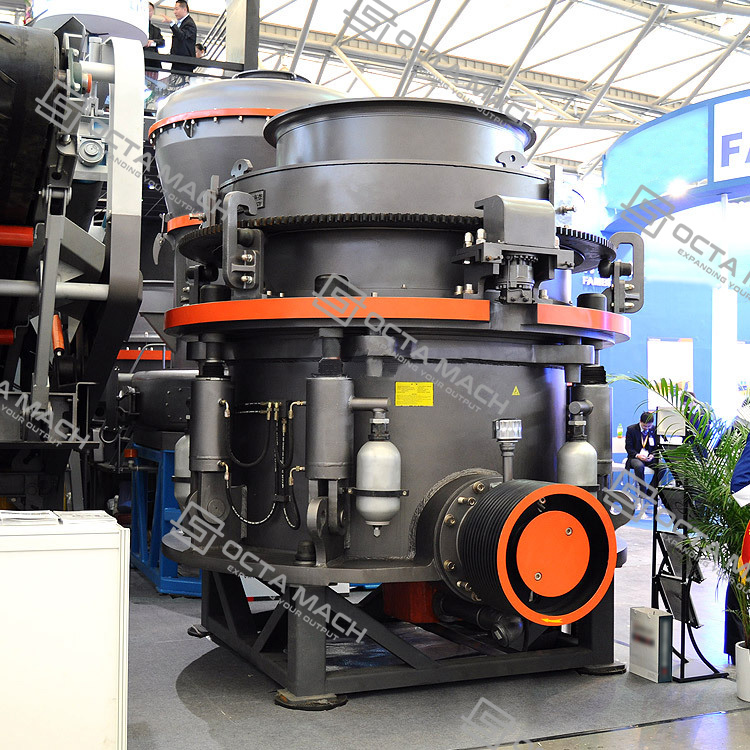
| Multi-Cylinder Hydraulic Cone Crusher | HP100–HP800 | Open-side feed ranges from 33 to 450 mm depending on cavity | Minimum outlet settings from 6 to 38 mm | 90–630 kW | Secondary, tertiary or fine crushing |
| Single-Cylinder Hydraulic Cone Crusher | CS/CH series | Maximum inlet ranges from 38 to 560 mm depending on model and cavity | Minimum outlet settings from 4 to 41 mm | 90–750 kW | Secondary or fine crushing |
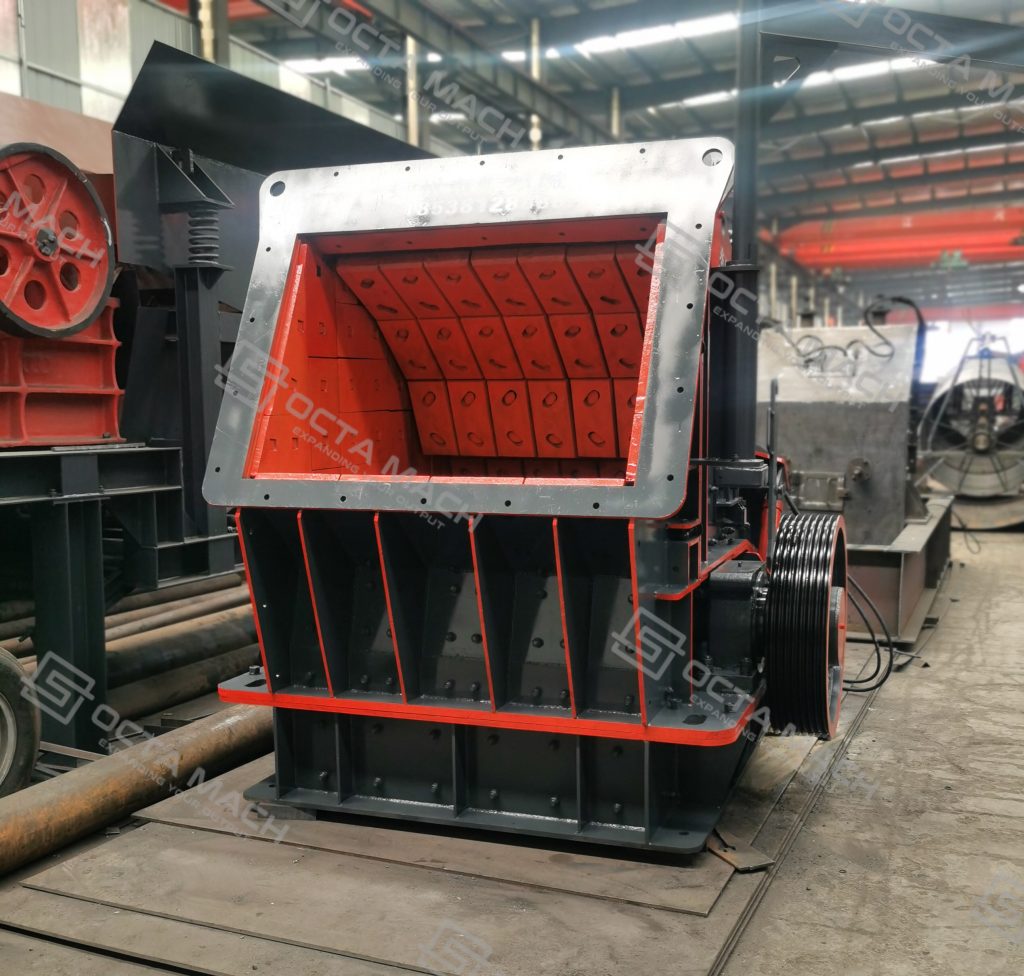
| PFW Impact Crusher | PFW1214–PFW1415 | Rotor sizes from Φ1150 × 1400 to Φ1400 × 1800 mm; maximum feed from 250 to 700 mm | Controlled by impact-apron position and screening arrangement | 132–315 kW | Primary or secondary impact crushing |
| PFV Impact Crusher | PFV-0807–PFV-1820 | Rotor sizes from Φ850 × 700 to Φ1800 × 2000 mm; maximum feed from 100 to 400 mm | Controlled by rotor and impact-frame configuration | 30–45 kW to 315–400 × 2 kW | Secondary crushing |
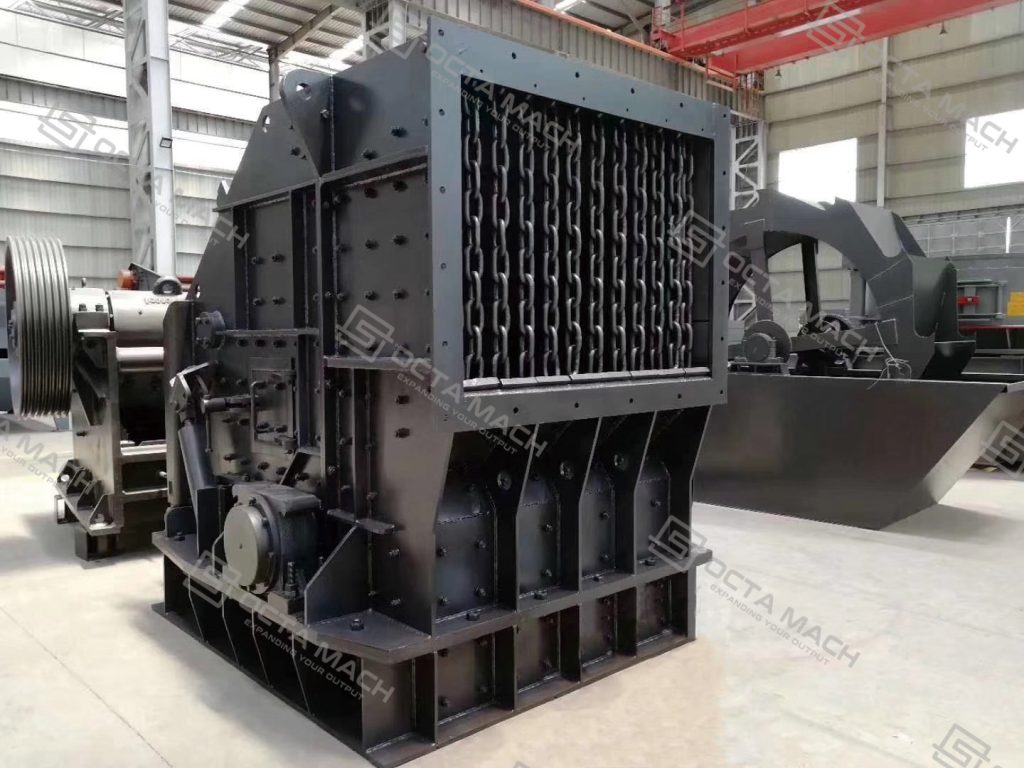
| Heavy Hammer Crusher | PCZ and PC series | Maximum feed from 250 to 800 mm | Controlled by grate or discharge-system configuration | 75–400 × 2 kW | Single-stage or coarse-to-medium crushing |
| Vertical-Shaft Impact Crusher | VSI configuration | Requires pre-crushed and controlled-size feed | Product size controlled through rotor duty and screening | Model-specific | Fine crushing and shaping |
The feed opening is the physical entrance to the crushing chamber. It is not identical to the maximum recommended feed size. Flat, elongated or irregular rock may still bridge at the inlet even when one dimension is smaller than the nominal opening.
Crushing Principle and Material Flow
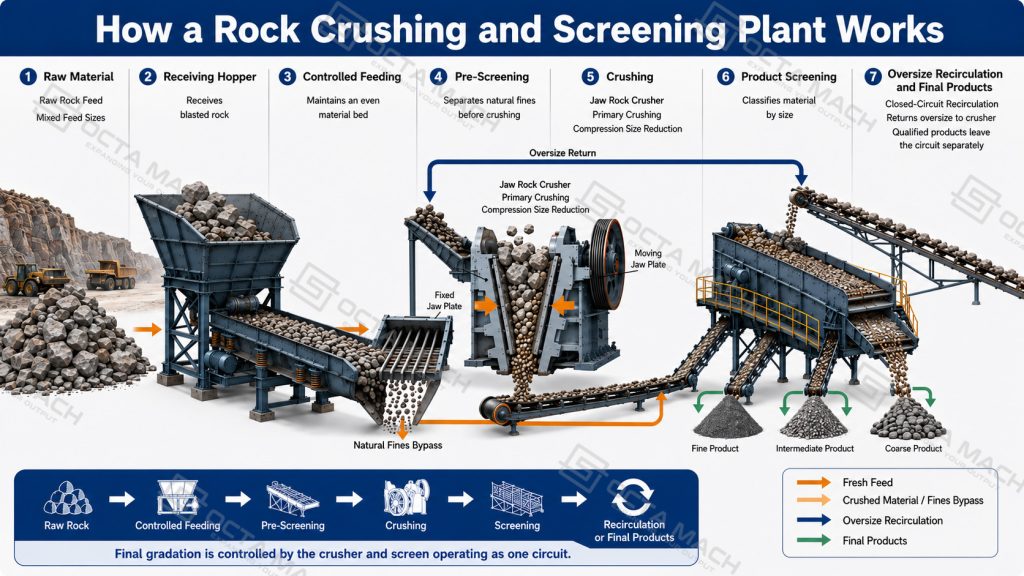
Rock crusher works through four connected stages: controlled feeding, size reduction, screening and material discharge. Raw rock first enters the receiving hopper and is delivered evenly into the crushing chamber. The crusher then reduces the material by compression or impact. After crushing, a screen separates particles that meet the required product size from oversized material. Qualified material is discharged as finished aggregate, while oversize is returned for further crushing.
Material Flow:
Raw Material → Receiving Hopper → Controlled Feeding → Crushing → Screening → Oversize Recirculation or Final Product
1. Controlled Feeding
Raw material is delivered to the receiving hopper by a loader, excavator or haul truck, then transferred into the crusher at a controlled rate by a vibrating feeder or heavy-duty plate feeder. Stable feeding maintains an even material bed inside the crushing chamber and limits sudden impact from concentrated batches of large rock. Where the feed contains natural fines, a grizzly or pre-screen removes particles already smaller than the primary crushing requirement, reducing unnecessary wear and reserving chamber capacity for material that requires size reduction.
2. Size Reduction
Inside the crushing chamber, the reduction mechanism depends on the selected crusher type. A jaw rock crusher applies intermittent compression between a fixed jaw plate and a moving jaw plate, making it suitable for large and irregular feed during primary crushing. A cone rock crusher uses continuous compression between the mantle and concave, allowing already reduced hard rock to be processed in secondary or fine-crushing stages.
Impact-based machines reduce material through dynamic loading rather than compression. An impact rock crusher accelerates rock with a high-speed rotor and breaks it against impact plates and internal liners. Hammer crushers apply repeated blows to achieve a higher reduction ratio, while vertical-shaft impact crushers use rock-on-rock or rock-on-metal collision for fine crushing and particle shaping.
During operation, the material is repeatedly compressed or impacted as it moves through the chamber. It remains inside the machine until the particles are small enough to pass through the adjusted outlet or internal discharge path, after which the crushed product is transferred to the downstream screening system.
3. Screening and Size Classification
The discharge conveyor transfers crushed material to the product screen, where it is separated according to the selected aperture sizes. Particles smaller than the screen openings pass into the finished product stream, while oversized material remains on the deck and is directed to a secondary crusher or returned to the same crushing stage. The crusher setting controls the degree of size reduction, whereas the screen determines whether each particle meets the required final product specification.
4. Recirculation and Final Discharge
In a closed crushing circuit, oversized material is returned to the crusher until it reaches the specified product size, so the recirculating load must be included when sizing the crusher, screen and conveyors because returned material adds to the incoming fresh feed. Material that meets the screen specification is discharged to a stockpile, storage bin or downstream washing and classification equipment, which means the final product gradation depends on the coordinated operation of the feeder, crusher, screen and return conveyor rather than on the crusher alone.
Selection According to Crushing Stage
The crushing stage is determined by the size and condition of the incoming material and by the feed required by the next process. Primary crushing handles the largest and least uniform rock, secondary crushing reduces the primary product to a controlled intermediate size, and fine crushing or shaping prepares material for final screening. Crusher type, chamber configuration and outlet setting must therefore be selected as one process sequence rather than as independent machines.
Primary Crushing
Primary crushing receives blasted rock or run-of-mine material containing large, irregular and sometimes slab-shaped pieces. The crusher must have sufficient feed-opening dimensions for the largest confirmed lump, but the nominal opening alone is not enough; feed shape, size distribution, moisture and clay content also affect whether material enters the chamber without bridging. A grizzly or pre-screen is normally positioned ahead of the crusher to bypass natural fines and prevent material that already meets the primary product size from occupying chamber capacity.
A jaw crusher is generally selected for hard, abrasive rock and variable coarse feed because compression between the fixed and moving jaws provides a controlled reduction path. A heavy hammer crusher may be used for suitable medium-hard, lower-abrasive material where a higher single-stage reduction is required. In either case, the primary discharge must be small enough for the transfer conveyor, secondary crusher and downstream screen, while remaining large enough to avoid excessive wear and unnecessary power demand.
Secondary Crushing
Secondary crushing receives a more uniform product from the primary stage and reduces it to the size required for final classification or fine crushing. A cone crusher is normally used for hard and abrasive material because the mantle and concave provide continuous compression and allow the outlet setting and chamber profile to be matched to the feed gradation. Stable, evenly distributed feeding is important; segregated feed or repeated empty-chamber operation can produce uneven liner wear, unstable power draw and inconsistent product size.
An impact crusher is used where the material breaks efficiently under dynamic impact and where a higher reduction ratio or improved particle shape is required. Its performance depends on rotor speed, impact-apron setting, feed size and wear condition. Highly abrasive feed can increase blow-bar and liner consumption, so impact crushing must be selected from both product requirements and expected wear cost.
Fine Crushing and Product Control
Fine crushing is used when the secondary product is still larger than the final aggregate or process specification. Fine-cavity cone crushers can provide further compression reduction, while vertical-shaft impact crushers are used when final particle shaping or manufactured-sand production is required. These machines must receive pre-crushed material within a controlled size range; oversize feed can overload the chamber or disturb rotor operation.
The final product is determined by the crusher and screen operating together. The crusher setting controls the degree of reduction, while the screen aperture separates qualified material from oversize. In a closed circuit, oversize returns to the crusher and becomes part of the total machine load. The crusher, screen and return conveyor must therefore be sized for both fresh feed and recirculating material.
Material and Process Inputs
Crusher selection is based on how the actual feed will behave inside the hopper, feeder, crushing chamber and screen circuit. The same machine can produce very different results when the feed changes from dry, uniformly graded rock to wet material containing clay, fines or isolated oversize blocks. The following inputs determine the required feed opening, crushing mechanism, chamber profile, wear-part configuration and downstream screening arrangement.
| Selection Input | Effect Inside the Crushing System | Direct Effect on Crusher Selection |
|---|---|---|
| Maximum Feed Size | Determines whether the largest lump can pass through the hopper, feeder and crusher inlet without bridging | Defines the minimum feed opening and primary crusher size |
| Feed-Size Distribution | Controls chamber filling; excessive fines reduce effective crushing volume, while isolated oversize creates impact loading | Affects feeder type, pre-screen requirement and crusher chamber configuration |
| Rock Compressive Strength | Determines the force required to break the material | Hard rock normally favors jaw and cone compression crushing; lower-strength material may suit impact or hammer crushing |
| Abrasiveness | Controls wear on jaw plates, mantles, concaves, blow bars and internal liners | Influences crusher type, wear-part material and expected maintenance demand |
| Bulk Density | Determines the mass entering the crusher at a given volumetric feed rate | Affects motor loading, feeder setting and actual tonnes-per-hour output |
| Moisture Content | Promotes adhesion on hopper walls, crusher surfaces and screen decks | May limit impact crushing, reduce screening efficiency and require improved pre-screening |
| Clay Content | Produces packing around the feeder, crusher inlet and discharge path | May require washing, separation or a more open material-flow arrangement before crushing |
| Feed Shape | Flat or elongated rock can bridge even when its nominal size is below the feed opening | Affects usable feed-opening margin and primary crusher configuration |
| Required Discharge Size | Defines the reduction required from the incoming feed | Determines outlet setting, chamber type and whether one or several crushing stages are needed |
| Required Product Shape | Controls whether the process only reduces size or also reshapes particles | May require impact or vertical-shaft crushing after compression crushing |
| Screen Aperture | Defines which particles leave the circuit as finished product | Determines the required crusher setting and quantity of oversize returned for further crushing |
| Recirculating Load | Adds returned oversize to the fresh feed entering the crusher | Increases the actual load on the crusher, screen and return conveyor |
The published crushing capacity represents operation within a defined feed and setting range. Actual output changes with rock density, feed gradation, moisture, chamber filling, wear condition and the quantity of material returned from the screen. Crusher capacity must therefore correspond to the complete feed and screening circuit rather than only to the rated output of the crusher body.
Stationary and Mobile Configurations
OctaMach configures rock crushing equipment as stationary, wheel-mounted portable or crawler-mounted mobile systems according to the expected operating period, relocation frequency, available foundation, site access and required integration with feeders, screens and conveyors. Stationary plants are arranged for long-term production at a fixed location, while portable and mobile systems reduce permanent civil work and allow the crushing circuit to follow changing project or feed locations.
| Configuration | Structural Arrangement | Operating Characteristic | Suitable Project Condition |
|---|---|---|---|
| Stationary Crusher | Installed on a permanent foundation and connected to fixed conveyors | Supports continuous operation at a defined production site | Long-term quarry or mine development |
| Portable Crusher | Crusher and auxiliary equipment mounted on a wheel-supported chassis | Relocated between project sites and supported during operation | Road, dam, aggregate and temporary construction projects |
| Crawler Mobile Crusher | Integrated feeder, crusher and conveyor on a tracked chassis | Moves directly within the working area | Advancing quarry faces, recycling areas and changing feed locations |
| Combined Mobile Station | Crushing, screening and conveying modules integrated into one relocatable system | Reduces separate foundation and transfer requirements | Projects requiring compact installation and rapid relocation |
Mobility changes the plant arrangement rather than the crusher’s breakage mechanism. A portable rock crusher is generally mounted on a wheel-supported chassis for transport between project sites and is stabilized before operation, while a mobile rock crusher uses crawler tracks to move within a quarry, mine or recycling area and normally integrates the feeder, crusher and discharge conveyor on one chassis. In every configuration, the jaw, cone or impact unit must still be selected according to feed size, material hardness and abrasiveness, target discharge size and crushing stage; the chassis primarily determines relocation method, site preparation, equipment interfaces and maintenance access.
Typical Crushing Applications
Quarry Crushing
In quarry crushing, blasted granite, basalt, limestone or other natural rock is transferred from the working face to a receiving hopper and reduced in stages before screening. A jaw crusher normally handles large and irregular feed during primary crushing, while a cone crusher is used for hard and abrasive stone requiring secondary or fine reduction. Lower-abrasive limestone may be processed by an impact crusher when the project requires a higher reduction ratio, increased fines or improved aggregate shape.
Mining Crushing
In mining crushing, run-of-mine ore is reduced to a size suitable for belt conveying, screening, grinding or mineral-separation equipment. The crushing circuit must accommodate irregular feed, ore hardness, abrasiveness, tramp metal and the required downstream feed size. Primary jaw crushing is commonly followed by cone crushing for competent ore, while feeders, metal-removal equipment, screens and conveyors maintain continuous transfer between stages.
Hard Rock Crushing
Hard rock crushing generally uses compression because granite, basalt and many ores produce high crushing loads and abrasive wear. A jaw crusher accepts the coarse feed, followed by a hydraulic cone crusher configured for secondary or fine reduction. Stable chamber filling and uniform feed distribution are important because segregated material, repeated empty-chamber operation or excessive oversize can cause uneven liner wear, unstable power demand and inconsistent product gradation.
Limestone and Aggregate Processing
Limestone and other lower-abrasive materials can be processed by jaw, impact or hammer crushers according to the initial feed size, required reduction ratio and final aggregate specification. Impact crushing is suitable where improved particle shape and additional fines are required, while hammer crushing may reduce suitable medium-hard material in fewer stages. The selected crusher must be coordinated with the product screen because the final aggregate size and grading depend on both the crusher setting and screen aperture.
OctaMach Supply Scope
OctaMach supplies standalone rock crusher machines and coordinated crushing systems for coarse, secondary, impact and fine-crushing duties. Available equipment includes PE, PEX and European jaw crushers; HP and CS/CH hydraulic cone crushers; PFW and PFV impact crushers; hammer crushers; and vertical-shaft impact equipment. Stationary, wheel-mounted portable and crawler-mounted mobile configurations can be arranged according to the required crushing stage and site conditions.
The supply scope can also include vibrating or heavy-duty feeders, product screens, belt conveyors, iron-removal equipment, dust-control interfaces and crusher wear parts such as jaw plates, mantles, concaves, hammers, blow bars and liners. OctaMach coordinates the crusher, feeder, screen and conveyor interfaces before the process layout is finalized, helping the equipment match the confirmed feed size, discharge requirement and material-flow route.
FAQ
Q1: Is the crusher feed opening the same as the maximum feed size?
A1: No. The feed opening is the physical chamber entrance, while maximum feed size is the recommended upper limit for normal operation. Rock shape and feed distribution must also be considered because flat or elongated pieces may bridge even when one dimension fits the opening.
Q2: Why can actual rock crusher capacity be lower than the catalogue rating?
A2: Actual capacity changes with feed gradation, bulk density, moisture, crusher setting, chamber filling and screen recirculating load. The crusher, feeder, screen and return conveyor must therefore be evaluated as one circuit rather than from the crusher rating alone.
Q3: When should a cone crusher be selected instead of an impact crusher?
A3: A cone crusher is generally preferred for hard and abrasive rock where compression crushing provides more economical wear performance. An impact crusher is more suitable for lower-abrasive material when a higher reduction ratio, increased fines or improved particle shape is required.
Q4: What information is required to select a portable or mobile rock crusher?
A4: Confirm the material type, maximum feed size, feed gradation, hardness, abrasiveness, required product sizes and operating capacity. Site access, relocation frequency, power supply, screen configuration and conveyor arrangement are also required to determine whether a wheel-mounted portable or crawler-mounted mobile system is suitable.