
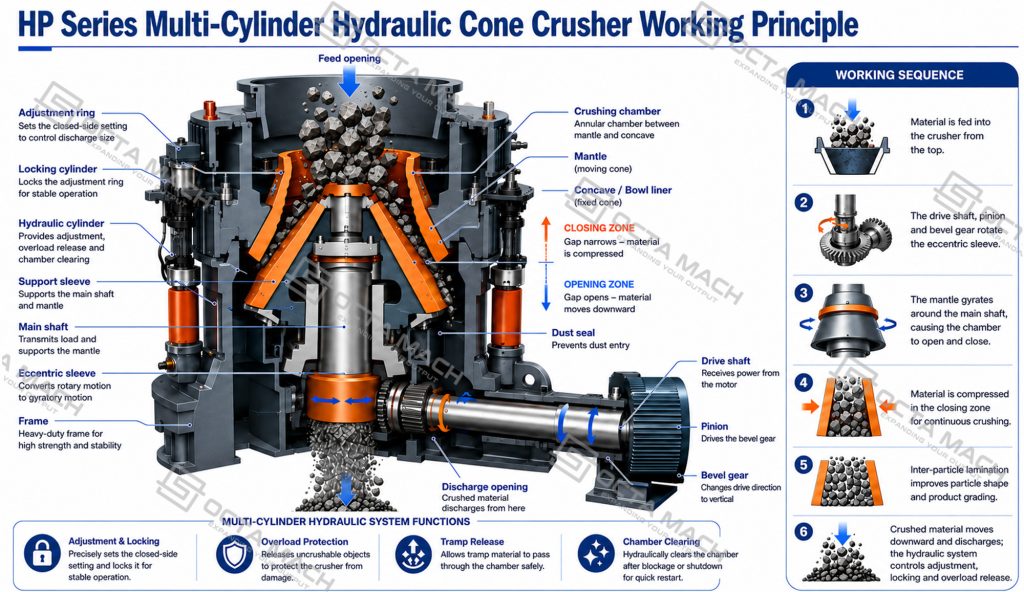
The HP Series Multi-Cylinder Hydraulic Cone Crusher is a compression-type crusher used for secondary, tertiary, and fine crushing of hard and abrasive materials. During operation, the motor transmits power through the drive shaft, pinion, and bevel gear to rotate the eccentric sleeve. The eccentric movement causes the moving cone to gyrate around the fixed main shaft, continuously changing the distance between the mantle and concave. Material is compressed when the crushing chamber closes, then moves downward when the chamber opens. This repeated compression continues until the particles are small enough to pass through the closed-side setting at the bottom of the chamber.
Under stable full-chamber feeding, the material is crushed not only between the mantle and concave but also between adjacent particles, creating inter-particle lamination crushing and a more controlled product grading. The multi-cylinder hydraulic system locks the adjustment ring, regulates the discharge opening, releases uncrushable material, and clears the chamber after blockage. OctaMach supplies HP100 to HP800 models with extra-coarse, coarse, medium, fine, and extra-fine cavities for granite, basalt, river pebble, iron ore, copper ore, quartzite, diabase, and hard limestone crushing.
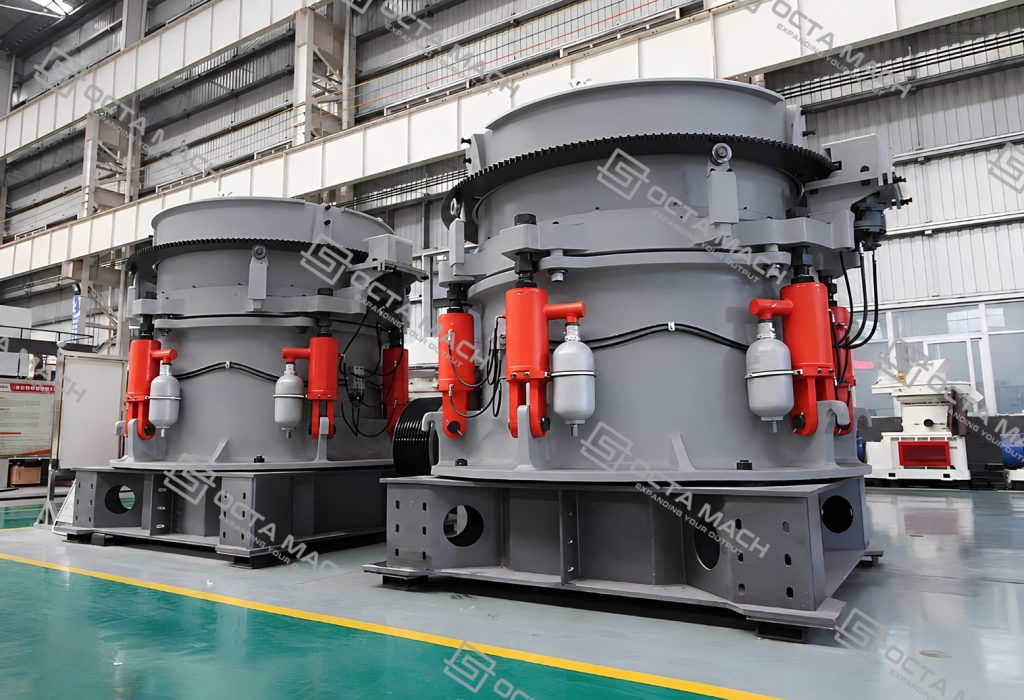
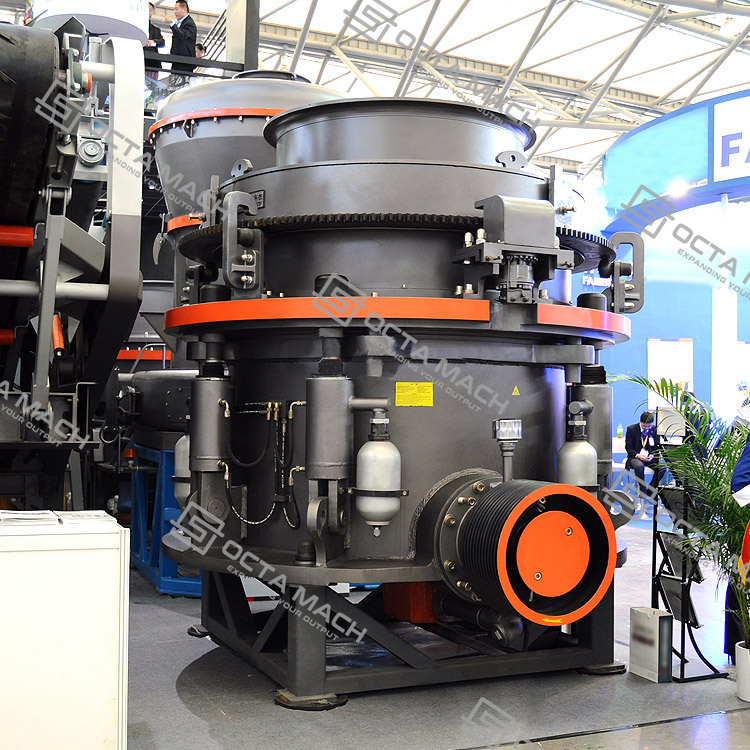
HP Series Technical Specifications
| Model | Cavity Type | Open-Side Feeding Size (mm) | Closed-Side Feeding Size (mm) | Minimum Outlet Size (mm) | Capacity (t/h) | Installed Power (kW) |
|---|---|---|---|---|---|---|
| HP100 | C1 Extra Coarse | 175 | 140 | 19 | 45–100 | 90 |
| HP100 | C2 Coarse | 125 | 105 | 13 | 45–100 | 90 |
| HP100 | M Middle | 100 | 70 | 10 | 45–100 | 90 |
| HP100 | F1 Fine | 71 | 50 | 9 | 45–100 | 90 |
| HP100 | F2 Extra Fine | 33 | 20 | 6 | 45–100 | 90 |
| HP200 | C2 Coarse | 235 | 190 | 19 | 65–250 | 160 |
| HP200 | M Middle | 171 | 120 | 16 | 65–250 | 160 |
| HP200 | F1 Fine | 150 | 95 | 13 | 65–250 | 160 |
| HP200 | F2 Extra Fine | 116 | 70 | 8 | 65–250 | 160 |
| HP300 | C1 Extra Coarse | 265 | 230 | 25 | 85–440 | 220 |
| HP300 | C2 Coarse | 240 | 210 | 20 | 85–440 | 220 |
| HP300 | M Middle | 190 | 150 | 15 | 85–440 | 220 |
| HP300 | F1 Fine | 145 | 105 | 11 | 85–440 | 220 |
| HP300 | F2 Extra Fine | 120 | 80 | 8 | 85–440 | 220 |
| HP400 | C1 Extra Coarse | 360 | 290 | 30 | 135–625 | 315 |
| HP400 | C2 Coarse | 310 | 250 | 25 | 135–625 | 315 |
| HP400 | M Middle | 260 | 196 | 20 | 135–625 | 315 |
| HP400 | F1 Fine | 182 | 110 | 13 | 135–625 | 315 |
| HP400 | F2 Extra Fine | 135 | 90 | 10 | 135–625 | 315 |
| HP500 | C1 Extra Coarse | 370 | 330 | 38 | 200–790 | 400 |
| HP500 | C2 Coarse | 320 | 290 | 28 | 200–790 | 400 |
| HP500 | M Middle | 245 | 210 | 22 | 200–790 | 400 |
| HP500 | F1 Fine | 180 | 130 | 13 | 200–790 | 400 |
| HP500 | F2 Extra Fine | 150 | 95 | 10 | 200–790 | 400 |
| HP800 | C1 Extra Coarse | 450 | 352 | 38 | 265–1200 | 630 |
| HP800 | C2 Coarse | 373 | 298 | 32 | 265–1200 | 630 |
| HP800 | M Middle | 340 | 275 | 25 | 265–1200 | 630 |
| HP800 | F1 Fine | 280 | 230 | 16 | 265–1200 | 630 |
| HP800 | F2 Extra Fine | 235 | 150 | 10 | 265–1200 | 630 |
| Model | 6 mm | 8 mm | 10 mm | 13 mm | 16 mm | 19 mm | 22 mm | 25 mm | 32 mm | 38 mm | 45 mm | 51 mm |
|---|---|---|---|---|---|---|---|---|---|---|---|---|
| HP100 | 45–55 | 50–60 | 55–70 | 60–80 | 70–90 | 75–95 | 80–100 | 90–115 | 100–150 | — | — | — |
| HP200 | — | 65–85 | 90–125 | 110–150 | 135–180 | 150–195 | 160–210 | 170–225 | 190–235 | 210–250 | — | — |
| HP300 | — | 85–120 | 115–140 | 150–185 | 180–220 | 200–240 | 220–260 | 235–290 | 250–320 | 300–380 | 350–440 | — |
| HP400 | — | — | 135–180 | 190–230 | 225–275 | 250–320 | 270–350 | 295–380 | 290–375 | 355–490 | 410–565 | 460–625 |
| HP500 | — | — | 200–250 | 230–290 | 280–350 | 320–400 | 345–430 | 370–460 | 405–535 | 445–605 | 510–700 | 580–790 |
| HP800 | — | — | 265–340 | 320–425 | 285–510 | 425–540 | 470–606 | 495–740 | 545–800 | 600–945 | 690–1050 | 785–1200 |
Working Principle and Hydraulic Control
The multi-cylinder hydraulic cone crusher working principle is based on continuous compression inside an annular crushing chamber. The motor transfers power through the drive shaft, pinion, and bevel gear to rotate the eccentric sleeve. This eccentric motion causes the moving cone to gyrate around the fixed main shaft, so the gap between the mantle and concave continuously narrows and opens. Material is compressed in the closing zone, then moves downward through the chamber as the gap opens. Under stable full-chamber feeding, particles are crushed both against the liners and against each other, creating inter-particle lamination crushing and a more uniform product grading. The final discharge size is controlled by the closed-side setting, while the multi-cylinder hydraulic system locks the adjustment ring, changes the discharge opening, releases uncrushable material under overload, and clears the chamber after blockage.
| Hydraulic Function | Purpose | Operating Effect |
|---|---|---|
| Hydraulic locking | Holds the adjustment ring in position | Maintains a stable discharge setting |
| Hydraulic discharge adjustment | Changes the crusher setting | Controls product size and circuit load |
| Hydraulic tramp release | Allows the chamber to open under overload | Protects the crusher from uncrushable material |
| Hydraulic cavity clearing | Opens the chamber after blockage | Reduces manual clearing time |
| Pressure monitoring | Tracks abnormal crushing load | Supports overload and feed-condition diagnosis |
The hydraulic system protects the crusher, but it does not replace feed control. Repeated overload caused by oversized feed, steel contamination, or uneven feeding should be corrected at the feeder or upstream crusher.
How to Select the Right HP Cone Crusher
The correct HP cone crusher model should be selected from the complete crushing and screening circuit rather than from motor power or catalogue capacity alone. Maximum feed size determines whether the material can enter the selected cavity, while feed gradation, abrasivity, required product size, and circulating load determine whether the crusher can maintain stable output in actual operation.
| Application | Position in the Process | Main Selection Point |
|---|---|---|
| Granite aggregate production | After jaw crushing, before closed-circuit screening | Abrasivity, cavity profile, and return load |
| Basalt roadstone production | Secondary or tertiary crushing | Product shape and liner wear |
| River-pebble crushing | Secondary crushing before classification | Smooth feed, hardness, and required reduction |
| Iron ore processing | After coarse crushing, before grinding preparation | Ore hardness and target mill feed size |
| Copper ore processing | Secondary and tertiary size reduction | Capacity and downstream grinding requirement |
| Hard limestone aggregate | Secondary crushing before final screening | Feed top size and product grading |
| Mobile hard-rock crushing | Integrated with feeder, screen, and conveyors | Chassis capacity and onboard screen performance |
The cavity should be matched to the actual feed before the CSS is finalized. A coarse cavity should not be forced to produce a fine product by operating at an excessively narrow setting, and a fine cavity should not receive oversized feed beyond its designed opening. Both conditions reduce chamber efficiency and accelerate uneven wear.
Before confirming the model, check that:
- the largest feed remains within the selected cavity limit;
- the feeder can maintain continuous and centrally distributed feeding;
- the required capacity includes the closed-circuit return load;
- the vibrating screen can separate the target products at the planned throughput;
- the selected CSS stays within the permitted operating range of the cavity;
- maintenance access is available for liner replacement and chamber inspection.
A smaller multi cylinder hydraulic cone crusher operating with the correct cavity, stable full-chamber feeding, and a matched screen can perform more consistently than a larger unit receiving segregated or intermittent feed. The final selection should therefore be based on feed size, cavity profile, CSS, required capacity, abrasivity, and the complete screening circuit.
Working Conditions and Applications
The HP Series Multi-Cylinder Hydraulic Cone Crusher is installed after primary jaw crushing for secondary, tertiary, or fine crushing of hard and abrasive materials. Its fixed-main-shaft design, multiple hydraulic cylinders, and selectable cavities are best suited to continuous full-chamber feeding and closed-circuit screening.
- Granite and basalt aggregate: Used after jaw crushing for secondary or tertiary reduction, with cavity type matched to the required grading.
- River pebble: Requires central, uniform feeding to control chamber filling and liner wear.
- Iron and copper ore: Produces controlled feed for downstream screening or grinding.
- Quartzite and abrasive rock: Compression crushing reduces the wear associated with impact crushing; mantle, concave, and lubrication condition require close monitoring.
- Closed-circuit crushing: Works with a vibrating screen and return conveyor, with circulating oversize included in the total crusher load.
The HP series performs best with clean, evenly distributed feed within the selected cavity limit. Excessive clay, uneven feeding, or repeated overload should be corrected upstream.
Why Choose OctaMach
OctaMach supplies HP100–HP800 crushers and supports cavity selection according to feed size, required capacity, final product, and crushing-stage position. As a multi cylinder hydraulic cone crusher manufacturer, OctaMach can also match the crusher with feeders, jaw crushers, vibrating screens, belt conveyors, and mobile plant structures.
Q1:How should the cavity type and CSS be matched on an HP cone crusher?
A1:Select the cavity from the largest regular feed size and crushing stage first, then set the CSS within that cavity’s permitted range. A coarse cavity should not be forced to produce fine material through an excessively small CSS.
Q2:Why does a multi-cylinder hydraulic cone crusher require full-chamber feeding?
A2:Full-chamber feeding increases inter-particle compression, stabilizes power draw, and distributes wear around the mantle and concave. Intermittent or segregated feed causes uneven liner wear and inconsistent product grading.
Q3:Why can actual HP cone crusher capacity be lower than the catalogue value?
A3:Actual capacity is reduced by oversized or poorly graded feed, excessive fines, moisture, clay, low bulk density, unstable feeding, liner wear, and high closed-circuit return load. CSS alone does not determine throughput.
Q4:How should the vibrating screen be matched with the HP cone crusher?
A4:The crusher CSS controls the discharge curve, while the screen aperture determines the final products. The screen and return conveyor must handle the circulating oversize, or material will accumulate and reduce the effective crusher capacity.