
A mobile crusher is a movable crushing system designed to process stone, ore, recycled concrete, asphalt waste and road construction materials directly at the job site. It combines feeding, crushing and conveying on a mobile chassis, with optional screening and return systems for producing controlled aggregate sizes.
The plant can be configured according to material hardness, feed size and final product requirements. Jaw crushing is commonly used for large feed and primary reduction, impact crushing is suitable for limestone and recycling applications, while cone crushing is preferred for hard and abrasive rock in secondary or tertiary stages.
Compared with a fixed crushing line, a mobile crusher plant reduces haulage distance, shortens site preparation work and allows the equipment to move closer to the raw material source. It is widely used in quarry expansion, mining pre-processing, road construction, temporary aggregate production and demolition waste recycling.
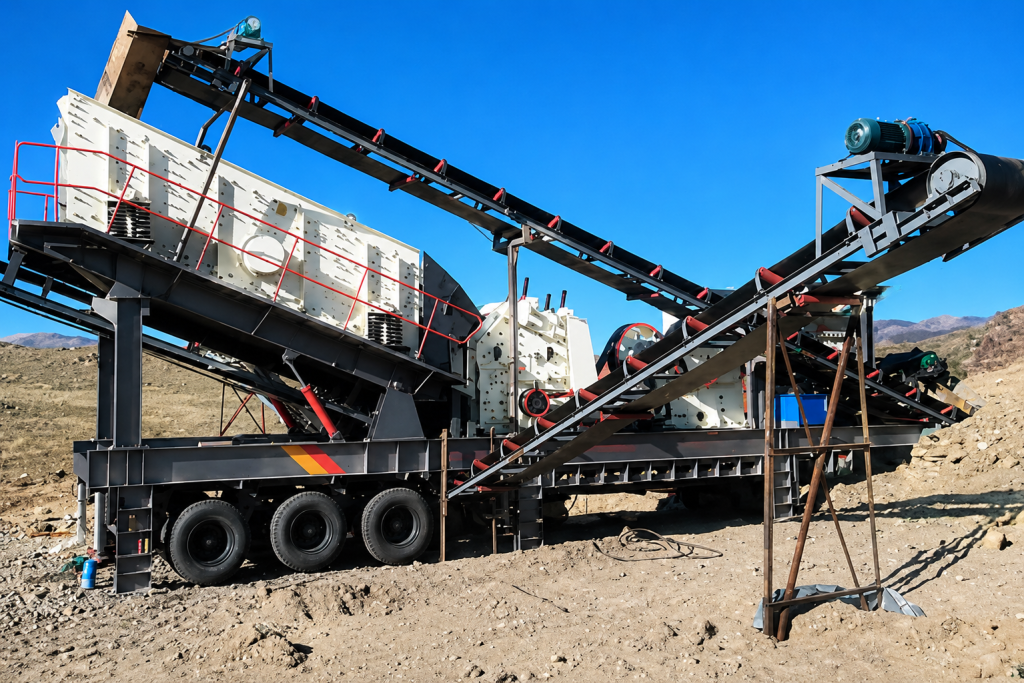
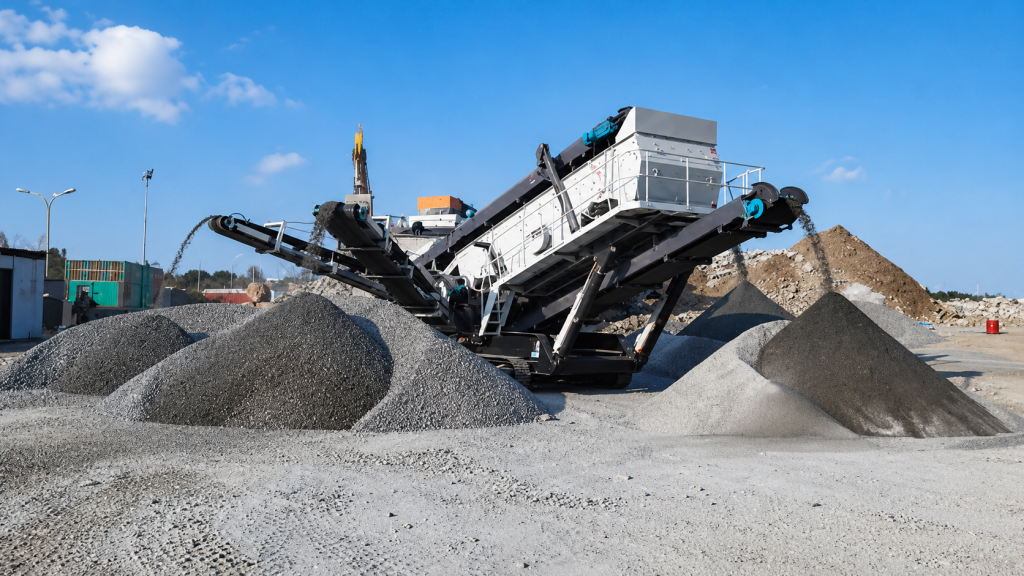
Mobile Crusher Plant Configuration
A mobile crusher plant should be configured as a complete process system. The feeder, crusher, screen and conveyors need to match each other so that the plant can maintain stable output, controlled product size and smooth material flow.
| Item | Configuration / Selection Range |
|---|---|
| Product Type | Mobile crusher plant, mobile crushing and screening plant |
| Main Crusher Options | Mobile jaw crusher, mobile impact crusher, mobile cone crusher |
| Crushing Stage | Primary crushing, secondary crushing, tertiary crushing |
| Feeding Equipment | Hopper, vibrating feeder, grizzly feeder |
| Screening Equipment | Vibrating screen, finished product screen, return screen |
| Conveying System | Main conveyor, side conveyor, return conveyor |
| Optional System | Magnetic separator, dust suppression, remote control, PLC control |
| Typical Materials | Granite, basalt, limestone, river stone, concrete waste, asphalt waste, ore |
| Main Applications | Quarry aggregate, mining, road construction, demolition recycling, sand and gravel production |
For hard rock, the common route is primary jaw crushing followed by cone crushing. For limestone, concrete waste and asphalt recycling, impact crushing is often selected because it can provide a high reduction ratio and a more cubical aggregate shape.
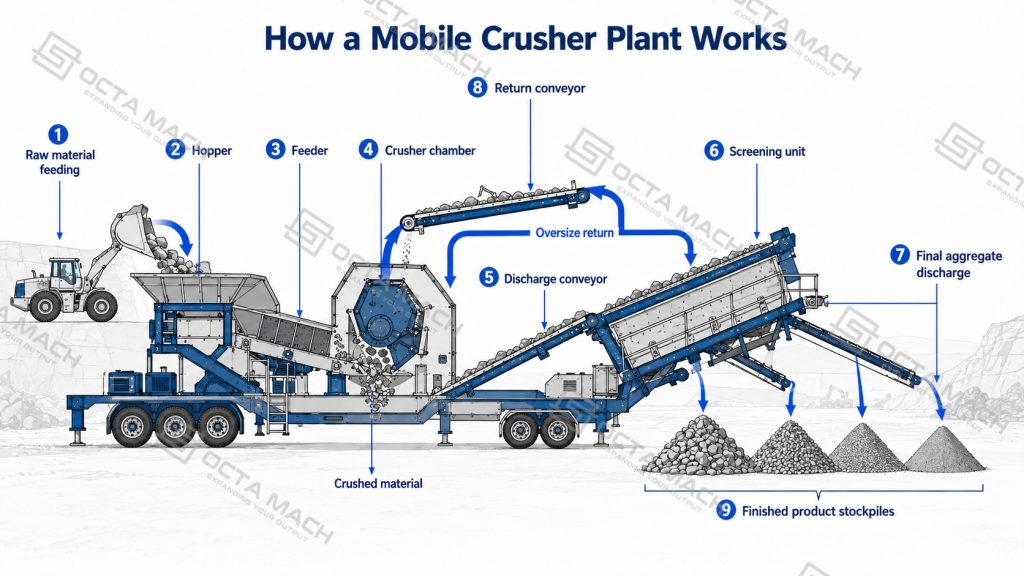
How a Mobile Crusher Works
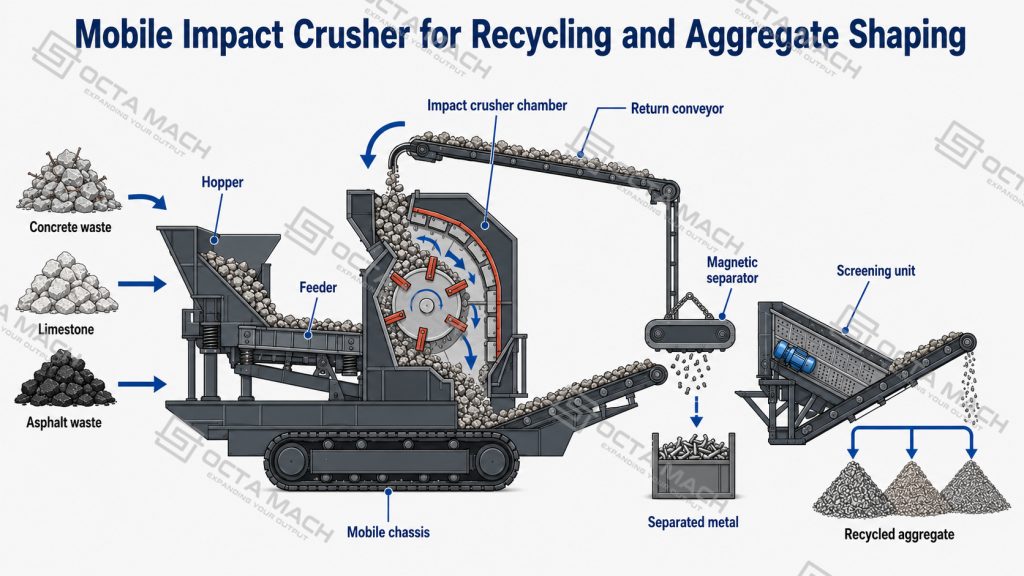
Raw material is loaded into the hopper and fed into the crusher through a vibrating feeder. The main crusher reduces the material size, and belt conveyors transfer the crushed product to a stockpile or screen. When a screening and return system is included, oversized material can be sent back to the crusher for further size reduction.
| Process Step | Main Equipment | Function |
|---|---|---|
| Feeding | Hopper and vibrating feeder | Controls material flow and removes part of the fine material before crushing |
| Primary Crushing | Jaw crusher or impact crusher | Reduces large feed into smaller material |
| Secondary Crushing | Cone crusher or impact crusher | Controls product size and improves particle shape |
| Screening | Vibrating screen | Separates finished products by size |
| Return Crushing | Return conveyor | Sends oversized material back to the crusher |
| Discharge | Belt conveyors | Transfers final aggregate to stockpiles |
Stable feeding has a direct effect on plant capacity. Oversized feed, wet clay, uneven loading or insufficient screening area may limit production even when the main crusher itself has enough power.
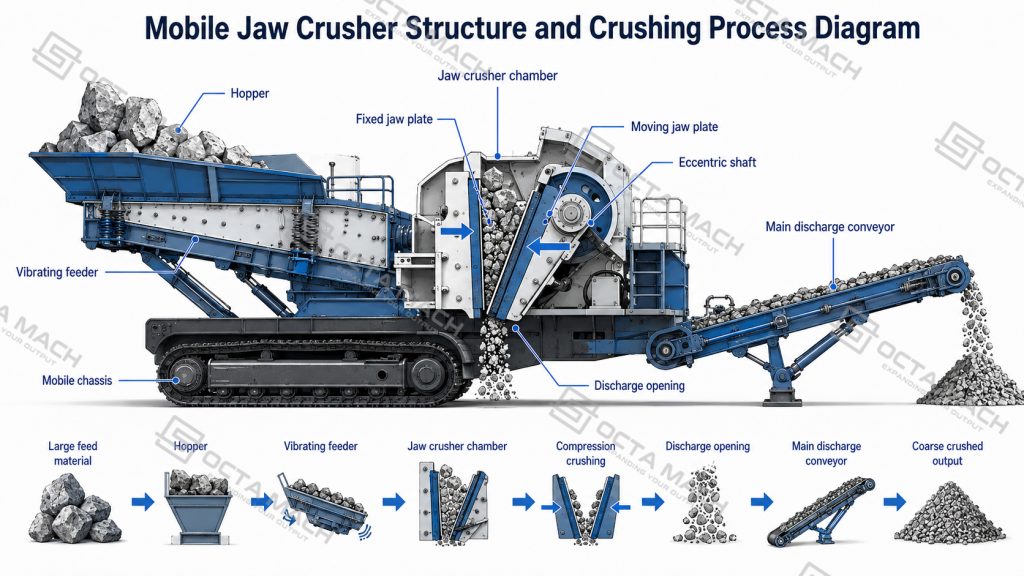
Mobile Jaw Crusher Technical Parameters
A mobile jaw crusher is commonly used as the primary crushing unit for hard stone, ore, river stone and reinforced concrete waste. PE jaw crushers are generally used for coarse primary crushing, while PEX jaw crushers are often used for secondary or fine jaw crushing.
| Model | Feed Opening Size (mm) | Max Feed Size (mm) | Discharge Opening Size (mm) | Capacity (t/h) | Rotary Speed of Eccentric Shaft (r/min) | Power (kW) | Weight (t) | Overall Dimension L×W×H (mm) |
|---|---|---|---|---|---|---|---|---|
| PE-150×250 | 150×250 | 125 | 10–40 | 1–3 | 250 | 5.5 | 0.8 | 720×660×850 |
| PE-200×300 | 200×300 | 180 | 15–50 | 2–6 | 260 | 7.5 | 1.2 | 910×750×990 |
| PE-200×350 | 200×350 | 180 | 18–70 | 3–10 | 260 | 11 | 1.5 | 1000×870×990 |
| PE-250×400 | 250×400 | 210 | 20–60 | 5–20 | 300 | 18.5 | 2.8 | 1300×1090×1270 |
| PE-400×600 | 400×600 | 340 | 40–100 | 16–60 | 275 | 30 | 7 | 1730×1730×1630 |
| PE-500×750 | 500×750 | 425 | 50–100 | 40–110 | 275 | 55 | 12 | 1980×2080×1870 |
| PE-600×900 | 600×900 | 500 | 65–160 | 50–180 | 250 | 75 | 17 | 2190×2206×2300 |
| PE-750×1060 | 750×1060 | 630 | 80–140 | 110–320 | 250 | 90 | 29 | 2660×2430×2800 |
| PE-900×1200 | 900×1200 | 750 | 95–165 | 220–450 | 200 | 110 | 52 | 3380×2870×3330 |
| PE-1000×1200 | 1000×1200 | 850 | 195–265 | 315–500 | 200 | 110 | 55 | 3480×2876×3330 |
| PE-1200×1300 | 1200×1300 | 1000 | 180–330 | 400–650 | 220 | 200 | 62.7 | 4538×2984×3959 |
| PE-1200×1500 | 1200×1500 | 1020 | 150–350 | 400–800 | 180 | 250 | 80 | 4200×3300×3500 |
| PE-1500×1800 | 1500×1800 | 1200 | 220–350 | 450–1000 | 180 | 280 | 122 | 5160×3660×4248 |
| PEX-150×750 | 150×750 | 120 | 18–48 | 8–25 | 320 | 15 | 3.8 | 1200×1530×1060 |
| PEX-250×750 | 250×750 | 210 | 25–60 | 13–35 | 330 | 30 | 5.5 | 1380×1750×1540 |
| PEX-250×1000 | 250×1000 | 210 | 25–60 | 16–52 | 330 | 37 | 7 | 1560×1950×1390 |
| PEX-250×1200 | 250×1200 | 210 | 25–60 | 20–61 | 330 | 37 | 9.7 | 2140×1660×1500 |
| PEX-300×1300 | 300×1300 | 250 | 20–90 | 16–105 | 300 | 55 | 15.6 | 2720×1950×1600 |
| PEX-300×1500 | 300×1500 | 250 | 25–120 | 60–140 | 300 | 75 | 16.5 | 2920×1950×1600 |
| PEX-500×1500 | 500×1500 | 350 | 25–120 | 50–160 | 300 | 90 | 20 | 2360×2660×2105 |
For a mobile jaw crusher plant, the jaw crusher model must also match the hopper volume, feeder width, discharge height, conveyor capacity, machine weight and transport dimensions.
Mobile Impact Crusher Technical Parameters
A mobile impact crusher is mainly used for limestone, concrete waste, asphalt waste, dolomite and other medium-hard or lower-abrasive materials. It is frequently chosen for recycling and road aggregate production where reduction ratio and particle shape are both important.
| Model | Specifications (mm) | Feed Opening (mm) | Feed Size (mm) | Capacity (t/h) | Motor Power (kW) | Dimensions (mm) |
|---|---|---|---|---|---|---|
| PFV-0807 | Φ850×700 | 400×730 | ≤100 | 15–30 | 30–45 | 2119×1654×2200 |
| PFV-1010 | Φ1000×1050 | 500×1080 | ≤150 | 40–70 | 55–75 | 2319×2001×2558 |
| PFV-1210 | Φ1250×1050 | 450×1060 | ≤150 | 70–120 | 110–132 | 2585×2053×2809 |
| PFV-1214 | Φ1250×1400 | 450×1440 | ≤200 | 100–150 | 132–160 | 2582×2403×2809 |
| PFV-1315 | Φ1320×1500 | 550×1530 | ≤300 | 130–280 | 200 | 2930×2761×3053 |
| PFV-1320 | Φ1320×2000 | 610×1900 | ≤350 | 180–400 | 250–280 | 3224×3175×2706 |
| PFV-1520 | Φ1500×2000 | 830×2040 | ≤350 | 300–550 | 220–250×2 | 3959×3564×3330 |
| PFV-1820 | Φ1800×2000 | 1260×2040 | ≤400 | 600–800 | 315–400×2 | 4400×3866×4009 |
Impact crusher selection should always consider abrasiveness. Limestone and recycled concrete can usually be processed efficiently by impact crushing. Granite, basalt and highly abrasive ore are better handled with a jaw crusher plus cone crusher arrangement for long-term wear control.
Mobile Cone Crusher for Hard Rock Processing
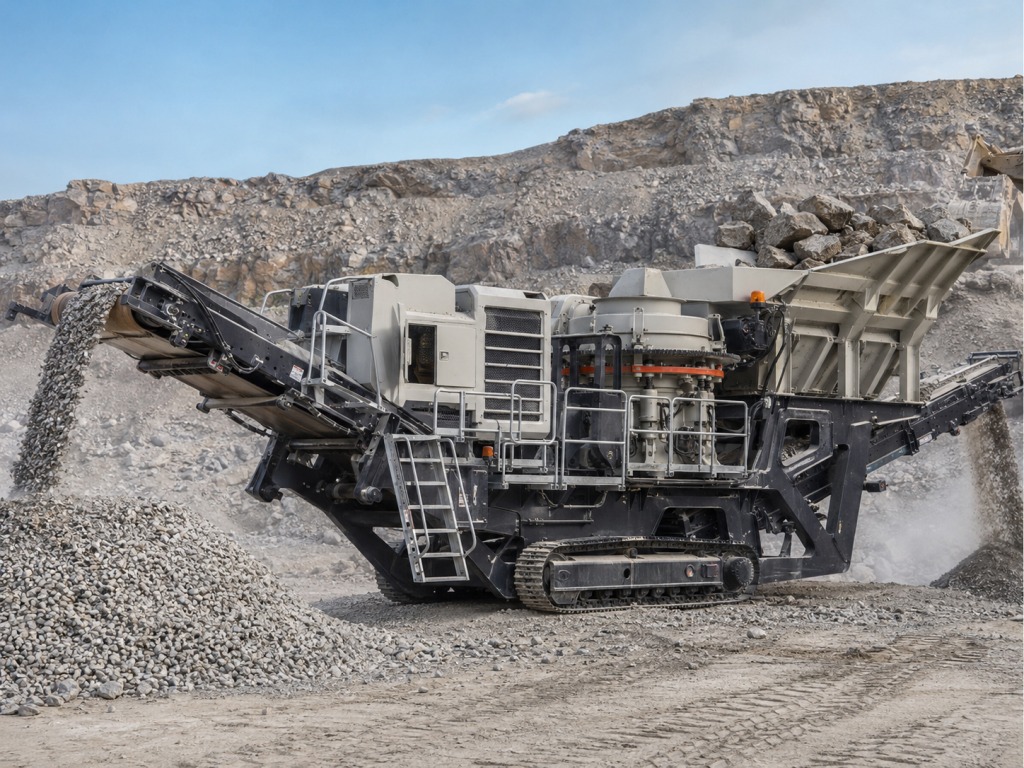
A mobile cone crusher is used for secondary and tertiary crushing of medium-hard to hard materials. It is normally placed after a mobile jaw crusher to process granite, basalt, river stone, iron ore and copper ore. The cone crusher uses compression between the mantle and concave to control discharge size and maintain stable hard-rock production.
| Item | Description |
|---|---|
| Main Function | Secondary crushing, tertiary crushing and fine crushing |
| Suitable Materials | Granite, basalt, river stone, hard rock, iron ore, copper ore |
| Typical Upstream Equipment | Mobile jaw crusher |
| Product Control | Controlled by chamber type and closed-side setting |
| Key Wear Parts | Mantle, concave, liner, sealing parts |
| Selection Focus | Feed size, chamber type, CSS, capacity and liner life |
A mobile cone crusher is the preferred choice when the material is hard, abrasive or requires continuous production with a controlled discharge size.
Mobile Rock Crusher Selection by Material
A mobile rock crusher should be selected according to material hardness, abrasiveness and final aggregate requirements. Hard rock normally requires compression crushing, while lower-abrasive materials can often be processed by impact crushing.
| Material | Recommended Mobile Crusher Configuration | Application Direction |
|---|---|---|
| Granite | Mobile jaw crusher + mobile cone crusher | Hard-stone aggregate production |
| Basalt | Mobile jaw crusher + mobile cone crusher | Road aggregate and high-strength concrete aggregate |
| Limestone | Mobile impact crusher or jaw + impact crusher | Aggregate, cement material and road base |
| River Stone | Mobile jaw crusher + mobile cone crusher | Sand and gravel aggregate |
| Construction Waste | Mobile jaw crusher or mobile impact crusher | Concrete recycling and road base material |
| Asphalt Waste | Mobile impact crusher | Recycled asphalt aggregate |
| Iron Ore / Copper Ore | Mobile jaw crusher + mobile cone crusher | Mining crushing and pre-processing |
Crusher selection should not rely on capacity alone. A high-capacity impact crusher may still be unsuitable for abrasive hard rock if blow bar wear becomes too high. A cone crusher may also be unnecessary for recycling projects where impact crushing and screening can already meet the required product shape.
Advantages of Mobile Crusher Plant
A mobile crusher plant is valuable when the raw material source changes across the site or when the crushing location needs to move with the working face. Instead of transporting large volumes of unprocessed stone, ore or construction waste to a fixed crushing line, the plant can process material closer to the source. This helps reduce haulage distance, loading cycles, fuel consumption and material handling pressure on site.
The mobile layout also reduces the amount of civil foundation work required before production. Feeding, crushing, screening and conveying systems can be integrated on one or several mobile units, allowing faster installation than a conventional stationary plant. This is especially useful for quarry expansion, road construction, temporary aggregate production, mining pre-processing and demolition recycling projects where the project location or production period may change.
Another advantage is configuration flexibility. A mobile jaw crusher can be used for primary crushing of large and hard feed material, a mobile impact crusher can be selected for limestone, concrete waste and asphalt recycling, and a mobile cone crusher can be added for hard-rock secondary or tertiary crushing. When the project requires multiple product sizes, a screening unit and return conveyor can be included to separate qualified aggregate and send oversized material back for re-crushing.
For recycling applications, mobile crushing equipment can also improve site efficiency by processing concrete waste, asphalt waste and mixed demolition material directly at the demolition or road project site. With optional magnetic separation, metal pieces can be removed before final discharge, while recycled aggregate can be used for road base, backfill or further aggregate processing. This makes the plant more practical for projects that need both mobility and controlled output size.
Mobile Crusher Plant vs Stationary Crushing Plant
| Item | Mobile Crusher Plant | Stationary Crushing Plant |
|---|---|---|
| Installation | Faster setup with less civil foundation work | Requires fixed foundation and longer installation |
| Mobility | Can move within or between job sites | Fixed location |
| Capacity Expansion | Flexible by adding mobile units | Usually planned as a fixed production line |
| Site Requirement | Suitable for temporary or changing sites | Suitable for long-term stable production |
| Maintenance Access | Compact layout, easy relocation | Larger fixed maintenance space possible |
| Best Use | Quarry working face, construction waste and road projects | Large long-term aggregate or mining plants |
A stationary plant is still better for very large, long-term production with a stable material source. A mobile crusher plant is more suitable when flexibility, fast deployment and reduced material transport are more important.
RFQ Information for Mobile Crusher for Sale
For a mobile crusher for sale inquiry, quotation accuracy depends on working-condition data. Capacity alone is not enough because the same crusher model may perform differently when feed size, material hardness, final product size and screening efficiency change.
| Information Needed | Example |
|---|---|
| Raw Material | Granite, basalt, limestone, concrete waste, asphalt waste, ore |
| Maximum Feed Size | 300 mm, 500 mm, 700 mm |
| Required Capacity | 100 t/h, 200 t/h, 300 t/h, 500 t/h |
| Final Product Size | 0–5 mm, 5–10 mm, 10–20 mm, 20–40 mm |
| Crushing Stage | Primary, secondary, tertiary crushing |
| Preferred Crusher Type | Mobile jaw crusher, mobile impact crusher, mobile cone crusher |
| Power Requirement | Diesel, electric, diesel-electric |
| Site Condition | Quarry, mine, road project, demolition site |
| Additional Equipment | Screen, return conveyor, magnetic separator, dust suppression |
| Destination | Country, port, transport limitation |
A complete inquiry helps confirm the correct crusher type, plant layout, power configuration and spare-parts plan. For hard rock, jaw and cone crushing are usually reviewed first. For recycling and limestone applications, impact crushing may be more suitable.
FAQ
Q: What is a mobile crusher plant used for?
A: A mobile crusher plant is used for on-site crushing of quarry stone, mining ore, concrete waste, asphalt waste and road construction materials. It combines feeding, crushing, conveying and optional screening to produce controlled aggregate sizes directly near the material source.
Q: How do I choose between a mobile jaw crusher, impact crusher and cone crusher?
A: Choose by feed size, hardness, abrasiveness and final product size. A jaw crusher handles large feed and primary crushing, an impact crusher fits limestone and recycling, while a cone crusher is better for hard rock secondary or tertiary crushing.
Q: Why is a mobile impact crusher often used for concrete and asphalt recycling?
A: A mobile impact crusher is often used because it gives a high reduction ratio and better aggregate shape. For reinforced concrete, add a magnetic separator to remove rebar and metal pieces before final discharge.
Q: What information is needed before selecting a mobile crusher for sale?
A: Prepare raw material, maximum feed size, required capacity, final aggregate size, power type and site condition. Also confirm whether screening, return conveyor, magnetic separator or dust suppression is needed before model selection.