
A stationary trommel screen separates bulk material by particle size as the feed moves through a slowly rotating, slightly inclined cylindrical drum. Material smaller than the selected screen aperture passes through the screen panels and is collected as undersize, while larger particles continue along the drum and discharge from the outlet end. The machine combines a screening drum, replaceable screen panels, rigid support frame, geared drive, feed section, support rollers and separate outlets for undersize and oversize products. It is suitable for the classification of mineral ore, sand, gravel, crushed stone and other free-flowing granular materials.
The Octa Mach trommel screen range covers drum diameters from 1,200 to 2,400 mm, drum lengths from 3,500 to 8,000 mm, installed powers from 4 to 37 kW, and published capacities from 30 to 300 t/h. Octa Mach supports model selection according to feed-size distribution, required cut size, moisture and clay content, target throughput, number of product fractions and site interfaces. Screen-aperture configuration, drum dimensions, drive arrangement and upstream or downstream equipment can therefore be coordinated around the actual process duty rather than selected only from nominal catalogue capacity.
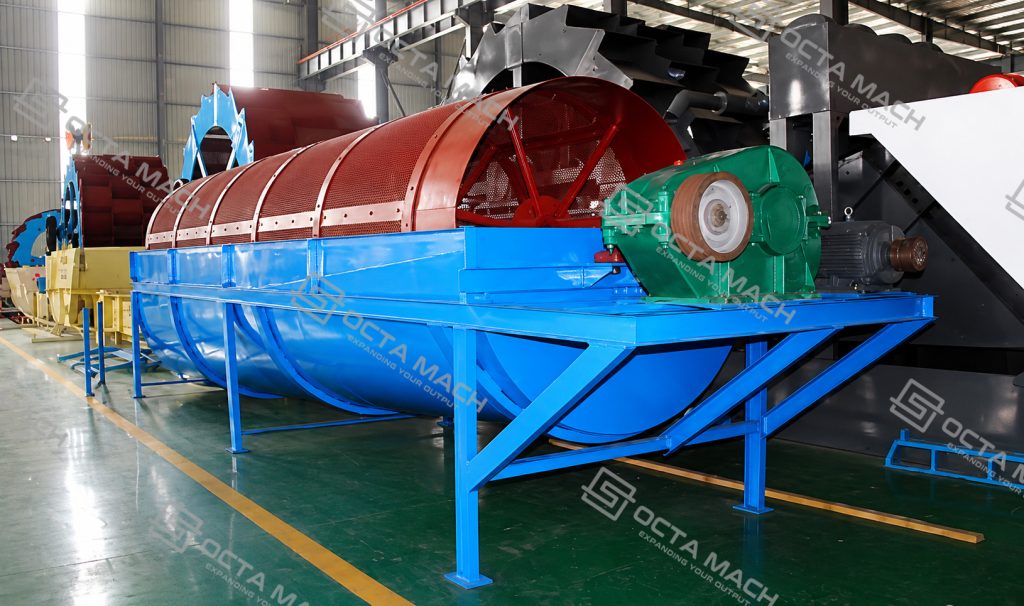
Main Operating Range
| Parameter | Available Range |
|---|---|
| Equipment type | Stationary rotary trommel screen |
| Model range | GS1.2×3.5 to TGS2.4×8.0 |
| Drum diameter | 1,200–2,400 mm |
| Drum length | 3,500–8,000 mm |
| Drum speed | 9–17 r/min |
| Drum gradient | 2–2.5° |
| Installed power | 4–37 kW |
| Published capacity | 30–300 t/h |
| Main separation method | Rotating cylindrical screen |
| Typical applications | Mining, quarrying, aggregate and mineral classification |
Published capacity is a nominal equipment range rather than a guaranteed production figure. Actual throughput depends on feed gradation, moisture, clay content, bulk density, screen opening, percentage of near-size particles and the required separation accuracy.
Trommel Screen Technical Parameters
The product is listed in the catalogue as a Drum Sieve, but it is the same category of industrial rotary screening equipment commonly marketed as a trommel screen.
| Model | Drum Diameter (mm) | Drum Length (mm) | Drum Speed (r/min) | Gradient (°) | Power (kW) | Capacity (t/h) |
|---|---|---|---|---|---|---|
| GS1.2×3.5 | 1,200 | 3,500 | 17 | 2–2.5 | 4 | 30–80 |
| GS1.5×5.0 | 1,500 | 5,000 | 14 | 2–2.5 | 7.5 | 30–150 |
| TGS1.8×6.0 | 1,800 | 6,000 | 12 | 2–2.5 | 18.5 | 30–250 |
| TGS2.0×5.0 | 2,000 | 5,000 | 11.5 | 2–2.5 | 22 | 30–300 |
| TGS2.2×6.0 | 2,200 | 6,000 | 10.5 | 2–2.5 | 30 | 30–300 |
| TGS2.4×8.0 | 2,400 | 8,000 | 9 | 2–2.5 | 37 | 30–300 |
The larger models do not automatically guarantee higher effective output in every application. A longer or wider drum provides more screening area and residence time, but the final trommel screen capacity must still be checked against the real feed and required product sizes.
Trommel Screen Working Principle
The trommel screen working principle is based on rotation, gravity and controlled material residence time.
1. Material Feeding
Sand, gravel, mineral ore or crushed stone is fed into the inlet of the rotating drum. A belt feeder or conveyor should provide a stable feed rather than intermittent surges.
2. Lifting and Tumbling
As the drum rotates, friction between the material and the screen surface lifts the particles before they roll or fall back into the material bed. This action loosens mixed particles and repeatedly exposes finer material to the screen openings.
3. Particle-Size Separation
Particles smaller than the selected trommel screen mesh size pass through the screen surface. Oversized particles remain inside the cylinder.
4. Axial Material Movement
The 2–2.5° drum gradient moves retained material toward the discharge end. Drum speed and feed rate must be balanced so that the material receives enough screening time without overfilling the cylinder.
5. Separate Discharge
Undersize material is collected beneath or beside the screening drum. Oversize material exits from the end of the drum and may be conveyed to another crusher, stockpile or processing stage.
The main operating variables include drum speed, feed rate, drum diameter, drum length, inclination angle, aperture size and material characteristics. Increasing throughput without considering bed depth and residence time can reduce separation quality, especially when a large proportion of the feed is close to the selected cut size.
Trommel Screen Structure
A typical industrial trommel screen structure includes the following assemblies
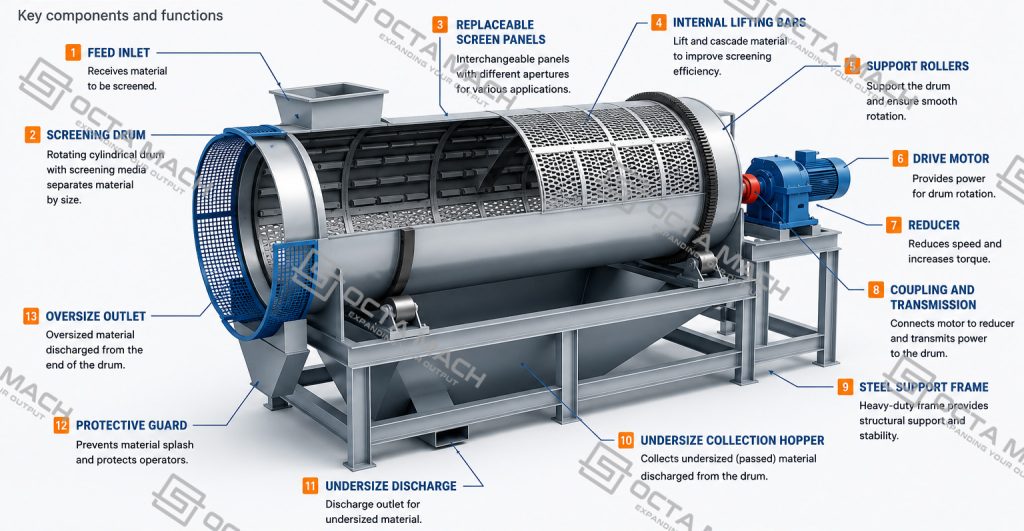
- Screening drum: The rotating cylindrical section that carries the screen panels or perforated screening surface.
- Support frame: A welded steel structure that carries the drum, drive and bearing assemblies.
- Drive system: Usually consists of a motor, reducer, coupling and transmission arrangement.
- Support rollers: Carry the rotating cylinder and maintain its operating position.
- Feed inlet: Receives material from the upstream feeder or conveyor.
- Undersize collection section: Directs particles passing through the screen into one or more discharge conveyors.
- Oversize outlet: Discharges retained material from the end of the cylinder.
- Screen panels: Selected according to required separation size, material abrasiveness and operating conditions.
- Protective guards and covers: Reduce access to rotating components and help contain dust or material spillage.
Depending on the project, the trommel screen machine may be supplied with replaceable mesh panels, perforated plates, internal lifting bars, cleaning brushes, dust covers, spray pipes or multiple screening sections. These items should be confirmed during technical selection rather than assumed as standard.
Mining, Quarry and Aggregate Applications
Mining Trommel Screen
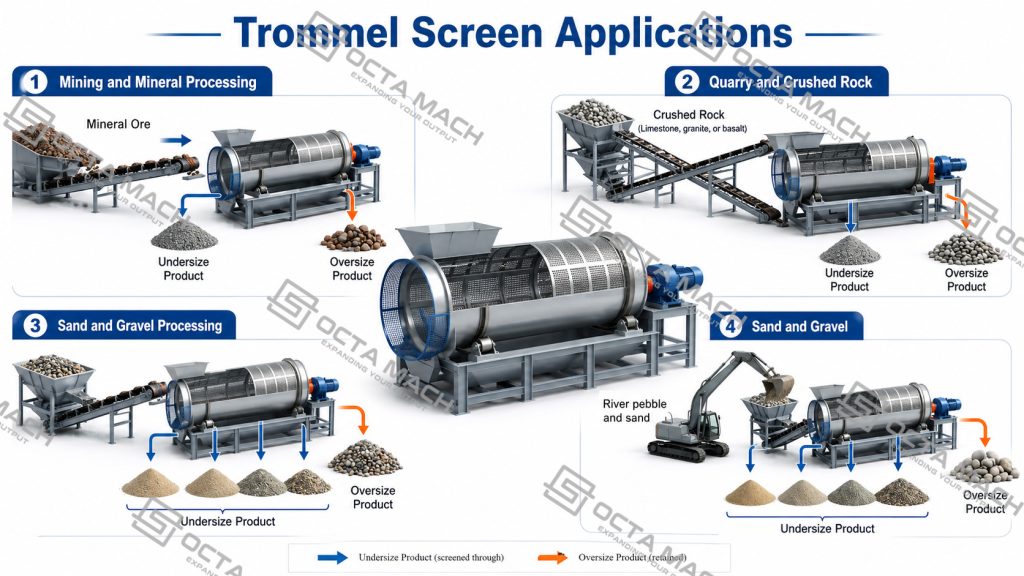
A mining trommel screen can be installed before crushing, grinding, gravity concentration or other beneficiation stages to remove undersize material and control the feed entering downstream equipment. It may also be used to classify washed ore or separate unwanted coarse fragments.
Typical applications include:
- Gold-bearing ore preparation
- Iron ore sizing
- Copper ore classification
- Manganese ore screening
- Coal and coal-gangue separation
- Mineral processing feed preparation
A mineral processing trommel screen should be selected according to the ore’s particle-size distribution, moisture, clay content, abrasiveness and downstream process requirements.
Quarry Trommel Screen
A quarry trommel screen can classify crushed rock into controlled size fractions or remove fines before secondary crushing. It is useful where a rotating screening action is preferred over a high-frequency flat deck.
Possible feed materials include:
- Limestone
- Granite
- Basalt
- Diabase
- Quartz stone
- Sandstone
- River stone
- Crushed aggregate
Sand and Gravel Trommel Screen
A sand and gravel trommel screen separates mixed material into usable fractions for aggregate production, construction material preparation or stockpile management.
Depending on the selected screen aperture, the equipment may operate as a:
- Sand trommel screen
- Gravel trommel screen
- Aggregate trommel screen
- Stone trommel screen
- River pebble trommel screen
For washed or clay-bearing feed, screen blinding, water drainage and cleaning arrangements must be evaluated. The tumbling action can help loosen irregular or partially agglomerated material, but very sticky clay can still block the screening surface if the aperture, feed rate and cleaning system are not correctly selected.
Material Applications and Screening Considerations
The stationary industrial trommel screen can be considered for a broad range of granular feeds, subject to technical confirmation.
| Material Group | Typical Examples | Main Selection Concern |
|---|---|---|
| Natural aggregate | River pebble, river stone, gravel | Feed size and oversize content |
| Sedimentary rock | Limestone, sandstone | Moisture and fines content |
| Hard rock | Granite, basalt, diabase | Abrasion and screen wear |
| Silica-rich material | Quartz, quartz stone, silica sand | Abrasive wear |
| Metallic ore | Iron ore, copper ore, manganese ore | Ore density and required cut size |
| Industrial mineral | Calcite, phosphate rock, perlite | Fragility and particle-size distribution |
| Coal material | Coal, coal gangue | Moisture, dust and lump size |
Keywords such as limestone trommel screen, granite trommel screen, basalt trommel screen, quartz trommel screen, iron ore trommel screen, copper ore trommel screen and manganese ore trommel screen should only be used where the screen configuration is supported by the actual feed data.
Heavy-Duty Trommel Screen Features
A properly configured heavy-duty trommel screen provides several practical advantages:
Continuous Size Classification
The drum rotates continuously, allowing feed, screening and discharge to proceed in one process.
Controlled Retention Time
Drum length, gradient and speed determine how long material remains in the screening zone.
Multiple Size Fractions
A drum may be divided into separate screening sections with different aperture sizes when the process requires more than one undersize product.
Stable Stationary Installation
Unlike portable recycling trommels, the catalogue models are designed as stationary trommel screens for integration with fixed feeders, conveyors, crushers and stockpile systems.
Adaptable Screening Surface
Screen openings and panel construction can be selected according to product size and wear conditions, subject to engineering confirmation.
These advantages do not remove the need for correct feed control. Excessive feed depth can carry undersize particles to the oversize outlet, while unsuitable aperture geometry can increase pegging or blinding.
Trommel Screen Selection
Correct trommel screen selection starts with the process duty rather than drum diameter alone.
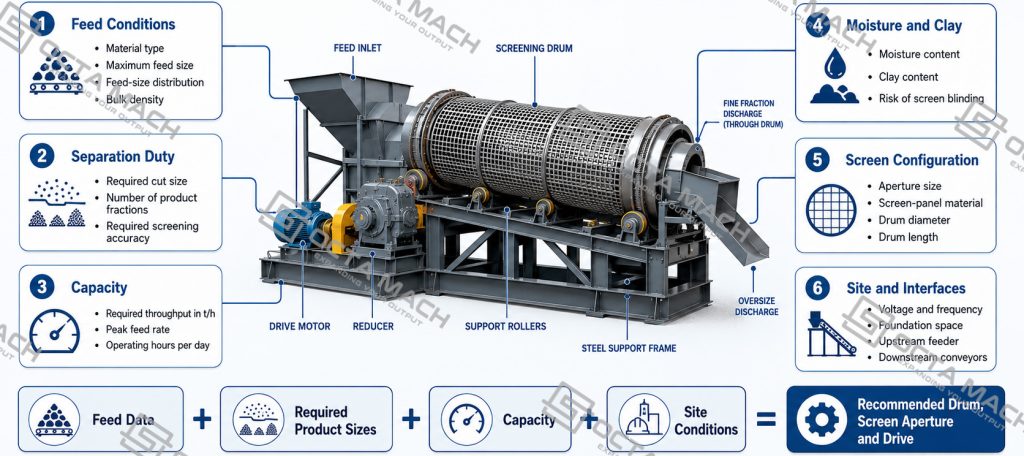
Information Required Before Selection
Provide the following data:
- Material type and mineral composition
- Maximum feed size
- Typical feed-size distribution
- Required product sizes
- Required capacity in t/h
- Bulk density
- Moisture and clay content
- Percentage of near-size material
- Dry or wet screening requirement
- Operating hours per day
- Site voltage and frequency
- Upstream and downstream equipment
- Required number of product fractions
- Installation space and foundation conditions
Model Selection Guidance
- GS1.2×3.5: Suitable for lower-capacity duties where a compact 1,200 mm drum is sufficient.
- GS1.5×5.0: Provides a longer screening zone and a published capacity of 30–150 t/h.
- TGS1.8×6.0: Intended for medium-to-high-capacity classification, with a published range of 30–250 t/h.
- TGS2.0×5.0: Uses a wider 2,000 mm drum where greater bed width is required.
- TGS2.2×6.0: Combines a 2,200 mm diameter with a 6,000 mm screening length.
- TGS2.4×8.0: The largest confirmed model, with a 2,400 mm diameter and 8,000 mm drum length.
The three largest models all have a published upper range of 300 t/h. Final selection should therefore be based on screening area, feed behaviour and separation duty rather than assuming that the largest motor always produces the highest usable output.
Trommel Screen vs Vibrating Screen
The trommel screen vs vibrating screen decision depends on feed condition, required capacity and product control.
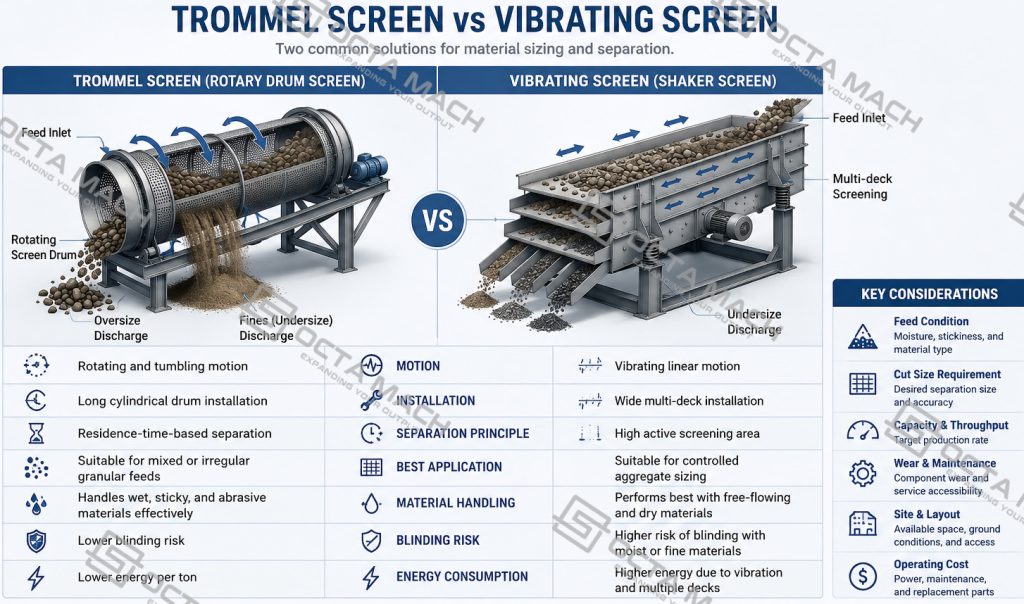
| Selection Factor | Trommel Screen | Vibrating Screen |
|---|---|---|
| Screening motion | Rotating and tumbling | Vibrating or elliptical motion |
| Screen shape | Cylindrical drum | Flat or inclined deck |
| Material travel | Rotation, gravity and drum gradient | Vibration and deck inclination |
| Typical strength | Mixed or irregular granular feeds | High-capacity dry aggregate sizing |
| Screening area use | Only the active lower drum section | Most of the deck surface |
| Near-size separation | Depends strongly on residence time | Often effective with controlled deck motion |
| Sticky-feed risk | Tumbling may loosen some agglomerates, but blinding remains possible | Vibration may reduce pegging in some applications |
| Installation | Long cylindrical layout | Wider multi-deck arrangement |
| Product fractions | Different drum sections possible | Multiple decks commonly used |
A trommel should not be described as universally better than a vibrating screen. Vibrating screens can process more material through an actively used deck area, while trommels may provide longer residence time and more tumbling action. The correct choice depends on the specific feed and required separation.
Trommel Screen Maintenance
Routine trommel screen maintenance should focus on the rotating cylinder, screening surface and drive alignment.
Recommended checks include:
- Inspect screen panels for wear, cracks or enlarged apertures.
- Remove wedged stones and accumulated material from the screen surface.
- Check the drum for deformation or abnormal runout.
- Inspect support rollers, bearings and contact surfaces.
- Confirm reducer oil level and operating temperature.
- Check motor current for sudden changes.
- Inspect couplings, bolts and guards.
- Verify that the feed is centred and evenly distributed.
- Keep undersize chutes and discharge conveyors clear.
- Check brushes or spray systems where supplied.
- Inspect the steel frame and anchor bolts for movement.
Screen panels should be replaced according to measured wear and separation performance, not only according to a fixed calendar interval.
Trommel Screen Price and Procurement
The price of a trommel screen for sale depends on more than the basic model number. Main cost factors include:
- Drum diameter and length
- Screen-panel material and aperture
- Number of screening sections
- Feed and discharge arrangements
- Motor, reducer and electrical configuration
- Dust enclosure or water-spray system
- Cleaning brushes
- Supporting conveyors
- Wear-resistant internal components
- Spare screen panels
- Packing and delivery destination
- Installation and commissioning support
As a trommel screen manufacturer and supplier, Octa Mach can configure the equipment around the customer’s feed, capacity, product-size and site requirements. The inquiry should include real process data so that the offered machine, screen aperture and auxiliary equipment can be matched to the intended duty.
Why Choose Octa Mach
A typical supply scope may include:
- Complete trommel screening machine
- Screening drum and support frame
- Motor and reducer
- Transmission assembly
- Support rollers and bearings
- Screen panels or perforated sections
- Inlet and discharge interfaces
- Protective guards
- Electrical control system
- Foundation or installation drawings
- Operation and maintenance documentation
- Recommended spare parts
- Remote or on-site installation support
The final supply boundary should be clearly stated in the quotation, especially where feeders, conveyors, dust covers, water systems or steel platforms are required.
FAQ
Q: What is the maximum capacity of the trommel screen?
A: The confirmed range covers published capacities from 30 to 300 t/h. Actual output depends on the model, feed distribution, moisture, aperture size and required screening accuracy.
Q: How is the trommel screen mesh size selected?
A: It is selected from the required undersize product, feed gradation, near-size percentage, material shape and risk of pegging or blinding.
Q: Can a trommel screen process granite, basalt or quartz?
A: These abrasive materials can be screened when the feed size and screen construction are suitable. Wear rate and replacement-panel strategy should be reviewed before final selection.
Q: What information is needed for an accurate quotation?
A: Provide the material type, maximum feed size, feed-size distribution, required product sizes, capacity, moisture, operating hours, voltage, installation conditions and delivery destination.