
Cone Crusher is a compression-type crushing machine used for secondary, tertiary and fine crushing after primary jaw crushing. During operation, the motor drives the transmission system and eccentric sleeve, causing the moving cone to swing inside the crushing chamber. Material is repeatedly compressed between the mantle and concave until it reaches the required discharge size, helping control product size, improve particle shape and prepare material for screening, sand-making or grinding circuits.
A Cone Crusher Machine is commonly used for granite, basalt, river pebble, iron ore, copper ore, limestone, quartz, diabase and aggregate stone in quarry, mining, manufactured sand and hard rock crushing projects. Depending on capacity, automation level and working condition, the machine can be configured as a Multi-cylinder Hydraulic Cone Crusher, single-cylinder Hydraulic Cone Crusher, Spring Cone Crusher, or mobile cone crusher.
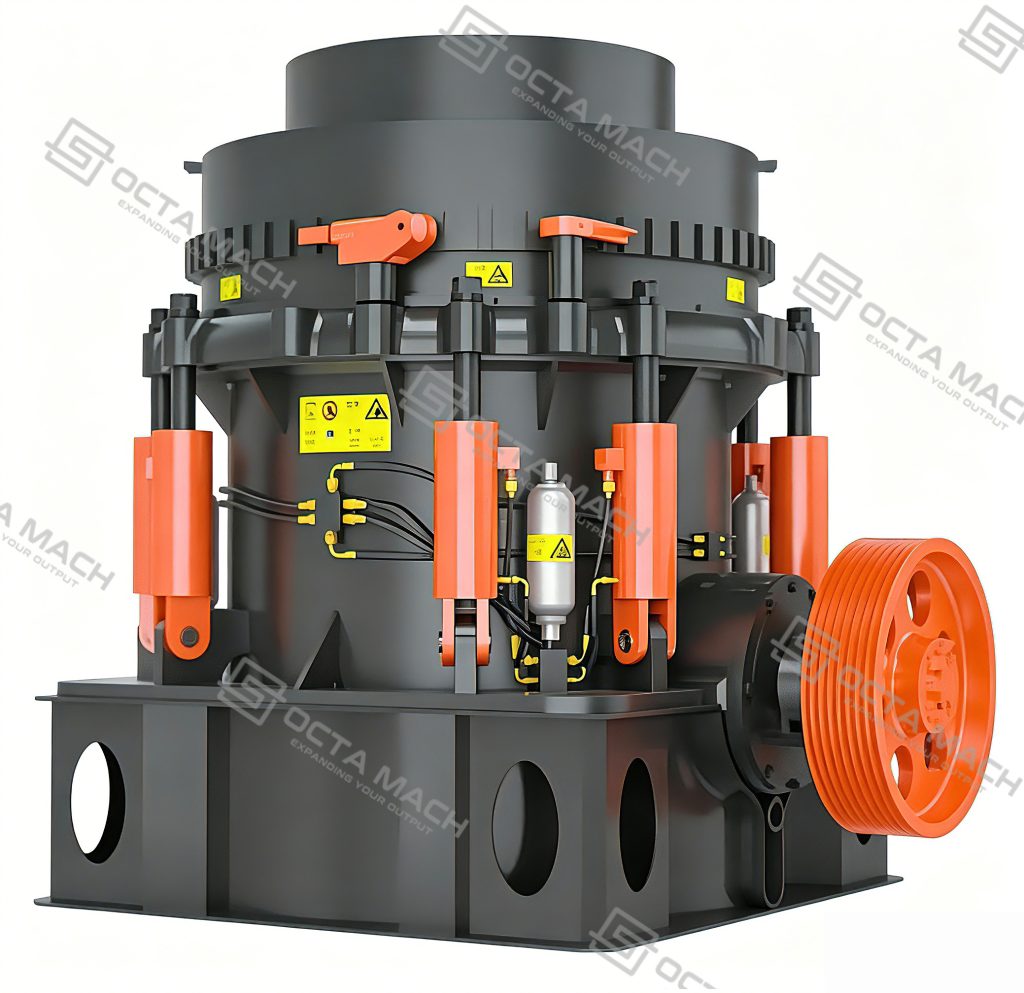
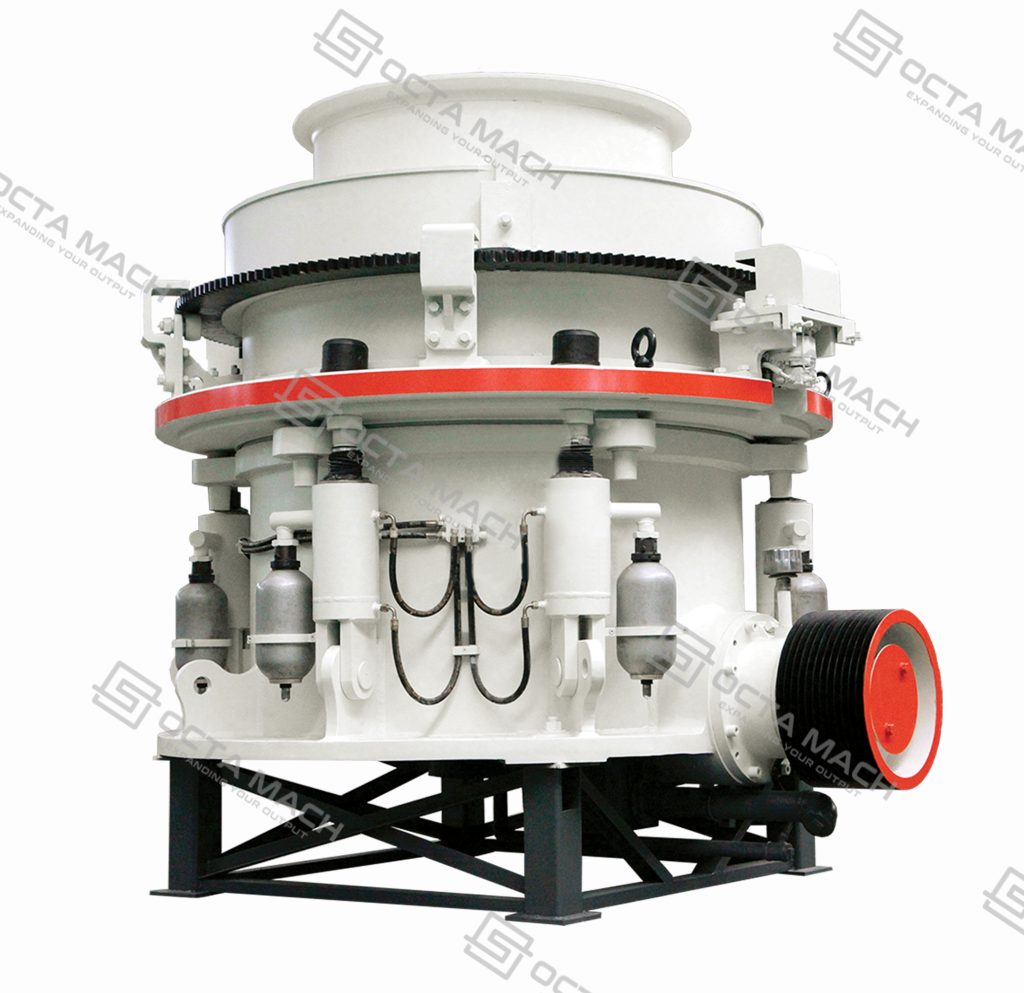
How a Cone Crusher Works
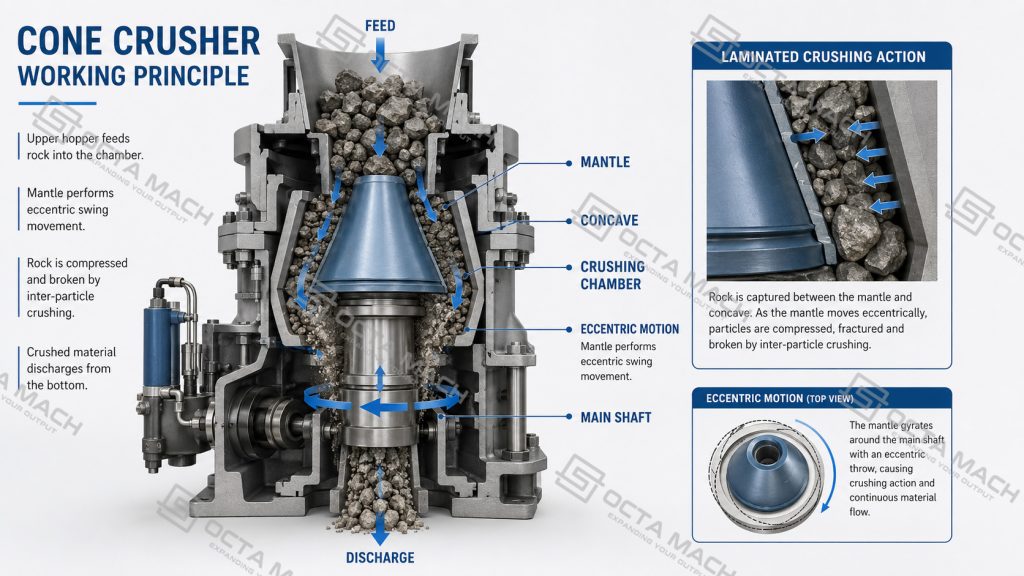
A cone crusher works by laminated compression. The motor drives the transmission system, the eccentric sleeve makes the moving cone swing, and the material is compressed between the mantle and concave. As the material moves downward, it is repeatedly squeezed and fractured until it becomes small enough to pass through the discharge opening.
| Working Part | Function |
|---|---|
| Mantle / Moving Cone | Applies crushing force to the material |
| Concave / Fixed Cone | Forms the fixed crushing surface |
| Eccentric Sleeve | Creates the swinging motion of the moving cone |
| Crushing Chamber | Controls material flow, reduction ratio and product gradation |
| Hydraulic System | Adjusts discharge setting and protects the machine under abnormal load |
| Lubrication System | Protects bearings, gears and moving components during operation |
| Discharge Opening / CSS | Controls final output size and affects capacity |
The design of the crusher cone assembly is important because the mantle, concave, eccentric motion and cavity shape work together to determine crushing efficiency, product shape and liner wear pattern.
Key advantages include:
- Stable secondary and tertiary crushing performance
- Suitable for hard and abrasive materials
- Adjustable discharge size
- Better particle shape under proper cavity selection
- Continuous operation in aggregate and mining plants
- Hydraulic adjustment and protection on hydraulic cone crusher models
Main Types of Cone Crushers
Cone crushers are selected according to the crushing stage, feed size, required discharge size, capacity target, automation level and maintenance condition. In a complete crushing plant, different cone crusher types may serve different duties: high-capacity hard-rock crushing, flexible hydraulic adjustment, or conventional medium and fine crushing with a simpler mechanical structure.
| Cone Crusher Type | Main Feature | Typical Use |
|---|---|---|
| HP Series Multi Cylinder Hydraulic Cone Crusher | Multi-cylinder hydraulic adjustment, strong laminated crushing and stable discharge control | High-capacity hard rock, aggregate, mining and fine-crushing applications |
| CS/CH Single Cylinder Hydraulic Cone Crusher | Single-cylinder hydraulic adjustment, compact structure and easier cavity clearing | Medium and fine crushing in quarry, mining and aggregate plants |
| High Efficient Spring Cone Crusher | Mature spring protection system and reliable mechanical structure | Conventional stone crushing lines with stable feed and moderate automation demand |
HP Series Multi Cylinder Hydraulic Cone Crusher
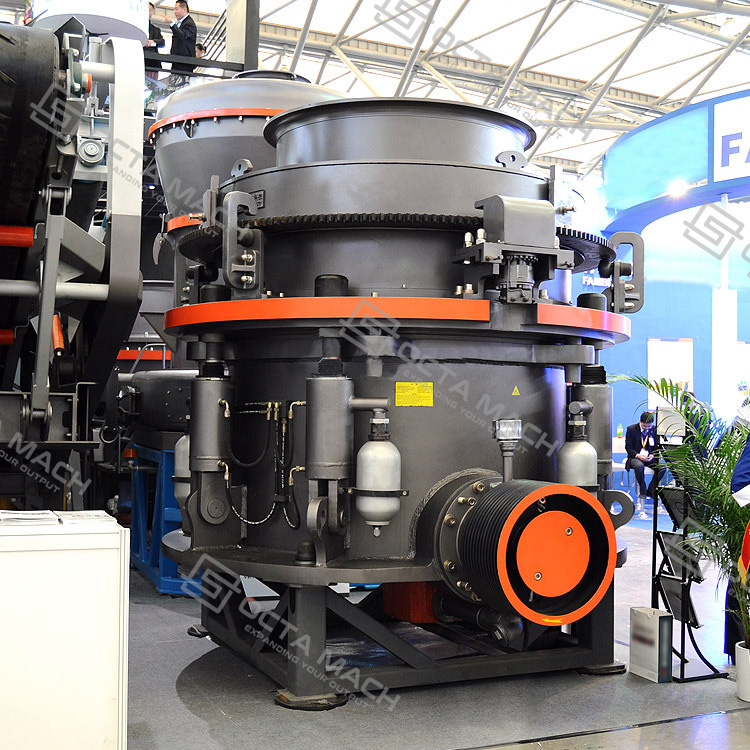
The HP Series Multi Cylinder Hydraulic Cone Crusher is designed for high-capacity secondary, tertiary and fine crushing in hard rock and mineral processing applications. Its multi-cylinder hydraulic system supports discharge adjustment, overload protection and cavity clearing, helping the crusher maintain stable operation when processing abrasive materials such as granite, basalt, river pebble, iron ore and copper ore.
This series is suitable for production lines that require consistent product size, good particle shape and continuous output under high-load conditions. Different cavity types can be selected according to feed size and required discharge size, including extra coarse, coarse, medium, fine and extra fine cavities. Typical HP models cover HP100 to HP800, with model selection based on feed opening, capacity range, installed power, liner profile and downstream screening requirements.
Typical specification focus:
| Model | Cavity Type | Open Side Feeding Size (mm) | Closed Side Feeding Size (mm) | Min Outlet Size (mm) | Capacity (t/h) | Installed Power (kW) |
|---|---|---|---|---|---|---|
| HP100 | C1 Extra Coarse | 175 | 140 | 19 | 45–100 | 90 |
| HP100 | C2 Coarse | 125 | 105 | 13 | 45–100 | 90 |
| HP100 | M Middle | 100 | 70 | 10 | 45–100 | 90 |
| HP100 | F1 Fine | 71 | 50 | 9 | 45–100 | 90 |
| HP100 | F2 Extra Fine | 33 | 20 | 6 | 45–100 | 90 |
| HP200 | C2 Coarse | 235 | 190 | 19 | 65–250 | 160 |
| HP200 | M Middle | 171 | 120 | 16 | 65–250 | 160 |
| HP200 | F1 Fine | 150 | 95 | 13 | 65–250 | 160 |
| HP200 | F2 Extra Fine | 116 | 70 | 8 | 65–250 | 160 |
| HP300 | C1 Extra Coarse | 265 | 230 | 25 | 85–440 | 220 |
| HP300 | C2 Coarse | 240 | 210 | 20 | 85–440 | 220 |
| HP300 | M Middle | 190 | 150 | 15 | 85–440 | 220 |
| HP300 | F1 Fine | 145 | 105 | 11 | 85–440 | 220 |
| HP300 | F2 Extra Fine | 120 | 80 | 8 | 85–440 | 220 |
| HP400 | C1 Extra Coarse | 360 | 290 | 30 | 135–625 | 315 |
| HP400 | C2 Coarse | 310 | 250 | 25 | 135–625 | 315 |
| HP400 | M Middle | 260 | 196 | 20 | 135–625 | 315 |
| HP400 | F1 Fine | 182 | 110 | 13 | 135–625 | 315 |
| HP400 | F2 Extra Fine | 135 | 90 | 10 | 135–625 | 315 |
| HP500 | C1 Extra Coarse | 370 | 330 | 38 | 200–790 | 400 |
| HP500 | C2 Coarse | 320 | 290 | 28 | 200–790 | 400 |
| HP500 | M Middle | 245 | 210 | 22 | 200–790 | 400 |
| HP500 | F1 Fine | 180 | 130 | 13 | 200–790 | 400 |
| HP500 | F2 Extra Fine | 150 | 95 | 10 | 200–790 | 400 |
| HP800 | C1 Extra Coarse | 450 | 352 | 38 | 265–1200 | 630 |
| HP800 | C2 Coarse | 373 | 298 | 32 | 265–1200 | 630 |
| HP800 | M Middle | 340 | 275 | 25 | 265–1200 | 630 |
| HP800 | F1 Fine | 280 | 230 | 16 | 265–1200 | 630 |
| HP800 | F2 Extra Fine | 235 | 150 | 10 | 265–1200 | 630 |
CS/CH Single Cylinder Hydraulic Cone Crusher
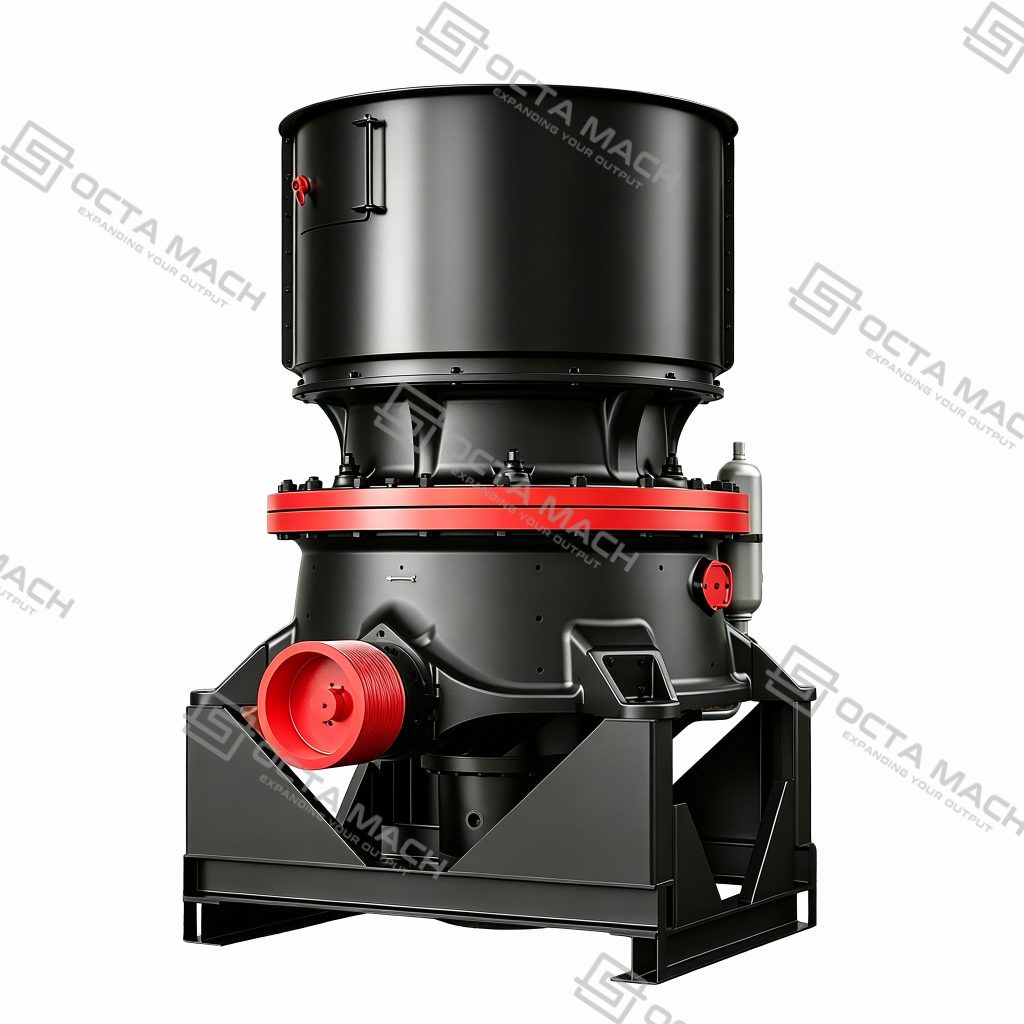
The CS/CH Single Cylinder Hydraulic Cone Crusher combines hydraulic adjustment, cavity clearing and overload protection in a compact structure. It is suitable for medium and fine crushing after jaw crushing, especially where the plant requires stable discharge control, convenient maintenance and lower system complexity than a multi-cylinder hydraulic cone crusher.
This type is commonly used in quarry, mining, coal, concrete mixing, dry mortar and aggregate production lines. Different cavity types can be selected according to feed size, required outlet size and capacity target, making it suitable for hard and medium-hard materials such as granite, basalt, river pebble, iron ore, limestone and quartz.
Typical specification focus:
| Model | Cavity Type | Max Inlet Size (mm) | Min Outlet Size (mm) | Max Installed Power (kW) |
|---|---|---|---|---|
| CS420 | S1 Extra Coarse | 240 | 22 | 90 |
| CS420 | S2 Medium Coarse | 200 | 19 | 90 |
| CS420 | H1 Fine | 135 | 10 | 90 |
| CH420 | H2 Medium Fine | 65 | 8 | 90 |
| CH420 | H3 Extra Fine | 38 | 4 | 90 |
| CS430 | S1 Extra Coarse | 360 | 25 | 160 |
| CS430 | S2 Medium Coarse | 300 | 22 | 160 |
| CS430 | S3 Coarse | 235 | 19 | 160 |
| CS430 | H1 Fine | 185 | 13 | 160 |
| CH430 | H2 Medium Fine | 90 | 10 | 160 |
| CH430 | H3 Extra Fine | 50 | 6 | 160 |
| CS440 | S1 Extra Coarse | 450 | 35 | 250 |
| CS440 | S2 Medium Coarse | 400 | 29 | 250 |
| CS440 | S3 Coarse | 300 | 25 | 250 |
| CS440 | H1 Fine | 215 | 16 | 250 |
| CH440 | H2 Medium Fine | 110 | 13 | 250 |
| CH440 | H3 Extra Fine | 70 | 8 | 250 |
| CS660 | S1 Extra Coarse | 560 | 41 | 315 |
| CS660 | S2 Medium Coarse | 500 | 38 | 315 |
| CS660 | H1 Fine | 275 | 16 | 315 |
| CH660 | H2 Medium Fine | 135 | 16 | 315 |
| CH660 | H3 Extra Fine | 65 | 13 | 315 |
| CH870 | H1 Fine | 300 | 22 | 560 |
| CH870 | H2 Medium Fine | 155 | 19 | 560 |
| CH870 | H3 Extra Fine | 80 | 10 | 560 |
| CH890 | H1 Fine | 370 | 25 | 750 |
| CH890 | H2 Medium Fine | 195 | 22 | 750 |
| CH890 | H3 Extra Fine | 85 | 10 | 750 |
High Efficient Spring Cone Crusher
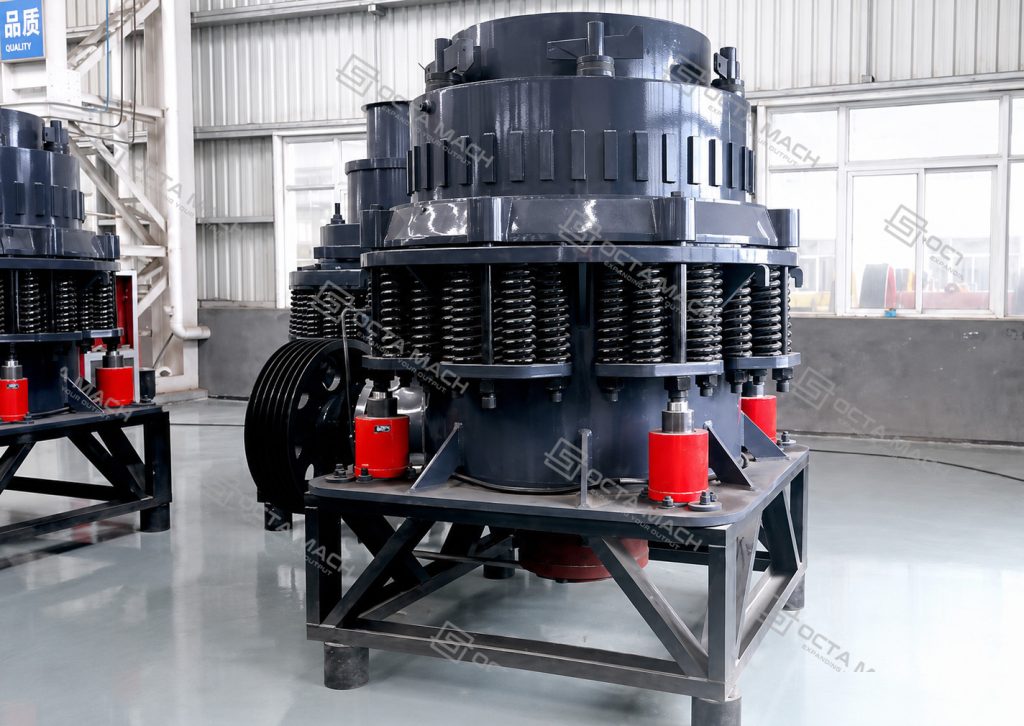
The High Efficient Spring Cone Crusher is a mechanically protected cone crusher designed for medium and fine crushing in conventional stone, aggregate and mineral-processing plants. It uses a spring safety system to absorb abnormal crushing load and help protect the machine when uncrushable material enters the chamber. The structure is mature, stable and easy to maintain, making it suitable for production lines where the feed condition is relatively consistent and full hydraulic automation is not required.
It is suitable for granite, basalt, river pebble, iron ore, limestone and quartz. Different fine, medium and coarse cavities can be selected according to feed size, discharge size and required capacity, making it a practical option for stable-feed crushing lines where full hydraulic automation is not required.
Typical specification focus:
| Standard Model | Dynamic Cone Diameter (mm) | Cavity Type | Feed Opening – Closed Side (mm) | Feed Opening – Open Side (mm) | Discharge Size (mm) | Speed (r/min) | Power (kW) | Production Capacity (t/h) | Weight (t) | Dimension (mm) |
|---|---|---|---|---|---|---|---|---|---|---|
| CS-75B | 900 | Fine | 83 | 102 | 9–22 | 580 | 75 | 45–91 | 15 | 2821×1880×2164 |
| CS-75B | 900 | Coarse | 159 | 175 | 13–38 | 580 | 75 | 59–163 | 15 | 2821×1880×2164 |
| CS-110B | 1200 | Fine | 127 | 131 | 9–31 | 485 | 110 | 63–188 | 20 | 2821×1974×2651 |
| CS-110B | 1200 | Medium | 156 | 156 | 13–38 | 485 | 110 | 100–200 | 20 | 2821×1974×2651 |
| CS-110B | 1200 | Coarse | 178 | 191 | 19–51 | 485 | 110 | 141–308 | 20 | 2821×1974×2651 |
| CS-160B | 1295 | Fine | 109 | 137 | 13–31 | 485 | 185 | 109–181 | 27 | 2800×2342×2668 |
| CS-160B | 1295 | Medium | 188 | 210 | 16–38 | 485 | 185 | 132–253 | 27 | 2800×2342×2668 |
| CS-160B | 1295 | Coarse | 216 | 241 | 19–51 | 485 | 185 | 172–349 | 27 | 2800×2342×2668 |
| CS-240B | 1650 | Fine | 188 | 209 | 16–38 | 485 | 240 | 181–327 | 55 | 3911×2870×3771 |
| CS-240B | 1650 | Medium | 213 | 241 | 22–51 | 485 | 240 | 258–417 | 55 | 3911×2870×3771 |
| CS-240B | 1650 | Coarse | 241 | 268 | 25–64 | 485 | 240 | 299–635 | 55 | 3911×2870×3771 |
| CS-315B | 2134 | Fine | 253 | 278 | 19–38 | 435 | 315 | 381–726 | 110 | 4613×3251×4732 |
| CS-315B | 2134 | Medium | 303 | 334 | 25–51 | 435 | 315 | 608–998 | 110 | 4613×3251×4732 |
| CS-315B | 2134 | Coarse | 334 | 369 | 31–64 | 435 | 315 | 789–1270 | 110 | 4613×3251×4732 |
How to Choose the Right Cone Crusher
Choosing the right cone crusher requires more than checking capacity. The selected model must match the upstream jaw crusher, feed size, material hardness, required output size, cavity type, screening circuit and maintenance condition.
| Selection Factor | What to Check | Why It Matters |
|---|---|---|
| Feed Size | Output from jaw crusher or previous crushing stage | Prevents chamber overload and unstable crushing |
| Material Hardness | Granite, basalt, ore, limestone, pebble or recycled material | Determines crusher strength and wear-part selection |
| Abrasion Level | Silica content and wear behavior | Affects mantle, concave and liner service life |
| Required Output Size | Final aggregate size or ore reduction target | Determines CSS and cavity type |
| Capacity | Required t/h and working hours | Must match screen, conveyor and plant output |
| Cavity Type | Coarse, medium, fine or extra-fine | Controls reduction ratio and product gradation |
| Automation Requirement | Spring, single-cylinder hydraulic or multi-cylinder hydraulic control | Affects adjustment speed, protection level and operation stability |
| Plant Layout | Stationary or mobile crushing plant | Influences feeding method, discharge direction and maintenance access |
For high-capacity hard rock plants, a Multi-cylinder Hydraulic Cone Crusher is usually preferred because it provides strong crushing force, stable discharge control and better automation. For conventional stone plants with stable feed and simpler operation requirements, a Spring Cone Crusher may be suitable. For site-moving projects, a mobile cone crusher provides more flexible layout and faster relocation.
Working Conditions and Applications
Cone crushers are used where material has already passed through primary crushing and needs controlled secondary, tertiary or fine crushing. They are common in quarry, mining, aggregate, manufactured sand and mobile crushing projects.
Typical application conditions include:
- Granite and basalt aggregate production: used after jaw crusher for secondary crushing before screening.
- River pebble and hard stone crushing: suitable for abrasive material requiring stable compression crushing.
- Mining ore crushing: used for iron ore, copper ore, gold ore and other hard ores before grinding or beneficiation.
- Limestone and construction aggregate plants: used where discharge size and particle shape need to be controlled.
- Manufactured sand preparation: used before vibrating screen or sand-making machine to prepare suitable feed size.
- Mobile crushing projects: used after mobile jaw crusher for secondary crushing and screening on changing job sites.
The final model should be selected according to actual feed size, material hardness, required product size, cavity type, production capacity and downstream screening conditions.
Why Choose Octa Mach Cone Crusher
Octa Mach supplies cone crusher equipment for quarry, mining, aggregate, manufactured sand and mobile crushing projects. Cone crusher model selection is matched with feed size, material hardness, cavity type, required capacity, discharge size and downstream screening system. Hydraulic cone crusher, single-cylinder cone crusher, Spring Cone Crusher and mobile cone crusher options can be reviewed according to production capacity, automation requirement, maintenance condition and project budget.
FAQ
Q1:How do I choose between multi-cylinder hydraulic, single-cylinder hydraulic and spring cone crusher?
A1:A Multi-cylinder Hydraulic Cone Crusher is suitable for hard rock, high capacity, stable CSS control and fine crushing duty. A CS/CH Single Cylinder Hydraulic Cone Crusher is suitable when hydraulic adjustment and easier cavity clearing are required with a more compact structure. A High Efficient Spring Cone Crusher is normally used for stable feed conditions and conventional medium or fine crushing with lower automation demand.
Q2:What feed size is suitable for a cone crusher?
A2:Cone crusher feed size should match the selected cavity type and should normally come from a primary jaw crusher or previous crushing stage. Oversized feed can overload the chamber, while too much fine material may reduce crushing efficiency and accelerate uneven liner wear.
Q3:What controls the final output size of a cone crusher?
A3:Final output size is mainly controlled by CSS, cavity type, mantle and concave liner profile, feed gradation and screening efficiency. A smaller CSS does not always mean better performance, because it may reduce capacity, increase power load and shorten liner service life.
Q4:Which cone crusher wear parts affect performance the most?
A4:The main cone crusher wear parts are the mantle and concave. Their wear profile directly affects crushing chamber shape, discharge size, product gradation, capacity and power draw, so replacement should be based on wear pattern and output stability rather than operating hours alone.