
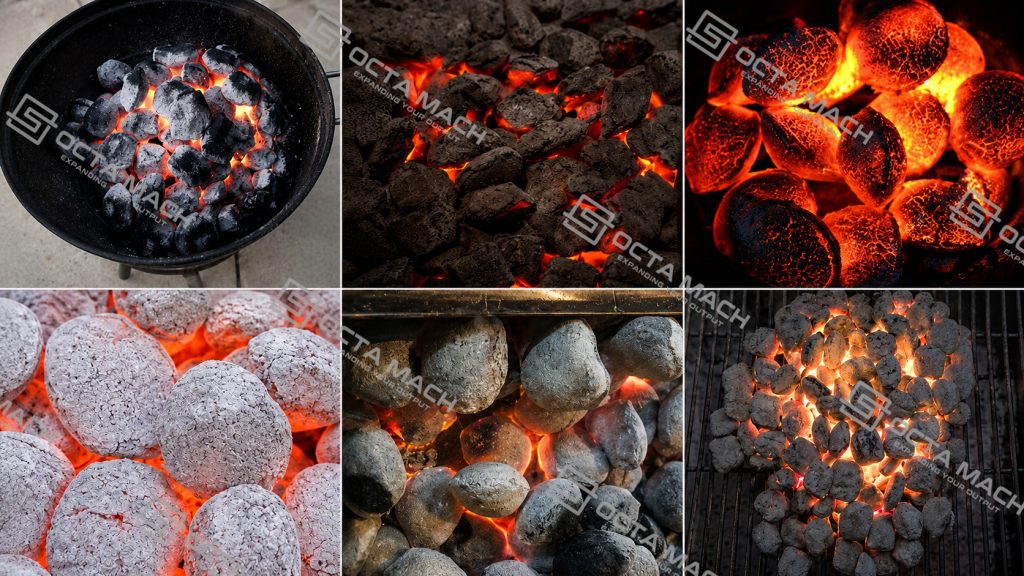
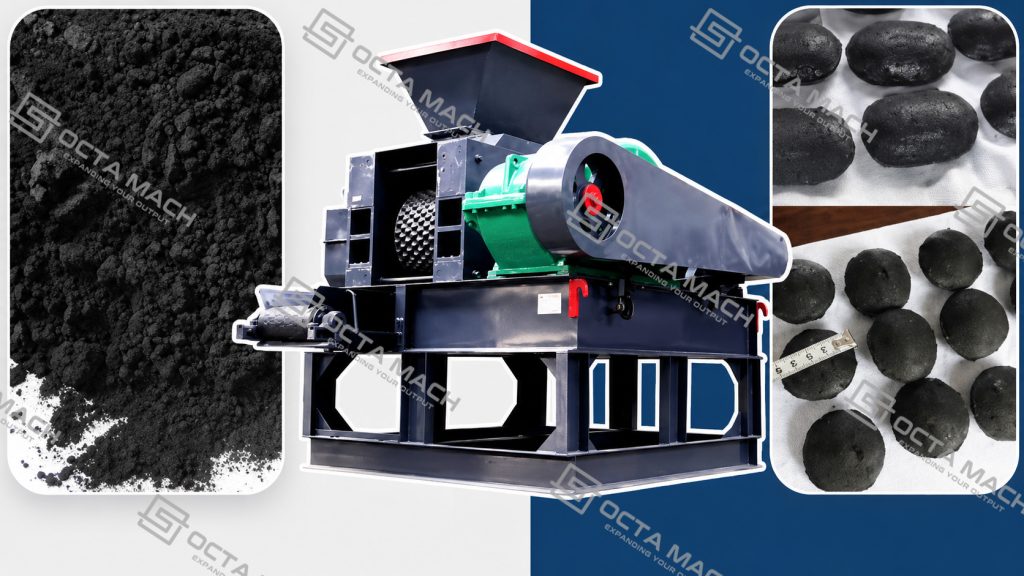
The Octa Mach coal briquette machine converts prepared coal fines, coal dust, coking-coal fines and coke powder into individual briquettes with controlled shape and density. Material is fed continuously between two synchronized, counter-rotating forming rollers. Matching pockets on the roller surfaces compact and shape the feed before releasing the finished briquettes onto the downstream conveyor.
A coal briquette machine is not a completely separate mechanical category from a Briquette Press Ball Machine. Briquette Press Ball Machine is the general equipment name, while Coal Briquette Machine describes the same double-roller pressing technology configured specifically for carbonaceous feed materials. The coal application requires greater attention to particle-size distribution, moisture stability, binder compatibility, dust control, briquette curing and the intended fuel or metallurgical use.
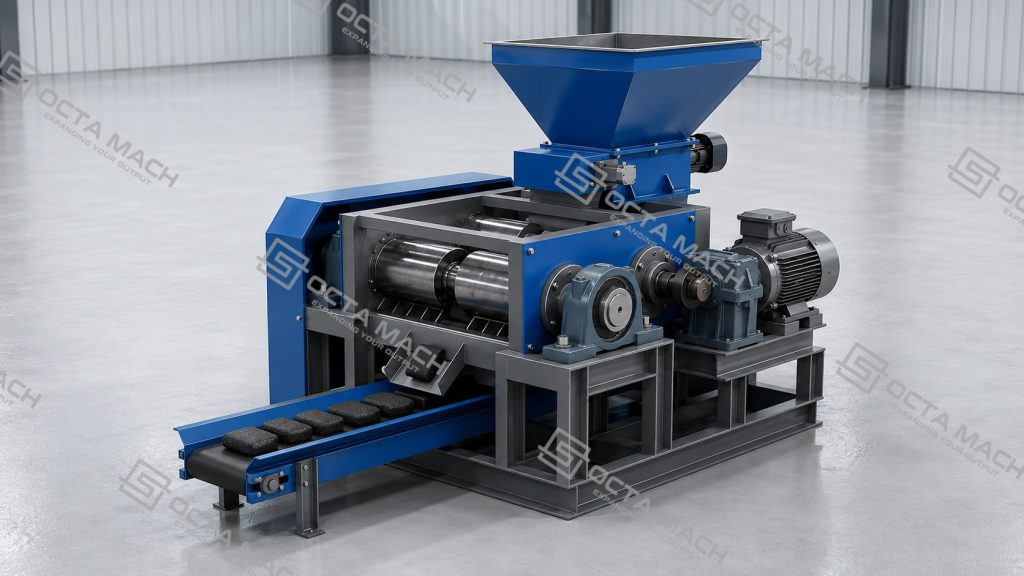
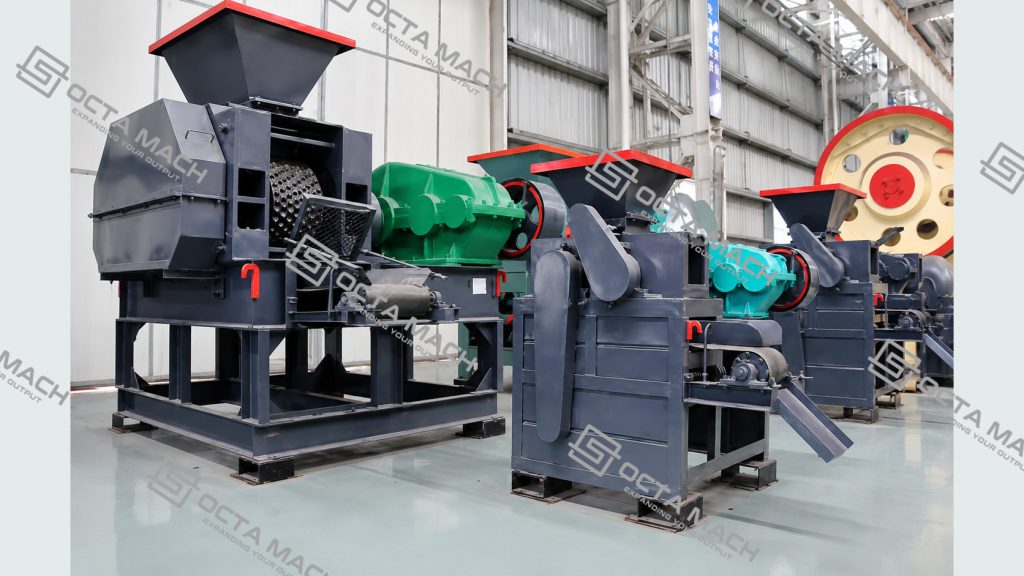
This equipment must also be distinguished from a coal rod extrusion machine. A double-roller coal briquette press machine produces separate pillow, oval, round or project-specific briquettes. A screw extruder pushes conditioned powder through a die to form continuous coal rods. The forming principle, machine structure, wear parts and finished-product geometry are different.
Coal Briquette Machine and Briquette Press Ball Machine
| Comparison | Briquette Press Ball Machine | Coal Briquette Machine |
| Product positioning | General double-roller briquetting equipment | Coal-specific application of the double-roller press |
| Typical feed | Coal fines, mineral fines, metallurgical residues and prepared powder blends | Coal fines, coal dust, coking-coal fines and coke fines |
| Forming mechanism | Counter-rotating rollers with matched pockets | The same roller-pocket pressing mechanism |
| Main application focus | Broad industrial powder agglomeration | Fuel briquettes, furnace feed, coal-fines recovery and carbonaceous material handling |
| Project-specific controls | Feed condition, pocket geometry and downstream requirements | Coal formulation, moisture, binder, dust control, drying or curing and combustion requirements |
| Finished product | Individual briquettes | Individual coal or coke briquettes |
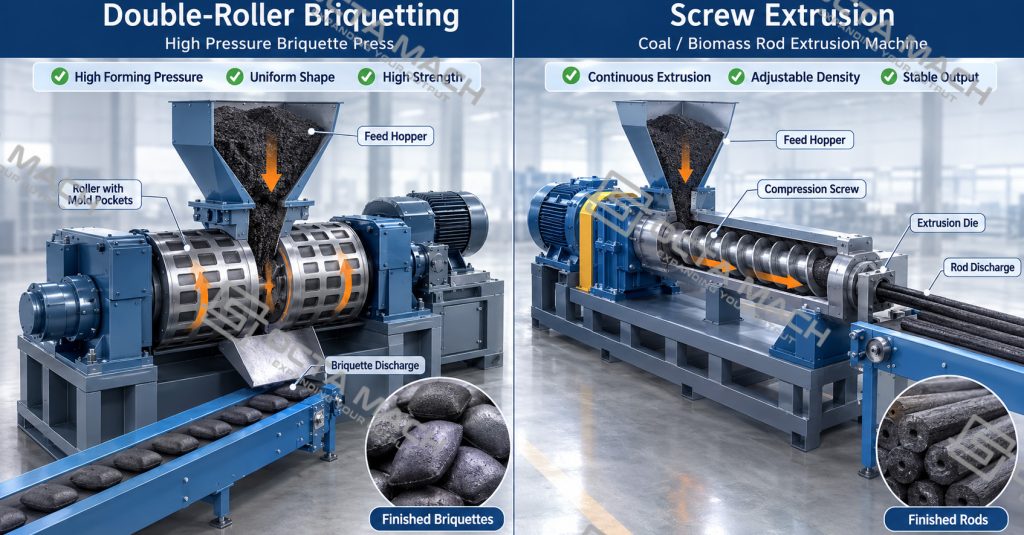
The main press may use the same YHQ/YHY platform, but the complete coal briquetting solution can require different feeders, mixers, roller-pocket profiles, drying equipment and product-testing procedures.
Main Operating Range
The YHQ/YHY series covers small production units through larger industrial coal briquette production lines.
| Item | Catalogue Range |
| Model range | YHQ290–YHY1000 |
| Catalogue capacity | 2–45 t/h |
| Roller size | Φ290 × 220 to Φ1000 × 530 mm |
| Roller speed | 10–25 r/min, depending on model |
| Main motor power | 5.5–132 kW |
| Main equipment type | Double-roller coal briquette press |
Actual output depends on coal bulk density, particle-size distribution, moisture stability, binder system, roller-pocket volume, feeding continuity, return-fines ratio and finished-briquette requirements.
Coal Briquette Machine Technical Parameters
| Model | Reducer | Ratio | Roller Size | Roller Speed | Motor Power | Catalogue Capacity | Dimensions |
| YHQ290 | ZQ350 | 1:23.24 | Φ290 × 220 mm | 20–25 r/min | 5.5 kW | 2–3 t/h | 1.20 × 1.00 × 1.40 m |
| YHQ360 | ZQ350 | 1:31.5 | Φ360 × 250 mm | 15–17 r/min | 7.5 kW | 3–5 t/h | 2.26 × 1.53 × 1.98 m |
| YHQ400 | ZQ400 | 1:31.5 | Φ400 × 250 mm | 15–17 r/min | 11 kW | 4–7 t/h | 2.30 × 1.38 × 1.96 m |
| YHQ500 | ZQ500 | 1:31.5 | Φ500 × 300 mm | 15–17 r/min | 22 kW | 8–10 t/h | 2.61 × 1.75 × 2.35 m |
| YHQ650 | ZQ650 | 1:31.5 | Φ650 × 300 mm | 12–16 r/min | 30 kW | 12–20 t/h | 3.42 × 2.00 × 2.40 m |
| YHY750 | ZQ750 | 1:31.5 | Φ750 × 380 mm | 12–15 r/min | 45–55 kW | 25–30 t/h | 3.70 × 2.55 × 2.60 m |
| YHY850 | ZQ850 | 1:31.5 | Φ850 × 380 mm | 10–15 r/min | 55–75 kW | 35–40 t/h | 3.90 × 2.60 × 2.70 m |
| YHY1000 | ZQ1000 | 1:31.5 | Φ1000 × 530 mm | 10–13 r/min | 110–132 kW | 40–45 t/h | 4.00 × 2.80 × 2.80 m |
The final motor, reducer, roller-pocket profile, feeder configuration and installation dimensions should be confirmed in the project-specific technical agreement.
How the Double-Roller Coal Briquette Press Works
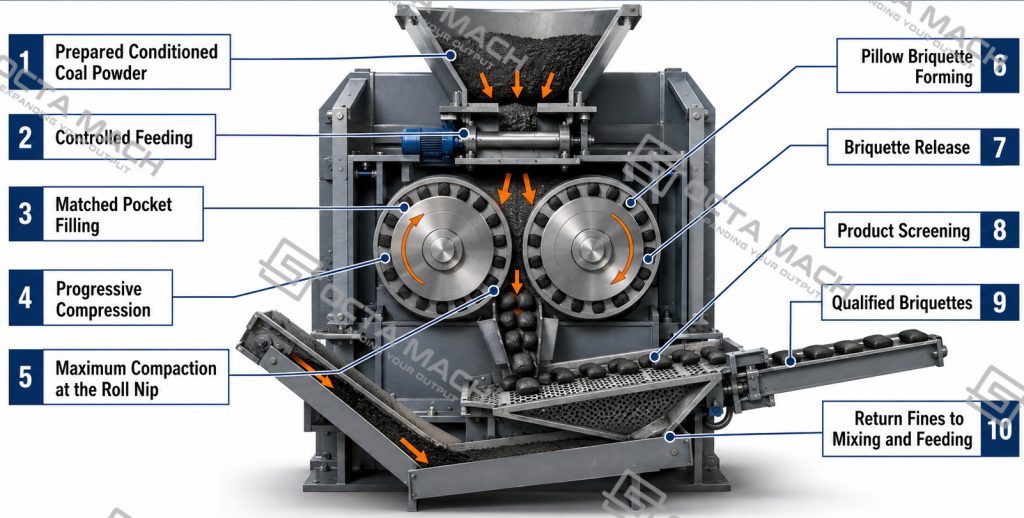
Prepared coal powder enters the feed hopper after screening, proportioning and contamination removal. A controlled feeding device distributes the material across the usable roller width and maintains stable pocket filling.
The two forming rollers rotate toward each other at synchronized speed. As matched pockets approach the roll nip, the available volume decreases and compression rises progressively. The highest compaction occurs near the minimum roller gap, where the conditioned coal particles form a briquette with the required outline and green strength.
After passing the roll centerline, the pockets separate and release the briquettes. A downstream screen separates acceptable product from loose fines and damaged pieces. Return fines can be sent back to the mixing and feeding section instead of entering the finished-product stream.
Roll-press briquetting is used to densify coal fines into manageable shapes, but successful operation depends on homogeneous feed preparation rather than pressure alone.
Main Machine Structure
| Assembly | Function |
| Feed Hopper | Provides temporary storage and stable delivery to the feeding system |
| Metering Feeder | Controls feed rate and distributes conditioned material across the roller width |
| Double Forming Rollers | Apply progressive compression and form individual briquettes |
| Roller Pockets | Determine briquette shape, dimensions, filling behaviour and release |
| Main Motor | Supplies power to the roller-press drive |
| Speed Reducer | Reduces motor speed and increases output torque |
| Coupling and Gear Transmission | Transfer torque and maintain synchronized roller rotation |
| Bearing Housings | Support the forming rollers and maintain shaft alignment |
| Heavy-Duty Frame | Carries pressing loads and keeps the main assemblies aligned |
| Discharge Chute or Conveyor | Transfers newly formed briquettes with controlled drop height |
| Downstream Screen | Separates qualified briquettes from return fines |
Their geometry must match the coal formulation, target briquette size, required release behaviour and downstream handling method.
Suitable Coal Materials and Feed Boundaries
Primary Feed Materials
- Screened coal fines
- Coal dust and pulverized coal
- Coking-coal fines
- Coke powder and coke fines
- Uniform coal-based formulations prepared for roller pressing
Representative Feed Testing Required
Lignite fines, anthracite fines, dewatered coal slime, coal gangue powder and mixed carbonaceous residues may require different preparation and binder systems. Their suitability cannot be determined from the material name alone.
Not Suitable for Direct Feeding:
Run-of-mine coal lumps, oversize coke pieces, unstable wet sludge, tramp metal and unscreened foreign contamination should not enter the forming rollers directly. Oversize material can interrupt pocket filling or damage the roller surface, while unstable moisture can cause sticking, deformation or weak briquettes.
Professional coal briquetting lines commonly condition coal fines through size control, drying when necessary and uniform binder mixing before the material reaches the roller press.
Binder and Moisture Control
Coal fines do not all respond to pressure in the same way. Some materials can develop sufficient inter-particle bonding without a binder, while others require a binder-assisted formulation to achieve the required handling and downstream strength. Binder-free operation should therefore be confirmed through representative coal testing rather than assumed from the material name alone.
| Control Point | Effect on Briquetting |
|---|---|
| Binder Compatibility | The binder must provide sufficient strength without introducing unacceptable ash, sulfur, phosphorus or other substances into the final fuel or furnace feed. |
| Binder Dosage | Insufficient binder can cause weak or cracked briquettes, while excessive addition may increase cost, ash content and drying demand. |
| Mixing Uniformity | Uniform distribution of binder and moisture helps maintain consistent pocket filling, briquette density and strength. |
| Moisture Control | Feed that is too dry may not bond adequately. Excess moisture can cause sticking, deformation, unstable feeding and a higher drying load. |
| Drying or Curing | Some formulations require controlled post-treatment to develop sufficient final strength after pressing. |
| Downstream Performance | The selected binder must remain compatible with combustion, coking, gasification or metallurgical process requirements. |
The suitable binder type, dosage and feed-moisture range should be established using representative coal samples. Trial results from another coal source should not be transferred directly because particle-size distribution, coal composition, natural bonding behaviour and final product requirements may differ.
Factors That Control Coal Briquette Quality
Particle-size distribution: Oversize particles can prevent complete pocket filling and create internal weak points. Excessively fine or poorly graded feed may also change binder demand and compaction behaviour.
Moisture stability: Fluctuating moisture causes inconsistent feeding, roller sticking, surface cracking or product deformation.
Uniform dosing and mixing: Stable feeding keeps both rollers evenly loaded and reduces briquette-density variation across the roller width.
Roller-pocket condition: Worn or contaminated pockets change the product dimensions, edge definition and release behaviour.
Pressing and release: Briquettes require sufficient compaction without excessive sticking, lamination or breakage during demoulding.
Downstream handling: Fresh briquettes may have limited green strength. Low-drop conveyors, suitable screening and controlled drying or curing help reduce fines generation.
Product evaluation should cover shape consistency, dimensions, green or cured strength, density, abrasion resistance, breakage and usable product yield. The acceptance method should be agreed according to the final application.
Available Coal Briquette Shapes
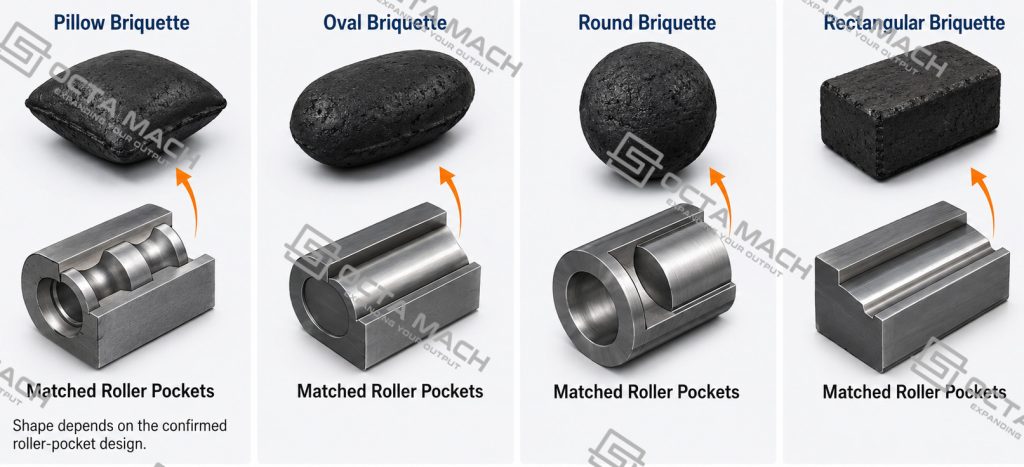
The forming rollers can be manufactured with different pocket profiles to produce:
- Pillow-shaped briquettes
- Oval briquettes
- Round briquettes
- Rectangular briquettes
- Cylindrical or project-specific briquettes
Shape selection should consider combustion behaviour, furnace charging, conveyor transfer, packaging, pocket release and resistance to breakage. One roller-pocket design should not be assumed suitable for every coal formulation.
Complete Coal Briquette Production Line
A typical line can be arranged as:
Raw Material Storage → Crushing or Screening → Proportioning → Binder and Water Addition When Required → Uniform Mixing → Double-Roller Briquetting → Screening → Drying or Curing When Required → Finished Briquettes
The production-line diagram in the supplied catalogue includes a storage tank, crusher, ingredient dispenser, biaxial mixer, briquetting machine and either a vertical dryer or mesh-belt dryer before final product discharge. The actual line should be simplified or expanded according to the incoming material condition.
Return fines from screening can be recycled to the preparation section after their condition is checked. The recycle ratio should remain controlled because uncontrolled fines circulation can change feed density, moisture and binder demand.
How to Select a Coal Briquette Machine
Model selection should start with the coal and product requirements rather than motor power alone.
| Selection Input | Information Required |
| Raw material | Coal type, coke fines, coal dust or blended feed |
| Feed condition | Particle-size distribution, bulk density, moisture and contamination |
| Binder route | Binder-free test result or proposed binder system |
| Required capacity | Stable hourly feed rate and expected operating hours |
| Briquette design | Shape, dimensions, density and required handling strength |
| Downstream use | Boiler fuel, furnace feed, gasification, coke-making or other project duty |
| Post-treatment | Screening, drying, curing, cooling or packing requirements |
| Site conditions | Voltage, frequency, installation space, dust control and maintenance access |
Coal briquettes can serve different industrial or fuel applications, but the correct machine and process route must match the complete coal formulation and downstream duty.
Inspection, Testing and Pre-Shipment Verification
Pre-shipment inspection should verify that the coal briquette machine conforms to the approved technical specification, assembly drawings and agreed inspection and test plan. The inspection scope should cover dimensional conformity, mechanical assembly, functional readiness, safety protection and delivery documentation rather than relying only on a short no-load run.
| Inspection Area | Verification Scope | Typical Record or Acceptance Basis |
| Forming Rollers and Pockets | Roller diameter and width, pocket profile, pocket distribution, surface condition, roller gap and visible machining defects | Approved drawing, dimensional inspection report and project-specific pocket specification |
| Roller Alignment | Roller parallelism, shaft positioning, center distance and uniform gap across the effective roller width | Assembly drawing and dimensional inspection record |
| Synchronized Rotation | Opposite roller-rotation direction, speed coordination, gear engagement and abnormal impact during rotation | No-load test record and visual operating check |
| Drive System | Motor, reducer, coupling, open gears, transmission shafts, guards and lubrication points | Component nameplates, assembly checklist and no-load test report |
| Bearings and Main Frame | Bearing-seat installation, fastener condition, frame alignment, weld appearance and structural connection points | Assembly inspection record and visual welding inspection |
| Feeding System | Hopper condition, feeder installation, feed-rate adjustment and material distribution across the roller width | Functional test and interface inspection |
| Discharge and Screening Interfaces | Discharge clearance, chute or conveyor connection, product drop height and downstream screen interface | Layout drawing and interface checklist |
| Hydraulic or Pressure-Control System | Cylinder, accumulator, piping, valves, seals and pressure-control components, when specified | Hydraulic schematic, leak check and project-specific functional test |
| Electrical System | Motor nameplate, voltage and frequency, control cabinet, emergency stop, cable terminals, grounding and interlocks | Electrical drawing and electrical inspection checklist |
| Safety Protection | Coupling guards, gear guards, rotating-part protection, warning labels and accessible maintenance points | Safety inspection checklist |
| Preservation and Packing | Rust prevention, exposed-surface protection, loose-part securing, moisture protection and packing identification | Packing specification, photographs and packing list |
Testing and Documentation
Before shipment, the assembled machine should undergo a no-load test to verify correct roller rotation, synchronized transmission, stable feeder and discharge operation, and the absence of abnormal noise, vibration, leakage or mechanical interference. When specified, a loaded test should use an agreed representative coal sample and documented feed conditions to evaluate material feeding, pocket filling, briquette release, product dimensions, visible defects, fines generation and measured output. Test results apply only to the recorded material and operating settings and do not constitute a universal capacity or strength guarantee. Relevant dimensional, assembly and test records should be linked to the equipment marking, component nameplates, spare-parts list and packing documents for delivery traceability.
Our Advantages
Octa Mach supplies YHQ/YHY series coal briquette press configurations for prepared coal fines, coal dust and coke fines. Equipment selection is based on actual feed properties, required output, briquette geometry and downstream process conditions rather than simply matching a catalogue capacity.
The machine can be coordinated with feeding, dosing, mixing, conveying, screening and drying equipment to form a project-specific coal briquette production line. Before shipment, the main drive, reducer, forming rollers, bearings and feeding interfaces can be checked according to the agreed inspection scope.
FAQ
Q: Is a Coal Briquette Machine different from a Briquette Press Ball Machine?
A: The Coal Briquette Machine is the coal-specific application of a general Briquette Press Ball Machine. Both use counter-rotating forming rollers, but the coal page focuses on coal preparation, binder, moisture, roller-pocket design and drying or curing.
Q: Can coal fines be briquetted without a binder?
A: Only when representative testing confirms sufficient bonding and handling strength. Many coal formulations require a compatible binder and controlled moisture.
Q: Is catalogue capacity the guaranteed production output?
A: No. Actual capacity depends on coal density, particle-size distribution, moisture, binder, pocket size, feeding stability, return fines and briquette-quality requirements.
Q: How is the correct coal briquette machine model selected?
A: Selection should combine required capacity with coal properties, feed preparation, binder route, briquette dimensions, downstream use, operating hours and supporting production-line equipment.