
Crusher parts are replacement components used to form and protect the crushing chambers of jaw and cone crushers. Common crusher wear parts include fixed and swing jaw plates, cheek plates, mantles, bowl liners, and feed plates. These components withstand repeated compression, rock impact, and abrasive wear during crushing. Their material properties and structural design affect crushing performance, wear resistance, and service life.
Jaw plates, mantles, and bowl liners are commonly manufactured from high manganese steel (Mn13, Mn18, and Mn22), which combines impact toughness with work-hardening capability. Octa Mach supplies crushing equipment and supports crusher spare parts requirements for quarrying, mining, and aggregate processing. Replacement components are selected according to their dimensions, material grade, working profile, and mounting arrangement to maintain compatibility with the crushing equipment.
Jaw Crusher Parts
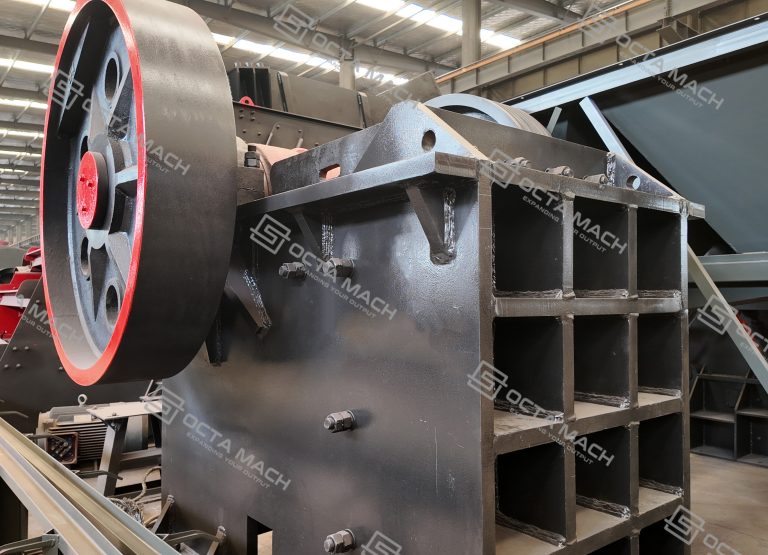
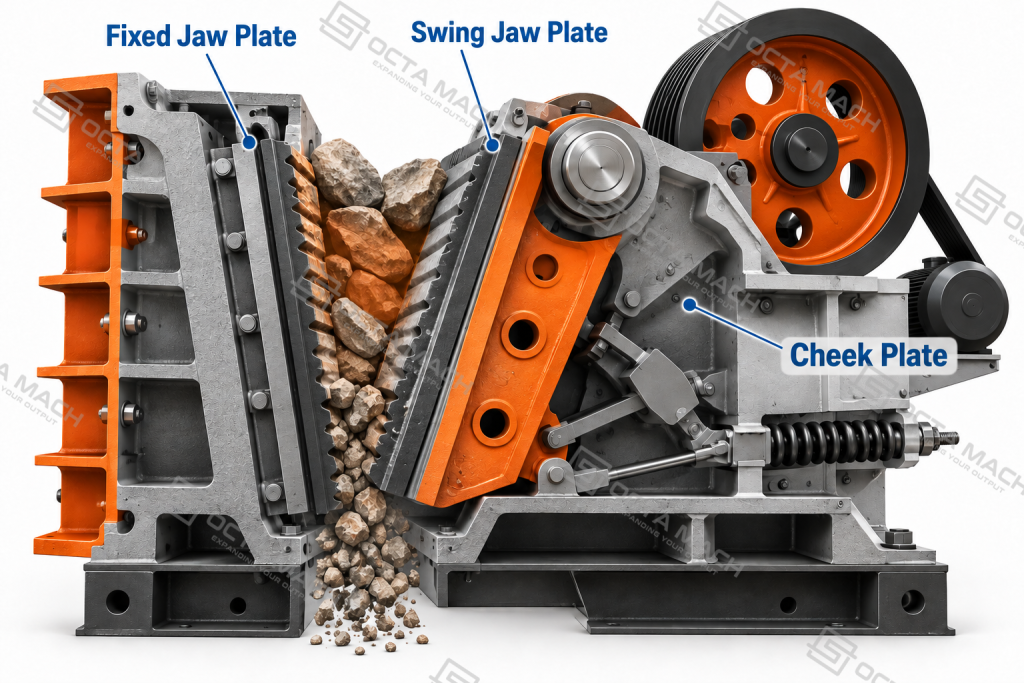
Jaw crusher parts include the crushing liners and protective components installed around the jaw crusher chamber. The fixed jaw plate forms the stationary crushing surface, while the swing jaw plate moves toward it under the eccentric drive to compress and fracture incoming rock. Both plates transfer crushing loads through their mounting surfaces to the supporting jaw structures. Cheek plates protect the chamber sidewalls from abrasive contact and localized impact as material moves toward the discharge opening.
Jaw plate performance depends on the tooth profile, manganese steel grade, liner thickness, and chamber geometry. Tooth spacing and profile affect material gripping and movement through the chamber, while liner wear gradually changes the effective crushing surfaces and discharge conditions. Proper seating and secure retention are equally important, as movement between a liner and its support can cause abnormal wear or damage to the mounting components. These factors determine how replacement parts should be specified for different feed materials and crushing conditions.
Fixed Jaw Plate
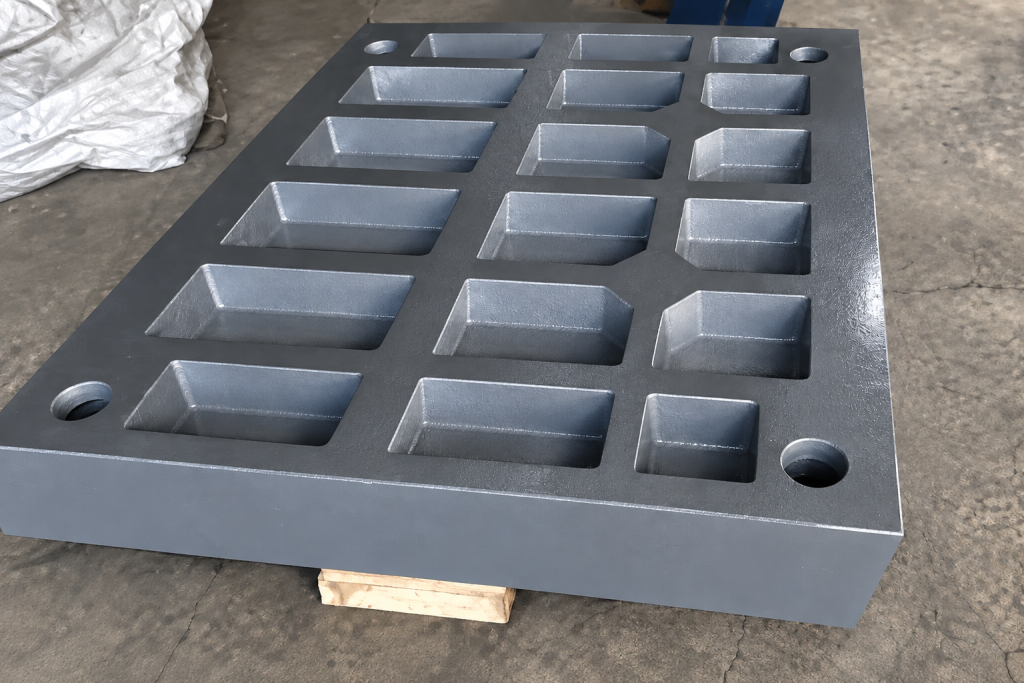
A fixed jaw plate is a stationary wear liner mounted against the fixed jaw support. Its working face normally has longitudinal teeth or corrugations that engage the feed material. The plate is secured by the machine’s designated clamping or retention arrangement and can be replaced without replacing the main supporting structure.
During operation, the swing jaw moves toward the fixed plate and compresses the rock between the two surfaces. Repeated contact creates high local compressive stresses, while particles sliding down the chamber produce additional abrasive wear. The plate must retain an effective tooth profile to grip incoming material and support its movement through the chamber.
Fixed jaw plates are commonly manufactured from high-manganese steel, with Mn13, Mn18, and Mn22 among the commonly used material grades. Their impact toughness and work-hardening capability make them suitable for repeated compressive loading and abrasive contact. The tooth profile helps maintain material grip during crushing, while the replaceable liner protects the underlying jaw support from direct wear.
Fixed Jaw Plate Specifications
| Specification | Reference Specifications |
|---|---|
| Material Grades | Mn13, Mn18, Mn22, Mn18Cr2 |
| Length × Width × Thickness | 1680 × 1040 × 145 mm |
| Unit Weight | 1250 kg |
| Tooth Count | 8 |
| Tooth Profile | Corrugated, Coarse Corrugated |
| Tooth Pitch | According to tooth-profile drawing |
| Construction | One-piece or segmented |
| Mounting | Wedge or model-specific retention system |
Compatible Octa Mach Jaw Crushers
| Crusher Series | Reference Models | Replacement Verification |
|---|---|---|
| PE Jaw Crusher | PE-400×600, PE-500×750 | Casting dimensions, tooth profile, and retaining arrangement |
| PE Jaw Crusher | PE-600×900, PE-750×1060 | Plate seating, working profile, and installation dimensions |
| PE Jaw Crusher | PE-900×1200 | Original plate drawing and fixing configuration |
Swing Jaw Plate
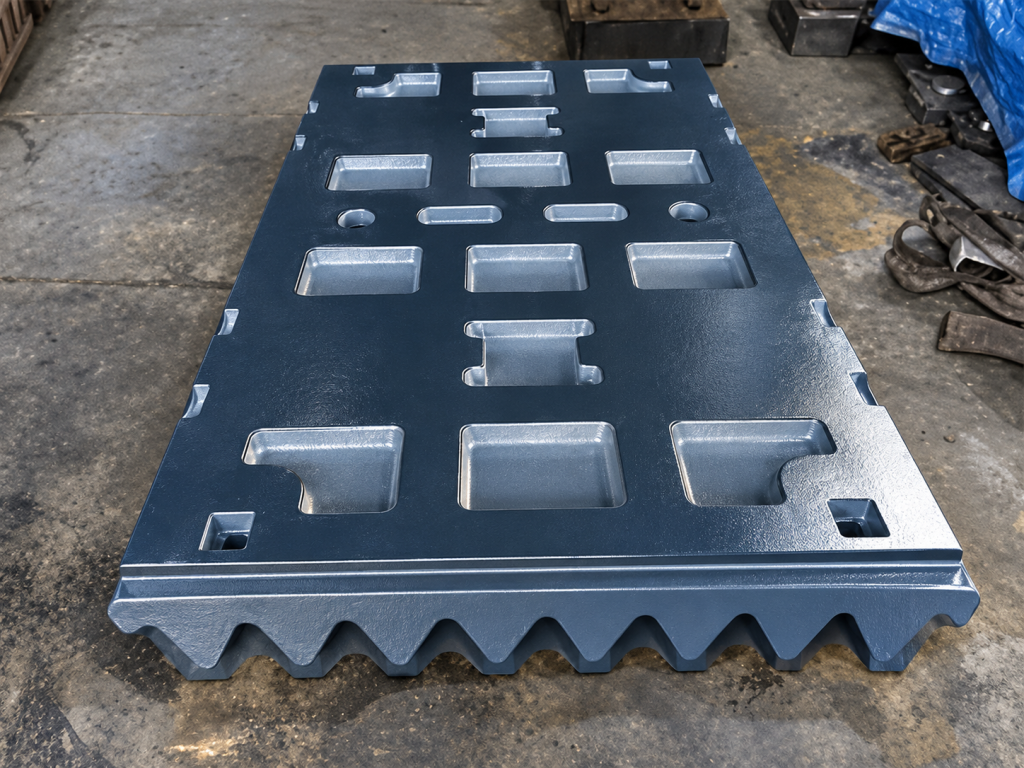
The swing jaw plate, also known as the movable jaw plate, is a replaceable wear component mounted on the moving jaw of a jaw crusher. Its crushing surface is formed with raised teeth or corrugations, while the back of the plate fits against the jaw support and is secured by the crusher’s fastening system.
As the eccentric drive moves the swing jaw through its crushing cycle, the plate approaches the fixed jaw plate and transfers compressive force to the rock. During the return movement, the chamber opens and material moves downward under gravity. The swing plate is repeatedly loaded and unloaded throughout operation, with abrasive sliding concentrated along areas of frequent rock contact.
Swing jaw plates are commonly manufactured from high-manganese steel, including Mn13, Mn18, and Mn22 grades, to withstand repeated crushing loads and abrasive wear. Unlike the stationary fixed jaw plate, the swing jaw plate moves with the jaw assembly and experiences cyclic loading as the crushing chamber opens and closes. This repeated movement and changing contact with rock can produce different wear patterns on its working surface, making tooth profile and liner thickness important considerations for maintaining crushing performance.
Swing Jaw Plate Specifications
| Specification | Reference Specifications |
|---|---|
| Material Grades | Mn13, Mn18, Mn22 |
| Length × Width × Thickness | 1890 × 1040 × 145 mm |
| Unit Weight | 1420 kg |
| Tooth Count | 7 |
| Tooth Profile | Corrugated, Coarse Corrugated |
| Tooth Pitch | According to tooth-profile drawing |
| Construction | One-piece or segmented |
| Mounting | Model-specific seating and retention system |
Compatible Octa Mach Jaw Crushers
| Crusher Series | Reference Models | Replacement Verification |
|---|---|---|
| PE Jaw Crusher | PE-400×600, PE-500×750 | Movable jaw seating and tooth geometry |
| PE Jaw Crusher | PE-600×900, PE-750×1060 | Plate profile, clamping arrangement, and backing dimensions |
| PE Jaw Crusher | PE-900×1200 | Original jaw-die geometry and fixing components |
Cheek Plate
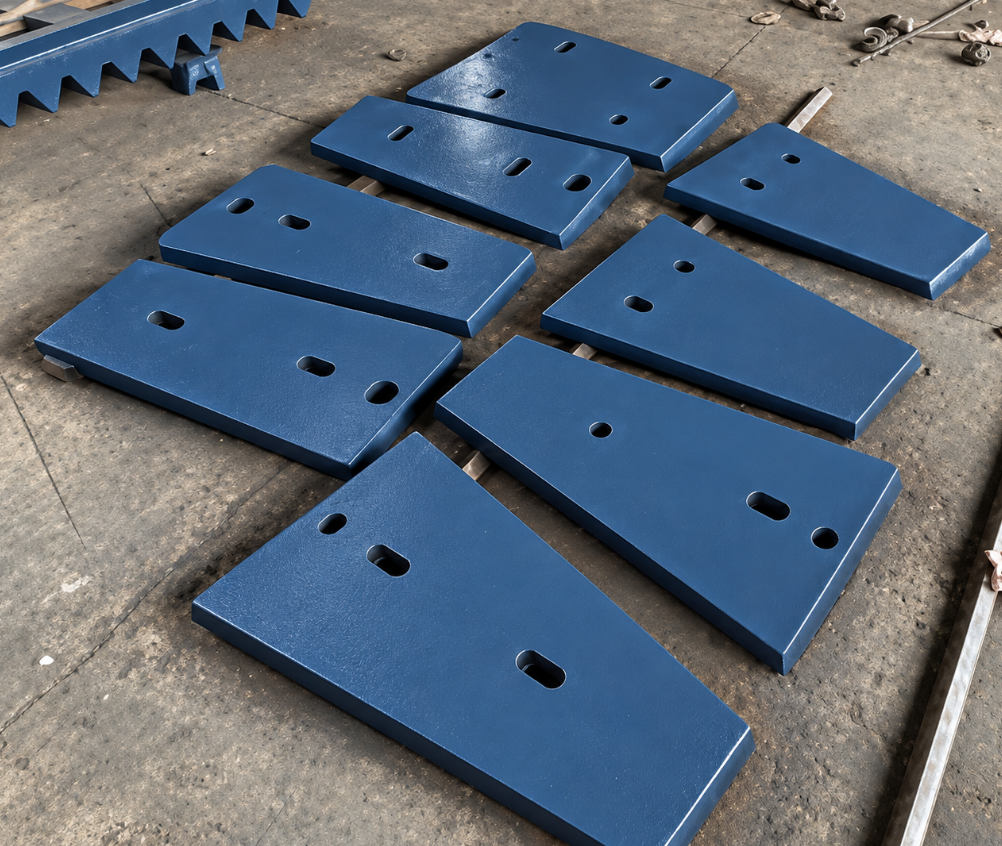
A jaw crusher cheek plate, also known as a side liner, is a replaceable wear component installed on the inner sidewalls of the crushing chamber. It is commonly manufactured from high-manganese steel, with its shape, thickness, and mounting holes designed to match the crusher’s sidewall structure. Cheek plates are available in upper and lower sections to protect different areas of the crushing chamber.
Unlike fixed and swing jaw plates, cheek plates do not form the primary crushing surfaces. They protect the chamber sidewalls against sliding abrasion and localized impact as rock moves downward between the jaw plates. Wear is influenced by material flow, particle size, and contact pressure, with the lower sections exposed to abrasive contact near the discharge opening.
The high-manganese steel construction provides toughness against repeated rock impact, while the plate thickness provides a sacrificial wear layer between the material and the crusher frame. The upper and lower sections can be inspected and replaced individually where the crusher uses a sectional arrangement, helping preserve the sidewall structure without replacing the entire protective lining.
Cheek Plate Specifications
| Specification | Reference Specifications |
|---|---|
| Material Grades | Mn13, Mn18, Mn22 |
| Configuration | Upper Cheek Plate, Lower Cheek Plate |
| Length × Width | According to component dimensions |
| Thickness | According to component design |
| Mounting | Bolt-fixed, model-specific mounting holes |
| Upper Cheek Plate Weight | 230 kg |
| Lower Cheek Plate Weight | 154 kg |
| Working Surface | Flat or contoured |
Compatible Octa Mach Jaw Crushers
| Crusher Series | Reference Models | Replacement Verification |
|---|---|---|
| PE Jaw Crusher | PE-400×600, PE-500×750 | Sidewall geometry and fixing-hole positions |
| PE Jaw Crusher | PE-600×900, PE-750×1060 | Upper/lower configuration and liner thickness |
| PE Jaw Crusher | PE-900×1200 | Side liner drawing and clearance from moving jaw |
Cone Crusher Parts
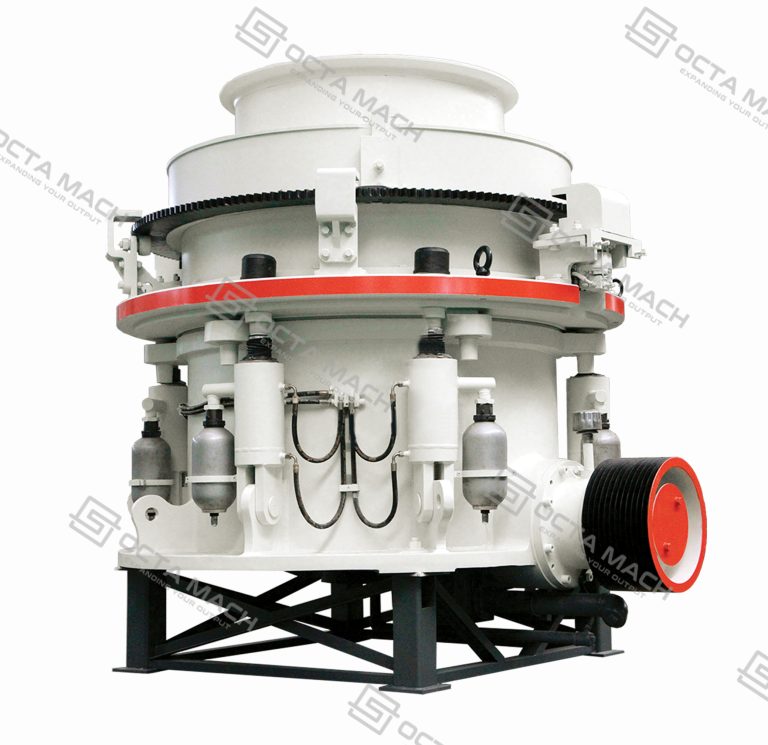
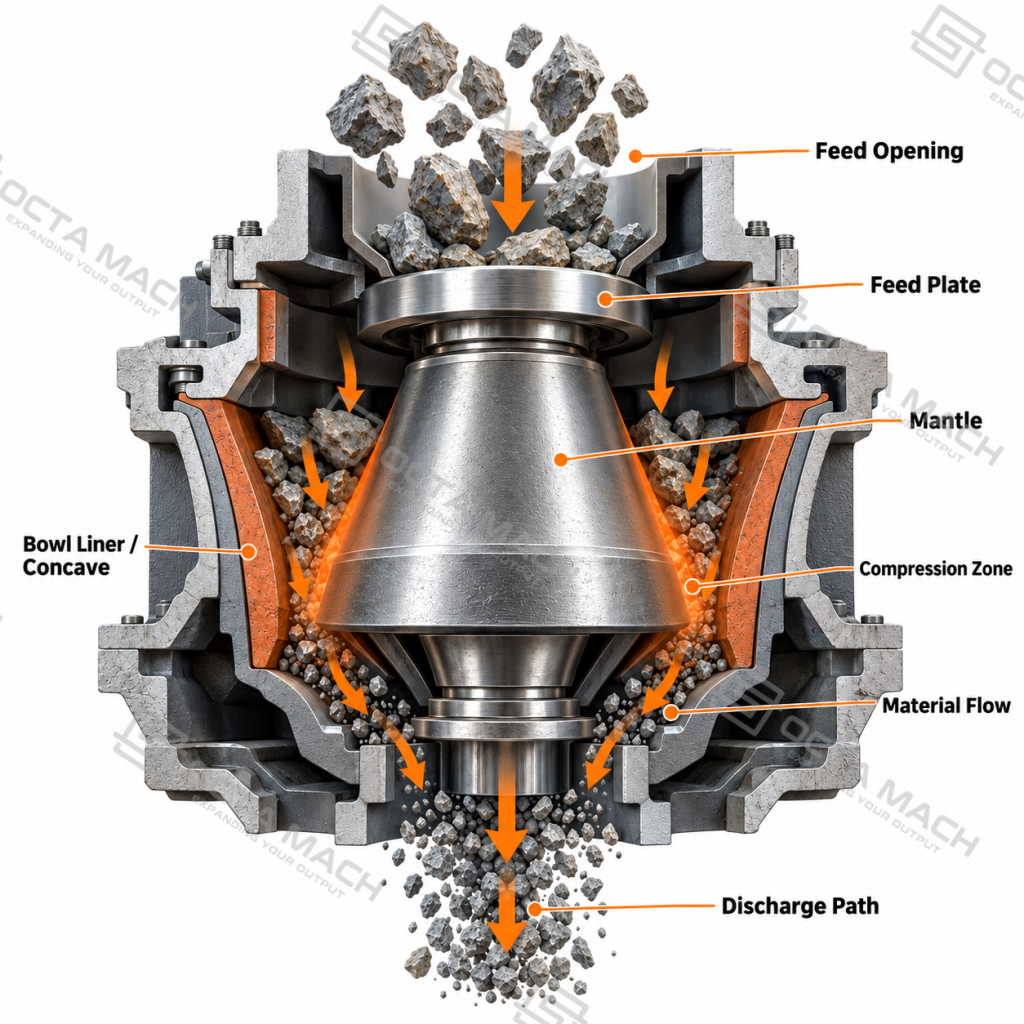
Cone crusher parts include the mantle, bowl liner (concave), and feed plate, which form and protect the working areas of a cone crusher. The mantle and bowl liner are the main crushing surfaces, applying compressive force to rock as the crusher head moves eccentrically. The feed plate protects the upper feed area and helps direct incoming material into the crushing chamber.
Mantles and bowl liners are commonly manufactured from high-manganese steel, with Mn13, Mn18, and Mn22 used for different wear conditions. Their liner profiles determine the crushing chamber shape, while the closed-side setting (CSS) influences the discharge opening and resulting product size distribution. Correctly matched liners help maintain the intended chamber geometry as the crusher operates, and worn components can be replaced without replacing the main supporting assemblies.
Mantle
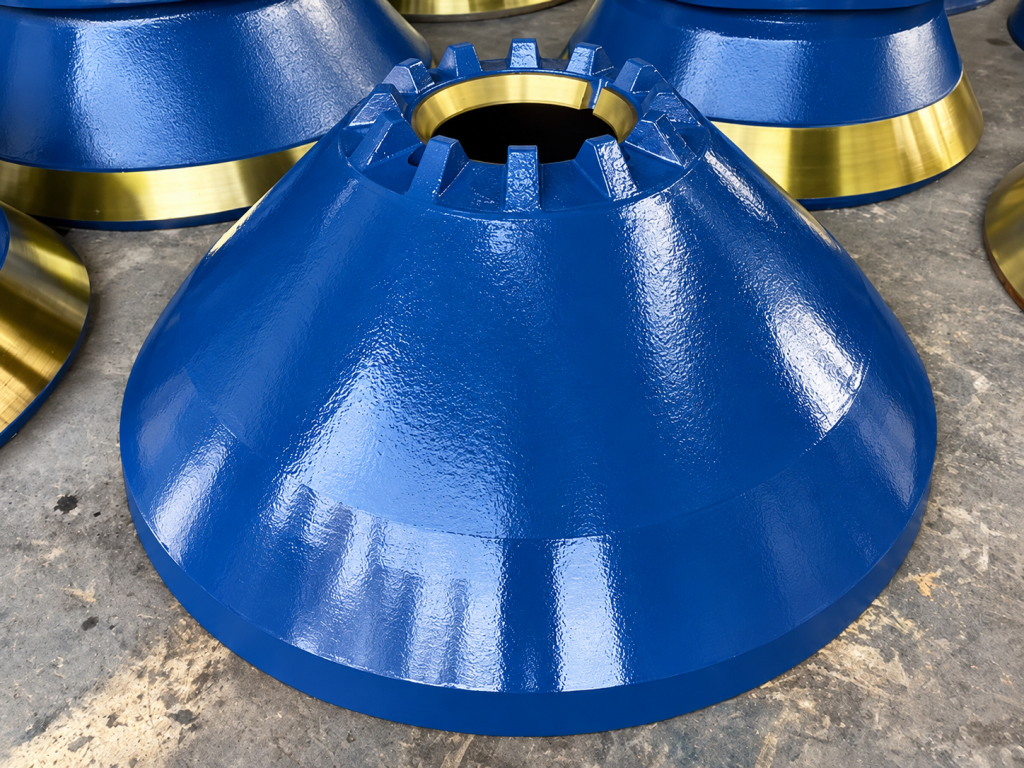
The mantle is mounted on the moving head of a cone crusher, forming the inner crushing surface opposite the stationary bowl liner. It has a conical shape that follows the contour of the crusher head and is secured by the corresponding locking assembly. As the head moves eccentrically, the mantle compresses rock against the bowl liner to reduce the material into smaller particles.
The mantle profile influences the shape of the crushing chamber, the size of material entering the compression zone, and how rock moves toward the discharge opening. Coarse chamber profiles accommodate larger feed particles, while finer profiles are used for smaller feed and tighter discharge settings. During operation, repeated contact with rock gradually wears the mantle surface, changing its profile and the effective clearance between the crushing liners.
Mantles are commonly manufactured from high-manganese steel, including Mn13, Mn18, and Mn22 grades. The material provides toughness under repeated compressive loading and develops increased surface hardness through work hardening under suitable contact conditions. Combined with the appropriate liner profile, these properties support resistance to impact and abrasive wear. The replaceable construction also protects the crusher head from direct rock contact and allows the worn liner to be renewed without replacing the head assembly.
Cone Crusher Mantle Specifications
| Specification | Reference Specifications |
|---|---|
| Material Grades | Mn13, Mn18, Mn22 |
| Material Type | High Manganese Steel |
| Chamber Profile | Extra Coarse, Coarse, Medium, Fine, Extra Fine |
| Construction | One-piece Cast Liner |
| Unit Weight | 804.3 kg |
| Mounting | Crusher Head Seating and Locking Assembly |
Compatible Octa Mach Cone Crushers
| Crusher Series | Reference Models | Replacement Verification |
|---|---|---|
| HP Multi-Cylinder Hydraulic Cone Crusher | HP100, HP200, HP300 | Head seating, mantle profile, and locking arrangement |
| HP Multi-Cylinder Hydraulic Cone Crusher | HP400, HP500, HP800 | Head geometry, cavity configuration, and retention |
| CS/CH Single-Cylinder Hydraulic Cone Crusher | CS420, CS430, CS440, CH430, CH440 | Crusher-head design and mantle configuration |
| CS/CH Single-Cylinder Hydraulic Cone Crusher | CS660, CH660, CH870, CH890 | Machine-specific drawing and chamber profile |
Bowl Liner / Concave
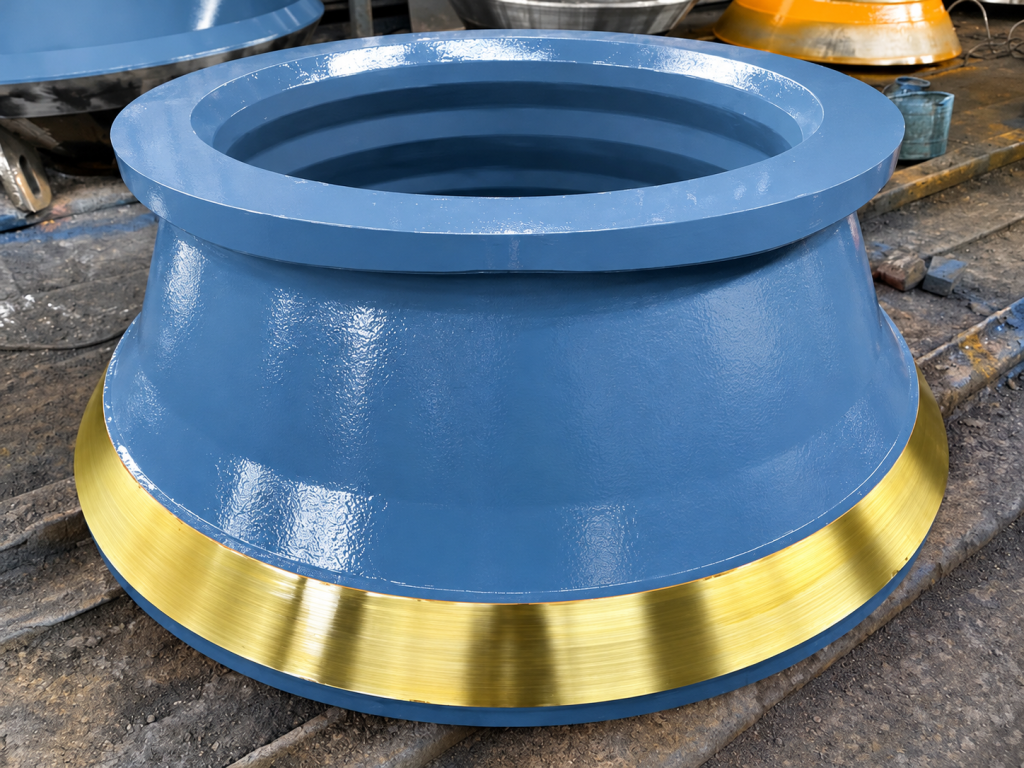
The bowl liner (concave) is installed inside the stationary bowl of a cone crusher, forming the outer crushing surface around the mantle. Its inner surface has a curved profile that defines the crushing chamber, while the outer surface fits against the bowl support. The liner remains stationary during operation and withstands the compressive forces generated as rock is crushed against the moving mantle.
The bowl liner profile influences the feed opening, material movement, and compression space within the crushing chamber. Coarse, medium, and fine liner configurations provide different chamber geometries for specific feed sizes and discharge requirements. As the liner wears, its inner contour gradually changes, affecting the crushing clearance and the distribution of material through the chamber. The bowl liner must therefore be matched with the corresponding mantle profile.
Bowl liners are commonly manufactured from high-manganese steel, including Mn13, Mn18, and Mn22, to withstand repeated rock compression and abrasive contact. Unlike the moving mantle, the bowl liner provides a stationary crushing surface and transfers the reaction forces to the supporting bowl assembly. Its replaceable construction protects the bowl structure from direct wear and allows the crushing surface to be renewed during maintenance.
Bowl Liner / Concave Specifications
| Specification | Reference Specifications |
|---|---|
| Material Grades | Mn13, Mn18, Mn22 |
| Material Type | High Manganese Steel |
| Chamber Profiles | Extra Coarse, Coarse, Medium, Fine, Extra Fine |
| Construction | One-piece Cast Liner |
| Unit Weight | 913.5 kg |
| Mounting | Stationary Bowl Seating and Retention System |
Compatible Octa Mach Cone Crushers
| Crusher Series | Reference Models | Replacement Verification |
|---|---|---|
| HP Multi-Cylinder Hydraulic Cone Crusher | HP100, HP200, HP300 | Bowl seating and selected chamber profile |
| HP Multi-Cylinder Hydraulic Cone Crusher | HP400, HP500, HP800 | Bowl liner dimensions and corresponding mantle |
| CS/CH Single-Cylinder Hydraulic Cone Crusher | CS420, CS430, CS440, CH430, CH440 | Upper support geometry and liner contour |
| CS/CH Single-Cylinder Hydraulic Cone Crusher | CS660, CH660, CH870, CH890 | Bowl arrangement and approved liner drawing |
Feed Plate
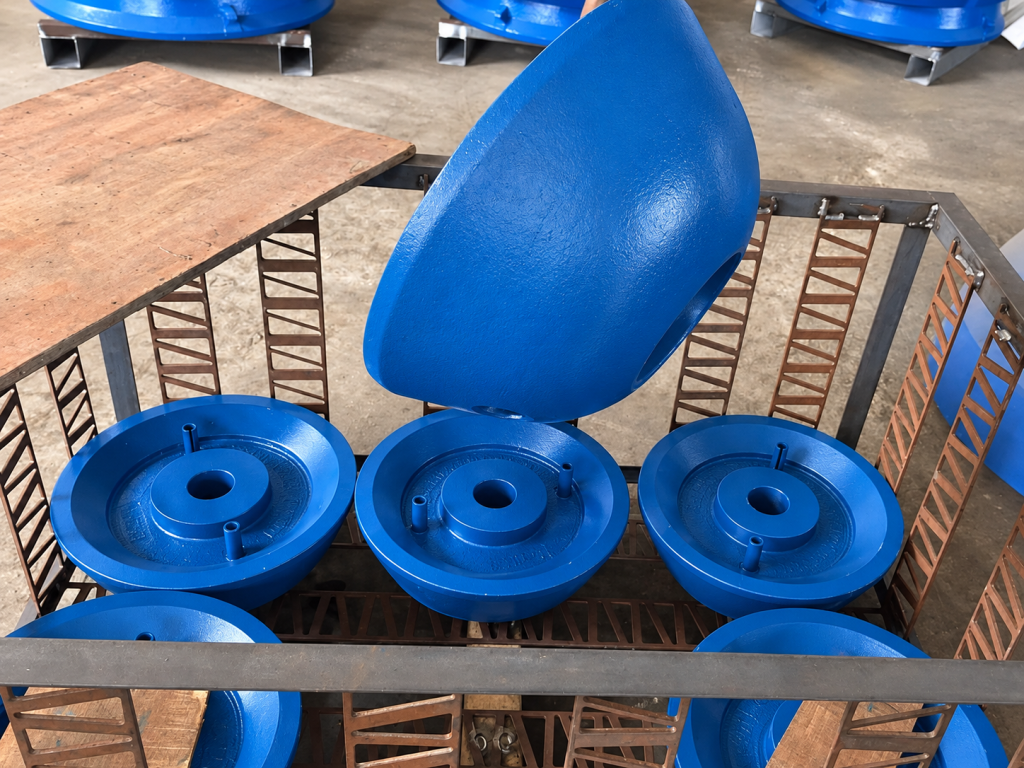
The feed plate is installed in the upper feed area of a cone crusher, above the mantle, to receive incoming rock and guide it into the crushing chamber. Its raised or conical surface helps distribute material around the mantle, while the plate protects the underlying head components from direct impact and abrasive contact.
During operation, the feed plate receives rock discharged from the feeding equipment and distributes it toward the space between the mantle and bowl liner. Its surface is exposed to repeated impact and abrasive contact, particularly when handling large, angular feed particles. Uneven feeding can concentrate material on one side of the plate, resulting in localized wear and potentially affecting material distribution into the crushing chamber.
Feed plates are available in high-manganese steel, with Mn13 and Mn18 alloy grades used in wear-resistant casting applications. Their toughness helps resist repeated rock impact, while the shaped surface supports material distribution into the chamber. As a replaceable component, the feed plate protects the head assembly and can be renewed when excessive wear affects its protective or feeding function.
Cone Crusher Feed Plate Specifications
| Specification | Reference Specifications |
|---|---|
| Material Grades | Mn13, Mn18Cr2 |
| Material Type | High Manganese Steel |
| Overall Height | 168 mm |
| Unit Weight | 84 kg |
| Construction | One-piece Cast Feed Plate |
| Mounting | Head-Mounted, Model-Specific Fixing |
Compatible Octa Mach Cone Crushers
| Crusher Series | Equipment Reference | Replacement Verification |
|---|---|---|
| HP Multi-Cylinder Hydraulic Cone Crusher | Selected HP configurations | Confirm whether a separate feed plate is fitted |
| HP Multi-Cylinder Hydraulic Cone Crusher | HP800 as an equipment-model reference | Feed assembly design, part drawing, and mounting dimensions |
| CS/CH Single-Cylinder Hydraulic Cone Crusher | Applicable configurations only | Confirm feed cone or feed plate construction |
Crusher Parts Materials and Wear Resistance
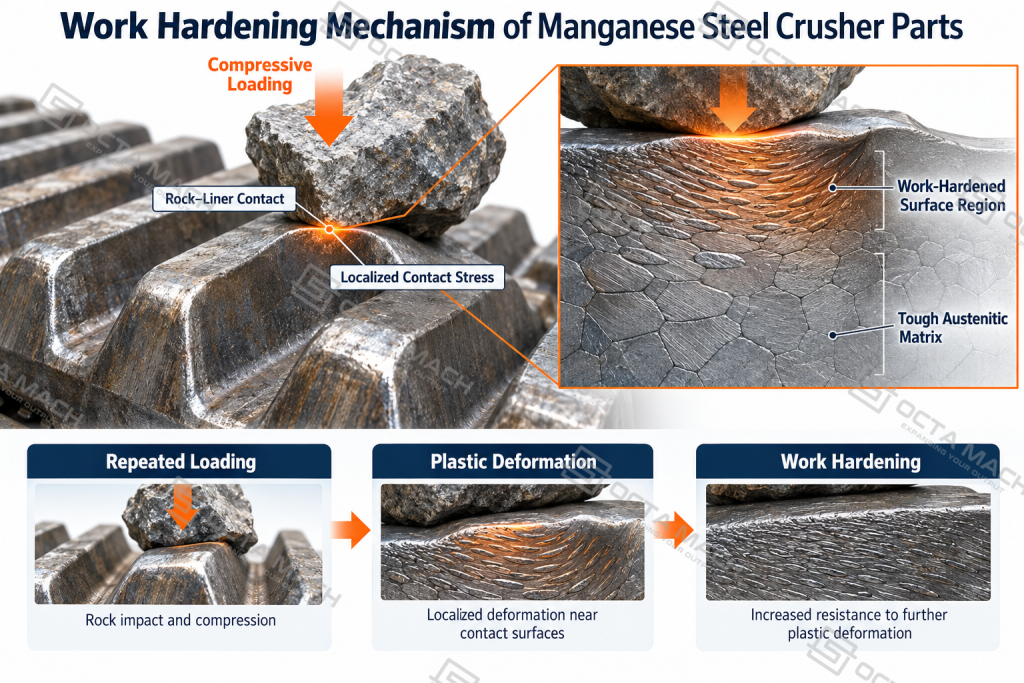
The wear resistance of crusher wear parts depends on steel composition, heat treatment, and the impact and abrasive forces generated during crushing. Jaw plates, mantles, and bowl liners are commonly manufactured from austenitic high-manganese steel, which combines impact toughness with work-hardening capability. Under repeated compressive loading, the working surface undergoes plastic deformation and becomes harder, while the underlying material retains the toughness needed to withstand rock impact.
Common manganese steel grades include Mn13, Mn18, and Mn22, with different manganese contents and alloy compositions. Higher manganese content does not automatically provide better wear resistance, as performance also depends on carbon content, crushing conditions, and heat treatment. Proper solution heat treatment and rapid quenching help obtain the required austenitic structure and limit detrimental carbide precipitation, reducing the risk of brittle cracking during service.
Common Manganese Steel Grades for Crusher Parts
| Material Grade | Approximate Mn Content | Material Characteristics | Typical Selection Considerations |
|---|---|---|---|
| Mn13 | 11–14% | High toughness and work-hardening capability | Repeated impact and compressive loading |
| Mn18 | 17–19% | Austenitic manganese steel used in heavy-duty wear castings | Combined impact and abrasive wear |
| Mn22 | 20–23% | High-manganese alloy family for demanding liner applications | High-wear applications requiring verified alloy and heat-treatment performance |
| Mn18Cr2 | 17–19% Mn, approximately 2% Cr | Chromium-alloyed manganese steel | Applications requiring a specified alloy composition and controlled heat treatment |
When selecting manganese steel for crusher parts, the specified grade should be evaluated together with the carbon content, alloy composition, heat-treatment condition, and actual crushing loads. Chemical composition establishes the material grade, but it does not independently determine wear performance. Castings with similar manganese contents can exhibit different service behavior if their microstructure or heat treatment differs. Material verification should therefore include the specified chemical composition and relevant heat-treatment records, while final grade selection should account for rock abrasiveness, impact intensity, and the wear conditions of the crushing chamber.
Crusher Parts Wear and Replacement
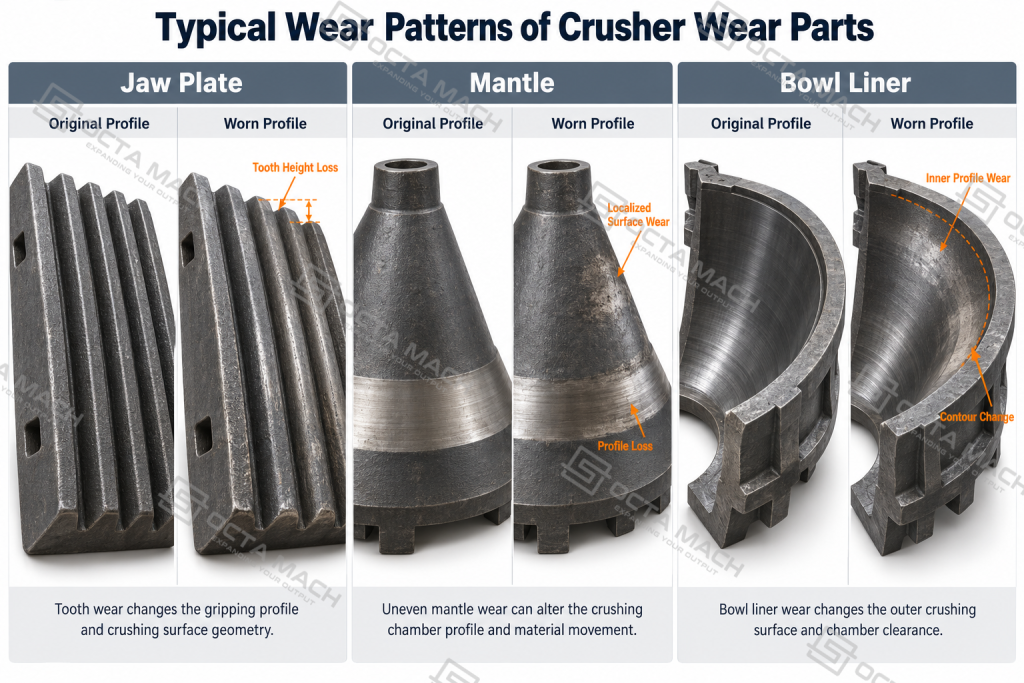
Wear in crusher parts is mainly caused by repeated compressive loading, rock impact, and abrasive contact during material processing. Jaw plates gradually lose tooth height as rock is gripped and crushed, while cone crusher mantles and bowl liners experience progressive surface wear that changes the crushing chamber profile. The wear rate is influenced by rock hardness, mineral composition, feed size, and operating conditions. Rocks containing high proportions of abrasive minerals, particularly quartz, can accelerate liner wear even when their compressive strength is moderate.
Uneven material distribution and incorrect crusher settings can increase localized wear, leaving some areas of a liner heavily worn while others retain substantial thickness. As wear progresses, changes in tooth geometry, liner profile, and crushing clearance can affect material gripping, product size distribution, and crushing efficiency. Regular inspection should therefore consider not only the remaining liner thickness but also the condition of the working surface and its effect on chamber geometry.
Crusher Parts Wear Conditions and Replacement Reference
| Crusher Part | Common Wear Condition | Effect on Crushing Performance | Inspection / Replacement Focus |
|---|---|---|---|
| Fixed Jaw Plate | Tooth flattening and localized surface wear | Reduced material grip and altered crushing chamber profile | Tooth height, wear distribution, remaining thickness |
| Swing Jaw Plate | Tooth wear and uneven abrasion | Changes in material gripping and crushing surface geometry | Tooth profile, liner thickness, seating condition |
| Cheek Plate | Sidewall abrasion and localized thinning | Reduced protection of the crusher frame | Remaining thickness, mounting condition |
| Mantle | Progressive wear along the conical surface | Changes in crushing chamber clearance and material movement | Mantle profile, liner thickness, retention condition |
| Bowl Liner / Concave | Inner surface wear and profile deformation | Changes in crushing clearance and product gradation | Concave profile, remaining thickness, mantle compatibility |
| Feed Plate | Impact wear and localized surface erosion | Reduced feed-area protection and possible changes in material distribution | Surface wear, cracking, fixing condition |
Wear patterns also provide useful information for replacement crusher parts selection. Concentrated tooth wear on jaw plates may require a review of the tooth profile and manganese steel grade, while uneven wear on mantles and bowl liners can indicate a mismatch between the chamber configuration and actual feed conditions. When selecting replacement castings, the original component dimensions, wear distribution, material grade, and crushing requirements should be evaluated together. This helps determine whether the existing liner design remains suitable or whether a different wear profile or material specification should be considered.
Octa Mach Crusher Parts Supply
Octa Mach supplies crusher parts for jaw and cone crushing equipment, including fixed jaw plates, swing jaw plates, cheek plates, mantles, bowl liners, and feed plates. Our product range covers PE jaw crushers, HP multi-cylinder hydraulic cone crushers, and CS/CH single-cylinder hydraulic cone crushers. Replacement parts are selected according to equipment configuration, component dimensions, and mounting requirements to ensure proper fit and compatibility.
As a crusher parts supplier, Octa Mach supports standard replacement and customized wear-part requirements based on original drawings and technical specifications. We focus on casting quality, dimensional accuracy, component compatibility, and coordinated delivery to meet the replacement needs of quarrying, mining, and aggregate processing operations.
FAQ
Q: Can cracked manganese steel crusher parts be repaired by welding?
A: Some manganese steel castings can be repaired using qualified welding procedures, but repairability depends on the crack location, extent of damage, and casting condition. Heat input and interpass temperature must be controlled to avoid damaging the austenitic structure. Severely cracked or structurally compromised liners should be replaced rather than welded.
Q: Can crusher liners with the same weight be interchangeable?
A: No. Similar casting weights do not guarantee compatibility. The seating dimensions, liner profile, mounting features, and retention system must match the crusher’s component design.
Q: What causes premature cracking in crusher wear parts?
A: Premature cracking can result from casting defects, improper heat treatment, excessive impact loading, or poor liner seating. Fracture location, casting records, and operating conditions should be examined before determining the cause.
Q: What should be included in a cone crusher liner replacement package?
A: The package should identify the mantle, matching bowl liner, and required fastening or backing components. Feed plates and locking hardware should also be confirmed against the specific crusher assembly and maintenance requirements.