
A Wet Pan Mill is a compact wet grinding machine used to crush, grind and mix previously crushed mineral material with process water. The machine combines a circular grinding basin, heavy grinding rollers, a grinding base, central transmission shaft, reducer, bearings, motor and steel support frame. During operation, the rollers repeatedly compress, shear and knead the material against the grinding base, producing a slurry that can be discharged by overflow for downstream mineral separation.
Often described as a gold wet pan mill, gold grinding machine or ore grinding machine, this equipment is commonly installed in small and medium mineral-processing plants where wet grinding, simple operation and moderate capacity are required. The current Octa Mach range covers 1000 to 1600 models, with published capacities from 0.5 to 7 t/h and motor powers from 5 to 37 kW.
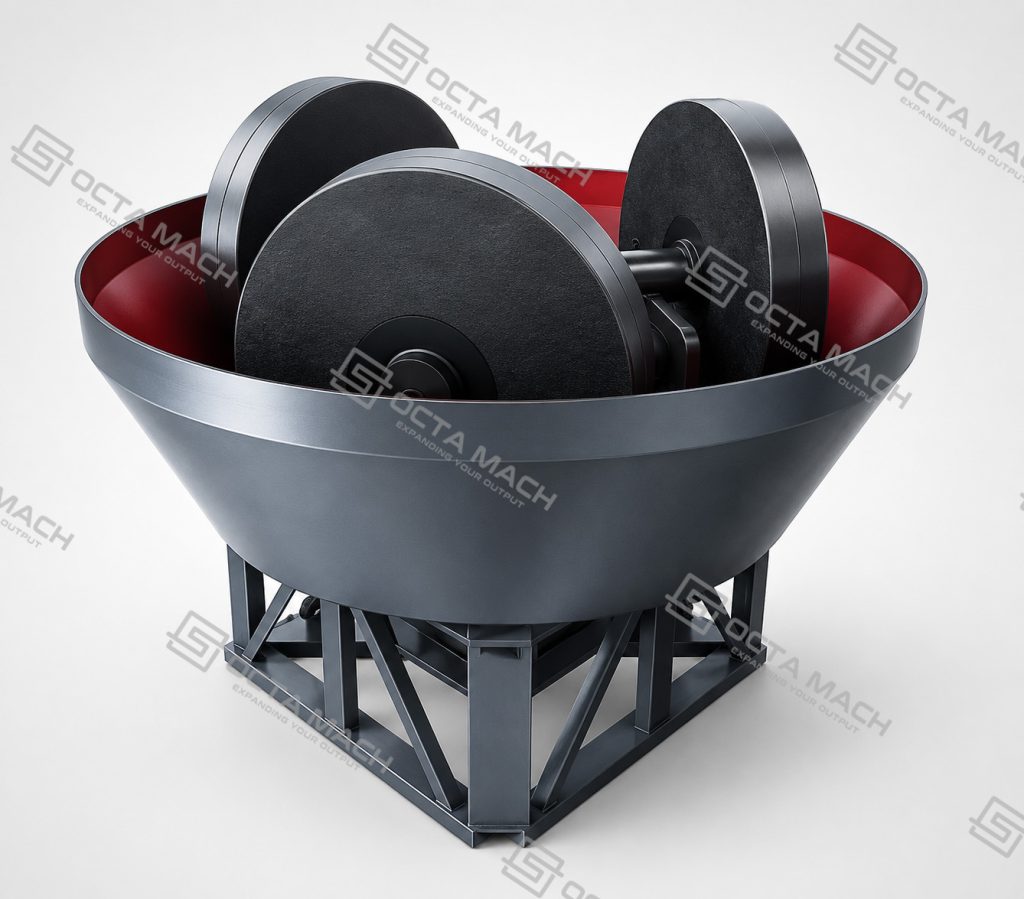
A correctly selected mineral processing wet pan mill may be used before gravity concentration, flotation, magnetic separation or other beneficiation stages. It is particularly suitable where the plant requires a compact wet grinding mill rather than a large continuous grinding circuit.
Wet Pan Mill Operating Range
| Parameter | Published Range |
|---|---|
| Model range | 1000–1600 |
| Wet pan mill capacity | 0.5–7 t/h |
| Wet pan mill feeding size | <20 mm or <30 mm, depending on model |
| Wet pan mill discharge size | 0.6–0.07 mm |
| Wet pan mill motor power | 5–37 kW |
| Roller diameter | 1,000–1,600 mm |
| Roller thickness | 200–400 mm |
| Discharging method | Overflow type |
| Equipment weight | 4–14.5 t |
| Typical duty | Wet grinding and mixing of crushed mineral ore |
Actual output depends on ore hardness, abrasiveness, feed grading, moisture, water addition, operating load, roller condition and the required downstream particle-size distribution.
Wet Pan Mill Technical Parameters
Because several 1500 and 1600 configurations share the same model designation, they are separated below according to roller thickness and installed power.
Operating Parameters
| Model | Configuration | Roller Diameter (mm) | Roller Thickness (mm) | Feeding Size (mm) | Discharge Size (mm) | Capacity (t/h) | Power (kW) |
|---|---|---|---|---|---|---|---|
| 1600 | A | 1,600 | 400 | <30 | 0.6–0.07 | 4–7 | 37 |
| 1600 | B | 1,600 | 350 | <30 | 0.6–0.07 | 3–6 | 30 |
| 1500 | A | 1,500 | 400 | <30 | 0.6–0.07 | 3–5 | 30 |
| 1500 | B | 1,500 | 350 | <30 | 0.6–0.07 | 2–4 | 22 |
| 1500 | C | 1,500 | 300 | <30 | 0.6–0.07 | 2.5 | 18 |
| 1400 | Standard | 1,400 | 250 | <30 | 0.6–0.07 | 2 | 15 |
| 1300 | Standard | 1,300 | 250 | <30 | 0.6–0.07 | 1.5 | 11 |
| 1200 | Standard | 1,200 | 200 | <20 | 0.6–0.07 | 1 | 7.5 |
| 1100 | Standard | 1,100 | 200 | <20 | 0.6–0.07 | 0.8 | 5 |
| 1000 | Standard | 1,000 | 200 | <20 | 0.6–0.07 | 0.5 | 5 |
Dimensions and Weight
| Model | Configuration | Grinding Base Diameter × Width (mm) | Overall Dimensions (mm) | Discharging Method | Weight (t) |
|---|---|---|---|---|---|
| 1600 | A | 2,100 × 500 | 2,800 × 2,800 × 2,100 | Overflow type | 14.5 |
| 1600 | B | 2,100 × 500 | 2,800 × 2,800 × 2,100 | Overflow type | 14 |
| 1500 | A | 2,050 × 450 | 2,800 × 2,800 × 2,100 | Overflow type | 13.5 |
| 1500 | B | 2,050 × 450 | 2,800 × 2,800 × 2,100 | Overflow type | 12.5 |
| 1500 | C | 2,050 × 450 | 2,800 × 2,800 × 2,100 | Overflow type | 11.5 |
| 1400 | Standard | Not stated | 2,700 × 2,700 × 2,700 | Overflow type | 8.5 |
| 1300 | Standard | Not stated | 2,700 × 2,700 × 2,700 | Overflow type | 7.5 |
| 1200 | Standard | Not stated | 2,400 × 2,400 × 1,600 | Overflow type | 4.5 |
| 1100 | Standard | Not stated | 2,400 × 2,400 × 1,600 | Overflow type | 4.2 |
| 1000 | Standard | Not stated | 2,400 × 2,400 × 1,600 | Overflow type | 4 |
These wet pan mill specifications support preliminary model comparison. Final confirmation should also include ore test data, site voltage, foundation conditions, required slurry handling and the downstream recovery process.
Wet Pan Mill Working Principle
The wet pan mill working principle is based on repeated compression, rolling, shearing and mixing.
The motor transfers power through the reducer to the central transmission shaft. The shaft drives the roller assembly around the circular grinding basin. Crushed ore and water are introduced into the pan, where the rollers press the material against the grinding base.
As the rollers move, coarse particles remain in the lower grinding zone and continue to be crushed. Finer particles become suspended in the slurry and move toward the overflow discharge. This repeated circulation helps combine grinding and slurry mixing within one machine.
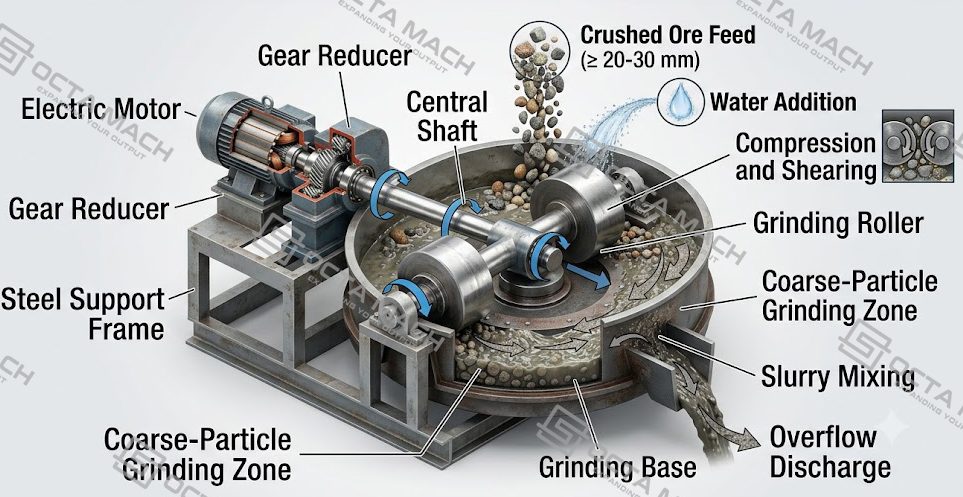
The process can be summarized as:
Crushed ore feeding → water addition → roller compression and kneading → particle-size reduction → slurry mixing → overflow discharge.
The machine should not be fed with uncrushed large rock. The upstream crusher must reduce the feed to the published limit of either below 20 mm or below 30 mm, depending on the selected model.
Wet Pan Mill Structure
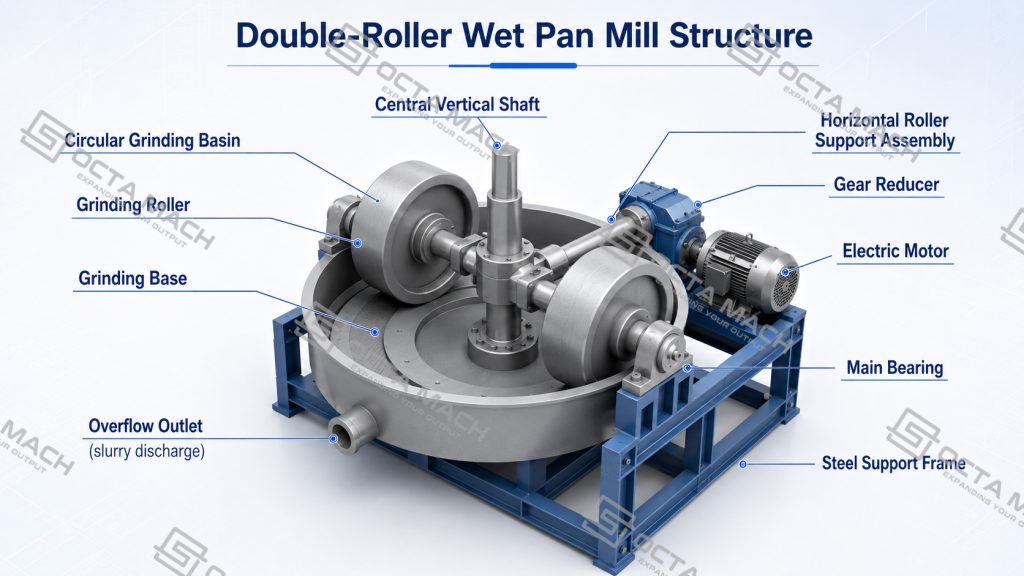
A typical wet pan mill structure includes:
- Circular steel grinding basin
- Heavy grinding rollers
- Grinding base or grinding ring
- Central vertical shaft
- Horizontal roller support assembly
- Gear reducer
- Electric motor
- Main bearings
- Overflow outlet
- Structural steel support frame
The common double roller wet pan mill uses two rollers positioned on opposite sides of the central shaft. This arrangement balances the rotating load and provides repeated contact between the ore, rollers and grinding base.
The grinding rollers and base are the principal wear parts. Their dimensions, thickness and material configuration should be selected according to ore abrasiveness, planned operating hours and replacement strategy. Exact wear-part material grades should be confirmed in the supply specification rather than assumed from model size alone.
Gold and Mineral Ore Applications
The Wet Pan Mill is frequently associated with gold processing, but its application is not limited to one mineral.
Gold Ore Wet Pan Mill
A gold ore wet pan mill is used to grind crushed gold-bearing ore into a finer slurry before gravity concentration or another recovery stage. A rock gold wet pan mill must be installed after crushing because hard-rock feed should first be reduced to the permitted feed size.
For smaller operations, a small scale gold mining wet pan mill can provide a compact grinding stage where plant layout, investment level and available power do not justify a larger conventional grinding circuit.
The term wet pan mill for gold should not be interpreted as a guarantee of gold recovery. Recovery depends on mineral liberation, gold particle size, ore mineralogy and the downstream separation process.
Other Mineral Applications
The machine may also be considered for:
- Copper ore wet pan mill duties before flotation or gravity separation
- Iron ore wet pan mill duties where wet grinding and mixing are required
- Lead zinc ore wet pan mill duties before flotation
- Silver-bearing ore
- Molybdenum-bearing ore
- Antimony ore
- Other metallic and precious-metal ores
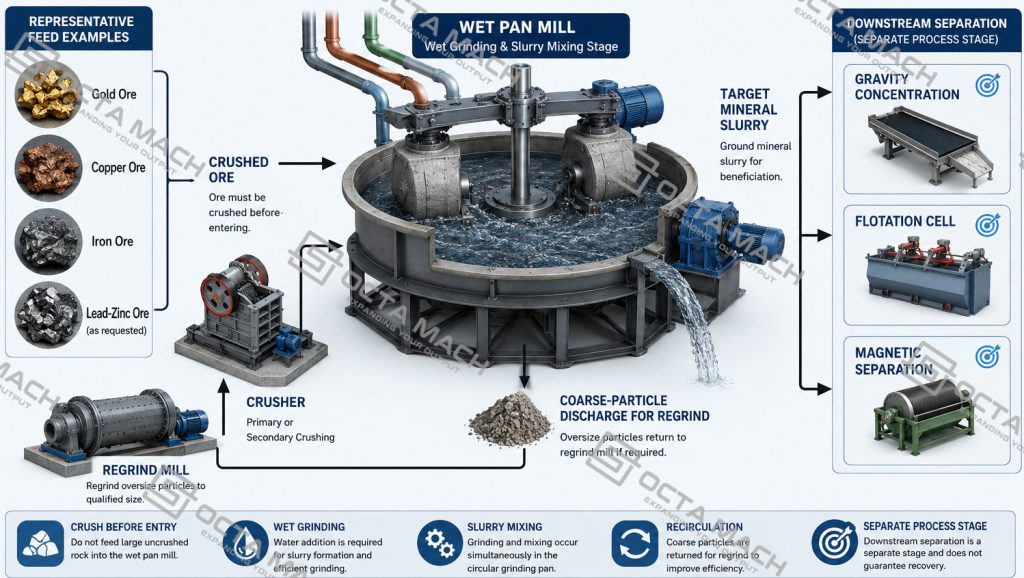
The suitability of each mineral should be confirmed through representative ore testing. Highly abrasive, clay-rich or unusually hard materials may require different roller configuration, wear-part selection or an alternative grinding route.
Wet Pan Mill Model Selection
Correct wet pan mill model selection should be based on process requirements rather than model diameter alone.
- 1200 Wet Pan Mill
The 1200 wet pan mill has a 1,200 mm roller diameter, 200 mm roller thickness, nominal capacity of 1 t/h and 7.5 kW motor power. Its feed size must be below 20 mm. It is suitable for relatively small grinding duties where limited footprint and power demand are important.
- 1500 Wet Pan Mill
The 1500 wet pan mill is available in three catalogue configurations:
400 mm roller thickness, 3–5 t/h, 30 kW、350 mm roller thickness, 2–4 t/h, 22 kW、300 mm roller thickness, 2.5 t/h, 18 kW
This model provides more configuration flexibility than smaller units. Selection should consider required throughput, ore hardness, wear rate and available motor power.
- 1600 Wet Pan Mill
The 1600 wet pan mill is the largest published model in the current range. The 400 mm roller configuration is rated at 4–7 t/h with 37 kW power, while the 350 mm configuration is rated at 3–6 t/h with 30 kW power.

It is suited to higher wet pan mill capacity requirements, but the final model must still be checked against feed grading, desired discharge size and downstream processing conditions.
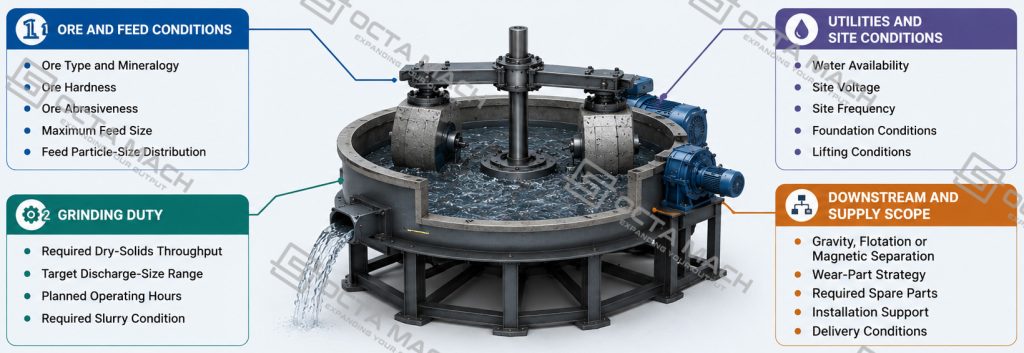
Information Required Before Selection
Before a model is released for production, the supplier should confirm:
- Ore type and mineralogy
- Maximum and typical feed size
- Feed particle-size distribution
- Required dry-solids throughput
- Target discharge-size range
- Ore hardness and abrasiveness
- Water availability
- Planned operating hours
- Downstream recovery method
- Site voltage and frequency
- Foundation and lifting conditions
- Required wear parts and spare-parts package
Wet Pan Mill vs Ball Mill
The question of wet pan mill vs ball mill should be answered according to process duty, not price alone.
| Selection Factor | Wet Pan Mill | Ball Mill |
|---|---|---|
| Grinding method | Wet grinding only | Wet or dry grinding, depending on design |
| Main action | Compression, rolling, shearing and kneading | Impact and abrasion from grinding media |
| Typical plant scale | Small to medium grinding duties | Small to large grinding circuits |
| Current published capacity | 0.5–7 t/h | Depends on selected ball-mill range |
| Layout | Compact circular machine | Horizontal cylindrical mill with drive system |
| Product control | Influenced by water, loading and overflow | Often combined with classifier for controlled product |
| Operation | Simple mechanical arrangement | More complex media, liner and circuit control |
| Best use | Compact wet grinding and mixing | Higher-throughput or more tightly controlled grinding circuits |
A Wet Pan Mill may replace a small ball mill in some projects, but it is not a universal substitute. A ball mill is generally more suitable when the plant requires higher throughput, a wider model range, dry grinding, or precise closed-circuit product control.
Operating and Wet Pan Mill Maintenance
Correct wet pan mill maintenance directly affects grinding stability and wear-part life.
Before starting the machine, operators should check the reducer oil level, bearing lubrication, fastening bolts, roller clearance, basin condition, overflow outlet and water supply. The pan should be free from hardened settled material that could obstruct the roller assembly.
During operation, the feed and water should be added steadily. Sudden overfeeding can increase mechanical load, produce unstable slurry and reduce effective grinding. Abnormal noise, vibration, motor current or reducer temperature should be investigated before continuous operation.
Maintenance attention should focus on:
- Roller surface wear
- Grinding-base wear
- Bearing lubrication
- Reducer and coupling condition
- Central shaft alignment
- Fastener tightness
- Overflow channel blockage
- Motor current and cable condition
- Structural-frame cracks or deformation
Wear parts should be replaced according to actual measured condition rather than only by calendar time. Uneven roller wear can change the grinding pressure and cause unbalanced operation.
Wet Pan Mill Supply Scope and Technical Support
Octa Mach supplies Wet Pan Mill models from 1000 to 1600 for mineral grinding and small-to-medium processing circuits. Equipment selection can be reviewed according to ore properties, feed size, capacity, target product size, plant voltage and downstream process.
The available supply scope may include:
- Complete Wet Pan Mill
- Motor and reducer
- Electrical control system
- Grinding rollers and grinding base
- Wear and spare parts
- Foundation reference drawings
- Installation and operating documents
- Packing and delivery preparation
- Installation and commissioning support according to contract
Final configuration and performance requirements should be agreed in the technical specification before manufacturing.
FAQ
Q: What is the maximum wet pan mill feeding size?
A: The catalogue specifies below 20 mm for the 1000, 1100 and 1200 models, and below 30 mm for the 1300 to 1600 models.
Q: What is the published wet pan mill discharge size?
A: The catalogue lists a discharge-size range of 0.6–0.07 mm. Actual particle-size distribution depends on the ore, water addition, loading and operating condition.
Q: Which model has the highest wet pan mill capacity?
A: The 1600 model with 400 mm roller thickness has the highest published range at 4–7 t/h and uses a 37 kW motor.
Q: How can I obtain an accurate wet pan mill price?
A: Provide the ore type, feed size, required capacity, target discharge size, selected model, site voltage, spare-parts scope and delivery destination. Price cannot be compared accurately from model name alone.