
The High Pressure Dry Powder Briquette Machine is designed to compact prepared low-moisture mineral, metallurgical, refractory and chemical powders into individual briquettes with controlled shape and density. The HY series combines an adjustable screw-feeding system with two counter-rotating forming rollers, allowing difficult dry powders to be pre-compacted, supplied steadily and pressed inside matched roller pockets.
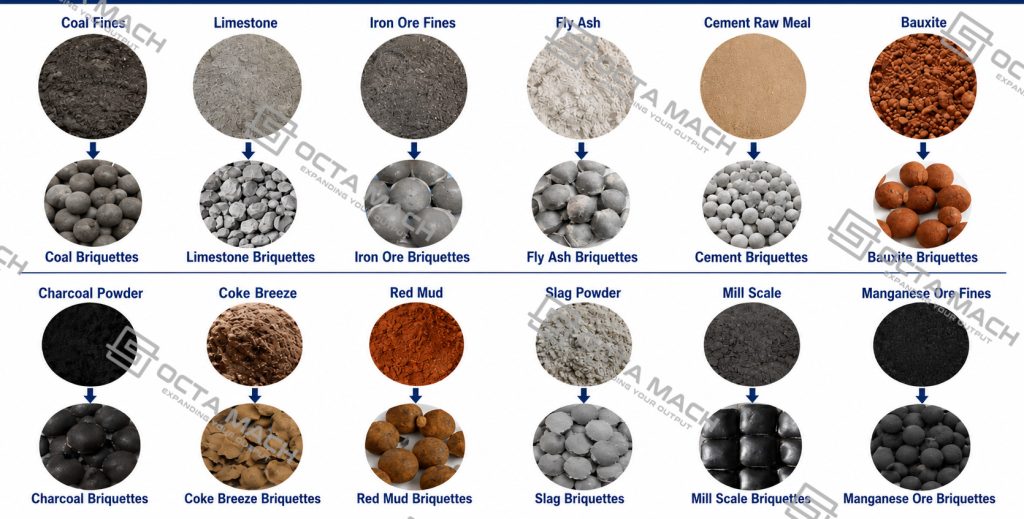
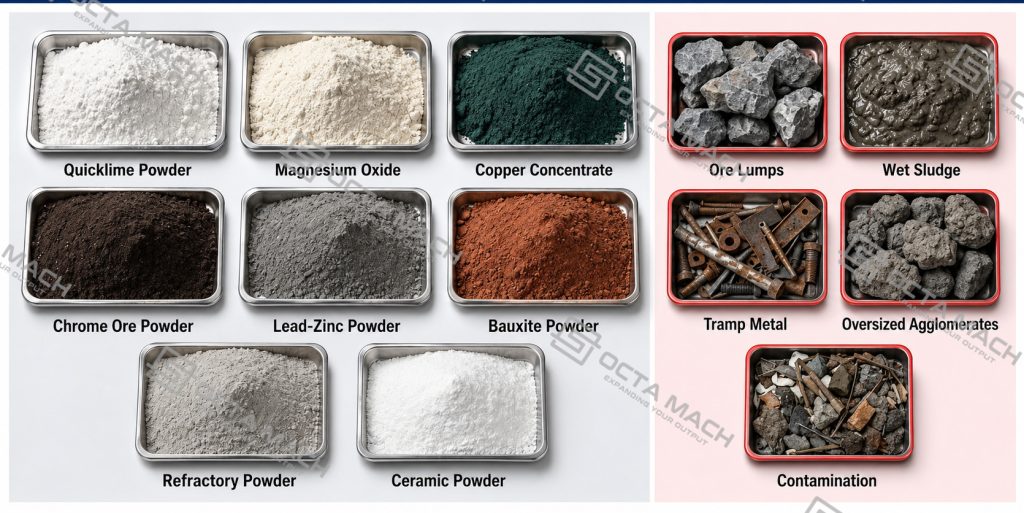
Typical feed materials include quicklime powder, magnesium oxide powder, copper concentrate, chrome ore powder, lead-zinc powder, bauxite powder, non-ferrous metal powders, refractory powders and ceramic powders. The machine is intended for prepared powder feed, not untreated mineral lumps. Raw ores or bulk materials must first be crushed, ground, screened and dried when necessary before entering the dry powder briquetting machine.
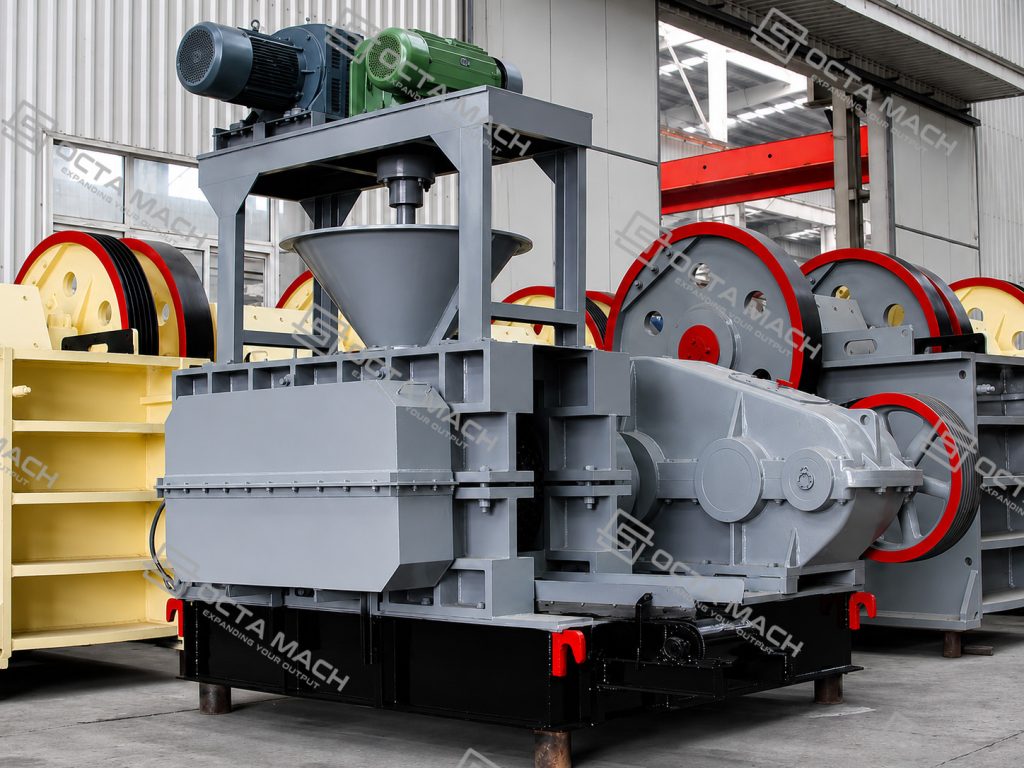
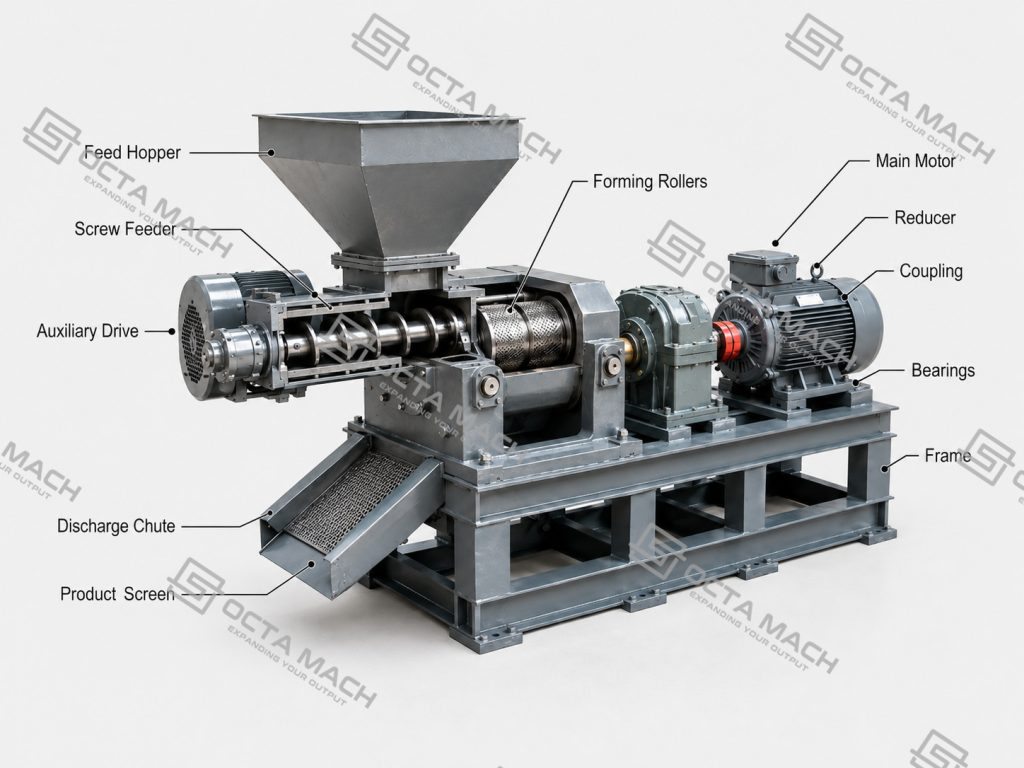
During operation, the screw feeder stabilizes the feed entering the roller nip. The prepared powder fills matched pockets on the two forming rollers and is progressively compacted as the available cavity volume decreases. Maximum densification occurs near the minimum roller gap. The pockets then separate, allowing individual briquettes to release from the roller surfaces. Industrial roller-press briquetting follows this general principle of controlled feeding, counter-rotating rollers, matched forming pockets and high-pressure compaction.
HY Series at a Glance
The HY high-pressure dry powder briquette machine series includes nine models for laboratory-scale evaluation, small production lines and continuous industrial processing. The range allows preliminary equipment selection according to required output, powder properties, briquette dimensions and downstream duty.
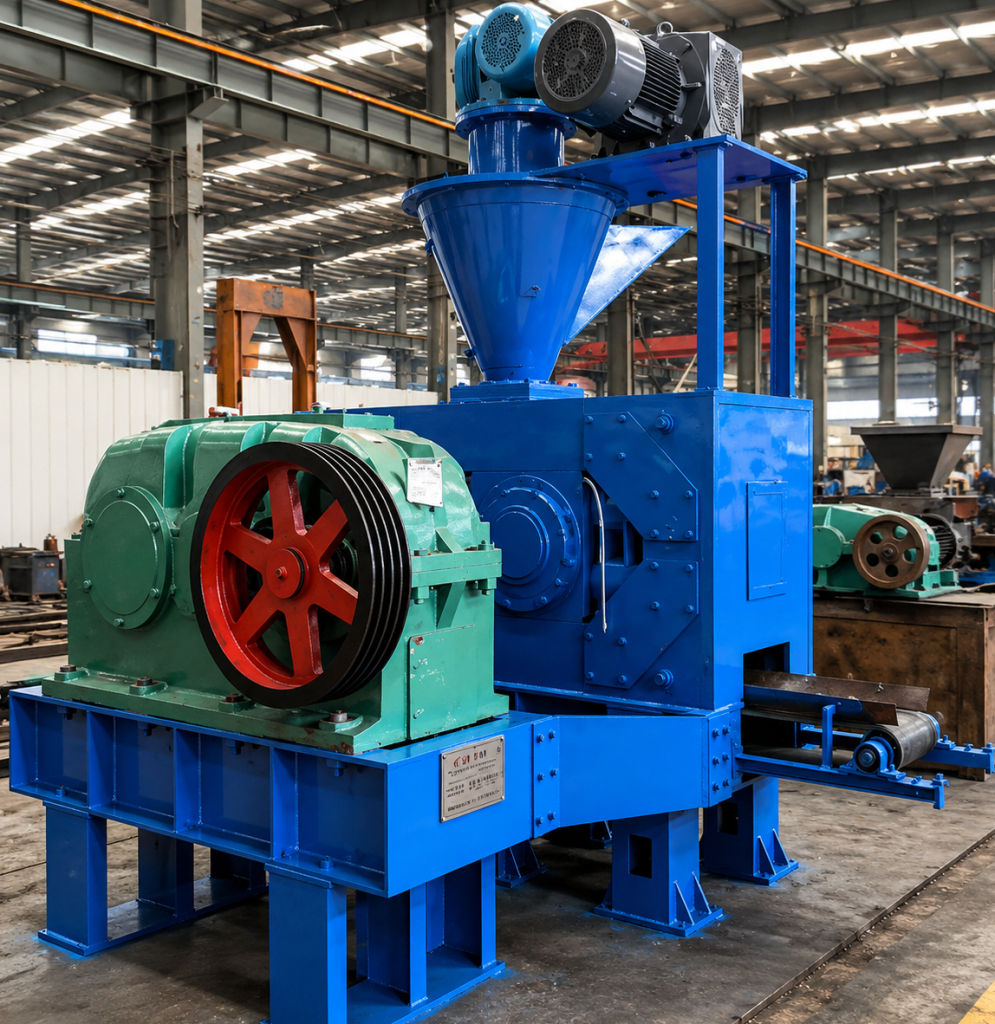
Key Technical Range
9 Models
HY0.5–HY10
0.5–10 t/h
Catalogue Capacity
Φ299–Φ858 mm
Roller Diameter
180–300 mm
Effective Roller Width
18.5–110 kW
Main Motor Power
11–22 kW
Screw-Feeder Motor Power
Forming Configuration
Prepared dry powder is delivered by an adjustable screw feeder, pre-compacted before entering the roll nip and formed between two counter-rotating rollers with matched briquette pockets.
Input: Prepared low-moisture powder
Process: Screw feeding and high-pressure double-roller compaction
Output: Individual shaped dry-powder briquettes
Stable output and final configuration depend on particle-size distribution, bulk density, flowability, entrained air, moisture condition, roller-pocket geometry and representative material testing.
HY Series Technical Parameters
| Model | Roller Diameter | Roller Width | Capacity | Main Motor Model | Main Motor Power | Auxiliary Motor Model | Auxiliary Motor Power |
| HY0.5 | Φ299 mm | 180 mm | 0.5 t/h | Y180M-4 | 18.5 kW | YCT225-4A | 11 kW |
| HY1.0 | Φ367 mm | 183 mm | 1 t/h | YCT315-4A | 37 kW | YCT225-4A | 11 kW |
| HY1.5 | Φ368 mm | 183 mm | 1.5 t/h | Y250M-6 | 37 kW | YCT225-4A | 11 kW |
| HY2.0 | Φ399 mm | 232 mm | 2 t/h | BY67315-413 | 45 kW | YCT225-4A | 15 kW |
| HY3.0 | Φ522 mm | 196 mm | 3 t/h | Y280S-6 | 55 kW | YCT225-4B | 15 kW |
| HY5.0 | Φ700 mm | 210 mm | 5 t/h | Y315M-6 | 90 kW | YCT250-4A | 18.5 kW |
| HY6.0 | Φ738 mm | 225 mm | 6 t/h | Y280S-4 | 90 kW | YCT250-4A | 18.5 kW |
| HY8.0 | Φ758 mm | 225 mm | 8 t/h | Y315S-4 | 110 kW | YCT250-4A | 18.5 kW |
| HY10 | Φ858 mm | 300 mm | 10 t/h | Y315M2-6 | 110 kW | YCT250-4B | 22 kW |
Final motor configuration, feeder arrangement, roller-pocket profile and recorded output should be confirmed in the project-specific technical agreement.
How the Dry Powder Briquetting Machine Works
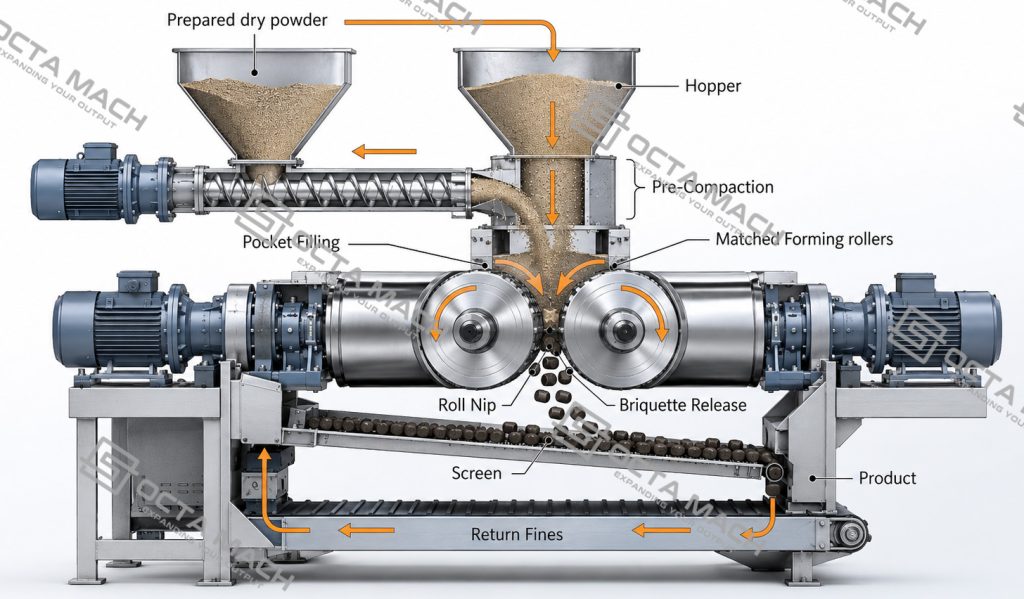
1. Prepared Powder Feeding
Screened and conditioned dry powder enters the upper hopper. Oversize particles, tramp metal and unstable wet material must be removed before feeding.
2. Screw Force Feeding and Pre-Compaction
The motor-driven screw feeder delivers powder continuously toward the forming rollers. This stage improves feeding consistency and pre-compacts low-density powder before it reaches the roll nip.
A stable feed stream is particularly important for fine or highly aerated powders. Industrial roll compactors commonly use a pre-densifying feeder because uncontrolled powder flow can produce uneven roller-pocket filling and inconsistent briquette density.
3. Matched Roller-Pocket Filling
The two forming rollers rotate in opposite directions. Prepared material enters the matched pockets distributed across the effective roller width.
Pocket size and geometry determine the basic briquette shape and influence filling, compression, release and downstream handling. A roller-pocket profile should therefore be selected for the actual powder rather than treated as a universal design.
4. Progressive High-Pressure Compaction
As the rollers turn toward the central gap, the available pocket volume decreases. The material is progressively densified instead of receiving all compression at one point.
This progressive compression helps convert loose powder into a coherent briquette while limiting uncontrolled displacement of material from the pocket.
5. Briquette Formation and Release
The opposing pockets form one complete briquette close to the roll nip. After passing the roller centreline, the pockets separate and the briquette releases downward.
The finished product may be formed into pillow, oval, round or project-specific shapes according to the confirmed roller-pocket design.
6. Screening and Fines Recycling
A downstream screen can separate qualified briquettes from loose powder, flashing and small broken particles. Screened fines may be returned to proportioning or feeding under a controlled recycle arrangement.
Industrial cold-briquetting systems commonly combine preparation, mixing when required, roller pressing, screening and post-treatment. Undersize material is normally separated after pressing and may be returned to the process.
Main Machine Structure
Feed Hopper
The hopper provides temporary powder storage above the force-feeding unit. Its configuration should suit the material’s flowability, bulk density and tendency to bridge or segregate.
Adjustable Screw Feeder
The screw feeder meters and pre-compacts the powder before the material reaches the rollers. Feed-screw operation must remain coordinated with roller demand to avoid underfilling, excessive accumulation or unstable briquette density.
Double Forming Rollers
Two counter-rotating rollers contain matched briquette pockets. Roller diameter, effective width, pocket arrangement and operating condition influence filling behaviour, compaction and production capacity.
Main Drive and Auxiliary Drive
The main motor drives the forming rollers, while the auxiliary motor supports the feeding system. The HY series uses different motor combinations according to model size and catalogue capacity.
Roller Bearings and Machine Frame
The bearing supports and frame maintain roller alignment under briquetting load. Alignment, fastening condition and drive installation should be checked before commissioning.
Discharge and Screening Section
Newly formed briquettes should leave the rollers through a controlled, low-drop discharge arrangement. Screening may be added to remove loose fines before storage, transport or downstream processing.
Suitable Dry Powder Materials
| Material Group | Representative Feed | Preparation Requirement |
| Lime-Based Powder | Quicklime powder | Stable particle size, controlled moisture and representative briquetting test |
| Magnesium Compounds | Magnesium oxide powder | Uniform fine feed and controlled feeding behaviour |
| Non-Ferrous Concentrates | Copper concentrate and lead-zinc powder | Chemistry, abrasiveness and downstream use must be reviewed |
| Chromium-Bearing Powder | Chrome ore powder | Particle-size distribution and roller wear conditions must be evaluated |
| Aluminium-Bearing Material | Prepared bauxite powder | Oversize lumps must be crushed and screened |
| Refractory Materials | Refractory powder blends | Composition and required green strength must be confirmed |
| Ceramic Materials | Prepared ceramic powder | Flowability and briquette-release behaviour require testing |
| Other Mineral Powders | Project-specific prepared powders | Suitability must be established through representative material trials |
Roller-press briquetting is widely applied to finely divided mineral, metallic-oxide, lime, chemical and metallurgical materials. However, industrial suppliers consistently base final press configuration on the actual material and intended downstream process rather than on the material name alone.
Materials Not Suitable for Direct Feeding
The following materials should not enter the machine without preparation:
- untreated ore or stone lumps;
- oversized agglomerates;
- unstable wet sludge or slurry;
- material containing tramp metal;
- unscreened foreign contamination;
- highly variable blends with uncontrolled moisture;
- powders whose chemical or safety characteristics have not been evaluated.
Binder Requirements for Dry Powder Briquetting
A dry powder briquette press can process many suitable powders without adding a liquid binder, particularly when the material develops sufficient cohesion under pressure. This can reduce or eliminate downstream drying associated with wet agglomeration. However, not every powder is naturally suitable for binderless briquetting.
Binder selection should be based on:
- the natural plasticity and cohesion of the powder;
- target green strength and final strength;
- compatibility with the downstream process;
- local binder availability;
- permissible chemical additions;
- curing, drying or storage requirements.
Where a binder is required, its type and dosage must be established through representative testing.Raw-material type, grain size, moisture and binder content as interacting variables that determine final briquette quality.
Factors That Control Briquette Quality
| Control Factor | Effect on Operation and Product |
| Particle-Size Distribution | Influences packing density, pocket filling and internal bonding |
| Moisture Stability | Affects flowability, cohesion, sticking and release |
| Bulk Density | Changes the amount of material delivered to each roller pocket |
| Entrained Air | Can interfere with stable filling and densification |
| Screw-Feeder Setting | Controls feed stability and pre-compaction |
| Roller-Pocket Geometry | Determines briquette shape, filling volume and release behaviour |
| Roller Operating Condition | Influences compaction time and material response |
| Binder Compatibility | Affects green strength and downstream suitability when a binder is needed |
| Discharge Height | Excessive impact can damage newly formed briquettes |
| Fines Recycle | Uncontrolled recycle can alter moisture, density and formulation balance |
No single pressure, moisture level or binder dosage is suitable for every dry powder. Particle size, moisture and pressure distribution are among the variables known to affect pressure agglomeration, and feasibility testing is recommended when material response is uncertain.
High Pressure Dry Powder Briquette Machine vs. Wet Pelletizing
| Comparison | High-Pressure Dry Briquetting | Wet Pelletizing |
| Forming Principle | Pressure between counter-rotating rollers | Tumbling growth with liquid or binder |
| Typical Product | Individual shaped briquettes | Round pellets or granules |
| Liquid Addition | Often low or unnecessary for suitable powders | Normally required |
| Drying Requirement | May be avoided when no liquid is added | Commonly required |
| Main Feed Control | Screw feeding and roller-pocket filling | Mixing, binder addition and pellet growth |
| Key Selection Basis | Compressibility, feed density, aeration and pocket geometry | Binder response, moisture and pellet-growth behaviour |
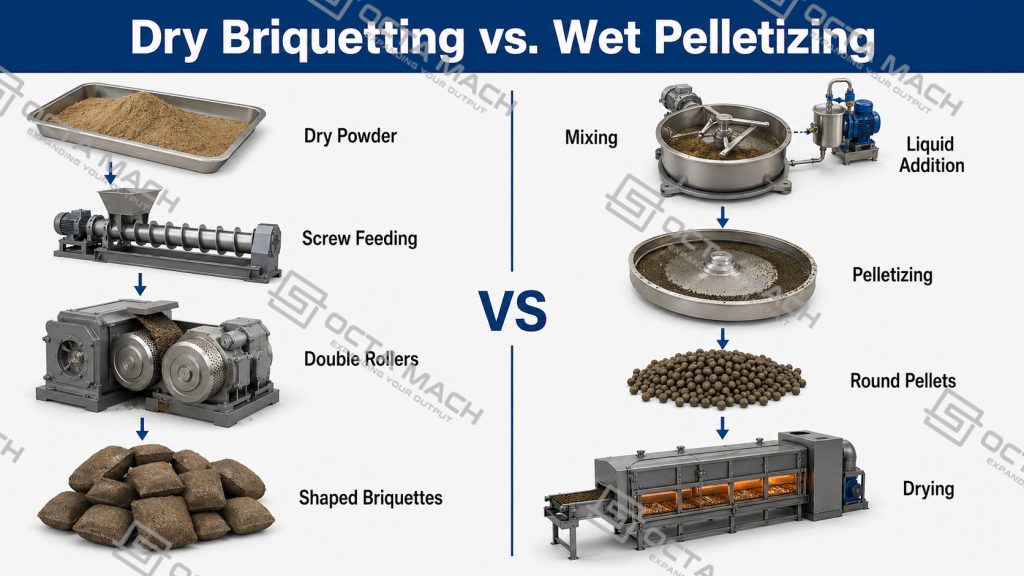
Pressure compaction and wet pelletizing are not interchangeable. Material response, desired product geometry, downstream use and processing cost determine which method is appropriate.
Typical Dry Powder Briquette Production Line
A project-specific line may include:
Powder Receiving → Crushing or Grinding When Required → Screening → Drying When Required → Proportioning → Binder Addition When Required → Mixing → Screw Force Feeding → High-Pressure Double-Roller Briquetting → Product Screening → Fines Recycling → Finished-Briquette Handling
Not every project requires every stage. A consistently dry, correctly sized and self-binding feed may use a relatively short process. A variable concentrate or refractory blend may require additional screening, mixing, dosing, dust control or post-treatment.
How to Select a Dry Powder Briquetting Machine
Machine selection should be based on actual material behaviour and product requirements, not catalogue capacity alone.
Feed Data
Provide the material composition, particle-size distribution, moisture range, bulk density, flowability, inlet temperature, abrasiveness and any existing binder or additive.
Briquette Requirements
Confirm the required shape, dimensions, green and final strength, acceptable fines level, storage conditions and downstream application.
Production Conditions
Specify the stable required capacity, operating hours, upstream feeding, downstream screening and conveying, recycle arrangement, power supply and installation limits.
Representative material testing is recommended when compressibility, binder response, feeding stability or briquette release has not been verified. Final machine configuration should be confirmed from the test results and project-specific technical agreement.
Inspection and Delivery Requirements
Before shipment, the agreed inspection scope may include:
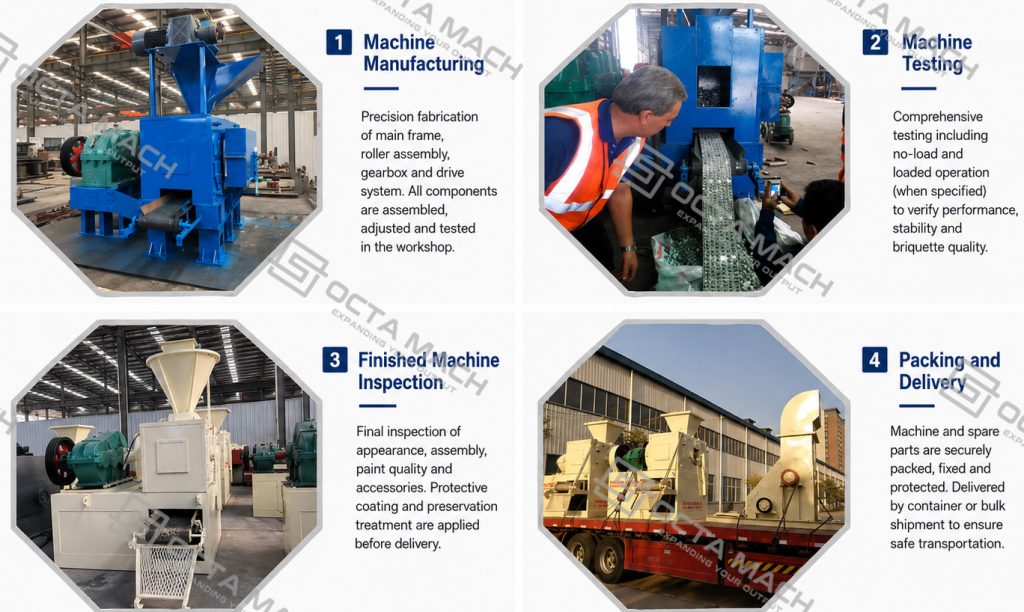
- roller and shaft dimensional inspection;
- roller alignment and pocket-matching check;
- screw-feeder rotation and clearance check;
- motor, reducer and coupling inspection;
- bearing and lubrication check;
- guard and emergency-stop inspection;
- no-load mechanical test;
- loaded test with representative material when specified;
- equipment marking and packing-list review;
- spare-parts and technical-document verification.
A no-load test confirms mechanical readiness but does not prove production capacity or briquette strength. Loaded-test results apply only to the recorded material formulation, machine settings and test conditions.
FAQ
Can the dry powder briquette machine operate without a binder?
Many suitable inorganic powders can be compacted without a liquid binder. Materials with insufficient natural cohesion may still require a compatible binder. The final binder route should be confirmed through material testing.
Why does the machine use a screw force feeder?
Fine dry powders may have low bulk density, poor gravity flow or high entrained-air content. The screw feeder meters and pre-compacts the powder so the roller pockets receive a more consistent feed.
Can large ore or stone pieces be fed directly?
No. The machine is designed for prepared powder. Large mineral pieces must be crushed, ground and screened before briquetting.
How should the HY model be selected?
The HY model should be selected from required stable output, powder bulk density, particle-size distribution, flowability, roller-pocket dimensions, product-strength requirement and representative test results—not nominal capacity alone.