
Three cylinder rotary dryer uses three concentric rotating drums to create a continuous triple-pass drying path within a compact shell. Wet material enters the inner drum, changes direction through the middle drum, and completes final moisture removal in the outer drum. As the drum assembly rotates, internal lifting flights repeatedly raise and scatter the feed through the hot-gas stream, forming a material curtain that supports uniform heat exchange and stable moisture reduction.
OctaMach supplies three cylinder rotary drum dryer systems for river sand, graded construction sand, and other suitable granular materials. The dryer can be supplied as an individual machine or integrated with wet-material feeding, heat generation, exhaust, dust collection, discharge conveying, screening, and storage equipment. Final configuration is based on feed rate, inlet and target moisture, particle-size distribution, bulk density, fines content, abrasiveness, heat source, and downstream process requirements.
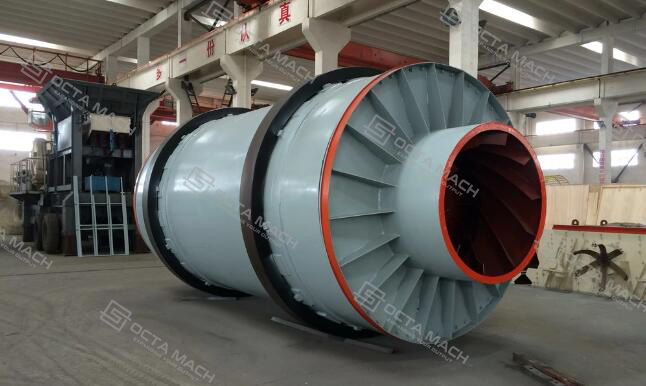
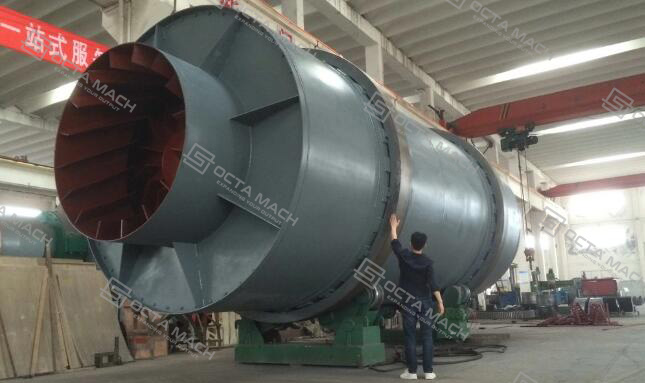
Three Cylinder Rotary Dryer Specifications
| Model | Outer Drum Diameter (m) | Outer Drum Length (m) | Rotation Speed (r/min) | Maximum Intake-Air Temperature (°C) | Capacity (t/h) | Motor Power (kW) |
|---|---|---|---|---|---|---|
| φ1.8 × 2 | 1.8 | 2 | 4–10 | 700–750 | 2–3 | 2.2 × 2 |
| φ2.0 × 2 | 2.0 | 2 | 4–10 | 700–750 | 3–5 | 3 × 2 |
| φ2.2 × 2.5 | 2.2 | 2.5 | 4–10 | 700–750 | 5–8 | 4 × 2 |
| φ2.5 × 2.7 | 2.5 | 2.7 | 4–10 | 700–750 | 8–12 | 4 × 2 |
| φ2.0 × 4.5 | 2.0 | 4.58 | 4–10 | 700–750 | 13–18 | 5.5 × 2 |
| φ2.2 × 5 | 2.2 | 5 | 4–10 | 700–750 | 15–23 | 7.5 × 2 |
| φ2.5 × 6 | 2.5 | 6 | 4–10 | 700–750 | 20–28 | 5.5 × 4 |
| φ2.7 × 6.5 | 2.7 | 6.5 | 4–10 | 700–750 | 24–33 | 7.5 × 4 |
| φ3.0 × 7 | 3.0 | 7 | 4–10 | 700–750 | 35–40 | 11 × 4 |
| φ3.2 × 8 | 3.2 | 8 | 4–10 | 700–750 | 40–60 | 15 × 4 |
| φ3.6 × 9 | 3.6 | 9 | 4–10 | 700–750 | 55–75 | 18.5 × 4 |
| φ4.2 × 9 | 4.2 | 9 | 4–10 | 700–750 | 70–120 | 22 × 4 |
A model cannot be selected from wet-material tonnage alone. Capacity must also be matched to the hourly water-evaporation load, feed grading, material curtain formation, available heat input, exhaust capacity, and required final moisture. Drum-volume units and the final model dimensions should be confirmed in the project-specific technical proposal.
Three-Pass Working Principle, Structure, and Advantages
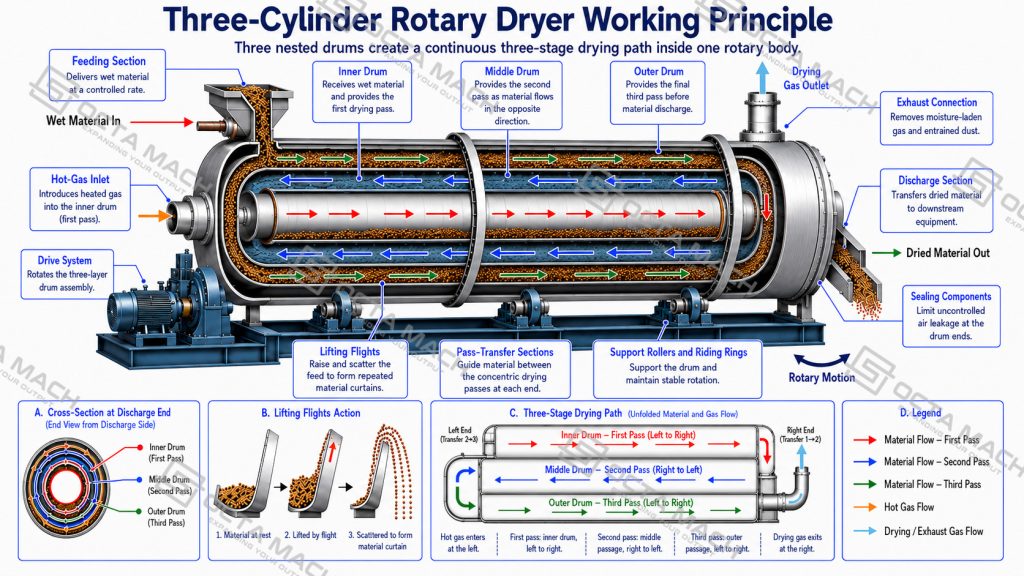
Wet material enters the inner drum through the feeding section. As the drum rotates, the lifting flights raise the feed and release it through the hot-gas stream. This repeated lifting and scattering forms a material curtain, exposes more particle surface area, and begins the main moisture-removal stage.
At the end of the inner drum, the material transfers into the middle drum and changes its travel direction. It is lifted again and follows the second drying pass, extending hot-air heat exchange within the same external dryer body. The material then transfers into the outer drum, where final moisture adjustment and discharge take place. The inner, middle, and outer drums therefore create a continuous three-stage drying path inside one nested drum assembly.
| Component | Function |
|---|---|
| Inner Drum | Receives wet feed, disperses the material, and starts rapid moisture removal |
| Middle Drum | Reverses the material path and provides the second drying stage |
| Outer Drum | Completes final drying and moves the product toward discharge |
| Lifting Flights | Raise and scatter the feed to form repeated material curtains |
| Pass-Transfer Sections | Guide material from the inner drum to the middle and outer drums |
| Feeding Section | Delivers wet material at a controlled rate |
| Drive System | Rotates the three-layer drum assembly |
| Support Rollers and Riding Rings | Support the drum and maintain stable rotation |
| Hot-Gas Inlet | Introduces heated gas into the drying system |
| Exhaust Connection | Removes moisture-laden gas and entrained dust |
| Discharge Section | Transfers dried material to downstream equipment |
| Sealing Components | Limit uncontrolled air leakage at the drum ends |
Operating Advantages
- Extended material path: Three drying passes provide a longer effective route inside a compact machine.
- Repeated particle exposure: Lifting flights repeatedly spread the material through the hot-gas stream.
- Compact drum arrangement: The three concentric cylinders use the same external installation envelope.
- Continuous drying: Feeding, heat transfer, pass transfer, and discharge operate without batch interruption.
- Stage-by-stage moisture removal: The inner, middle, and outer drums perform successive drying duties.
- Integrated heat containment: The nested three-layer drum structure keeps multiple drying zones within one shell.
- Production-line compatibility: The dryer can connect with feeding, combustion, exhaust, dust collection, screening, and storage equipment.
Lifting Flights, Material Curtains, and Pass Transfer
The performance of a three drum dryer depends on more than drum diameter and heat input. The internal lifting system must pick up the material without excessive accumulation, release it at the correct position, and maintain a reasonably continuous curtain across the gas stream.
In the first pass, high-moisture feed may be heavier and more likely to stick or move as a dense layer. The lifting flights in this area must separate the feed and distribute it without creating persistent wall buildup. In the middle pass, the material has already lost part of its moisture, so the flight arrangement must continue lifting while controlling forward movement and residence time. In the outer pass, the internal components complete final drying and guide the product toward a stable discharge.
The transfer areas between the three concentric cylinders are equally important. Restricted transfer can cause accumulation and unstable drum loading, while uncontrolled short-circuiting can reduce residence time. A stable three pass rotary dryer therefore requires coordinated flight geometry, transfer openings, drum speed, feed rate, and exhaust flow.
Key operating relationships include:
- Uneven lifting creates an intermittent material curtain and inconsistent gas–solid contact.
- Excessive fines increase dust carryover and may leave the dryer before the coarser fraction.
- Sticky material can coat flights and reduce their effective lifting capacity.
- Abrasive sand concentrates wear at impact and transfer zones.
- Unstable pass transfer changes the material inventory in each drum section.
- Excessive drum loading can reduce the space available for lifting and scattering.
Feed Preparation and Drum Loading for Three-Pass Drying
A three cylinder rotary dryer requires a stable and controllable feed entering the inner drum. The material must spread across the lifting flights, form a repeated material curtain, and transfer through the inner, middle, and outer drums without persistent buildup. Uneven feeding changes drum loading, residence time, and evaporation duty, which can lead to fluctuating outlet moisture. Complete sand-drying lines therefore commonly use an adjustable feeder to maintain a steady wet-material flow.
| Feed Control Item | Preparation Before Drying | Effect on Three-Pass Operation |
|---|---|---|
| Stable Feed Rate | Use a controlled feeder to maintain continuous material flow | Prevents alternating overloading and underloading of the inner drum |
| Controlled Inlet Moisture | Blend variable feed or apply mechanical dewatering when moisture is excessive | Stabilizes hourly evaporation load and final moisture |
| Broken Wet Lumps | Break up agglomerates before they enter the drum | Allows the lifting flights and transfer sections to handle the material continuously |
| Defined Particle-Size Distribution | Confirm maximum size and fine fraction | Supports consistent lifting while limiting segregation and dust carryover |
| Limited Sticky Contamination | Control clay, mud, or other adhesive material in the feed | Reduces coating on drum walls, flights, and pass-transfer sections |
| Known Wet Bulk Density | Measure the actual wet feed rather than using dry-material data | Supports correct volumetric loading and drive selection |
| Confirmed Abrasiveness | Identify quartz content and other abrasive particles | Defines wear requirements for flights and transfer zones |
| Foreign-Material Removal | Remove metal pieces, oversized debris, and other contaminants | Prevents impact damage and blockage at internal transfer points |
High inlet moisture increases the thermal load and may require physical dewatering before drying, while excessive fines increase exhaust dust loading and product loss. The feed should remain sufficiently free-flowing for the spiral guides and lifting flights to move, raise, and scatter it through all three passes.
Correct drum loading leaves enough internal space for the material to be lifted and released through the hot-gas stream. Overfeeding produces a dense rolling layer and weak material curtains, while unstable feeding changes the amount of material held in each pass. During commissioning, the feed rate should be coordinated with drum rotation, motor load, pass-transfer stability, exhaust condition, and final product moisture.
Moisture Control Across the Three Drying Passes
In a three cylinder rotary dryer, moisture removal is distributed across the inner, middle, and outer drums rather than completed in a single straight pass. The inner drum receives the wettest and heaviest feed, the middle drum continues bulk moisture removal after the first material transfer, and the outer drum completes final drying before discharge. Stable outlet moisture depends on maintaining continuous lifting and reliable transfer between all three stages.
| Drying Pass | Material Condition | Main Drying Function | Key Control Point |
|---|---|---|---|
| Inner Drum | Highest moisture and greatest sticking tendency | Disperses wet feed and removes initial moisture | Stable feeding, effective lifting, and limited buildup |
| Middle Drum | Lower moisture and improved flowability | Continues bulk moisture removal through repeated lifting | Uniform pass transfer and consistent material curtain |
| Outer Drum | Near the target moisture | Completes final drying and stabilizes discharge | Residence time, product temperature, and outlet flow |
Final moisture can fluctuate when material accumulates in one pass, transfers unevenly between drums, or forms an unstable material curtain. Control should therefore focus on feed stability, flight performance, pass-transfer condition, hot-gas flow, and continuous discharge rather than adjusting inlet temperature alone.
Three Cylinder Rotary Dryer Applications and Selection Criteria
A three cylinder rotary dryer is primarily used for continuous drying of free-flowing sand and granular mineral materials. The three-pass material path provides repeated lifting and hot-gas contact within the inner, middle, and outer drums, making the equipment suitable for production lines that require stable throughput, controlled final moisture, and a relatively compact drying section.
| Application | Typical Material | Process Position | Main Selection Concern |
|---|---|---|---|
| River Sand Drying | Washed or naturally moist river sand | Before screening, storage, or dry-mortar production | Inlet moisture, fines content, and stable wet-feed rate |
| Quartz Sand Drying | Graded quartz sand | Before classification, packing, or further processing | Abrasiveness, particle-size distribution, and product cleanliness |
| Silica Sand Drying | Selected industrial silica sand | Before grading, storage, or industrial use | Dust carryover, final moisture, and exhaust treatment |
| Manufactured Sand Drying | Crushed and washed manufactured sand | Before dry screening and batching | High fines content, wide size distribution, and internal wear |
| Dry Mortar Sand Preparation | Graded construction sand | Before silo storage and dry mixing | Stable outlet moisture and continuous production capacity |
| Selected Granular Minerals | Free-flowing slag or mineral particles | Before grinding, classification, storage, or packing | Stickiness, abrasiveness, thermal behavior, and gas compatibility |
Key Selection Inputs
1. Material characteristics
The material name alone is not sufficient for dryer selection. Particle size, size distribution, wet bulk density, fines content, stickiness, abrasiveness, and thermal behavior affect lifting-flight performance, material-curtain formation, internal wear, and transfer between the three drums.
2. Inlet and target moisture
Inlet moisture defines the initial water load, while the target final moisture determines the required evaporation duty. Both values must use the same moisture basis. Feed with very high or unstable moisture may require blending, drainage, or mechanical dewatering before entering the dryer.
3. Required processing capacity
Capacity should be stated as a continuous wet-feed rate in t/h, together with the planned operating hours. Model selection must consider both solids throughput and hourly water evaporation rather than relying only on the nominal capacity shown in a standard parameter table.
4. Heat source and drying-gas conditions
The available heat source influences furnace design, gas temperature, gas volume, fuel consumption, and control requirements. Possible project heat sources may include natural gas, coal, oil, biomass, or available process heat, subject to material compatibility and local operating conditions.
5. Final product requirements
The required outlet moisture, allowable product temperature, particle integrity, and downstream process must be defined before sizing. Sand entering a storage silo, screening system, dry-mortar mixer, or packing line may have different discharge-temperature and moisture-stability requirements.
6. Site and system interfaces
Ambient temperature, elevation, voltage, installation space, exhaust routing, dust-control requirements, and downstream conveying capacity affect the final system configuration. The dryer body, heat source, exhaust fan, dust collector, feeder, and discharge equipment must operate as one coordinated drying section.
A suitable triple pass rotary dryer model is therefore determined from the complete drying duty: material properties, wet-feed rate, moisture-removal requirement, heat source, site conditions, and final product specification. No single parameter can define the correct drum size or system configuration.
Three Cylinder Rotary Dryer Project Implementation
A three cylinder rotary dryer must be integrated with the foundation, feeding, heat-generation, exhaust, dust-control, discharge, and electrical systems before it can operate as a stable drying section. Project implementation therefore focuses on matching the dryer body with the actual material duty, site layout, available utilities, and downstream production requirements.
| Implementation Item | Project Requirement | Operational Importance |
|---|---|---|
| Wet-Material Feeding | Stable feed rate, controlled particle size, and limited oversized material | Maintains consistent drum loading and material-curtain formation |
| Foundation and Alignment | Support positions, equipment loads, drum slope, and drive alignment must follow approved drawings | Supports stable drum rotation, roller contact, and material transfer |
| Heat-Source Connection | Furnace capacity, fuel type, gas temperature, and duct arrangement must match the evaporation duty | Provides sufficient and controllable drying heat |
| Exhaust and Dust Control | Fan duty, duct resistance, and dust-collector capacity must suit the gas volume and fines load | Maintains system draft and controls dust carryover |
| Discharge Handling | Conveyor, screen, or storage equipment must accept the continuous dryer output | Prevents material accumulation at the discharge end |
| Electrical and Controls | Voltage, motors, instruments, interlocks, and control logic must suit the site | Coordinates startup, operation, shutdown, and equipment protection |
| Maintenance Access | Working space is required around the drive, support rollers, seals, ducts, and inspection points | Allows adjustment, inspection, cleaning, and component replacement |
| Commissioning Records | Feed rate, inlet moisture, gas condition, drum speed, motor load, and final moisture should be recorded | Establishes the stable operating range for the actual material |
Foundation preparation should be based on approved equipment loads and support positions rather than general layout dimensions. During installation, the drum axis, riding rings, support rollers, transmission system, and seals require coordinated alignment. Commissioning should then proceed from mechanical checks to controlled feeding and thermal operation, with material flow, exhaust draft, motor load, and outlet moisture monitored together.
OctaMach Project Support Advantages
- Integrated system coordination: The dryer body, feeding equipment, heat source, exhaust path, dust control, and discharge system are coordinated around one drying duty.
- Material-based configuration: Drum size, internal lifting arrangement, heat input, and auxiliary equipment are matched to the feed rate, moisture load, particle size, and abrasiveness.
- Site-oriented layout support: Equipment interfaces, foundation positions, maintenance space, utilities, and downstream connections are considered during layout development.
- Defined technical documentation: Project documents may include equipment layout, foundation references, installation instructions, operating guidance, component lists, and recommended spare parts.
- Flexible supply boundary: The dryer can be supplied as a standalone machine or as part of a complete sand drying production line, with the final scope clearly defined in the technical proposal.
OctaMach coordinates the principal process interfaces before final configuration so that the three cylinder rotary dryer, heat source, exhaust system, feeding equipment, and downstream handling equipment operate as one continuous drying section.
FAQ
Q1:What feed conditions are required for a three cylinder rotary dryer?
A1:A three cylinder rotary dryer works best with free-flowing sand or granular solids that have controlled particle size, limited fines, low stickiness, and stable inlet moisture. Wet lumps, clay contamination, or excessive fines can reduce lifting efficiency and interrupt transfer between the three drums.
Q2:Why is wet feed capacity alone not enough to size a triple pass rotary dryer?
A2:Dryer sizing depends on hourly water evaporation, not only wet feed tonnage. Inlet moisture, target final moisture, bulk density, particle-size distribution, heat input, and operating hours must be evaluated together to define the required thermal and material-handling duty.
Q3:How is final moisture controlled across the three drying passes?
A3:The inner drum disperses the wet feed and removes initial moisture, the middle drum continues bulk drying, and the outer drum completes final moisture adjustment. Stable output requires consistent feeding, effective material curtains, reliable pass transfer, balanced hot-gas flow, and continuous discharge.
Q4:What auxiliary equipment must be matched with a three cylinder rotary dryer?
A4:A complete drying section normally includes controlled feeding, a heat source, exhaust fan, dust collector, discharge conveying, screening or storage, and electrical controls. These systems must be matched to the dryer’s feed rate, gas volume, fines load, and continuous output rather than selected independently.