
Mobile cone crusher plant is a movable secondary or tertiary crushing system designed for processing hard and abrasive rock. It integrates a cone crusher, feeding and discharge conveyors, hydraulic controls, and, when required, a vibrating screen and return conveyor on a mobile chassis. The plant is commonly installed after a jaw crusher to process granite, basalt, quartzite, river stone, hard limestone, and mineral ores into controlled aggregate or downstream process-feed sizes.
Octa Mach mobile cone crusher plants are configured around project duty rather than a single crusher model. According to feed size, rock hardness, required capacity and final aggregate grading, the plant can be matched with suitable cone crusher chamber, vibrating screen, return conveyor, hydraulic control system and mobile chassis. This helps maintain stable secondary or tertiary crushing performance while keeping the layout practical for quarry, mining, road construction and aggregate production sites.
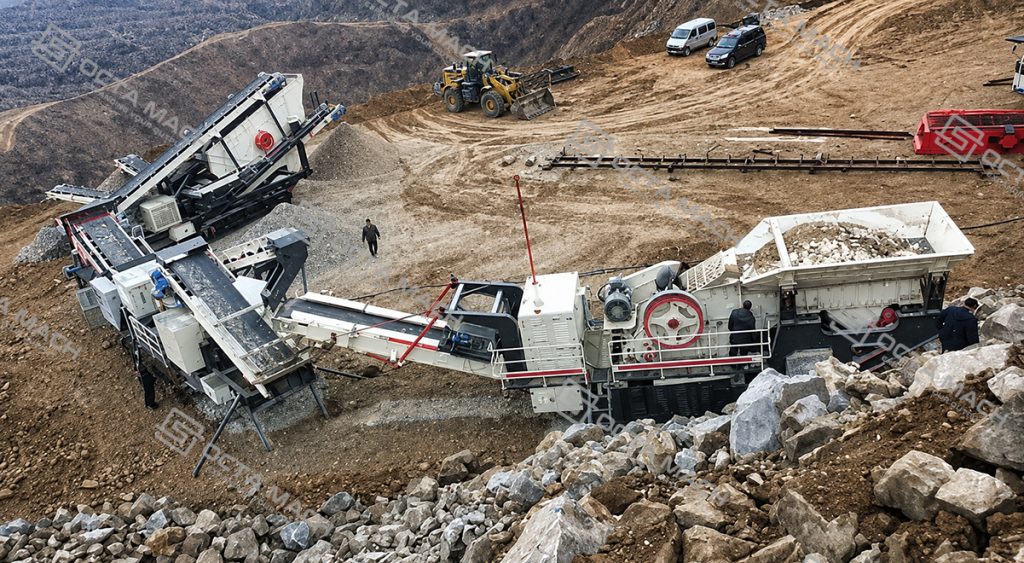
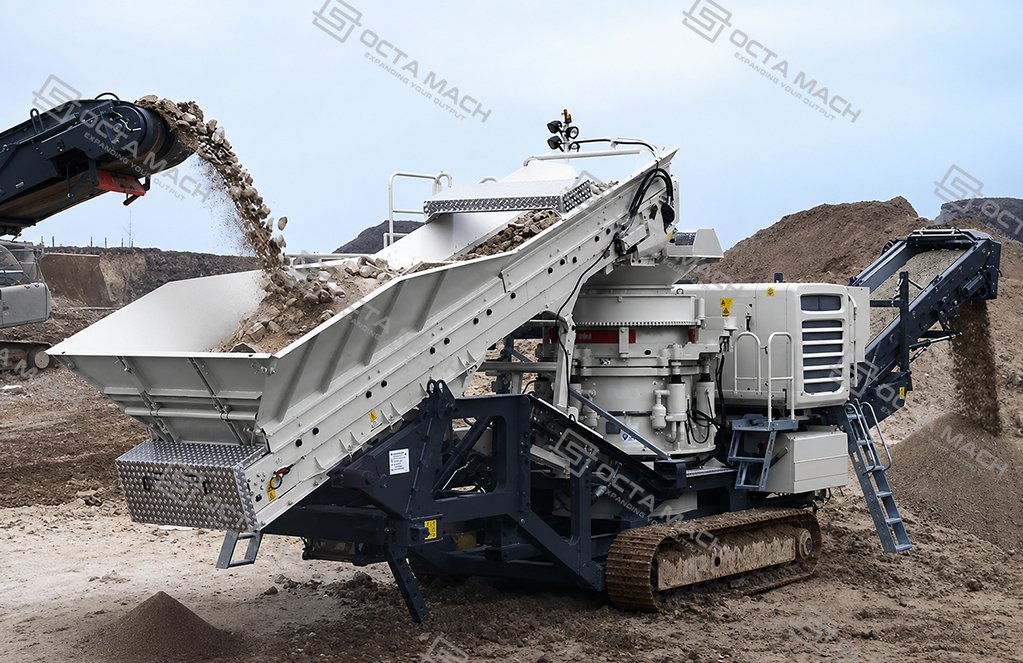
How a Mobile Cone Crusher Plant Works
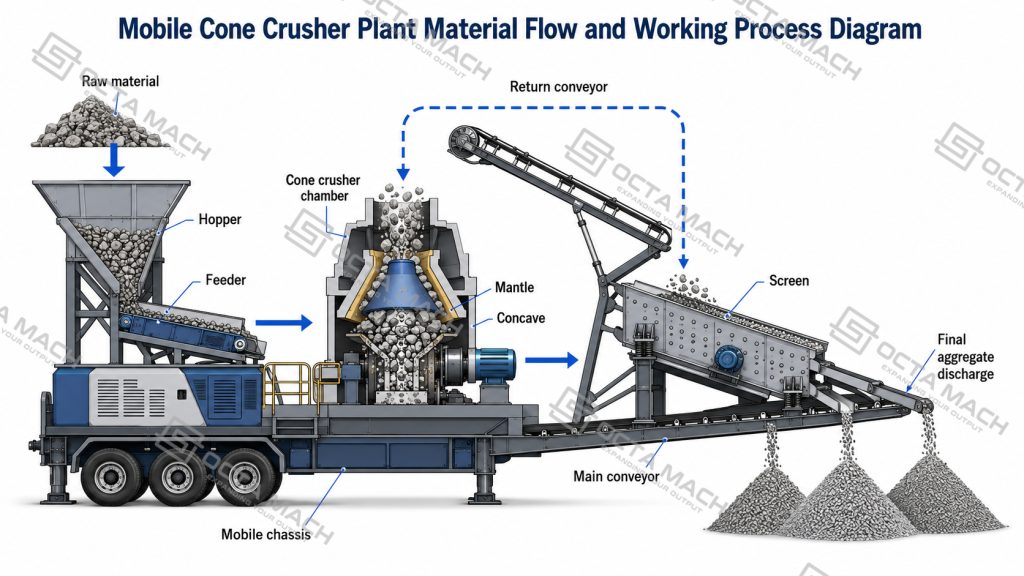
The cone crusher reduces material by compression between a moving mantle and a fixed concave. An eccentric mechanism causes the mantle to move continuously toward and away from the concave. Material is repeatedly compressed as it travels downward through the crushing chamber and is discharged after reaching a size smaller than the selected crusher setting.
In a complete mobile crushing plant, the material normally follows this process:
- Pre-crushed material enters the plant through the feeding conveyor.
- Material is evenly distributed into the cone crusher.
- The mantle and concave compress the material inside the crushing chamber.
- Crushed material is transferred to a product conveyor or vibrating screen.
- Qualified products are discharged, while oversized particles can be returned for further crushing in a closed circuit.
Stable operation requires a continuous and evenly distributed feed. Oversized lumps, segregated feed, or insufficient chamber loading may reduce output, create unstable power demand, and cause uneven liner wear. For this reason, the cone crusher normally receives controlled material from a jaw crusher or another primary crushing stage rather than untreated run-of-mine rock.
Mobile Cone Crusher Plant Technical Parameters
The following published model data provide an initial reference for comparing cone crusher models, maximum feed size, nominal capacity, screening equipment, and transport dimensions.
| Standard Model | Corollary Equipment | Cone Crusher Model | Maximum Feed Size (mm) | Capacity (t/h) | Transport Dimensions (mm) |
|---|---|---|---|---|---|
| S-CS75 | 3YZK1848 | CS75 | ≤160 | 59–163 | 12600 × 2800 × 4400 |
| S-CS110 | 3YZK1860 | CS110 | ≤178 | 100–200 | 13800 × 3000 × 4400 |
| S-CS160 | 3YZK2160 | CS160 | ≤188 | 132–253 | 13800 × 3000 × 4400 |
| S-CS220 | 3YZK2160 | CS220 | ≤230 | 215–330 | 14500 × 3000 × 4500 |
| S-Q300 | 3YZK1848 | SQ300 | ≤160 | 105–205 | 12600 × 2800 × 4400 |
| S-Q400 | 3YZK1860 | SQ400 | ≤230 | 235–575 | 13800 × 3000 × 4400 |
| S-Q500 | 3YZK2160 | SQ500 | ≤240 | 304–640 | 14500 × 3000 × 4600 |
| S-H420 | 3YZK1848 | SH420 | ≤240 | 85–170 | 12600 × 2900 × 4400 |
| S-H430 | 3YZK1860 | SH430 | ≤360 | 120–345 | 13800 × 3000 × 4500 |
| S-H440 | 3YZK2160 | SH450 | ≤450 | 255–605 | 14800 × 3200 × 4600 |
| S-HP100 | 3YZK1860 | SHP100 | ≤140 | 75–140 | 13800 × 2900 × 4300 |
| S-HP200 | 3YZK2160 | SHP200 | ≤185 | 145–250 | 14200 × 3000 × 4500 |
| S-HP300 | 3YZK2160 | SHP300 | ≤230 | 220–440 | 16500 × 3200 × 4600 |
The values in the table should be used for preliminary model comparison rather than as fixed production guarantees. Actual output varies with feed-size distribution, rock hardness, abrasiveness, moisture, fines and clay content, crushing-chamber type, closed-side setting, liner condition, screen aperture, and circulating load.
Maximum feed size must be verified against the selected crushing chamber. A model with sufficient nominal capacity may still be unsuitable if the largest feed particles exceed the allowable chamber opening.
Transport dimensions should also be reviewed against local road regulations, bridge and tunnel clearances, site access, and lifting conditions. When frequent relocation is required, transportability can be as important as nominal crushing capacity.
Main Components and Plant Configuration
A mobile cone crusher plant is a coordinated production unit rather than simply a cone crusher mounted on a chassis. Its principal components include the crushing unit, feeding and discharge conveyors, hydraulic and lubrication systems, electrical controls, mobile chassis, and optional screening and return-conveyor modules.
The crushing unit contains the mantle, concave, main shaft, eccentric assembly, and replaceable liners. Its hydraulic system supports discharge-setting adjustment, overload protection, and cavity clearing, while the lubrication system protects bearings and other moving components during continuous operation.
An open-circuit mobile cone crusher discharges crushed material without returning oversize to the crusher. It is suitable when screening is handled by a separate plant or when the cone crusher prepares material for another processing stage.
A closed-circuit mobile cone crusher plant combines crushing, screening, and oversize return. Qualified material leaves the circuit, while screen oversize returns to the crusher. This arrangement provides better control of the final top size, but the crusher, screen, conveyors, and return system must be selected for the total circulating load—not only the finished-product capacity.
Crawler-mounted and wheel-mounted configurations are available for different site and relocation requirements. Power may be supplied by an external electrical connection, a diesel-powered system, or a combined arrangement, depending on the selected model and available site utilities.
Mobile Cone Crusher Applications
Mobile cone crushers are built for secondary and tertiary crushing of medium-hard to hard, abrasive materials with compressive strength above 150 MPa. If your material falls below this threshold, an impact crusher is usually more cost-effective.
Typical applicable materials:
· Granite (150–250 MPa), Basalt (200–350 MPa), Diabase (200–300 MPa)
· Iron ore, copper ore, manganese ore (150–300 MPa)
· River pebbles (150–250 MPa), Limestone (50–150 MPa – acceptable)
Key technical parameters you should know:
· Capacity range: 65–900 t/h (most common mid-range: 150–450 t/h)
· Max feed size: 185–400 mm (must be pre-crushed by a jaw crusher)
· Output size: adjustable 8–52 mm via Closed Side Setting (CSS)
· Unit weight: 34–111 t
Where it’s used :
· Mining – crushes ore at the extraction face, cutting haulage costs by 30–40%
· Aggregates – produces cubic-shaped material for concrete/asphalt, with low flaky particle content
· CDW recycling – processes concrete rubble with optional magnetic separator for rebar removal
· Infrastructure – on-site crushing for dams, tunnels, highways, eliminating material transport
Quick selection tips :
- Material hardness >150 MPa? → Cone is your only efficient choice.
- Need closed-circuit to guarantee final size? → Choose a unit with integrated screen and return conveyor.
- Frequent site moves? → Track-mounted models pay back the premium in under 18 months through zero foundations and reduced logistics.
Advantages of a Mobile Cone Crusher Plant
A mobile cone crusher combines the wear resistance of compression crushing with the operational flexibility of mobile equipment. It is particularly suitable for hard-rock applications in which impact crushing may result in excessive blow-bar and impact-plate wear.
Because the crushing unit can operate closer to the quarry face or project work area, the plant may reduce haul-truck travel and the need for permanent foundations. This makes it suitable for quarry development, temporary aggregate projects, staged mining operations, and sites where the working position changes over time.
The plant can be configured for open-circuit crushing, closed-circuit crushing and screening, or modular operation with separate jaw-crushing and screening units. Hydraulic setting adjustment, overload protection, and cavity clearing can reduce manual intervention during routine adjustment and blockage recovery, subject to the control system fitted to the selected model.
However, production performance depends on the complete system. An undersized screen, restricted transfer chute, narrow conveyor, or insufficient return capacity can limit the plant even when the cone crusher itself has adequate nominal output.
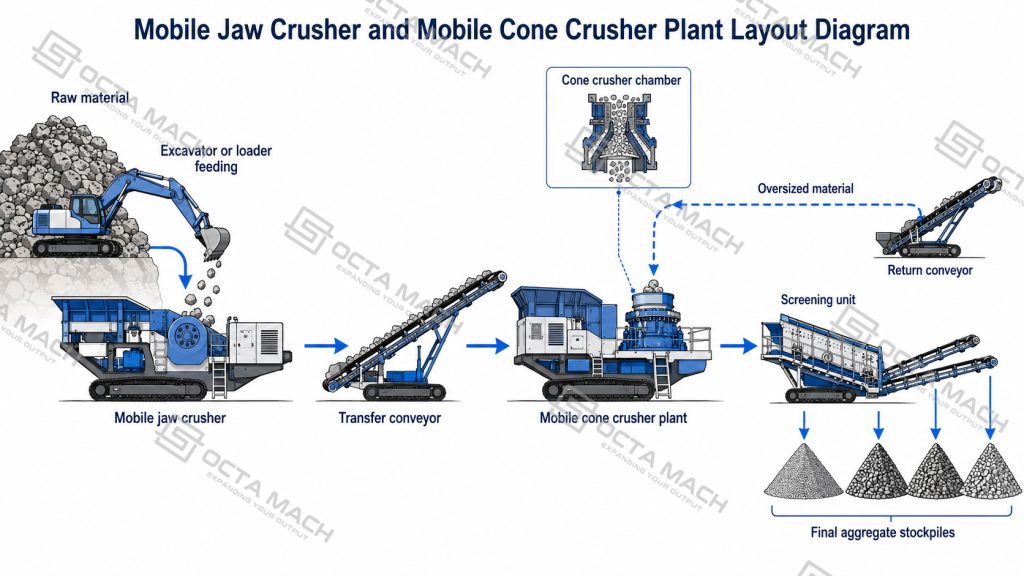
How to Select a Mobile Cone Crusher Plant
Selection should begin with the actual discharge produced by the upstream primary crusher. Both the maximum lump size and the complete feed-size distribution must be considered when choosing the crushing chamber. Required capacity should be stated as the continuous production rate under normal material conditions rather than only as a short-term peak figure.
The target product sizes determine the crusher setting, chamber profile, screening arrangement, and whether a closed circuit is necessary. Where several finished fractions or strict top-size control are required, screen area and return-conveyor capacity must be evaluated together with the cone crusher.
Before confirming a model and configuration, the following information should be provided:
- Material type, hardness, abrasiveness, bulk density, moisture, clay content, and maximum feed size
- Complete feed-size distribution and upstream crusher discharge size
- Required continuous capacity, peak feed rate, and operating hours
- Required final sizes, number of product fractions, and permitted oversize
- Secondary or tertiary crushing duty and open- or closed-circuit requirement
- Site voltage, frequency, altitude, ambient conditions, and preferred power arrangement
- Access-road limits, transport restrictions, relocation frequency, and foundation conditions
- Required wear parts, spare parts, technical documentation, installation, and commissioning support
For a closed-circuit plant, the screen and conveyors must be sized for the total material flow, including returned oversize. The return load can be affected by feed grading, screen aperture, crusher setting, and required product specification.
Price comparisons should therefore cover the complete supply scope. Two plants with similar advertised capacities may differ considerably in crushing chamber, screen size, conveyor width, control system, power arrangement, wear-part supply, and technical support. The largest crusher or motor does not automatically provide the most suitable production result.
FAQ
Q: What is a mobile cone crusher plant used for?
A: It is mainly used for secondary and tertiary crushing of medium-hard to hard materials after primary reduction. Typical applications include quarry aggregate production, ore preparation, roadstone processing, and controlled feed preparation for screening or sand making.
Q: Can a mobile cone crusher process large raw stone directly?
A: Normally, no. A cone crusher should receive controlled feed from a jaw crusher or another primary crusher. The maximum feed lump must remain within the allowable size of the selected crushing chamber.
Q: What is the difference between a mobile cone crusher and a mobile impact crusher?
A: A cone crusher reduces material through compression and is generally more suitable for hard, abrasive rock. An impact crusher uses high-speed impact and is commonly selected for softer materials, recycling duties, or applications where particle shaping is a primary requirement.
Q: When should a closed-circuit mobile cone crusher plant be used?
A: A closed circuit is suitable when screening is required to control the final top size or produce specified aggregate fractions. Qualified material is discharged, while oversize returns to the cone crusher. The crusher, screen, conveyors, and return circuit must be sized as one complete system.