
Mining Drilling Rig systems are used to drill blast holes in rock for mining operations. Hydraulic drilling generates percussion inside the hydraulic rock drill and transfers impact energy through the drill rods to the bit, while Down-the-Hole (DTH) drilling uses a compressed-air-powered hammer positioned directly above the bit to break rock at the bottom of the borehole. Both methods combine impact, rotation and feed to advance the drill bit, with their drilling capabilities determined by the drilling system, hole diameter, drilling depth and rock conditions.
OCTA MACH offers three types of mining drilling rigs: Hydraulic Mining Drill Rig, Conventional DTH Drilling Rig and Intelligent DTH Drilling Rig. The range covers different hole diameters, drilling depths and equipment configurations. The Hydraulic Mining Drill Rig features a hydraulic rock drilling system, while the two DTH models are designed around pneumatic percussion drilling. The Intelligent DTH Drilling Rig additionally incorporates an automatic drill rod handling system, an onboard drill rod magazine and intelligent control functions to support automated drilling operations.
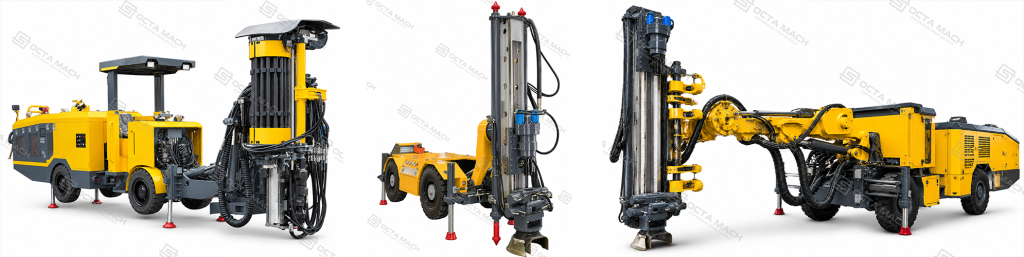
Hydraulic Mining Drill Rig Technical Specifications
The Hydraulic Mining Drill Rig consists of a self-propelled carrier, a hydraulically operated drilling boom and feed assembly, a hydraulic rock drill, and drill rods and bits. During drilling, the hydraulic rock drill generates percussion and transfers impact energy through the drill rod to the bit. The rotation and feed systems work together to turn and advance the bit into the rock, forming blast holes for mining operations.
The Hydraulic Mining Drill Rig is available in three configurations with different machine dimensions and drilling capacities. The main differences include hole diameter, drill rod length, drilling depth, impact power, and rotation torque. The following technical drawings and tables present the dimensional specifications and operating parameters of each configuration.
Machine Dimensions
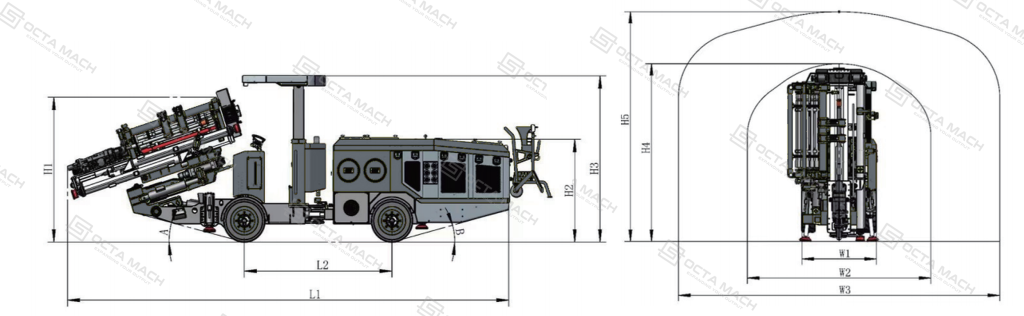
| Configuration | L1 (mm) | L2 (mm) | A (°) | B (°) | H1 (mm) | H2 (mm) | H3 (mm) | H4 (mm) |
|---|---|---|---|---|---|---|---|---|
| Configuration 1 | 5380 | 1660 | 16 | 15 | 2000 | 1650 | — | 2800 |
| Configuration 2 | 7490 | 2500 | 15 | 15 | 2370 | 1780 | 1885 | 3200 |
| Configuration 3 | 8500 | 2800 | 15 | 15 | 2480 | 1900 | 2100 | 3600 |
| Configuration | H5 (mm) | W1 (mm) | W2 (mm) | W3 (mm) | W4 (mm) | Machine Weight |
|---|---|---|---|---|---|---|
| Configuration 1 | 3550 | 980 | 2220 | 5320 | 3500 | 8200 |
| Configuration 2 | 4100 | 1300 | 3200 | 5600 | 4200 | 11800 |
| Configuration 3 | 4400 | 1750 | 3600 | 6800 | 6000 | 13000 |
Performance Specifications
| Category | Parameter | Unit | Configuration 1 | Configuration 2 | Configuration 3 |
|---|---|---|---|---|---|
| Operating Parameters | Working Range | m² | 2.5 × 3.0–5.3 × 3.5 | 3.2 × 3.2–5.6 × 4.1 | 3.6 × 3.6–6.8 × 4.4 |
| Hole Diameter | mm | 64–76 | 64–76 | 76–102 | |
| Drill Rod Length | mm | 915 | 1,220 | 1,550 | |
| Drilling Depth | m | 16 | 29 | 42 | |
| Rock Drill Parameters | Impact Power | kW | 18 | 22 | 25 |
| Impact Pressure | bar | 170–210 | 170–210 | 170–210 | |
| Rotation Torque | N·m | 1,050 | 1,550 | 1,670 | |
| Travel Parameters | Outer Turning Radius | mm | — | 5,100 | 5,100 |
| Inner Turning Radius | mm | — | 3,600 | 3,400 | |
| Steering Angle | ° | — | 33 | 40 | |
| Travel Speed | km/h | 5 | 5 | 12 | |
| Power Parameters | Main Motor Power | kW | 55 | 75 | 75 |
| Voltage | V | 380 (Optional: 660 / 1,000 / 1,140) | 380 (Optional: 660 / 1,000 / 1,140) | 380 (Optional: 660 / 1,000 / 1,140) | |
| Diesel Engine Power | kW | — | 66 | 66 |
These specifications show how drilling capacity and machine configuration vary across the three options. Hole diameter, drill rod length, drilling depth, impact power and rotation torque define the main drilling capabilities, while machine dimensions, weight and turning radius affect equipment access and positioning at the work site. Configuration selection should therefore account for the required hole specifications, available working clearance and site power supply.
DTH Drilling Rig Technical Specifications
Both the Conventional DTH Drilling Rig and the Intelligent DTH Drilling Rig use the same basic Down-the-Hole (DTH) drilling method. Compressed air passes through the hollow drill rods to operate a hammer positioned directly above the drill bit at the bottom of the borehole. The hammer piston repeatedly strikes the bit to break the rock, while the rig’s rotation and feed systems advance the drill string. Exhaust air carries rock cuttings back to the surface through the annular space between the drill rods and borehole wall. The main differences between the two rigs lie in their machine structures, drill rod handling systems and level of operational automation.
Conventional DTH Drilling Rig
The Conventional DTH Drilling Rig is built around a mobile carrier, drilling feed assembly and rotary power head. Its four configurations include standard, low-profile, standard self-propelled and low-profile self-propelled arrangements to accommodate different equipment access and mobility requirements. The drilling assembly features a bidirectional shock-absorbing power head to reduce the transmission of impact and rotary vibrations to the machine, along with a dust-collection hood designed to limit the escape of rock cuttings during drilling.
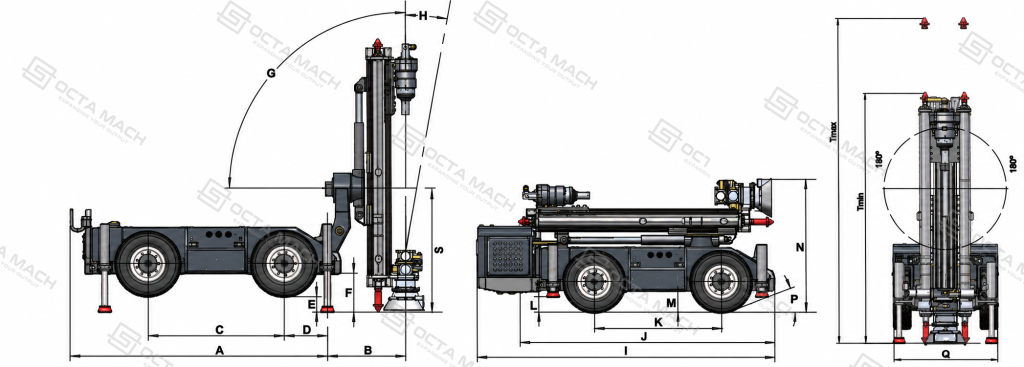
| Parameter | Standard Configuration | Low-Profile Configuration | Standard Self-Propelled Configuration | Low-Profile Self-Propelled Configuration |
|---|---|---|---|---|
| Tmin (mm) | 3,393 | 2,800 | 3,393 | 2,800 |
| Tmax (mm) | 5,223 | 4,230 | 5,223 | 4,230 |
| Machine Weight (t) | 4.5 | 4.2 | 5.5 | 5.2 |
| Length (mm) | 3,440 | 3,440 | 3,956 | 3,956 |
| A (mm) | B (mm) | C (mm) | D (mm) | E (mm) | F (mm) | G (°) | H (°) | I (mm) |
|---|---|---|---|---|---|---|---|---|
| 3340 | 929 | 1700 | 545 | 192 | 492 | 90 | 10 | 3956 |
| J (mm) | K (mm) | L (mm) | M (mm) | N (mm) | P (°) | Q (mm) | S (mm) |
|---|---|---|---|---|---|---|---|
| 3440 | 1700 | 209 | 300 | 1789 | 21 | 1400 | 1525 |
Performance Specifications
| Category | Parameter | Unit | Value |
|---|---|---|---|
| Operating Parameters | Air Pressure | MPa | 0.6–2.4 |
| Hole Diameter | mm | 76–165 | |
| Drilling Depth | m | 0–100 | |
| Drilling Angle | ° | −10 to 90 | |
| Rotation Parameters | Rated Rotation Torque | kN·m | 4.5 |
| Peak Rotation Torque | kN·m | 7.2 | |
| Rotation Speed | rpm | 0–28 | |
| Feed Parameters | Feed Force | kN | 0–81 |
| Back Pull Force | kN | 0–81 | |
| Feed Stroke | mm | Standard: 1,865 / Optional: 1,365 | |
| Travel Parameters | Travel Speed | km/h | 0–2.5 |
| Maximum Gradeability | ° | 14 | |
| Ground Clearance | mm | 209 | |
| Power Parameters | Voltage | V | Standard: 380 (Optional: 660 / 1000 / 1140) |
| Electric Motor Power | kW | 22 | |
| Diesel Engine Power | kW | 36 |
Intelligent DTH Drilling Rig
The Intelligent DTH Drilling Rig integrates a robotic drill rod handling system, an onboard automatic drill rod magazine and an intelligent control system. A multi-axis hydraulic handling mechanism performs drill rod pickup, transfer and connection, reducing the need for manual rod handling. The onboard control system supports automated drilling functions, including positioning, anti-jamming and drilling operation management. An integrated air compressor supplies compressed air to the DTH hammer, eliminating the need for a separate compressor trailer when the onboard system meets the project’s air supply requirements.
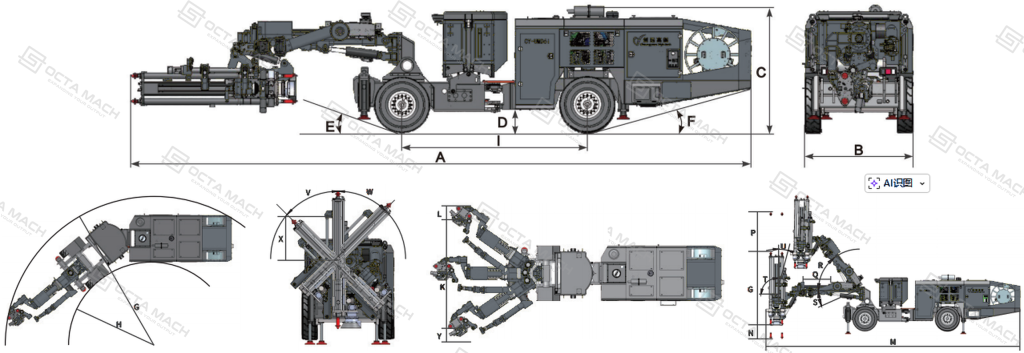
| Equipment | A (mm) | B (mm) | C (mm) | D (mm) | E (°) | F (°) | G (mm) | H (mm) |
|---|---|---|---|---|---|---|---|---|
| Intelligent DTH Drilling Rig | 11,669 | 2,200 | 2,400 | >300 | 16 | 16 | 7,050 | 4,133 |
| Equipment | I (mm) | J (mm) | K (mm) | L (mm) | Y (mm) | M (mm) | N (mm) | P (mm) |
|---|---|---|---|---|---|---|---|---|
| Intelligent DTH Drilling Rig | 3,810 | 500 | 600 | 700 | 500 | 12,996 | 620 | 1,830 |
| Q (mm) | R (°) | S (°) | T (°) | U (°) | V (°) | W (°) | X (mm) |
|---|---|---|---|---|---|---|---|
| 1,250 | 55 | 24 | 90 | 13 | 45 | 45 | 1,030 |
Performance Specifications
| Category | Parameter | Unit | Value |
|---|---|---|---|
| Overall Parameters | Machine Weight | t | 23.3 |
| Operating Parameters | Air Pressure | MPa | 0.8–1.8 |
| Hole Diameter | mm | 76–165 | |
| Drilling Depth | m | 0–60 | |
| Drilling Angle | ° | 0–90 | |
| Maximum Parallel-Hole Spacing | mm | 6,000 | |
| Minimum Wall Clearance | mm | 500 | |
| Feed Parameters | Feed Force | kM | 0–80 |
| Back Pull Force | kN | 0–80 | |
| Feed Beam Total Length | mm | 2,700 | |
| Feed Stroke | mm | 1,865 | |
| Rotation Parameters | Drill Rod | mm | 89 / 114 |
| Rated Torque | kN·m | 4.5 | |
| Peak Torque | kN·m | 7.2 | |
| Rotation Speed | rpm | 0–36 | |
| Travel Parameters | Ground Clearance | mm | greater than 300 |
| Departure Angle / Approach Angle | ° | 16 / 16 | |
| Maximum Gradeability | ° | 14 | |
| Travel Speed | km/h | 0–10 | |
| Steering Angle | ° | ±40 | |
| Power Parameters | Diesel Engine Power | kW | 96 |
| Voltage | V | 380 | |
| Electric Motor Power | kW | 55 | |
| Air Compressor | Rated Power | kW | 160 |
| Nominal Volumetric Flow Rate | m³/min | 18 | |
| Rated Discharge Pressure | bar | 18 |
Both DTH drilling rigs use the same down-the-hole percussion method but offer different equipment arrangements to meet varying operational requirements. The Conventional DTH Drilling Rig provides four configurations to accommodate different working clearances and mobility requirements, while the Intelligent DTH Drilling Rig integrates robotic drill rod handling, an onboard rod magazine, intelligent control functions and an air compressor into one machine. The choice between these two rigs depends on the required hole diameter and drilling depth, site access conditions, equipment mobility, power and air supply requirements, and the desired level of automation in drilling operations.
How to Choose the Right Mining Drilling Rig
Selecting the right mining drilling rig involves more than comparing equipment specifications. The drilling method, geological conditions, hole requirements, available working space, power supply and level of automation all influence the choice of equipment. Each factor should be evaluated against the actual drilling conditions and project requirements.
| Selection Factor | What to Consider | Selection Guidelines |
|---|---|---|
| Drilling Method | Hydraulic rock drilling or Down-the-Hole (DTH) drilling | Determine the required drilling method according to the drilling operation, rock conditions and project requirements. Hydraulic rigs use a hydraulic rock drill to generate impact energy, while DTH rigs use a hammer positioned close to the drill bit. |
| Hole Requirements | Hole diameter, drilling depth and hole specifications | Confirm the required hole dimensions and drilling schedule before selecting a configuration. The drill bit, drill rod, hammer or hydraulic rock drill must match the intended hole specifications. |
| Geological Conditions | Rock hardness, abrasiveness, fractures and groundwater conditions | Assess the actual rock formation and its variations. These conditions influence drilling tool selection, impact requirements, flushing arrangements and tool wear. |
| Working Space | Available operating area, equipment dimensions and access clearance | Check the machine’s overall dimensions, turning space, drilling unit movement and required operating clearance. Low-profile or more compact configurations may be necessary where equipment height or access is restricted. |
| Drilling Tools Compatibility | Drill rods, drill bits, hammer and connection specifications | Confirm that all drilling components are compatible with the selected drilling system. For DTH equipment, particular attention should be paid to hammer, bit and drill rod connections. |
| Power and Air Supply | Electrical supply, diesel power and compressed-air availability | Verify the site’s available power supply and equipment requirements. DTH drilling requires sufficient compressed-air pressure and flow, which must be checked together rather than considering pressure alone. |
| Automation Requirements | Drill rod handling, positioning and drilling control | Consider whether conventional operating arrangements are sufficient or whether robotic drill rod handling, an automatic rod magazine and intelligent control functions are required. |
| Maintenance and Mobility | Equipment transportation, maintenance access and spare parts | Evaluate transportation restrictions, service accessibility, replacement tool availability and the maintenance resources available at the project site. |
The most suitable mining drilling rig is the one that matches the project’s drilling method, hole requirements, geological conditions and site constraints. Equipment capacity should be evaluated together with drilling tool compatibility, supporting utilities and operating requirements, rather than relying on a single specification such as maximum drilling depth.
Mining Drilling Rig Applications
The three mining drilling rig configurations are designed for different drilling tasks. Their applications depend on the required hole arrangement, drilling conditions, available working space and equipment requirements.
Hydraulic Mining Drill Rig for Medium- and Deep-Hole Mining
The Hydraulic Mining Drill Rig is suitable for medium- and deep-hole drilling in mining sections where multiple holes need to be arranged across different positions and directions. Its rotating drilling frame allows the drilling unit to cover different positions within the working section, reducing the need to reposition the carrier for every hole. The compact self-propelled design is particularly useful in mining areas where maneuverability and limited operating space are important considerations.
Conventional DTH Drilling Rig for Large-Diameter Mining Holes
The Conventional DTH Drilling Rig is suitable for mining operations requiring large-diameter boreholes and different drilling orientations. Its standard and low-profile configurations provide options for sites with different access heights and equipment clearance requirements. It can be considered for projects where conventional DTH drilling is sufficient and equipment selection is primarily determined by hole specifications, working conditions and available operating space.
Intelligent DTH Drilling Rig for Repetitive Drilling Operations
The Intelligent DTH Drilling Rig is designed for mining projects involving repeated drilling cycles, particularly where frequent drill rod changes and large drilling coverage are required. Its automated rod-handling arrangement reduces manual intervention during drilling operations, making it suitable for projects where operational automation and reduced manual handling are important considerations. The integrated air supply also provides a more self-contained equipment arrangement for sites where compressed-air supply needs to be considered as part of equipment deployment.
Mining Drilling Rig Solutions from OCTA MACH
OCTA MACH offers three types of mining drilling rigs, covering hydraulic rock drilling, conventional DTH drilling and intelligent DTH drilling systems. Each configuration is designed to address different drilling requirements, from hydraulic medium- and deep-hole drilling to large-diameter DTH drilling and automated drilling operations. Based on the project’s hole specifications, geological conditions, working space and equipment requirements, OCTA MACH can help evaluate suitable equipment configurations and compatible drilling systems. Customers can share their drilling requirements, project drawings and site conditions with our team to discuss the appropriate mining drilling rig for their operations.
FAQ
Q:What is the difference between a hydraulic mining drill rig and a DTH drilling rig?
A: A hydraulic mining drill rig generates percussion through a hydraulic rock drill and transfers impact energy through the drill rod to the bit. A DTH drilling rig uses a compressed-air-powered hammer positioned directly behind the bit at the bottom of the borehole. The two methods differ in impact delivery and drilling system configuration.
Q:What is the difference between conventional and intelligent DTH drilling rigs?
A: Both use the same Down-the-Hole drilling principle. A conventional DTH rig uses a standard drilling arrangement, while an intelligent DTH rig adds robotic drill rod handling, an onboard rod magazine, intelligent positioning and drilling control functions, and an integrated air compressor. The main difference is the level of automation and equipment integration.
Q:What factors affect the actual drilling performance of a mining drilling rig?
A: Drilling performance depends on hole diameter, drilling depth, rock hardness and abrasiveness, drill bit selection, and the compatibility of the drilling tools and power system. For DTH rigs, sufficient compressed-air pressure and flow are also essential for hammer operation and effective removal of rock cuttings.
Q:Does a DTH drilling rig require a separate air compressor?
A: It depends on the equipment configuration. The Intelligent DTH Drilling Rig described here has an integrated onboard air compressor. For conventional DTH configurations, the compressor arrangement should be confirmed before ordering. In either case, the available air pressure and flow must match the selected DTH hammer’s operating requirements.