
A rotary blasthole drill rig is a heavy-duty surface drilling machine designed to create production blast holes in open-pit mines, quarries and large-scale mining operations. It uses a roller-cone drilling system to penetrate rock formations through controlled rotary torque and axial loading, while compressed air removes drilled cuttings from the borehole. Unlike down-the-hole (DTH) drilling equipment, which relies on a pneumatic or hydraulic hammer to deliver repeated impacts, a roller-cone drill rig transfers rotational force through the drill string to break rock at the bottom of the hole using rotating cones fitted with cutting elements.
Rotary blasthole drill rigs are designed for surface mining operations requiring large-diameter drilling, extended hole depths and reliable performance under demanding environmental conditions. Available configurations cover hole diameters from 140 to 380 mm, with maximum drilling depths reaching 52.2 m, depending on the equipment configuration. The drilling system is designed for rock formations with a Protodyakonov hardness coefficient of f4–f20 and ambient temperatures ranging from −40°C to +50°C. Drilling angle, mast configuration and power supply can also be selected according to individual mining site requirements.
The drilling system integrates a rotary head, drill pipe assembly, hydraulic feed mechanism, roller-cone bit and high-volume air compressor. During operation, the rotary head transfers torque through the drill pipes, while the feed system applies controlled axial force to maintain the required bit loading. Compressed air passes through the drill string and exits through the bit nozzles, carrying fragmented rock upward through the annular space between the drill pipe and borehole wall. The coordination of these systems determines penetration performance, drilling stability and cuttings removal efficiency, particularly when working in hard or abrasive formations.
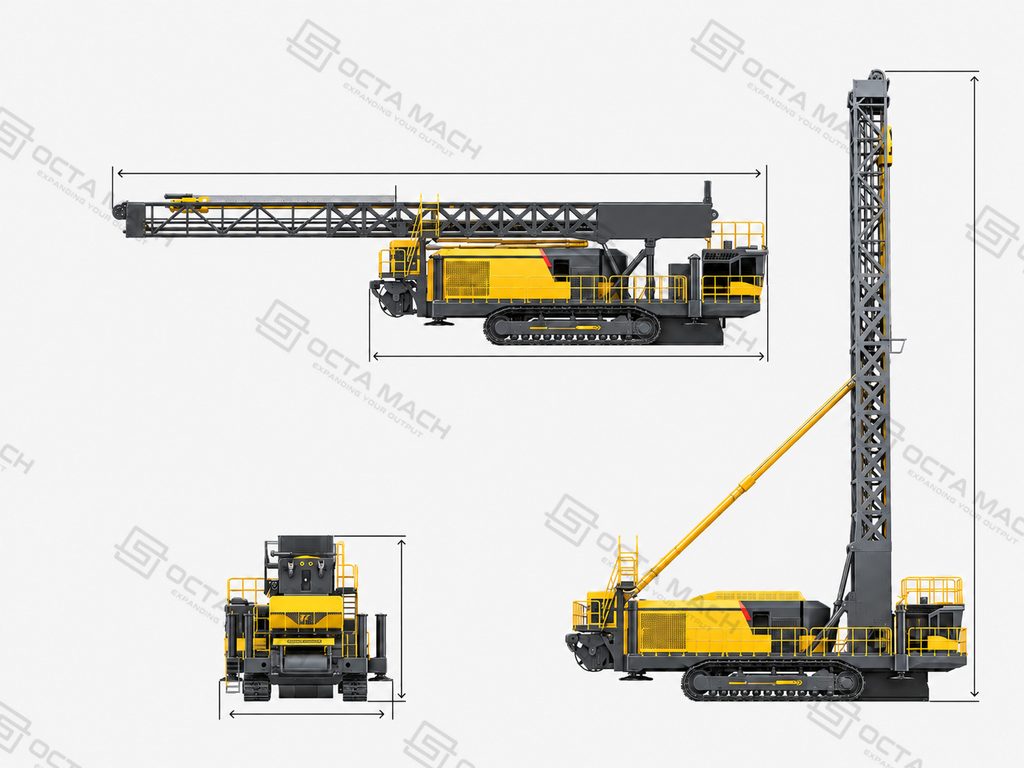
Rotary Blasthole Drill Rig at a Glance
| Technical Item | Specification |
|---|---|
| Drilling Method | Rotary Roller-Cone Drilling |
| Equipment Type | Crawler-Mounted Surface Mining Drill Rig |
| Hole Diameter | 140–380 mm |
| Maximum Hole Depth | 45–52.2 m, depending on model |
| Rock Hardness | Protodyakonov coefficient f4–f20 |
| Drilling Angle | 60°–90° |
| Ambient Temperature | -40°C to +50°C |
| Compressor Air Volume | 40, 60 or 85 m³/min |
| Power Configuration | Diesel or electric, with optional auxiliary diesel power on selected configurations |
| Main Applications | Open-Pit Mining, Production Blasting and Surface Rock Drilling |
Rotary Blasthole Drill Rig Models and Technical Specifications
Rotary blasthole drill rigs are available in multiple configurations to meet different drilling requirements in open-pit mines and large-scale quarry operations. These machines use roller-cone drilling technology, with variations in hole diameter, drilling depth, compressor capacity, hydraulic performance and power systems.
The equipment is available in diesel-powered and electric-powered configurations. Diesel-powered rigs provide greater flexibility for mining sites with limited electrical infrastructure, while electric-powered rigs are suitable for operations with a stable power supply. Selected electric configurations can also be equipped with an auxiliary diesel power unit to support operation under different site conditions.
Rotary Blasthole Drill Rig Technical Specifications
| Parameter | Unit | 140–225 mm Diesel | 140–225 mm Electric | 200–270 mm Diesel | 200–270 mm Electric | 270–380 mm Diesel | 270–380 mm Electric |
|---|---|---|---|---|---|---|---|
| Drilling method | – | Roller cone | Roller cone | Roller cone | Roller cone | Roller cone | Roller cone |
| Hole diameter | mm | 140–225 | 140–225 | 200–270 | 200–270 | 270–380 | 270–380 |
| Single-pass hole depth | m | 8.6 | 8.6/17.7 | 9.4 | 9.4/20.1 | 9.6 | 9.6/19.6 |
| Maximum hole depth | m | 45 | 45 | 52.2 | 52.2 | 49.6 | 49.6 |
| Drilling angle | ° | 60–90 | 60–90 | 60–90 | 60–90 | 60–90 | 60–90 |
| Drill pipe length | m | 9.1 | 9.1 | 10.7 | 10.7 | 10 | 10 |
| Drill pipe diameter | mm | 102–178 | 102–178 | 159–219 | 159–219 | 219–324 | 219–324 |
| Drill pipe magazine | pcs | 4+1 | 4+1 | 4+1 | 4+1 | 4+1 | 4+1 |
The single-pass hole depth and maximum hole depth represent different drilling capabilities. Single-pass depth refers to the depth achieved with the initial drill pipe arrangement, while maximum hole depth represents the total drilling capacity when additional drill pipes are connected during multi-pass drilling.
Air Compressor and Hydraulic Feed System
Compressed air is essential for removing rock cuttings from the borehole during rotary drilling. The required airflow and discharge pressure depend on the drilling diameter, penetration conditions and cuttings removal requirements.
| Parameter | Unit | 140–225 mm Diesel | 140–225 mm Electric | 200–270 mm Diesel | 200–270 mm Electric | 270–380 mm Diesel | 270–380 mm Electric |
|---|---|---|---|---|---|---|---|
| Compressor pressure | bar | 8 | 8 | 8 | 8 | 5 | 5 |
| Air volume | m³/min | 40 | 40 | 60 | 60 | 85 | 85 |
| Feed speed | m/min | 0–48 | 0–48 | 0–27 | 0–27 | 0–20 | 0–20 |
| Feed force | kN | 0–230 | 0–230 | 0–350 | 0–350 | 0–480 | 0–480 |
| Axial pressure | kN | 0–252 | 0–252 | 0–380 | 0–380 | 0–520 | 0–520 |
| Pullback force | kN | 0–110 | 0–110 | 0–160 | 0–160 | 0–250 | 0–250 |
| Pullback speed | m/min | 0–70 | 0–70 | 0–48 | 0–48 | 0–42 | 0–42 |
The hydraulic feed system controls the downward movement of the drill string and the axial force applied during drilling. Feed speed and force must be adjusted according to rock hardness, bit characteristics and operating conditions. Excessive feed force can increase bit loading and mechanical stress, while insufficient force may reduce penetration efficiency.
Rotary, Travel and Power Specifications
| Parameter | Unit | 140–225 mm Diesel | 140–225 mm Electric | 200–270 mm Diesel | 200–270 mm Electric | 270–380 mm Diesel | 270–380 mm Electric |
|---|---|---|---|---|---|---|---|
| Rotation speed | rpm | 0–200 | 0–200 | 0–145 | 0–145 | 0–145 | 0–145 |
| Rotary torque | kN·m | 0–15 | 0–15 | 0–25 | 0–25 | 0–35 | 0–35 |
| Travel speed | km/h | 0–2.1 | 0–2.1 0–1.1 | 0–1.4/2.3 | 0–1.4/2.3 0–0.7/1.1 | 0–1.0/1.5 | 0–1.0/1.5 0–0.7/1.1 |
| Climbing ability | ° | 20 | 20 | 14 | 14 | 14 | 14 |
| Ground pressure | kPa | 103 | 103 | 122 | 122 | 144 | 144 |
| Installed power | kW | 566 | 450 | 670 | 655 | 1118 | 800 |
| Machine weight | t | 40–48 | 40–50 | 110–120 | 110–130 | 168–178 | 168–178 |
Operating Environment and Configuration Options
| Parameter | Diesel-Powered Configurations | Electric-Powered Configurations |
|---|---|---|
| Maximum operating elevation | Below 3,500 m | Below 5,400 m |
| Ambient temperature | -40°C to +50°C | -40°C to +50°C |
| Rock hardness | Protodyakonov coefficient f4–f20 | Protodyakonov coefficient f4–f20 |
The equipment can be configured with high or low masts, inclined drilling capability within the specified 60°–90° range, and a low-temperature heating system. Electric models can also be equipped with an optional diesel power unit.
How Does a Rotary Blasthole Drill Rig Work?
A rotary blasthole drill rig breaks rock through the combined action of rotary torque and axial drilling force. The rotary head transfers torque through the drill string, while the hydraulic feed system applies controlled axial loading to the roller-cone bit. The drilling process consists of four coordinated operations.
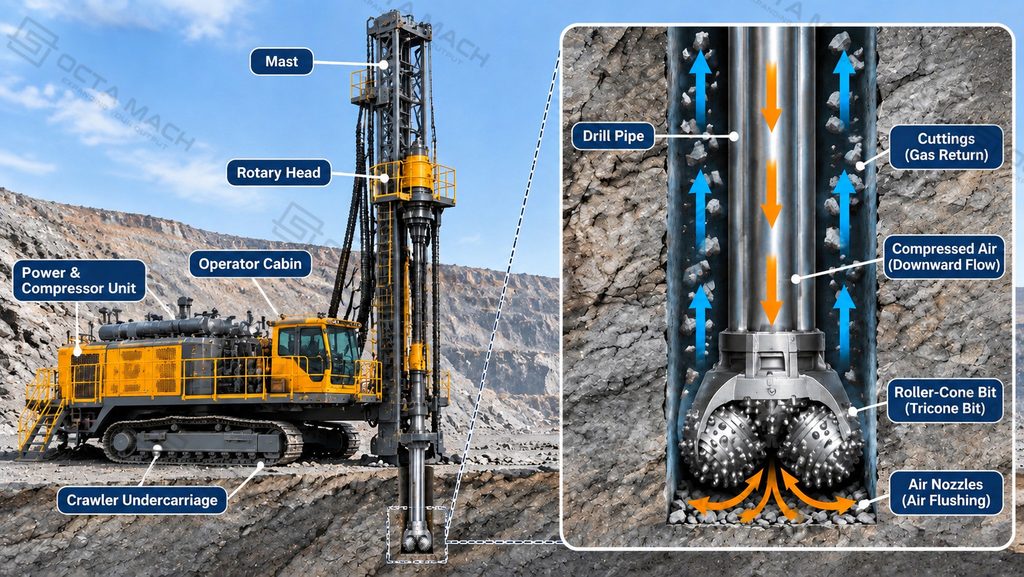
1. Rig Positioning and Mast Alignment
The crawler undercarriage moves the drilling machine to the designated blast-hole position. Once positioned, the mast is raised and aligned according to the drilling plan.The rig must maintain stable ground contact and the required drilling angle before the bit enters the rock. Accurate positioning is important because deviations in hole location, inclination and depth can affect the final blast pattern and rock fragmentation.
2. Rotary Loading and Rock-Breaking Mechanism
The rotary head transfers torque through the drill string to the roller-cone bit, while the hydraulic feed system applies controlled axial force to maintain contact between the cutting elements and the rock formation.
As the drill string rotates, the cones roll across the bottom of the borehole, generating concentrated compressive forces that penetrate and fracture the rock. The cutting structure may use milled steel teeth or tungsten carbide inserts (TCI), depending on formation hardness, abrasiveness and required wear resistance.
Bit selection should also consider hole diameter, available rotary torque, axial loading, bearing protection and expected drilling footage. Incorrect bit selection can accelerate wear, reduce penetration efficiency and increase operating costs.
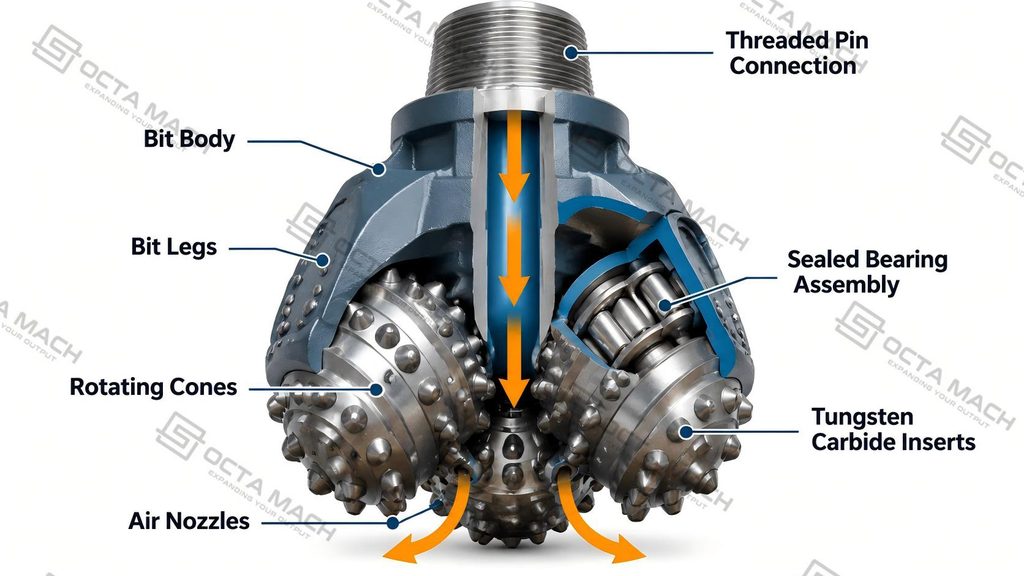
3. Compressed Air Flushing and Cuttings Removal
During drilling, compressed air travels through the drill pipe and exits through the passages in the drill bit. The airflow lifts fragmented rock from the bottom of the borehole and carries it upward through the annular space between the drill pipe and the borehole wall. This process is commonly called air flushing or bailing.
Effective cuttings removal is necessary to maintain a clean drilling bottom. Inadequate airflow can allow cuttings to accumulate, increasing the risk of regrinding, reduced penetration efficiency and drill string sticking. Compressor capacity must therefore be matched to the hole diameter, drilling depth and formation conditions.
4. Multi-Pass Drilling and Drill Pipe Handling
When the required hole depth exceeds the single-pass drilling capacity, additional drill pipe sections are connected to extend the drill string.
The feed and hoisting systems control drill string movement during pipe connections and drilling. After reaching the specified depth, the drill string is withdrawn, the drilling assembly is secured, and the equipment is repositioned for the next blast hole.
Main Components of a Roller Cone Drill Rig
The performance of a rotary blasthole drill rig depends on the coordination of its drilling, power, air supply and mobility systems.
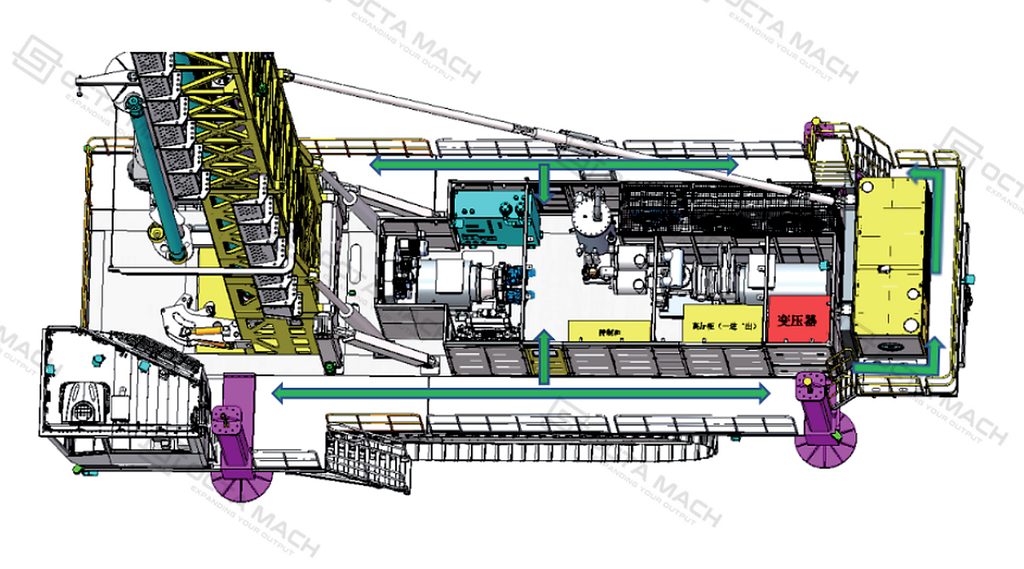
Mast and Rotary Head
The mast supports the drill string and provides the structural guide for vertical or inclined drilling. It also carries the rotary head and feed mechanism.The rotary head generates the torque required to rotate the drill pipe and bit. Its operating speed and torque range must correspond to the selected bit diameter and geological conditions.
Drill Pipe and Pipe Handling System
Drill pipes transmit rotary torque and axial loading from the rotary head to the drill bit. Their diameter, length and connection design influence drilling stability, torque transmission and the performance of the complete drill string. Rotary blasthole drill rigs are available with drill pipe lengths of 9.1–10.7 m and a 4+1 pipe magazine configuration. Depending on the drilling diameter and equipment configuration, drill pipe diameters range from 102–178 mm, 159–219 mm and 219–324 mm.
The pipe handling system supports drill pipe storage, positioning and connection during drilling operations, reducing manual handling requirements. Drill pipe straightness, connection integrity and thread condition require regular inspection, as excessive wear or connection damage can interrupt drilling operations and increase the risk of drill string failure.
Hydraulic Feed and Hoisting System
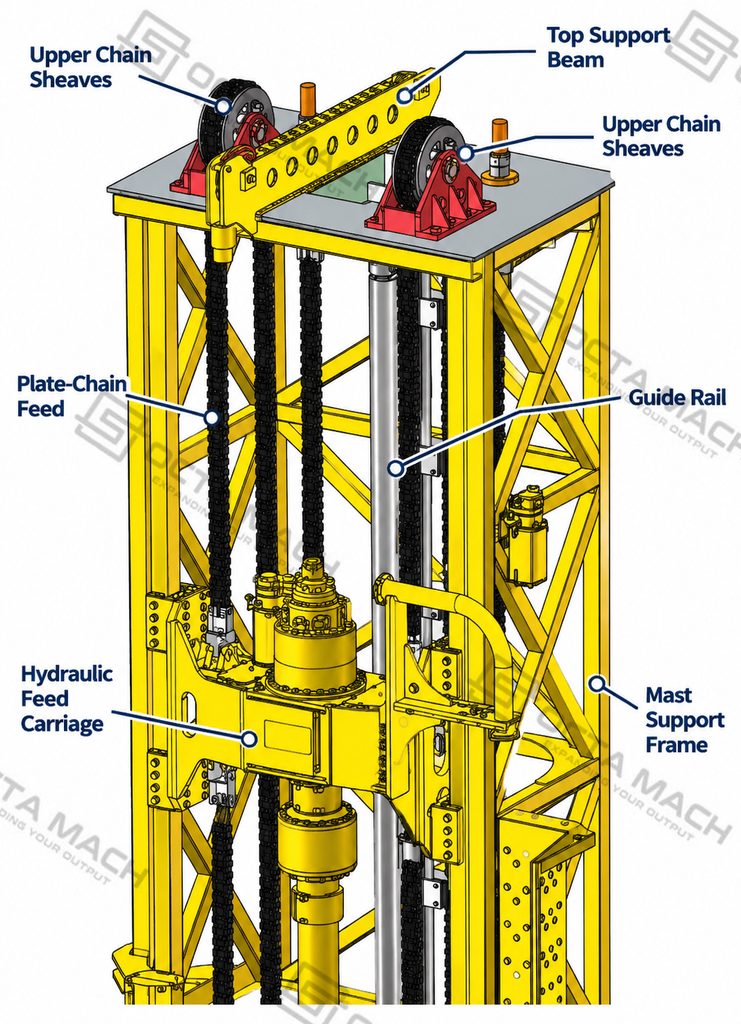
The hydraulic feed system controls the downward movement of the drill string and applies the required axial force during drilling. The hoisting mechanism raises the drill string during pipe handling, connection changes and withdrawal. A plate-chain feed arrangement provides controlled movement under repeated drilling loads and is designed to support mechanical stability and durability. Compared with conventional wire-rope feed systems, its performance depends on chain design, load capacity, lubrication and maintenance conditions.
Air Compressor System
The air compressor supplies compressed air for borehole cleaning and cuttings removal. Airflow travels down through the drill string and returns through the annular space between the drill pipe and borehole wall, carrying fragmented rock to the surface.
Compressor pressure and airflow must be evaluated together to maintain effective borehole cleaning. Actual flushing performance also depends on pressure losses, drill pipe dimensions, bit nozzle passages, drilling depth and formation conditions.
Crawler Undercarriage and Hydraulic Travel System
The crawler undercarriage supports the machine and enables movement between drilling positions.The hydraulic travel system controls movement and maneuverability across the mine bench. Ground pressure and climbing capability are important when evaluating the rig for uneven or soft ground conditions.
Operator Cabin and Control System
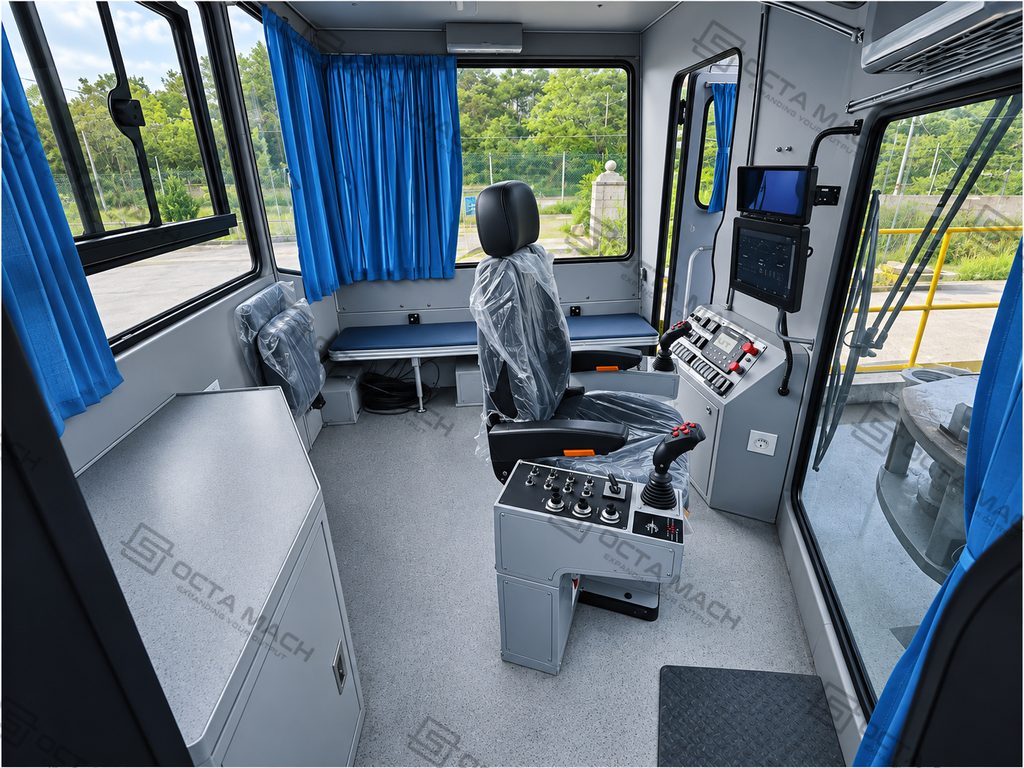
The operator cabin provides the controls and monitoring interfaces required for drilling operations and machine movement. Designed for operator visibility, comfort and safety, the cabin features heating and air conditioning, an ergonomic seat and remote operation capabilities in applicable configurations. The reference equipment specifications indicate an in-cabin noise level below 80 dBA during drilling, helping reduce operator exposure to excessive noise during extended working periods.
Design Features for Open-Pit Mining
Rotary blasthole drill rigs incorporate hydraulic drive systems, modular mechanical structures and automated operating functions to support continuous drilling in open-pit mines. These features help maintain equipment stability, simplify maintenance and improve operational consistency under demanding mining conditions.
Full Hydraulic Travel and Drilling System
The hydraulic system integrates crawler travel, drill feed and hoisting functions, allowing controlled movement and drilling operations. A load-sensitive hydraulic system adjusts hydraulic output according to operating demand, helping reduce unnecessary energy consumption and maintain stable performance under varying loads.
The crawler undercarriage supports movement across uneven mine benches, while the hydraulic feed mechanism provides controlled axial loading during drilling. System performance depends on hydraulic pressure, flow capacity, component condition and the actual operating load.
Modular Maintenance Design
The equipment incorporates modular and replaceable mechanical assemblies to improve access to key components during inspection and servicing. Maintenance passages allow technicians to inspect hydraulic connections, drive components and other functional systems without extensive disassembly.
This arrangement simplifies routine maintenance and component replacement, helping reduce servicing time and equipment downtime. Actual maintenance intervals depend on operating hours, rock abrasiveness, environmental conditions and manufacturer recommendations.
Intelligent Control and Remote Operation
Intelligent control systems can support automatic hole positioning, equipment leveling and drilling operations, reducing repetitive manual adjustments during production drilling. These functions help maintain consistent drilling parameters and improve operational efficiency across successive blast holes.
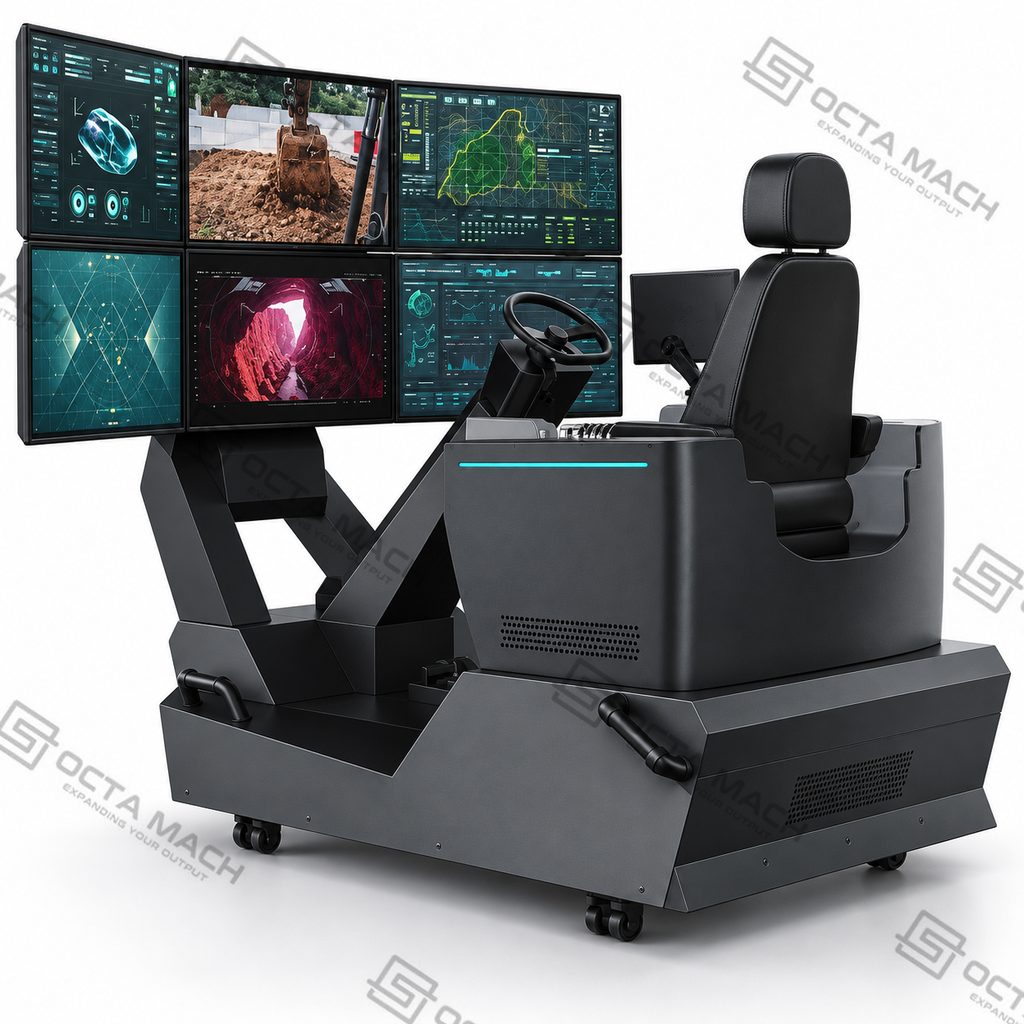
Depending on the equipment configuration, remote operation allows operators to monitor and control drilling activities from a dedicated control station. Advanced systems may also support multiple-rig monitoring and coordinated operation, reducing direct operator exposure to noise, vibration and potentially hazardous drilling environments.
Rotary Blasthole Drill Rig Applications
Open-Pit Metal Mining
In open-pit metal mines, production drilling is carried out across successive benches before blasting and excavation.A rotary blasthole drill rig creates the planned production holes according to the required diameter, depth and inclination. Hole positioning and depth consistency influence explosive distribution, fragmentation and the efficiency of downstream loading and hauling operations.
Coal Mining and Overburden Drilling
Coal mining operations often require drilling through overburden and associated rock formations before extraction.The required hole diameter and drilling depth depend on bench height, overburden thickness, geological conditions and the blasting design. The selected drill bit and operating parameters must match the actual formation.
How to Select the Right Rotary Blasthole Drill Rig
Selecting a rotary blasthole drill rig requires evaluating the drilling requirements, geological conditions, equipment capacity and mine-site environment together. Hole diameter alone is not sufficient to determine the correct configuration. The selected rig must also meet the required drilling depth, rock formation characteristics, air supply requirements and site operating conditions.
Required Hole Diameter and Depth
Start with the blast-hole diameter specified in the mine’s drilling and blasting plan. The required drilling depth must then be compared with the single-pass drilling capacity and maximum hole depth of the selected equipment.
When the required hole depth exceeds the single-pass capacity, additional drill pipes must be connected to extend the drill string. Pipe magazine capacity, connection time and hoisting efficiency should therefore be considered, particularly in production drilling operations where frequent pipe changes can affect overall productivity.
Rock Hardness and Geological Conditions
Rock strength, abrasiveness, jointing and variations in formation characteristics influence drilling parameters and bit selection. Rotary blasthole drill rigs are designed for rock formations with a Protodyakonov hardness coefficient of f4–f20, depending on the equipment configuration.
Actual penetration performance depends on geological conditions, roller-cone bit design, rotary torque and feed force. Hard and abrasive formations require particular attention to cutting element wear, bit bearing protection and mechanical loading to maintain drilling efficiency and equipment reliability.
Compressor Capacity and Cuttings Removal
Compressor airflow and discharge pressure must be matched to the required hole diameter, drilling depth and expected cuttings volume. The selected compressor must maintain sufficient air velocity through the annular space between the drill pipe and borehole wall to transport fragmented rock effectively to the surface.
Insufficient airflow can cause cuttings accumulation, repeated rock crushing and increased drill string sticking risk. Compressor selection should therefore account for drill pipe dimensions, bit nozzle passages, pressure losses and actual borehole conditions rather than relying on nominal air volume alone.
Power Supply and Site Elevation
Rotary blasthole drill rigs are available in diesel-powered and electric-powered configurations, with optional auxiliary diesel power units for selected electric configurations.Electric-powered rigs are suitable for mining sites with stable electrical infrastructure, while diesel-powered equipment provides greater flexibility where access to fixed power supplies is limited. Site elevation must also be considered because reduced air density at higher altitudes can affect diesel engine output and compressor performance. The selected power system should be evaluated against the mine’s actual elevation and operating requirements.
Temperature and Ground Conditions
Rotary blasthole drill rigs have a listed operating temperature range of −40°C to +50°C, with optional low-temperature heating systems available for cold-climate applications.
Ground bearing capacity, slope conditions and equipment weight must also be evaluated when selecting a crawler-mounted rig. Ground pressure influences how the machine distributes its weight across the working surface, while climbing capability determines its mobility on inclined terrain. These factors should be checked against mine bench conditions, access routes and equipment stability requirements before installation and operation.
Operation and Maintenance Considerations
Regular inspection is necessary to maintain drilling accuracy, mechanical reliability and consistent production performance.
Important maintenance areas include:
- Roller-cone drill bits: Inspect cutting elements, cone rotation, bearing condition and signs of abnormal wear. Replace worn or damaged bits before they compromise drilling performance.
- Drill pipes and connections: Check thread condition, connection tightness, pipe straightness and visible damage. Keep connection surfaces clean during pipe handling.
- Hydraulic Feed and Hoisting System: Inspect the plate chain, sprockets, lubrication points, hydraulic hoses, fittings, cylinders and fluid condition. Monitor abnormal feed movement, pressure fluctuations, overheating and leakage.
- Air compressor: Check operating pressure, airflow, lubrication, temperature and filter condition. Reduced air capacity can affect cuttings removal and drilling efficiency.
- Crawler system: Check track tension, rollers, drive components and undercarriage wear, particularly when operating on uneven mine benches.
- Dust collection system: Where fitted, maintain the drill deck enclosure, filters and discharge arrangements to control airborne dust during drilling.
Inspection intervals should follow the equipment manufacturer’s maintenance manual and actual operating hours. Drilling conditions, abrasive formations and low-temperature operation may require additional attention to wear components and fluid systems.
Why Choose Octa Mach
Octa Mach focuses on practical equipment selection, technical configuration and project-oriented supply for mining and mineral processing applications. For rotary blasthole drill rigs, equipment selection is based on actual drilling requirements rather than nominal machine specifications alone. Hole diameter, drilling depth, rock hardness, site elevation, operating temperature and available power supply are considered together to determine a suitable model and configuration.
FAQ
Q: What is a rotary blasthole drill rig used for?
A: A rotary blasthole drill rig is used to drill production blast holes in open-pit mines. It uses rotary torque and axial drilling force to operate a roller-cone bit, with compressed air removing rock cuttings from the borehole.
Q: What hole diameters can a rotary blasthole drill rig drill?
A: Rotary blasthole drill rigs are available for hole diameters ranging from 140 to 380 mm, depending on the equipment configuration. Different drilling capacities accommodate various production blasting requirements in open-pit mines and quarries. The appropriate hole diameter should be selected according to the blasting plan, rock formation, drill bit specifications and required drilling depth.
Q: What is the maximum drilling depth of a rotary blasthole drill rig?
A: Rotary blasthole drill rigs offer maximum drilling depths ranging from 45 to 52.2 m, depending on the equipment configuration. Actual drilling capacity is influenced by drill pipe length, single-pass drilling depth and the pipe handling system. For deeper holes, additional drill pipes are connected to extend the drill string. Equipment selection should consider the required hole depth, geological conditions and drilling efficiency.
Q: How do you select a roller cone drill rig for open-pit mining?
A: Selection should consider the required hole diameter, single-pass and maximum drilling depth, rock hardness, drill pipe dimensions, compressor airflow, rotary torque, power supply, site elevation and ambient temperature. The selected model must meet the mine’s drilling plan and geological conditions.