
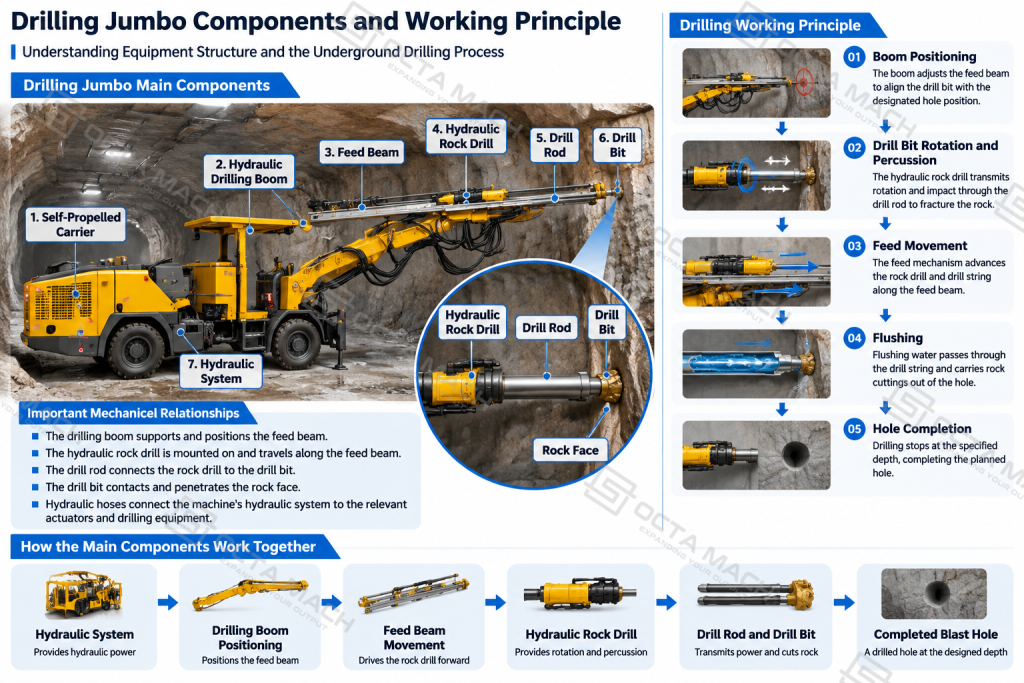
Drilling Jumbo equipment combines a self-propelled carrier, articulated drilling boom, feed beam and hydraulic rock drill to carry out blast-hole drilling in underground tunnel faces and mine development headings. During operation, the hydraulic rock drill generates repeated impacts and rotation to break the rock, while the feed mechanism advances the drill bit along the borehole. Flushing water removes rock cuttings from the hole, allowing drilling to continue to the required depth.
Octal supplies single-boom and multi-boom Drilling Jumbo configurations for different excavation requirements. The single-boom range covers working areas of 10 m², 15 m² and 34 m², with different drilling diameters and depths. The three-boom configuration combines two heading drilling assemblies with a dedicated cut-hole drilling assembly, allowing different groups of blast holes to be drilled within the same working setup. The appropriate configuration depends on tunnel dimensions, blast-hole design, rock conditions and required drilling coverage.
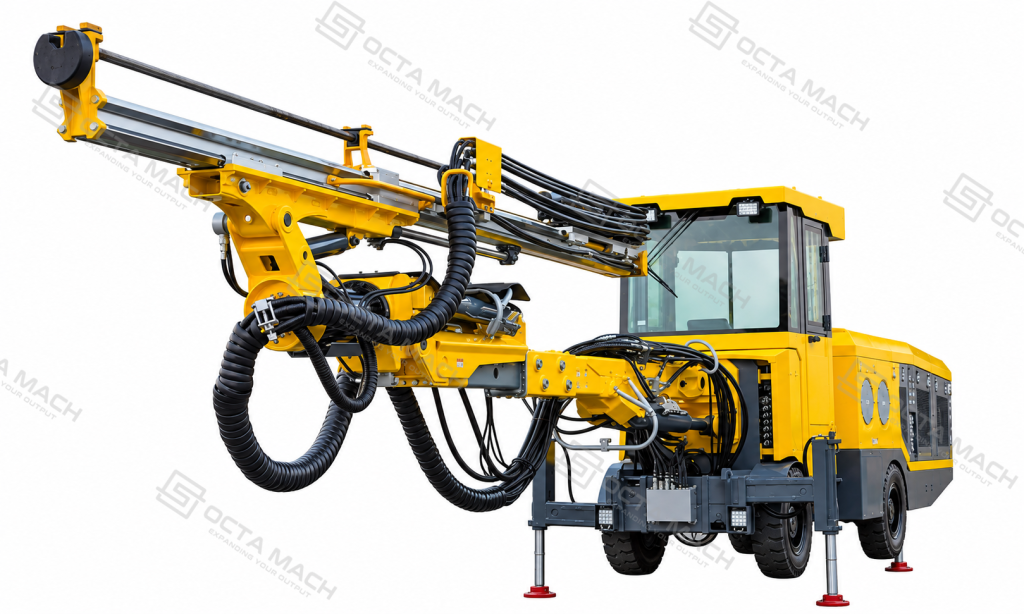
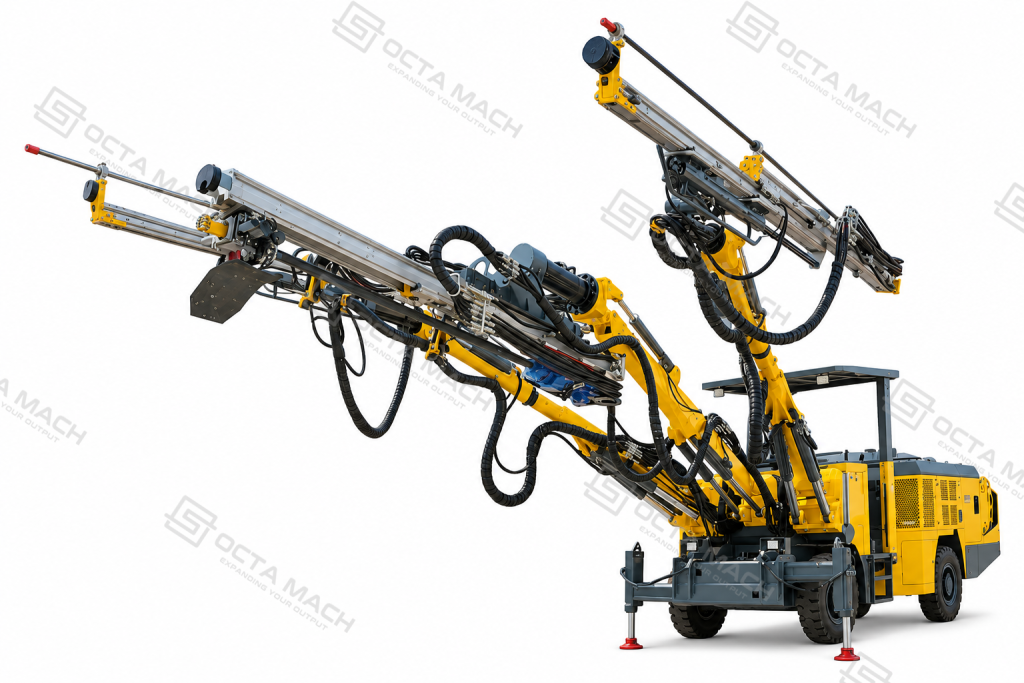
Drilling Jumbo Specifications
The single-boom and multi-boom Drilling Jumbo configurations differ in overall dimensions, boom arrangement and working envelope. Single-boom models feature one drilling assembly and a relatively compact structure, while the three-boom configuration incorporates two heading drilling assemblies and a dedicated cut-hole drilling assembly, requiring more space for equipment installation and boom movement.
Single Boom Drilling Jumbo Specifications
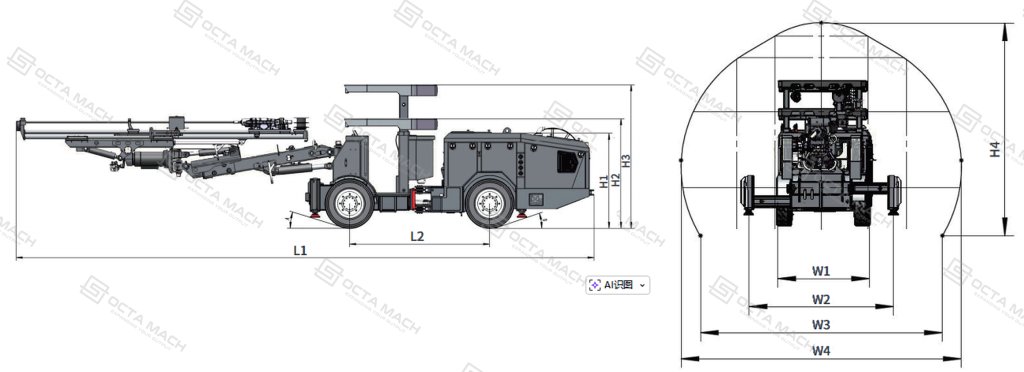
| Model | L1 (mm) | L2 (mm) | A (°) | B (°) | H1 (mm) | H2 (mm) | H3 (mm) | H4 (mm) | W1 (mm) | W2 (mm) | W3 (mm) | W4 (mm) | Weight (kg) |
|---|---|---|---|---|---|---|---|---|---|---|---|---|---|
| Model 1 | 8,700 | 2,480 | 16 | 15 | 1,720 | 1,800 | 2,700 | 3,650 | 980 | 1,470 | 3,400 | 3,500 | 8,200 |
| Model 2 | 10,500 | 2,500 | 16 | 15 | 1,780 | 1,885 | 2,785 | 4,000 | 1,300 | 2,040 | 4,000 | 4,200 | 10,500 |
| Model 3 | 11,500 | 2,800 | 17 | 16 | 1,900 | 2,100 | 2,820 | 6,200 | 1,750 | 2,900 | 5,800 | 6,000 | 13,800 |
Performance Parameters
| Category | Parameter | Unit | Model 1 | Model 2 | Model 3 |
| Operating Parameters | Working Area | m² | 10 | 15 | 34 |
| Hole Diameter (Reaming) | mm | 32–45 (76–102) | 32–64 (76–115) | 32–64 (76–115) | |
| Drill Rod Length | mm | 3,100 | 3,100 / 3,700 | 3,700 / 4,300 | |
| Drilling Depth | mm | 2,800 | 2,800 / 3,400 | 3,400 / 4,000 | |
| Rock Drill Parameters | Impact Power | kW | 14 | 18 | 18 |
| Impact Pressure | bar | 115–140 | 170–210 | 170–210 | |
| Rotation Torque | N·m | 975 | 1,050 | 1,050 | |
| Outer Turning Radius | mm | 5,200 | 5,100 | 5,100 | |
| Travel Parameters | Inner Turning Radius | mm | 3,600 | 3,600 | 3,400 |
| Steering Angle | ° | 32 | 33 | 40 | |
| Travel Speed | km/h | 5 | 5 | 12 | |
| Power Parameters | Main Motor Power | kW | 45 | 55 | 55 |
| Voltage | V | Standard: 380 (Optional: 660 / 1,000 / 1,140) | |||
| Diesel Engine Power | kW | 37 | 66 | 66 | |
Multi Boom Drilling Jumbo Specifications
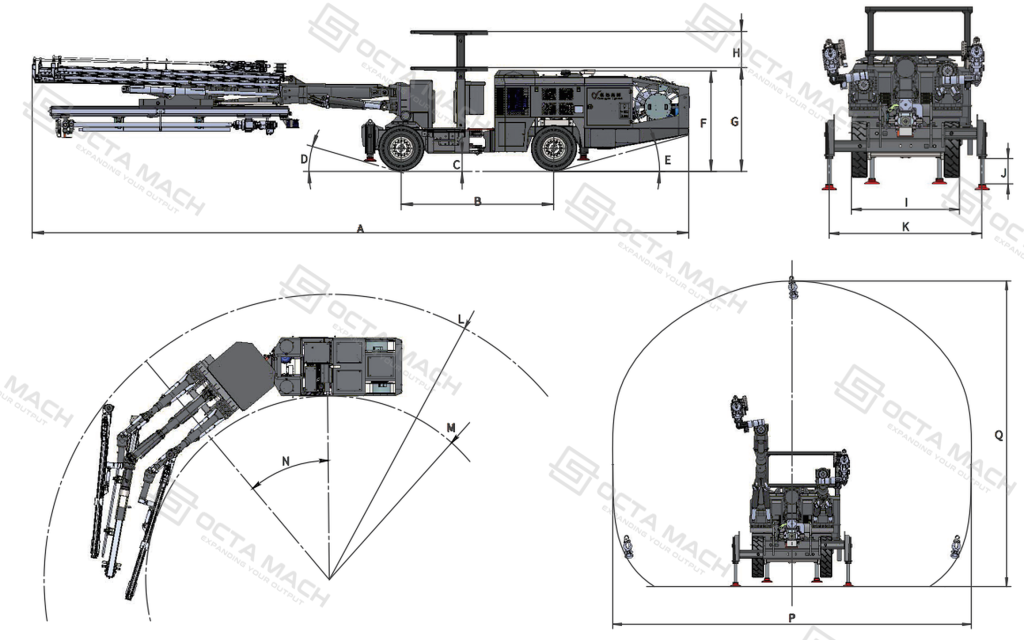
| Model | A (mm) | B (mm) | C (mm) | D (°) | E (°) | F (mm) | G (mm) | H (mm) | I (mm) |
|---|---|---|---|---|---|---|---|---|---|
| Model 1 | 15,697 | 3,810 | 442 | 16 | 16 | 2,600 | 3,500 | 900 | 2,200 |
| Model | J (mm) | K (mm) | L (mm) | M (°) | N (°) | P (mm) | Q (mm) | S (mm) | T (mm) |
|---|---|---|---|---|---|---|---|---|---|
| Model 1 | 500 | 3,134 | 8,500 | 4,000 | 40 | 10,000 | 7,800 | 4,200 | 3,500 |
Performance Parameters
| Category | Parameter | Unit | Value | |
|---|---|---|---|---|
| Cut-Hole | Heading (Composite Beam) | |||
| Operating Parameters | Shank Adapter | – | T60 | R38/T38 |
| Hole Diameter | mm | 127–180 | 38–64 | |
| Maximum Impact Power | kW | 35 | 18 | |
| Rock Drill Parameters | Maximum Rotation Torque | N·m | 2,285 | 1,050 |
| Total Length | mm | 5,310 | 4,910 | |
| Drilling Depth | mm | 6,300 | 6,000 | |
| Feed Force | kN | 20 | 15 | |
| Travel Parameters | Feed Compensation | mm | 1,800 | |
| Feed Beam Rotation | ° | 360 | ||
| Boom Pitch Angle | ° | -25 / 55 | ||
| Power Parameters | Diesel Engine Power | kW | 96 | |
| Departure Angle | ° | 16 | ||
| Approach Angle | ° | 16 | ||
| Maximum Gradeability | ° | 14 | ||
| Travel Speed | km/h | 3.7 | ||
| Electrical System | Main Motor Power | kW | 55 / 75 | |
| Voltage | V | 1,000 | ||
| Frequency | Hz | 50 | ||
| Hydraulic System | Maximum System Pressure | bar | 250 | |
| Hydraulic Oil Tank Capacity | L | 480 | ||
| Filtration Accuracy | μm | 10 | ||
| Water Supply System | Motor Power | kW | 7.5 | |
| Maximum Flow Rate | L/min | 400 | ||
| Air Supply System | Rated Power | kW | 11 | |
| Maximum Flow Rate | L/min | 1,970 | ||
Drilling Jumbo Components and Working Principle
Single-boom and multi-boom Drilling Jumbo configurations share the same basic machine structure and hydraulic rock drilling principle. The main components include a self-propelled carrier, drilling boom, feed beam, hydraulic rock drill, hydraulic system and electrical control system. The carrier supports the equipment and moves it into position at the tunnel face, while the drilling boom adjusts the drilling position and angle. The feed beam guides the hydraulic rock drill along the drilling direction, providing the movement required to advance and retract the drill steel.
The drilling process relies on four coordinated actions: percussion, rotation, feed and flushing. The hydraulic rock drill generates repeated impacts that transfer energy through the drill steel to the bit, breaking the rock at the bottom of the borehole. The rotation mechanism turns the drill steel and bit between impacts, while the feed mechanism applies axial force to maintain contact with the rock and advance the bit. Water supplied through the flushing system carries rock cuttings out of the borehole, helping maintain effective drilling conditions. These functions work together to complete blast-hole drilling at the required positions and depths.
Single Boom Drilling Jumbo
A Single Boom Drilling Jumbo consists of one articulated drilling boom equipped with a feed beam and hydraulic rock drill, mounted on a self-propelled carrier. The boom moves horizontally and vertically to position the drill at different collar locations across the tunnel face. Each hole is drilled individually, with the boom repositioned according to the blast-hole layout. This arrangement provides a relatively compact machine structure and is suitable for underground headings where one drilling assembly can cover the required working area through successive positioning.
The single-boom configurations cover working areas of 10 m², 15 m² and 34 m², with different drilling diameters, feed lengths and drilling depths. Depending on the selected configuration, available functions include anti-jamming protection, automatic drill-steel retraction, anti-blank-firing protection and assisted hole positioning. These functions help manage abnormal drilling resistance, protect the drilling assembly and support accurate positioning of blast holes. The modular arrangement also facilitates equipment transportation and assembly in underground working areas.
Multi Boom Drilling Jumbo
A Multi Boom Drilling Jumbo uses three independently controlled drilling assemblies mounted on a common carrier. The supplied configuration consists of two heading drilling assemblies and one dedicated cut-hole drilling assembly. Unlike a conventional single-boom Tunneling Jumbo, this arrangement divides the drilling work between different assemblies according to their specific functions and drilling requirements.
The two heading drilling assemblies are designed for regular blast-hole drilling, using R38/T38 shank adapters and hole diameters of 38–64 mm. The dedicated cut-hole assembly uses a T60 shank adapter and supports larger hole diameters of 127–180 mm. Its larger drilling capacity allows it to create the initial relief opening required by the blasting pattern, while the two heading assemblies drill the surrounding holes. The three booms operate independently, allowing cut-hole and heading drilling operations to be coordinated within the same working setup.
The separate boom movements provide a wider drilling coverage and reduce the need to repeatedly reposition a single drilling assembly between different drilling tasks. The arrangement is particularly relevant to tunnel faces requiring both large-diameter cut holes and conventional blast holes. Actual drilling sequences and the degree of simultaneous operation depend on the tunnel cross-section, blast-hole layout and available working space.
How to Choose the Right Drilling Jumbo
Selecting a suitable Drilling Jumbo requires matching the machine configuration with underground excavation conditions and the drilling plan. Tunnel cross-section, required drilling coverage, hole diameter, drilling depth and blast-hole arrangement are the main factors to consider. The choice between a single-boom and multi-boom machine also depends on the number of drilling assemblies required and the types of drilling operations at the tunnel face.
| Selection Factor | What to Consider |
|---|---|
| Working Area | Match the machine’s drilling coverage to the tunnel cross-section and required face area. Available single-boom configurations cover 10 m², 15 m² and 34 m² working areas. |
| Drilling Diameter | Check the required diameters for conventional blast holes and large-diameter cut holes. The multi-boom configuration supports 38–64 mm heading holes and 127–180 mm cut holes. |
| Drilling Depth | Compare the required hole depth with the machine’s drilling capacity. Single-boom configurations offer drilling depths of 2,800–4,000 mm, depending on the configuration. |
| Boom Configuration | A single boom is suitable when one drilling assembly can complete the planned hole pattern through successive positioning. Multi-boom equipment is designed for projects requiring separate drilling assemblies for different tasks. |
| Underground Space | Check machine dimensions, working clearance, access passages and turning space to ensure the equipment can reach and operate at the designated tunnel face. |
| Power Supply | Confirm that the available underground electrical supply matches the machine’s voltage, frequency and power requirements. |
For conventional underground development headings, a Single Boom Drilling Jumbo is suitable when its working coverage, hole diameter and drilling depth meet the project requirements. For larger tunnel faces or excavation patterns requiring both conventional heading holes and large-diameter cut holes, a Multi Boom Drilling Jumbo offers a more specialized arrangement, with two heading drilling assemblies and one dedicated cut-hole assembly. The final selection should account for the excavation profile, geological conditions, blast-hole design, available underground space and required drilling cycle to ensure that the machine configuration matches the actual working conditions.
Drilling Jumbo Manufacturing and Quality Control
The performance of Rock Drilling Equipment depends on the structural strength of the carrier and booms, the accuracy of the drilling assemblies, and the operating condition of the hydraulic and electrical systems. These components must work together to maintain stable boom positioning, controlled feed movement and reliable rock drilling.
For a Drilling Jumbo, quality control covers both individual components and the complete assembled machine. Inspection of the hydraulic rock drill alone is not sufficient; boom movement, feed beam alignment, hydraulic circuit performance and control functions must also be checked before delivery.
| Inspection Area | Main Inspection Items | Quality Control Focus |
|---|---|---|
| Structural Fabrication and Boom Assembly | Carrier frame dimensions, welded connections, boom mounting interfaces, pivot points and alignment of moving components | Structural integrity, dimensional accuracy and reliable boom movement |
| Hydraulic System | Hydraulic circuit connections, hose routing, sealing conditions, operating pressure and flow performance, hydraulic cylinder and control valve response | Hydraulic stability, leakage prevention and accurate movement control |
| Feed Beam Assembly | Feed beam alignment, straightness, feed travel and drill carriage movement | Stable drill guidance and smooth axial feeding |
| Rock Drill Assembly | Drill mounting, percussion and rotation mechanisms, flushing connections | Reliable drilling operation and proper component installation |
| Electrical and Control System | Wiring connections, control functions, protection devices and safety interlocks | Reliable machine control and operational safety |
| Complete Machine Testing | Carrier movement, boom positioning, feed operation and drilling functions | Coordination of mechanical, hydraulic and electrical systems |
Dimensional inspections should follow approved engineering drawings, while hydraulic and functional tests should use the specified operating parameters and factory inspection procedures. Non-destructive examination of structural welds should be carried out where required by the inspection plan.
After final assembly, the complete Drilling Jumbo should undergo functional testing to verify the coordination of its major systems. For multi-boom configurations, each drilling assembly should be checked for independent movement and correct operation, including its positioning range and clearance from adjacent components.
Drilling Jumbo Applications
Drilling Jumbos are primarily used for underground rock excavation where drilling and blasting are adopted to advance tunnel faces and mine development headings. The machine drills a predetermined pattern of blast holes into the exposed rock face, with hole positions, angles, diameters and depths determined by the excavation profile and blasting design. After drilling is completed, the jumbo is moved away from the face for the subsequent charging and blasting operations. The blasted rock is then removed before the next excavation round begins. This cycle is repeated as the tunnel or underground roadway advances.
Underground Mine Development
Drilling Jumbos are widely used in underground mine development for excavating access tunnels, mine drifts, crosscuts and connecting roadways. During each excavation round, the machine drills a planned pattern of cut holes, production holes and perimeter holes. Cut holes create the initial relief opening, production holes expand the excavation, and perimeter holes define the final roadway profile.
Single-boom Drilling Jumbos are suitable for development headings where one drilling assembly can cover the required working area through successive positioning. Available configurations cover 10 m², 15 m² and 34 m² working areas, providing options for different underground roadway dimensions and drilling requirements.
Tunnel Development and Excavation
In underground tunnel construction, Drilling Jumbos perform face drilling before each blasting round. The drilling booms are positioned according to the tunnel cross-section and blast-hole layout, with drilling angles, hole spacing and depths determined by the excavation design and surrounding rock conditions. Accurate perimeter drilling is particularly important for controlling the excavated tunnel profile and limiting unnecessary overbreak.
For tunnel faces requiring wider drilling coverage, a multi-boom Drilling Jumbo provides multiple independently controlled drilling assemblies. Its three-boom configuration includes two heading drilling assemblies and one dedicated cut-hole assembly, allowing conventional blast holes and larger-diameter cut holes to be handled by separate drilling units.
Face Drilling for Different Excavation Patterns
Different excavation patterns require different combinations of hole diameters, depths and drilling positions. A single-boom Drilling Jumbo completes the drilling sequence by repositioning one drilling assembly across the face, making it suitable for headings where the required coverage can be achieved with one boom.
A multi-boom configuration provides greater drilling coverage through its three independent assemblies. The dedicated cut-hole assembly handles larger-diameter holes of 127–180 mm, while the two heading drilling assemblies handle conventional holes of 38–64 mm. This division allows cut-hole and heading drilling tasks to be coordinated within the same working setup, particularly where the blasting design requires both types of holes.
Drilling Jumbo Solutions from OCTA MACH
OCTA MACH provides single-boom and multi-boom Drilling Jumbos for underground mining and tunnel construction projects. With different drilling coverage, boom configurations and rock drilling capabilities, the equipment can be selected according to tunnel dimensions, blast-hole requirements and underground working conditions. From conventional mine development headings to larger tunnel faces requiring multiple drilling assemblies, OCTA MACH focuses on providing practical drilling equipment solutions that match the technical requirements of each project.
FAQ
Q:What Is the Difference Between a Single-Boom and Multi-Boom Drilling Jumbo?
A:A single-boom Drilling Jumbo uses one drilling assembly to complete the planned blast-hole pattern through successive positioning. A multi-boom configuration uses multiple independently controlled drilling assemblies, allowing different drilling tasks to be assigned to separate booms. The three-boom configuration presented here includes two heading drilling assemblies and one dedicated cut-hole assembly.
Q:What Working Areas and Drilling Depths Are Available for Single-Boom Drilling Jumbos?
A:The available single-boom configurations cover working areas of 10 m², 15 m² and 34 m². Their corresponding drilling depths are 2,800 mm, 2,800/3,400 mm and 3,400/4,000 mm, respectively. The appropriate configuration depends on the tunnel face dimensions and required drilling pattern.
Q:What Hole Diameters Can a Three-Boom Drilling Jumbo Drill?
A:The three-boom Drilling Jumbo uses two heading drilling assemblies for conventional holes with diameters of 38–64 mm and one dedicated cut-hole assembly for larger holes measuring 127–180 mm. This arrangement separates conventional heading drilling from large-diameter cut-hole drilling within the same machine configuration.
Q:How Do You Select a Drilling Jumbo for a Narrow or Low Tunnel?
A:Selecting a Drilling Jumbo for a narrow or low tunnel requires checking both transport dimensions and drilling coverage. The machine must pass through the underground access route, negotiate available turning space and reach the required blast-hole positions without interference. Machine width, overall height, turning clearance, boom reach and feed positioning should therefore be verified against the actual tunnel drawings before selecting a configuration.