
Gyratory crusher is a heavy-duty compression machine designed for primary crushing in large-scale mining and quarrying operations. It reduces coarse rock and run-of-mine ore through the continuous gyratory movement of a mantle against a stationary concave, allowing large volumes of material to pass through the crushing chamber. Model selection depends on feed opening size, material characteristics, required throughput, discharge opening, and the capacity of downstream processing equipment.
The gyratory crusher range includes six models, from 42-65 to 60-110, with feed port sizes ranging from 1,066 mm to 1,575 mm and maximum power ratings from 450 kW to 1,500 kW. Different discharge openings provide a range of processing capacities for large-scale crushing operations. Its integrated mechanical, hydraulic, electrical, and intelligent control systems support continuous production and coordinated equipment operation.
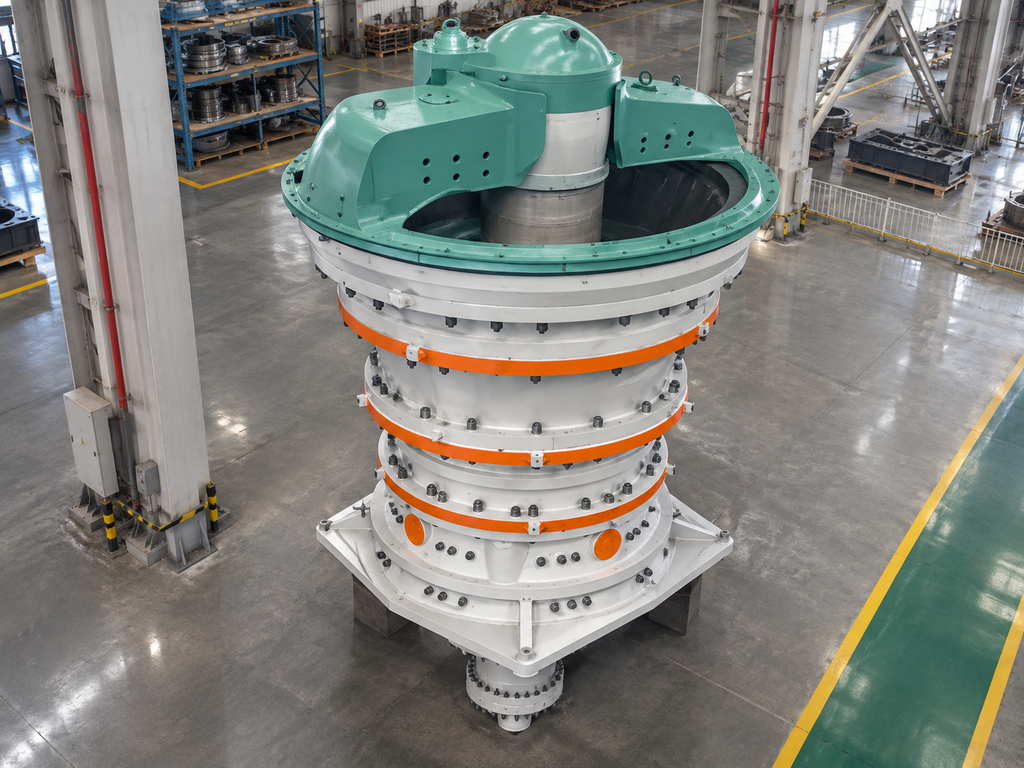
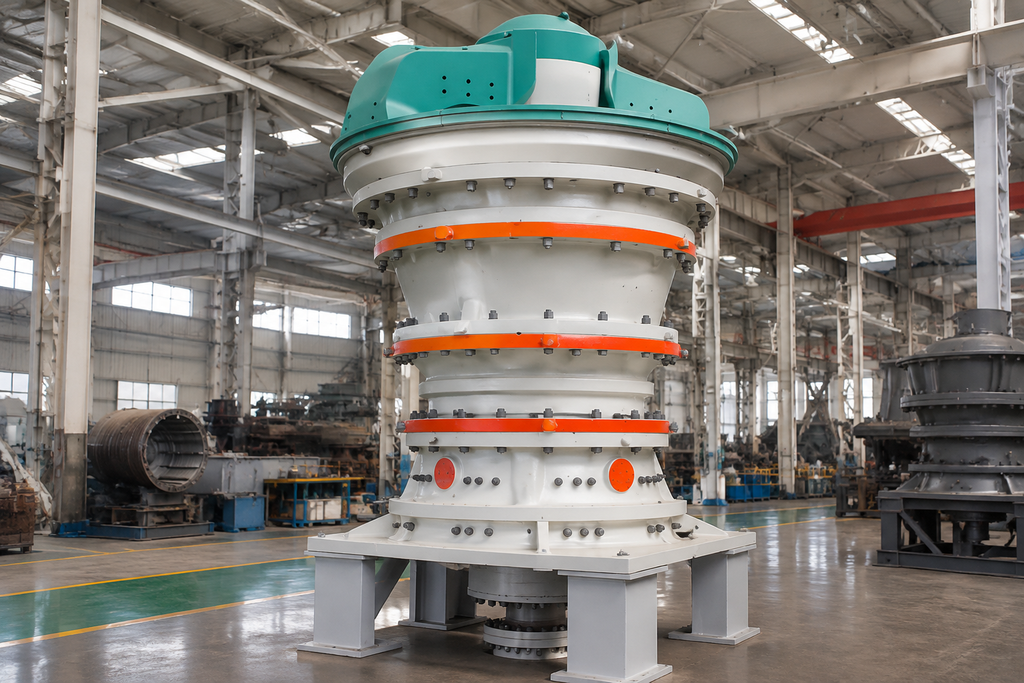
Gyratory Crusher Models and Specifications
Gyratory crushers are available in different configurations to accommodate variations in feed size, production requirements, and crushing conditions. The six models listed below cover different feed opening dimensions and power requirements, with processing capacity varying according to the selected discharge opening.
Gyratory Crusher Technical Specifications
| Model | Feeding Port Size (mm) | Max. Power (kW) |
|---|---|---|
| 42-65 | 1,066 | 450 |
| 50-65 | 1,270 | 450 |
| 54-75 | 1,370 | 600 |
| 62-75 | 1,575 | 600 |
| 60-89 | 1,525 | 750 |
| 60-110 | 1,525 | 1,500 |
The feeding port size determines the available opening through which material enters the crushing chamber. However, the maximum acceptable feed lump size must also be checked against the crusher’s actual design and feed conditions. It should not be determined from the opening dimension alone.
Maximum power varies from 450 kW to 1,500 kW across the listed models. The larger power ratings accommodate different crushing duties and production requirements, but power alone does not establish the actual throughput of a machine.The processing capacity also depends on the discharge opening and the characteristics of the material being processed.
How Does a Gyratory Crusher Work?
A gyratory crusher uses compression rather than high-speed impact to reduce rock size. Its crushing action is generated by the eccentric movement of the main shaft and mantle inside a stationary concave, creating a continuously changing gap within the crushing chamber.The crushing process takes place through repeated compression as material moves downward under gravity.
Gyratory Crushing Process
| Working Stage | Machine Action | Crushing Result |
|---|---|---|
| Material Feeding | Run-of-mine ore enters through the upper feed opening | Large rock enters the crushing chamber |
| Gyratory Movement | The eccentric drive produces the gyratory movement of the mantle | The gap between the mantle and concave changes continuously |
| Primary Compression | Material is compressed between the moving and stationary crushing surfaces | Large rock fragments are reduced in size |
| Continuous Crushing | Material moves downward and encounters repeated compression | Further particle size reduction takes place |
| Material Discharge | Reduced material passes through the lower discharge opening | Crushed material enters the downstream conveying system |
The mantle forms the moving crushing surface, while the concave provides the stationary crushing surface surrounding it. As the mantle moves closer to one side of the concave, the available space decreases and material is compressed. On the opposite side, the gap becomes wider, allowing material to move downward.
Unlike an impact crusher, which relies on the kinetic energy of a rotating rotor and blow bars, a gyratory crusher relies on sustained mechanical compression. This operating principle makes it suitable for handling large quantities of coarse material in primary crushing applications.
The crushing chamber geometry, eccentric movement, and discharge setting work together to determine the reduction process and the resulting material flow.
Gyratory Crusher Capacity and Discharge Opening
The processing capacity of a gyratory crusher is closely related to its discharge opening. A larger opening generally allows more material to pass through the crushing chamber, while a smaller opening produces a finer discharge under comparable operating conditions.However, changing the discharge opening also changes the crushing conditions. The selected setting must therefore balance throughput requirements with the particle size required by the next processing stage.
Processing Capacity by Model and Discharge Opening
The following data are taken from the supplied technical specification sheet. All processing capacities are expressed in metric tons per hour (t/h).
| Discharge Opening (mm) | 42-65 | 50-65 | 54-75 | 62-75 | 60-89 | 60-110 |
|---|---|---|---|---|---|---|
| 152 | 2,354–3,362 | 2,414–3,449 | 2,908–4,154 | 2,913–4,162 | — | — |
| 177 | 2,893–4,133 | 2,958–4,226 | 3,170–4,529 | 3,846–5,494 | 4,576–6,538 | 5,579–7,970 |
| 203 | — | — | 3,513–5,018 | 4,365–6,235 | 5,337–7,625 | 7,394–10,562 |
| 230 | — | — | — | — | 5,851–8,359 | 8,346–11,923 |
| 254 | — | — | — | — | — | 8,961–12,802 |
| 305 | — | — | — | — | — | 9,857–14,082 |
— indicates that no capacity value is listed for the corresponding model and discharge opening in the supplied specification.
The capacity figures are calculated under the following reference conditions:
- Material bulk density: 1.6 t/m³.
- 100% of the feed material passes through a sieve opening equal to 80% of the feed opening width.
- 80% of the feed material passes through a sieve opening equal to 50% of the feed opening width.
- 30% of the feed material passes through a sieve opening equal to 10% of the maximum feed material size.
- All capacity values are calculated at the maximum eccentricity of each unit.
These assumptions are important when interpreting the listed gyratory crusher capacity. A machine operating with a different material density or feed particle distribution may produce a different output even when the model and discharge opening remain unchanged.
Material hardness, abrasiveness, moisture content, clay content, and feeding consistency can also influence actual production. Uneven feeding or excessive accumulation inside the crushing chamber may prevent the machine from reaching its rated operating capacity.
For a complete crushing plant, the discharge conveyor, secondary crusher, and screening equipment must also accommodate the expected material flow. Selecting a crusher solely from its maximum catalog capacity can create bottlenecks elsewhere in the production line.
Main Components and Wear Parts
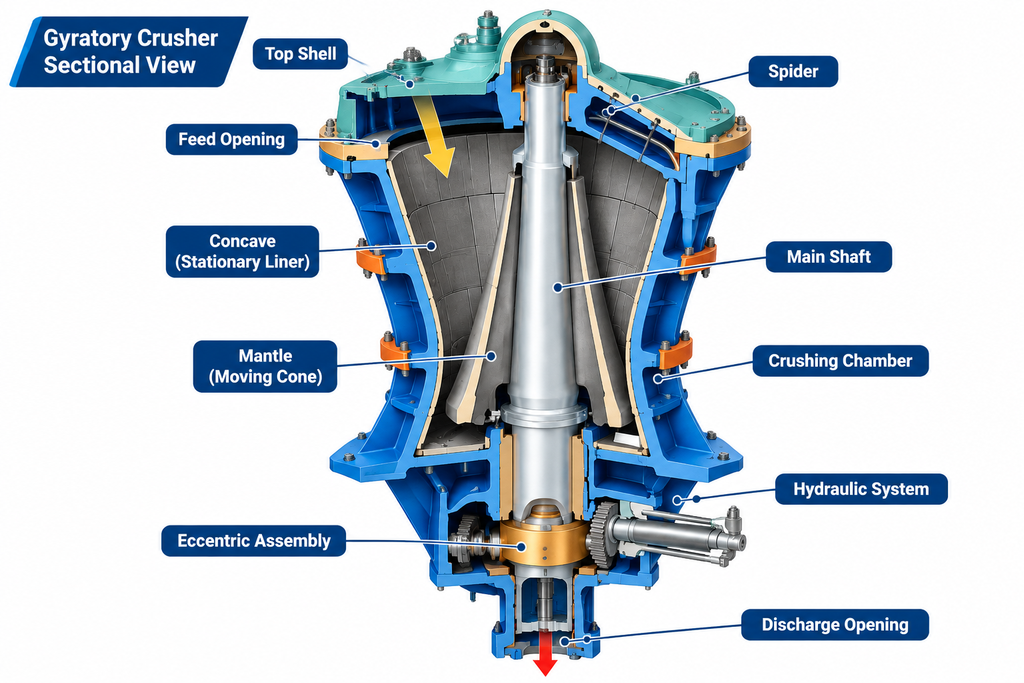
The crushing performance of a gyratory crusher depends on the interaction between its crushing surfaces, drive assembly, supporting structure, and auxiliary systems. The mantle and concave directly contact the material, while the shaft and eccentric assembly generate the movement required for compression.
Mantle and Concave
The mantle and concave form the primary crushing surfaces inside the chamber. The mantle moves relative to the stationary concave, creating the compression zone where incoming rock is reduced.Both components are exposed to repeated impact loading, compressive forces, and abrasive wear. Their surface profiles gradually change during operation, which can affect the effective crushing chamber geometry and product discharge.
Wear condition should be monitored to determine when replacement or adjustment is required. The appropriate liner material and profile depend on the processed rock, operating conditions, and expected service life.
Main Shaft and Eccentric Assembly
The main shaft supports the moving crushing member and transfers the mechanical loads generated during crushing. The eccentric assembly creates the offset movement responsible for the gyratory crushing action.These components must maintain the required mechanical alignment and operating clearances. Abnormal vibration, changes in operating noise, and unusual bearing temperatures should be investigated because they may indicate mechanical wear or lubrication problems.
Lubrication and Hydraulic Systems
Lubrication supports the operation of moving mechanical components by reducing friction and controlling heat generation. The hydraulic system, depending on the machine configuration, may provide functions associated with adjustment, positioning, or overload protection.
Lubrication condition, oil circulation, operating temperature, hydraulic pressure, and leakage should be checked according to the equipment manufacturer’s maintenance instructions.
Wear part condition and auxiliary system performance directly affect operating stability. Regular inspection helps identify deterioration before it develops into a major maintenance issue.
Design Features for Large-Scale Primary Crushing
Large mining operations require crushing equipment that can handle substantial quantities of coarse material without creating unnecessary interruptions in the production process. The gyratory crusher design addresses these requirements through its crushing chamber geometry, mechanical drive arrangement, and integrated control systems.
High Crushing Capacity and Reduction Performance
The large feed opening and compression-based crushing chamber allow the machine to process coarse material in high-volume primary crushing applications. Its crushing action reduces large rock fragments into smaller particles suitable for subsequent crushing, screening, or grinding operations.
The supplied model range includes capacities reaching 14,082 t/h under the specified reference conditions. Actual production depends on the model, discharge opening, feed characteristics, and operating conditions.
Compact Structural Arrangement
The equipment combines the main crushing assembly and supporting mechanical systems within an integrated structure. This arrangement helps organize the major components and supports installation within large mining crushing stations.
A compact installation footprint can be valuable where the available space around a dump pocket, feeder, or transfer station is restricted. Actual foundation requirements, overall dimensions, and maintenance clearances must be confirmed using the equipment’s general arrangement drawings.
Optimized Energy Consumption
The crushing design and structural arrangement are intended to improve energy utilization during material reduction. However, actual energy consumption depends on the properties of the feed material, required reduction, equipment loading, and operating conditions.For engineering evaluation, specific energy consumption expressed in kWh/t is more useful than motor power alone.
Dust and Noise Control
The product literature describes an enclosed crushing arrangement intended to reduce dust and noise pollution during operation.Actual environmental performance depends on the enclosure design, material transfer points, sealing arrangements, and any external dust collection or noise-control systems installed with the crushing plant.
Adaptability to Different Production Requirements
Different materials and production targets require different crushing settings and wear part configurations. Adjustments to the crushing parameters and the replacement of suitable wear components allow the equipment to accommodate changing operating requirements.
This flexibility is particularly relevant to mining operations where ore characteristics, feed conditions, and downstream production targets may vary during the life of a project.
Gyratory Crusher Applications
Gyratory crushers are primarily associated with large-scale mining and quarrying operations where coarse material must be reduced before entering secondary crushing or mineral processing stages.
Their large feed openings and high processing capacities make them particularly relevant to production lines handling substantial volumes of run-of-mine material.
Large-Scale Mining Operations
In large open-pit mines, gyratory crushers are installed at primary crushing stations to process blasted ore delivered by haul trucks. Typical materials include iron ore, copper ore, gold-bearing ore, and other hard rock. The crusher reduces large rock fragments before the material enters conveyor systems, secondary crushing, or stockpile facilities. Feed-size distribution, ore hardness, bulk density, and abrasiveness are important factors affecting equipment selection and operating performance.
Quarrying and Coarse Rock Crushing
Large aggregate quarries use gyratory crushers to reduce blasted granite, basalt, limestone, and other quarried rock into sizes suitable for downstream processing. A properly designed dump hopper, grizzly, and feeder help maintain consistent material delivery and prevent oversized rocks from disrupting chamber loading. The primary crusher’s discharge size and throughput must also match the capacity of secondary crushers and screening equipment to maintain stable aggregate production.
Metallurgical and Mineral Processing Plants
In mineral processing facilities, primary crushing prepares extracted ore for subsequent size reduction and separation processes. The crushed material may be transferred to secondary cone crushers, screens, or grinding equipment depending on the plant configuration.The primary crusher’s discharge characteristics influence the loading conditions of downstream equipment and should be considered during the overall plant design.
Other Industrial Material Processing
Gyratory crushers may also be considered for selected applications involving building materials, hydropower construction, ceramics, chemical processing, and refractory materials. They can reduce large volumes of coarse raw material before further processing or handling. However, material hardness, moisture, abrasiveness, contamination requirements, and target particle size must be evaluated to determine whether gyratory crushing is suitable for the specific application.
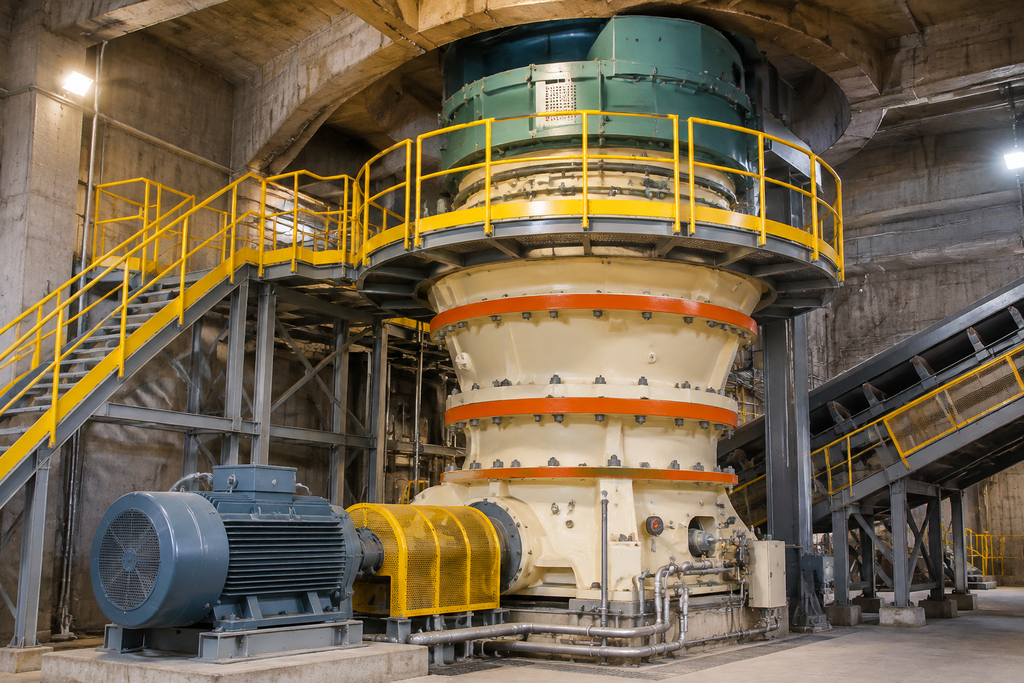
Gyratory Crusher in a Primary Crushing Plant
A gyratory crusher normally operates as part of a larger material handling and crushing system rather than as an isolated machine. The feeder, crusher, discharge conveyor, secondary crushing equipment, and screening system must operate at compatible capacities.
A typical primary crushing circuit follows this sequence:
ROM Ore → Dump Hopper → Feeder → Gyratory Crusher → Discharge Conveyor → Secondary Cone Crusher → Vibrating Screen → Finished Aggregate or Ore Feed
The dump hopper receives material transported from the mine. A suitable feeder regulates the flow entering the gyratory crusher, helping prevent irregular loading and excessive accumulation in the crushing chamber.
After primary crushing, the discharged material travels through a conveyor to the next processing stage. Depending on the required product size and plant arrangement, a cone crusher may perform secondary or tertiary size reduction.
The vibrating screen separates the crushed material into different size fractions. Oversized particles can be returned to the secondary crushing circuit, while material meeting the required grading proceeds to stockpiling or further processing.
The capacity of each stage must be considered together. A primary gyratory crusher with a high rated output cannot maintain continuous production if the discharge conveyor, secondary crusher, or screening equipment has insufficient capacity.
Gyratory Crusher Selection Factors
Selecting a suitable gyratory crusher requires more than matching the required throughput with a catalog capacity figure. The feed characteristics, crushing conditions, product requirements, and surrounding plant configuration all influence the final model selection.
| Selection Factor | Information to Evaluate | Effect on Equipment Selection |
|---|---|---|
| Maximum Feed Size | Largest rock dimensions and feed particle distribution | Determines the required feed opening and acceptable feed conditions |
| Required Capacity | Average and peak production in t/h | Determines the necessary processing capacity and model range |
| Discharge Opening | Required discharge setting and downstream feed size | Influences throughput and the particle size leaving the crusher |
| Material Properties | Bulk density, hardness, abrasiveness, moisture, and clay content | Affects crushing performance, power demand, and wear |
| Downstream Equipment | Conveyor, secondary crusher, and screen capacities | Determines whether the complete production line can handle the crusher output |
| Installation Conditions | Foundation, available space, power supply, and maintenance access | Influences equipment arrangement and supporting infrastructure |
Feed Size and Particle Distribution
The maximum feed size must be checked against the manufacturer’s permitted feed size rather than estimated from the feeding port dimension alone. The distribution of particle sizes also matters because a feed containing a high proportion of oversized material behaves differently from a consistently graded feed.
A suitable feeding arrangement should distribute material across the available crushing chamber and avoid excessive segregation or localized loading.
Required Throughput and Discharge Setting
The required production rate should be considered together with the desired discharge size. A smaller discharge opening generally produces finer material but may reduce throughput, while a larger setting can increase the volume discharged at the expense of a coarser product.
The selected setting must be compatible with the feed requirements of downstream crushing and screening equipment.
Material Characteristics and Wear Conditions
Bulk density, hardness, silica content, abrasiveness, and moisture influence the crushing process and the service conditions of wear components.
Highly abrasive materials may require closer attention to mantle and concave material selection, wear profiles, and replacement planning. Wet or clay-rich feed may also affect material flow through the crushing chamber and downstream handling equipment.
When evaluating a gyratory crusher for sale, the comparison should therefore include actual operating conditions, expected production requirements, wear part availability, and the complete plant configuration rather than relying on maximum rated capacity alone.
For projects comparing different crushing configurations, our crusher selection guide provides a broader evaluation of crusher types, material characteristics, feed requirements and production capacity.
Why Choose Us
Octa Mach focuses on delivering heavy-duty crushing equipment built for demanding industrial environments. We emphasize robust mechanical construction, wear-resistant components, structural stability, and reliable power transmission to support continuous operation under high-load crushing conditions.
Our strength lies in understanding the practical demands of mining and aggregate production. From equipment performance and service accessibility to long-term operating efficiency, we consider the factors that affect plant productivity, maintenance requirements, and overall equipment value. This approach helps customers make informed investment decisions and build crushing systems suited to their production goals.
FAQ
Q: What factors affect the actual throughput of a gyratory crusher?
A: The rated capacity is based on defined operating conditions, not motor power alone. The published capacity figures for this model range assume a bulk density of 1.6 t/m³, a specified feed-size distribution, and maximum eccentricity. Actual throughput varies with ore crushability, feed gradation, moisture, clay content, and feeding consistency. The discharge conveyor and downstream equipment must also handle the required material flow.
Q: What is the maximum feed size for a primary gyratory crusher?
A: The allowable maximum feed size must be checked against the selected model’s manufacturer specifications rather than estimated from the feed opening alone. One primary gyratory crusher application guide recommends keeping maximum feed below 80–85% of the nominal feed opening to reduce bridging at the spider. This is model-specific guidance, not a universal limit. Oversized, wet, or sticky material can increase blockage and overload risks.
Q: When should gyratory crusher mantle and concave liners be replaced?
A: Liner replacement should be based on measured wear and operating performance rather than a fixed number of operating hours. Monitor mantle and concave profiles, liner thickness, product gradation, throughput, and power draw to identify deterioration. Where available, mainshaft position readings can also help track liner wear. Replace worn parts before they wear through or damage their supporting surfaces, following the manufacturer’s maintenance limits.
Q: When should a gyratory crusher be chosen over a jaw crusher for primary crushing?
A: A primary gyratory crusher is generally preferred for large, stationary mining plants requiring high and continuous throughput with coarse run-of-mine feed. A jaw crusher may be more economical for lower-capacity operations, tighter capital budgets, or installations requiring greater mobility. The selection should consider feed size, ore properties, production targets, foundation requirements, installation space, and downstream processing capacity.