
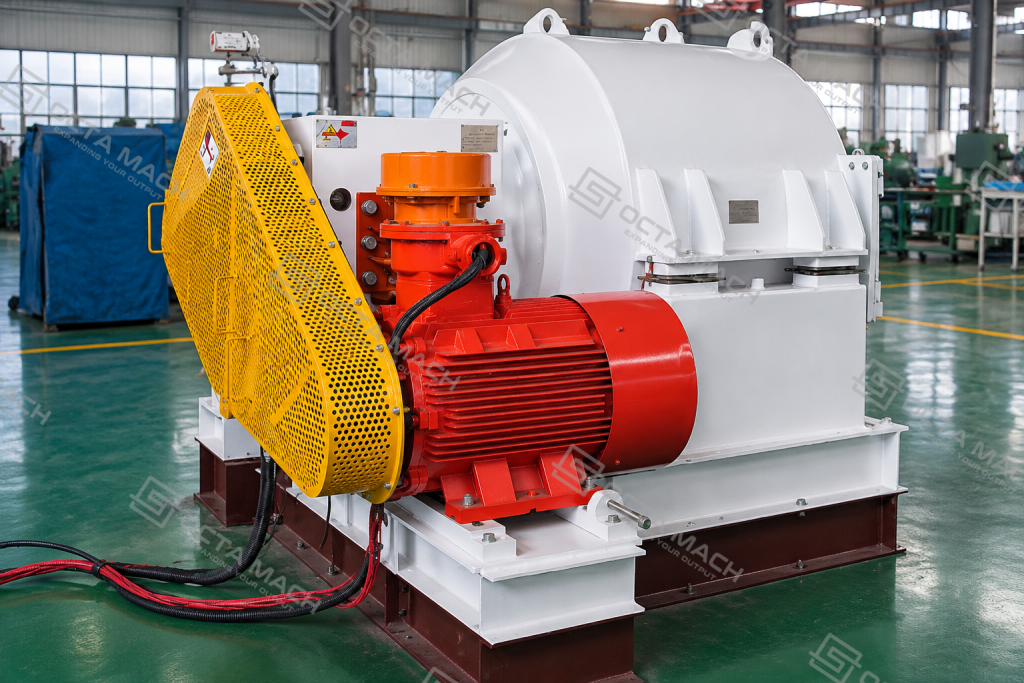
An industrial vibration motor is a three-phase asynchronous motor designed to generate controlled centrifugal force through rotating eccentric weights. The resulting excitation force produces vibration in machinery used for material feeding, screening, conveying and separation. Industrial vibration motors are widely used in mining, quarrying, aggregate processing and other bulk material handling operations, particularly in vibrating screens and vibrating feeders where stable and adjustable vibration is required.
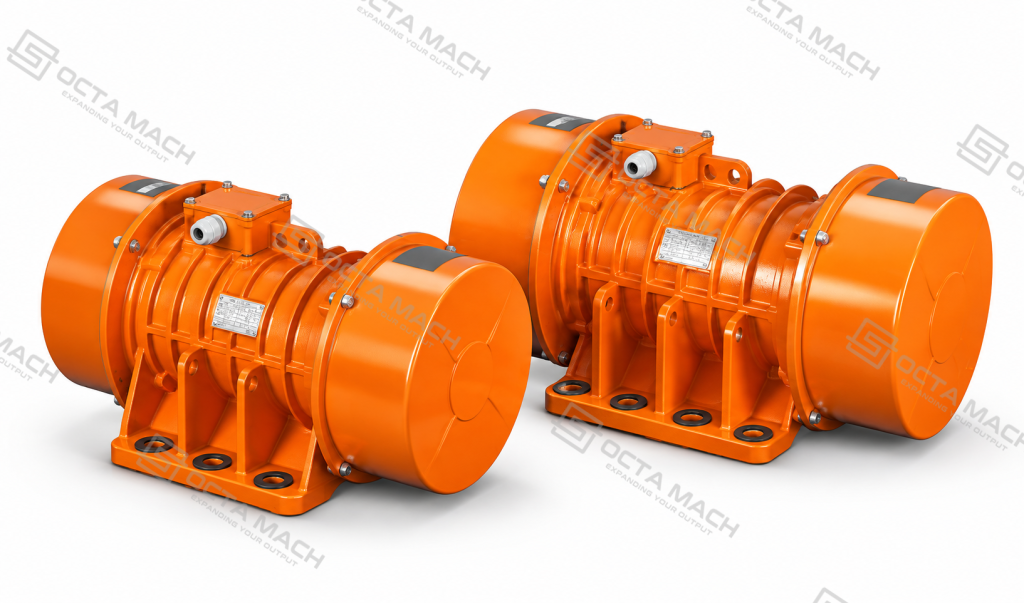
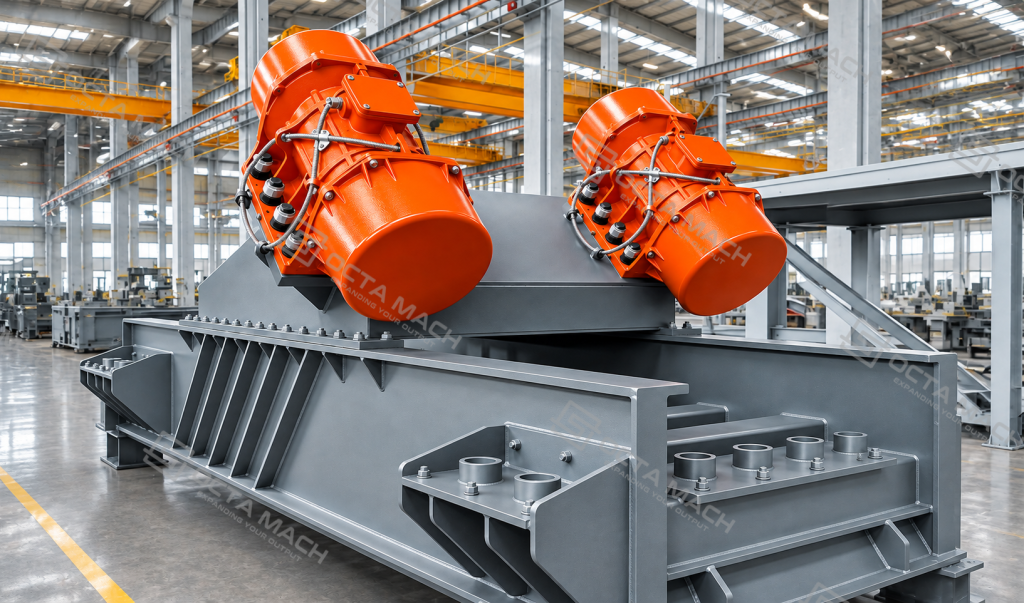
The motor’s performance is determined by its excitation force, rotational speed, rated power, pole configuration and mounting arrangement. Different motor series are available for standard industrial applications and specialized operating environments, with model configurations covering a broad range of vibration requirements. Adjustable eccentric weights allow the excitation force to be changed to match the operating characteristics of the driven equipment.
Industrial Vibration Motor Specifications
Industrial vibration motors are available in multiple configurations to accommodate different machine sizes, vibrating masses and operating requirements. The main technical parameters include maximum excitation force, rated speed, rated power, rated current, pole number and installation dimensions.
Main Technical Specifications
| Technical Parameter | Available Specifications |
| Motor Type | Three-Phase Asynchronous Vibratory Motor |
| Motor Series | YZ, YZE, YZB, YZCB |
| Maximum Excitation Force | 3–180 kN across the listed YZ range |
| Rated Power | 0.12–13 kW across the listed YZ range |
| Number of Poles | 2, 4, 6 and 8 poles, depending on series |
| Rated Speed | Approximately 725–2,880 rpm, depending on model |
| Standard Rated Voltage | 380 V |
| Standard Frequency | 50 Hz |
| Insulation Class | Class F |
| Protection Rating | IP55 for the listed standard configurations |
| Duty Type | S1 – Continuous Duty |
| Electrical Connection | Star / Delta (Y/Δ) |
| Ambient Temperature | -20°C to +40°C |
| Maximum Installation Altitude | 1,000 m |
| Mounting Direction | Model-dependent |
| Excitation Force Adjustment | Adjustable eccentric weights |
The specifications above represent the available model ranges rather than a single motor configuration. Excitation force, speed, power, current and mounting dimensions vary according to the selected series and pole number.
Other voltage and 60 Hz configurations can also be considered according to the electrical requirements of the installation.
Technical Parameters by Motor Series
| Series | Pole Configuration | Excitation Force (kN) | Speed (rpm) | Rated Power (kW) |
| YZ | 2 Poles | 3–20 | 2,600–2,880 | 0.20–1.80 |
| YZ | 4 Poles | 3–100 | 1,400–1,460 | 0.12–6.30 |
| YZ | 6 Poles | 3–180 | 950–986 | 0.20–13.00 |
| YZ | 8 Poles | 50–100 | 725–735 | 3.00–7.50 |
| YZE | 4 Poles | 15–52 | 1,430–1,460 | 0.75–2.20 |
| YZB | 4 Poles | 10–38 | 1,420–1,450 | 0.50–2.20 |
| YZB | 6 Poles | 10–60 | 960–975 | 0.70–3.70 |
| YZCB | Model-specific | Confirm by model | Confirm by model | Confirm by model |
Each configuration has its own rated current, installation dimensions, mounting bolt size and overall weight. These values should be checked against the selected motor model and the equipment mounting drawing before installation.
Industrial Vibration Motor Series
The product range includes four series: YZ, YZE, YZB and YZCB. They share the same basic operating principle but differ in their product classification, electrical configuration and application requirements.
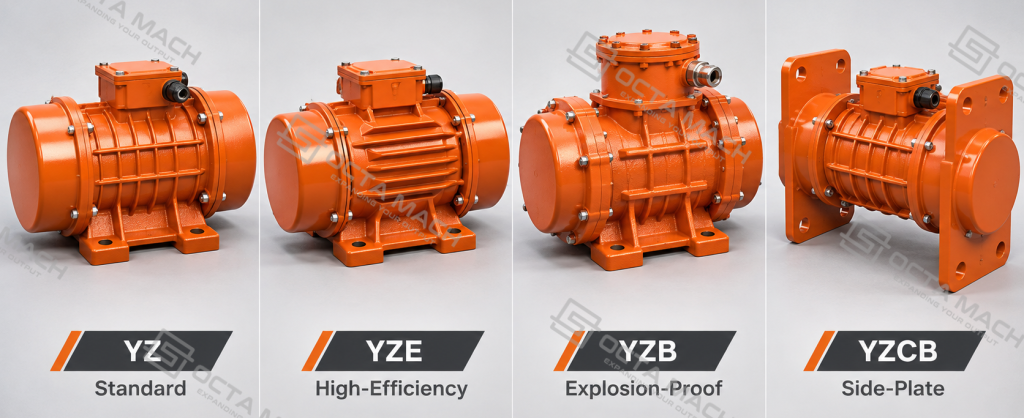
YZ Series – Standard Vibratory Motor
The YZ series is a standard three-phase asynchronous vibration motor designed for general industrial vibrating machinery. It provides multiple excitation force and speed configurations, covering applications that require different vibration intensities and operating frequencies.
The series includes 2-pole, 4-pole, 6-pole and 8-pole models. Its excitation force ranges from 3 kN to 180 kN, while rated power ranges from 0.12 kW to 13 kW across the available models.
The main characteristics include:
- Multiple pole configurations for different operating speeds.
- Adjustable eccentric weights for controlling excitation force.
- Various mounting dimensions and bolt arrangements.
- Continuous-duty operation under the specified service conditions.
- Compatibility with different types of vibrating machinery.
The YZ series is suitable for general vibrating screens, vibrating feeders and other industrial equipment designed for direct vibratory motor drive. Model selection depends on the vibrating mass, required excitation force, operating speed and installation dimensions.
YZE Series – Three-Phase Asynchronous Vibratory Motor
The YZE series is a separate three-phase asynchronous vibratory motor range with 4-pole configurations. Its listed models cover excitation forces from 15 kN to 52 kN, rated speeds from 1,430 rpm to 1,460 rpm and rated power from 0.75 kW to 2.20 kW.
The series provides a defined range of medium-speed configurations for vibrating machinery requiring these excitation force levels.
Representative models include:
| Model | Maximum Excitation Force (kN) | Speed (rpm) | Rated Power (kW) | Rated Current (A) |
| YZE-15-4 | 15 | 1,435 | 0.75 | 1.80 |
| YZE-25-4 | 25 | 1,450 | 1.25 | 2.77 |
| YZE-38-4 | 38 | 1,440 | 1.80 | 3.83 |
| YZE-52-4 | 52 | 1,460 | 2.20 | 4.82 |
The YZE series uses the same basic eccentric-weight vibration principle. Its rated voltage, frequency, insulation class, protection rating and duty conditions should be matched to the selected model and electrical supply.
YZB Series – Explosion-Proof Vibratory Motor
The YZB series is classified as an explosion-proof three-phase asynchronous vibratory motor. It is intended for applications where the motor must meet specific explosion-protection requirements in addition to its vibration and electrical performance requirements.
The listed YZB configurations include 4-pole and 6-pole models, with excitation forces ranging from 10 kN to 60 kN. Rated speeds range from approximately 960 rpm to 1,450 rpm, and rated power ranges from 0.50 kW to 3.70 kW.
Representative model parameters include:
| Model | Maximum Excitation Force (kN) | Speed (rpm) | Rated Power (kW) | Rated Current (A) |
| YZB-10-4 | 10 | 1,420 | 0.50 | 1.30 |
| YZB-20-4 | 20 | 1,440 | 1.10 | 2.65 |
| YZB-38-4 | 38 | 1,440 | 1.80 | 4.15 |
| YZB-20-6 | 20 | 965 | 1.52 | 3.99 |
| YZB-60-6 | 60 | 975 | 3.70 | 9.02 |
The specified explosion-protection marking includes Ex d IIB T4 Gb. This marking identifies the protection concept, gas group and temperature classification of the corresponding configuration. The applicable certificate, equipment protection level and hazardous-area suitability must be verified for the exact motor model and destination market before installation.
The explosion-proof series should be selected according to the actual hazardous-area classification, gas or vapor characteristics, temperature requirements and electrical installation conditions. An explosion-proof designation alone does not establish suitability for every hazardous location.
YZCB Series – Explosion-Proof Vibratory Motor
The YZCB series is also classified as an explosion-proof three-phase asynchronous vibratory motor.
Its configuration should be evaluated according to the required excitation force, rotational speed, electrical rating and installation arrangement. The explosion-protection marking and certified construction must correspond to the exact model supplied.
Model-level technical ratings, installation dimensions and applicable certification details need to be confirmed for the selected YZCB configuration before final equipment matching.
Working Principle of an Industrial Vibration Motor
An industrial vibration motor generates excitation force through eccentric weights installed at the two ends of its rotating shaft. As the motor operates, these eccentric masses rotate with the shaft and produce centrifugal force. The force is transmitted through the motor housing and mounting structure to the vibrating equipment.
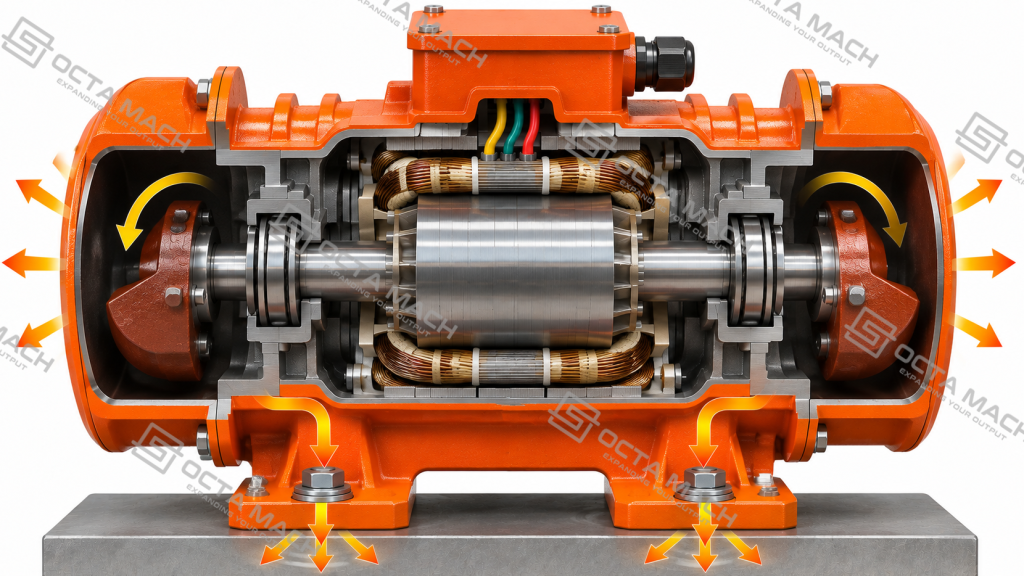
The magnitude and direction of the resulting vibration depend on the eccentric weight arrangement, rotational speed, mounting position and mechanical characteristics of the driven machine.
Adjustable Eccentric Weights
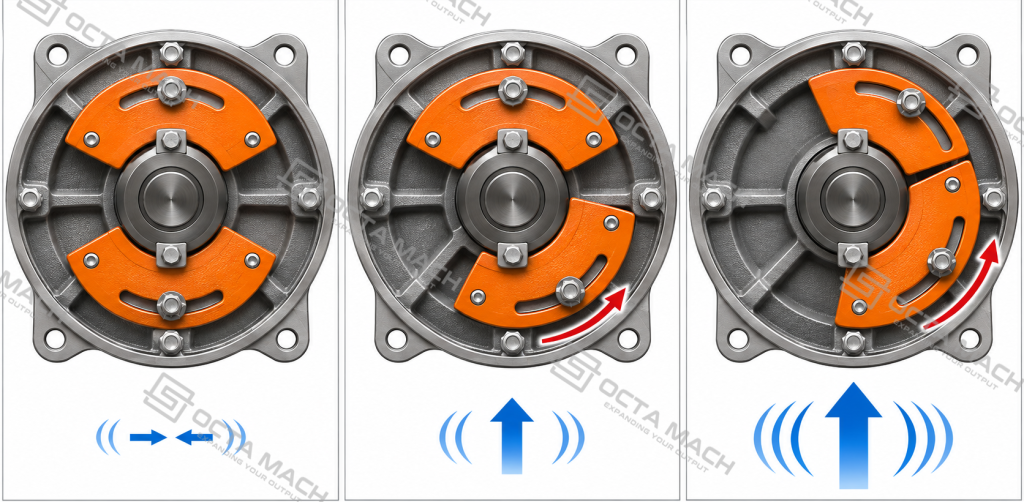
The eccentric weights are a key part of the vibration motor’s operating mechanism. Their relative angular position determines the effective eccentric mass and therefore changes the excitation force.Adjusting the included angle between the eccentric blocks allows the excitation force to be increased or reduced without changing the motor’s basic rated power.
This adjustment is important because different materials and processing conditions require different vibration intensities. For example, a screening application may require a different excitation force from a feeder handling coarse rock or crushed aggregate.The adjustment range and permitted settings must remain within the motor’s specified operating limits. Both ends of the motor should be configured in accordance with the manufacturer’s adjustment procedure to maintain the intended vibration output.
Motor Speed and Pole Configuration
The number of motor poles directly affects rotational speed and the vibration frequency produced by the eccentric weights.
The available configurations provide different speed ranges:
| Pole Number | Approximate Rated Speed Range | Typical Configuration |
| 2 Poles | 2,600–2,880 rpm | High-speed vibration |
| 4 Poles | 1,400–1,460 rpm | Medium-speed vibration |
| 6 Poles | 950–986 rpm | Lower-speed vibration |
| 8 Poles | 725–735 rpm | Low-speed vibration |
These are model-specific rated speed ranges, not fixed values for every motor operating at a given pole number.
A higher rotational speed does not automatically produce better screening or conveying performance. The appropriate combination of speed, excitation force and vibrating mass must be determined according to the mechanical design of the equipment.
Multiple Motor Configurations
Some vibrating machines use two or more vibration motors to generate a particular vibration pattern. The motor arrangement, rotation direction and relative operating conditions determine the resulting movement.
Depending on the machine design, multiple motors can be configured to produce different vibration forms for screening, conveying or material distribution.
The motors must be matched in excitation force, speed and electrical characteristics. Their installation positions and rotation directions also need to comply with the equipment design to avoid unwanted forces and uneven vibration.
Applications in Crushing and Screening Equipment
Industrial vibration motors are used as drive components in vibrating machinery across mining, quarrying and aggregate processing operations. Their main function is to provide the excitation force required to move, screen or distribute bulk materials.
Vibrating Screens
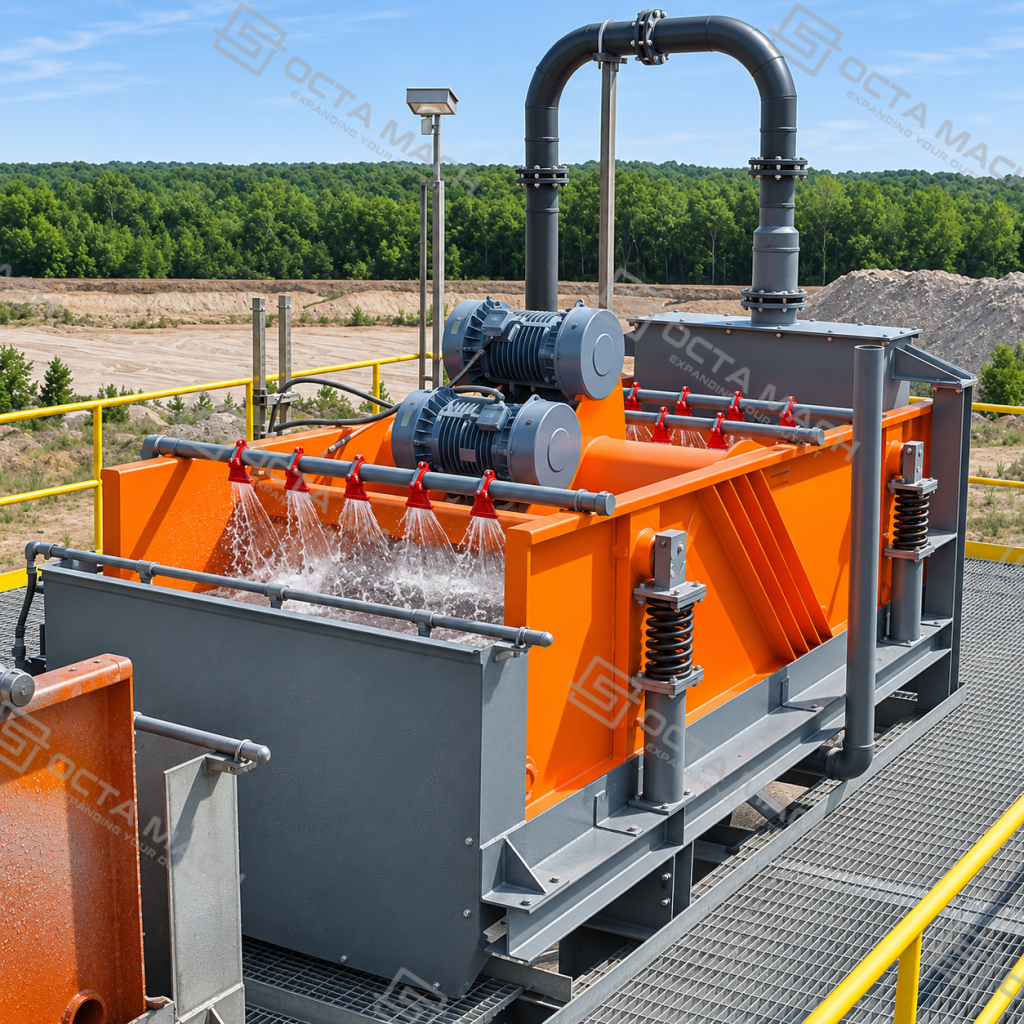
Vibrating screens use controlled vibration to separate materials according to particle size. The vibration motor drives the screen structure, causing material to move across the screening surface while particles pass through or remain on the screen according to the opening size.
Motor selection affects the excitation force and operating frequency available to the screen. These parameters must be matched to the screen dimensions, deck arrangement, vibrating mass, material properties and required processing capacity.
Applications include aggregate sizing, crushed stone classification, mineral screening and other bulk material separation processes.
Vibrating Feeders
Vibrating feeders regulate the movement of bulk materials from hoppers, bins or storage systems to downstream equipment.
In crushing plants, they are commonly used to deliver raw materials to primary crushers and to control the feed entering subsequent processing stages.
The vibration motor provides the mechanical excitation required for material movement. Its force and speed configuration must correspond to the feeder structure, material load and required feed rate.
Vibrating Conveyors
Vibrating conveyors use periodic mechanical movement to transport bulk materials along a conveying surface. Vibration motors provide the excitation needed to move material forward through the conveying system.
Their operating requirements depend on conveyor length, material characteristics, conveying direction, vibrating mass and the intended transport rate.
Mineral Processing and Material Classification
In mineral processing plants, vibration motors can drive equipment used for material separation, screening, classification and dewatering. The required motor configuration depends on the equipment structure and the physical properties of the processed material.
For all these applications, the vibration motor must be selected as part of the complete machine system rather than solely by its rated power.
Manufacturing and Quality Control
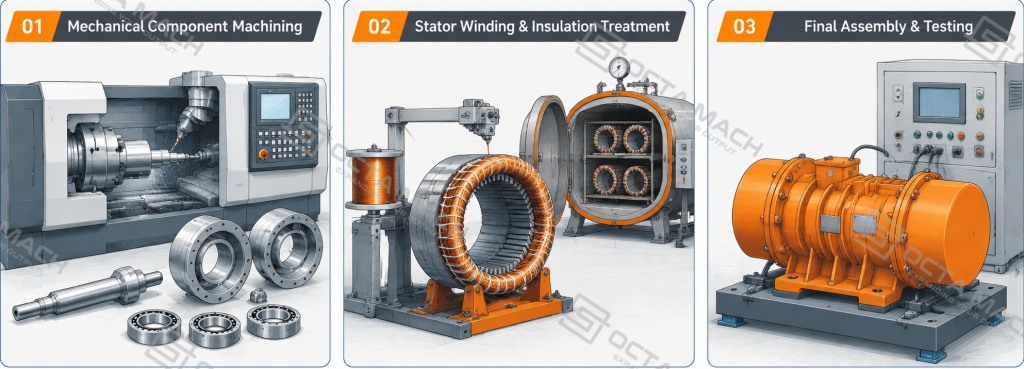
Industrial vibration motor manufacturing involves precision machining, stator winding, insulation treatment, assembly and electrical testing. Particular attention is given to mechanical accuracy and insulation performance due to continuous vibration and dynamic loading during operation.
Mechanical Component Machining
CNC lathes, vertical lathes and surface milling machines are used to process motor housings and mechanical components. Precision machining provides accurate mounting dimensions, bearing fits and flat mounting surfaces, reducing mechanical stress during operation.
Stator and Winding Production
Stator winding and vacuum impregnation are important manufacturing processes that influence electrical insulation, mechanical strength and thermal performance. Dedicated stator testing equipment is used to evaluate electrical characteristics and insulation quality.
Final Motor Testing
Assembled vibration motors undergo electrical and functional testing using dedicated motor testing equipment. Inspection focuses on electrical performance, insulation integrity, mechanical assembly and operating condition, with acceptance requirements determined by the selected motor configuration.
Operating Conditions and Installation Requirements
Correct installation is essential for maintaining the intended vibration output and avoiding excessive mechanical stress on the motor and supporting structure.
The listed standard operating conditions for the YZ and YZE series, as well as the specified YZB configurations, include:
| Operating Parameter | Specification |
| Rated Voltage | 380 V |
| Rated Frequency | 50 Hz |
| Ambient Temperature | -20°C to +40°C |
| Maximum Altitude | 1,000 m |
| Insulation Class | F |
| Protection Rating | IP55 |
| Duty Type | S1 – Continuous |
| Connection | Y/Δ |
Other voltage and 60 Hz configurations are available subject to the selected motor model.
Mounting Surface and Fasteners
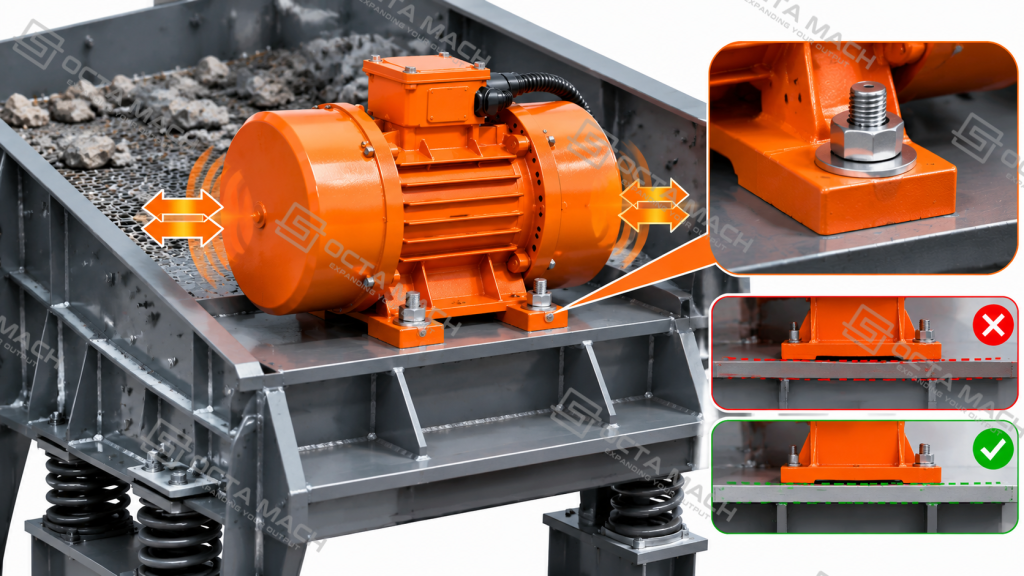
The mounting base must provide sufficient rigidity to withstand the cyclic forces generated during operation. The motor should be installed on a flat, properly prepared mounting surface, with the specified bolt pattern and fastener size.
Mounting dimensions differ among models. The motor’s installation drawing should therefore be checked against the equipment frame before installation.
Loose mounting bolts, uneven contact surfaces or insufficient support rigidity can result in additional vibration, noise and mechanical stress.
Electrical Connection
The motor’s rated voltage, frequency, current and connection arrangement must match the power supply and electrical control system.
Electrical protection and cable routing should be selected according to the motor’s rated current, starting requirements and installation environment. Explosion-proof configurations require the corresponding certified electrical accessories and installation practices.
Eccentric Weight Adjustment and Maintenance
The eccentric weights should be adjusted according to the required excitation force and the equipment manufacturer’s operating requirements. Adjustment must be carried out with the motor isolated from the electrical supply and in accordance with the specified procedure.
Regular maintenance should include checking mounting fasteners, electrical connections, bearing condition, abnormal noise and signs of overheating.
The listed bearing service-life figures are 5,000 operating hours for 2-pole models and 10,000 operating hours for 4-, 6- and 8-pole models. These figures refer to bearing life rather than a guaranteed service life for the complete motor. Actual bearing life depends on operating load, mounting conditions, maintenance and other service factors.
Key Selection Factors for Industrial Vibration Motors
The selection of an industrial vibration motor depends on the dynamic characteristics of the vibrating equipment, material handling requirements and electrical operating conditions. The following factors directly influence equipment compatibility and operating performance.
Excitation Force and Vibrating Mass: The required excitation force depends on the vibrating mass, material load and target acceleration. Insufficient force can restrict material movement, while excessive force may increase dynamic loading on the equipment frame and supporting components.
Rotational Speed and Pole Number: The 2-, 4-, 6- and 8-pole configurations provide different vibration frequencies. The appropriate speed depends on material characteristics, screening requirements, conveying behavior and the intended vibration amplitude.
Power and Electrical Configuration: Rated power, current, voltage, frequency and winding connection must match the electrical supply and control system. Standard 380 V, 50 Hz configurations and alternative electrical configurations accommodate different installation requirements, subject to model availability.
Mounting Dimensions and Mechanical Compatibility: Bolt hole spacing, shaft center height, mounting orientation and motor weight are critical parameters, particularly when replacing existing vibration motors.
Operating Environment: Ambient temperature, altitude, dust exposure and moisture affect motor selection. Applications in hazardous areas require specialized motor configurations with appropriate explosion-protection markings and valid certification.
Motor Arrangement and Vibration Pattern: Single-motor or dual-motor arrangements can generate circular or linear vibration, depending on the installation geometry and direction of rotation. The resulting motion must correspond to the mechanical design of the screening, feeding or conveying equipment.
Why Choose OctaMach for Industrial Vibration Motors
OctaMach provides industrial equipment solutions for mining, quarrying, aggregate production and mineral processing. Our support for industrial vibration motor projects focuses on equipment compatibility, technical configuration and coordinated supply.
- Application-Based Selection: Motor configurations can be reviewed according to the driven equipment, required excitation force, operating speed, vibrating mass and working conditions.
- Technical Configuration Support: We assist with checking rated power, voltage, frequency, pole number and mounting dimensions to match the requirements of vibrating screens, feeders and other processing equipment.
- Integrated Equipment Coordination: For complete crushing and screening projects, vibration motors can be coordinated with feeders, screens, conveyors, supporting structures and related equipment to ensure compatibility across the processing line.
- Quality and Delivery Coordination: Manufacturing checks, assembly verification, applicable trial operation, technical documentation and shipment preparation are coordinated according to the confirmed project scope.
- Project and After-Sales Support: Technical communication and equipment support are available throughout project coordination, installation preparation and subsequent operation.
Whether supplying an individual vibration motor or coordinating equipment for a complete crushing and screening plant, OctaMach focuses on matching the equipment configuration to actual operating requirements.
FAQ
1. What Is an Industrial Vibration Motor Used For?
An industrial vibration motor generates centrifugal excitation force to drive vibrating machinery. Common applications include vibrating screens, vibrating feeders, vibrating conveyors and material classification equipment used in mining, quarrying and aggregate processing.
2. How Is the Excitation Force of a Vibration Motor Adjusted?
The excitation force is adjusted by changing the relative angular position of the eccentric weights installed at the motor shaft ends. Changing their included angle alters the effective eccentric mass and the resulting centrifugal force. Adjustments must remain within the motor’s specified operating limits.
3. What Is the Difference Between a Standard and an Explosion-Proof Vibration Motor?
A standard vibration motor is designed for general industrial operating environments within its specified protection rating and service conditions. An explosion-proof vibration motor is designed and certified for particular hazardous environments. Its explosion-protection type, gas group, temperature class and equipment protection level must match the actual installation requirements.
4. How Do I Choose a Vibration Motor for a Vibrating Screen?
The selection depends on the screen’s vibrating mass, required excitation force, operating speed, screen structure, mounting dimensions and electrical supply. The motor’s force and pole configuration must match the screening equipment’s mechanical design and required operating frequency.