
High Pressure Grinding Rolls (HPGR) reduce hard and abrasive materials through controlled compression between two counter-rotating rolls. The equipment combines hydraulic pressure control, a synchronized drive system, and wear-resistant roll surfaces to process mineral feed at high throughput rates. Roll diameter, installed motor power, and processing capacity are selected according to material properties, feed size, moisture content, and required product fineness, making HPGR suitable for large-scale mineral processing and cement operations.
Unlike conventional roll crushers that primarily rely on direct compression between two rolls, HPGR technology uses inter-particle comminution. The material forms a compressed bed in the grinding zone, where particles fracture against one another under high pressure. This mechanism produces a finer and more uniformly crushed product while creating microcracks that can benefit subsequent grinding stages.
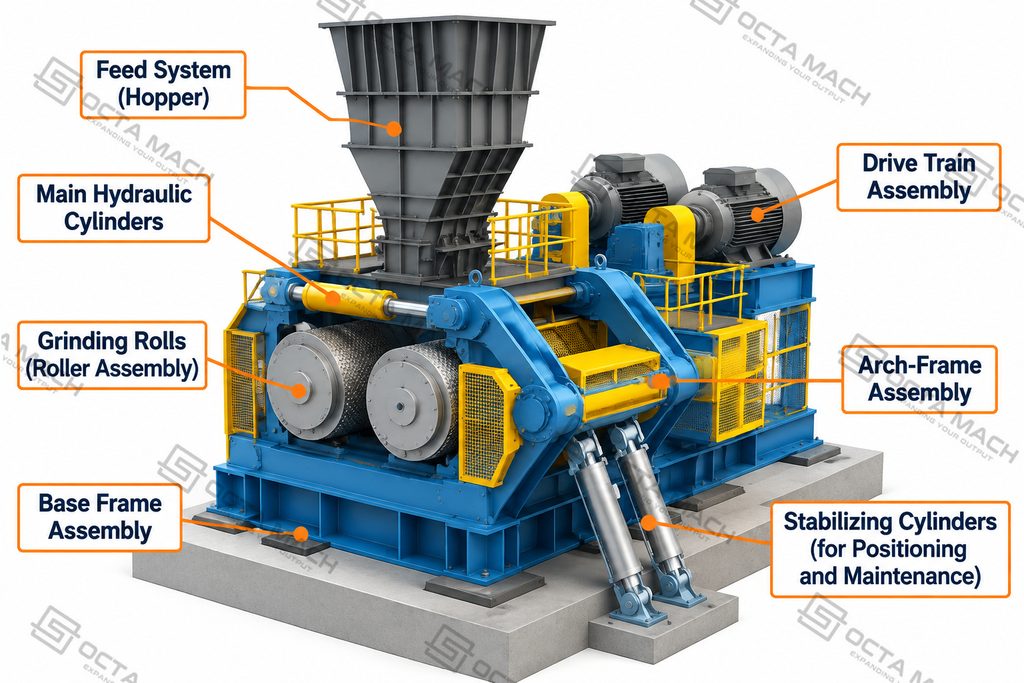
High Pressure Grinding Rolls (HPGR) Technical Specifications
The HGR high pressure grinding roll series includes 19 configurations with different roll dimensions, motor power ratings and processing capacities. Model selection depends on the required throughput, feed particle size, ore characteristics and the target product size.
HGR Model and Capacity Table
| Roll Diameter (mm) | Roll Width (mm) | Motor Power (kW) | Feed Size (mm) | Throughput (t/h) |
|---|---|---|---|---|
| 1,000 | 630 | 630 | ≤25 | 105–145 |
| 1,200 | 500 | 710 | ≤25 | 180–210 |
| 1,200 | 800 | 1,000 | ≤25 | 260–340 |
| 1,400 | 800 | 1,260 | ≤35 | 390–500 |
| 1,400 | 1,100 | 1,600 | ≤35 | 480–610 |
| 1,600 | 1,200 | 1,800 | ≤40 | 830–980 |
| 1,600 | 1,400 | 2,500 | ≤40 | 1,000–1,200 |
| 1,800 | 1,600 | 3,200 | ≤40 | 1,400–1,800 |
| 2,000 | 1,300 | 3,200 | ≤50 | 1,400–1,800 |
| 2,000 | 1,500 | 3,600 | ≤50 | 1,500–2,000 |
| 2,000 | 1,700 | 4,000 | ≤50 | 1,800–2,600 |
| 2,200 | 1,400 | 4,480 | ≤55 | 2,000–2,800 |
| 2,200 | 1,800 | 5,000 | ≤55 | 2,250–3,100 |
| 2,400 | 1,300 | 4,480 | ≤60 | 2,200–2,800 |
| 2,400 | 1,500 | 5,000 | ≤60 | 2,500–3,200 |
| 2,400 | 1,700 | 5,600 | ≤60 | 2,800–3,600 |
| 2,400 | 1,800 | 6,300 | ≤60 | 3,000–3,800 |
| 2,600 | 1,800 | 7,100 | ≤65 | 3,400–5,000 |
| 3,000 | 2,000 | 11,200 | ≤75 | 6,000–6,500 |
Note: The specifications above represent available HPGR equipment configurations. Actual processing capacity depends on feed material hardness, moisture content, particle size distribution, operating pressure, and required product fineness. Final equipment selection should be based on specific processing requirements.
Main Technical Range
| Parameter | HGR Series Range |
|---|---|
| Roll Diameter | 1,000–3,000 mm |
| Roll Width | 500–2,000 mm |
| Installed Motor Power | 630–11,200 kW |
| Maximum Feed Size | 25–75 mm |
| Processing Capacity | 105–6,500 t/h |
High Pressure Grinding Rolls (HPGR) are available in different configurations to accommodate varying processing capacities and material requirements. Larger equipment configurations can achieve throughput rates of several thousand tonnes per hour, with roll diameters reaching 3,000 mm, roll widths up to 2,000 mm, and installed motor power up to 11,200 kW. These specifications represent the overall available technical range rather than a single equipment configuration. Actual processing capacity depends on ore hardness, feed particle size distribution, moisture content, operating pressure, roll speed, and required discharge particle size.
How the HPGR Crusher Works
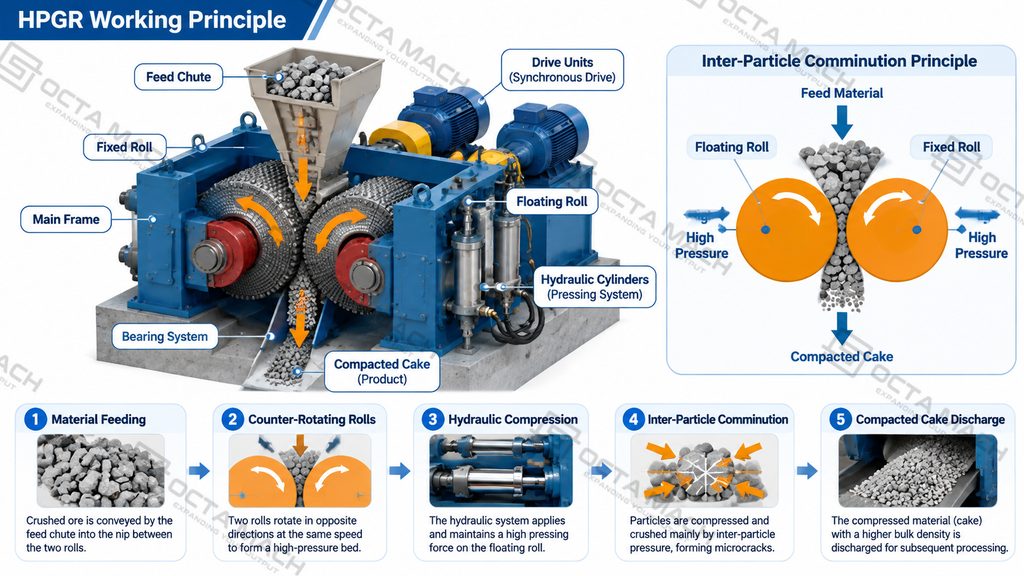
High Pressure Grinding Rolls (HPGR) use high-pressure particle-bed compression to reduce the size of mineral feed. Two counter-rotating rolls draw material into the narrow working gap, where hydraulic force compresses the particles into a dense bed. The grinding process can be divided into four stages.
Material Feeding
Prepared ore enters the feed hopper and moves continuously toward the gap between the two rolls. A stable feed rate and reasonably consistent particle size distribution help maintain uniform material loading across the roll width.
Hydraulic Pressure Application
The hydraulic system applies force to the movable roll. As the material enters the compression zone, the movable roll responds to changes in the material bed while the fixed roll provides the opposing reaction force. The applied grinding force must be matched to the material characteristics and the required product size. Excessive or insufficient pressure can affect energy consumption, throughput, and roll wear.
Inter-Particle Comminution
Under high compression, individual particles fracture through contact with neighboring particles. This is the defining mechanism of high pressure grinding rolls. Unlike impact-based crushing, inter-particle comminution distributes the crushing action through the compressed material bed. It can also create microcracks inside larger particles, weakening their internal structure before downstream grinding.
Compacted Cake Discharge
After passing through the roll gap, the compressed material leaves the machine as a compacted cake. Depending on the process arrangement, this material can be sent to a de-agglomeration stage, vibrating screen, ball mill, or another downstream processing unit. The final product size is determined by the feed properties, applied grinding force, operating conditions, and circuit configuration rather than by roll dimensions alone.
The mechanical arrangement of High Pressure Grinding Rolls (HPGR) must maintain stable roll rotation and consistent pressure distribution under heavy operating loads. The equipment integrates a coordinated drive system, hydraulic pressing mechanism, and wear-resistant roll surfaces to maintain reliable grinding performance.
Single-Motor Synchronous Drive
A single-motor synchronous drive system can operate the fixed and movable rolls in opposite directions through a coordinated mechanical transmission. This arrangement maintains synchronized roll rotation and helps distribute the driving force consistently during high-pressure grinding.
Compared with conventional dual-motor drive arrangements, the supplied technical data indicate a 15%–20% reduction in power consumption for the single-motor configuration. However, this reported improvement is configuration-specific and should not be treated as a guaranteed energy saving for all HPGR installations. Actual power consumption depends on material hardness, grinding pressure, throughput, drive efficiency, and operating conditions.
Fixed and Movable Roll Assemblies
The two grinding rolls form the main crushing unit of the HPGR.
- Fixed Roll: Maintains its position within the main frame and provides the reaction force during compression.
- Movable Roll: Moves under hydraulic control to accommodate variations in the material bed and maintain the required grinding pressure.
The relative movement of the rolls allows the equipment to respond to changing feed conditions while maintaining a controlled grinding force.
Hydraulic Pressing System
The hydraulic system supplies the force required for high-pressure grinding. It acts on the movable roll and regulates compression within the working gap. Stable hydraulic pressure is essential for maintaining consistent product particle size distribution, controlling mechanical loads, and reducing uneven wear on the roll surfaces.
Studded Grinding Roll Surface
The HPGR uses a studded roll surface designed for processing hard and abrasive mineral materials. During operation, particles accumulate between the wear-resistant studs, forming an autogenous protective material layer that reduces direct abrasive contact with the underlying roll surface.
This arrangement helps extend roll service life and reduce maintenance requirements under demanding grinding conditions. Actual wear rates depend on ore abrasiveness, operating pressure, feed characteristics, and the condition of the protective material layer.
Main Frame and Bearing Assembly
The main frame supports the grinding roll assemblies and withstands the high compressive forces generated during operation. The bearing system carries the substantial radial loads produced by continuous high-pressure grinding. Proper roll alignment, effective lubrication, and bearing temperature control are essential for maintaining mechanical stability, reducing premature wear, and ensuring long-term equipment reliability.
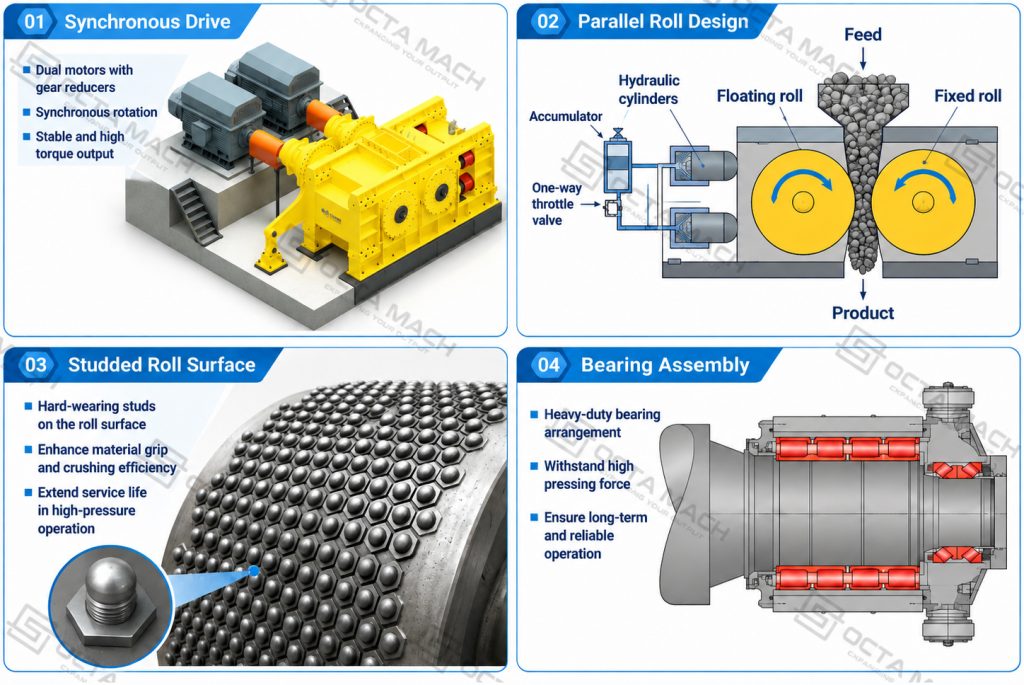
Key Performance Features of HGR
Energy-Efficient Synchronous Drive
The single-motor synchronous drive reduces the number of main drive motors and coordinates the rotation of both grinding rolls. Technical performance data indicate a 15%–20% reduction in power consumption compared with conventional dual-motor drive arrangements under specified operating conditions. This improvement relates to the drive-system configuration rather than the total electricity consumption of an entire mineral processing plant. Actual energy savings depend on motor efficiency, transmission losses, material properties, and operating load.
Uniform Grinding Pressure Distribution
The fixed and movable rolls are designed to maintain parallel alignment during operation, helping reduce material leakage at the roll edges and minimize uneven pressure distribution across the grinding width. Technical performance data indicate that optimized roll alignment and pressure distribution can reduce circulating loads and increase throughput by up to 15% under suitable operating conditions. Consistent compression also improves material bed stability and helps maintain a more uniform discharge particle size distribution.
Studded Roll Surface with Autogenous Protection
Wear-resistant studs create spaces where compressed mineral particles accumulate, forming an autogenous protective material layer that reduces direct abrasive contact with the underlying roll body. Technical product data report a potential roll surface service life exceeding 20,000 operating hours under specified conditions. Actual service life depends on ore hardness, abrasiveness, feed moisture, grinding pressure, material distribution, and maintenance practices. Regular inspection of stud wear and surface condition is essential for maintaining grinding efficiency and reducing unplanned downtime.
Long-Life Bearing Design
The bearing assembly is engineered for heavy-duty operation under sustained mechanical loads. Technical design information indicates a potential bearing service life exceeding eight years under specified operating conditions. This represents a design-life reference rather than a guarantee of maintenance-free operation. Actual bearing life depends on lubrication quality, load distribution, installation accuracy, operating temperature, and maintenance practices.
Applications of High Pressure Grinding Rolls
High Pressure Grinding Rolls (HPGR) are used in mineral processing operations that require high-capacity crushing and controlled particle size reduction. Their inter-particle compression mechanism is particularly suitable for processing hard and abrasive ores before downstream grinding and mineral separation.
Iron Ore Processing
In iron ore processing, HPGR equipment can be installed in tertiary or quaternary crushing circuits or ahead of downstream grinding equipment. When hard iron ore enters the grinding zone, high-pressure compression reduces particle size and can create microcracks along mineral boundaries. These microcracks may improve grinding efficiency and facilitate mineral liberation in subsequent processing stages.
For iron ore concentrate production, HPGR discharge can be combined with screening and additional grinding stages to achieve the required particle size distribution while controlling circulating loads and energy consumption.
Copper and Gold Ore Processing
Copper and gold ores often contain hard, competent rock that requires substantial energy for particle size reduction. HPGR equipment can process prepared ore ahead of ball milling or other downstream treatment stages. High-pressure compression promotes inter-particle breakage and can generate internal microcracks, potentially reducing the energy required for subsequent grinding.
Grinding pressure, feed size, and circuit configuration should be selected according to ore hardness, mineral composition, moisture content, and the liberation size required for downstream recovery processes.
Diamond Ore Processing
Diamond-bearing ore requires controlled crushing to reduce the surrounding host rock while minimizing damage to valuable diamond crystals. High Pressure Grinding Rolls (HPGR) can be considered for diamond processing circuits where particle-bed compression is compatible with the ore characteristics and diamond recovery requirements. The suitability of this grinding method depends on the ore structure, diamond size distribution, and potential for crystal breakage under compression.
Grinding pressure, feed preparation, and downstream separation processes must be evaluated together to balance size reduction efficiency with diamond preservation. Equipment selection should consider diamond liberation, potential diamond damage, and overall recovery performance rather than throughput alone.
Cement Industry
High Pressure Grinding Rolls (HPGR) are used in cement production for clinker grinding, raw material preparation, and pre-grinding applications. The equipment applies high-pressure compression to reduce particle size and can improve grinding circuit efficiency when integrated with ball mills or other downstream grinding systems.
For cement applications, roll dimensions, installed motor power, and operating pressure should be selected according to material hardness, feed size, moisture content, required product fineness, and processing capacity. Proper circuit configuration can help reduce specific energy consumption while maintaining consistent material throughput.
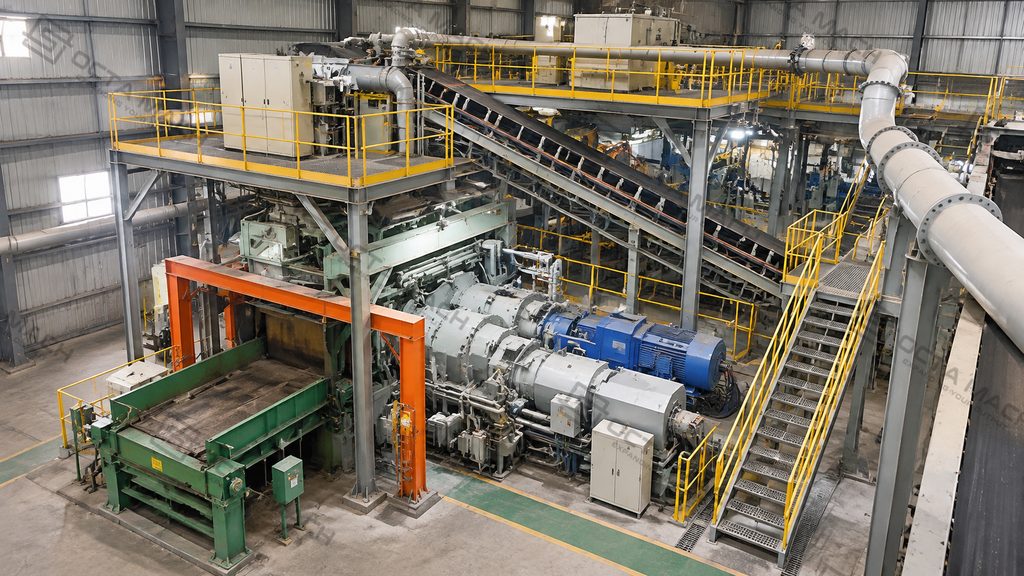
HPGR Grinding Circuit Integration
High Pressure Grinding Rolls (HPGR) are typically integrated into complete crushing and grinding circuits. Their contribution to overall plant productivity depends on feed preparation, operating conditions, and downstream screening or grinding arrangements.
HPGR in Tertiary and Quaternary Crushing
In a multi-stage crushing plant, HPGR equipment can receive material after primary and secondary crushing. High-pressure inter-particle compression reduces the feed particle size before the material enters the next processing stage. This arrangement is suitable for mineral processing operations requiring high throughput, consistent particle size reduction, and controlled feed preparation for downstream grinding equipment.
HPGR in Closed-Circuit Screening
A vibrating screen can be installed downstream of the HPGR to classify material according to the required particle size. Oversized particles are returned for further grinding, while material meeting the specified size proceeds to the next processing stage.
The typical process includes:
- Prepared ore enters the HPGR feed system.
- Counter-rotating rolls compress the material and discharge it as a compacted cake.
- The compacted material undergoes de-agglomeration when required.
- A vibrating screen separates the material into different particle size fractions.
- Oversized particles return to the HPGR for further size reduction.
- Material meeting the specified particle size proceeds to downstream grinding or mineral separation.
This closed-circuit arrangement helps control product particle size distribution and circulating loads. Actual circuit performance depends on screen efficiency, feed characteristics, operating pressure, and the selected cut size.
HPGR Before Ball Mill Grinding
High Pressure Grinding Rolls (HPGR) can be installed ahead of a ball mill to reduce feed particle size and improve downstream grinding efficiency. High-pressure inter-particle compression can generate microcracks within mineral particles, weakening their internal structure and potentially reducing the energy required during subsequent ball milling.
Depending on ore characteristics and circuit design, this arrangement can reduce the grinding load on the ball mill, increase processing capacity, or improve overall circuit efficiency. HPGR and ball mills generally perform complementary functions rather than serving as direct substitutes. The final circuit configuration should be determined through ore testing, energy consumption analysis, and process evaluation.
HGR Model Selection and Capacity
Selecting High Pressure Grinding Rolls (HPGR) requires evaluating more than nominal throughput and equipment dimensions. Feed material characteristics, operating pressure, roll geometry, and circuit configuration determine whether the equipment can consistently achieve the required processing capacity and discharge particle size.
Required Processing Capacity
The required production rate is a key factor when selecting High Pressure Grinding Rolls (HPGR). Available equipment configurations offer processing capacities ranging from 105 to 6,500 t/h, with installed motor power varying according to roll dimensions and grinding requirements. The following specifications provide a preliminary comparison of processing capacity and motor power.
| Listed Throughput (t/h) | Motor Power (kW) |
|---|---|
| 105–145 | 630 |
| 480–610 | 1,600 |
| 1,000–1,200 | 2,500 |
| 1,800–2,600 | 4,000 |
| 3,000–3,800 | 6,300 |
| 3,400–5,000 | 7,100 |
| 6,000–6,500 | 11,200 |
These figures represent selected equipment configurations rather than guaranteed processing rates. Actual throughput depends on ore hardness, feed size distribution, moisture content, grinding pressure, and operating conditions. Final equipment selection should consider the required production capacity, specific energy consumption, and downstream grinding requirements.
Feed Particle Size Distribution
The maximum feed size for High Pressure Grinding Rolls (HPGR) varies from 25 to 75 mm, depending on equipment configuration. The proportion of coarse and fine particles affects material flow into the roll gap and the formation of a stable compressed material bed. Uneven feed distribution can cause inconsistent loading across the roll width, reducing grinding efficiency and increasing localized wear. Upstream crushing and screening equipment should therefore be configured to provide a consistent feed size distribution.
Ore Hardness and Abrasiveness
Ore hardness determines the grinding force required for particle breakage, while abrasiveness influences roll surface wear and maintenance frequency. For highly abrasive materials, studded roll surfaces and their autogenous wear protection are important selection considerations. Representative ore sampling, laboratory testing, and pilot-scale grinding trials can help establish suitable operating pressures, expected throughput, and wear performance under actual processing conditions.
Moisture Content
Feed moisture influences material flow, inter-particle friction, and the formation of the protective material layer on the grinding rolls. Excessive moisture may cause material buildup, uneven feeding, or reduced discharge efficiency, while very low moisture can affect material-bed stability and frictional behavior. The acceptable moisture range depends on ore characteristics, feed particle size distribution, and operating pressure, and should be verified through material testing.
Required Product Size
The target product size determines how High Pressure Grinding Rolls (HPGR) should be integrated with screening and downstream grinding equipment. Finer product requirements may require a closed-circuit arrangement with additional material recirculation, while coarser product requirements may allow a simpler circuit configuration.Final equipment selection should consider feed particle size distribution, target product fineness, circulating load, installed motor power, and overall grinding circuit performance.
Why Choose Octa Mach
Octa Mach supplies High Pressure Grinding Rolls (HPGR) for mining and mineral processing projects requiring high-capacity crushing and efficient pre-grinding. Available configurations cover different roll dimensions, installed motor powers, and processing capacities, allowing equipment selection to be matched to specific production requirements and material characteristics.
When selecting HPGR equipment, Octa Mach evaluates the key technical factors affecting grinding performance and long-term operation:
- Required processing capacity and daily operating hours.
- Ore hardness, abrasiveness, and material characteristics.
- Maximum feed size and particle size distribution.
- Target product size and downstream grinding requirements.
- Available installation space and plant layout.
- Equipment configuration, wear protection, and project supply scope.
Octa Mach focuses on matching equipment specifications to actual operating conditions rather than relying solely on nominal throughput ratings. For large-scale mineral processing projects, HPGR equipment can be evaluated alongside feeding, screening, conveying, and downstream grinding systems to support stable production, controlled energy consumption, and reliable long-term operation.
FAQ
Q: What are high pressure grinding rolls used for?
A: High pressure grinding rolls are used for high-capacity size reduction of hard and abrasive materials through inter-particle compression. They are commonly applied in iron ore, copper, gold ore and cement processing. The compression process can generate microcracks within mineral particles, improving their response to downstream grinding. HPGR equipment is often installed in tertiary crushing, quaternary crushing or pre-grinding circuits.
Q: What is the maximum feed size of an HGR machine?
A: The maximum feed size of HPGR equipment ranges from 25 mm to 75 mm, depending on the equipment configuration. Larger configurations can accept feed sizes up to 75 mm according to the supplied specifications. Feed particle size distribution and material characteristics should also be considered. The allowable feed size must be confirmed against the technical specifications of the selected equipment.
Q: What determines the processing capacity of an HPGR machine?
A: HPGR processing capacity is primarily determined by roll diameter, roll width, operating pressure and roll speed. Ore hardness, feed particle size distribution and moisture content also affect material flow and crushing performance. The required discharge size and circulating load influence the capacity of the complete grinding circuit. Proper equipment selection requires evaluating these factors together rather than relying on motor power alone.
Q: Can an HPGR crusher replace a conventional ball mill?
A: An HPGR crusher does not universally replace a conventional ball mill because the two machines perform different roles in mineral processing. HPGR reduces particle size through high-pressure compression, while ball mills use impact and abrasion for further grinding. HPGR equipment is frequently installed ahead of ball mills to reduce feed size and generate microcracks in mineral particles. The final circuit configuration depends on ore properties, target product size and grinding test results.