
Octa Mach completed factory inspection, export packing, and loading of the main equipment package for an iron ore processing plant bound for Minas Gerais, Brazil. The shipment covered the principal machines required for crushing, grinding, classification, and magnetic separation of magnetite-dominant iron ore.
Before dispatch, the equipment was checked against the approved layout and equipment list. Major components were match-marked, exposed machined surfaces were protected, and loose parts were packed separately to simplify identification during unloading and assembly.
Project Background
The Brazilian customer required an iron ore beneficiation line capable of producing a consistent magnetic concentrate from variable run-of-mine feed. The project therefore needed more than a conventional crushing circuit. It required controlled preparation of mill feed, closed-circuit grinding, staged magnetic separation, and reliable slurry transfer between process stages.
The following values formed the project design basis. Final operating results depend on representative ore mineralogy, hardness, liberation characteristics, moisture, and stable plant operation.
| Project Parameter | Design Basis |
|---|---|
| Project location | Minas Gerais, Brazil |
| Main feed material | Magnetite-dominant iron ore |
| Nominal dry-feed capacity | 200 t/h |
| Maximum feed size | 500 mm |
| Feed moisture | ≤6% |
| Indicative head grade | 30–38% Fe |
| Target grinding size | P80 of 75–106 μm |
| Target concentrate grade | 65–68% Fe |
| Target iron recovery | ≥88% |
| Filtered concentrate moisture | ≤10% |
These figures are project targets rather than universal guarantees. Ore samples must confirm the required grinding size and magnetic response before final performance acceptance.
Processing Circuit
The plant layout follows a practical sequence from run-of-mine ore reception to magnetic concentrate production:
- Controlled feeding into the primary crushing stage;
- Primary and secondary crushing;
- Closed-circuit screening of crushed material;
- Storage and regulated feeding of fine ore;
- Closed-circuit grinding in the ball mill;
- Hydrocyclone classification;
- Staged wet magnetic separation;
- Concentrate collection and dewatering;
- Tailings discharge and process-water recovery.
Oversized material retained by the vibrating screen returns to secondary crushing. Correctly sized material enters the fine-ore stockpile, which provides a buffer between dry crushing and wet grinding.
The ball mill operates with hydrocyclone classification to control the particle-size distribution entering magnetic separation. Coarse cyclone underflow returns to the mill, while qualified overflow advances to the magnetic separator circuit.
Main Equipment Supplied
| Process Stage | Main Equipment | Function |
|---|---|---|
| Ore feeding | Receiving hopper and vibrating feeder | Regulate the flow of run-of-mine ore |
| Primary crushing | Jaw crusher | Reduce large iron ore to a manageable size |
| Secondary crushing | Cone crusher | Produce controlled feed for screening and grinding |
| Screening | Multi-deck vibrating screen | Separate qualified mill feed and return oversize |
| Material transfer | Belt conveyors and transfer chutes | Connect the dry-processing stages |
| Fine-ore storage | Surge bin and belt feeder | Stabilize feed to the grinding circuit |
| Grinding | Ball mill | Liberate magnetite from gangue minerals |
| Classification | Hydrocyclone cluster | Separate qualified slurry from coarse circulating load |
| Concentration | Wet drum magnetic separator | Recover magnetic iron minerals from the slurry |
| Slurry handling | Pumps, tanks, and pipelines | Transfer slurry between process stages |
| Concentrate handling | Thickening and filtration equipment | Reduce concentrate moisture for storage and transport |
| Electrical control | Motor control cabinets and field instruments | Monitor equipment status and operating conditions |
Technical Highlights of the Plant
Stable Feed Between Crushing and Grinding
The fine-ore surge bin separates the operating rhythm of the crushing circuit from that of the grinding circuit. Temporary crusher stops therefore do not immediately interrupt the ball mill, while changes in truck feeding have less influence on mill loading.
A variable-speed belt feeder controls the withdrawal rate from the bin. This helps maintain a steadier mill feed rate and reduces sudden changes in circulating load, cyclone pressure, and grinding density.
Closed-Circuit Grinding
Magnetite liberation depends strongly on grinding size. Material that is too coarse can carry locked magnetite into the tailings, while excessive grinding increases power consumption and produces fine particles that are more difficult to dewater.
The ball mill grinding circuit for iron ore operates with hydrocyclone classification. Coarse cyclone underflow returns for additional grinding, while overflow at the required particle size moves to magnetic separation. Sampling points are provided around the mill discharge and cyclone streams so operators can monitor density and particle-size distribution.
Staged Magnetic Separation
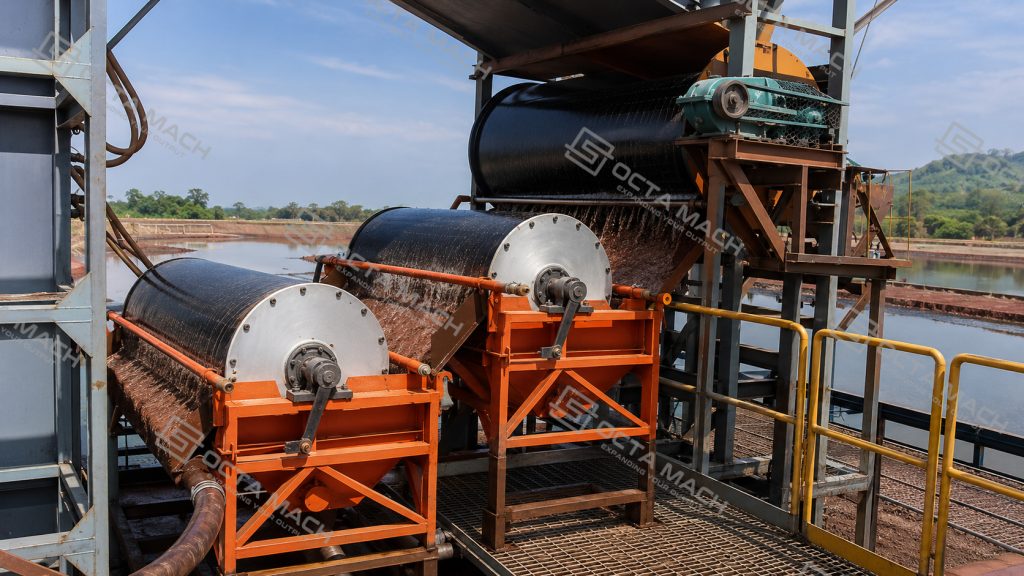
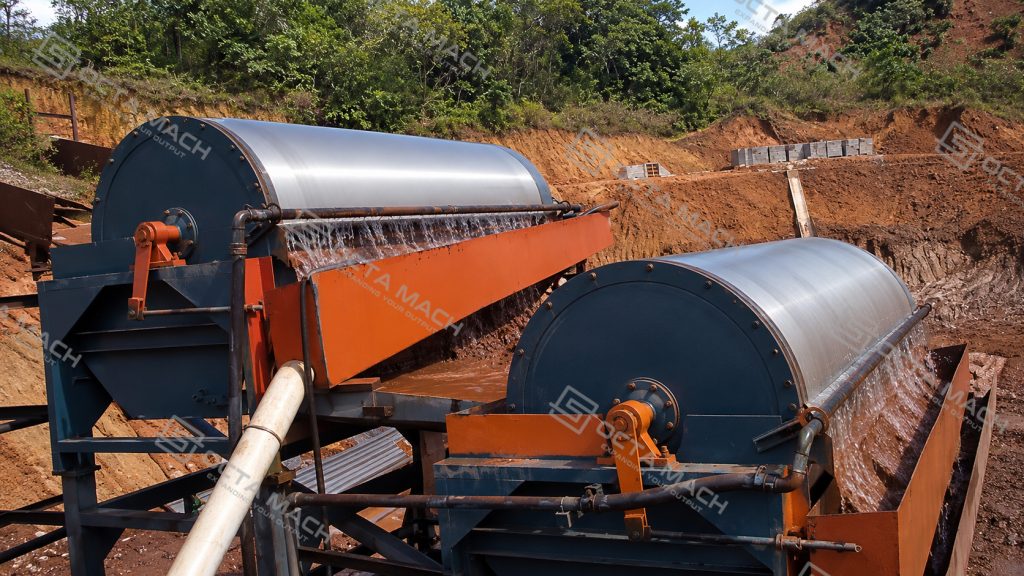
The wet drum magnetic separator for magnetite is arranged in separate recovery and cleaning stages instead of relying on one separation pass. The first stage recovers the main magnetic fraction, while the later stage removes additional non-magnetic gangue from the rough concentrate.
This arrangement allows operators to balance concentrate grade and iron recovery. Drum speed, magnetic field configuration, slurry density, feed rate, and rinse-water distribution can be adjusted according to actual ore response.
Wear and Maintenance Access
Brazilian iron ore can be abrasive, particularly in crusher liners, screen media, mill liners, pump wet ends, and transfer chutes. The equipment layout therefore provides access for replacing major wear parts without removing unrelated machinery.
Key wear areas use replaceable liners, and the main machines include inspection platforms or access points for routine maintenance. Critical slurry pumps can also be isolated individually to reduce unnecessary wet-circuit downtime.
Factory Inspection Before Packing
Octa Mach inspected the main equipment and supporting components before releasing the shipment. The inspection focused on equipment identity, mechanical condition, interface dimensions, and completeness of the supply package.
The factory inspection covered:
- Verification of equipment models and nameplates;
- Measurement of principal connection and installation dimensions;
- Rotation checks on crushers, the ball mill, pumps, and magnetic separators;
- Inspection of bearings, couplings, guards, and lubrication points;
- Confirmation of motor voltage, frequency, and rated power;
- Examination of welded frames, platforms, and supporting structures;
- Checking of electrical cabinets, instruments, and terminal identification;
- Match-marking of dismantled steel structures and connecting components;
- Review of loose parts, fasteners, wear parts, and installation accessories;
- Photography of equipment condition before packing.
Components belonging to the same machine were grouped and marked consistently. This reduces the risk of mixing structural members, drive parts, guards, or fasteners during unloading and site assembly.
Export Packing and Loading
Packing methods were selected according to component size, weight, surface condition, and sensitivity to moisture. Large steel structures were prepared as open cargo, while electrical equipment, instruments, and small components were placed in closed cases.
| Cargo Type | Packing Method | Main Protection |
|---|---|---|
| Crusher and mill assemblies | Steel supports with secured lifting points | Mechanical restraint and impact protection |
| Magnetic separator drums | Supported frames with locked rotating components | Shaft, bearing, and drum protection |
| Motors and gearboxes | Covered export packing | Moisture and dust protection |
| Electrical cabinets | Sealed wooden cases with desiccant | Humidity and impact protection |
| Instruments and sensors | Padded internal packaging | Vibration and moisture protection |
| Steel platforms and frames | Bundled and match-marked | Identification and loss prevention |
| Pipes and structural sections | Bundled by installation area | Easier unloading and sorting |
| Fasteners and small parts | Numbered boxes inside wooden cases | Traceability and inventory control |
| Spare and wear parts | Separate marked cases | Protection and rapid identification |
Unpainted machined surfaces received temporary corrosion protection before loading. Flange openings, shaft ends, threaded connections, and exposed bearings were sealed against dust and moisture. Equipment lifting points remained visible to help the receiving team handle heavy packages safely.
With the main equipment inspected, match-marked, and secured for export, the shipment was released for transport to Brazil. The package provides the core crushing, grinding, classification, and magnetic separation equipment required for the planned iron ore beneficiation circuit. Final operating settings will be adjusted according to the customer’s actual ore characteristics and commissioning results.
FAQ
Q: Why does this iron ore processing plant use both crushing and grinding?
A: Crushing reduces run-of-mine ore to a size suitable for controlled feeding, while grinding liberates fine magnetite particles from gangue minerals. Crushing alone normally cannot achieve the liberation size required for effective magnetic separation.
Q: What determines the required ball mill discharge size?
A: Mineralogical and grinding tests determine the relationship between particle size, magnetite liberation, concentrate grade, and recovery. The selected grinding target must release enough magnetic mineral without creating unnecessary fines or excessive energy consumption.
Q: Why are several magnetic separation stages used?
A: The recovery stage captures the main magnetic fraction, while subsequent cleaning removes more non-magnetic gangue. Staged separation provides greater control over the balance between concentrate grade and iron recovery than a single magnetic separator.
Q: Can the plant treat iron ore with a different feed grade?
A: The circuit can accommodate reasonable feed variation, but major changes in mineralogy, hardness, oxidation, or magnetic response may require adjustments to grinding size, feed rate, separator settings, or the process configuration. Representative testwork should confirm the required changes.