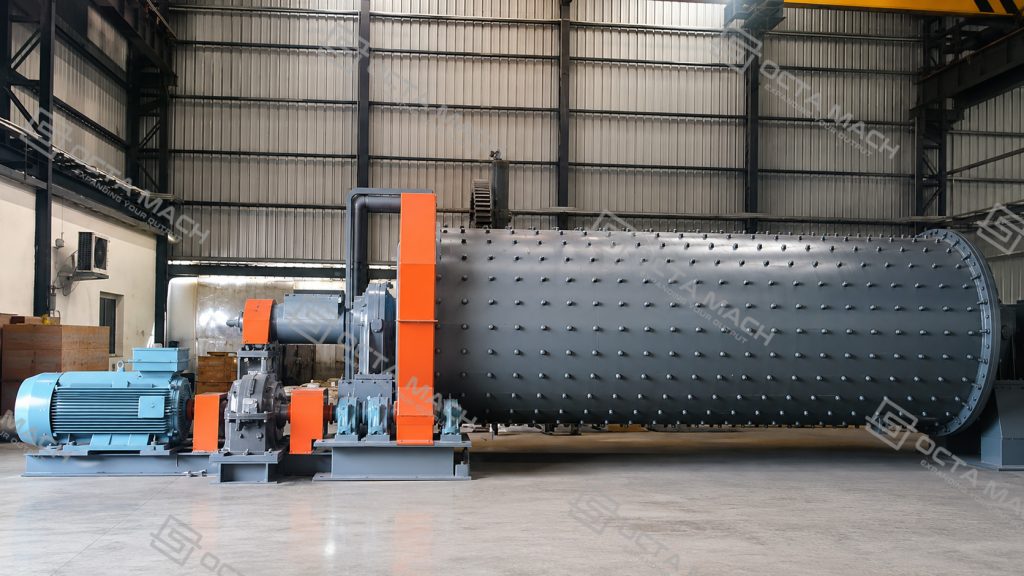
A ball mill is a horizontal mineral-grinding machine designed to reduce crushed ore into a controlled fine product through repeated impact and abrasion. It is built around a fabricated-steel cylindrical shell fitted with replaceable wear-resistant liners and charged with graded steel grinding media. The main assembly also includes hollow feed and discharge trunnions, bearing supports, a girth-gear transmission, reducer and electric motor. As the cylinder rotates, the liners lift the ball mill balls, which then cascade through the material and break the ore while promoting continuous mixing and particle-size reduction.
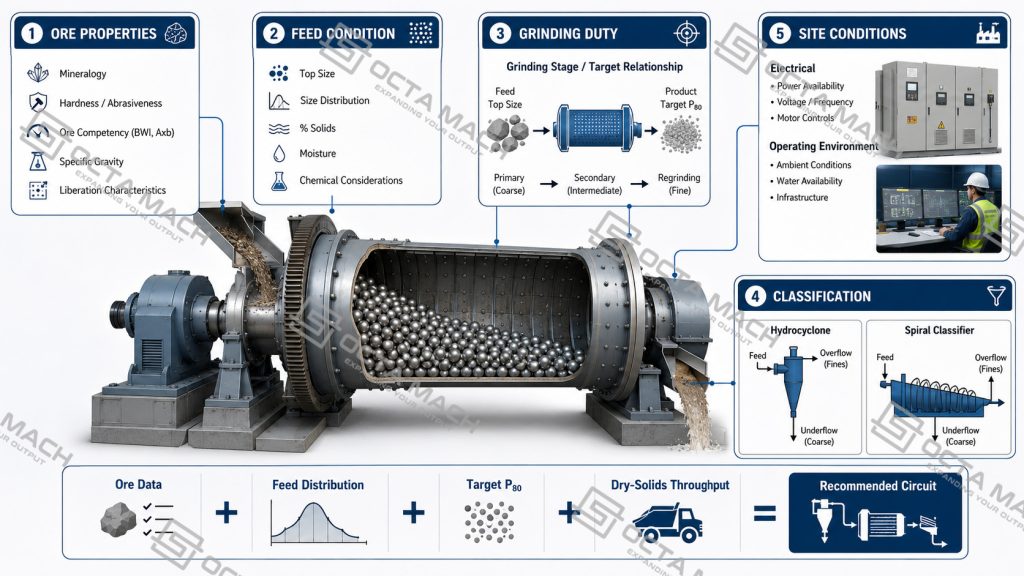
Industrial ball mills are suitable for wet or dry grinding of gold, copper, iron, lead-zinc, manganese and other metallic ores, as well as limestone and selected industrial minerals. They are commonly installed after crushing and before flotation, magnetic separation, gravity concentration or leaching. Selecting a ball mill for ore grinding should therefore begin with the actual process duty—including ore hardness, feed-size distribution, target product P80, dry-solids throughput, grinding method, discharge type and classifier arrangement—rather than simply choosing the largest cylinder, motor or catalogue capacity.
Grinding Requirements
Before selecting a ball mill, the required grinding result must be clearly defined. A ball mill does more than reduce the size of crushed ore; it must produce a particle-size distribution and degree of mineral liberation suitable for the next processing stage.
Depending on the process route, the grinding duty may include:
- Liberating valuable minerals from gangue before flotation
- Producing a controlled ore slurry for magnetic or gravity separation
- Preparing finely ground material for leaching
- Regrinding concentrate before a cleaning stage
- Producing dry mineral powder for storage, mixing or further processing
The required product size should therefore be determined from the downstream process and mineral-liberation target. Grinding finer than necessary may reduce throughput, increase energy and media consumption, and generate excessive fine particles.
Ball Mill Selection Inputs
| Selection input | Information required | Why it matters |
| Ore properties | Mineral composition, hardness and abrasiveness | Affects power demand, wear and achievable throughput |
| Feed condition | Maximum size, F80 and size distribution | Influences impact requirement and initial media grading |
| Required output | Normal and peak dry-solids throughput | Determines mill volume, drive power and classifier duty |
| Product requirement | Target P80 and acceptable oversize | Controls residence time and circuit design |
| Grinding method | Wet or dry | Determines material handling, sealing and auxiliaries |
| Discharge system | Overflow or grate | Affects material retention and discharge rate |
| Circuit arrangement | Open or closed circuit | Determines whether classification and circulating load are required |
| Site conditions | Voltage, frequency, foundation and elevation | Affects the drive, installation and plant layout |
Ore Properties and Grinding Duty
Different ores can behave very differently inside the same ball grinding mill. Gold ore, copper ore, iron ore and lead-zinc ore may require different residence times and power inputs even when their feed sizes appear similar.
The initial technical review should identify:
- Valuable mineral and gangue composition
- Degree of mineral liberation required
- Ore hardness and abrasiveness
- Moisture, clay and fines content
- Downstream recovery process
- Potential contamination restrictions
An abrasive ore may increase grinding-media and liner consumption. A harder ore may reduce throughput at the same installed power. A feed containing excessive clay or moisture can also affect material transport, slurry behavior and classification.
Ore Hardness and Grindability
Ore hardness should not be described only as soft, medium or hard. For important projects, representative samples should be tested to determine grindability.
The Bond Ball Mill Work Index, commonly abbreviated as BWI or BBWI, is widely used to support the estimation of net power requirements when sizing industrial grinding ball mills. The Bond test is performed as a locked-cycle grindability test under controlled conditions.
The test product size should also be reasonably close to the intended full-scale circuit P80. Using a test result generated at a very different closing screen may reduce its value for the actual design duty.
For variable ore deposits, one sample may not represent the entire mine. Testing several ore domains can reveal whether harder zones are likely to reduce future plant throughput.
Feed Size and Size Distribution
Maximum feed size is important, but it is not enough for mill selection.
A feed described only as “below 25 mm” could contain:
- Mostly fine material below 3 mm
- A broad distribution from fines to 25 mm
- A high proportion of coarse particles near 25 mm
These three feeds will not create the same grinding duty.
The selection data should therefore include:
- Maximum particle size
- F80, meaning the size through which 80% of the feed passes
- Full feed-size distribution
- Percentage of near-maximum particles
- Stability of the crusher discharge
Coarser feed generally requires stronger impact and a suitable proportion of larger grinding media. Finer feed usually needs more contact points and may require a different media distribution.
Better crushing control can sometimes reduce the grinding burden more effectively than simply choosing a larger mill.
Target Grinding Fineness
The required product size must be confirmed before selecting a ball mill. Buyers may initially describe the grinding requirement as “200 mesh,” but mesh size alone does not show the complete particle-size distribution.
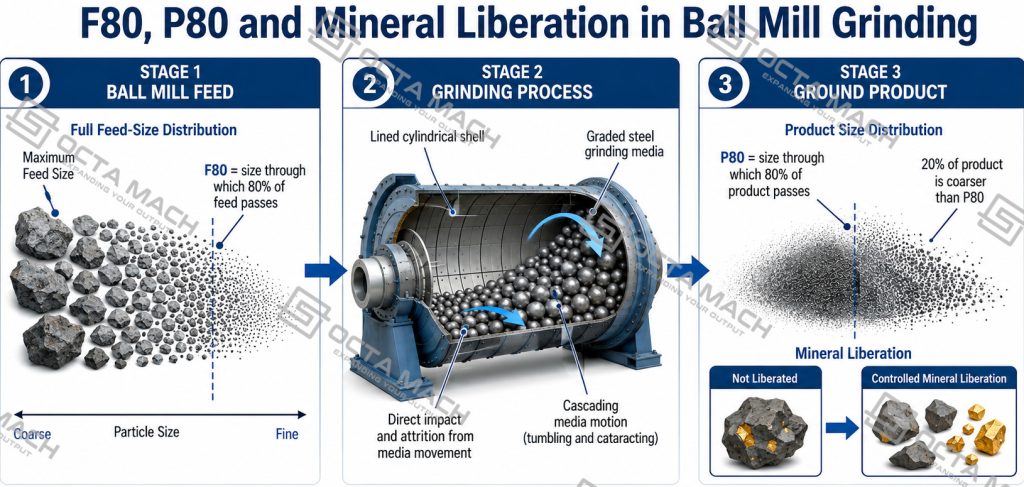
A more accurate engineering specification is the target P80. For example, a product P80 of 75 μm means that approximately 80% of the ground material passes 75 μm, while the remaining 20% is coarser.
The target P80 should be based on mineral-liberation tests and the requirements of the downstream flotation, magnetic separation, gravity concentration or leaching process. Grinding significantly finer than required may:
- Increase power consumption
- Reduce effective throughput
- Increase grinding-media and liner wear
- Produce excessive fine particles or slimes
- Make downstream mineral separation more difficult
The purpose of ball milling is to achieve sufficient mineral liberation at a controlled particle size—not simply to produce the finest possible powder.
Wet vs Dry Ball Mill Grinding
Both wet and dry ball milling are used industrially, but they serve different process routes.
| Selection factor | Wet ball mill | Dry ball mill |
| Material condition | Ore is mixed with process water | Material remains dry |
| Typical application | Metallic ore beneficiation | Limestone, cement raw materials and industrial minerals |
| Product handling | Pumpable slurry | Dry powder |
| Downstream equipment | Classifier, flotation, magnetic or gravity separation | Storage, pneumatic conveying or mixing |
| Main auxiliary requirements | Pumps, pipes, sumps and water control | Dust collection, air handling and sealing |
| Main selection concern | Slurry concentration and classification | Moisture control and dust containment |
Wet grinding is commonly selected when the next process already handles slurry. Dry grinding is more appropriate when water is unavailable, undesirable or incompatible with the required product.
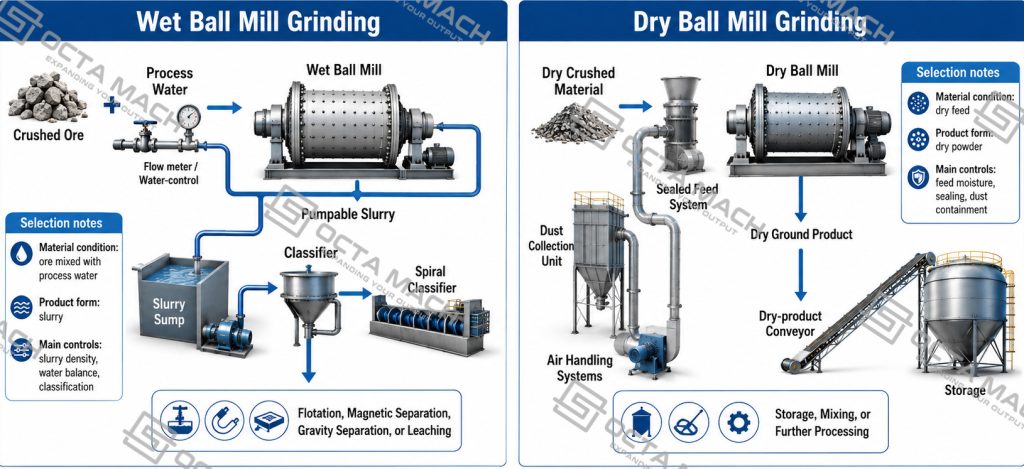
The choice should follow the complete process route rather than a general assumption that one method is always more efficient.
Overflow vs Grate Discharge
The discharge arrangement affects the residence time, slurry level and removal of ground material.
| Comparison item | Overflow ball mill | Grate-discharge ball mill |
| Discharge principle | Product leaves through the hollow discharge trunnion | Product passes through grate openings and is lifted out |
| Material retention | Generally longer | Generally shorter |
| Typical product tendency | Relatively fine product | Faster discharge |
| Common duty | Secondary grinding and finer grinding | Primary grinding and higher-discharge duties |
| Main selection concern | Overgrinding and slurry-level control | Grate condition and discharge capacity |
An overflow mill is not automatically the correct choice for every fine-grinding application, and a grate mill is not automatically the best option for every high-capacity circuit.
Selection should also consider:
- Target particle-size distribution
- Slurry density
- Required discharge rate
- Risk of overgrinding
- Circulating load
- Classifier arrangement
- Downstream process sensitivity
Closed-Circuit Classification
An open-circuit mill passes material through the machine without returning coarse particles for additional grinding. It has a simpler flow arrangement but offers less control over the final particle-size distribution.
A closed-circuit system combines the mill with a spiral classifier or hydrocyclone:
Crusher → Ball Mill → Classifier → Downstream Separation
The classifier divides the product into two streams:
- Correctly ground material proceeds to flotation, magnetic separation, gravity concentration or leaching.
- Coarse material returns to the ball mill for further grinding.
This arrangement provides better control of the final P80, but the classifier must be sized together with the mill. Poor classification can increase circulating load, overload the grinding circuit and allow coarse particles to enter downstream equipment.
Spiral Classifier or Hydrocyclone?
A spiral classifier uses settling and a rotating spiral to separate coarse particles from fine slurry. It is mechanically simple and is commonly paired with small and medium grinding circuits.
A hydrocyclone uses centrifugal forces and normally requires a slurry pump. It offers a compact layout and can handle larger circulating loads, but its performance is sensitive to feed pressure, slurry density and cyclone geometry.
The choice depends on capacity, cut size, available space, pumping conditions and the stability required from the closed circuit.
Media and Liner Selection
The mill model cannot be selected independently of its grinding-media and liner configuration.
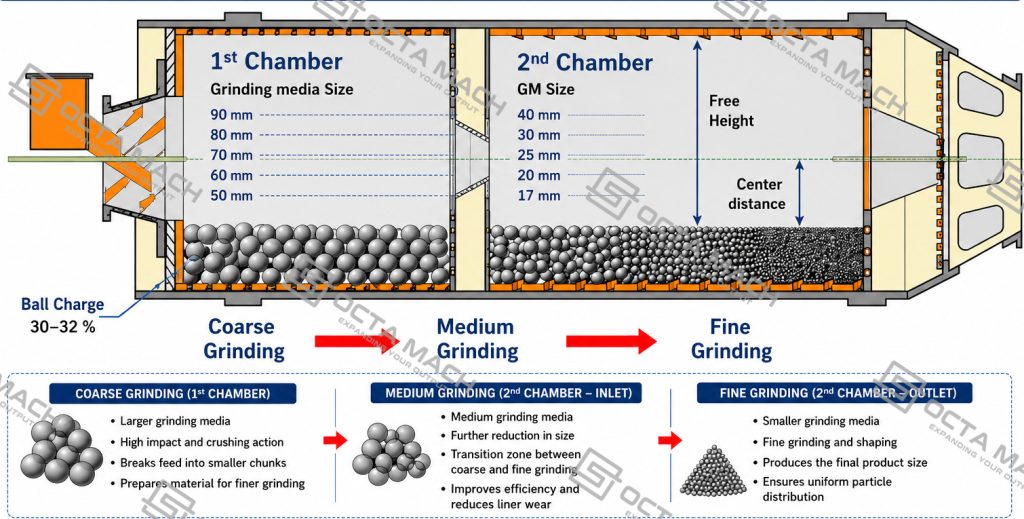
Larger balls provide stronger impact for coarse particles. Smaller balls provide more contact points for fine grinding. A practical charge normally combines several sizes rather than filling the mill with one ball diameter.
| Configuration item | Main effect |
| Ball diameter | Controls impact energy and contact area |
| Ball-size grading | Balances coarse breakage and fine grinding |
| Ball filling ratio | Influences power draw and media movement |
| Ball hardness | Affects wear, breakage and contamination |
| Liner profile | Controls lifting height and cascading action |
| Liner material | Affects shell protection and replacement interval |
| Media wear condition | Changes the effective charge over time |
Media grading must be developed from the feed size, ore hardness, mill diameter and required product size. Copying the ball charge from another project can lead to poor breakage, excessive wear or unstable product fineness.
Site and Installation Conditions
A technically suitable mill can still create project problems when site interfaces are confirmed too late.
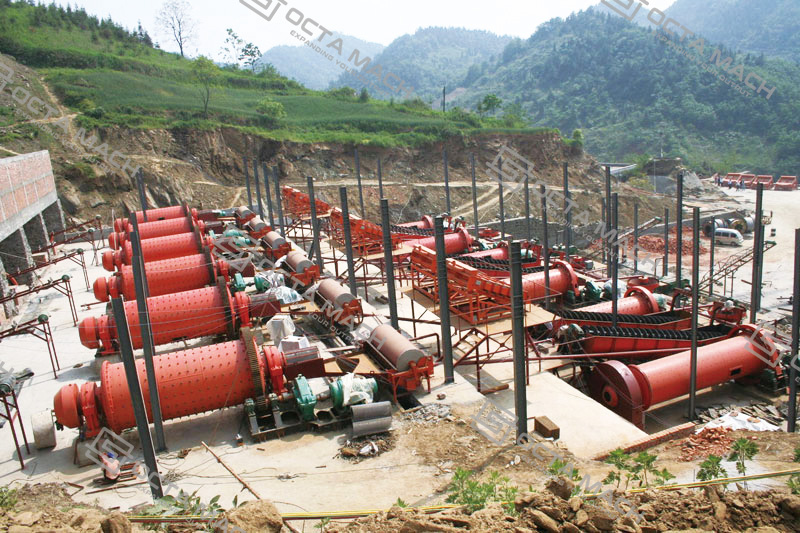
Before final equipment release, review:
- Site voltage and frequency
- Motor starting method
- Foundation dimensions and loads
- Lifting and maintenance access
- Feed chute and discharge connection
- Lubrication requirements
- Water and slurry interfaces
- Upstream conveyor or feeder capacity
- Downstream pump and classifier capacity
- Control cabinet and instrumentation scope
- Spare-parts and wear-parts strategy
The supply boundary should state whether the quotation includes only the main machine or also covers the motor, reducer, liners, grinding media, electrical control, lubrication equipment, foundation information and installation support.
Ball Mill Selection Support
The Octa Mach energy-saving ball mill range covers models from Φ900 × 1800 to Φ3200 × 4500, with published feed sizes up to 25 mm, discharge ranges of 0.074–0.89 mm, preliminary capacities of 0.65–90 t/h, and installed motor powers from 15 to 800 kW, depending on model and grinding duty. These figures support preliminary comparison and should not be interpreted as unconditional performance guarantees.
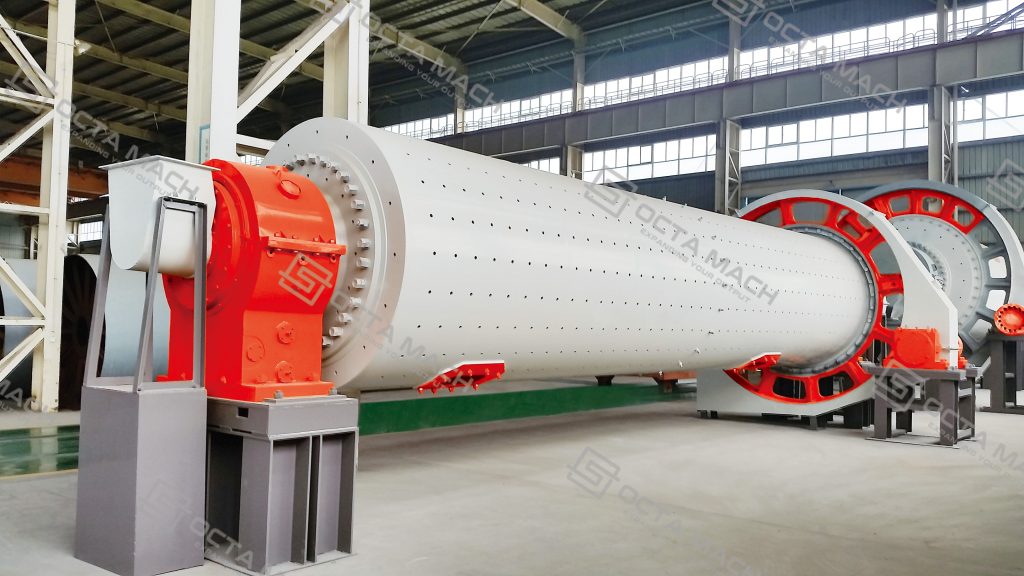
Octa Mach reviews the following information before recommending a configuration:
Material → Feed Size → Throughput → Target P80 → Wet or Dry Grinding → Overflow or Grate Discharge → Ore Hardness → Classifier → Site Power → Installation Conditions
Based on these inputs, the technical team can coordinate the mill model, motor power, grinding-media plan, liner configuration, discharge arrangement and classifier interface. This process reduces the risk of selecting a machine that meets a catalogue capacity but does not match the actual ore or beneficiation circuit.
FAQ
What information is required to select a ball mill?
Provide the ore type, maximum feed size, feed-size distribution, required dry-solids capacity, target P80, Bond Work Index or hardness data, wet or dry operation, discharge type, classifier arrangement, voltage and installation conditions.
How is ball mill capacity determined?
Capacity depends on mill dimensions and installed power, but also on ore hardness, feed grading, target fineness, ball charge, liner profile, slurry concentration, circulating load and classifier performance.
What size ball mill balls should be used?
Larger balls are generally required for coarse and hard feed, while smaller media provide more contact points for fine grinding. The final grading should be based on mill diameter, feed size, ore hardness and target P80.
Is wet grinding better than dry grinding?
Neither method is universally better. Wet grinding normally suits ore-beneficiation circuits that already handle slurry, while dry grinding is selected when the product must remain dry or water use is unsuitable.
Does every ore-grinding ball mill need a classifier?
No. A classifier is mainly required when the circuit must return coarse particles and maintain tighter control of the final particle-size distribution. Open-circuit grinding may be sufficient for less demanding duties.