
Underground Scaler equipment uses a crawler-mounted chassis, hydraulic boom and hydraulic breaker to remove loose, fractured and unstable rock from mine roofs (backs) and sidewalls. During underground drilling and blasting, cracked rock layers and partially detached blocks may remain on excavation surfaces, creating falling-rock hazards. The hydraulic boom positions the breaker against these unstable sections, where repeated impact loosens and detaches the rock before subsequent mining, tunneling or ground support operations. Unlike drilling jumbos and roof bolters, its primary function is mechanical rock removal rather than blast-hole drilling or ground reinforcement.
OCTA MACH offers three Underground Scaler models: S11, S21 and S22. All three feature crawler-mounted hydraulic working systems, but differ in transport dimensions, working height and auxiliary functions. The S11 features a compact modular design for easier underground transportation, while the S21 combines video-based remote operation with a hydraulic breaker and bucket for scaling and auxiliary mucking operations. The S22 features a multifunctional working system designed for scaling, floor leveling and secondary rock breaking.
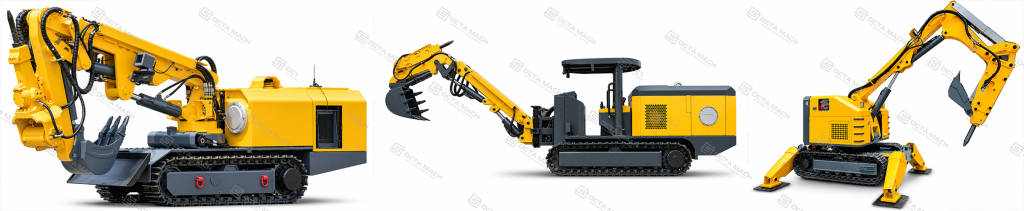
Underground Scaler Specifications
Underground access conditions place strict limits on equipment dimensions. Overall length, transport width and height determine whether a scaler can pass through shaft cages, access drifts and low-clearance sections. Ground clearance and turning space also affect machine movement across uneven mine floors and through confined passages. Model selection should therefore account for the full underground transport route, available working space and equipment positioning requirements at the excavation site.
S11 Dimensions
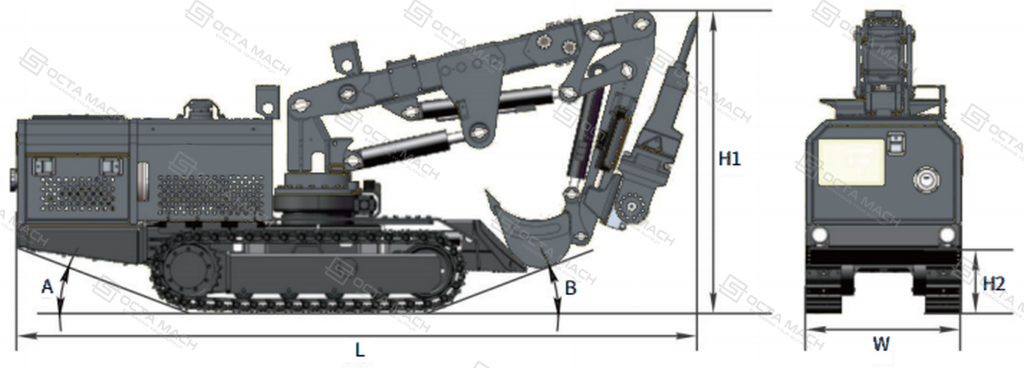
| Model | L (mm) | W (mm) | H1 (mm) | A (°) | B (°) | H2 (mm) |
|---|---|---|---|---|---|---|
| S11 | 3510 | 800 | 1550 | 22 | 18 | 229 |
S21 Dimensions
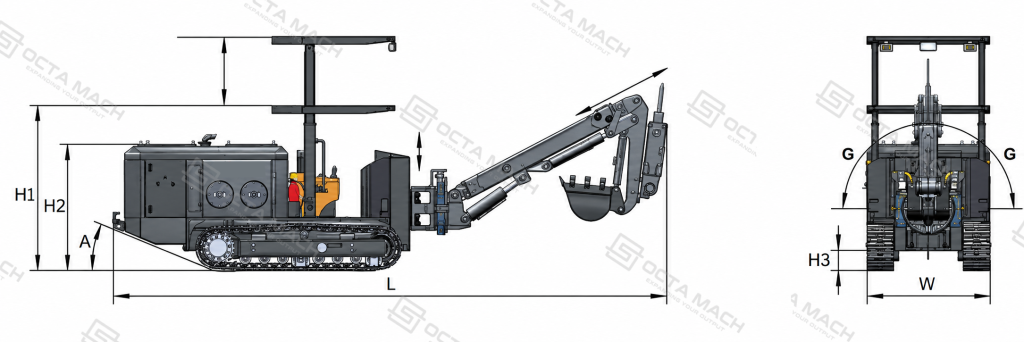
| Model | L (mm) | W (mm) | H1 (mm) | A (°) | H2 (mm) | H3 (mm) |
|---|---|---|---|---|---|---|
| S21 | 7356 | 1600 | 2142 | 22 | 1615 | 259 |
S22 Dimensions
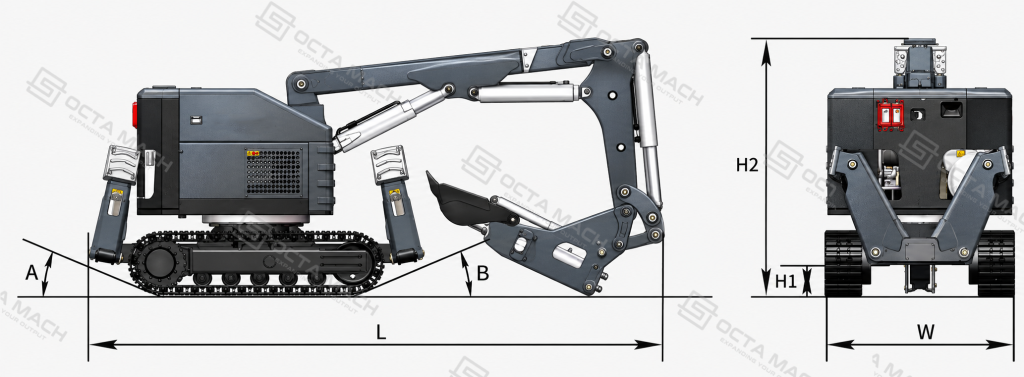
| Model | L (mm) | W (mm) | H1 (mm) | A (°) | B (°) | H2 (mm) |
|---|---|---|---|---|---|---|
| S22 | 4581 | 1600 | 270 | 32 | 32 | 2235 |
Performance Specifications
The operating performance of an underground scaler depends on its hydraulic breaker capacity, working reach, chassis mobility and power configuration. Impact energy, chisel diameter and hydraulic flow determine the breaker’s operating capability, while scaling height and maximum leveling distance define its working range. Chassis gradeability, ground clearance and travel speed are also important when evaluating equipment movement through underground mine passages. The three models share the same main performance parameters but differ in their working capacities and power configurations.
| Performance Parameters | Unit | S11 | S21 | S22* |
|---|---|---|---|---|
| Machine Mass | kg | 2650 ± 200 | 10500 ± 200 | 6500 ± 200 |
| Impact Energy | J | ≥220 | ≥300 | 785 |
| Chisel Diameter | mm | 45 | 53 | 75 |
| Impact Frequency | Hz | 750–2300 | 600–1200 | 750–2300 |
| Breaker Working Pressure | MPa | 10–15 | ≤14 | 12–15 |
| Breaker Flow Rate | L/min | 16–35 | ≤50 | 50–90 |
| Bucket Capacity | L | 22 | 120 | 100 |
| Scaling Height | mm | 4380 | 6658 | 7000 |
| Maximum Leveling Distance | mm | 2592 | 6580 | 6560 |
| Minimum Ground Clearance | mm | 229 | 259 | 270 |
| Gradeability | ° | 22 | 22 | 30 |
| Power Unit Rating | kW | 22 (Electric Motor) | 103 (Diesel Engine) | 37 (Electric Motor) |
| Rated Voltage | V | AC 380* | 380 / 660 / 1000 / 1140 | 380 |
| Travel Speed (Low) | Not stated | 1.7 ± 0.17 | 1.7 ± 0.17 | 1.7 ± 0.17 |
| Travel Speed (High) | Not stated | 2.6 ± 0.26 | 3.0 ± 0.3 | 2.5 ± 0.25 |
| Hydraulic System Rated Pressure | MPa | 26 | 17 | 17 |
| Hydraulic System Maximum Pressure | MPa | 31 | 20 | 20 |
Selecting the right Underground Scaler requires more than comparing individual specifications. Underground access dimensions, available working space, required scaling reach, rock-breaking demands and site power conditions must all be considered together. The S11, S21 and S22 offer different combinations of machine size, hydraulic breaker capacity, mobility and auxiliary working functions. The final configuration should match the mine layout, excavation profile and actual scaling workload, ensuring that the machine can access the working area and perform the required tasks under site conditions.
Underground Scaler Models and Working Features
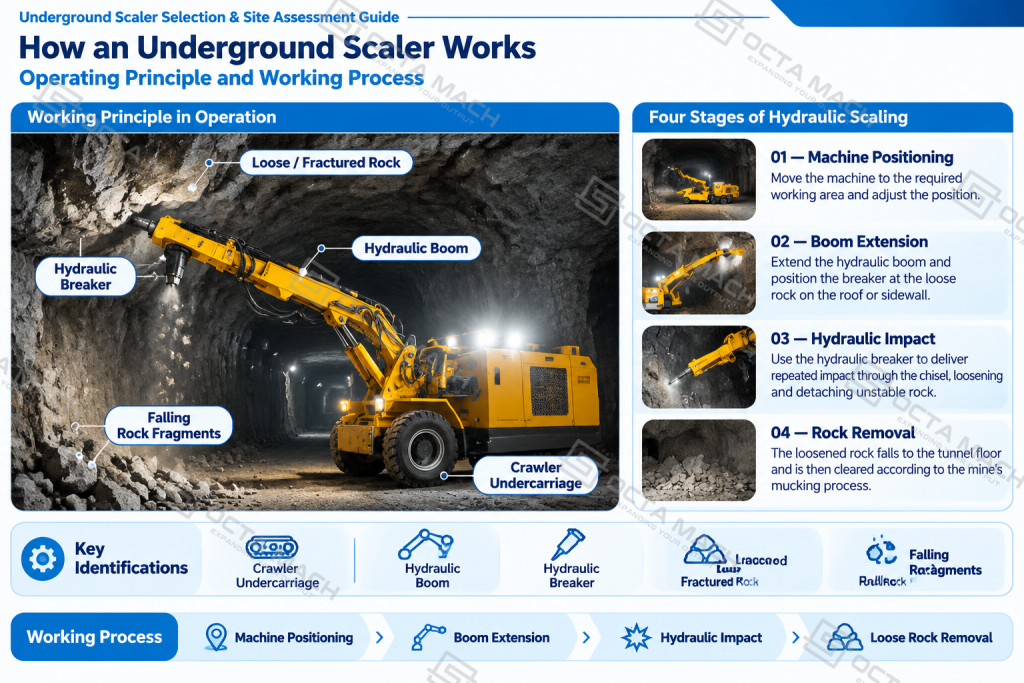
All three Underground Scaler models operate on the same basic hydraulic scaling principle. The crawler undercarriage moves the machine into position, while the hydraulic boom extends and positions the working attachment against loose or fractured rock on mine roofs and sidewalls. The hydraulic breaker delivers repeated impact through its chisel to loosen and detach unstable rock. Once separated, the fallen material is cleared according to the mine’s mucking procedure. The basic working process is common to the S11, S21 and S22, while their mechanical configurations, control arrangements and auxiliary functions are designed for different underground operating requirements.
Main Structure and Configuration
| Main Components | S11 | S21 | S22 |
|---|---|---|---|
| Travel System | Crawler Undercarriage | Crawler Undercarriage | Crawler Undercarriage |
| Working Mechanism | Hydraulic Boom and Breaker | Hydraulic Boom and Breaker | Hydraulic Boom and Breaker |
| Working Attachment | Hydraulic Breaker and Bucket | Hydraulic Breaker and Bucket | Multifunctional Working Attachment |
| Special Design | Modular, Detachable Structure | Video-Based Remote Operation | Multifunctional Attachment System |
| Main Working Functions | Rock Scaling and Floor Leveling | Rock Scaling and Auxiliary Ore Handling | Rock Scaling, Floor Leveling and Secondary Rock Breaking |
| Operating Control | One-Touch Function Switching | Video-Based Remote Control | One-Touch Function Switching |
| Power Configuration | 22 kW Electric Motor | 103 kW Diesel Engine | 37 kW Electric Motor |
Key Advantages of Underground Scalers
- Mechanized Loose Rock Removal
Hydraulic breaker technology enables mechanical removal of fractured and unstable rock from mine roofs and sidewalls. Compared with manual scaling, mechanized operation reduces the need for workers to directly approach loose rock during removal, helping limit exposure to falling-rock hazards.
- Flexible Working Reach
The hydraulic boom provides extended reach and flexible positioning of the breaker against overhead and lateral rock surfaces. This allows operators to address loose rock across different sections of an excavation without repeatedly repositioning the machine.
- Crawler Mobility for Underground Conditions
The crawler undercarriage supports machine movement across uneven mine floors and confined underground passages. Its mobility allows the equipment to travel between working areas and position the breaker where scaling is required. Actual accessibility depends on machine dimensions and underground route conditions.
- Multiple Configurations for Different Mining Tasks
The S11, S21 and S22 offer different configurations to meet varying underground requirements. The S11 features modular construction for restricted transport routes, the S21 provides video-based remote operation and auxiliary mucking functions, while the S22 combines scaling, floor leveling and secondary rock breaking.
How to Choose the Right Underground Scaler
Selecting an Underground Scaler requires evaluating the mine’s access conditions, scaling requirements, geological environment and available site resources. Machine dimensions, working reach, hydraulic breaker capacity and auxiliary functions should be considered together to ensure that the selected model can access the working area and handle the required tasks.
| Selection Factors | Key Considerations | Selection Guidance |
|---|---|---|
| Underground Access Dimensions | Transport length, width, height, shaft cage dimensions, drift clearance and turning space | Check transport clearance and turning space. Consider the S11’s 800 mm width and modular design for restricted access. |
| Scaling Height and Working Range | Maximum roof height, sidewall coverage and required leveling distance | Match the machine’s scaling height and leveling distance to the excavation profile. |
| Rock and Geological Conditions | Rock hardness, joint spacing, fracture orientation and loose block size | Match breaker impact energy and chisel diameter to site rock conditions. |
| Required Working Functions | Roof and sidewall scaling, floor leveling, secondary rock breaking and auxiliary material handling | Choose S11 for modular scaling, S21 for remote operation and auxiliary ore handling, or S22 for multifunctional operations. |
| Power and Control Requirements | Electric or diesel power, rated voltage, cable routing, ventilation and remote operation | Confirm site power supply, voltage, ventilation and control requirements. |
| Maintenance and Service Access | Access to hydraulic components, breaker wear parts, service points and maintenance space | Check maintenance space, wear-part replacement and spare parts availability. |
The final model selection should be based on the actual combination of transport restrictions, excavation geometry, rock conditions and operating tasks. A machine with higher impact energy or greater working reach is not necessarily the right choice if its dimensions, power requirements or auxiliary functions do not match the mine’s operating conditions.
Applications of Underground Scalers
Underground Scalers perform mechanized loose rock removal in underground mines and tunneling projects. Equipped with a crawler undercarriage, hydraulic boom and hydraulic breaker, these machines remove fractured and unstable rock from mine roofs and sidewalls after blasting or excavation.
Roof Scaling After Drilling and Blasting
Drilling and blasting can leave fractured rock and partially detached blocks on mine roofs (backs). An Underground Mining Scaler uses its hydraulic breaker to remove unstable material before subsequent mining operations, helping reduce workers’ exposure to falling-rock hazards.
Sidewall Scaling in Development Drifts
Loose rock along development headings, access drifts and crosscuts requires mechanical removal from irregular lateral surfaces. A Mining Scaler uses its hydraulic boom to reach these areas, with boom reach and machine positioning determining its access to confined sections.
Scaling in Underground Tunneling Projects
Tunnel excavation can leave fractured rock around the newly exposed crown and sidewalls. An Underground Scaling Machine removes unstable material before subsequent support or construction work, with machine dimensions and working height matched to the tunnel cross-section.
Stope Boundary Scaling and Residual Ore Preparation
In underground stopes, loose rock may remain along excavation boundaries, while residual ore can accumulate in difficult-to-access areas. The S21 combines video-based remote operation with a hydraulic breaker and bucket for loose rock removal, residual ore breaking and floor leveling before mucking and recovery.
Floor Leveling and Secondary Rock Breaking
Uneven mine floors and oversized rock can affect equipment movement and underground work preparation. The S11 provides integrated impact and leveling functions, while the S22 supports floor leveling and secondary rock breaking through its multifunctional working system.
Why Choose OCTA MACH Underground Scalers
Underground scaling requirements vary with mine layout, access restrictions and operating conditions. OCTA MACH offers three Underground Scaler models, S11, S21 and S22, with different configurations for underground mining and tunneling applications. The product range covers compact modular equipment, video-based remote operation and multifunctional systems for scaling, floor leveling and secondary rock breaking.
OCTA MACH can review equipment selection according to mine passage dimensions, required scaling height, rock conditions, transport arrangements, power availability and auxiliary working functions. By providing project details such as mine or tunnel cross-sections, available transport space and expected scaling tasks, customers can obtain a model recommendation and confirm the appropriate equipment configuration for their operating requirements.
FAQ
Q1: What does an Underground Scaler do?
A:An Underground Scaler mechanically removes loose, fractured and unstable rock from mine roofs, sidewalls and excavation faces after drilling and blasting. Its hydraulic boom and working attachment reach unstable sections that require scaling before subsequent mining or tunneling operations.
Q2: What is the difference between an Underground Scaler and a drilling jumbo?
A:An Underground Scaler removes loose rock using a hydraulic breaker or other scaling attachment, while a drilling jumbo drills holes for blasting or other drilling operations. A scaler prepares the excavation by removing unstable material rather than creating drill holes or installing rock reinforcement.
Q3: What factors determine the working height required for an Underground Scaler?
A:The required working height depends on the mine cross-section, roof elevation, sidewall coverage and machine positioning. The boom’s actual working envelope should be checked against the excavation profile, rather than relying on the maximum scaling height alone.
Q4: What are the differences between S11, S21 and S22 Underground Scalers?
A:The S11 features a compact modular structure with scaling and floor-leveling functions. The S21 adds video-based remote operation and bucket-assisted residual ore handling, while the S22 supports scaling, floor leveling and secondary rock breaking through its multifunctional working system.