
A conveyor belt is the continuous load-carrying component of a material handling system, designed to support and transport bulk materials between processing stages with a steady and uninterrupted flow. In mining, quarrying, aggregate production, and mineral processing plants, it connects feeders, crushers, vibrating screens, stockpiles, and downstream equipment, handling materials ranging from fine powders and sand to large, sharp-edged rocks and mineral ores. Beyond basic material transportation, conveyor belts are engineered to withstand longitudinal tension, repeated bending, abrasion, impact, and varying environmental conditions. Their performance is determined by the interaction of several structural elements: the carcass, made from textile plies or steel cords, provides tensile strength and dimensional stability; rubber covers protect the reinforcement against wear, heat, moisture, and other operating hazards; while specialized surface profiles, corrugated sidewalls, and transverse cleats improve material grip, prevent spillage, and enable steep-angle or vertical conveying.
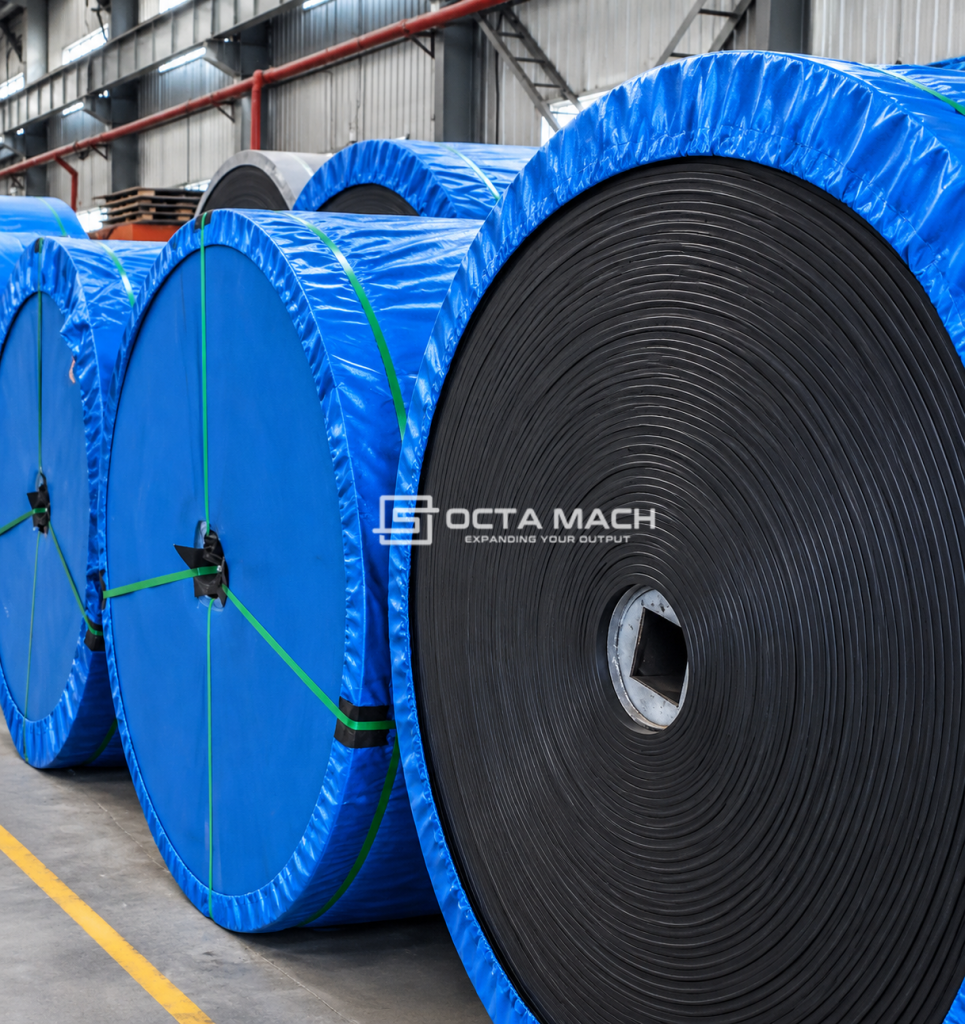
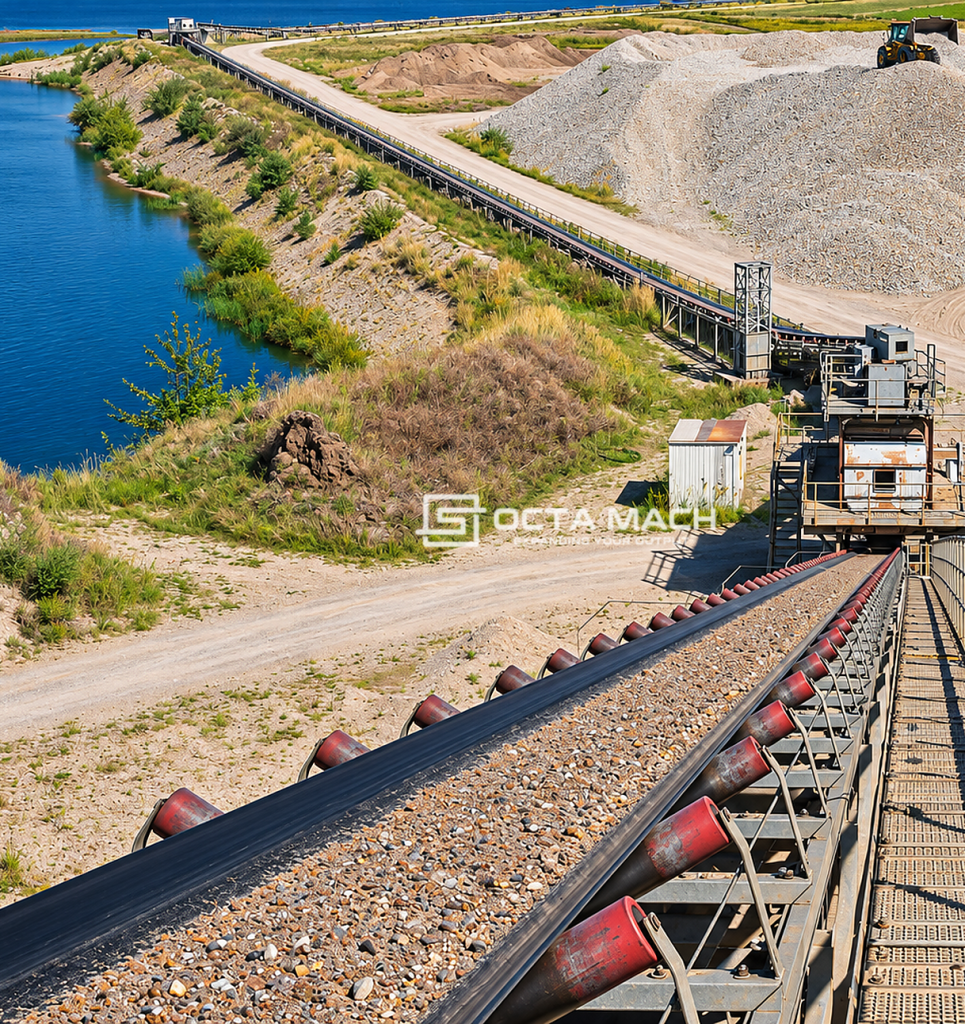
Depending on the application, specialized designs also support long-distance high-tension transportation, enclosed material handling, hot or sticky material conveying, and continuous filtration and dewatering processes. These different constructions allow conveyor belts to accommodate demanding material handling requirements while maintaining reliable operation across a wide range of industrial applications.
Conveyor Belt Specifications
Conveyor belt specifications are determined by the material being transported, conveying distance, required capacity, operating temperature, and conveyor configuration. A belt designed for a short transfer between crushers has different requirements from one used for long-distance mine transportation or steep-angle material lifting.
The main specifications include:
| Specification | Description |
| Belt Width | The usable width of the belt, selected according to material flow and required capacity |
| Belt Tensile Strength | The rated longitudinal strength of the belt carcass, expressed in N/mm |
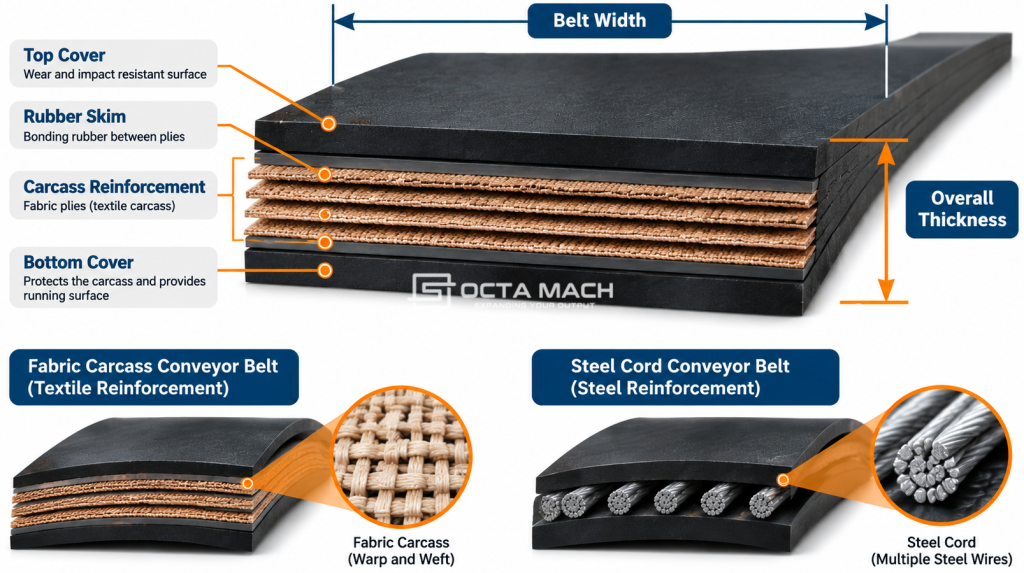
| Carcass Material | Textile reinforcement such as EP, NN, and EE, or longitudinal steel cord reinforcement |
| Number of Plies | The number of textile reinforcement layers in a multi-ply belt |
| Top Cover Thickness | The thickness of the material-carrying rubber cover, selected according to abrasion and impact conditions |
| Bottom Cover Thickness | The thickness of the pulley-side rubber cover, selected according to operating and flexing requirements |
| Rubber Cover Grade | The rubber compound selected for abrasion, heat, oil, chemical, flame, or other operating conditions |
| Belt Length | The required endless or open belt length, including the specified joint arrangement |
| Surface Profile | A flat surface, chevron pattern, cleats, or other profiles selected for the conveying angle and material |
| Minimum Pulley Diameter | The minimum pulley diameter compatible with the belt construction and operating tension |
Belt Width and Tensile Strength
Belt width and tensile strength are two important parameters in conveyor belt selection. Width determines the available carrying area, while tensile strength determines the belt’s ability to withstand the working tension generated by the conveyed load, conveyor length, elevation change, and starting conditions.
For textile-carcass conveyor belts, ISO 251:2024 specifies nominal widths including 300, 400, 500, 600, 650, 800, 1,000, 1,200, 1,400, 1,600, 1,800, 2,000, 2,200, and 2,400 mm, together with corresponding width tolerances. The standard does not establish a universal belt length; length is determined by the conveyor layout and ordering requirements.
Steel cord conveyor belts use ST strength designations. Common strength classes include ST630, ST800, ST1000, ST1250, ST1600, ST2000, ST2500, ST3150, ST3500, ST4000, ST4500, ST5000, ST5400, ST6300, ST7000, and ST7500. The number represents the nominal longitudinal tensile strength in N/mm of belt width.
The required strength class must be calculated from the conveyor’s working tension, safety requirements, starting and stopping conditions, and splice efficiency. A higher ST rating should not be selected simply because it is available; the belt, drive, pulleys, take-up system, and vulcanized joints must be designed as a compatible system.
Textile Carcass Designations
Textile conveyor belts are commonly identified by the fiber materials used in the warp and weft directions:
- EP: Polyester in the warp direction and polyamide (nylon) in the weft direction.
- NN: Polyamide (nylon) in both the warp and weft directions.
- EE: Polyester in both directions.
EP fabric is widely used where relatively low elongation and good dimensional stability are required. NN fabric offers good flexibility and resistance to impact and repeated bending. EE constructions use polyester in both directions and are selected according to the required strength and operating characteristics.
The final designation should also identify the belt’s tensile strength, number of plies or construction type, cover thickness, cover grade, and required dimensions. EP, NN, and EE describe the fabric composition, not a complete conveyor belt specification by themselves.
Rubber Cover and Profile Dimensions
The top and bottom rubber covers perform different functions. The top cover is exposed to the conveyed material and receives most of the impact, abrasion, and environmental exposure. The bottom cover contacts the pulleys and idlers, so its flexibility and wear resistance must suit the conveyor configuration.
For profiled belts, additional dimensions must be specified:
- Sidewall height and base width
- Cleat height, spacing, and profile
- Chevron pattern height and pitch
- Pipe diameter and belt overlap, where applicable
- Minimum pulley diameter and transition geometry
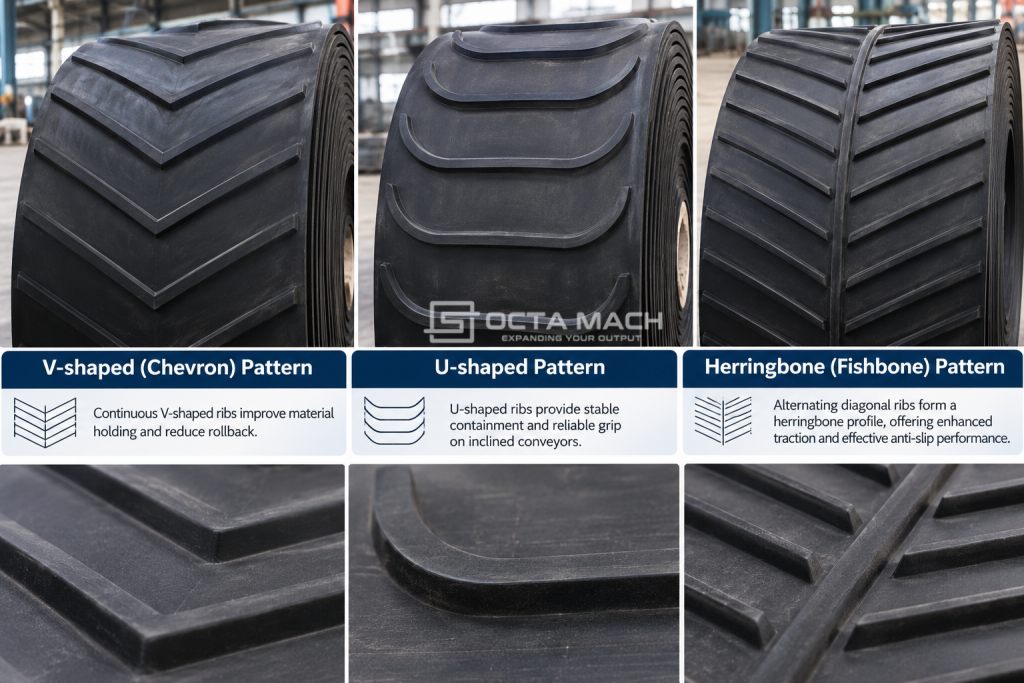
Chevron pattern heights vary according to belt design, with some profiles ranging from approximately 5 to 32 mm. The appropriate pattern shape, height, and spacing depend on the material’s particle size, moisture content, flow characteristics, and conveying inclination. Higher profiles provide greater material retention on steeper conveying routes, while the pattern geometry must also allow effective material discharge and belt cleaning.
Conveyor Belt Standards
Conveyor belt standards define requirements for belt construction, dimensions, tensile properties, rubber covers, and testing. The applicable standard depends on the reinforcement material and intended service.
| Standard | Scope |
| ISO 14890:2026 | Requirements for rubber- or plastics-covered textile conveyor belts for general surface use |
| ISO 251:2024 | Nominal widths, lengths, and width tolerances for textile-carcass conveyor belts |
| ISO 15236-1:2016 | Design, dimensions, and mechanical requirements for general-purpose steel cord conveyor belts |
| ISO 15236-2:2017 | Preferred types of steel cord conveyor belts |
| ISO 15236-4:2004 | Vulcanized joints for steel cord conveyor belts |
| ISO 4195:2026 | Heat resistance requirements and test methods for rubber conveyor belt covers |
| ISO 252:2023 | Adhesion test methods for conveyor belt constituent elements |
| ISO 4649:2024 | Abrasion resistance testing of vulcanized or thermoplastic rubber |
These standards do not apply indiscriminately to every conveyor belt category. ISO 14890, for example, addresses general-use textile-carcass belts rather than establishing the complete design requirements for every sidewall, pipe, or specialized filter belt.
ISO 4195:2026 evaluates the changes in rubber cover hardness, tensile strength, and elongation after heat exposure. Its scope applies to belts with a carrying-side cover thickness of at least 4 mm. The actual operating temperature must still be established from the belt grade, material temperature, exposure time, and conveyor conditions.
ISO 252:2023 provides methods for measuring adhesion between belt plies and between covers and carcass. It excludes belts containing steel cord reinforcement, so the applicable inspection method must be selected according to belt construction.
Types of Conveyor Belts
Conveyor belts can be classified by carcass construction, surface profile, operating performance, or application. Some categories overlap. For example, a steel cord conveyor belt can also have a heat-resistant cover, while a sidewall conveyor belt can use textile or steel cord reinforcement. The following types cover the main belt constructions and specialized designs used in industrial material handling.
1. Steel Cord Conveyor Belt
A Steel Cord Conveyor Belt uses high-tensile steel cords arranged longitudinally within a rubber matrix as its primary load-carrying reinforcement. The cords provide high tensile strength and relatively low elongation, making this construction suitable for long-distance, high-capacity, and heavy-duty material transportation.
Unlike multi-ply fabric belts, which rely on layers of woven textile reinforcement, steel cord belts transfer the main longitudinal tensile load through individual steel cords. The surrounding rubber penetrates and bonds around the cords, while the top and bottom covers protect the reinforcement from abrasion, moisture, and mechanical damage.
Steel cord conveyor belts are commonly designated by ST tensile strength classes, including ST630, ST800, ST1000, ST1250, ST1600, ST2000, ST2500, ST3150, ST3500, ST4000, ST4500, ST5000, ST5400, ST6300, ST7000, and ST7500.
Important design considerations include:
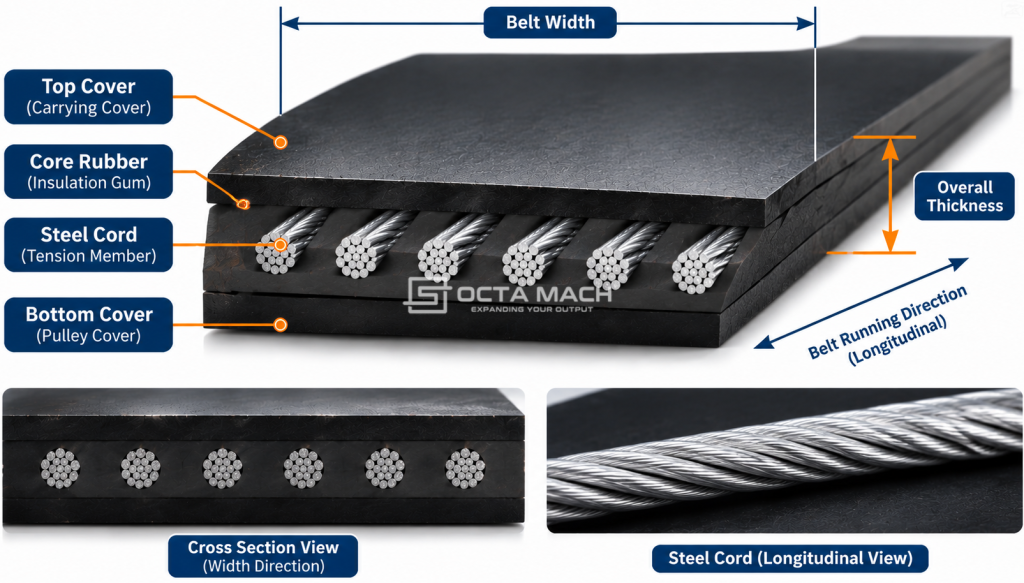
- Steel cord diameter and spacing: These affect the belt’s tensile properties, transverse flexibility, and resistance to damage.
- Rubber penetration and bonding: The rubber must properly surround the cords to limit moisture penetration and reduce the risk of corrosion.
- Top and bottom cover thickness: Cover selection depends on material size, impact energy, abrasiveness, and operating conditions.
- Dynamic splice performance: The vulcanized joint must transfer the required working tension without creating a weak point in the belt.
- Pulley diameter: The pulley arrangement must be compatible with the selected belt construction and tensile rating.
Steel cord conveyor belts are used in large mining operations, open-pit mines, ports, power plants, and long-distance bulk material handling systems where high belt strength and controlled elongation are important.
2. Fabric Conveyor Belt
A Fabric Conveyor Belt, also called a textile conveyor belt, uses one or more layers of woven synthetic fabric as its load-carrying carcass. The textile layers are bonded together with rubber skim compounds and protected by top and bottom rubber covers.
EP, NN, and EE are common fabric designations. EP belts combine polyester warp yarns with nylon weft yarns, while NN belts use nylon in both directions. These materials provide different combinations of longitudinal strength, transverse flexibility, elongation, and impact resistance.
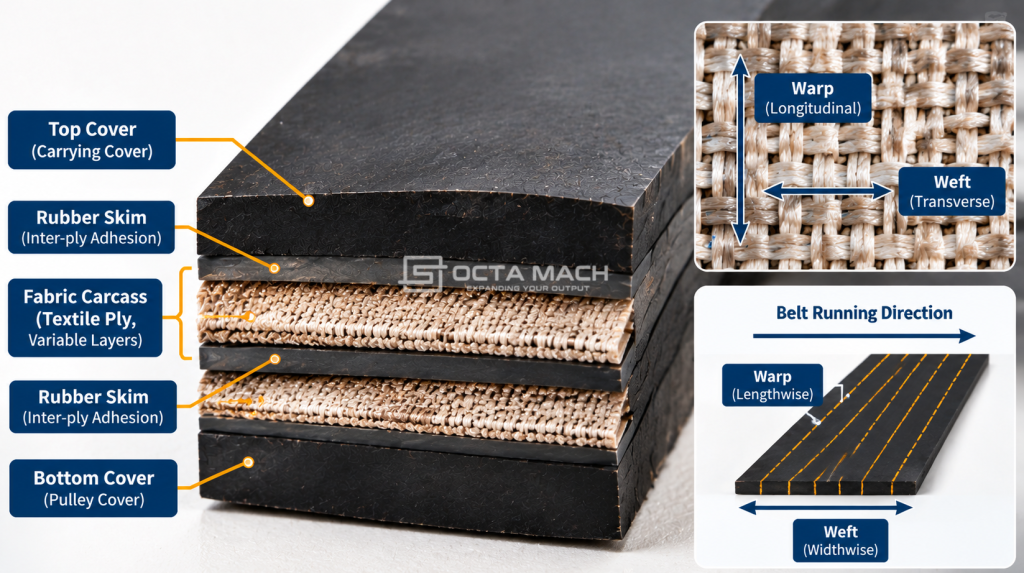
Fabric conveyor belts are available in multi-ply constructions, with the number of plies and fabric strength selected according to the working tension and conveyor arrangement.
The main design considerations include:
- Fabric tensile strength: Determines the belt’s ability to carry longitudinal working loads.
- Ply construction: The number and arrangement of fabric layers affect strength, flexibility, and thickness.
- Adhesion between plies: Proper bonding prevents separation under repeated bending and loading.
- Cover rubber: Abrasion-resistant, heat-resistant, oil-resistant, or other specialized covers can be selected according to the conveyed material.
- Troughability: The belt must form the required trough shape on the idler set without excessive edge tension or instability.
Fabric conveyor belts are widely used in quarries, aggregate plants, cement factories, coal handling systems, and general mining operations. They are often selected for short- and medium-distance conveying duties where their flexibility and construction are suitable for the required load.
3. Corrugated Sidewall Conveyor Belt
A Corrugated Sidewall Conveyor Belt is designed for transporting bulk materials at steep inclines or vertically, particularly where conventional flat belts cannot prevent material rollback or spillage. Its structure combines a reinforced base belt, flexible corrugated sidewalls, and transverse cleats to form a continuous carrying surface with enclosed material compartments.
The base belt provides the required tensile strength and transverse stability, while the corrugated sidewalls retain material along both edges. Transverse cleats support the load and limit backward movement during elevation. These components work together to maintain material containment while allowing the belt to flex around pulleys.
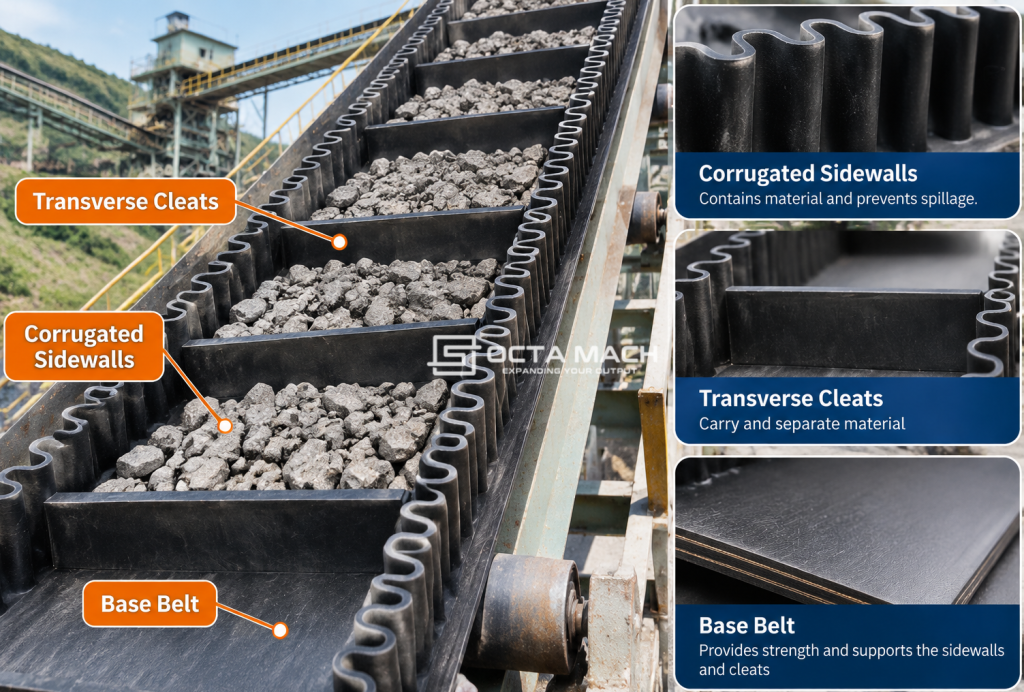
Sidewall height, cleat profile, and cleat spacing are selected according to material size, bulk density, moisture, conveying capacity, and inclination. Depending on the belt design and conveyor configuration, this construction can handle conveying angles approaching 90°.
Corrugated sidewall conveyor belts are commonly used in mining, quarrying, cement production, and crushing plants, especially where material must be elevated within limited installation space.
4. Pipe Conveyor Belt
A Pipe Conveyor Belt is designed to form a closed tubular shape during operation, enclosing the conveyed material and reducing exposure to the surrounding environment.
At the loading point, the belt operates in a conventional troughed configuration. As it passes through specially arranged idlers, the belt edges overlap and the belt gradually forms a circular or near-circular cross-section. The enclosed belt then carries the material through the conveying route before opening again at the discharge point.
Pipe conveyor belts can use textile or steel cord reinforcement, depending on the required tensile strength, conveying distance, and system design.
Important design factors include:
- Pipe diameter: Determines the available carrying cross-section and must accommodate the required material size and throughput.
- Belt width: Must provide sufficient material capacity and the correct overlap when the belt forms a closed tube.
- Transverse flexibility: Allows the belt to form and maintain its tubular shape.
- Longitudinal tensile strength: Must support the operating tension and starting loads.
- Transition sections: The belt must change between open and closed configurations without excessive stress or material spillage.
Pipe conveyor belts are used for transporting limestone, coal, ash, ores, and other bulk materials where dust control, spillage reduction, or route flexibility is important. They are particularly useful when the conveying route passes through environmentally sensitive areas or requires horizontal and vertical curves.
5. Pipe Conveyor Belt
A Pipe Conveyor Belt forms a closed tubular shape during operation, enclosing the conveyed material to reduce dust emissions and material spillage. As it passes through specially arranged idlers, the belt edges overlap to create a circular cross-section. Pipe conveyor belts can use textile or steel cord reinforcement depending on the required tensile strength and conveying distance. They are used for transporting coal, limestone, ores, and other bulk materials along complex routes where material containment is important.
6. Heat Resistant Conveyor Belt
A Heat Resistant Conveyor Belt uses specially formulated rubber covers to withstand elevated temperatures and reduce thermal deterioration. Its performance depends on the rubber compound, material temperature, exposure time, and operating conditions. Both fabric and steel cord carcasses can be combined with suitable heat-resistant covers. Typical applications include cement plants, steel mills, foundries, and power stations handling hot clinker, sinter, coke, and other heated materials.
7. Vacuum Filter Belt
A Vacuum Filter Belt is a specialized rubber belt used in horizontal vacuum filtration systems for continuous solid-liquid separation. It features drainage grooves and vacuum openings that allow liquid to pass through the filter cloth and flow into the vacuum collection system. Belt dimensions, drainage layout, reinforcement, and rubber compound must match the filtration equipment and process conditions. Typical applications include mineral concentrate filtration, tailings dewatering, and chemical processing.
8. Bucket Elevator Belt
A Bucket Elevator Belt is designed for vertical material lifting and carries individual buckets attached at regular intervals. Its carcass must withstand continuous tension, repeated bending, and the combined weight of the buckets and conveyed materials. EP and NN fabric constructions are commonly used, while reinforced designs are available for heavier-duty applications. These belts are widely used in cement plants, grain handling facilities, fertilizer production, and mineral processing.
9. Anti-Adhesion Conveyor Belt
An Anti-Adhesion Conveyor Belt uses specialized rubber compounds or surface treatments to reduce material sticking and accumulation on the carrying surface. It is particularly suitable for handling wet clay, gypsum, limestone powder, and other cohesive materials that can cause carryback and buildup around pulleys and idlers. Its surface properties must balance reduced material adhesion with adequate abrasion resistance and flexibility.
10. Extra-Wide Conveyor Belt
An Extra-Wide Conveyor Belt is a wide-belt configuration designed for high-capacity material handling where a larger carrying surface is required. It can use textile or steel cord reinforcement depending on the required width, tensile strength, and operating conditions. Belt width must be matched with the conveyor frame, idlers, pulleys, loading arrangement, and tracking system. These belts are used in large mining operations, bulk terminals, and high-throughput material handling facilities.
Conveyor Belt Structure and Materials
The carcass and rubber covers determine the main mechanical and protective properties of a conveyor belt. Although different belt types have different constructions, most heavy-duty rubber conveyor belts consist of a load-carrying reinforcement structure, bonding layers, and protective covers.
Carcass Reinforcement
The carcass carries the longitudinal tensile load generated during operation. Its construction is selected according to the conveyor’s working tension, distance, capacity, and mechanical arrangement.
Textile carcasses use woven fabric layers such as EP, NN, or EE. Steel cord carcasses use longitudinal steel cords embedded in rubber. Special constructions may also include transverse reinforcement to improve lateral stability, particularly in sidewall and pipe conveyor belts.
Rubber Covers
The top cover protects the belt from direct contact with conveyed materials, while the bottom cover protects the carcass from wear caused by pulleys and idlers.
Common rubber cover options include:
- Abrasion-Resistant Rubber: For crushed rock, ore, sand, gravel, and other abrasive materials.
- Heat-Resistant Rubber: For hot clinker, sinter, coke, and heated industrial materials.
- Oil-Resistant Rubber: For materials containing mineral oils, lubricants, or other oil-based substances.
- Chemical-Resistant Rubber: For selected acidic, alkaline, or chemically aggressive environments.
- Flame-Resistant Rubber: For applications requiring specified fire-related safety properties.
- Cold-Resistant Rubber: For low-temperature operating environments.
- Anti-Static Rubber: For applications with defined electrical resistance requirements.
The selected compound must match the actual material and operating environment. A cover designed for abrasion resistance, for example, should not automatically be assumed to provide suitable oil or chemical resistance.
Bonding and Profile Construction
The bonding layers connect the reinforcement plies and rubber covers. Proper adhesion is essential because repeated bending, impact, and tensile loading place stress on the interfaces within the belt.
Special-profile belts require additional construction considerations. Chevron patterns are generally molded into the carrying cover, while sidewalls and transverse cleats are attached to the base belt using a suitable bonding and vulcanization process. Pipe conveyor belts require sufficient transverse flexibility and shape retention to form and maintain their closed cross-section.
Conveyor Belt Manufacturing and Splicing
The manufacturing process depends on the belt construction, reinforcement material, rubber compound, and surface profile.
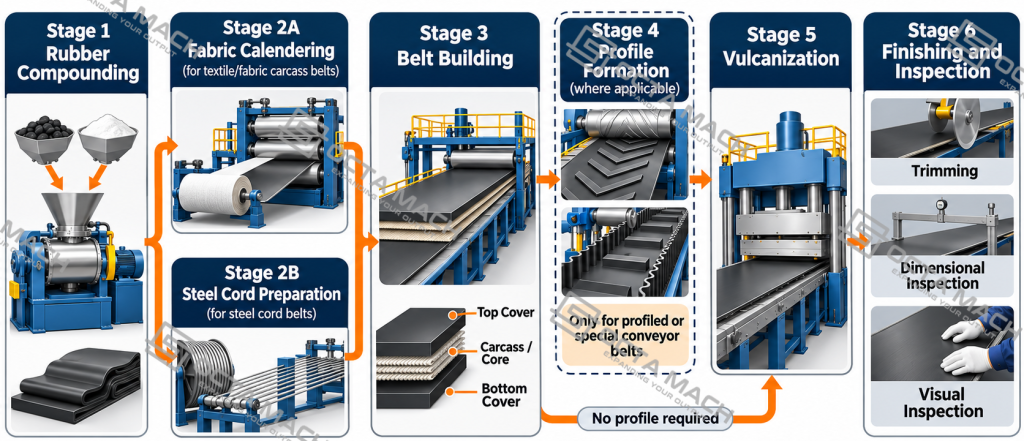
A typical heavy-duty rubber conveyor belt manufacturing sequence includes:
- Rubber Compounding: Rubber polymers, reinforcing fillers, curing agents, and other additives are mixed to achieve the required physical and chemical properties.
- Fabric Calendering or Steel Cord Preparation: Textile fabric is coated with rubber, or steel cords are arranged and treated for bonding with the surrounding rubber.
- Belt Building: Reinforcement layers, skim rubber, and top and bottom cover sheets are assembled according to the required belt construction.
- Profile Formation: Chevron patterns, sidewalls, or cleats are formed or attached according to the belt design.
- Vulcanization: Heat and pressure are applied under controlled conditions to cure the rubber and bond the belt components.
- Finishing and Inspection: The belt is trimmed, measured, and inspected before being prepared for shipment.
Belt splicing is another important part of the manufacturing and installation process. Textile belts may use hot vulcanized, cold-bonded, or suitable mechanical joints depending on their construction and operating conditions. Steel cord conveyor belts generally require specialized vulcanized splices that reconnect the cords through a carefully designed joint arrangement.
For high-tension applications, the splice must be compatible with the belt strength, cord or fabric construction, pulley arrangement, and operating tension. An unsuitable splice can become a critical failure point even when the belt carcass itself has sufficient tensile strength.
Conveyor Belt Testing and Quality Control
Conveyor belt testing verifies the mechanical strength, rubber properties, bonding performance, and dimensional accuracy of the finished belt.
Key inspection and testing items include:
| Test or Inspection | Purpose |
| Tensile Strength Test | Evaluates belt strength and elongation |
| Adhesion Test | Checks bonding between fabric plies and rubber covers |
| Abrasion Resistance Test | Evaluates rubber cover wear resistance |
| Heat Resistance Test | Assesses rubber property changes after heat exposure |
| Dimensional Inspection | Checks belt width, thickness, and profile dimensions |
| Visual Inspection | Identifies cracks, surface defects, and structural irregularities |
| Splice Inspection | Evaluates joint quality and workmanship |
ISO 252 specifies adhesion testing for applicable belt constructions, while ISO 4649 provides methods for measuring rubber abrasion resistance. Steel cord conveyor belts also require construction-specific inspection of cord alignment, rubber penetration, and vulcanized splice quality.
How to Select a Conveyor Belt for Mining and Crushing Plants
Selecting a conveyor belt for mining and crushing plants requires consideration of material properties, conveying capacity, operating conditions, and conveyor design.
1. Material Characteristics
Consider particle size, maximum lump size, bulk density, moisture, and abrasiveness to determine the appropriate belt construction and rubber cover.
2. Conveying Capacity
Belt width and speed must meet the required throughput while maintaining stable material loading and minimizing spillage.
3. Conveying Distance and Inclination
Long-distance conveyors require suitable tensile strength and elongation control, while inclined routes may need chevron or sidewall belts to prevent material rollback.
4. Loading and Impact Conditions
For heavy or sharp-edged materials, carcass strength, cover thickness, and impact resistance must match the loading conditions.
5. Operating Environment
Temperature, moisture, oil, chemicals, and fire-safety requirements determine the appropriate rubber compound and belt performance grade.
6. Conveyor Configuration
Pulley diameter, idler arrangement, trough angle, take-up system, and belt tracking must be compatible with the selected belt construction.
Conveyor Belt Wear and Service Life
Conveyor belt service life depends on belt construction, material characteristics, operating conditions, and maintenance practices. Common wear and failure issues include:
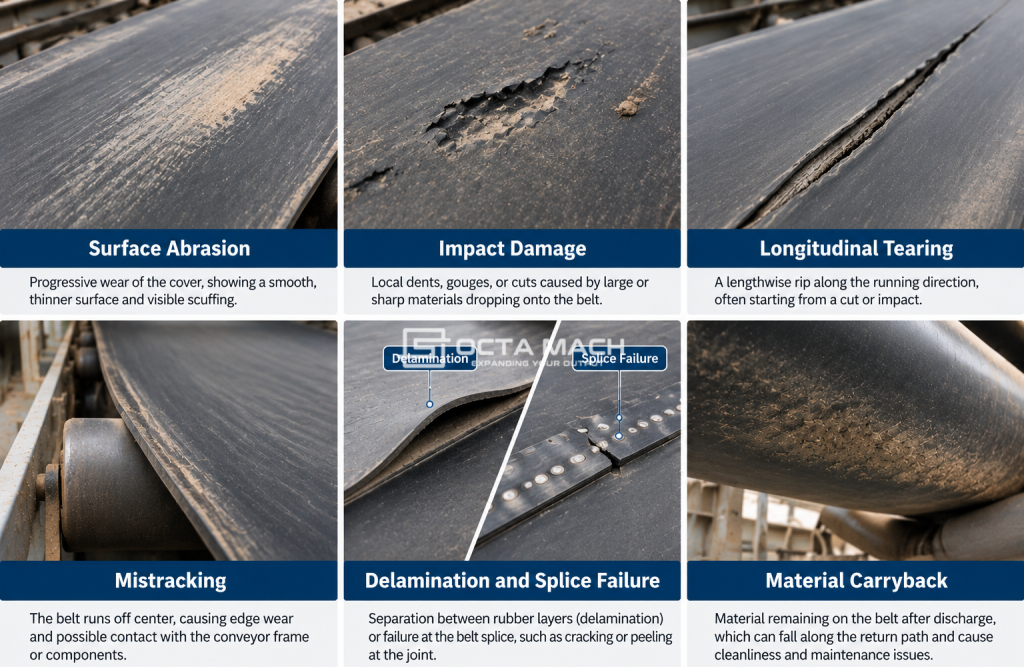
- Surface Abrasion: Gradual rubber cover wear caused by continuous contact with abrasive materials.
- Impact Damage: Cover or carcass damage caused by heavy materials falling onto the belt.
- Longitudinal Tearing: Belt cuts caused by sharp objects, trapped metal, or damaged equipment.
- Belt Mistracking: Off-center belt movement resulting from misaligned pulleys, idlers, or uneven loading.
- Delamination and Splice Failure: Separation between belt layers or joint damage caused by poor bonding, improper splicing, or excessive stress.
- Material Carryback: Sticky materials accumulating on the belt and conveyor components, increasing wear and cleaning requirements.
Regular inspection of belt surfaces, edges, splices, pulleys, idlers, and cleaning systems helps identify damage early and reduce unplanned downtime. For profiled belts, sidewalls, cleats, and surface patterns should also be checked for wear or detachment.
Conveyor Belt Selection for Crushing and Mineral Processing Projects
A conveyor belt is not an isolated component in a mining or aggregate production line. Its construction, tensile rating, cover properties, and surface profile must match the material flow and mechanical arrangement of the entire system.
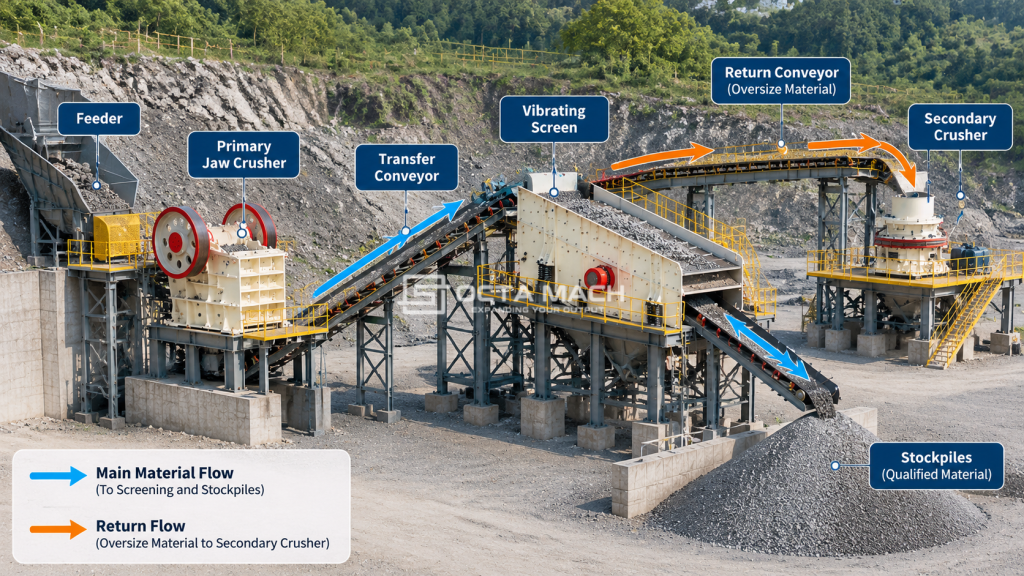
For crushing and screening projects, the belt specification should be coordinated with the feeder, crusher discharge, vibrating screen, transfer chutes, stockpile arrangement, and return conveyor. Providing the material characteristics, target throughput, conveying distance, elevation change, and operating environment allows the belt construction and technical requirements to be evaluated against the actual application.
Octa Mach focuses on crushing, screening, and mineral processing equipment. For an integrated production line, conveyor belt requirements should be considered together with the upstream and downstream equipment to maintain suitable material flow through the plant.
FAQ
1. What Are the Main Types of Conveyor Belts?
Common conveyor belt types include steel cord conveyor belts, fabric conveyor belts, corrugated sidewall conveyor belts, pipe conveyor belts, chevron conveyor belts, heat-resistant conveyor belts, bucket elevator belts, and specialized belts for filtration or anti-adhesion applications. Each type is designed for different material characteristics and operating conditions.
2. What Is the Difference Between Steel Cord and Fabric Conveyor Belts?
Steel cord conveyor belts use longitudinal steel cords as the primary reinforcement and are generally selected for high-tension, long-distance, and high-capacity applications. Fabric conveyor belts use textile layers such as EP or NN and are commonly used for general industrial and mining conveying duties where their tensile strength and flexibility meet the system requirements.
3. Which Conveyor Belt Is Suitable for a Crushing Plant?
The selection depends on the material size, required throughput, conveying distance, and loading conditions. Fabric conveyor belts are commonly used for general transfer conveyors, while steel cord belts are suitable for demanding long-distance or high-tension routes. Chevron belts and sidewall belts can be used where inclined material transport requires additional grip or material containment.
4. What Is the Difference Between a Chevron Belt and a Sidewall Conveyor Belt?
A chevron conveyor belt uses raised patterns on the carrying surface to improve grip and reduce material rollback on inclined conveyors. A sidewall conveyor belt uses corrugated rubber barriers along both edges and transverse cleats across the belt to retain material during steep-angle or vertical conveying.
5. How Is Conveyor Belt Tensile Strength Selected?
Tensile strength is selected according to the calculated working tension, belt length, material load, elevation change, starting and stopping conditions, and splice design. Steel cord belts use ST strength classes, while textile belts use their specified carcass tensile rating. The selected rating must be compatible with the complete conveyor system.