
The toothed roll crusher uses two counter-rotating toothed rolls to grip, split and crush large material lumps through combined compression and shearing forces. Designed for large-feed and high-capacity crushing applications, the equipment can handle feed sizes up to 2,000 mm and processing capacities of up to 10,000 t/h, depending on the configuration and operating conditions.
The toothed roll crusher features a low-profile machine structure, a large feeding opening and adjustable crushing configurations to accommodate different discharge requirements. Its toothed crushing mechanism provides effective material gripping and controlled size reduction, helping limit excessive fines generation under suitable operating conditions. The equipment is suitable for coal, coal gangue, low- and medium-hardness rock, selected wet and clay-rich materials, underground mining operations and compatible industrial waste processing applications.
Working Principle of Double Toothed Roll Crusher
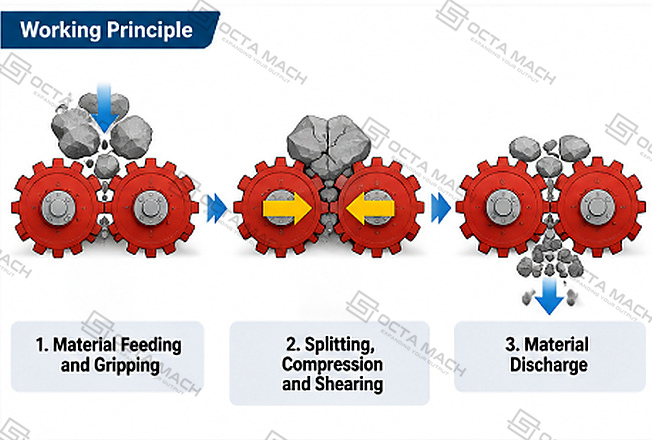
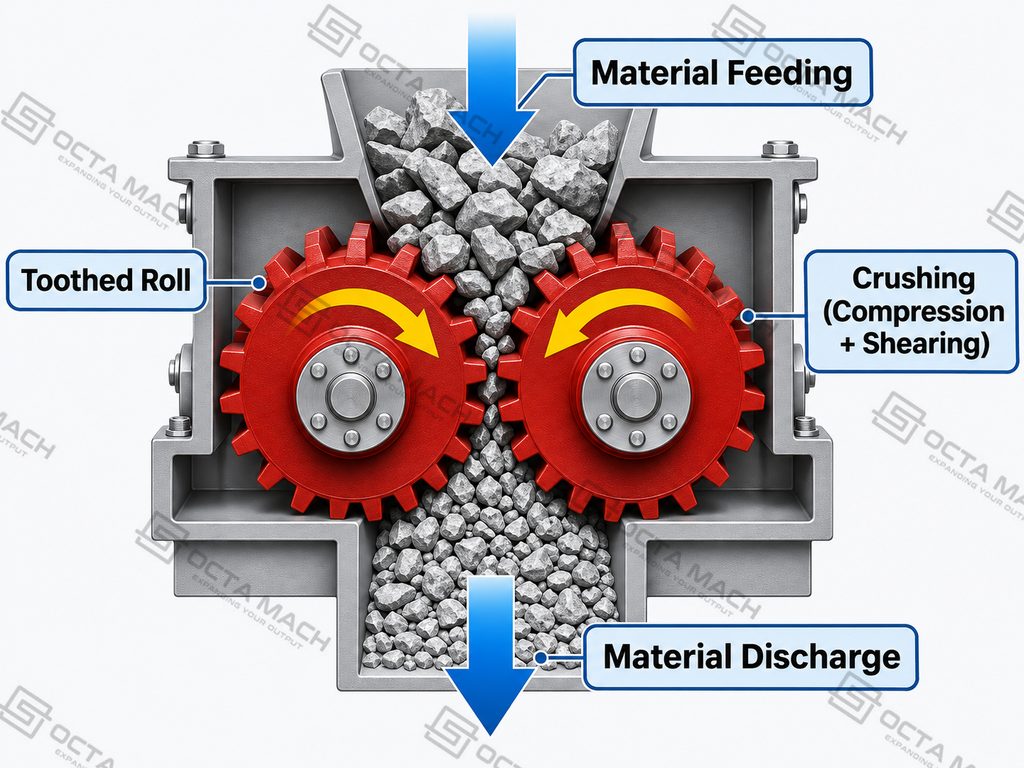
A double toothed roll crusher reduces material through two rolls rotating in opposite directions. The crushing teeth engage with incoming lumps and apply concentrated forces to break them into smaller particles.
Material Feeding and Gripping
Large material lumps enter the crushing chamber through the upper feeding opening. As the two rolls rotate inward toward the crushing zone, their teeth engage with the material and pull it between the rolls. The toothed surfaces provide a strong gripping action, allowing the crusher to handle irregular and oversized particles that require positive engagement before crushing.
Splitting, Compression and Shearing
As material moves through the crushing zone, the teeth penetrate its surface and generate concentrated crushing forces. Internal cracks develop under splitting and compression, while the interaction between the rotating teeth produces additional shearing forces. This combined action reduces large particles without relying on high-speed impact, helping control excessive fragmentation under suitable material conditions.
Material Discharge
After size reduction, the crushed material passes through the space between the rolls and exits through the lower discharge opening. The selected tooth arrangement and crushing configuration influence the target discharge size, while material strength, feed particle distribution and operating conditions affect the final product gradation.
Main Structure and Design Features
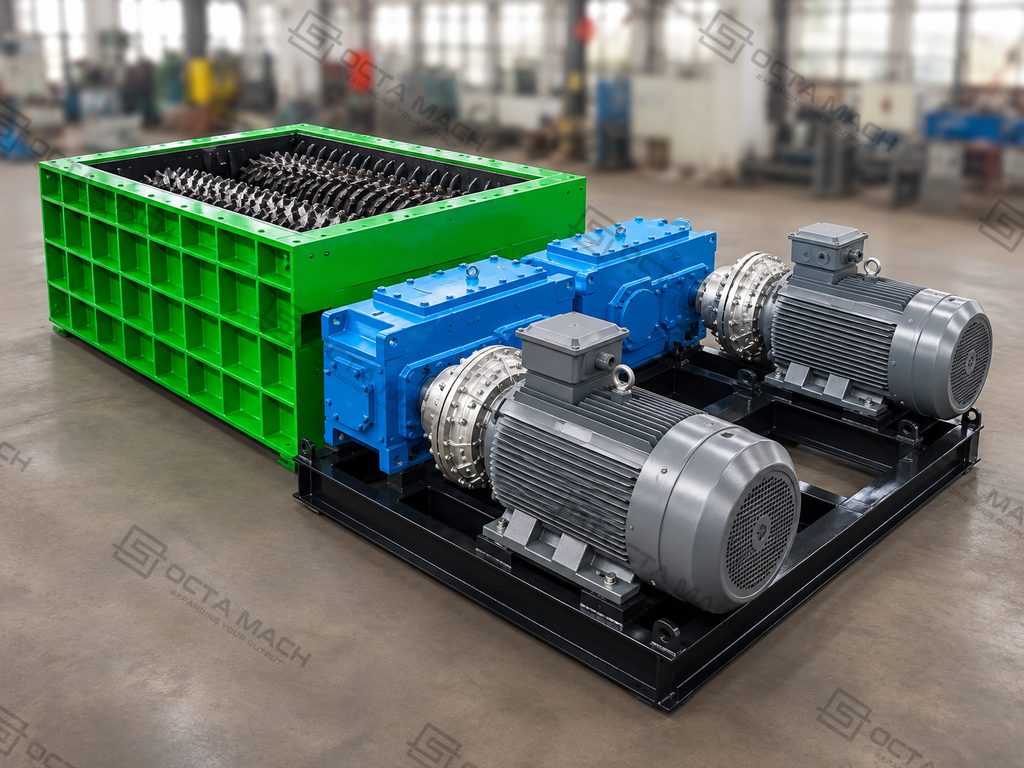
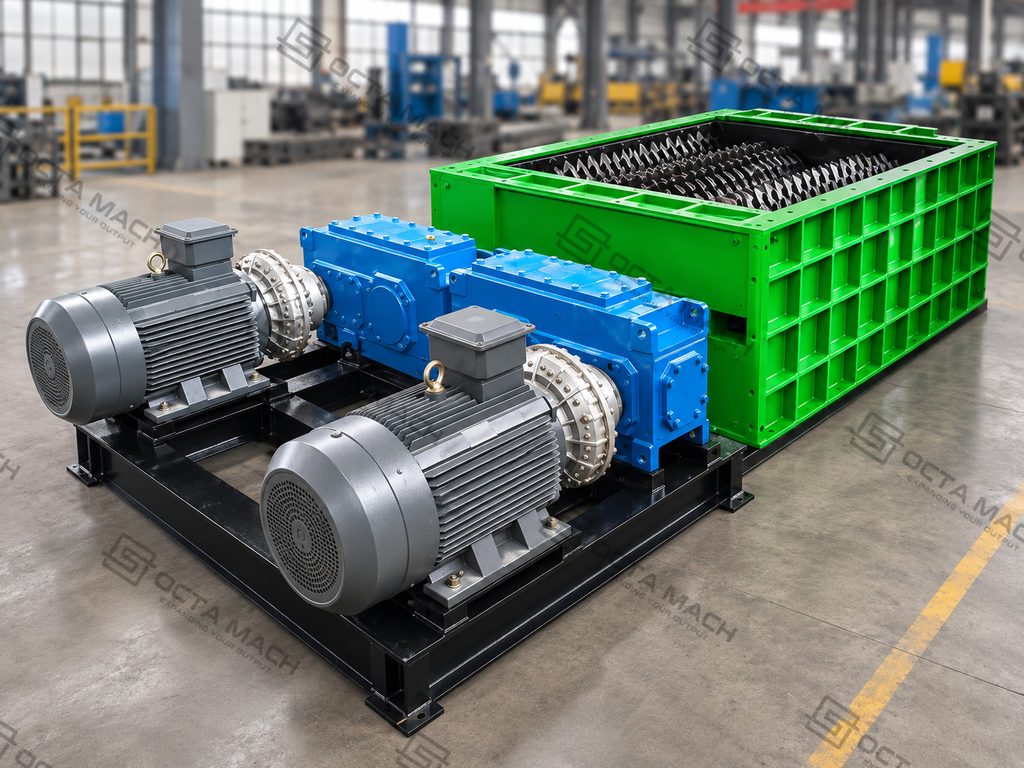
The toothed roll crusher consists of a heavy-duty frame, two crushing rolls, toothed crushing elements, roll shafts, bearing assemblies and a motor-driven transmission system. These components work together to maintain stable operation and support continuous crushing under different material and production conditions.
Crushing Rolls and Wear-Resistant Teeth
The crushing rolls are the primary working components. Their teeth grip incoming material and generate the forces required for size reduction. Tooth geometry, spacing and material selection influence feeding performance, crushing efficiency and wear resistance.For abrasive materials, crusher wear parts and tooth material selection are particularly important because excessive wear can reduce gripping ability, change the crushing clearance and affect discharge particle consistency.
Drive System and Bearing Assemblies
The drive system supplies the torque required for counter-rotating operation. Depending on the equipment configuration, single-motor or dual-motor drive systems are available, with installed power reaching 2 × 450 kW in selected high-capacity configurations.The bearing assemblies support the roll shafts and maintain rotational stability under crushing loads. Proper lubrication, shaft alignment and bearing inspection help reduce friction, overheating and premature component wear.
Heavy-Duty Frame and Feeding Structure
The machine frame supports the crushing rolls, shafts and transmission components. The upper feeding structure directs material into the crushing chamber, while the lower discharge arrangement connects with downstream conveying equipment.The relatively low-profile design is useful when arranging crushing stations with restricted installation height, including underground mining facilities.
Toothed Roll Crusher Specifications
The toothed roll crusher is available in multiple configurations, with roll center distances ranging from 500 to 1,500 mm. Depending on the equipment configuration, discharge particle sizes range from 30 to 500 mm, allowing the crusher to accommodate different material characteristics, crushing stages and production capacity requirements.
Technical Specifications
| Configuration | Roll Center Distance (mm) | Feed Size (mm) | Discharge Size (mm) | Crushing Strength (MPa) | Capacity (t/h) | Motor Power (kW) | Weight (kg) |
|---|---|---|---|---|---|---|---|
| 1 | 500 | ≤300 | 80 | ≤160 | 70–100 | 45–55 | 9,300 |
| 2 | 500 | ≤300 | 120 | ≤160 | 120–150 | 45–55 | 9,300 |
| 3 | 500 | ≤300 | 80 | ≤160 | 100–180 | 75–90 | 11,800 |
| 4 | 500 | ≤300 | 120 | ≤160 | 130–210 | 75–90 | 11,800 |
| 5 | 500 | ≤300 | 150 | ≤160 | 220–280 | 75–90 | 11,800 |
| 6 | 500 | ≤150 | 40–50 | ≤160 | 110–220 | 75–90 | 11,050 |
| 7 | 500 | ≤300 | 50–80 | ≤160 | 180–320 | 75–110 | 11,300 |
| 8 | 500 | ≤200 | 30 | ≤160 | 80–100 | 110 | 12,390 |
| 9 | 500 | ≤300 | 80 | ≤160 | 180–240 | 90–110 | 12,800 |
| 10 | 500 | ≤300 | 120 | ≤160 | 220–280 | 90–110 | 12,800 |
| 11 | 500 | ≤300 | 150 | ≤160 | 300–420 | 90–110 | 12,800 |
| 12 | 500 | ≤300 | 80 | ≤160 | 200–360 | 110–160 | 13,600 |
| 13 | 500 | ≤300 | 120 | ≤160 | 300–400 | 110–160 | 13,600 |
| 14 | 500 | ≤300 | 150 | ≤160 | 450–620 | 110–160 | 13,600 |
| 15 | 500 | ≤150 | 40–50 | ≤160 | 220–300 | 110–160 | 16,200 |
| 16 | 500 | ≤300 | 50–80 | ≤160 | 260–500 | 110–160 | 16,500 |
| 17 | 500 | ≤200 | 30 | ≤160 | 120–150 | 160 | 17,800 |
| 18 | 625 | ≤800 | 200–300 | ≤160 | 400–650 | 132–160 | 17,250 |
| 19 | 625 | ≤300 | 50–80 | ≤160 | 250–400 | 2 × (75–90) | 22,000 |
| 20 | 625 | ≤200 | 30 | ≤160 | 160–220 | 2 × 90 | 23,200 |
| 21 | 625 | ≤800 | 200–300 | ≤160 | 600–1,050 | 160–200 | 25,600 |
| 22 | 625 | ≤300 | 50–80 | ≤160 | 400–800 | 2 × (110–160) | 24,600 |
| 23 | 625 | ≤200 | 30 | ≤160 | 250–400 | 2 × 132 | 25,000 |
| 24 | 625 | ≤800 | 200–300 | ≤160 | 850–1,350 | 200–220 | 27,100 |
| 25 | 625 | ≤300 | 50–80 | ≤160 | 800–1,200 | 2 × (160–220) | 29,800 |
| 26 | 625 | ≤200 | 30 | ≤160 | 450–600 | 2 × 200 | 31,300 |
| 27 | 625 | ≤800 | 200–300 | ≤160 | 1,200–2,050 | 250–280 | 30,600 |
| 28 | 680 | ≤600 | 250–300 | ≤160 | 500–600 | 130–160 | 26,275 |
| 29 | 680 | ≤600 | 250–300 | ≤160 | 600–900 | 160–200 | 33,500 |
| 30 | 850 | ≤900 | 150–300 | ≤250 | 300–1,200 | 2 × 110 | 20,000 |
| 31 | 850 | ≤900 | 150–300 | ≤250 | 500–1,800 | 2 × 132 | 26,000 |
| 32 | 850 | ≤900 | 150–300 | ≤250 | 800–2,400 | 2 × 200 | 40,000 |
| 33 | 850 | ≤900 | 150–300 | ≤250 | 1,200–4,000 | 2 × 280 | 60,000 |
| 34 | 1,000 | ≤1,200 | 200–400 | ≤300 | 800–2,400 | 2 × 200 | 38,000 |
| 35 | 1,000 | ≤1,200 | 200–400 | ≤300 | 1,800–5,000 | 2 × 280 | 60,000 |
| 36 | 1,150 | ≤1,200 | 300 | ≤200 | 1,800 | 2 × 200 | 67,000 |
| 37 | 1,300 | ≤1,500 | 300–500 | ≤300 | 600–2,400 | 2 × 250 | 56,000 |
| 38 | 1,300 | ≤1,500 | 300–500 | ≤300 | 1,800–5,000 | 2 × 315 | 89,000 |
| 39 | 1,300 | ≤1,500 | 300–500 | ≤300 | 2,400–7,000 | 2 × 355 | 100,000 |
| 40 | 1,500 | ≤2,000 | 400–500 | ≤300 | 800–3,000 | 2 × 280 | 60,000 |
| 41 | 1,500 | ≤2,000 | 400–500 | ≤300 | 1,200–6,000 | 2 × 355 | 90,000 |
| 42 | 1,500 | ≤2,000 | 400–500 | ≤300 | 2,400–10,000 | 2 × 450 | 130,000 |
High-Capacity Crushing Performance
The toothed roll crusher is designed to handle large material lumps and high production requirements. Depending on the equipment configuration, it can accommodate feed sizes up to 2,000 mm and achieve processing capacities of up to 10,000 t/h under suitable operating conditions.
Large-feed crushing is particularly important in mining and bulk material handling operations where oversized material must be reduced before transportation or further processing. The toothed roll configuration helps grip and break large particles, while tooth geometry and crushing clearance influence discharge size and processing capacity.
Actual performance depends on several operating conditions:
- Feed size and distribution: Oversized or irregular lumps may affect feeding stability.
- Material properties: Crushing strength and abrasiveness influence crushing forces and tooth wear.
- Moisture content: Wet and sticky materials may accumulate on the crushing teeth and affect discharge.
- Discharge requirements: Smaller target particle sizes generally require more intensive size reduction.
- Feeding consistency: Stable and evenly distributed feeding helps maintain continuous throughput.
For large production lines, the crusher should be matched with the upstream feeder, discharge conveyor and downstream screening equipment. The capacity of the complete system must be considered rather than relying only on the maximum catalogue capacity of the crusher.ity of the complete system must be considered rather than relying only on the maximum catalogue capacity of the crusher.
Applications of Toothed Roll Crusher
Toothed roll crushers can be configured for different bulk material processing requirements, particularly in applications involving large feed particles, controlled size reduction and continuous material handling.
Coal and Coal Gangue Crushing
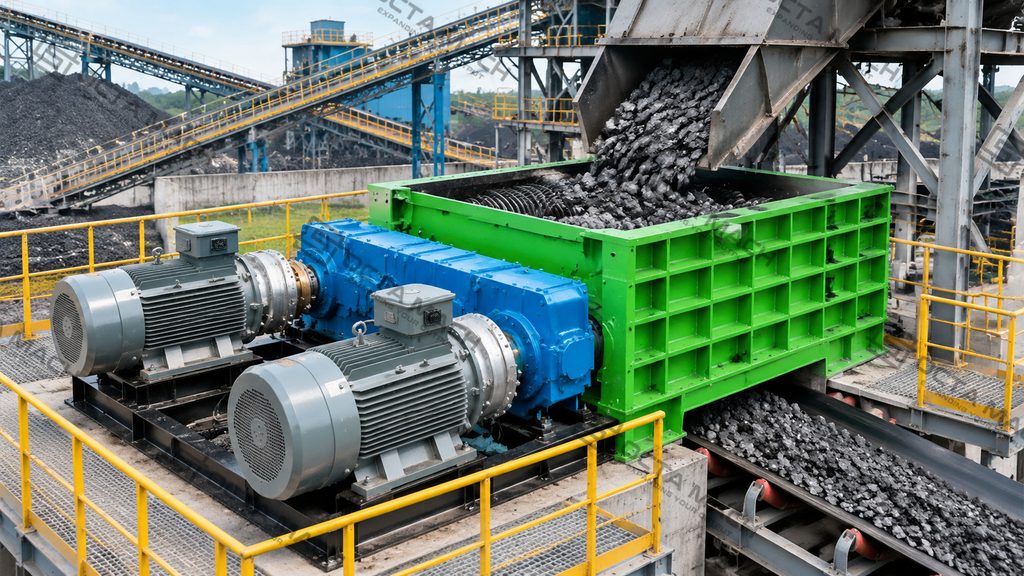
Coal and coal gangue are common materials processed by toothed roll crushers. During coal preparation, large lumps are reduced in size before screening, separation or further processing.
The toothed rolls grip irregular particles and help control discharge particle size while limiting excessive fines generation under suitable operating conditions. Equipment selection should consider coal characteristics, gangue content, material abrasiveness and required product size.
Low- and Medium-Hardness Rock Crushing
Toothed roll crushers can process suitable low- and medium-hardness rocks, including certain limestone and other relatively brittle materials. Rock strength, mineral composition and abrasiveness should be considered when selecting the crushing teeth and equipment configuration.
For rocks containing highly abrasive minerals, tooth wear resistance and expected replacement intervals should be evaluated to maintain crushing efficiency and consistent discharge particle size.
Wet and Clay-Rich Material Crushing
The toothed crushing mechanism can process certain moist and clay-bearing materials through gripping, compression and shearing actions. However, excessive moisture and sticky clay may cause material buildup on the crushing teeth or blockage at the discharge opening.
Feed moisture, clay content and material flow characteristics should be evaluated during equipment selection. Appropriate feeding arrangements and accessible cleaning areas can help reduce material accumulation and maintain stable operation.
Underground Mining and Waste Recycling
The relatively low-profile design of toothed roll crushers can be advantageous in underground crushing stations where installation height and available space are limited. Equipment dimensions, feeding arrangements and maintenance clearance should be considered during installation planning.
Toothed roll crushers can also process selected industrial waste and bulk materials when their physical properties are compatible with the crushing mechanism. Material composition, feed size and the presence of uncrushable objects should be evaluated to minimize damage to the crushing teeth, shafts and other mechanical components.
Model Selection and Configuration
Selecting the right toothed roller crusher requires matching equipment specifications with actual material characteristics and production requirements. Maximum feed size alone is not sufficient to determine the appropriate equipment configuration.A broader crusher selection guide can also help compare feed size, material properties, processing capacity and crushing stage requirements.
Feed Size and Material Characteristics
The maximum feed dimensions and particle size distribution should be confirmed before selecting a toothed roll crusher. Material crushing strength, abrasiveness, moisture content and bulk density also influence the required tooth arrangement and crushing configuration.
Different equipment configurations can accommodate feed sizes of up to 900 mm, 1,500 mm or 2,000 mm, depending on the crushing chamber dimensions and operating requirements. The selected crusher must be capable of handling the largest expected material lumps while maintaining stable feeding and crushing performance.
Discharge Size and Processing Capacity
The required discharge size should be determined according to downstream screening, conveying or grinding requirements. Smaller discharge targets may require different tooth arrangements, crushing clearances and greater crushing effort.The selected equipment must also meet the required hourly production capacity without creating bottlenecks in the crushing line. Feed characteristics, material strength and operating conditions should be evaluated together to ensure consistent throughput and discharge particle size.
Motor Power and Installation Conditions
Motor power should be matched to the crushing load, material properties and operating requirements. Toothed roll crushers are available with single-motor or dual-motor drive configurations, depending on the required processing capacity and crushing conditions.Installation planning should also consider equipment dimensions, foundation loads, feeding height, discharge clearance and maintenance access. The crusher must be properly integrated with upstream feeding equipment and downstream conveyors to ensure stable operation and continuous material flow.
| Selection Parameter | Information to Confirm |
|---|---|
| Feed Size | Maximum lump size and feed distribution |
| Material | Material type, crushing strength and abrasiveness |
| Moisture | Moisture content and clay characteristics |
| Discharge Size | Required finished particle size |
| Capacity | Target production in t/h |
| Drive Configuration | Motor power and electrical requirements |
| Installation | Available space, foundation and conveyor connections |
Final model selection should be confirmed against material test data, required output size and actual production conditions.
Quality Inspection and Routine Maintenance
The crushing rolls, teeth, shafts, bearings and drive components require particular attention during manufacturing, assembly and equipment inspection.
Manufacturing and Pre-Shipment Inspection
Important inspection activities include:
- Checking crushing roll dimensions and tooth arrangement.
- Inspecting shaft machining and bearing assembly.
- Verifying motor specifications and transmission alignment.
- Checking frame dimensions and structural weld quality where applicable.
- Inspecting electrical connections and control components.
- Conducting no-load trial operation to check abnormal vibration, noise and bearing temperature.
Technical drawings, operating instructions and inspection records should be prepared according to the agreed equipment specifications and supply requirements.
Routine Maintenance and Wear Parts
The crushing teeth are the primary wear components because they directly contact the feed material. Their condition influences material gripping, crushing efficiency and discharge consistency.
Routine maintenance should focus on:
- Inspecting teeth for excessive wear, cracks and deformation.
- Checking bearing lubrication, temperature and vibration.
- Inspecting roll shafts and drive connections.
- Cleaning accumulated material from accessible feeding and discharge areas after safe shutdown.
- Replacing worn components according to the manufacturer’s maintenance requirements.
The replacement interval depends on material abrasiveness, operating hours and tooth material.
Why Choose Octa Mach
Octa Mach supplies crushing equipment for mining, mineral processing and bulk material handling applications. Its toothed roll crushers are available in multiple configurations to accommodate different feed sizes, discharge requirements and production capacities.
Equipment selection and project support can cover:
- Toothed roll crusher selection and equipment configuration.
- Motor and drive system specifications.
- Crushing teeth and wear parts.
- Technical drawings and equipment documentation.
- Export packing and delivery coordination.
For large-scale crushing projects, Octa Mach can assist with equipment selection according to material properties, maximum feed size, target discharge particle size and required hourly capacity.
FAQ
Q: What materials can a toothed roll crusher process?
A: Toothed roll crushers can process coal, coal gangue, limestone, suitable low- and medium-hardness rocks, and selected wet or clay-bearing materials. They are also used for reducing compatible industrial bulk materials. Material suitability depends on crushing strength, abrasiveness, moisture content and feed particle size. The crushing teeth and equipment configuration should be selected according to the material properties and required discharge size.
Q: What is the maximum feed size of a toothed roll crusher?
A: Heavy-duty toothed roll crushers can accommodate feed sizes of up to 2,000 mm, depending on the equipment configuration. Smaller machines have different feed-size limits based on their crushing chamber dimensions and tooth arrangements. The maximum allowable feed size also depends on material strength, lump shape and particle distribution. Equipment selection should ensure that oversized material can enter the crushing zone without causing unstable feeding or blockage.
Q: What is the maximum processing capacity of a toothed roll crusher?
A: High-capacity toothed roll crushers can achieve processing capacities of up to 10,000 t/h in selected large-scale configurations. Actual throughput depends on feed size, material hardness, bulk density, moisture content and required discharge particle size. The feeding system, crusher and downstream conveying equipment must be properly matched to maintain continuous production. Maximum catalogue capacity should not be treated as the guaranteed output under all operating conditions.
Q: How do you select the right toothed roll crusher?
A: Selecting a suitable toothed roll crusher requires evaluating the maximum feed size, material crushing strength, abrasiveness, moisture content and required discharge particle size. The equipment must also meet the target hourly processing capacity and available installation conditions. Tooth configuration, motor power, foundation requirements and connections to downstream equipment should be considered together. Final selection should be based on actual material characteristics and the production requirements of the crushing plant.