
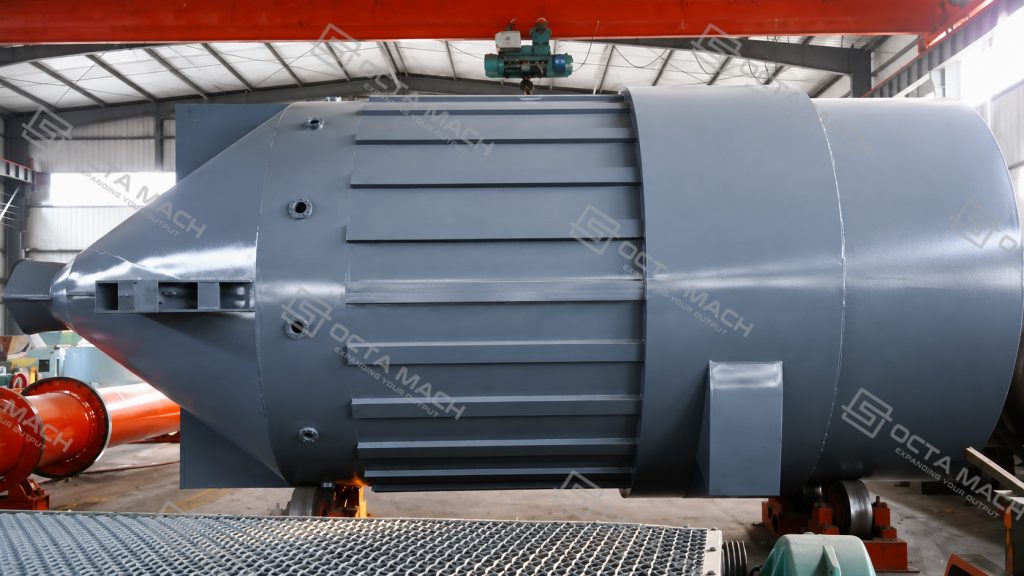
Vertical dryer removes moisture from briquettes, pellets, clay-based formed products, and other compacted solids by moving them downward through an upright drying chamber while hot air rises from the lower section. This counter-current process supports continuous drying after briquetting or pelletizing and before screening, cooling, storage, packing, or transport. The bottom discharge system regulates material movement and residence time, while stable operation depends on feed that retains sufficient wet strength, resists severe sticking, and maintains open voids for uniform airflow.
OctaMach supplies gravity-flow vertical dryer equipment for continuous production lines. Each system can be configured with the dryer body, feeding section, heat source, exhaust connection, and discharge equipment. Model selection is based on the feed material, wet throughput, inlet and target moisture, particle dimensions, bulk density, bed permeability, allowable temperature, available heat source, and downstream handling requirements.
Vertical Dryer Specifications
| Parameter | Model 2200 | Model 2600 | Model 2800 | Model 3200 |
|---|---|---|---|---|
| Drying Capacity (t/h) | 3–5 | 6–8 | 8–10 | 10–14 |
| Drying Time (h) | 2–2.5 | 2–2.5 | 2–2.5 | 2–2.5 |
| Moisture Content Before Drying (%) | 8–12 | 8–12 | 8–12 | 8–12 |
| Moisture Content After Drying (%) | 1.5–3 | 1.5–3 | 1.5–3 | 1.5–3 |
| Required Power (kW) | 18.5 | 22 | 37 | 45 |
| Coal Consumption (kg/h) | ≥100 | ≥150 | ≥180 | ≥230 |
| Hot-Air Temperature Range (°C) | 200–260 | 200–260 | 200–260 | 200–260 |
| Operators Required | 2 persons/shift | 2 persons/shift | 2 persons/shift | 2 persons/shift |
Model selection should be based on both the required solids throughput and the hourly moisture-removal load. The listed operating range applies to formed materials that maintain sufficient strength and bed permeability; final sizing must also consider briquette or pellet dimensions, fines content, heat-source capacity, and the residence time needed to reach the target moisture.
Vertical Dryer Working Principle, Structure, and Advantages
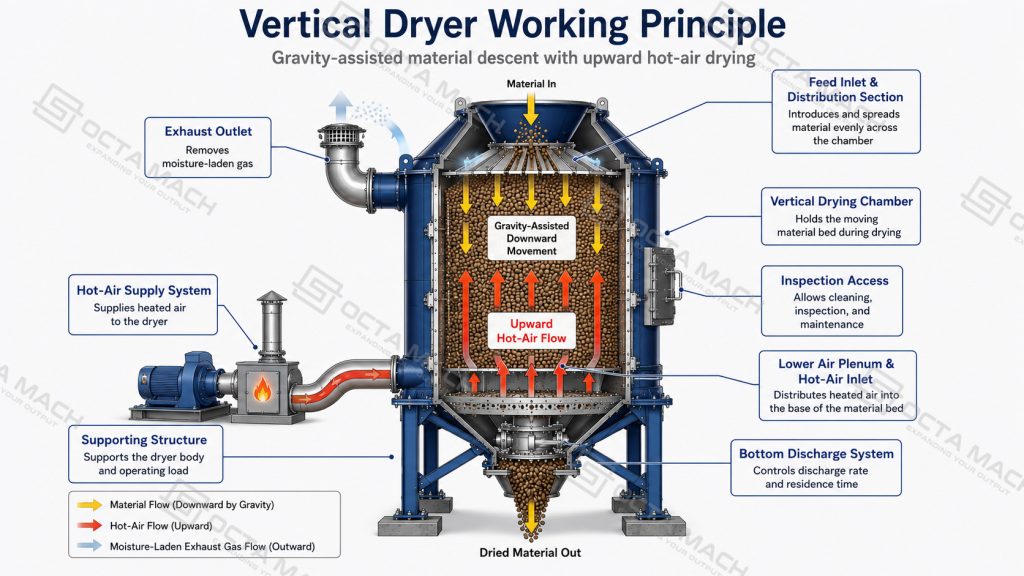
The vertical dryer working principle uses gravity-assisted downward material movement and upward hot-air flow. Formed briquettes, pellets, or similar solids enter from the top, move gradually through the drying chamber, and exchange heat with hot air introduced from below. Moisture leaves with the exhaust gas, while the bottom discharge system regulates material flow and residence time. Uniform feeding, sufficient material strength, and good bed permeability are essential for stable drying.
Main Structure of the Vertical Dryer
| Component | Function |
|---|---|
| Feed Inlet and Distribution Section | Introduces and spreads the material evenly across the chamber |
| Vertical Drying Chamber | Holds the moving material bed during drying |
| Hot-Air Inlet | Supplies heated air from the lower section |
| Exhaust Outlet | Removes moisture-laden gas |
| Bottom Discharge System | Controls material movement and residence time |
| Supporting Structure | Supports the dryer body and operating load |
| Inspection Access | Allows cleaning, inspection, and maintenance |
| Heat-Source Interface | Connects the dryer to the hot-air system |
Advantages of the Vertical Dryer
- Continuous operation: Supports coordinated feeding, drying, and discharge.
- Compact arrangement: Uses vertical space and reduces horizontal installation length.
- Gentle material movement: Gravity flow limits repeated mechanical tumbling.
- Counter-current drying: Upward hot air contacts downward-moving material continuously.
- Adjustable residence time: Discharge speed can be matched to moisture and throughput requirements.
- Easy line integration: Connects with feeding, heating, exhaust, conveying, screening, or cooling equipment.
Feed Requirements Before Entering the Vertical Dryer
Stable drying begins with the condition of the formed feed. Briquettes, pellets, or other compacted solids must retain their shape during conveying, top loading, movement through the material bed, and bottom discharge. They must also leave enough open space between individual pieces for hot air to pass through the chamber.
Feed that is weak, sticky, highly irregular, or mixed with excessive fines can restrict airflow and interrupt downward movement. These conditions may cause bridging, uneven residence time, higher pressure drop, local wet zones, and increased product breakage.
| Feed Requirement | Why It Matters | Risk if Not Controlled |
|---|---|---|
| Adequate wet strength | Allows the formed material to withstand feeding, bed pressure, and discharge | Breakage, deformation, and increased fines |
| Stable dimensions and shape | Helps maintain consistent void space throughout the material bed | Uneven airflow and irregular downward movement |
| Controlled fines content | Keeps air passages open between briquettes or pellets | Higher airflow resistance and wet zones |
| Low surface stickiness | Supports continuous movement through the chamber | Agglomeration, wall buildup, and bridging |
| Suitable binder behavior | Maintains product integrity during heating | Cracking, softening, or structural collapse |
| Consistent feed moisture | Keeps the evaporation load within a stable operating range | Fluctuating outlet moisture and dryer capacity |
| Sufficient bed permeability | Allows hot air to contact the full material bed | Airflow channeling and uneven drying |
| Thermal compatibility | Confirms that the material can tolerate the selected drying conditions | Discoloration, oxidation, softening, or product damage |
Feed inspection should focus on the actual material condition immediately before drying, not only on the final strength of the dried product. A briquette that becomes strong after drying may still be too fragile when it first leaves the forming machine. Feed transfer, drop height, storage time before drying, and upstream forming consistency should therefore be reviewed together with the vertical dryer.
Airflow, Residence Time, and Moisture Control
In a vertical dryer, hot air must pass through the spaces between the formed materials before moisture can be removed effectively. The resistance of this material bed is therefore a key operating factor. When the feed is distributed evenly and maintains a stable shape, airflow can pass through the chamber more uniformly. If the bed contains excessive fines, compacted material, or uneven loading, the airflow will follow areas of lower resistance and the drying result will become less consistent.
- Uneven particle or briquette size: Fine material fills the spaces between larger pieces, reducing bed permeability and increasing airflow resistance.
- Excessive fines: Accumulated fines can partially block air passages, creating low-flow areas with higher residual moisture.
- Insufficient wet strength: Weak briquettes or pellets may break during feeding and downward movement, increasing the fines content inside the chamber.
- Sticky material surfaces: Agglomeration and wall buildup can restrict material movement, cause bridging, and disturb the airflow path.
- Uneven top feeding: Different bed depths across the chamber create unequal resistance, allowing more hot air to pass through shallow areas.
- Material deformation during heating: Softening, swelling, or collapse reduces the void space between formed pieces and raises the pressure drop through the bed.
Residence time must be coordinated with the actual airflow condition. Extending drying time cannot fully correct a blocked or uneven material bed, while increasing the hot-air temperature may raise the risk of local overheating. Stable outlet moisture therefore depends on uniform feeding, adequate material strength, controlled fines content, consistent bed permeability, and a discharge rate matched to the required drying time.
Vertical Dryer Applications
A vertical dryer is typically selected when briquettes, pellets, or other formed solids require continuous moisture reduction after forming. The feed must retain sufficient wet strength, move steadily through the chamber, and maintain enough void space for hot air to pass through the material bed. This configuration is especially suitable for production lines that require continuous feeding and discharge, controlled residence time, compact vertical installation, and relatively gentle gravity-assisted material movement.
| Application Category | Typical Materials | Process Position | Main Suitability Requirements |
|---|---|---|---|
| Briquette Drying | Coal briquettes, mineral powder briquettes, iron-containing briquettes, and carbon-based formed materials | After briquetting and before screening, cooling, storage, packing, or transport | Adequate wet strength, stable dimensions, limited fines, and binder resistance to drying temperature |
| Pellet Drying | Mineral pellets and other mechanically formed pellets | After pelletizing and before downstream handling or processing | Stable pellet shape, sufficient abrasion resistance, and good bed permeability |
| Clay-Based Formed Products | Formed clay pieces and related products | After forming and before storage or further processing | Controlled shrinkage, crack resistance, surface stability, and suitable heating rate |
| Granulated or Compacted Solids | Coarse granules and project-specific compacted materials | Within continuous processing lines requiring moisture stabilization | Uniform size distribution, free downward movement, low stickiness, and sufficient airflow passages |
| Project-Specific Formed Materials | Selected mineral, chemical, or industrial formed solids | Before packaging, storage, transport, or subsequent processing | Thermal stability, acceptable vapor release, suitable moisture range, and verified compatibility with hot-air drying |
Vertical dryers are most appropriate when the material can form a stable, permeable bed and does not require intensive mechanical agitation. Slurry, paste, loose ultrafine powder, highly sticky feed, and formed materials that collapse or soften during heating are generally unsuitable for direct feeding into this type of dryer.
Vertical Dryer Operating Control and Troubleshooting
A vertical dryer operates most consistently when feed rate, material level, hot-air conditions, exhaust flow, and bottom discharge remain balanced. When one variable changes, the effect often appears as unstable outlet moisture, reduced capacity, material breakage, or irregular movement inside the chamber.
| Operating Condition | Likely Cause | Inspection or Adjustment |
|---|---|---|
| Outlet moisture remains high | Insufficient residence time, low heat input, excessive feed moisture, or restricted airflow | Check inlet moisture, feed rate, discharge speed, hot-air condition, and bed resistance |
| Outlet moisture varies across the discharge | Uneven top feeding, different bed depths, or airflow channeling | Inspect feed distribution, fines accumulation, and material level across the chamber |
| Dryer capacity decreases | Higher evaporation load, reduced airflow, material buildup, or unstable discharge | Check current feed moisture, exhaust condition, chamber buildup, and discharge operation |
| Briquette or pellet breakage increases | Low wet strength, excessive drop height, high bed pressure, or abrupt discharge movement | Review forming quality, feed-transfer points, internal material level, and discharge stability |
| Material movement becomes irregular | Surface sticking, bridging, deformation, or uneven size distribution | Inspect internal buildup, feed temperature response, material size, and discharge opening |
| Airflow resistance rises | Excessive fines, compacted bed, material swelling, or blocked air passages | Check fines content, material condition, bed permeability, and chamber cleanliness |
| Local overheating occurs | Uneven airflow, slow material movement, or excessive heat input | Check airflow distribution, discharge rate, material level, and hot-air supply |
| Fuel or heat consumption increases | Higher inlet moisture, cold-air leakage, unstable feed, or reduced heat transfer | Inspect seals, feed conditions, heat-source stability, and exhaust performance |
| Discharge becomes unstable | Bridging above the outlet, inconsistent bed pressure, or mechanical interference | Check material flow, discharge mechanism, buildup, and downstream conveyor capacity |
Operating adjustments should be made from the material path outward. First confirm the feed condition and top distribution, then check bed movement and discharge, followed by hot-air and exhaust conditions. Increasing temperature alone may not correct poor drying if the material bed is blocked, uneven, or moving at an unstable rate.
Routine operating records should include feed moisture, feed rate, outlet moisture, material condition, hot-air status, discharge behavior, and any observed buildup or breakage. Comparing these records over time helps identify whether a change originates from the material, the heat source, or the vertical dryer equipment itself.
OctaMach Vertical Dryer Supply Scope
OctaMach supplies vertical drying equipment as a standalone machine or as part of an integrated drying section. The final configuration is determined by the material form, moisture-removal duty, required capacity, heat source, site layout, and downstream process.
| Supply Item | Scope and Function |
|---|---|
| Vertical Dryer Body | Main drying chamber for continuous downward material movement and upward hot-air contact |
| Feed Inlet and Distribution Section | Receives formed material and distributes it across the chamber |
| Bottom Discharge Equipment | Controls product discharge and residence time |
| Supporting Structure | Supports the dryer body and operating load |
| Hot-Air Furnace | Provides the required drying heat according to the selected fuel and duty |
| Air Fan and Exhaust Connections | Supplies hot air and removes moisture-laden exhaust gas |
| Dust-Control Interface | Connects the dryer to the specified dust-collection or exhaust-treatment system |
| Temperature and Process Controls | Monitors key operating conditions and supports coordinated dryer control |
| Electrical Control System | Controls the dryer, feeding, discharge, and related auxiliary equipment |
| Feeding and Discharge Conveyors | Transfers material into and out of the drying section |
| Foundation and Installation Drawings | Provides equipment layout, foundation, and installation reference |
| Equipment and Component Lists | Identifies the main supplied equipment and system components |
| Operating and Maintenance Instructions | Supports installation, commissioning, operation, inspection, and routine maintenance |
| Recommended Spare-Parts List | Identifies parts recommended for commissioning and regular operation |
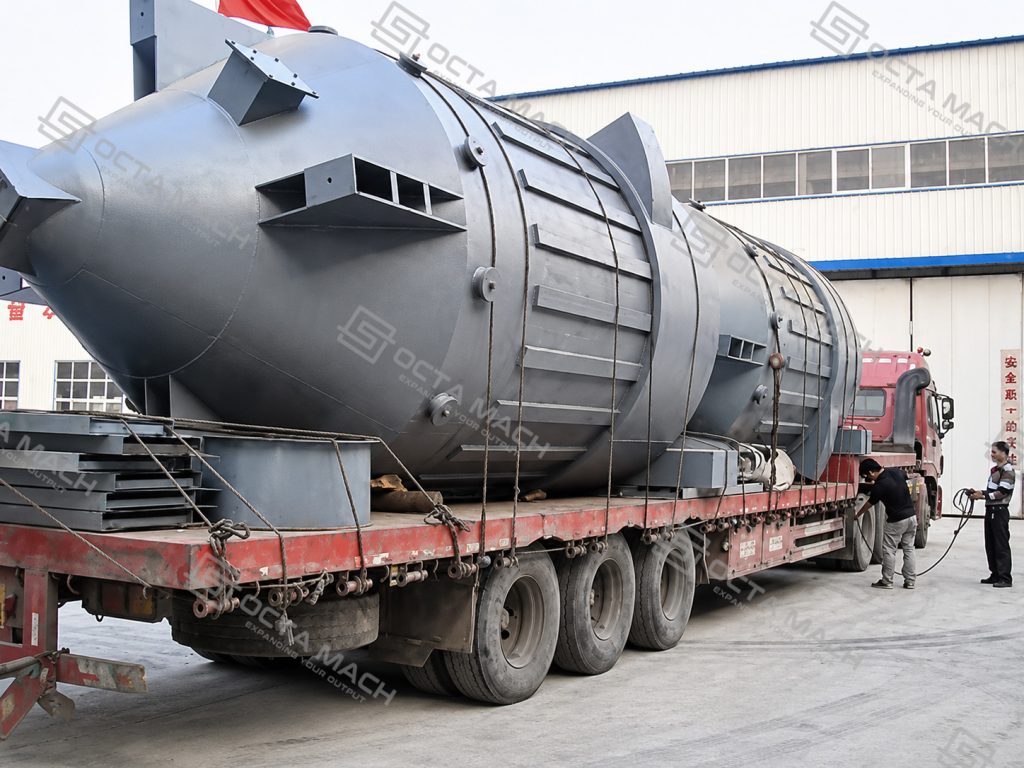
| Export Packing | Protects equipment and components during inland and international transport |
OctaMach coordinates the dryer body, feeding, hot-air, exhaust, and discharge interfaces as one process section rather than treating them as unrelated machines. This reduces mismatches between dryer capacity, heat input, material flow, and downstream conveying.
The final supply boundary is confirmed in the technical proposal. Depending on the project, OctaMach can also support equipment layout, foundation coordination, installation documentation, export packing, and integration with briquetting, pelletizing, screening, cooling, or conveying systems. For equipment selection, provide the material form, feed rate, inlet and target moisture, dimensions, bulk density, wet strength, heat source, operating schedule, and downstream process.
FAQ
Q1:Can loose powder be fed directly into a vertical dryer?
A1:No. This gravity-flow vertical dryer is designed for briquettes, pellets, and other formed solids with enough wet strength to retain their shape and sufficient void space for hot air to pass through the material bed. Loose powder, paste, or highly cohesive feed requires a different drying configuration.
Q2:What determines the capacity of a vertical dryer?
A2:Vertical dryer capacity depends on both the wet feed rate and the amount of water that must be evaporated per hour. Material size, bulk density, fines content, bed permeability, hot-air conditions, and required residence time also affect the final model selection.
Q3:Why can outlet moisture be uneven in a vertical dryer?
A3:Uneven top feeding, wide material-size variation, excessive fines, sticking, or deformation during heating can create different airflow resistance across the chamber. Hot air then follows low-resistance paths, leaving some material over-dried and other areas above the target moisture.
Q4:What information is required to select a vertical dryer?
A4:Provide the material name, formed shape and dimensions, wet strength, feed rate, inlet and target moisture, bulk density, fines content, maximum allowable temperature, heat source, operating hours, and downstream process. These inputs define the moisture-removal duty, airflow requirement, and residence time.