
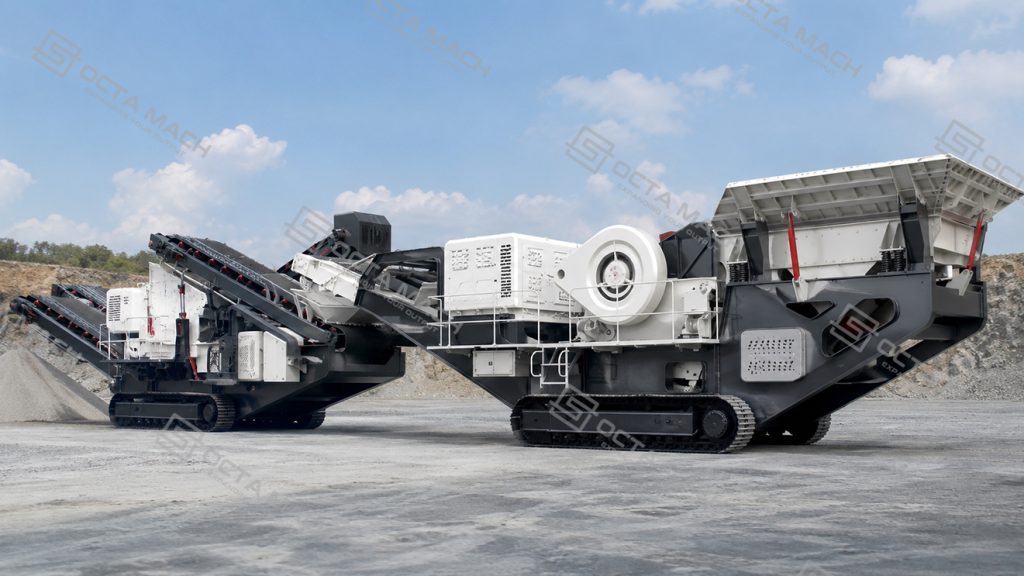
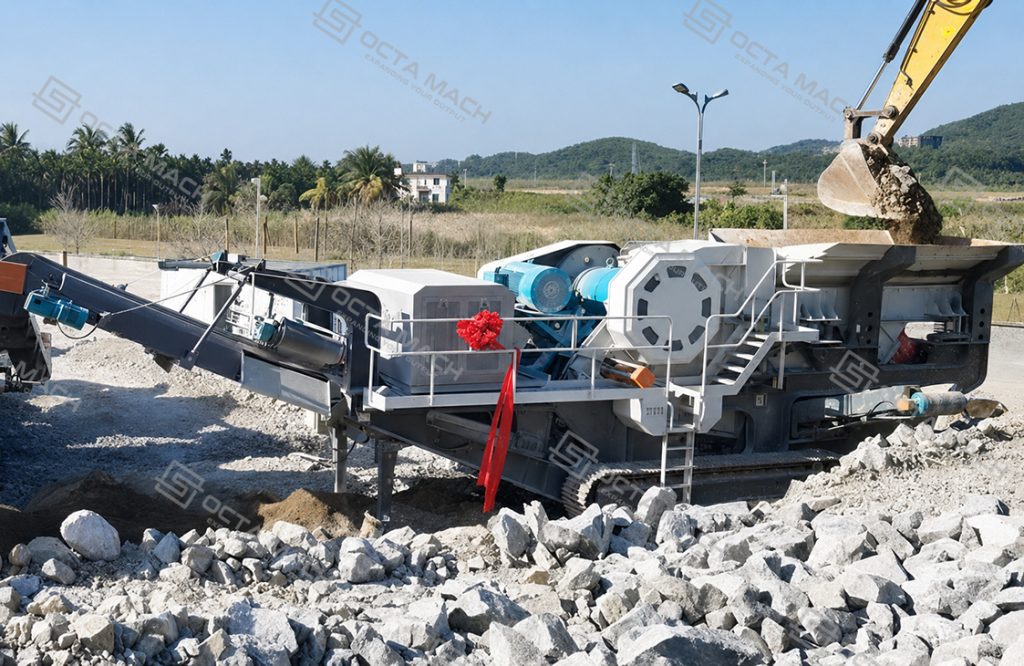
A Crawler Type Mobile Crusher is a track-mounted crushing and screening plant designed for on-site material processing. It integrates feeding, crushing, conveying and optional screening on a self-moving crawler chassis, allowing the equipment to operate close to the quarry face, mining area, road construction site or demolition project.
Compared with a stationary crushing plant, a crawler mobile crusher reduces raw material hauling distance and requires less fixed foundation work. The plant can be configured with jaw crusher, impact crusher, cone crusher, heavy hammer crusher or screening equipment according to crushing stage, feed size, material condition, required capacity and final aggregate size.
A crawler type mobile crushing plant is especially useful when the working site changes frequently, the ground condition is uneven, or the project needs fast installation with a complete crushing and screening process. In international markets, this equipment may also be called a Crawler Mobile Crusher, track crusher, tracked mobile crusher or crawler mobile crushing station.
How a Crawler Mobile Crusher Works
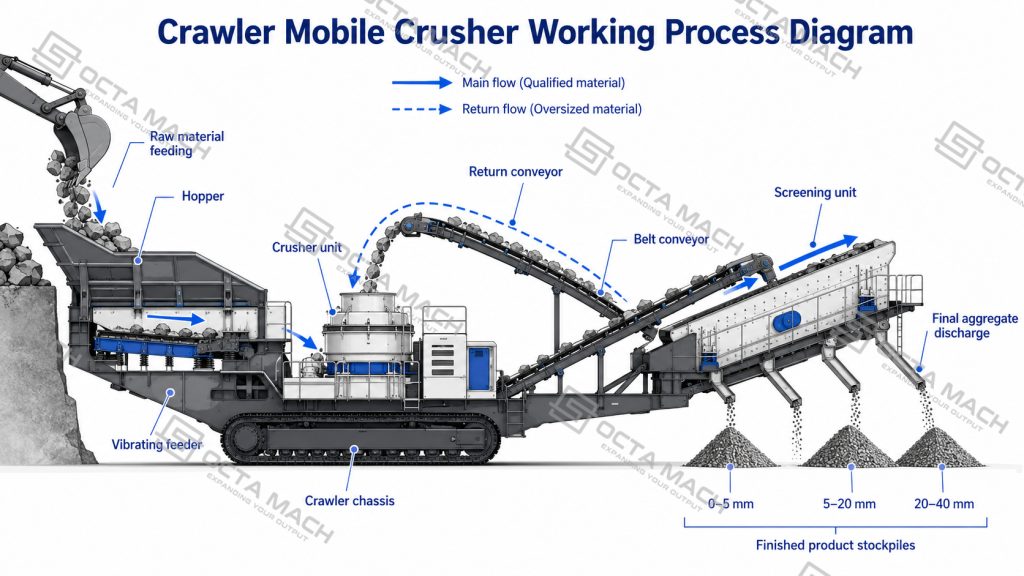
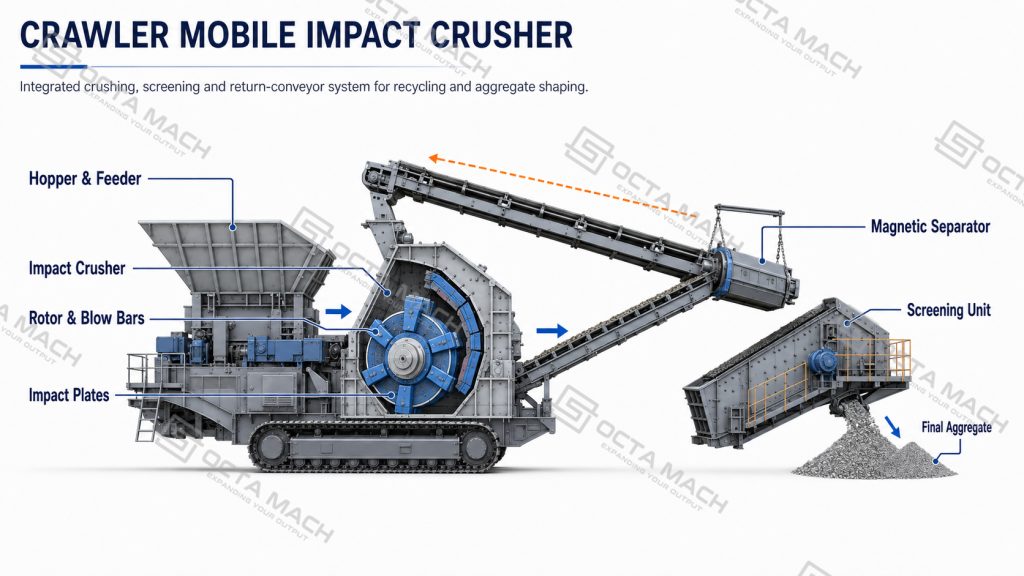
A crawler mobile crusher works as an integrated material-processing system. Raw material is loaded into the hopper, fed evenly by the vibrating feeder, crushed by the main crusher, and then discharged by belt conveyor. When the plant includes a screen, qualified material is separated into finished products while oversized material can return to the crusher for further reduction.
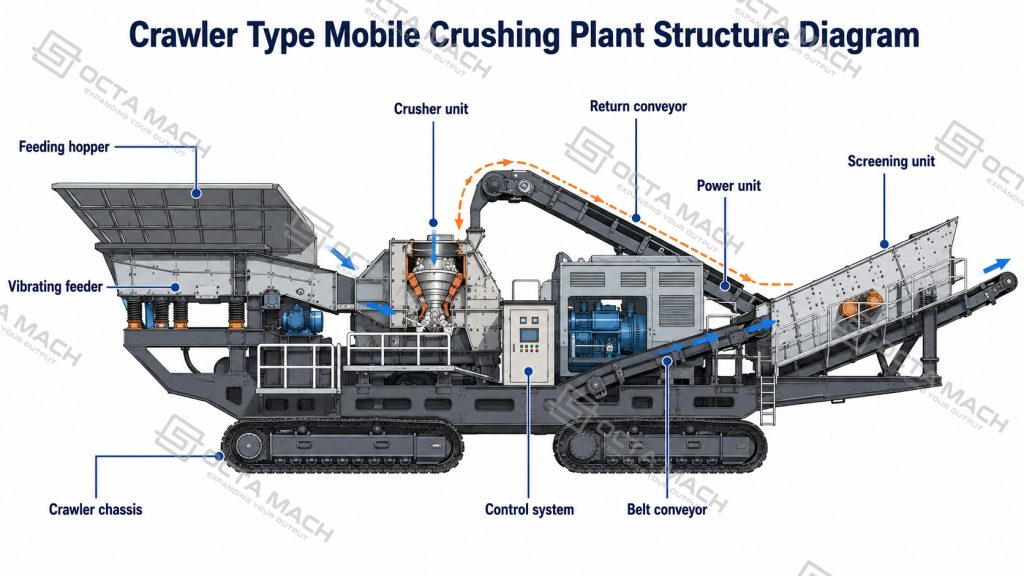
| Working Part | Function |
|---|---|
| Feeding Hopper | Receives raw material from loader or excavator |
| Vibrating Feeder | Controls feeding speed and sends material evenly into the crusher |
| Crusher Unit | Performs primary, secondary or fine crushing |
| Belt Conveyor | Transfers crushed material to the screen or stockpile |
| Screening Unit | Separates finished aggregate sizes |
| Return Conveyor | Sends oversized material back for re-crushing |
| Crawler Chassis | Supports site movement without fixed foundation |
| Power and Control System | Coordinates feeding, crushing, conveying and safety protection |
The design of the complete plant is important because the feeder, crusher, screen and conveyors must work at the same capacity level. A large crusher model alone does not guarantee stable production if the feed control, screening area or discharge conveyor cannot match the material flow.
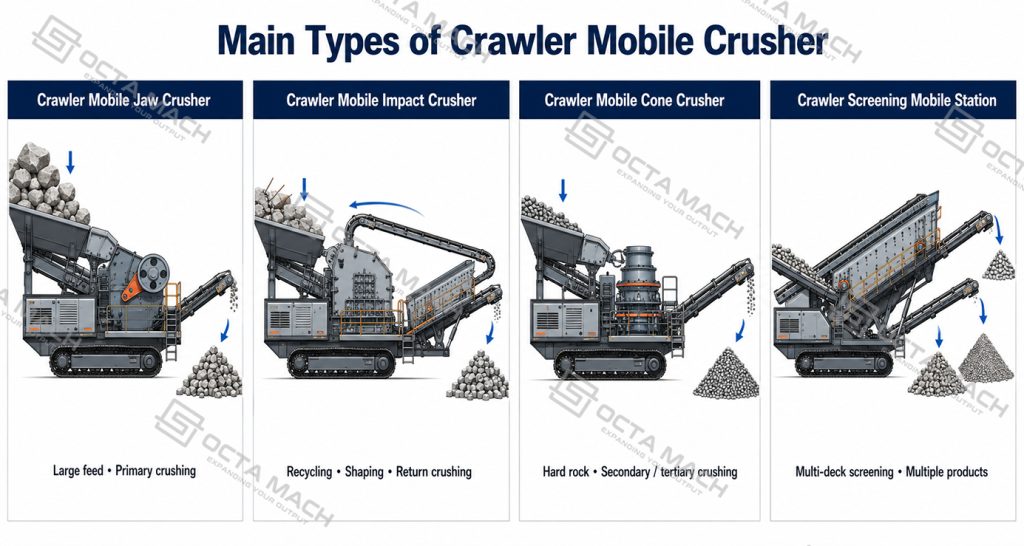
Main Types of Crawler Mobile Crushers
Crawler mobile crushers are selected according to crushing duty, feed size, material hardness, abrasiveness, capacity target and final product size. In a complete crushing project, different crawler stations may work together as a combined production line.
| Crawler Mobile Crusher Type | Main Feature | Typical Application |
|---|---|---|
| Crawler Mobile Jaw Crusher | Strong primary crushing and large feed acceptance | First-stage crushing for large stone, ore and reinforced material |
| Crawler Mobile Impact Crusher | High reduction ratio and better particle shape | Medium-hard material, recycling and aggregate shaping |
| Crawler Mobile Cone Crusher | Compression crushing with controlled discharge size | Secondary and tertiary crushing for hard and abrasive material |
| Crawler Heavy Hammer Crusher | High reduction in one crushing stage | Medium-hard brittle material where one-stage crushing is suitable |
| Crawler Screening Mobile Station | Mobile classification and finished product separation | Multi-size aggregate screening after crushing |
For large feed and hard working conditions, a crawler mobile jaw crusher is normally used as the first crushing unit. For recycling and aggregate shaping, a crawler mobile impact crusher is often more suitable. For hard-material secondary or tertiary crushing, a crawler mobile cone crusher provides better wear control and discharge stability.
Crawler Mobile Crusher Specification
The following standard models cover crawler mobile crusher plants equipped with different crusher and screening units.
| Standard Model | Corollary Equipment | Crusher / Screen Model | Feeding Size (mm) | Capacity (t/h) | Transport Dimension (mm) |
|---|---|---|---|---|---|
| S-CS75 | 3YZK1848 | CS75 | ≤160 | 59–163 | 12600×2800×4400 |
| S-CS110 | 3YZK1860 | CS110 | ≤178 | 100–200 | 13800×3000×4400 |
| S-CS160 | 3YZK2160 | CS160 | ≤188 | 132–253 | 13800×3000×4400 |
| S-CS220 | 3YZK2160 | CS220 | ≤230 | 215–330 | 14500×3000×4500 |
| S-Q300 | 3YZK1848 | SQ300 | ≤160 | 105–205 | 12600×2800×4400 |
| S-Q400 | 3YZK1860 | SQ400 | ≤230 | 235–575 | 13800×3000×4400 |
| S-Q500 | 3YZK2160 | SQ500 | ≤240 | 304–640 | 14500×3000×4600 |
| S-H420 | 3YZK1848 | SH420 | ≤240 | 85–170 | 12600×2900×4400 |
| S-H430 | 3YZK1860 | SH430 | ≤360 | 120–345 | 13800×3000×4500 |
| S-H440 | 3YZK2160 | SH450 | ≤450 | 255–605 | 14800×3200×4600 |
| S-HP100 | 3YZK1860 | SHP100 | ≤140 | 75–140 | 13800×2900×4300 |
| S-HP200 | 3YZK2160 | SHP200 | ≤185 | 145–250 | 14200×3000×4500 |
| S-HP300 | 3YZK2160 | SHP300 | ≤230 | 220–440 | 16500×3200×4600 |
| S-PF1214 | 3YZK1860 | PF1214 | ≤300 | 100–200 | 14500×2900×4500 |
| S-PF1315 | 3YZK2160 | PF1315 | ≤350 | 130–280 | 15200×3000×4500 |
| S-PF1320 | 3YZK2460 | PF1320 | ≤500 | 180–400 | 15200×3000×4500 |
| S-S1860 | — | 3YZK1860 | ≤400 | 65–586 | 10500×2700×4200 |
| S-S2160 | — | 3YZK2160 | ≤400 | 81–720 | 10500×3000×4500 |
| S-S2460 | — | 3YZK2460 | ≤400 | 100–810 | 10500×3200×4500 |
Crawler mobile crusher capacity is affected by feed gradation, material hardness, moisture, crusher setting, screening efficiency and return load. Model selection should be based on the complete plant configuration rather than capacity range alone.
Crawler Type Jaw Crusher Mobile Crushing Station
The crawler type jaw crusher mobile crushing station is mainly used for primary crushing. It is designed for large feed material and first-stage size reduction before secondary crushing, screening or further processing.
| Model | Feeder Bucket Capacity (m³) | Feed Size (mm) | Production Capacity (t/h) |
|---|---|---|---|
| L-CX116 | 6 | ≤730 | 190–625 |
| L-CX106 | 5 | ≤580 | 155–580 |
| L-CX96 | 5 | ≤460 | 120–455 |
This type is selected when the project requires strong feed acceptance and stable coarse crushing. It can work as an independent primary crushing unit or as the first section of a crawler crushing and screening plant.
Crawler Impact Crushing Station
The crawler impact crushing station is used for medium-hard and relatively low-abrasive materials. It is suitable for projects where reduction ratio, particle shape and recycling performance are important.
| Model | Feeder Bucket Capacity (m³) | Feed Size (mm) | Production Capacity (t/h) |
|---|---|---|---|
| L-PFW1214 | 3 | ≤600 | 100–200 |
| L-PFW1315 | 5 | ≤800 | 200–300 |
| L-PFW1415 | 5 | ≤800 | 300–500 |
A crawler mobile impact crusher can improve finished aggregate shape and is commonly used in recycling and road-base aggregate production. For highly abrasive feed, blow bar wear should be reviewed before final selection.
Crawler Cone Crushing Station
The crawler cone crushing station is mainly used for secondary and tertiary crushing. It is selected when material requires compression crushing, controlled discharge size and better long-term wear control.
| Model | Feeder Bucket Capacity (m³) | Feed Size (mm) | Production Capacity (t/h) |
|---|---|---|---|
| L-HP300 | 3 | ≤150 | 85–440 |
| L-HP400 | 3 | ≤196 | 135–625 |
| L-CH430 | 3 | ≤90 | 115–320 |
| L-CH440 | 3 | ≤110 | 240–550 |
A crawler mobile cone crusher is usually installed after jaw crushing. It is used when the plant needs stable output size, continuous hard-material processing and controlled aggregate grading.
Crawler Heavy Hammer Crushing Mobile Station
The crawler heavy hammer crushing mobile station is designed for high-reduction crushing where material condition allows one-stage size reduction.
| Model | Feeder Bucket Capacity (m³) | Feed Size (mm) | Production Capacity (t/h) |
|---|---|---|---|
| L-PCZ1615 | 8 | ≤1000 | 420–500 |
| L-PCZ1512 | 8 | ≤750 | 250–320 |
| L-PCZ1312 | 8 | ≤600 | 100–200 |
This configuration can simplify the crushing process when the material is suitable. Before selection, material hardness, moisture, clay content, target output size and wear behavior should be checked.
Crawler Screening Mobile Station
The crawler screening mobile station is used for aggregate classification after crushing. It can work with jaw, impact, cone or hammer crushing stations to produce different finished sizes.
| Model | Feed Size (mm) | Production Capacity (t/h) |
|---|---|---|
| L-3YZK1860 | ≤400 | 65–586 |
| L-3YZK2160 | ≤400 | 81–720 |
| L-3YZK2460 | ≤400 | 100–810 |
Screening capacity depends on feed gradation, moisture, fine content, screen opening and required product sizes. In recycling applications, screening may also work with magnetic separation to improve finished material cleanliness.
How to Choose the Right Crawler Mobile Crusher
Choosing the right crawler mobile crusher requires more than checking the rated capacity. The selected plant should match the feed material, crusher type, screening requirement, conveyor layout and site condition.
| Selection Factor | What to Check | Why It Matters |
|---|---|---|
| Feed Size | Maximum lump size and feed gradation | Prevents blockage and unstable crushing |
| Material Hardness | Soft, medium-hard, hard or abrasive material | Determines crusher type and wear-part selection |
| Crushing Stage | Primary, secondary or tertiary crushing | Decides jaw, impact, cone or hammer configuration |
| Required Output Size | Final aggregate size or process target | Affects crusher setting, screen opening and return load |
| Capacity Requirement | Required t/h and working hours | Must match feeder, crusher, screen and conveyors |
| Site Condition | Quarry, mine, road project or demolition site | Determines mobility, chassis and layout requirement |
| Screening Requirement | One size or multiple finished sizes | Decides whether screen and return conveyor are needed |
| Transport Limit | Road width, bridge limit and site access | Affects transport dimension and delivery planning |
For hard and abrasive material, a jaw crusher plus cone crusher configuration is usually reviewed first. For medium-hard recycling or shaping applications, impact crushing may be more practical. When the final product requires several aggregate sizes, a crawler screening station or closed-circuit configuration should be considered.
Working Conditions and Applications
Crawler mobile crushing stations are used where material needs to be processed close to the source or where the working position changes during the project.
Typical application conditions include:
- Quarry aggregate production: Used for producing controlled aggregate sizes near the quarry face.
- Mining pre-crushing: Applied before further crushing, screening or grinding when the feed requires staged reduction.
- Construction waste recycling: Used for crushing demolition concrete and mixed waste; magnetic separation can be added when metal removal is required.
- Asphalt recycling: Impact crushing is often selected for recycled road-base aggregate.
- Road construction: Used to produce graded aggregate near the road project site and reduce material transport distance.
- Temporary crushing projects: Suitable when the production period is limited and fixed foundation investment should be reduced.
- Hard-material crushing: Jaw and cone configurations are commonly used when wear control and stable output size are important.
The final configuration should be confirmed according to actual feed size, material hardness, required product size, capacity target, site condition and downstream screening demand.
Advantages of Crawler Mobile Crushing Station
A crawler mobile crushing station is valuable when the production location changes or when material should be processed closer to the source. The track-mounted design helps reduce raw material hauling distance, shorten installation time and lower fixed foundation requirements.
Its main engineering value is the integration of feeding, crushing, screening and conveying into a movable production system. Depending on the project, the plant can be configured with jaw, impact, cone, hammer or screening modules, and can also include return conveyor, dust control or magnetic separation.
For quarry, mining, road construction and recycling projects, this flexibility helps the crushing process move with the working face and reduces unnecessary material handling inside the site.
FAQ
Q: What is a Crawler Type Mobile Crusher used for?
A: A Crawler Type Mobile Crusher is used for on-site crushing and screening where the production location may change. It is suitable for quarry, mining, road construction and recycling projects that need mobility and fast setup.
Q: How do I choose between crawler jaw, impact and cone crusher?
A: Choose by feed size, material hardness, abrasiveness and final product size. Jaw crusher handles large feed and primary crushing, impact crusher fits recycling and shaping, while cone crusher is better for hard-material secondary or tertiary crushing.
Q: Why choose a track crusher instead of a stationary crushing plant?
A: A track crusher is better when the working site changes or the ground condition is complex. It reduces foundation work, moves closer to the material source and lowers unnecessary hauling inside the site.
Q: What materials can a crawler mobile crusher process?
A: It can process quarry stone, mining ore, concrete waste, asphalt waste and recycled aggregate. The crusher type should be selected according to feed size, material hardness, abrasiveness and final product size.