
Mineral processing converts mined ore or quarried rock into a controlled product by reducing its particle size, exposing the valuable minerals and separating them from unwanted material. The finished product may be a graded construction aggregate, a metal-bearing concentrate, a clean coal product or a correctly sized feed for leaching, smelting or further refining.
The process is not limited to operating a rock crusher. A complete plant may combine feed preparation, crushing, screening, grinding, classification, physical separation and dewatering. The correct arrangement depends on the mineral being recovered, the surrounding waste rock, the required liberation size and the final product specification.
Granite aggregate, for example, may only require staged crushing, shaping and screening. Gold or platinum ore normally needs additional grinding and concentration because the valuable minerals remain locked within the host rock after crushing.
What Happens After Ore Enters the Plant?
A mineral processing flowsheet should follow the physical and mineralogical characteristics of the feed. It should not be copied from another plant simply because both operations process a material with the same commercial name.
The main processing stages are shown below.
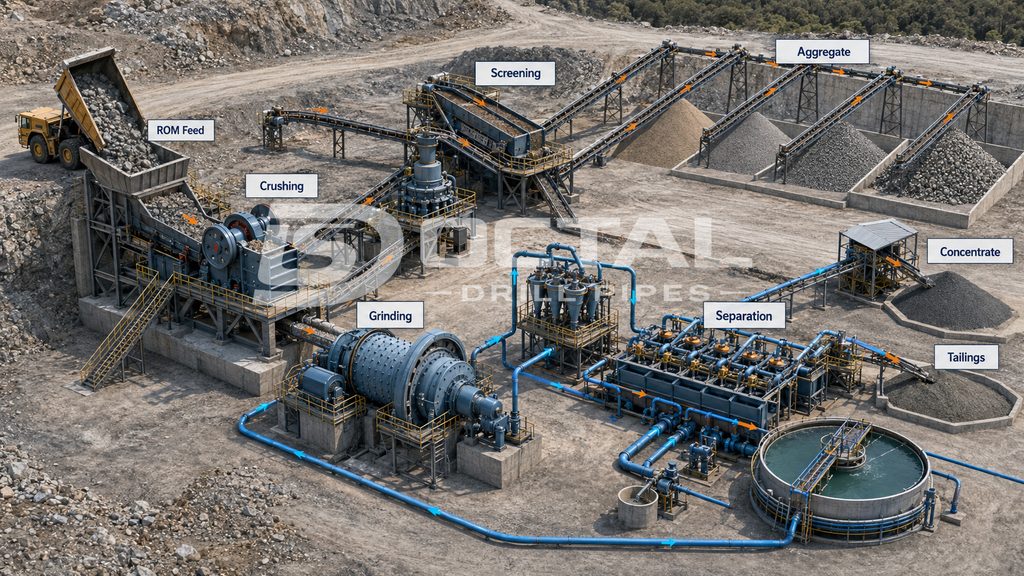
| Processing stage | Main purpose | Common mineral processing equipment | Controlled output |
|---|---|---|---|
| Feed preparation | Regulate flow and remove soil, clay or undersize material | Feed hopper, apron feeder, vibrating feeder and grizzly | Stable crusher feed with controlled top size |
| Primary crushing | Reduce run-of-mine lumps to a transportable and screenable size | Jaw crusher, gyratory crusher or eccentric roll crusher | Coarse crushed ore |
| Secondary and tertiary crushing | Reduce the material further and improve size distribution | Cone crusher, impact crusher or roll crusher | Mill feed, screen feed or graded aggregate |
| Screening | Divide material at specified cut sizes | Inclined, horizontal, banana or flip-flow screen | Separate size fractions and a controlled oversize stream |
| Grinding | Produce particles fine enough for mineral liberation | SAG mill, ball mill, stirred mill, HPGR circuit or vertical roller mill | Fine particles prepared for concentration |
| Classification | Separate fine and coarse particles within a grinding circuit | Hydrocyclone, screen or air classifier | Correctly sized product and returned coarse material |
| Concentration | Separate valuable minerals from gangue | Dense-media separator, spiral, jig, flotation cell, magnetic separator or sensor sorter | Concentrate and reject streams |
| Dewatering | Remove process water from the product or tailings | Thickener, filter press, vacuum filter or dewatering screen | Transportable concentrate and controlled tailings |
| Product handling | Store and transfer the finished material without remixing fractions | Conveyors, bins, stockpiles and sampling systems | Traceable final product |
Crushing and grinding create the particle size needed for the next operation. Separation then uses differences in density, magnetic response, surface chemistry, electrical properties, colour or particle shape.
The objective is not always to make the material as fine as possible. Excessive size reduction consumes additional energy, increases wear and can create slimes that reduce flotation, gravity-separation or dewatering performance.
Why Crushing Controls Everything Downstream
Primary crushing determines how consistently the rest of the plant receives material. Uncontrolled oversize can block transfer chutes, overload secondary crushers and reduce screening efficiency. Too many fines can also create problems, especially when moist clay adheres to screens or enters equipment intended for coarse material.
A jaw crusher commonly handles hard, abrasive and irregular feed in primary crushing. Cone crushers provide controlled compression in secondary or tertiary duty. Impact and hammer crushers can deliver higher reduction and a more cubical product, but their wear rate may become uneconomic when the feed contains large amounts of quartz or other abrasive minerals.
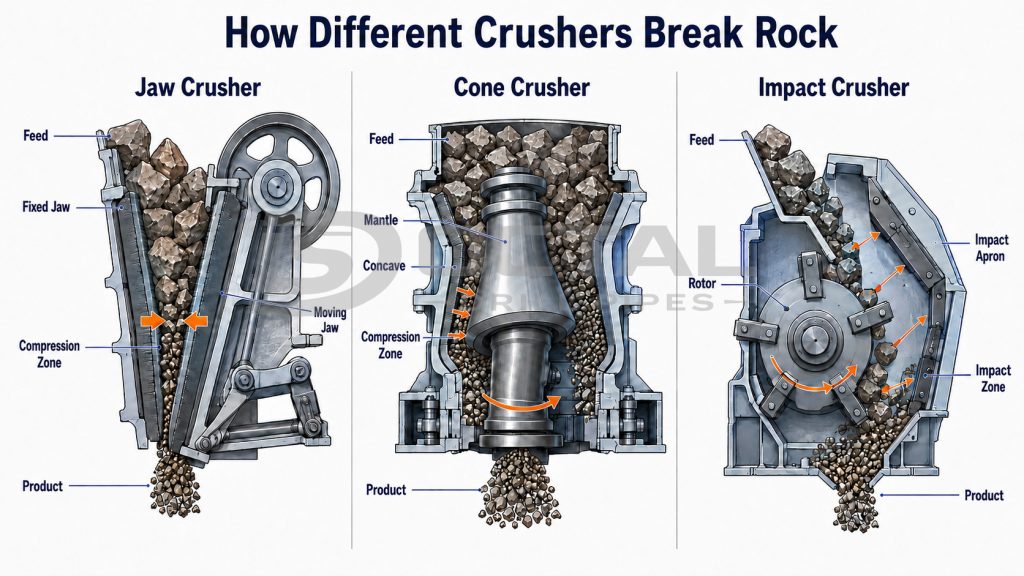
The selected machine therefore depends on more than nominal hourly capacity.
| Selection variable | Required measurement | Why it affects the crusher |
|---|---|---|
| Maximum lump size | Top-size measurement in mm | Determines the required feed opening and feeder arrangement |
| Feed-size distribution | F80 and complete sieve analysis | Controls chamber loading, power draw and expected product distribution |
| Compressive strength | UCS in MPa | Indicates the resistance of intact rock to compressive breakage |
| Abrasivity | Bond Abrasion Index or project-approved wear test | Influences liner material, wear cost and maintenance frequency |
| Grindability | Bond Work Index or other applicable test | Helps estimate the energy required for downstream grinding |
| Moisture | Mass percentage | Affects flowability, screen blinding, chute buildup and dust generation |
| Clay content | Mineralogical and washing test result | Determines whether prescreening, scrubbing or wet processing is required |
| Bulk density | t/m³ | Affects volumetric capacity, conveyor loading and storage volume |
| Target product | Required passing percentage at each sieve size | Determines crusher setting, screen apertures and recirculating load |
| Tramp material | Expected metal or uncrushable content | Determines the need for magnets, detectors and hydraulic protection |
Purchasing a larger rock crusher does not automatically correct an unsuitable circuit. The feeder, crusher chamber, screen area, conveyors and return loop must carry the same design mass flow. A restriction at any one point limits the entire system.
How Closed-Circuit Crushing Produces Consistent Fractions
Closed-circuit crushing sends material from a crusher to a screen. Particles that meet the product size leave the circuit, while oversize material returns for further reduction.
This arrangement gives the operator more control over product size than an open circuit. It also prevents the crusher from repeatedly processing particles that already meet the specification.
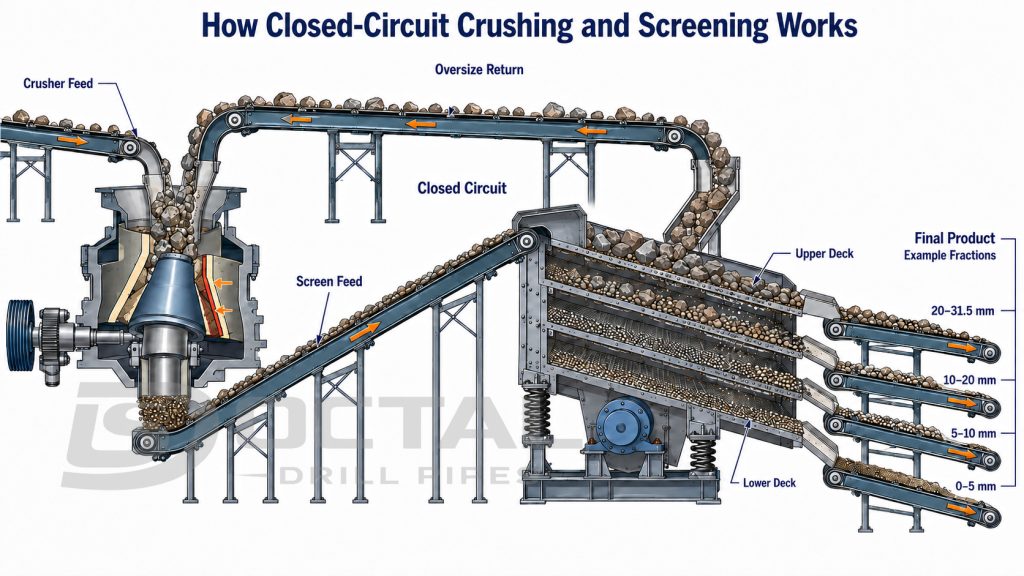
The supplied process PPT shows two useful circuit families. Hard and abrasive rock is processed through staged compression crushing, with optional vertical-shaft impact shaping. Softer stone can be processed through a hammer-crushing circuit with downstream classification.
| Circuit family in the supplied PPT | Capacity bands shown | Principal processing route | Product fractions shown | Oversize control |
|---|---|---|---|---|
| Staged hard-rock circuit | 150–200 t/h | Grizzly feeding, jaw crushing, cone crushing, screening and optional VSI shaping | 0–5 mm, 5–10 mm, 10–20 mm and 20–31.5 mm | Material above 31.5 mm or 40 mm returns to the applicable crushing stage |
| Expanded hard-rock circuit | 200–300 t/h | Jaw crusher, single-cylinder cone, multi-cylinder cone, VSI and multiple screens | 0–5 mm, 5–10 mm, 10–20 mm and 20–31.5 mm | Oversize circulates through the secondary or tertiary crusher |
| High-capacity hard-rock circuit | 400–1,000 t/h | Parallel crushing and screening units with intermediate bins | 0–5 mm, 5–10 mm, 10–20 mm and 20–31.5 mm | Return conveyors maintain closed-circuit operation |
| Heavy-hammer circuit | 250–320 t/h | Vibrating feeder, heavy hammer crusher and two-stage screening | Stone powder, 5–10 mm, 10–20 mm and 20–30 mm | Material above 30 mm returns to the hammer crusher |
| Expanded heavy-hammer circuit | 400–600 t/h | Larger feeder, hammer crusher and multi-deck screens | Stone powder, 5–10 mm, 10–20 mm and 20–30 mm | Screen oversize forms a closed recycle loop |
These figures are configuration examples from the supplied PPT rather than guaranteed plant capacities. Actual output depends on feed gradation, moisture, rock strength, abrasivity, crusher setting, screen efficiency, recirculating load and operating availability.
The aggregate fractions in the PPT are also project examples. A plant must use the sieve sizes and grading limits stated in the applicable construction standard, customer specification or local market requirement.
How Different Rocks Change the Circuit
Commercial rock names do not provide enough information for equipment selection. Granite from one quarry may contain more quartz than material sold under the same name elsewhere. River pebble composition also depends on its geological source.
The following materials are common in aggregate production and are highly relevant to crushing-equipment searches. Dolerite, granite, quartzite, limestone and related hard rock are also processed in South African quarry operations.
| Material | Dominant mineral characteristics | Indicative mineral hardness | Relative crushing concern | Common processing route | Typical finished use |
|---|---|---|---|---|---|
| Limestone | Mainly calcite; silica and clay content vary by deposit | Calcite: Mohs 3 | Usually easier to break, but silica can sharply increase wear | Scalping, jaw or impact crushing, secondary impact or hammer crushing and screening | Cement raw material, road base and concrete aggregate |
| Granite | Quartz, feldspar and mica | Quartz: Mohs 7; feldspar: Mohs 6 | Hard and commonly abrasive | Jaw crusher, cone crusher, optional VSI and multi-deck screening | Concrete aggregate, manufactured sand and road stone |
| Basalt | Plagioclase, pyroxene and iron-bearing minerals | Main minerals: approximately Mohs 5–6.5 | High strength and potentially high wear | Jaw crusher followed by cone crushing and screening | Asphalt aggregate, concrete aggregate and road base |
| Dolerite or diabase | Coarse or medium-grained mafic minerals similar to basalt | Main minerals: approximately Mohs 5–6.5 | Strong rock requiring stable compression crushing | Jaw crusher, cone crusher and controlled screening | Road stone, railway ballast and concrete aggregate |
| River pebble | Frequently quartz-rich and naturally rounded | Quartz-rich feed: up to Mohs 7 | High abrasivity and difficult gripping in some chambers | Jaw crusher, cone crusher, VSI shaping and screening | Manufactured sand and graded aggregate |
| Quartzite | Rock composed predominantly of interlocking quartz | Quartz: Mohs 7 | Very abrasive with high liner-wear potential | Heavy-duty jaw and cone crushing with wear monitoring | Road aggregate, railway ballast and silica-bearing products |
| Andesite | Plagioclase with pyroxene, amphibole or related minerals | Main minerals: approximately Mohs 5–6.5 | Strength and abrasivity vary with mineral composition | Jaw crusher followed by cone or impact crushing | Concrete aggregate and road construction |
| Sand and gravel | Mixed unconsolidated particles | Composition-dependent | Clay, moisture and contamination may matter more than strength | Washing, scrubbing, screening and limited crushing | Concrete sand, drainage material and road construction |
The hardness figures describe dominant minerals rather than a universal hardness value for the complete rock. Intact rock strength, fracture pattern, weathering, porosity and abrasivity must still be tested.
Soft limestone with low silica may suit impact or hammer crushing. Quartz-rich granite or river pebble usually favours compression crushing because continuous high-speed impact can increase wear costs. VSI equipment may still be installed at the final stage when particle shape or manufactured-sand production justifies the additional wear.
Which South African Ores Need Concentration?
South Africa processes both construction minerals and globally important metal-bearing ores. The country’s ore processing requirements therefore extend far beyond aggregate production.
Official USGS data identify South Africa as a leading producer of platinum, chromium and manganese, with significant iron ore, gold, diamond and industrial-mineral production. These commodities use different liberation and separation routes even when their plants begin with similar crushing equipment.
| South African material | Reported position or world production share | Common front-end preparation | Typical concentration route | Main circuit risk |
|---|---|---|---|---|
| Platinum-bearing ore | Approximately 70% of mined platinum production | Staged crushing and fine grinding | Flotation followed by smelting and refining | Overgrinding, chromite entrainment and variable liberation |
| Palladium-bearing PGM ore | Approximately 38% of mined palladium production | Crushing and grinding with close size control | Sulfide flotation and downstream metallurgical treatment | Loss of fine valuable minerals and unstable flotation feed |
| Chromium ore | Approximately 46% of world mine production | Crushing, screening and size classification | Dense-media separation, spirals and other gravity methods | Generation of ultrafines and misplaced chromite |
| Manganese ore | Approximately 40% of world mine production | Crushing, screening and possible washing | Dense-media separation, jigging or size-based upgrading | Clay contamination and degradation of lump product |
| Iron ore | Approximately 3% of world iron production by contained iron; ranked eighth globally | Crushing, screening and grinding where liberation is required | Magnetic separation, gravity separation or flotation | Variable hardness, silica rejection and excessive fines |
| Gold ore | Approximately 3% of world mine production; ranked twelfth globally | Crushing followed by controlled grinding | Gravity recovery, flotation, cyanide leaching or combined routes | Gold locked in sulfides, preg-robbing carbon and overgrinding |
| Industrial diamond ore | Approximately 8% of world industrial-diamond production | Controlled staged crushing and scrubbing | Dense-media separation and sensor-based sorting | Diamond damage caused by aggressive breakage |
| Gem-diamond ore | Approximately 3% of world gemstone-diamond production | Low-damage crushing, scrubbing and screening | Dense-media separation, X-ray sorting and final recovery | Breaking large diamonds or losing stones into undersize |
| Coal | 232 million tonnes reported for South African production in 2023 | Sizing, crushing and removal of oversize | Dense-media separation, spirals and fine-coal flotation | Excessive fines, high moisture and unstable feed density |
The production figures in the table are based on publicly released mineral-industry statistics. They show the relative importance of these commodities in South Africa but do not determine the capacity, recovery or equipment configuration of a specific processing plant.
A chrome plant cannot be designed as a smaller version of an aggregate quarry. Aggregate production aims to control size, shape and cleanliness. Metal ore processing must also achieve liberation, grade and recovery.
Where Grinding and Separation Begin
Crushing normally stops when the material becomes suitable for milling, screening or coarse concentration. Grinding continues the size-reduction process until valuable mineral grains are sufficiently exposed for separation.
The required liberation size may be coarse where minerals occur as large distinct grains. Finely disseminated sulfide ores may require much finer grinding. The correct size must be established through mineralogical analysis and metallurgical testing rather than assumed from the commodity name.
After liberation, the plant selects a separation method based on measurable mineral differences.
| Separation method | Property used | Suitable applications | Important feed controls |
|---|---|---|---|
| Screening | Particle size | Aggregate grading, crushed ore preparation and circuit classification | Feed distribution, aperture size, moisture and near-size material |
| Dense-media separation | Particle density | Coal, diamond, manganese, chromite and pre-concentration duties | Feed-size range, medium density and medium stability |
| Gravity concentration | Density and particle movement | Gold, chromite, tin and heavy-mineral recovery | Liberation, narrow size distribution and water balance |
| Magnetic separation | Magnetic susceptibility | Magnetite, ilmenite, some manganese minerals and tramp-metal removal | Particle size, field strength and mineral association |
| Froth flotation | Surface chemistry | Sulfide ores, phosphate, coal and selected industrial minerals | Grind size, pulp density, pH, reagent dosage and water chemistry |
| Sensor-based sorting | X-ray, optical or electromagnetic response | Diamond, limestone, industrial minerals and waste rejection | Particle presentation, surface condition and sensor contrast |
| Leaching | Chemical solubility | Gold, copper, uranium and selected oxide ores | Liberation, permeability, reagent consumption and solution chemistry |
| Dewatering | Particle settling and filtration response | Concentrate and tailings handling | Particle-size distribution, clay content, flocculation and solids concentration |
A high crusher throughput has limited value if the resulting particle-size distribution reduces recovery in the next process. Each unit must be assessed as part of the complete flowsheet.
Why Dry Circuits Are Receiving More Attention
Dry grinding is gaining attention where water availability, tailings management or process simplification makes conventional wet milling less attractive. It can also avoid the need to pump large slurry volumes between grinding and classification stages.
Recent vertical-roller-mill developments show how dry size reduction may be combined with coarse flotation, magnetic separation or other dry and reduced-water processes. However, the technology is not automatically suitable for every mineral.
| Published dry-grinding parameter | Manufacturer-reported value | Engineering interpretation |
|---|---|---|
| Maximum stated feed size | F100 below 150 mm | Applies to the stated vertical roller mill configuration |
| Stated product size | P100 below 20 µm | Must be confirmed for the actual mineral and circuit duty |
| Stated reduction ratio | Greater than 3,000:1 | Represents the manufacturer’s equipment claim, not a universal plant result |
| Stated energy saving | Up to 40% | Comparison basis, ore properties and complete auxiliary load must be verified |
| Previous references in cement and other industries | More than 2,400 | Does not represent the installed mineral-processing reference base |
| Technology announcement | February 2026 | Marks the introduction of the stated dry-grinding system to broader mineral-processing applications |
The values above are published figures for one dry vertical roller mill configuration rather than universal mineral-processing limits. Feed mineralogy, moisture, abrasivity, required product size and downstream separation must be tested before these figures are used in a plant design or performance assessment.
Dry processing can be attractive when:
- Water supply is restricted or expensive.
- The downstream separation method can accept dry material.
- The feed flows consistently without severe clay buildup.
- Dust extraction and enclosure can be engineered effectively.
- Reduced oxidation of sulfide surfaces improves the downstream response.
- Dry tailings or backfill integration provides a project benefit.
Wet processing may remain preferable when:
- Washing is required to remove clay or soluble contamination.
- Slurry transport simplifies movement between plant stages.
- Hydrocyclone classification is integral to the grinding circuit.
- Flotation or leaching immediately follows grinding.
- Dry dust control would create excessive auxiliary demand.
- Feed moisture changes cause unstable dry screening or mill operation.
The decision must be based on pilot testing, energy balance, water balance, dust assessment and downstream recovery—not on the grinding machine alone.
What Defines Acceptable Plant Performance?
A mineral processing plant cannot be accepted solely because it reaches nominal throughput. Capacity, product size, energy use, recovery and availability must be evaluated under a defined feed condition.
| Performance indicator | Calculation or unit | What it confirms |
|---|---|---|
| Net throughput | Dry t/h | Quantity of accepted feed processed after accounting for moisture |
| Feed size | F80 in mm or µm | Size below which 80% of the feed passes |
| Product size | P80 in mm or µm | Size below which 80% of the product passes |
| Reduction ratio | F80 ÷ P80 | Degree of size reduction across the selected equipment |
| Screen efficiency | Correctly placed material ÷ total material in that size class × 100% | Accuracy of the size separation |
| Circulating load | Returned oversize ÷ new circuit feed × 100% | Amount of material repeatedly processed |
| Concentrate grade | %, g/t or applicable assay unit | Concentration of the valuable component |
| Metallurgical recovery | Valuable material in concentrate ÷ valuable material in feed × 100% | Proportion of the valuable mineral recovered |
| Mass pull | Concentrate mass ÷ feed mass × 100% | Quantity of total feed reporting to concentrate |
| Specific energy | kWh/t | Electrical energy consumed per dry tonne |
| Water intensity | m³/t | Process-water demand per dry tonne |
| Wear consumption | kg of wear material per tonne | Effect of abrasivity and operating conditions |
| Plant availability | Operating time ÷ scheduled time × 100% | Reliability of the complete processing line |
An acceptance test should define the feed source, top size, feed gradation, moisture, mineral grade and test duration before measuring performance. Otherwise, a capacity figure cannot be compared fairly with the design basis.
For metal ores, recovery without concentrate grade is incomplete information. Raising recovery by transferring more gangue into the concentrate may reduce the commercial value of the final product.
What Information Is Needed Before Equipment Selection?
Reliable mineral processing equipment selection begins with representative feed data and a clear product objective. A crusher quotation based only on the rock name and requested capacity leaves too many engineering variables unresolved.
The minimum technical package should include:
- Representative mineralogical and chemical analysis
- Run-of-mine top size and complete feed-size distribution
- Moisture, clay content and bulk density
- Uniaxial compressive strength and fracture characteristics
- Abrasion and grindability test results
- Required dry throughput and operating schedule
- Target crusher product and final product grading
- Valuable-mineral liberation data
- Intended separation method
- Available power and water
- Site elevation, temperature and dust restrictions
- Required plant availability and maintenance access
- Tailings, waste-rock and process-water arrangements
Where these data are unavailable, representative samples should be tested before finalising the flowsheet. The test program should reproduce the proposed crushing, grinding and separation route closely enough to identify recovery losses, excessive wear, difficult material handling and unstable recirculating loads.
FAQ
Q: Is crushing the same as mineral processing?
A: No. Crushing is one stage of mineral processing. A complete ore processing route may also include screening, grinding, classification, gravity separation, flotation, magnetic separation, leaching and dewatering.
Q: Can one rock crusher process limestone, granite and metal ore?
A: A crusher may physically break several materials, but economic suitability depends on feed size, strength, abrasivity, moisture, required product and downstream process. Chamber design, wear materials and circuit configuration must be selected for the actual feed.
Q: Is dry grinding better than wet grinding?
A: Neither method is universally better. Dry grinding can reduce process-water demand and simplify some flowsheets, while wet grinding may provide easier classification, slurry transport and integration with flotation or leaching. Testwork must compare the complete circuits.
Q: What is the main purpose of mineral processing?
A: Mineral processing reduces and classifies mined material, liberates valuable minerals and separates them from gangue to produce a controlled aggregate, concentrate or downstream-process feed.