
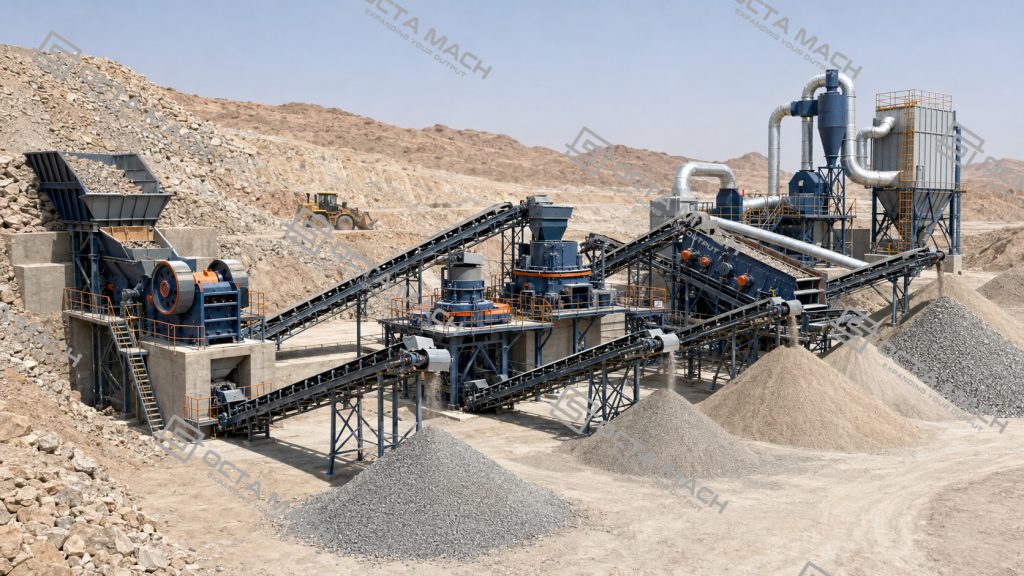
Octa Mach configured the sand making plant for a granite-processing project in Riyadh Province, Saudi Arabia. The dry aggregate crushing and screening plant combines controlled feeding, staged crushing, closed-circuit screening, VSI shaping and dry fines removal to produce manufactured sand and graded construction aggregate.
The customer required one line to supply concrete sand, asphalt aggregate and road-base material. Because production water is limited at the site, the plant uses dry classification and dust collection instead of a conventional wet washing circuit. Equipment selection focused on hard-rock reduction, consistent feed to the sand-making stage and flexible control of the final grading.
Project Background
Granite from the quarry arrives as large, irregular blocks with variable proportions of natural fines. Feeding this material directly into a sand making machine would cause unstable loading, excessive wear and poor particle-size control.
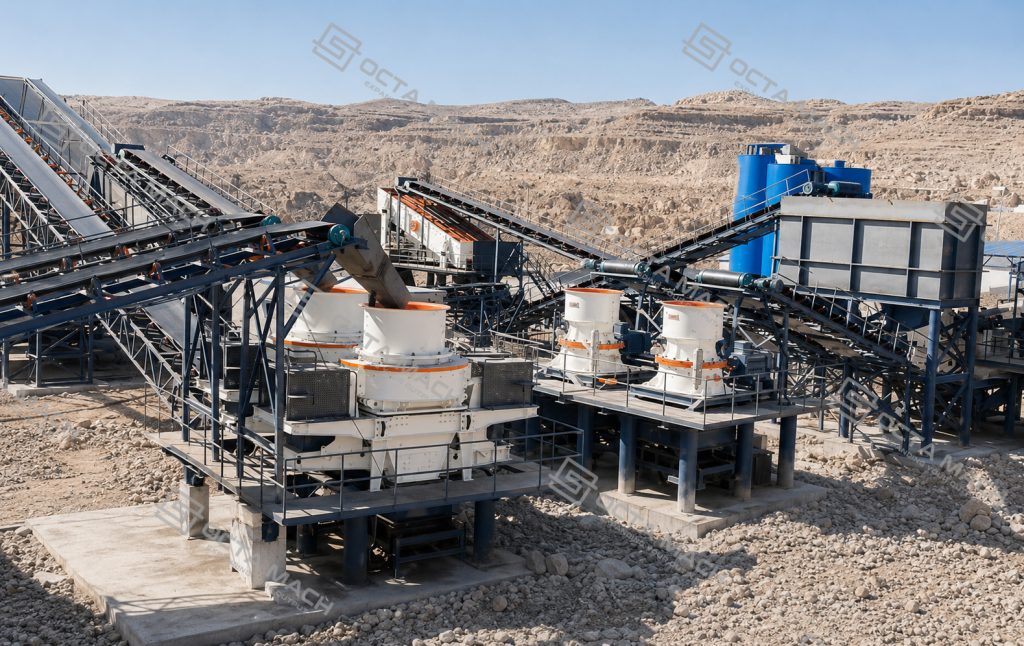
The selected aggregate crushing plant therefore separates the work into several duties. The jaw crusher handles the largest feed, the cone crusher prepares a controlled intermediate product, and the VSI unit performs final reduction and particle shaping. Multi-deck screens separate saleable aggregate while returning oversized material to the appropriate crushing stage.
Design Basis
| Project Parameter | Design Basis |
|---|---|
| Project location | Riyadh Province, Saudi Arabia |
| Raw material | Hard granite |
| Nominal feed capacity | 250 t/h |
| Maximum feed size | ≤600 mm |
| Feed moisture | ≤3% |
| Feed size to VSI stage | ≤40 mm |
| Processing method | Dry crushing, screening and sand making |
| Main final products | Manufactured sand and graded aggregate |
| Main applications | Concrete, asphalt and road construction |
The stated capacity applies to the specified feed condition. Actual output changes with granite hardness, feed gradation, moisture, crusher settings, screen efficiency and circulating load.
Required Product Sizes
| Product Size | Intended Application |
|---|---|
| 0–5 mm | Manufactured sand for concrete and mortar |
| 5–10 mm | Fine aggregate and asphalt mixes |
| 10–20 mm | Concrete aggregate |
| 20–31.5 mm | Road base and general construction |
Final screen openings can be changed according to local construction specifications and the customer’s product orders. The manufactured sand grading must also be checked against the intended concrete mix rather than accepted only by nominal top size.
Material Flow Through the Plant
Quarried granite enters the receiving hopper and passes over a grizzly feeder. The feeder regulates the load entering the primary stone crusher and removes part of the naturally occurring fines before they occupy crusher capacity.
The main processing sequence is:
- Receiving and controlled feeding;
- Primary jaw crushing;
- Secondary cone crushing;
- Closed-circuit screening;
- VSI sand making and shaping;
- Final screening and dry classification;
- Separate conveying of sand and aggregate products.
After primary reduction, conveyors transfer the material to the cone-crushing section. A vibrating screen then separates correctly sized aggregate from oversized particles. Saleable aggregate moves directly to its product conveyor, while oversized material returns for additional crushing.
Material selected for sand production enters the VSI sand making machine only after the preceding crusher and screen have controlled its maximum size. Inside the VSI chamber, accelerated particles strike the crushing zone and collide with other particles. This reduction mechanism produces smaller particles and improves the shape of the manufactured sand.
The final screen separates the required sand and aggregate fractions. An air-classification and dust-collection system removes excess ultrafine material without introducing process water.
Main Equipment Package
| Process Stage | Main Equipment | Operating Duty |
|---|---|---|
| Material receiving | Feed hopper | Receive granite delivered from the quarry |
| Controlled feeding | Grizzly vibrating feeder | Regulate feed and remove natural fines |
| Primary reduction | Jaw crusher | Break large granite into manageable material |
| Secondary reduction | Cone crusher | Prepare controlled feed for screening and sand making |
| Size classification | Multi-deck vibrating screen | Separate products and return oversized material |
| Sand production | VSI sand making machine | Produce and shape manufactured sand |
| Fine-particle control | Air classifier and dust collector | Control excess dust and ultrafine particles |
| Material transfer | Belt conveyors | Connect each processing stage |
| Product handling | Separate discharge conveyors | Prevent mixing between finished size fractions |
| Electrical control | Central control cabinet | Coordinate feeding, crushing, screening and interlocks |
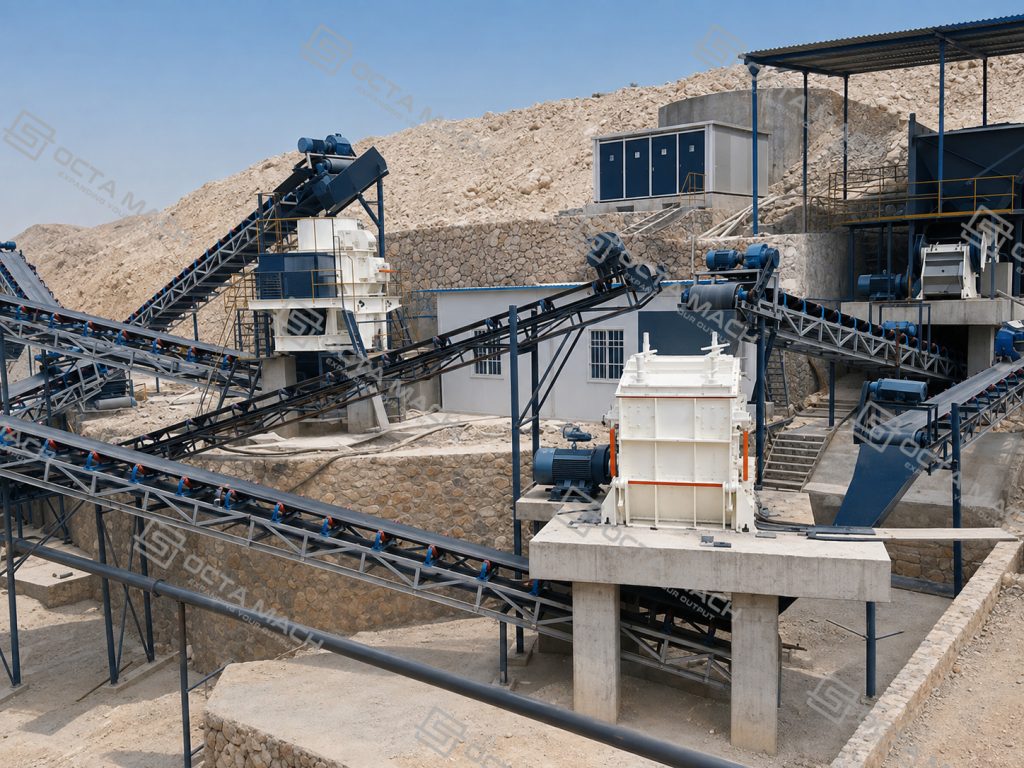
The machines are connected as a complete production circuit. Selecting each unit independently can create bottlenecks where crusher discharge, screen capacity, conveyor width or stockpile arrangement does not match the rest of the line.
Practical Design Decisions
Protecting the Sand-Making Stage
The VSI unit receives pre-crushed and screened granite rather than uncontrolled quarry feed. This limits large particles entering the rotor, reduces impact on internal wear parts and allows the machine to focus on final reduction and shaping.
Crusher discharge settings must be coordinated with the VSI feed limit. Worn cone-crusher liners or an excessively wide setting can increase the proportion of oversized material reaching the sand-production stage.
Controlling Final Grading
The vibrating screen determines which particles leave as finished aggregate, which enter the sand-making stage and which return for further crushing. Screen aperture, deck arrangement and effective screening area must therefore match the required product split.
Dry classification provides another adjustment point. Operators can control the proportion of fine particles in the final sand without washing away all useful fines. The target setting should follow the concrete or mortar specification used by the customer.
Managing Abrasive Granite
Granite places continuous wear on jaw plates, cone mantles, concaves, VSI rotor components, screen media and transfer chutes. The layout includes access around the main wear areas so maintenance teams can inspect and replace components without dismantling unrelated sections.
Replaceable liners protect high-impact transfer points. The feed chutes are also arranged to reduce uncontrolled material drop and keep the load centred on the conveyors.
Operating in a Dry Environment
A wet sand-washing circuit would increase water supply, settling and sludge-management requirements. The selected dry process uses enclosed transfer points, dust extraction and air classification to control fine particles.
Water washing can still be added when the feed contains clay, soluble contaminants or surface coatings that dry classification cannot remove. That decision should follow material testing rather than climate alone.
Equipment Preparation and Delivery
Before dispatch, the main machines were checked against the approved equipment list and general arrangement. Motors, guards, lubrication points, connection interfaces and supporting structures were inspected before packing.
Large frames and conveyor structures were match-marked by installation area. Electrical cabinets, instruments and loose components were packed in enclosed cases, while machined surfaces and flange openings received temporary protection against dust and moisture.
The modular arrangement helps the site team identify components during unloading and reduces unnecessary sorting before mechanical installation.
FAQ
Q: Why is a cone crusher installed before the VSI machine?
A: The cone crusher reduces hard granite to a controlled intermediate size. This protects the VSI rotor from oversized feed and allows the sand-making stage to concentrate on fine reduction and particle shaping.
Q: Can the plant produce aggregate and manufactured sand at the same time?
A: Yes. The multi-deck screen separates saleable aggregate before selected material enters the VSI circuit. Independent product conveyors keep the finished size fractions separated.
Q: Why does this project use dry classification instead of sand washing?
A: Dry classification reduces water demand and avoids the need for settling ponds and wet-sludge handling. Conventional washing remains an option when clay or surface contamination cannot be removed through dry processing.
Q: What controls the actual output of the plant?
A: Granite hardness, feed-size distribution, moisture, crusher settings, screen condition, VSI loading and circulating material all affect output. Plant performance must be evaluated with stable, representative quarry feed.