
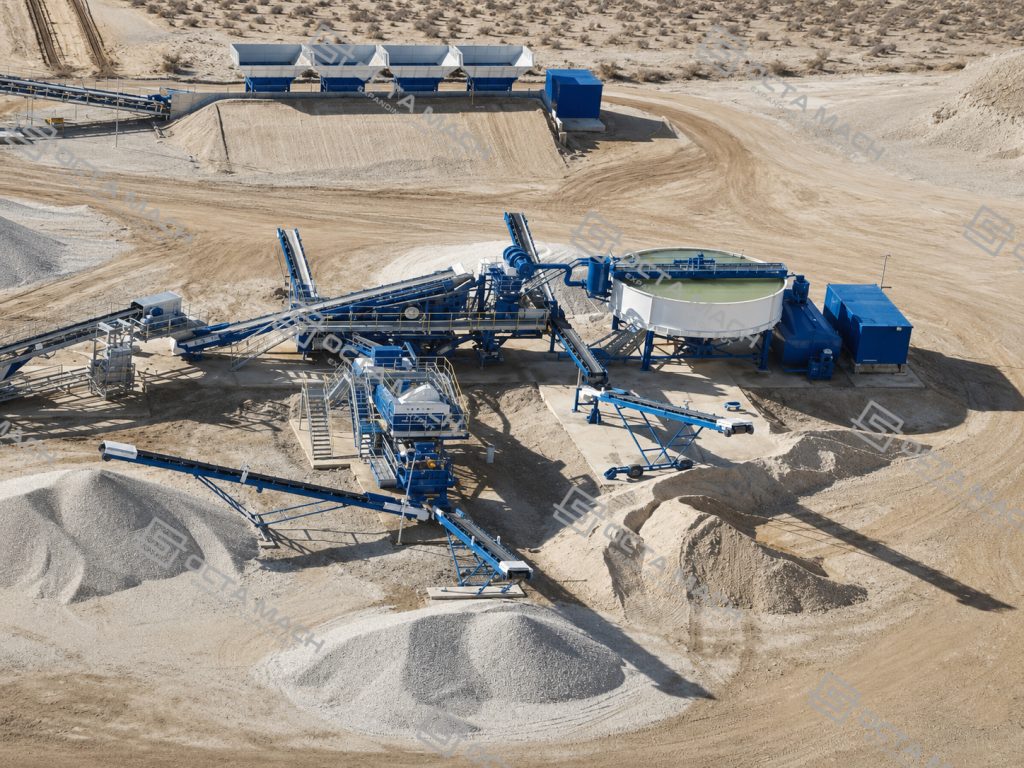
This project converts hard quartzite into washed and classified quartz sand through crushing, particle shaping, screening, scrubbing, washing, magnetic separation, and dewatering. Located in Egypt’s Suez Governorate, the plant is configured to produce controlled sand fractions for glass, foundry, engineered-stone, and construction-material applications.
The complete line combines a sand making machine with wet cleaning and classification equipment. This arrangement controls particle size and shape while removing clay, excessive fines, and liberated iron-bearing impurities from the silica sand.
Project Overview
The customer required a continuous processing line for locally quarried quartzite. Raw material contained surface clay, weathered coatings, and small amounts of iron-bearing minerals that could not be controlled by dry crushing alone.
The proposed silica sand processing plant follows a complete mineral processing flow that combines dry and wet processing sections.Crushing prepares a stable feed for sand production, while scrubbing, washing, classification, and magnetic separation improve the cleanliness and chemical quality of the final product.
| Project Item | Design Basis |
|---|---|
| Location | Suez Governorate, Egypt |
| Raw material | Quartzite rock |
| Nominal capacity | 100 t/h |
| Maximum feed size | 400 mm |
| Feed moisture | ≤5% |
| Raw-feed SiO₂ | 98.5–99.2% |
| Raw-feed Fe₂O₃ | 0.10–0.25% |
| Main product sizes | 0.10–0.60 mm and 0.60–1.20 mm |
| Target product SiO₂ | ≥99.5% |
| Target product Fe₂O₃ | ≤0.05% |
| Product moisture after dewatering | ≤12% |
| Main application | Glass, foundry sand, engineered stone, and dry mortar |
The product chemistry shown above represents a design target. Representative mineralogical, washing, and magnetic-separation tests must confirm whether the quartzite can meet these limits.
Processing Requirements
Producing saleable quartz sand requires more than reducing quartzite to a smaller particle size. The plant must also address several processing requirements:
- Reduce coarse and abrasive quartzite without excessive liner consumption;
- Control the feed size entering the sand-making stage;
- Produce consistently shaped sand rather than flaky crusher fines;
- Remove clay and surface contamination attached to the quartz grains;
- Separate unwanted ultrafines from usable silica sand;
- Remove liberated iron-bearing particles;
- Dewater the washed products before stockpiling;
- Recover process water for reuse in the washing circuit.
The high silica content makes the material particularly abrasive. Crusher liners, shaping wear parts, screen media, pump components, and transfer chutes must therefore use replaceable wear-resistant materials.
Process Flow
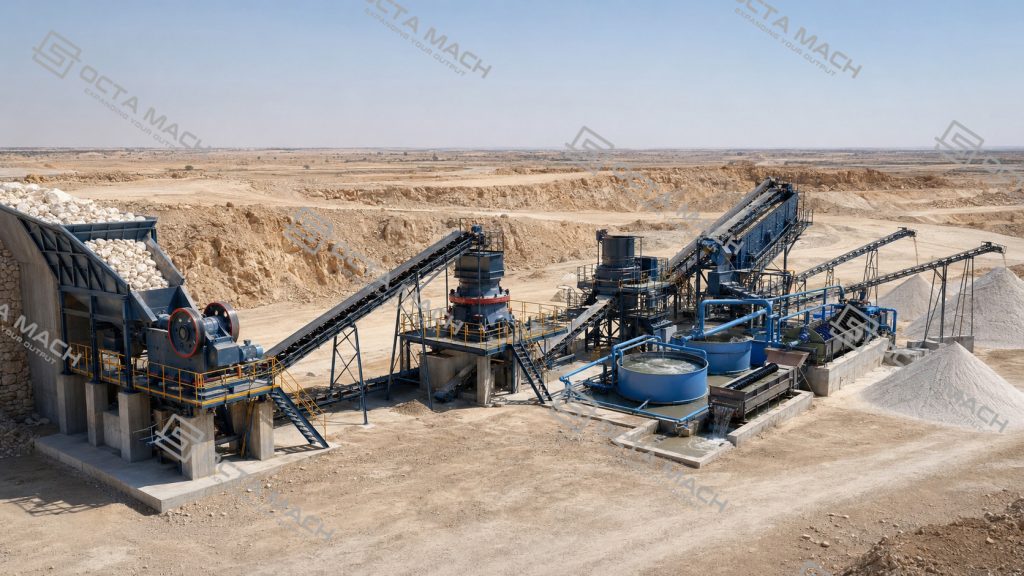
Quarried quartzite enters the receiving hopper and passes through a vibrating feeder. The feeder regulates material flow and removes loose undersize before primary crushing.
A jaw crusher for primary crushing reduces the coarse quartzite, after which a cone crusher for secondary crushing produces a more uniform intermediate product. The crushed material then passes through closed-circuit screening. Oversize returns to the cone crusher, while correctly sized material moves to the sand making machine.
The sand-making stage improves particle shape and produces the required sand-sized fraction. A vibrating screen removes remaining oversize and divides the material before wet processing.
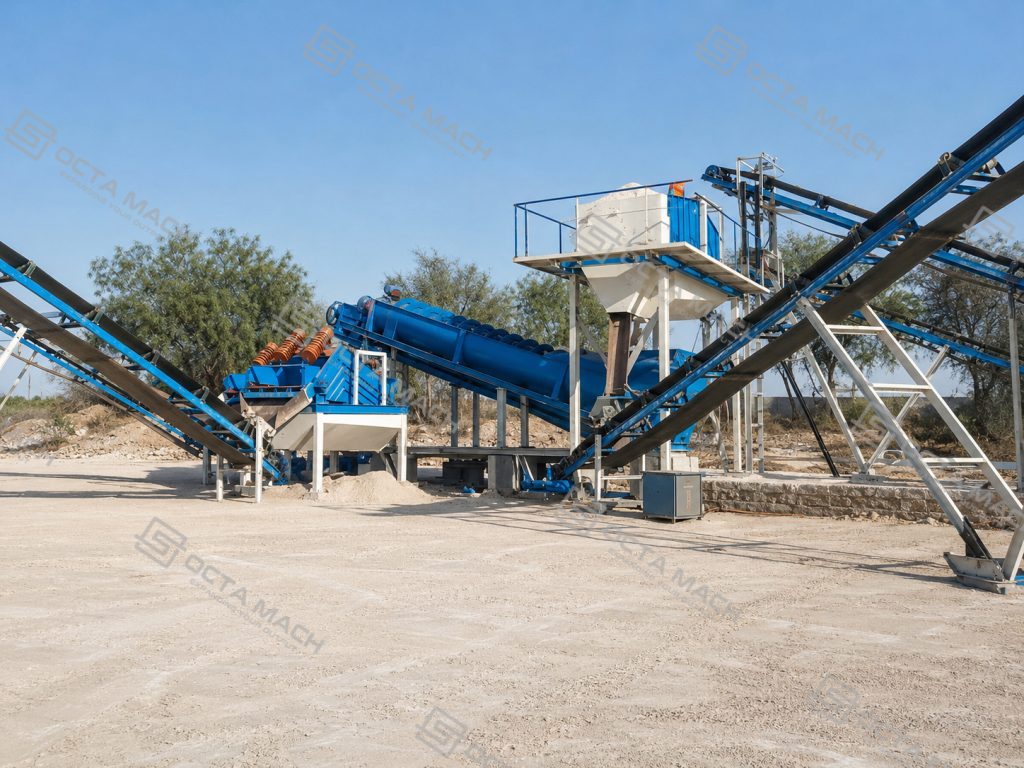
The usable sand fraction enters an attrition scrubber, where particle-to-particle friction releases clay, weathered films, and weak surface contamination. A sand washing machine then removes the loosened impurities and transfers the material to the classification system.
Hydrocyclones separate excessive slimes from usable grains. The washed quartz sand subsequently passes through high-intensity magnetic separation to remove liberated iron-bearing minerals and metallic contamination.
Finally, a dewatering screen reduces the free moisture before separate conveyors deliver the finished size fractions to their stockpiles.
The complete process follows this sequence:
Feeding → Primary Crushing → Secondary Crushing → Sand Making → Screening → Attrition Scrubbing → Washing and Classification → Magnetic Separation → Dewatering
Main Equipment Configuration
| Equipment | Main Function |
|---|---|
| Vibrating feeder | Regulates raw-material flow and removes loose undersize |
| Jaw crusher | Performs primary crushing of coarse quartzite |
| Cone crusher | Produces controlled feed for the shaping stage |
| Sand making machine | Shapes particles and produces sand-sized material |
| Vibrating screen | Separates oversize, usable sand, and excessive fines |
| Attrition scrubber | Removes clay coatings and surface contamination |
| Sand washing machine | Washes and transports the classified sand |
| Hydrocyclone | Removes slimes and recovers usable fine particles |
| Magnetic separator | Extracts liberated iron-bearing contaminants |
| Dewatering screen | Reduces finished-product moisture |
| Thickener | Clarifies process water and concentrates fine tailings |
| Filter press | Converts fine slurry into manageable filter cake |
The jaw crusher and cone crusher perform most of the size reduction before the material reaches the shaping stage. This reduces impact wear inside the sand making machine and helps maintain a more stable particle-size distribution.
Washing and Classification
The sand washing machine removes loose dust and clay, but washing alone cannot clean strongly coated particles. Attrition scrubbing is therefore installed before final classification.
During scrubbing, quartz grains rub against each other at a controlled slurry concentration. This action breaks down weak surface coatings without relying on excessive mechanical grinding. The released contaminants then leave the circuit with the fine overflow.
Hydrocyclone classification controls the lower particle-size boundary of the final product. Correct adjustment prevents usable fine silica sand from being discharged with the slimes while keeping clay and excessive ultrafines out of the finished product.
The wet section improves:
- Product cleanliness;
- Particle-size consistency;
- Removal of clay and dust;
- Separation of unwanted ultrafines;
- Efficiency of downstream magnetic separation;
- Finished-stockpile drainage.
Iron Removal
Magnetic separation for quartz sand takes place after washing and desliming to remove liberated iron-bearing particles. Clean and correctly classified grains respond more consistently to the magnetic field than unwashed material covered with fine clay.
The separator can remove liberated magnetite, iron-rich accessory minerals, metallic particles, and some hematite- or limonite-bearing grains. It cannot reliably remove iron locked inside the quartz crystal structure.
For this reason, final Fe₂O₃ content depends on:
- The mineralogical form of the iron;
- The degree of mineral liberation;
- Feed-particle size;
- Magnetic susceptibility;
- Field intensity;
- Number of separation stages;
- Stability of the slurry feed.
If testing shows that most iron is structurally locked within the quartz, additional flotation or chemical treatment may be required. Such stages should only be added when product specifications and test results justify the higher operating cost.
Water Recovery and Tailings Handling
Washing and classification produce a fine slurry containing clay, quartz fines, and removed impurities. This stream enters a thickener instead of being discharged directly.
Clarified overflow returns to the process-water tank, reducing fresh-water consumption. Thickener underflow can be processed through a filter press to form a transportable cake for controlled disposal or further evaluation.
The closed-water arrangement is especially relevant in Egypt, where water availability may limit continuous wet processing. Actual recovery depends on feed-clay content, settling behavior, water chemistry, and the selected flocculant.
Project Benefits
The proposed configuration provides several practical advantages:
- Staged crushing protects the shaping equipment from excessively coarse feed;
- Closed-circuit screening controls the load entering the sand-making section;
- Particle shaping improves the consistency of the final quartz sand;
- Scrubbing and washing remove clay and surface contamination;
- Classification limits unwanted fines in the saleable products;
- Magnetic separation reduces liberated iron contamination;
- Separate stockpiles prevent different product fractions from mixing;
- Water clarification reduces fresh-water demand;
- Replaceable wear parts simplify maintenance of abrasive-material contact zones.
The final equipment configuration should be confirmed using representative quartzite samples. Testing must establish crushing behavior, abrasion, particle-shape response, clay-removal efficiency, classification performance, magnetic response, and achievable product chemistry before manufacturing begins.
FAQ
Q: What raw material can this quartz sand plant process?
A: The line is designed for hard quartzite rock. Feed size, silica content, iron mineralogy, clay contamination, moisture, and abrasion must be tested before equipment selection.
Q: Why does the plant need both a cone crusher and a sand making machine?
A: The cone crusher prepares a controlled intermediate feed, while the sand making machine produces the required particle shape and sand-sized fraction. Separating these duties reduces wear and stabilizes production.
Q: Can the sand washing machine remove iron from silica sand?
A: The washing machine removes clay, dust, and loose surface contamination. Liberated iron-bearing minerals require magnetic separation, while structurally locked iron may require flotation or chemical treatment.
Q: Can this plant produce glass-grade quartz sand?
A: It can produce quartz sand for selected glass applications when representative testwork confirms the required SiO₂, Fe₂O₃, particle-size distribution, and contamination limits. Final quality depends primarily on the mineralogy of the raw quartzite.