
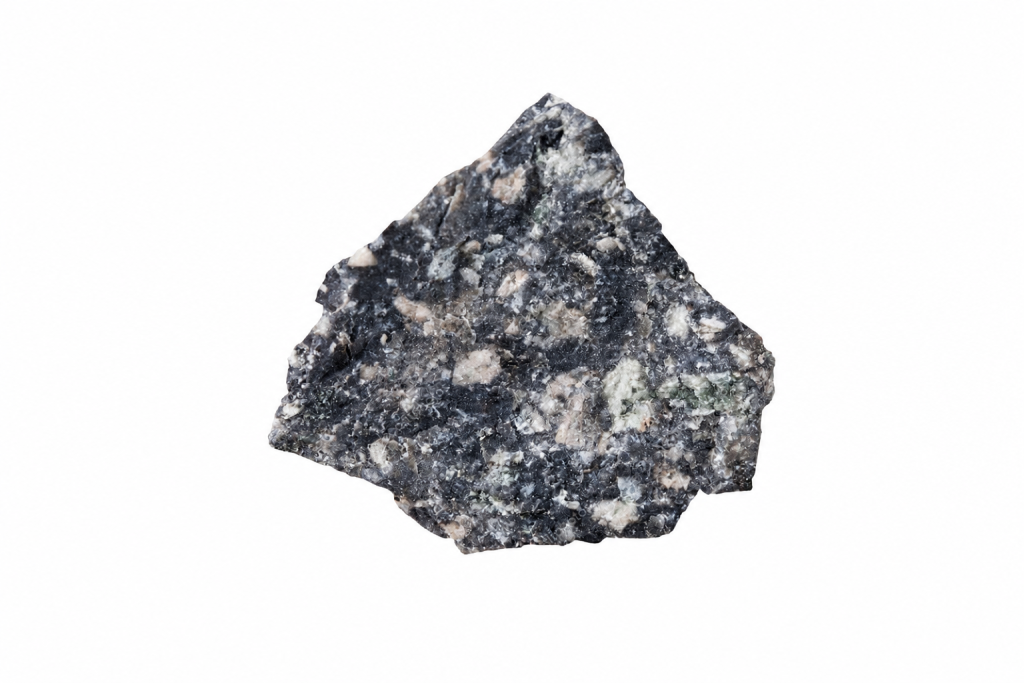
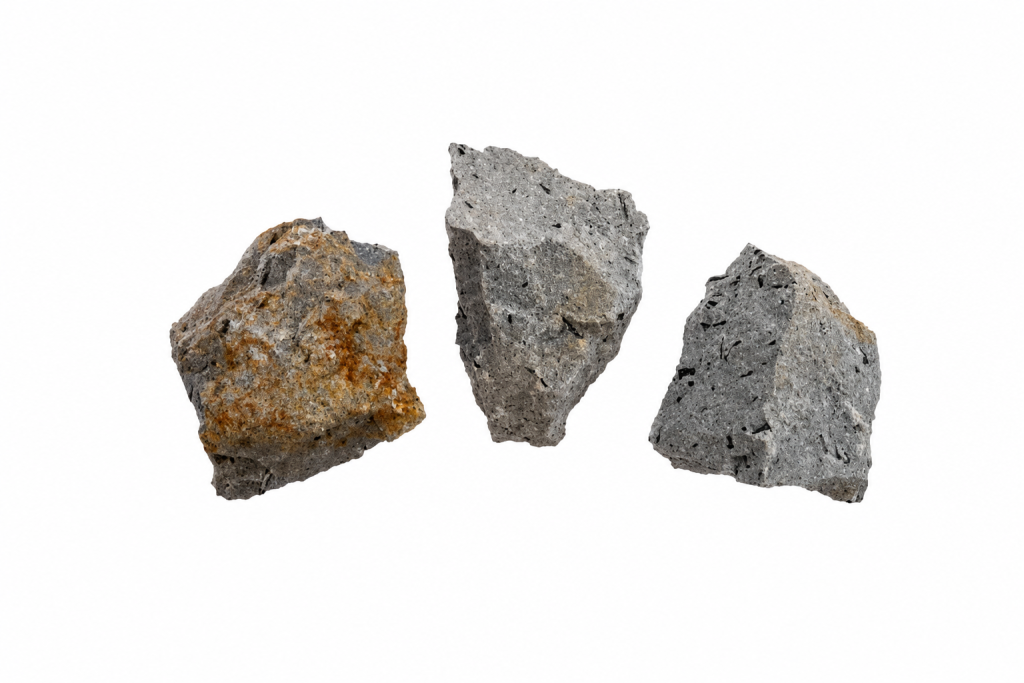
Andesite forms from intermediate-composition volcanic magma and develops a dense fine-grained igneous structure during rapid cooling near the Earth’s surface. As an andesite igneous rock, it mainly consists of plagioclase feldspar with variable amounts of pyroxene, amphibole, biotite and other volcanic minerals. The silica content of andesite commonly ranges from approximately 52–63% SiO₂, placing it between basalt and rhyolite in volcanic rock classification. Its typical density is around 2.5–2.8 g/cm³, while andesite hardness usually falls within approximately Mohs 6–7, depending on mineral composition and geological formation conditions.
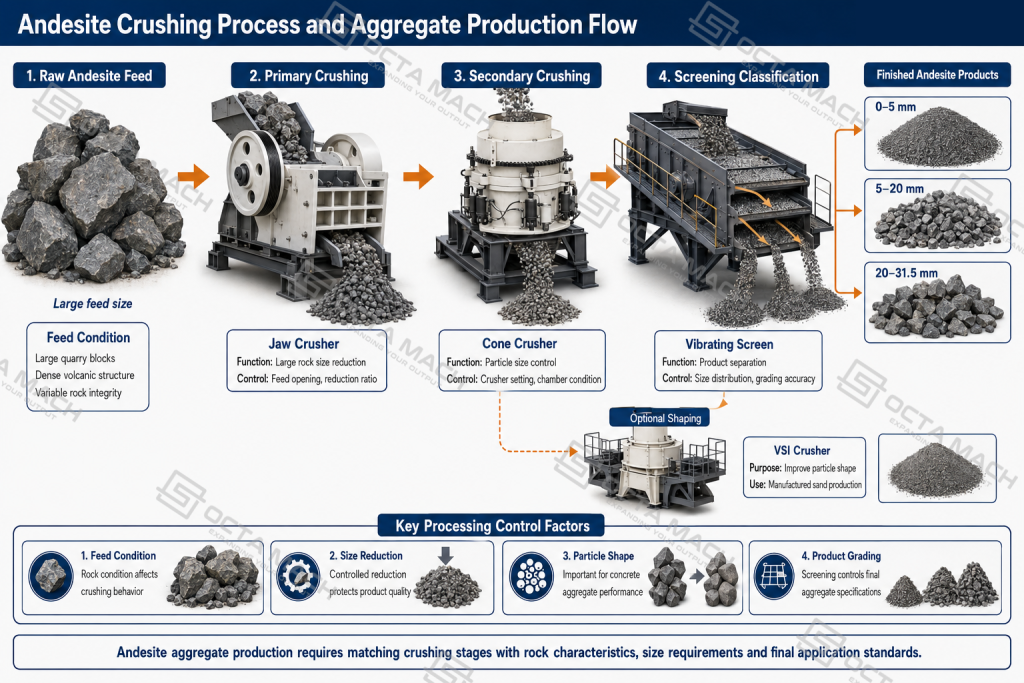
The mechanical properties of andesite rock vary between deposits because differences in mineral composition, crystal structure and weathering degree affect strength and crushing behavior. Fresh and compact andesite generally provides good resistance to mechanical breakdown and is commonly processed into crushed aggregate, road base material, railway ballast and manufactured sand. In aggregate production, quarry blocks are usually reduced through jaw crushing for primary size reduction, followed by cone crushing for controlled particle sizing and screening for product classification. When applications require improved particle shape, such as high-quality concrete aggregate or manufactured sand, an additional VSI crushing stage can be introduced.
Andesite Rock Formation and Mineral Composition
Andesite develops from magma with an intermediate chemical composition between basaltic and rhyolitic systems. During volcanic activity, the magma cools relatively quickly, creating a fine-grained crystalline structure where mineral grains are tightly interconnected. Unlike sedimentary rocks with layered structures or weak bonding planes, andesite generally forms a compact volcanic matrix with relatively uniform internal bonding.
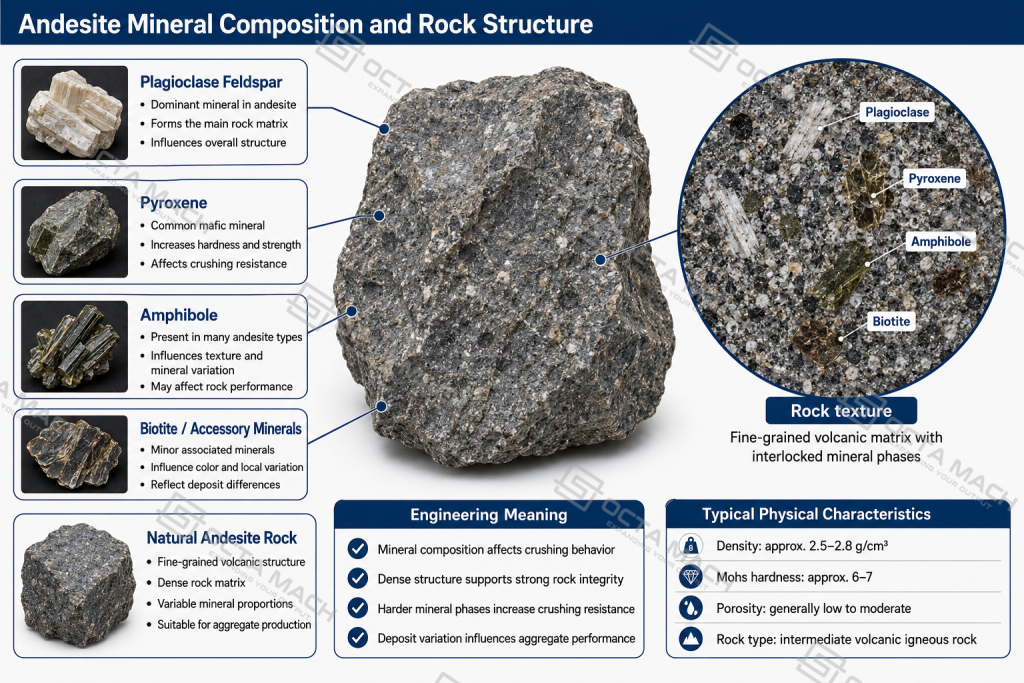
The andesite composition is mainly dominated by plagioclase feldspar, with different proportions of pyroxene, amphibole, biotite and other volcanic minerals. These mineral variations influence the color, density, hardness and mechanical characteristics of different andesite deposits.
| Mineral Component | Typical Role in Andesite Structure |
|---|---|
| Plagioclase Feldspar | Main framework mineral forming the rock matrix |
| Pyroxene | Contributes to hardness and mechanical strength |
| Amphibole | Influences rock texture and mineral composition |
| Biotite | Affects dark coloration and mineral variation |
| Quartz (in some varieties) | Appears in silica-rich andesite formations |
The andesite mineral composition varies between geological formations, meaning that different deposits with the same rock classification may show different physical behavior. Fresh and compact andesite normally develops a dense structure with strong mineral bonding, while altered or weathered formations may contain weaker zones caused by mineral changes and natural fractures. These differences affect not only rock appearance but also density, strength and suitability for different aggregate applications.
Andesite Properties and Engineering Performance
The physical properties of andesite rock determine its suitability for construction applications and aggregate production. Unlike rocks classified only by mineral composition, engineering evaluation of andesite focuses on measurable characteristics such as hardness, density, compressive strength and internal structure.
Typical andesite properties include:
| Property | Typical Range | Engineering Meaning |
|---|---|---|
| Rock Type | Volcanic igneous rock | Intermediate volcanic formation |
| Main Minerals | Plagioclase feldspar, pyroxene, amphibole | Defines the crystalline framework |
| Density | Approx. 2.5–2.8 g/cm³ | Reflects rock compactness |
| Mohs Hardness | Approx. 6–7 | Indicates resistance to scratching and mechanical wear |
| Compressive Strength | Varies by geological formation | Represents resistance to applied load |
| Porosity | Generally low to moderate | Related to internal void structure |
The andesite hardness is mainly associated with its crystalline structure and the presence of hard mineral phases such as pyroxene. Its relatively high density and low internal porosity are typical characteristics of compact volcanic rocks, allowing andesite to maintain good mechanical stability in applications such as crushed stone and structural aggregate.
Fresh, Fractured and Weathered Andesite Feed Conditions
The extracted andesite rock feed condition can vary significantly between different quarry areas because volcanic rocks are affected by cooling processes, tectonic activity and long-term surface weathering. Although the material is classified as andesite, the internal structure of individual blocks may differ depending on the development of natural fractures, mineral alteration and weathering depth.
| Andesite Feed Condition | Material Characteristics | Engineering Influence During Processing |
|---|---|---|
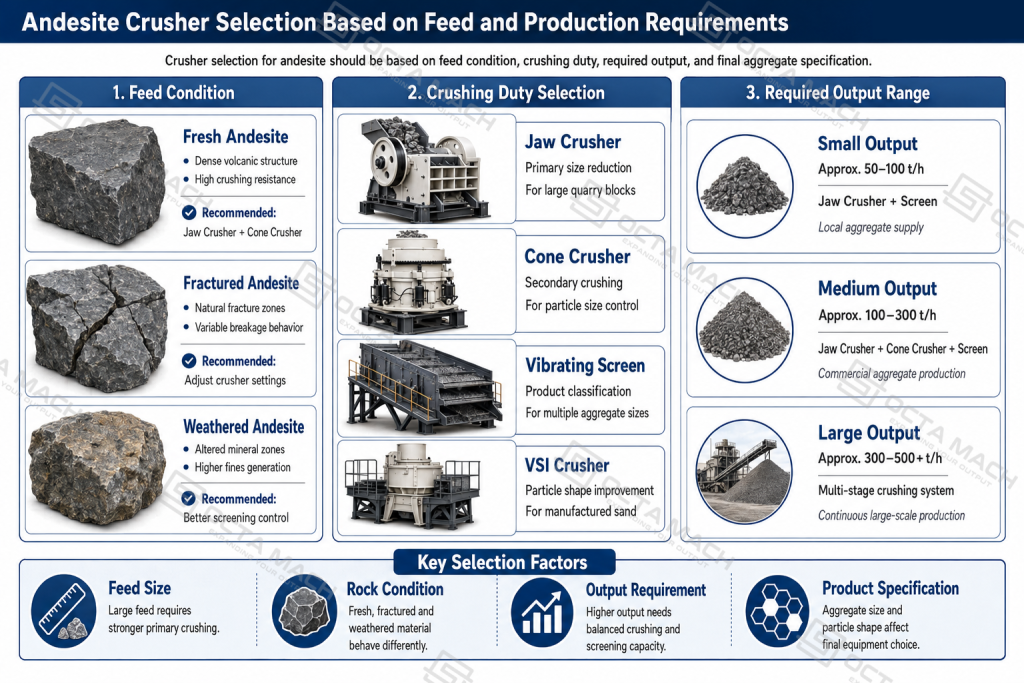
| Fresh Andesite | Dense volcanic structure with intact mineral bonding and limited internal defects | Higher resistance to breakage; requires stable crushing force and controlled size reduction to maintain efficient processing |
| Fractured Andesite | Contains natural joints, cracks or weak internal planes caused by geological stress | Breakage may occur along existing fractures, affecting feed behavior, reduction efficiency and particle shape distribution |
| Weathered Andesite | Partial mineral alteration, increased micro-fractures and weaker zones near exposed surfaces | May generate more fines during crushing and requires better feed classification to maintain product quality |
Fresh, fractured and weathered andesite show different breakage behaviors during processing. Fresh andesite maintains a dense volcanic structure with strong mineral bonding, providing high mechanical stability and durable aggregate performance but requiring sufficient crushing force for size reduction. Fractured andesite contains natural discontinuities that can become preferred breakage paths, reducing resistance in some areas while potentially creating irregular particle shapes. Weathered andesite develops altered minerals and weaker bonding zones, which may increase fines generation and cause greater variation in product grading during crushing.
For quarry evaluation and andesite crushing system design, understanding the proportion of different feed conditions is important because material variability directly affects crusher performance, particle size distribution and aggregate consistency. A crushing circuit designed for uniform fresh rock may require different operating adjustments when processing fractured or weathered material. Therefore, geological assessment of the extracted andesite feed is an important step before selecting equipment and defining the final processing route.
Andesite Crushing Process for Aggregate Production
The andesite crushing process is designed around controlled size reduction, screening classification and aggregate quality requirements. Because andesite usually develops a dense volcanic structure with variable mineral composition, the processing route is normally arranged in multiple stages to gradually reduce large quarry blocks while maintaining stable particle size distribution.
A typical andesite aggregate production circuit includes:
| Processing Stage | Equipment | Main Function | Key Control Factor |
|---|---|---|---|
| Feeding | Vibrating Feeder | Provides stable and continuous material supply | Feed distribution and consistency |
| Primary Crushing | Jaw Crusher | Reduces large quarry blocks into smaller feed material | Feed opening and reduction ratio |
| Secondary Crushing | Cone Crusher | Controls intermediate particle size and improves grading | Crusher setting and chamber condition |
| Screening | Vibrating Screen | Separates different aggregate specifications | Screening efficiency and size classification |
| Optional Shaping | VSI Crusher | Improves particle shape for higher-quality aggregate or manufactured sand | Cubical shape and fines control |
The first crushing stage focuses on reducing large andesite rock blocks extracted from the quarry into a size range suitable for further processing. Because quarry feed can contain different proportions of fresh, fractured and weathered material, stable feeding and appropriate primary reduction are important for maintaining consistent downstream performance.
After primary reduction, secondary crushing and screening work together to control the final aggregate grading. Cone crushing provides further size reduction, while screening separates qualified products and returns oversize material when a closed-circuit arrangement is required. For applications such as concrete aggregate and manufactured sand, additional shaping may be introduced to improve particle geometry and meet stricter product requirements.
Andesite Crusher Selection and Production Requirements
Selecting an andesite crusher requires matching equipment performance with feed characteristics, final aggregate specifications and required production capacity. Although andesite is generally classified as a durable volcanic rock, differences in mineral composition, fracture condition and weathering degree can influence crushing behavior. Therefore, the crushing configuration should be determined according to material characteristics, product requirements and processing scale rather than rock type alone.
Crusher Selection Based on Processing Duty
Different crushing stages perform specific size reduction and classification duties. A multi-stage configuration allows each machine to operate within a suitable feed range while maintaining better control over particle size distribution and aggregate quality.
| Requirement | Recommended Equipment | Main Reason |
|---|---|---|
| Large quarry block reduction | Jaw Crusher | Handles coarse and high-strength feed through compression crushing |
| Controlled secondary reduction | Cone Crusher | Provides stable particle size distribution and efficient intermediate crushing |
| Multiple aggregate specifications | Vibrating Screen | Separates different product sizes and maintains grading accuracy |
| Improved particle shape | VSI Crusher | Produces more cubical particles for higher-quality aggregate applications |
A crusher for andesite should be selected according to the role of each crushing stage rather than using one machine for all reduction duties. Primary crushing mainly focuses on accepting large quarry feed, while secondary crushing and screening are responsible for controlling product size and grading. When the final application requires improved particle shape, additional shaping equipment can be introduced.
Andesite Crusher Capacity and Equipment Selection
The production capacity of an andesite crusher depends on several factors, including feed size, rock strength, reduction ratio, equipment type and final product requirements. Different output requirements require different crusher combinations to achieve stable size reduction and aggregate quality.
| Production Scale | Reference Capacity | Typical Equipment Configuration | Main Application |
|---|---|---|---|
| Small-scale aggregate production | Approx. 50–100 t/h | Jaw Crusher + Vibrating Screen | Local aggregate supply and small construction projects |
| Medium-scale aggregate production | Approx. 100–300 t/h | Jaw Crusher + Cone Crusher + Vibrating Screen | Commercial aggregate production with multiple product sizes |
| Large-scale aggregate production | Approx. 300–500+ t/h | Multi-stage crushing with additional screening capacity | Continuous aggregate production for large projects |
For lower output requirements, a simplified crushing arrangement may be sufficient when the final product range is limited. As production capacity increases, secondary crushing and higher screening capacity are usually required to maintain consistent particle size distribution and meet multiple aggregate specifications.
The actual capacity of an andesite crusher can vary according to material hardness, feed gradation, crusher settings and operating conditions. Equipment selection should balance required throughput with reduction efficiency and final aggregate quality rather than focusing only on maximum processing capacity.
Crushed Andesite Sizes, Applications and Quality Factors
The final application of crushed andesite aggregate depends not only on particle size but also on grading distribution, particle shape and material quality. Screening separates crushed material into different size fractions, while crushing conditions and original rock characteristics influence the performance of each product category.
| Product Size | Typical Application | Main Requirement |
|---|---|---|
| 0–5 mm | Manufactured sand and fine aggregate | Fines control and particle shape |
| 5–10 mm | Fine concrete aggregate | Size consistency and grading control |
| 10–20 mm | Concrete aggregate | Balanced grading and particle integrity |
| 20–31.5 mm | Coarse aggregate and road materials | Strength and durability |
| Larger fractions | Railway ballast and structural applications | Rock integrity and resistance to breakdown |
Key Factors Affecting Andesite Aggregate Quality
| Quality Factor | Influence on Aggregate Performance |
|---|---|
| Particle Shape | Affects packing performance and concrete workability |
| Size Distribution | Controls grading stability and material performance |
| Weathering Degree | Influences strength and long-term durability |
| Fines Content | Affects application suitability and product consistency |
The performance of crushed andesite depends on both processing control and original rock condition. Concrete aggregate usually requires controlled grading and suitable particle shape, while road materials and ballast applications place greater emphasis on strength, durability and resistance to degradation.
Andesite Processing Solutions
The andesite processing system should be selected according to rock characteristics, required aggregate specifications and production objectives. Different crushing stages perform specific duties, from reducing large quarry blocks to controlling final particle size and shape.
- Jaw Crusher for primary reduction of large andesite blocks
- Cone Crusher for secondary size control and stable aggregate grading
- Vibrating Screen for separating different product sizes
- VSI Crusher when improved particle shape or manufactured sand production is required
The final crushing arrangement should be determined according to feed condition, target aggregate sizes and production requirements. OctaMach provides crushing equipment configurations for andesite and other hard rock applications, including jaw crushers, cone crushers, vibrating screens and optional shaping equipment. Based on feed characteristics, required output and final product specifications, OctaMach can assist in selecting suitable equipment combinations for different aggregate production requirements.
FAQ
Q:What minerals are commonly found in andesite rock?
A:Andesite rock mainly consists of plagioclase feldspar, with varying amounts of pyroxene, amphibole and biotite. Some deposits may also contain minor quartz or other accessory minerals. The variation in mineral composition affects rock texture, hardness, weathering behavior and crushing performance.
Q:How does weathering affect andesite crushing performance?
A:Weathered andesite usually contains altered mineral zones and weaker internal structures compared with fresh material. During crushing, these weaker areas can increase fines generation and create unstable particle size distribution. Therefore, quarry evaluation should consider the proportion of fresh, fractured and weathered material before selecting crushing equipment and screening methods.
Q:What crusher is suitable for hard andesite processing?
A:Hard andesite normally requires compression-based crushing stages. A jaw crusher is commonly used for primary reduction of large quarry blocks, while a cone crusher is applied for secondary size control and stable aggregate production. When better particle shape or manufactured sand is required, a VSI crusher can be added as an optional shaping stage.
Q:What factors determine the final quality of crushed andesite aggregate?
A:The quality of crushed andesite aggregate depends on more than particle size. Important factors include particle shape, size distribution, fines content and original rock integrity. Proper crushing and screening control helps produce aggregate suitable for concrete, road construction and other infrastructure applications.