
Quartz rock forms through the crystallization of silicon dioxide (SiO₂), creating a dense crystalline mineral structure with strong internal bonding. High-purity quartz deposits commonly contain more than 90% SiO₂, while natural quartz formations may include different amounts of associated minerals depending on geological origin. With a Mohs hardness of approximately 7, a density of around 2.60–2.70 g/cm³ and compressive strength commonly ranging from 100–300 MPa, quartz shows high resistance to mechanical breakdown and significant abrasion during size reduction.
The compact crystal structure of quartz provides excellent durability for producing materials such as quartz aggregate and quartz sand, but it also increases crushing resistance and equipment wear during processing. Industrial quartz crushing normally requires controlled primary crushing, secondary crushing and screening stages, with optional shaping processes when specific particle size distribution or manufactured sand production is required. The selection of a quartz crusher depends on feed size, reduction ratio, abrasion conditions and final product specifications.
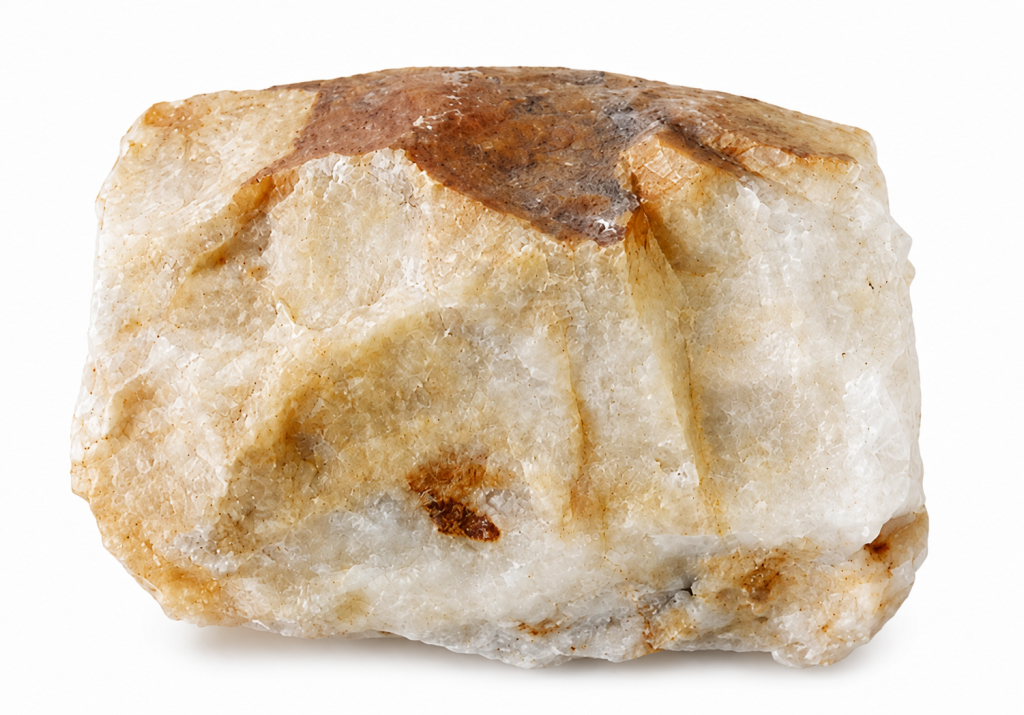
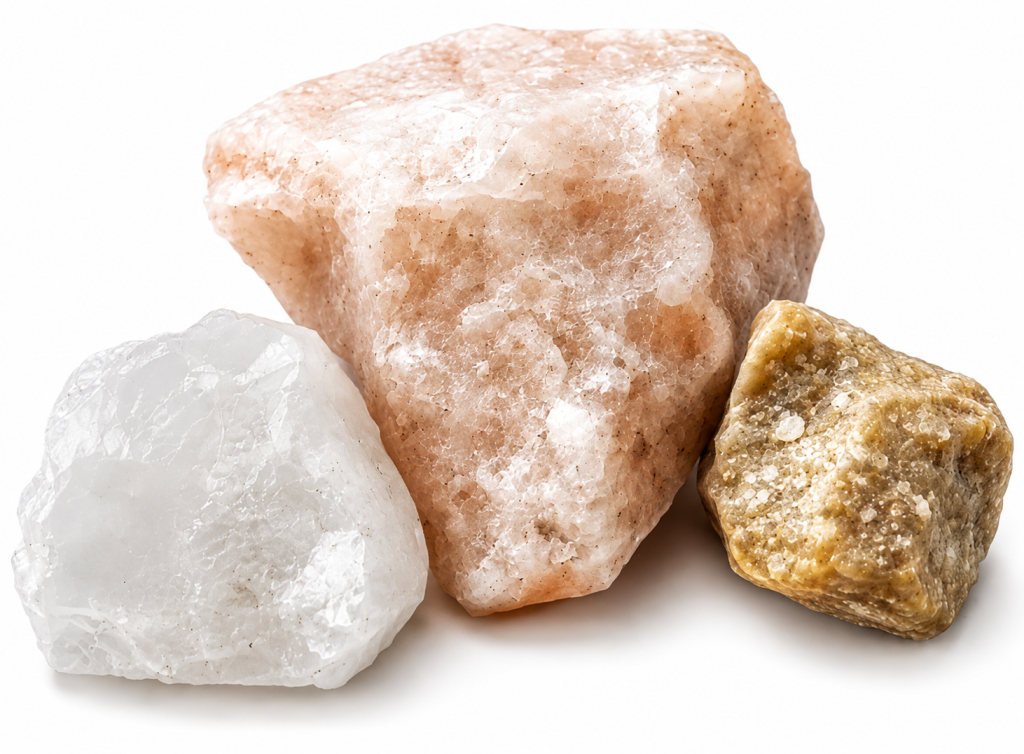
Quartz Properties and Mineral Structure
Quartz mainly consists of silicon dioxide (SiO₂) and develops a stable crystalline structure through natural geological processes. The strong bonding between silicon and oxygen atoms forms a compact crystal framework, giving quartz high hardness, chemical stability and strong resistance to environmental weathering. Compared with many rocks composed of multiple mineral phases, quartz has a relatively simple mineral composition, with quartz crystals forming the primary structure of the rock.
The composition of natural quartz varies depending on geological formation conditions. High-purity quartz deposits commonly contain more than 90% SiO₂, while natural quartz rock may contain small amounts of associated minerals such as feldspar, mica and iron-bearing minerals. These mineral variations can influence quartz purity, appearance and physical characteristics between different deposits.
Common associated minerals in natural quartz include:
| Associated Mineral | Typical Influence |
|---|---|
| Feldspar | May affect mineral purity and composition variation |
| Mica | May influence mineral texture and impurity content |
| Iron-bearing Minerals | May affect color and deposit characteristics |
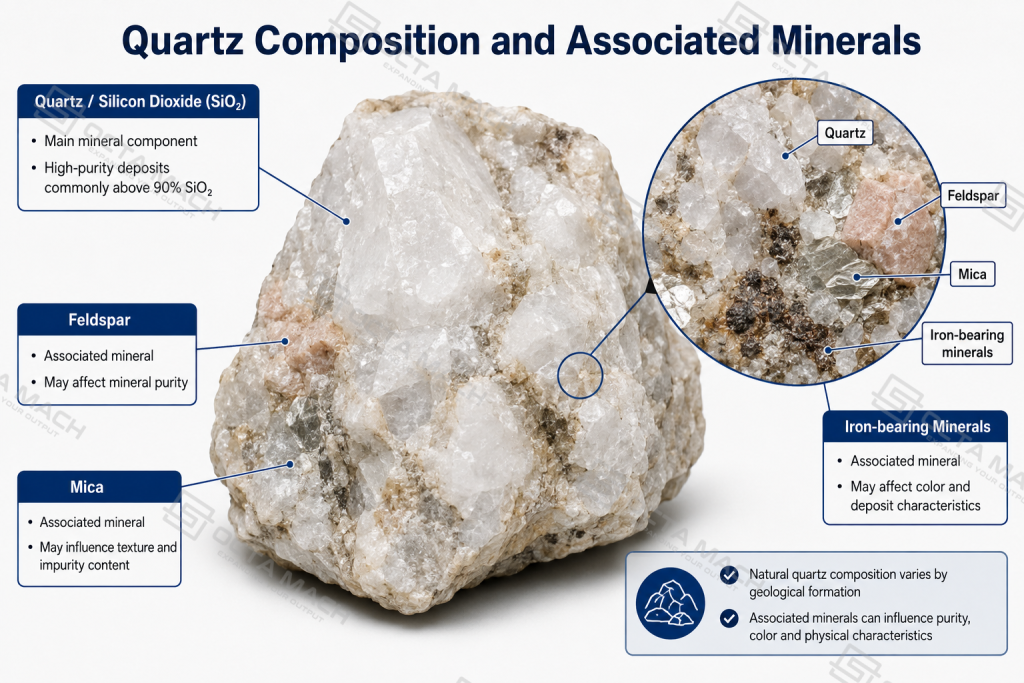
The typical physical properties of quartz are shown below:
| Property | Typical Range |
|---|---|
| Main Composition | Silicon dioxide (SiO₂) |
| SiO₂ Content | Commonly above 90% in high-purity quartz deposits |
| Crystal Structure | Dense crystalline structure |
| Mohs Hardness | Approx. 7 |
| Density | Approx. 2.60–2.70 g/cm³ |
| Specific Gravity | Approx. 2.60–2.70 |
| Compressive Strength | Approx. 100–300 MPa (varies by geological formation) |
| Porosity | Generally low |
| Water Absorption | Usually low |
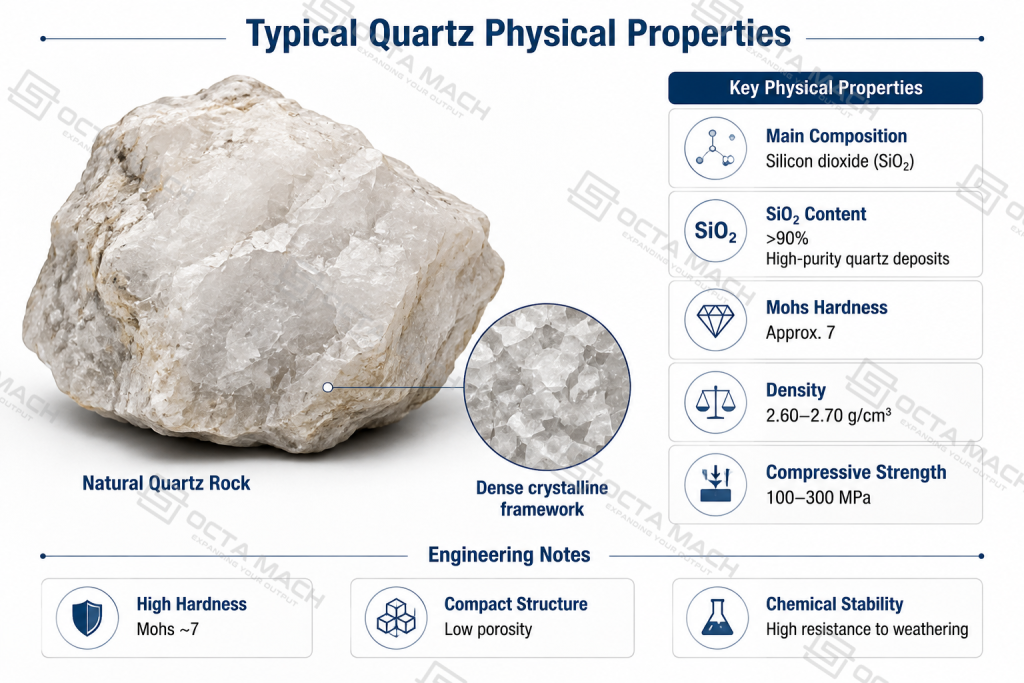
The physical characteristics of quartz can vary between deposits due to differences in mineral composition, crystal development and geological conditions. Massive quartz formations typically show a compact structure with limited internal voids, while fractured or weathered quartz may contain weaker zones that affect overall rock integrity.
For industrial applications, quartz is valued for its high purity, durability and stable mineral characteristics, making it suitable for products such as quartz aggregate, quartz sand and other silica-based materials.
Quartz Abrasion Characteristics and Crushing Requirements
Quartz presents higher processing challenges because its hard crystalline structure creates significant abrasion during size reduction. With a Mohs hardness of approximately 7, quartz particles can cause continuous wear on crushing components, especially during repeated compression and closed-circuit operation.
The main crushing challenges of quartz include:
| Crushing Challenge | Engineering Requirement |
|---|---|
| High abrasion from quartz particles | Wear-resistant jaw plates and cone liners |
| Strong resistance to fracture | Sufficient crushing force and proper reduction ratio |
| Large quarry feed size | Primary crushing before secondary reduction |
| Strict final size requirements | Effective screening and size control |
For quarry-produced quartz, the raw feed size may reach approximately 500–600 mm depending on extraction conditions. Large quartz blocks normally require primary reduction before entering secondary crushing equipment.
Because excessive reduction in a single stage increases equipment stress and wear, quartz processing commonly uses staged size reduction. A typical configuration separates large feed reduction, secondary compression crushing and screening to maintain stable operation and consistent final product sizes.
Quartz Crushing Process
Quartz processing is normally designed around controlled size reduction rather than simple crushing through multiple machines. Because quartz has a dense crystalline structure and high hardness, the crushing process separates coarse reduction, secondary shaping and product classification into different stages. Each stage is responsible for reducing a specific size range while maintaining stable product grading and controlling excessive equipment stress.
| Processing Stage | Typical Feed Condition | Main Purpose | Equipment Example |
|---|---|---|---|
| Primary Reduction | Large quartz blocks, up to approx. 500–600 mm | Reduce oversized rock into manageable feed size | Jaw Crusher |
| Secondary Reduction | Pre-crushed quartz from primary stage | Further reduce size and improve particle distribution | Cone Crusher |
| Screening Classification | Mixed crushed quartz particles | Separate required product sizes and control grading | Vibrating Screen |
| Optional Shaping | Fine crushed quartz requiring better shape or sand production | Improve particle shape and produce manufactured sand | VSI Crusher |
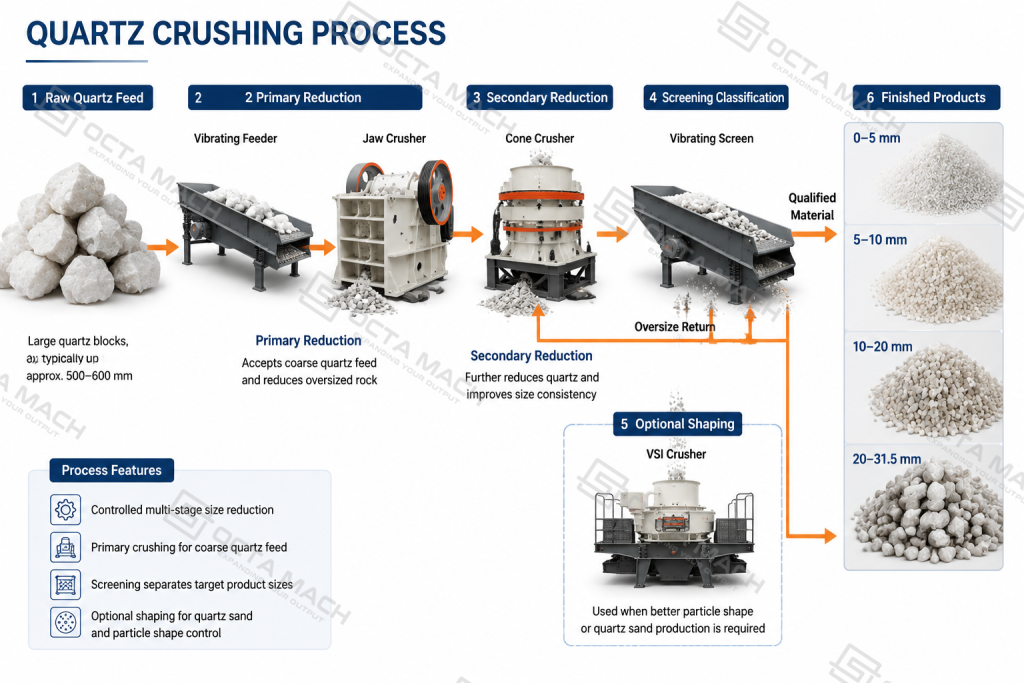
The first crushing stage mainly handles the size reduction of large quartz blocks. A jaw crusher for quartz is commonly applied because its large feed opening allows it to accept coarse material while providing high compression crushing force.
After primary reduction, the material enters secondary crushing where product size control becomes more important. A cone crusher for quartz is commonly used for further compression reduction because it provides controlled particle reduction and is suitable for hard and abrasive materials.
When the final application requires specific grading, such as quartz aggregate or quartz sand, screening and optional shaping stages are added to control particle size distribution and improve final product quality.
Quartz Crusher Selection and Capacity Configuration
Quartz crusher selection depends on matching the crushing equipment with quartz hardness, feed condition and final product requirements. Because quartz combines high hardness with strong abrasion characteristics, the crushing configuration normally uses different stages for coarse reduction, secondary size control and final classification.
Quartz Crusher Selection
| Processing Requirement | Recommended Equipment | Main Selection Factor |
|---|---|---|
| Primary reduction of large quartz blocks | Jaw Crusher | Feed opening, compression force and wear-resistant components |
| Secondary size reduction | Cone Crusher | Chamber selection, liner wear and product control |
| Final size classification | Vibrating Screen | Screening efficiency and grading accuracy |
| Manufactured sand production | VSI Crusher | Particle shape and fines control |
A typical quartz crushing configuration starts with jaw crushing to reduce large feed material into a manageable size range. Cone crushing is then applied for further reduction where stable particle size distribution and wear control become more important. Screening separates qualified products, while VSI shaping is added only when applications require improved particle shape or manufactured sand production.
Reference Quartz Crusher Capacity
After determining the crushing stages, equipment capacity must be matched with the required production rate. Actual throughput depends on quartz feed size, hardness, crusher settings, reduction ratio and final product requirements.
| Reference Capacity | Typical Configuration |
|---|---|
| 50–100 t/h | Single jaw crushing with screening |
| 150–300 t/h | Jaw crusher + cone crusher + screening |
| 300–500 t/h | Multi-stage crushing with increased screening capacity |
| 500+ t/h | Multiple crushing units and large-scale screening system |
The final quartz crushing configuration should be selected based on the relationship between feed condition, reduction requirement, capacity target and product specification rather than selecting a crusher only by production rate.
Crushed Quartz Sizes and Applications
Quartz products are classified mainly according to particle size distribution, silica purity requirements and final application purpose. Unlike ordinary construction aggregates, quartz processing often requires stricter control of particle size, fines content and particle shape, especially for applications such as quartz sand, glass production and industrial silica materials.
The required product size depends on the end use. Coarse quartz particles are mainly used as construction materials, while finer fractions are commonly processed for sand production and industrial applications requiring controlled grading.
| Product Size | Typical Application | Main Quality Control |
|---|---|---|
| 0–5 mm | Quartz sand, silica sand, manufactured sand | Fines content, SiO₂ purity, particle size distribution |
| 5–10 mm | Fine aggregate for concrete and construction applications | Size consistency and grading control |
| 10–20 mm | Concrete aggregate and general construction aggregate | Continuous grading and particle shape |
| 20–31.5 mm | Coarse aggregate and structural applications | Strength, particle integrity and size distribution |
| Larger fractions | Railway ballast and heavy-duty aggregate applications | Oversize control, durability and resistance to breakdown |
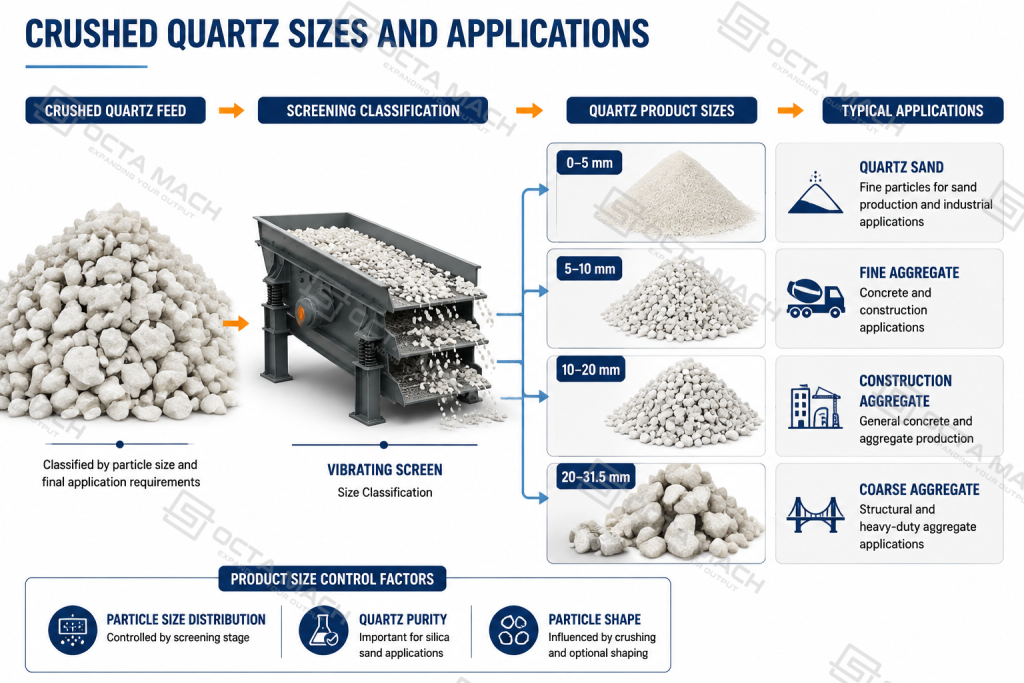
For quartz sand and silica sand production, the main requirement is not only achieving a fine particle size but also maintaining consistent grading and controlling excessive fines. These materials are commonly used in applications where silica content, cleanliness and particle uniformity affect final performance.
For construction aggregate applications, quartz products require balanced particle size distribution and sufficient mechanical strength. Larger fractions are generally selected for structural applications where durability and resistance to breakdown are required.
The crushing and screening process should therefore be adjusted according to the required quartz product rather than producing a single standard size fraction.
Quartz Purity Requirements for Different Applications
The final value of processed quartz depends not only on particle size but also on silica purity, impurity control and particle characteristics. Different applications require different quality standards. Construction aggregate mainly focuses on strength and grading, while industrial quartz products require stricter control of mineral composition and particle consistency.
| Application | Main Requirement | Key Quality Factor |
|---|---|---|
| Glass Manufacturing | High-purity quartz raw material | High SiO₂ content, low iron content and controlled size distribution |
| Quartz Sand Production | Consistent fine-grained material | Particle size distribution and fines control |
| Foundry Sand | Durable and uniform sand particles | Grain size consistency, particle shape and thermal stability |
| Construction Aggregate | Strong and stable aggregate material | Grading, strength and particle integrity |
Natural quartz deposits may contain associated minerals such as feldspar, mica and iron-bearing minerals. These impurities influence the selection of quartz applications, with low-iron and high-purity requirements becoming more critical for industrial uses such as glass manufacturing. Therefore, mineral composition analysis is an important step when evaluating quartz processing requirements.
Quartz Crushing Solution Configuration
Quartz crushing solutions need to balance material characteristics, production requirements and final product specifications. Because quartz has high hardness and strong abrasion characteristics, an effective crushing arrangement usually requires staged size reduction, stable feeding, accurate screening and optional shaping processes when quartz sand or improved particle shape is required.
OctaMach develops quartz crushing configurations based on feed size, required capacity and end-product requirements. The solution can combine primary crushing, secondary reduction, screening and shaping stages to achieve stable operation, controlled product grading and suitable performance for different quartz applications.
FAQ
Q:What properties of quartz rock affect the crushing process?
A:Quartz rock mainly consists of silicon dioxide (SiO₂) with a Mohs hardness of approximately 7 and a dense crystalline structure. Its high hardness, low porosity and abrasive mineral characteristics increase crushing resistance and equipment wear, making staged crushing and wear-resistant components important for stable processing.
Q:Why does quartz require multiple crushing stages?
A:Quartz usually requires staged size reduction because its dense crystal structure makes excessive reduction in a single crushing stage inefficient. Primary crushing reduces large quartz blocks, while secondary crushing and screening provide better control over particle size distribution, product grading and equipment wear.
Q:How does quartz purity affect the final product application?
A:Quartz purity directly influences its suitability for different applications. High-purity quartz with controlled impurities is commonly required for industrial uses such as glass manufacturing, while construction aggregate applications mainly focus on strength, grading and particle integrity.
Q:How do you choose a crusher for quartz processing?
A:A crusher for quartz should be selected according to feed size, required output size, production capacity and final product requirements. Jaw crushers are commonly used for primary reduction, while cone crushers and optional VSI crushers are applied when further size control or particle shape improvement is required.