
Diabase, also known as dolerite, develops when mafic magma intrudes into relatively shallow parts of the crust and cools more slowly than surface basalt but faster than deep-seated gabbro. This cooling history produces a dark gray to black, fine- to medium-grained diabase rock dominated by plagioclase feldspar and pyroxene. Mafic igneous rocks typically fall near 45–52 wt.% SiO₂, while diabase commonly shows a dense mineral framework, density around 2.8–3.1 g/cm³, and hard constituent minerals that make fresh material suitable for high-strength construction aggregate.
For diabase aggregate processing, the important issue is not hardness alone. Plagioclase and augite commonly form an interlocking ophitic or subophitic texture, giving intact blocks strong structural continuity and influencing both breakage and wear during size reduction. Industrial diabase crushing therefore usually separates coarse reduction, secondary compression crushing, screening and—when required—particle shaping into controlled duties. Finished products may include concrete aggregate, road material, railway ballast, diabase gravel, and manufactured diabase sand.
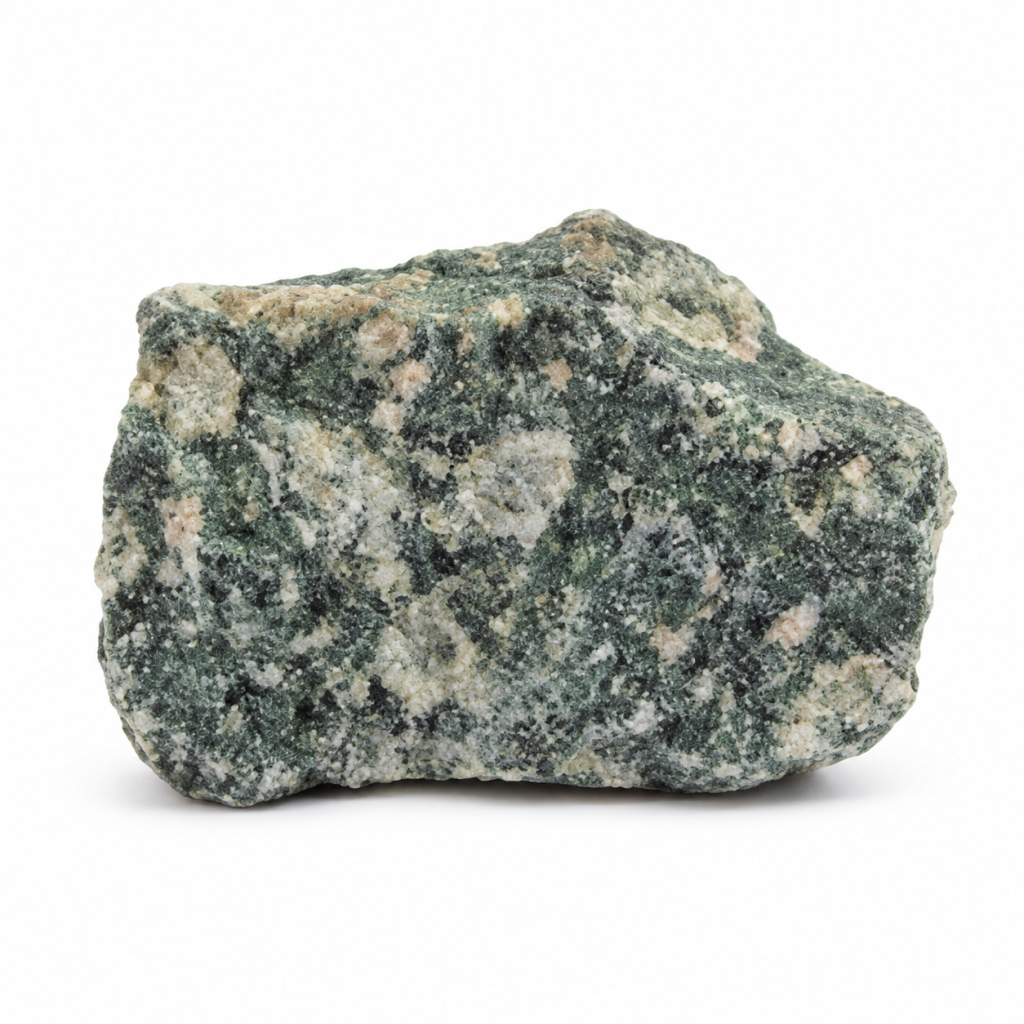
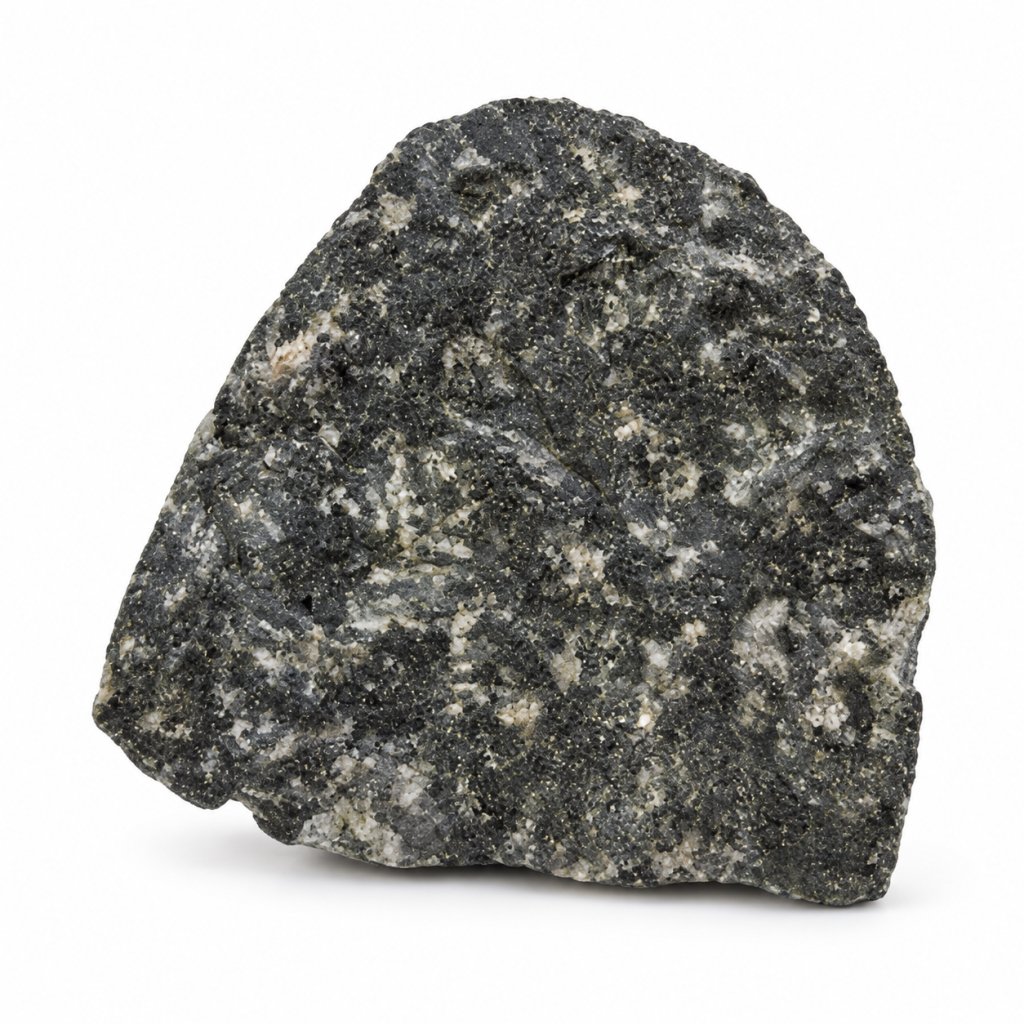
Diabase Composition and Ophitic Mineral Texture
The diabase composition is dominated by calcium-rich plagioclase and pyroxene. Plagioclase, commonly labradorite, may account for approximately 40–70% of the rock, while much of the remaining primary mineral fraction consists of pyroxene, especially augite. Minor olivine, hornblende, magnetite, ilmenite, biotite and quartz may occur depending on magma chemistry and later alteration.
| Mineral Component | Typical Occurrence in Diabase | Structural Significance |
|---|---|---|
| Plagioclase Feldspar | Major mineral; commonly labradorite | Forms lath-shaped crystals and much of the rock framework |
| Augite / Pyroxene | Major dark mafic mineral | Intergrows with plagioclase and contributes to the dense texture |
| Olivine | Minor in some varieties | Adds harder mafic mineral grains where present |
| Magnetite / Ilmenite | Accessory minerals | Contribute to dark color and local mineral variation |
| Hornblende / Biotite | Minor or secondary phases | Reflect magma evolution or alteration |
| Quartz | Minor in some varieties | Occurs in more silica-rich diabase types |
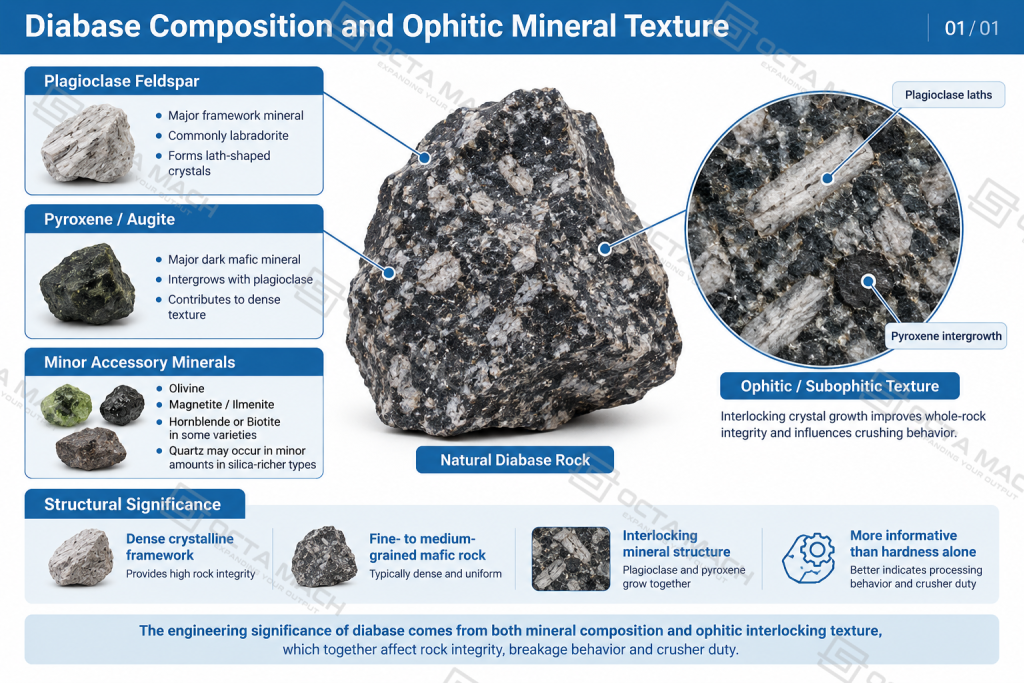
The most characteristic diabase mineral composition is not simply a mixture of feldspar and pyroxene; the way these minerals grow together is equally important. In an ophitic texture, lath-shaped plagioclase crystals are enclosed by larger pyroxene crystals. In a subophitic texture, pyroxene only partly encloses the feldspar laths. This interlocking structure reduces the importance of individual mineral cleavage planes at the whole-rock scale and contributes to the durability for which good-quality diabase is valued as construction stone.
Diabase, Dolerite, Basalt and Gabbro: Key Structural Differences
The terms diabase and dolerite generally describe the same mafic rock type, although regional geological terminology differs. Its chemical composition is broadly comparable with basalt and gabbro; the main distinction is cooling environment and resulting crystal size. Basalt cools rapidly at or near the surface, diabase commonly crystallizes in shallow dikes and sills, while gabbro develops more slowly at greater intrusive depths.
| Rock Type | Typical Grain Character | Geological Setting | Typical Structural Feature |
|---|---|---|---|
| Basalt | Very fine-grained | Extrusive / volcanic | Crystals commonly too fine to identify easily |
| Diabase / Dolerite | Fine- to medium-grained | Shallow intrusive / subvolcanic | Ophitic or subophitic mineral intergrowth |
| Gabbro | Coarse-grained | Deeper intrusive | Clearly visible coarse mineral crystals |
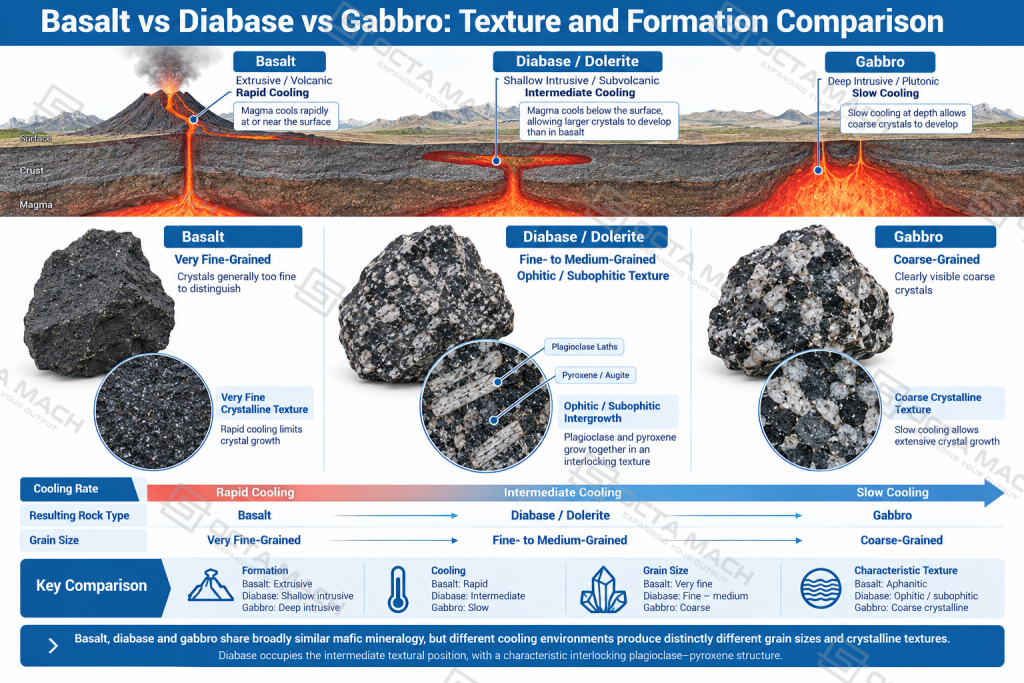
Diabase occupies an intermediate textural position between basalt and gabbro, with a fine- to medium-grained structure formed by interlocking plagioclase and pyroxene crystals. Compared with fine-grained basalt, the more developed ophitic or subophitic texture creates a dense and mechanically coherent rock framework. For crushing, this means fresh diabase can show strong resistance to breakage, while reduction behavior depends on the combined effects of mineral interlocking, block integrity and natural fractures rather than on hardness alone.
Diabase Properties and Crushing Behavior
The physical and mechanical properties of diabase rock are closely related to its mafic mineral composition and interlocking crystalline structure. Plagioclase and pyroxene form a dense rock framework, while grain size, mineral proportion and structural integrity can vary between deposits. These characteristics determine the basic engineering behavior of diabase, including its density, hardness, strength and resistance to mechanical breakdown.
| Property | Typical Engineering Range | Engineering Significance |
|---|---|---|
| Rock Class | Mafic shallow intrusive igneous rock | Reflects its dense crystalline and basaltic mineral character |
| SiO₂ Content | Approx. 45–52 wt.% | Typical of mafic compositions dominated by Fe-Mg-bearing minerals |
| Density | Approx. 2.8–3.1 g/cm³ | Indicates a relatively compact and heavy rock structure |
| Mohs Hardness | Approx. 6–7 | Reflects resistance to scratching and mechanical wear |
| Compressive Strength | Approx. 120–300+ MPa | Indicates substantial resistance to compressive failure |
| Main Minerals | Plagioclase + augite/pyroxene | Forms the interlocking framework that contributes to whole-rock integrity |
Fresh diabase generally shows high block integrity and strong resistance to size reduction. Its dense interlocking mineral structure increases the force required to initiate fracture, while hard plagioclase and pyroxene phases contribute to wear on jaw plates, cone liners and other contact surfaces. Natural joints, alteration and weathered zones create preferred fracture paths and can significantly change breakage behavior. Diabase crushing performance therefore varies with both rock strength and the structural condition of the actual feed.
Diabase Aggregate Processing and Crushing Stages
Diabase aggregate processing is normally arranged as staged crushing and classification because dense, hard feed is better reduced through controlled duties than by excessive reduction in a single stage. Primary crushing handles large quarry blocks, while secondary compression crushing brings the material into a narrower size range suitable for classification. Screening separates qualified aggregate from oversize material, with the oversize fraction returned for further reduction in a closed circuit. An additional shaping stage is only required when the final product has stricter particle-shape or manufactured-sand requirements.
| Processing Stage | Typical Equipment | Main Duty | Important Control Point |
|---|---|---|---|
| Feeding | Vibrating Feeder | Stabilizes material delivery | Feed distribution and maximum lump size |
| Primary Crushing | Jaw Crusher | Reduces large quarry blocks | Feed opening, nip condition and reduction duty |
| Secondary Crushing | Cone Crusher | Controls intermediate particle size | Chamber selection, closed-side setting and liner condition |
| Screening | Vibrating Screen | Separates product fractions | Aperture size, screening load and grading accuracy |
| Closed-Circuit Return | Screen + Secondary Crusher | Reprocesses oversize fraction | Circulating load and crusher-screen balance |
| Optional Shaping | VSI Crusher | Improves particle shape or produces manufactured sand | Feed size, rotor loading and fines generation |
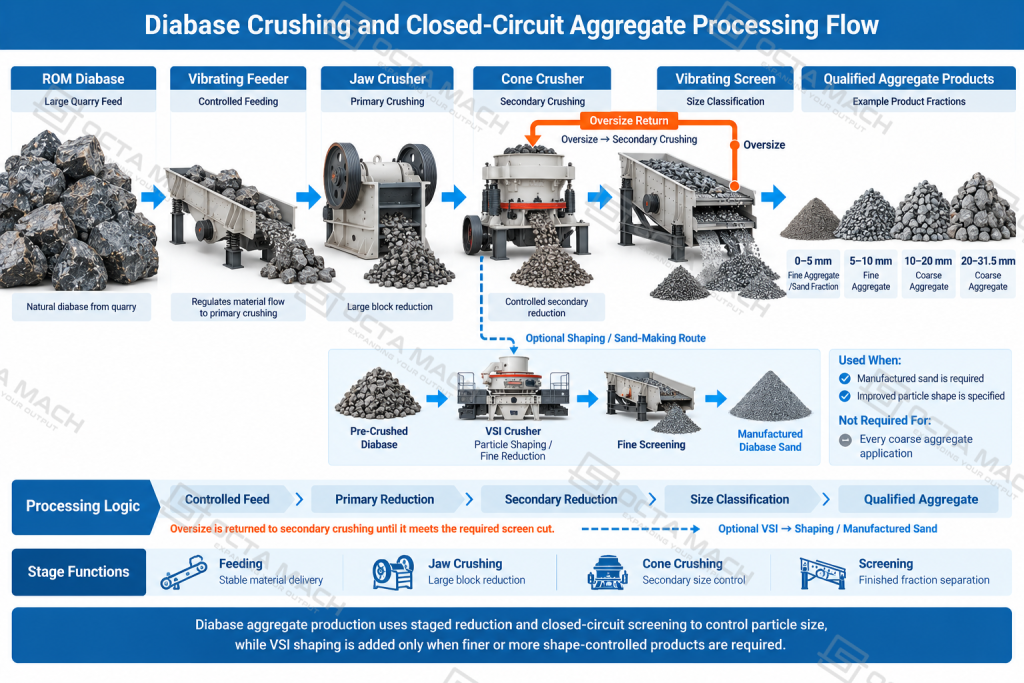
For hard and relatively abrasive diabase, compression crushing is normally a strong choice for the primary and secondary duties because the reduction load is distributed through jaw and cone crushing stages. Screening should not be treated as a final accessory: it determines which particles leave the circuit and which particles return for further reduction. If screening capacity is undersized relative to crusher output, circulating load rises and the secondary crusher can become overloaded even when its nominal throughput appears sufficient.
Diabase Crushing Line Characteristics
A diabase crushing line should be configured around the load distribution between feeding, primary reduction, secondary crushing and screening rather than around the nominal capacity of a single machine. Dense and abrasive diabase can impose high compression loads and accelerate wear when excessive reduction is concentrated in one stage, while insufficient screening capacity increases circulating load and forces oversize material back into the crushing circuit. The main engineering objective is therefore to balance feed rate, reduction ratio, crusher duty, screen capacity and wear load so that the required product grading can be maintained without creating downstream bottlenecks or unnecessary recirculation.
| Crushing Line Characteristic | Why It Matters for Diabase | Engineering Control |
|---|---|---|
| Stable Feed Control | Large or uneven blocks create unstable crusher loading | Match feeder capacity and feed opening to actual ROM size distribution |
| Staged Compression Reduction | Dense interlocking rock can impose high crushing loads | Divide reduction between primary jaw and secondary cone crushing |
| Closed-Circuit Size Control | Oversize particles must not contaminate final grading | Return oversize material from the screen to the appropriate crushing stage |
| Wear Load Distribution | Hard mineral phases increase wear on contact surfaces | Avoid concentrating excessive reduction in one crusher; monitor jaw plates and cone liners |
| Screening Capacity Matching | Crusher throughput is not equal to saleable product throughput | Size screen area and deck loading for both final products and circulating material |
| Optional Shaping Branch | Aggregate and manufactured sand have different particle-shape requirements | Add VSI shaping only where cubical particles or finer sand products are specified |
| Fines Management | Excessive fine crushing can increase unwanted stone powder | Control reduction ratio, VSI loading and final screen cut points |
Crusher and screen performance should be evaluated as one coupled system. If secondary crushing capacity is increased without corresponding screening capacity, oversize accumulation and circulating load can rise even though crusher throughput improves. Excessive recirculation increases repeated contact with jaw plates, cone liners and other wear surfaces, while also raising the proportion of fines. Stable diabase aggregate production therefore depends on matching crusher discharge, screen aperture, deck loading and return-load capacity so that qualified material leaves the circuit efficiently and oversize material is reprocessed without creating a downstream bottleneck.
Diabase Crusher Selection and Capacity Matching
Diabase equipment selection should begin with the reduction requirement of the material and the specification of the final product. Feed size, rock integrity, target reduction ratio and required aggregate grading determine how the crushing duty should be divided between primary reduction, secondary crushing, classification and optional shaping. The equipment used at each stage should therefore be selected according to its specific processing duty rather than from nominal capacity alone.
| Processing Requirement | Recommended Equipment | Selection Focus |
|---|---|---|
| Large diabase block reduction | Jaw Crusher | Feed opening, feed size distribution and compression capacity |
| Secondary size reduction | Cone Crusher | Chamber type, reduction ratio, liner wear and product size |
| Multiple aggregate products | Vibrating Screen | Screen aperture, deck arrangement and classification efficiency |
| Particle-shape improvement | VSI Crusher | Cubical shape requirement and allowable fines generation |
| Manufactured sand production | VSI + Screening | Fine grading, particle shape and fines classification |
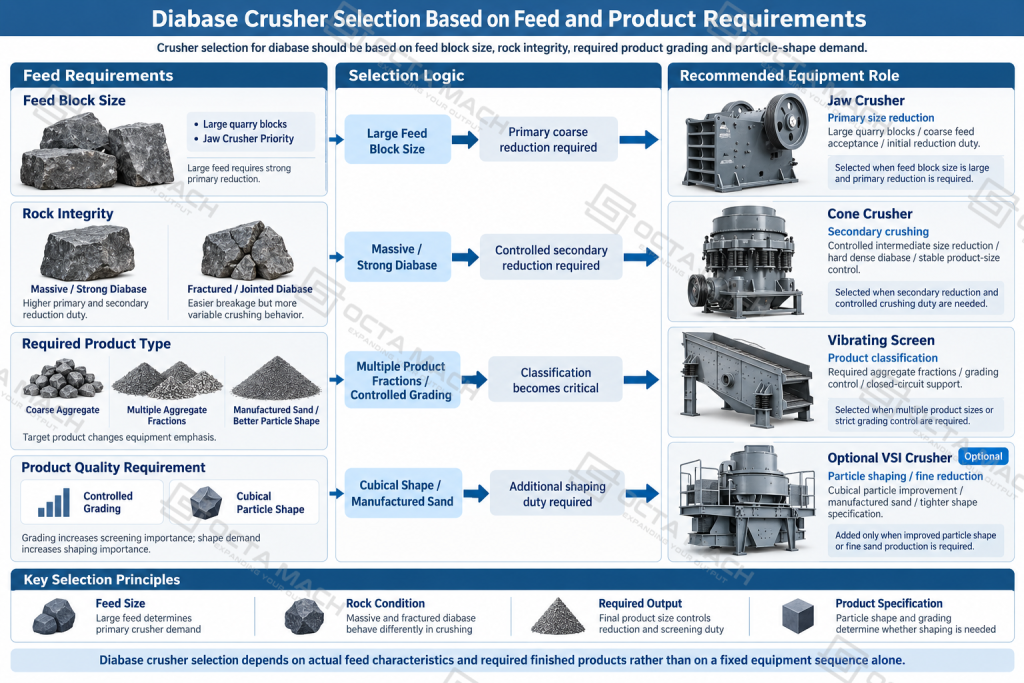
Capacity matching becomes critical once the crushing duties have been assigned. Crusher throughput, screen capacity and circulating load must remain balanced so that material can move through the system without creating a downstream bottleneck. If secondary crushing capacity exceeds classification capacity, oversize return can increase without raising saleable aggregate output. Required equipment capacity should therefore be checked against feed gradation, screen loading, return load and the number of finished product fractions.
Diabase Crusher Output Requirements and Equipment Matching
Required output directly affects the size and duty of the crushing equipment selected for diabase processing. As throughput increases, the primary crusher must accept a higher continuous feed rate, the secondary crusher must provide sufficient reduction capacity without excessive liner loading, and the screening equipment must handle both finished fractions and circulating oversize. Equipment capacity should therefore be matched across the entire crushing and classification sequence rather than increased at one stage only.
| Required Output Range | Typical Equipment Arrangement | Main Engineering Requirement |
|---|---|---|
| 50–100 t/h | Jaw Crusher + Cone Crusher + Vibrating Screen | Maintain stable feed reduction and produce controlled aggregate fractions with a compact equipment combination |
| 100–300 t/h | Jaw Crusher + Cone Crusher + Multi-deck Vibrating Screen | Increase secondary crushing and classification capacity while maintaining multiple finished product sizes |
| 300–500+ t/h | Higher-capacity or parallel crushing equipment + expanded screening capacity | Maintain continuous feed, control circulating load and prevent screening from becoming the system bottleneck |
At 50–100 t/h, equipment selection is mainly governed by feed opening, reduction ratio and the number of required finished fractions. When output increases to 100–300 t/h, secondary crushing and screening capacity become more critical because a larger material flow must be classified without increasing oversize accumulation. For 300–500+ t/h duties, crusher discharge, screen area and return-load capacity must be matched more closely; otherwise, additional crushing capacity can raise circulating load without producing a corresponding increase in qualified aggregate output.
Crushed Diabase Aggregate, Gravel and Applications
Crushed diabase is used differently depending on the mechanical duty of the finished material. Its dense plagioclase–pyroxene framework gives intact particles good resistance to breakdown, but the required grading, particle shape and allowable fines vary substantially between concrete, asphalt, road base and ballast applications. Coarse structural products rely more on particle integrity and resistance to degradation, while concrete and asphalt aggregate require tighter control of grading, cleanliness and particle geometry. Manufactured sand places additional emphasis on fine-particle distribution and shape control.
| Product / Application | Typical Product Requirement | Main Quality Concern |
|---|---|---|
| Concrete Aggregate | Controlled coarse and fine fractions | Grading, particle integrity and shape |
| Road Base Material | Continuous or specified grading | Load distribution, durability and fines content |
| Asphalt Aggregate | Consistent sized particles | Wear resistance, cleanliness and grading |
| Railway Ballast | Larger durable coarse particles | Resistance to breakdown and long-term particle integrity |
| Diabase Gravel | Sized crushed stone | Consistency, strength and drainage performance |
| Manufactured Diabase Sand | Fine controlled fraction, commonly around 0–5 mm | Shape, fines content and grading |
The crushing and screening route should be adjusted according to the required end product rather than using the same reduction strategy for every diabase fraction. Railway ballast and coarse road material should avoid unnecessary fine crushing so that particle integrity is preserved, whereas concrete and asphalt aggregate usually require tighter screening and more consistent particle shape. When the target product is manufactured diabase sand, additional shaping and fine classification become necessary to control both particle geometry and fines content.
Diabase Processing Solutions
Diabase processing equipment should be matched to feed size, rock strength, required output and final aggregate specification. For hard and dense feed, primary jaw crushing and secondary cone crushing provide the main size-reduction duties, while vibrating screens control finished grading and circulating load. VSI equipment can be added where the product requires manufactured sand or improved particle shape.
OctaMach supplies jaw crushers, cone crushers, vibrating screens and VSI crushing equipment for diabase and other hard-rock applications. Equipment combinations can be selected around the actual feed condition and required product range, with particular attention to reduction-stage balance, screening capacity, liner wear and final aggregate grading.
FAQ
Q:What mineral structure defines diabase rock?
A:Diabase rock is mainly composed of plagioclase feldspar and pyroxene, especially augite. Its characteristic ophitic or subophitic texture forms when plagioclase laths are enclosed or partly enclosed by larger pyroxene crystals. This interlocking mineral structure is one of the main features that distinguishes diabase from finer-grained basalt and coarse-grained gabbro.
Q:Why is a cone crusher commonly used for secondary diabase crushing?
A:Diabase combines high rock integrity with hard plagioclase and pyroxene minerals, making controlled compression suitable for secondary reduction. A cone crusher allows the reduction ratio, chamber condition and product size to be controlled while handling the wear load associated with hard diabase feed.
Q:How does weathering affect diabase aggregate production?
A:Weathered diabase may contain altered minerals, microfractures and weaker bonding zones. These changes can reduce particle integrity and increase fines generation during crushing, so weathered feed may require tighter feed separation and screening control than fresh diabase.
Q:When does diabase require VSI shaping for sand production?
A:VSI shaping is mainly required when the target product is manufactured diabase sand or when stricter particle-shape control is specified. If cone crushing and screening already produce the required coarse aggregate grading, an additional VSI stage may increase wear and fines without providing a useful product benefit.