
Lithium ore refers to natural mineral deposits containing lithium-bearing minerals that can be processed to produce lithium concentrate for battery materials, ceramics, glass and other industrial applications. Unlike some metallic ores that are mainly classified by a single dominant mineral, lithium resources occur in different mineral forms, mainly including spodumene, lepidolite and petalite in hard-rock deposits.
These lithium minerals have different chemical compositions, crystal structures and physical properties, which directly affect their processing requirements. Spodumene (LiAlSi₂O₆) is currently the most important hard-rock lithium mineral and is widely used for lithium concentrate production, while lepidolite and petalite require different separation strategies due to their mica and silicate structures. Their differences also influence crushing conditions, grinding requirements and beneficiation methods.
For hard-rock lithium deposits, the ore is typically mined as large pegmatite rock blocks and requires staged size reduction before mineral separation. The feed size, mineral hardness, associated gangue minerals and liberation requirements determine whether equipment such as jaw crushers, cone crushers and screening systems are suitable for the processing circuit.
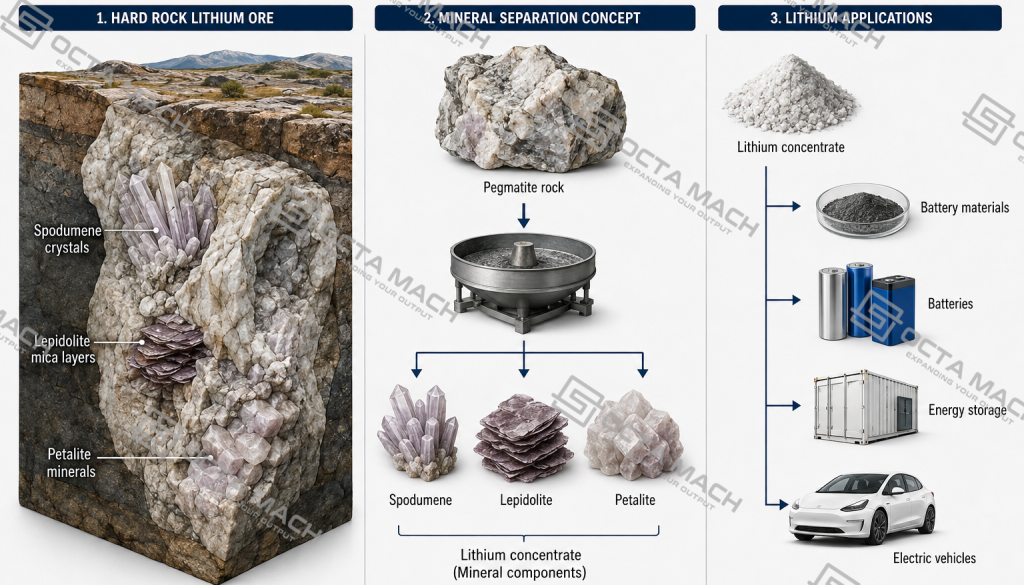
Understanding the differences between spodumene, lepidolite and petalite helps mining companies evaluate lithium ore characteristics, select appropriate processing methods and design a more suitable crushing and beneficiation route.
What Are Hard Rock Lithium Ores?
Lithium resources mainly come from three geological types:
| Lithium Resource Type | Main Characteristics | Typical Development Method |
| Brine Lithium | Lithium dissolved in saltwater deposits | Evaporation and chemical extraction |
| Clay Lithium | Lithium contained in clay minerals | Specialized extraction processes |
| Hard Rock Lithium | Lithium-bearing minerals in rock formations | Crushing, grinding and beneficiation |
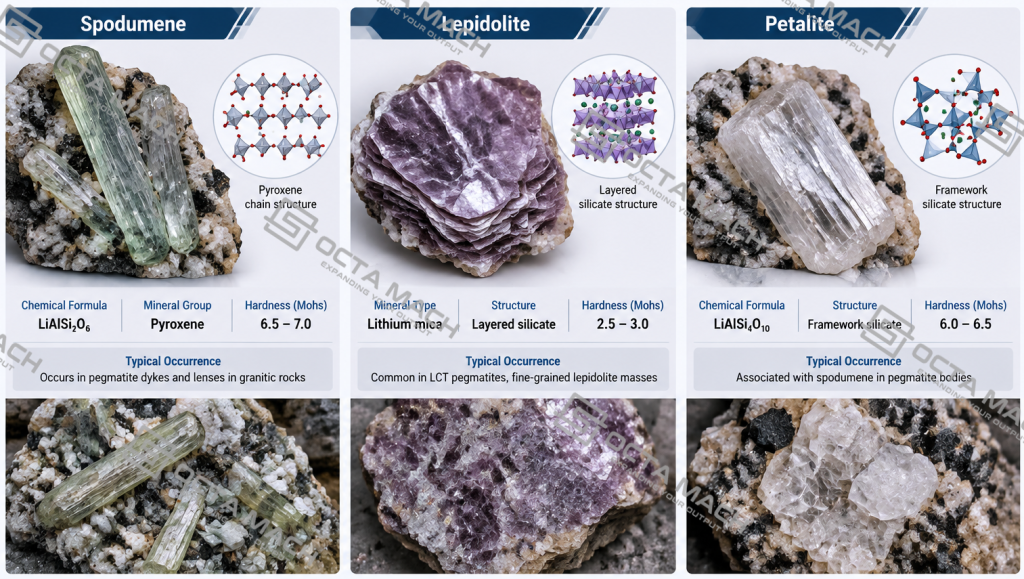
Hard-rock lithium deposits are commonly associated with pegmatite rocks, which are coarse-grained igneous rocks containing valuable minerals such as spodumene, feldspar, quartz and mica.
Compared with brine deposits, hard-rock lithium requires physical processing to separate lithium-bearing minerals from surrounding gangue minerals. The mineral composition determines the required crushing and beneficiation strategy.
Spodumene: The Main Hard Rock Lithium Mineral
Spodumene (LiAlSi₂O₆) is currently the most important lithium-bearing mineral for hard-rock lithium production. Large-scale lithium projects in countries such as Australia and Canada mainly rely on spodumene-bearing pegmatite deposits.
Spodumene belongs to the pyroxene mineral group and usually occurs together with quartz, feldspar and mica. It has a Mohs hardness of approximately 6.5–7, making it a relatively hard mineral that requires controlled size reduction before beneficiation.
| Property | Spodumene |
| Chemical formula | LiAlSi₂O₆ |
| Mineral group | Pyroxene |
| Typical deposit | Pegmatite |
| Mohs hardness | Approx. 6.5–7 |
| Common associated minerals | Quartz, feldspar, mica |
Because spodumene is hosted in hard rock, processing usually includes:
ROM Ore
→ Primary Crushing
→ Secondary Crushing
→ Screening
→ Grinding and Beneficiation
The crushing stage focuses on reducing large ore blocks while maintaining suitable particle size conditions for downstream mineral separation.
Lepidolite: A Lithium-Bearing Mica Mineral
Lepidolite is a lithium-bearing mica mineral that belongs to the mica group. Unlike spodumene, which has a pyroxene structure, lepidolite has a layered crystal structure containing lithium, potassium and fluorine.
Its general composition can be represented as:
K(Li,Al)₃(Si,Al)₄O₁₀(F,OH)₂
Lepidolite is often associated with other pegmatite minerals, but its layered structure creates different processing characteristics compared with spodumene.
| Property | Lepidolite |
| Mineral group | Lithium mica |
| Structure | Layered silicate |
| Main elements | Lithium, potassium, fluorine |
| Typical occurrence | Pegmatite deposits |
| Processing consideration | Mineral separation complexity |
The difference in crystal structure means lepidolite cannot always follow the same processing route as spodumene. Mineral liberation, particle size control and beneficiation methods must be evaluated according to the specific ore composition.
Petalite: A Lithium Silicate Mineral
Petalite (LiAlSi₄O₁₀) is another lithium-bearing silicate mineral commonly found in pegmatite deposits. It can occur with spodumene and other lithium minerals but has different physical and mineralogical characteristics.
| Property | Petalite |
| Chemical formula | LiAlSi₄O₁₀ |
| Mineral type | Lithium silicate |
| Typical occurrence | Pegmatite |
| Structure | Framework silicate |
| Processing consideration | Liberation and separation behavior |
Petalite generally requires evaluation of its association with surrounding minerals before selecting a processing method. The relationship between petalite and gangue minerals determines whether crushing, grinding or additional beneficiation stages are required.
Spodumene vs Lepidolite vs Petalite: Key Differences
Although spodumene, lepidolite and petalite are all lithium-bearing minerals found in hard-rock lithium deposits, they have different chemical compositions, crystal structures and processing characteristics. These differences affect how lithium minerals are liberated from host rock and influence the selection of crushing, grinding and beneficiation methods.
| Comparison Factor | Spodumene | Lepidolite | Petalite |
| Chemical formula | LiAlSi₂O₆ | K(Li,Al)₃(Si,Al)₄O₁₀(F,OH)₂ | LiAlSi₄O₁₀ |
| Mineral group | Pyroxene | Lithium mica | Lithium silicate |
| Crystal structure | Chain silicate | Layered silicate | Framework silicate |
| Typical occurrence | Pegmatite deposits | Pegmatite deposits | Pegmatite deposits |
| Main characteristic | Major hard-rock lithium source | Lithium-bearing mica with more complex separation behavior | Lithium silicate mineral with different liberation characteristics |
| Processing consideration | Hardness and liberation from host rock | Mineral structure and separation conditions | Mineral association and recovery conditions |
The main difference between these lithium minerals is not only their lithium content, but also how lithium is hosted inside the rock. Spodumene, as the most common commercial hard-rock lithium mineral, usually requires staged crushing and grinding to achieve suitable liberation. Lepidolite and petalite may require different beneficiation considerations because their mineral structures and associated minerals are different.
For lithium ore projects, understanding the dominant lithium mineral helps engineers determine suitable crushing stages, particle size control and downstream processing requirements.
How Do Lithium Ore Types Affect Crushing and Processing?
Although spodumene, lepidolite and petalite are all lithium-bearing minerals, their different mineral structures and associated rocks influence the crushing and beneficiation requirements. In hard-rock lithium deposits, crushing is mainly used to reduce large ROM ore into a suitable size range while improving the liberation of lithium minerals from gangue minerals such as quartz and feldspar.
The crushing process is usually designed according to ore hardness, feed size and mineral characteristics rather than the lithium mineral name alone. For example, spodumene-bearing pegmatite is often a hard and abrasive rock that requires reliable size reduction equipment before further concentration.
A typical hard-rock lithium crushing circuit includes:
ROM Ore → Vibrating Feeder → Jaw Crusher → Cone Crusher → Vibrating Screen.
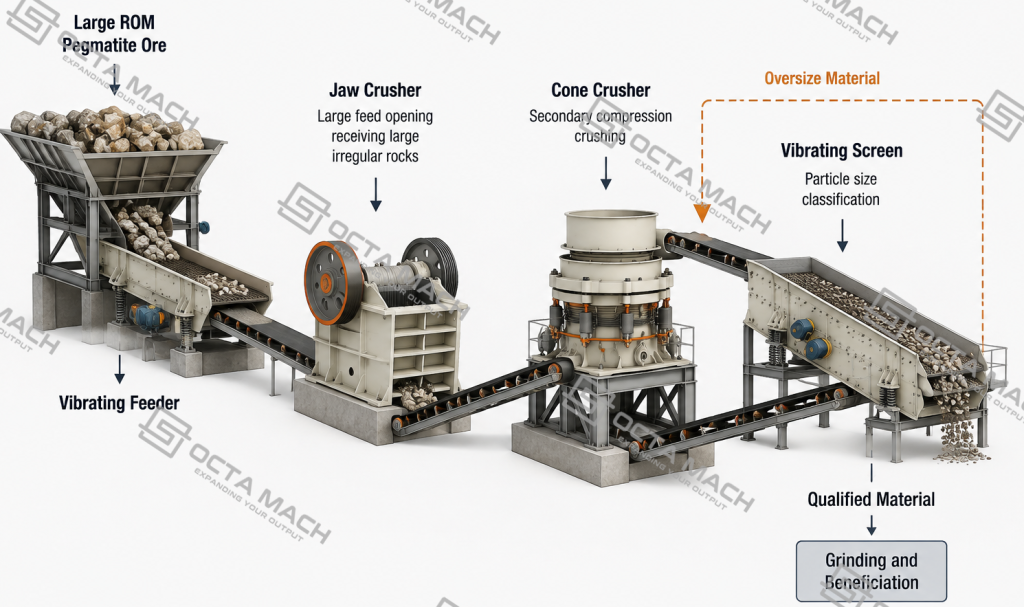
The Jaw Crusher is mainly used for primary crushing, handling large ore blocks from the mine and reducing them to a smaller feed size. The Cone Crusher is commonly used for secondary crushing, providing more controlled particle size reduction before screening, grinding or beneficiation.
| Crushing Stage | Main Purpose | Common Equipment |
| Primary Crushing | Reduce large ROM ore size | Jaw Crusher |
| Secondary Crushing | Improve particle size control | Cone Crusher |
| Screening | Separate qualified and oversized material | Vibrating Screen |
For lithium ore projects, the goal of crushing is not only size reduction but also preparing suitable feed conditions for downstream processing. Proper control of particle size helps improve mineral liberation and provides more stable conditions for lithium concentrate production.
How to Identify the Right Lithium Ore Processing Route?
Selecting a suitable lithium ore processing route depends on the characteristics of the deposit rather than applying the same method to every lithium project. Before designing a crushing and beneficiation system, engineers need to evaluate the lithium mineral type, ore properties and the requirements of the final concentrate.
| Evaluation Factor | Why It Matters |
| Lithium mineral type | Determines the suitable processing approach |
| Ore hardness and abrasiveness | Affects crusher selection and wear requirements |
| Mineral association | Influences liberation and separation difficulty |
| Feed size and production capacity | Determines crushing circuit design |
| Target product size | Defines crushing and screening requirements |
| Laboratory test results | Helps confirm processing feasibility |
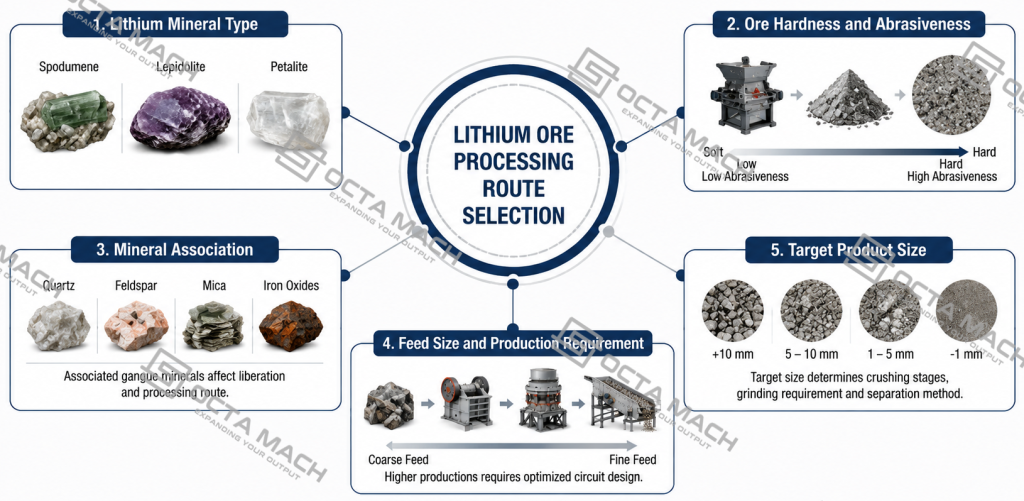
For hard-rock lithium projects, the crushing stage is an important part of preparing stable feed material for downstream beneficiation. A suitable crushing circuit should consider the relationship between ore characteristics, equipment performance and final processing requirements.
How OctaMach Supports Lithium Ore Crushing Projects
OctaMach focuses on providing crushing and screening equipment for mining applications, helping customers prepare suitable feed material for downstream lithium ore processing. Based on factors such as ROM feed size, ore hardness, abrasiveness and required output size, OctaMach can provide equipment options including jaw crushers, cone crushers and vibrating screens for hard-rock lithium ore preparation.
For lithium projects involving spodumene-bearing pegmatite or other hard-rock deposits, OctaMach can support the selection of suitable crushing stages and equipment configurations to achieve stable particle size control and reliable operation before beneficiation.
FAQ
What are the main types of lithium ore?
The main hard-rock lithium minerals include spodumene, lepidolite and petalite. They differ in chemical composition, crystal structure and processing requirements.
Why is spodumene the most important lithium ore?
Spodumene is one of the major commercial hard-rock lithium minerals because it contains recoverable lithium and is widely developed in pegmatite deposits.
Are spodumene and lepidolite processed in the same way?
No. Their mineral structures are different. Spodumene is a pyroxene mineral, while lepidolite is a lithium mica, resulting in different liberation and beneficiation requirements.
Does lithium ore require crushing before beneficiation?
Yes. Crushing reduces large rock particles and prepares suitable feed material for grinding and beneficiation processes.
Which factors affect lithium ore processing equipment selection?
Equipment selection depends on ore hardness, feed size, mineral composition, liberation requirements and the selected beneficiation method.