
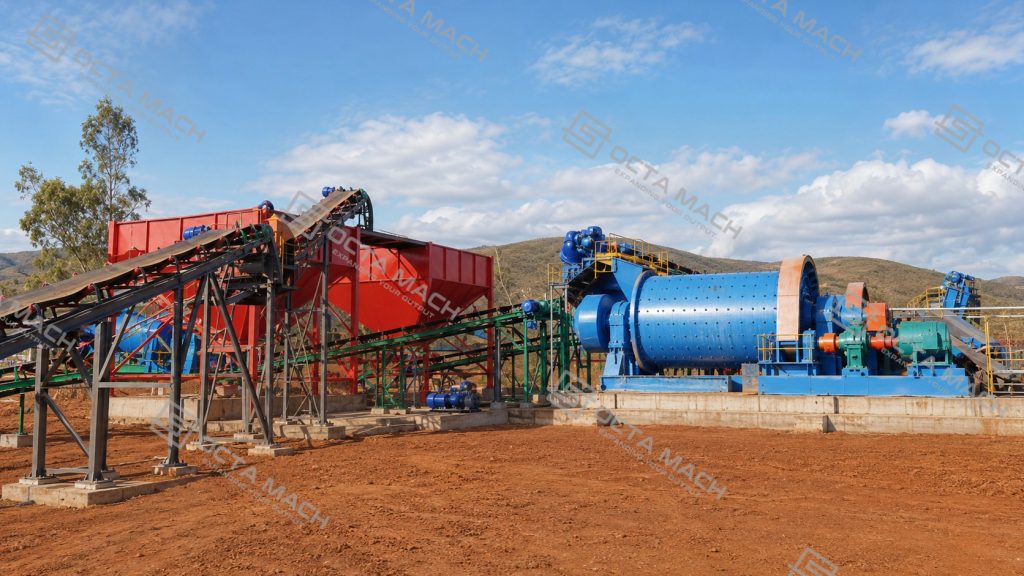
Octa Mach configured this copper processing plant to treat 150 tonnes of dry copper ore per hour through closed-circuit crushing, ball milling, classification and staged flotation. Located in Haut-Katanga Province, Democratic Republic of the Congo, the project is designed for chalcopyrite-dominant sulfide ore containing minor bornite and pyrite in quartz-rich host rock.
The circuit prepares a consistent grinding feed, liberates copper-bearing sulfides from gangue and separates the valuable minerals through rougher, scavenger and cleaner flotation. Concentrate thickening and filtration produce a transportable copper concentrate, while clarified water returns to the process.
The values presented in this project establish the engineering design basis. Final equipment sizes, reagent additions, concentrate grade and copper recovery must be confirmed through representative mineralogical analysis, comminution testing and locked-cycle flotation testwork.
Project Background
The project is located in Haut-Katanga Province, within the Central African Copperbelt. The selected deposit is treated as a predominantly sulfide copper resource containing chalcopyrite, minor bornite and pyrite in a quartz-rich host rock.
Flotation was selected because most of the copper occurs in sulfide minerals rather than as liberated metallic particles. Crushing reduces the mined material to a stable mill feed, but copper separation begins only after the minerals have been sufficiently liberated during grinding.
| Project item | Design basis |
|---|---|
| Project location | Haut-Katanga Province, DRC |
| Plant application | Sulfide copper ore beneficiation |
| Nominal dry-feed capacity | 150 t/h |
| Scheduled operation | 20 h/day |
| Scheduled operating period | 300 days/year |
| Nominal annual feed capacity | 900,000 t/year |
| Maximum ROM lump size | 500 mm |
| Crushing circuit product | P80 ≤12 mm |
| Primary grinding target | P80 75 µm |
| Main separation method | Froth flotation |
| Final product | Filtered copper concentrate |
| Tailings treatment | Thickening and process-water recovery |
Annual capacity is calculated from scheduled operating time. It is not a guarantee of yearly output.
| Capacity calculation | Value |
|---|---|
| Nominal dry throughput | 150 t/h |
| Scheduled operating hours | 6,000 h/year |
| Calculated annual feed | 900,000 t/year |
| Required plant availability for scheduled output | Project-specific |
| Performance test feed basis | Dry tonnes |
Weather interruptions, power supply, ore competency, maintenance, spare-parts availability and operator performance can affect annual production.
Ore Characteristics Used for Process Design
Equipment selection began with the physical and mineralogical properties of the feed. Material described only as copper ore does not provide enough information to select a crusher, size a ball mill or define a flotation circuit.
The design assumes that sulfide minerals contain most of the recoverable copper. If the proportion of malachite, chrysocolla or other oxide minerals increases significantly, the flotation response may change and a separate oxide-ore route may be required.
| Feed characteristic | Project design basis | Engineering use |
|---|---|---|
| Maximum ROM size | 500 mm | Hopper, feeder and jaw crusher sizing |
| Feed moisture | 3–6% | Dry crushing and chute design |
| Loose bulk density | 1.70–1.85 t/m³ | Storage and conveyor calculations |
| Solid particle density | 2.75–2.95 t/m³ | Slurry and mass-balance calculations |
| Unconfined compressive strength | 140–190 MPa | Crusher selection |
| Bond Ball Mill Work Index | 14–18 kWh/t | Grinding power estimate |
| Abrasion Index | 0.30–0.50 | Wear-liner and media assessment |
| Head grade | 1.3–2.0% Cu | Metallurgical design range |
| Design calculation grade | 1.65% Cu | Example mass balance |
| Sulfide copper distribution | ≥85% of total copper | Supports conventional sulfide flotation |
| Oxide copper distribution | ≤10% of total copper | Upper basis for the selected circuit |
| Primary liberation target | P80 75 µm | Initial flotation testwork basis |
| Clay content | ≤5% | Screening, slurry handling and flotation control |
These figures must be replaced by certified project data before the equipment configuration is released for manufacturing.
Representative testwork should determine:
- Complete feed-size distribution;
- Copper grade by size fraction;
- Chalcopyrite, bornite, pyrite and oxide-mineral distribution;
- Copper association with gangue minerals;
- Liberation at different grinding sizes;
- Bond Work Index and abrasion characteristics;
- Flotation kinetics and maximum recoverable copper;
- Concentrate grade versus recovery;
- Reagent response and water-quality sensitivity;
- Tailings mineralogy and settling characteristics.
Why This Ore Requires Flotation
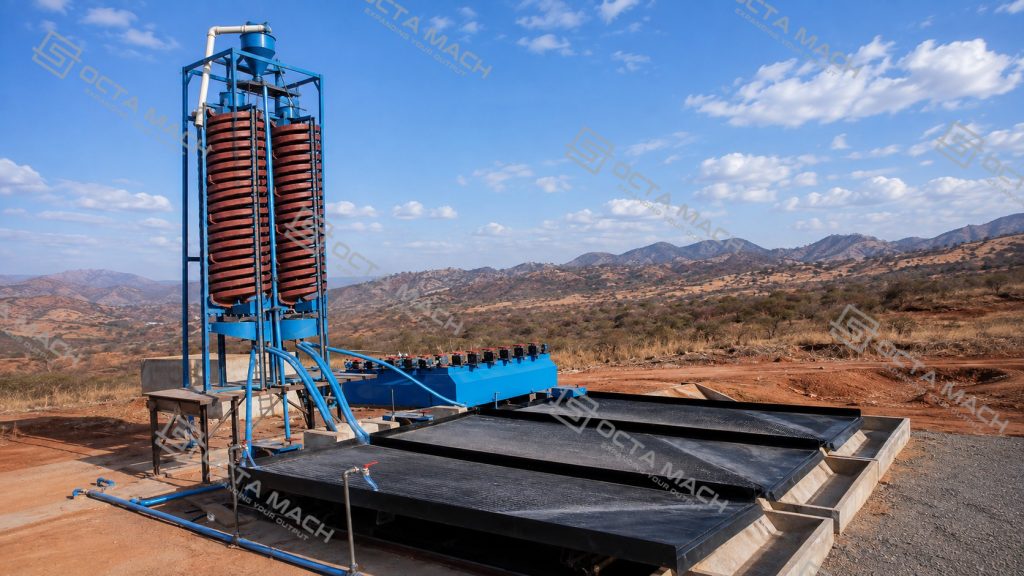
Chalcopyrite has a greater density than most silicate gangue, but density separation alone does not normally provide adequate copper recovery from finely disseminated ore. Flotation separates minerals according to their surface properties after grinding exposes sufficient copper-sulfide surface.
The selected process contains:
- Slurry conditioning before flotation;
- Rougher cells for rapid recovery of liberated copper sulfides;
- Scavenger cells for recovering copper remaining in rougher tailings;
- Cleaner stages for increasing concentrate grade;
- Regrinding provision if the rougher concentrate remains insufficiently liberated;
- Concentrate thickening and filtration;
- Tailings thickening and process-water recovery.
A flotation machine does not establish recovery by itself. Mineral liberation, residence time, air dispersion, froth depth, pulp density, pH and reagent conditions must work together.
If the feed changes from sulfide-dominant ore to oxide-rich ore, the process should be reassessed. Conventional sulfide flotation conditions cannot be transferred directly to malachite- or chrysocolla-rich material without specific testwork.
Crushing and Screening Circuit
Run-of-mine material enters a feed hopper fitted with a grizzly. The vibrating feeder controls the load entering the jaw crusher and removes material that does not require primary crushing.
Primary crusher discharge moves to the secondary cone crusher and vibrating screen. The screen sends correctly sized material to the fine-ore storage bin, while oversize returns to the cone crusher.
| Crushing stage | Feed condition | Required product | Control variable |
|---|---|---|---|
| ROM reception | ≤500 mm | Controlled feeder discharge | Hopper level |
| Grizzly separation | Project-specific opening | Remove undersize before jaw crushing | Aperture and bar condition |
| Primary crushing | ROM oversize | P80 approximately 110–130 mm | Closed-side setting |
| Secondary crushing | Primary crusher product | Screenable product | Choke-fed operation |
| Vibrating screening | Mixed secondary product | P80 ≤12 mm | Deck loading and aperture |
| Oversize return | Material above target size | Return to cone crusher | Circulating load |
| Fine-ore storage | P80 ≤12 mm | Stable ball mill feed | Bin level |
Compression crushing was selected because the feed is hard and abrasive. Repeated impact crushing could increase wear and produce excessive fines without improving copper liberation.
Closed-circuit crushing provides several operational benefits:
- Controls the maximum size entering the grinding circuit;
- Returns only screen oversize for additional crushing;
- Prevents repeated crushing of correctly sized material;
- Stabilizes mill feed size and mill power draw;
- Allows crusher and screen performance to be measured separately;
- Reduces blockages caused by uncontrolled coarse feed.
The screen must provide enough effective area for both new feed and circulating material. Crusher capacity alone does not determine the final throughput of a closed circuit.
Main Equipment Configuration
The copper mining equipment is arranged as one continuous processing system rather than as a collection of independent machines. Equipment duty, transfer elevations, access platforms and maintenance clearances must be coordinated during layout design.
| Process section | Main equipment | Quantity | Design duty |
|---|---|---|---|
| ROM reception | Feed hopper and grizzly | 1 set | Receive and regulate mined ore |
| Controlled feeding | Vibrating feeder | 1 | Maintain stable primary crusher feed |
| Primary crushing | Jaw crusher | 1 | Reduce maximum ROM lumps |
| Secondary crushing | Cone crusher | 1 | Prepare material for final screening |
| Screening | Vibrating screen | 1 | Produce ≤12 mm mill feed |
| Intermediate storage | Fine-ore bin | 1 | Separate crushing from grinding |
| Mill feeding | Belt feeder and belt scale | 1 line | Control dry tonnes entering the mill |
| Grinding | Ball mill | 1 line | Liberate copper-bearing sulfides |
| Classification | Hydrocyclone cluster | 1 set | Separate flotation feed from coarse return |
| Conditioning | Agitation tanks | 2 sets | Control pulp chemistry and reagent contact |
| Rougher flotation | Mechanical flotation cells | 1 bank | Recover readily floatable copper sulfides |
| Scavenger flotation | Mechanical flotation cells | 1 bank | Reduce copper loss in rougher tailings |
| Cleaner flotation | Mechanical flotation cells | 2 stages | Upgrade copper concentrate |
| Concentrate thickening | High-rate thickener | 1 | Increase concentrate solids content |
| Concentrate filtration | Pressure filter | 1 | Produce transportable concentrate |
| Tailings thickening | High-rate thickener | 1 | Recover process water |
| Water return | Reclaim-water pumps | Duty/standby | Return clarified water to the plant |
Major pumps should have duty and standby arrangements where a single failure would stop the complete wet-processing circuit.
Chutes, pipelines and conveyors must form a continuous material path. Transfer points should also provide access for inspection, cleaning and liner replacement without requiring unrelated equipment to be dismantled.
Grinding and Classification
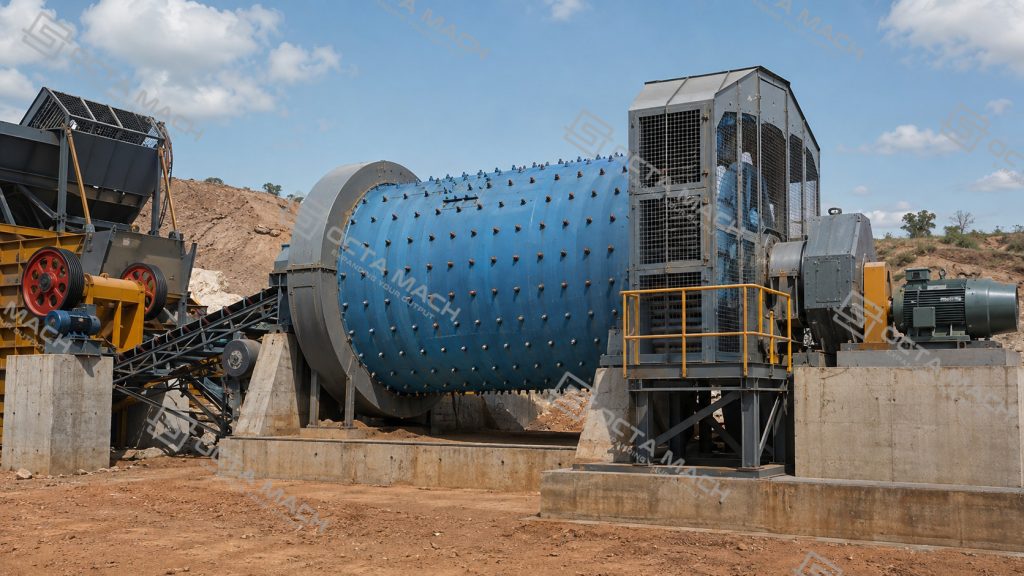
The ball mill reduces the crushing product to the preliminary liberation target. A hydrocyclone cluster separates sufficiently fine material from coarse particles that require further grinding.
Stable classification is essential. When cyclone pressure, feed density or apex condition changes, the flotation feed becomes coarser or finer even if the mill feed rate remains constant.
| Grinding parameter | Initial design target | Verification |
|---|---|---|
| Dry new-feed rate | 150 t/h | Calibrated belt scale |
| Mill feed size | F80 10–12 mm | Composite screen analysis |
| Flotation feed size | P80 75 µm | Laboratory particle-size analysis |
| Permitted operating range | P80 68–83 µm | Approximately ±10% from target |
| Mill discharge solids | 70–75% by mass | Density measurement |
| Cyclone overflow solids | 30–35% by mass | Density and moisture correction |
| Indicative circulating load | 250–350% | Sampled stream calculation |
| Grinding specific energy | 13–18 kWh/t | Power meter and dry throughput |
| Cyclone feed pressure | 80–140 kPa | Pressure transmitter |
| Overflow-size monitoring | Once per shift | Composite sampling |
A finer grind is not automatically better. Overgrinding can produce copper-bearing slimes, reduce flotation selectivity, increase reagent consumption and accelerate media and liner wear.
The final grinding target must be selected from mineral liberation and recovery tests rather than from a generic particle size. Size-by-size copper assays should identify whether losses are associated with coarse locked particles or fine liberated material.
Flotation Circuit
Cyclone overflow enters the conditioning section, where pulp density, pH and reagent additions are stabilized before flotation. Rougher cells recover readily floatable copper sulfides, while scavenger cells treat the rougher tailings.
Rougher concentrate passes through cleaner flotation to increase copper grade. If composite particles prevent the cleaner section from reaching the required grade, the circuit can include concentrate regrinding.
| Flotation variable | Preliminary operating range | Status |
|---|---|---|
| Feed particle size | P80 68–83 µm | Testwork required |
| Flotation feed solids | 30–35% by mass | Initial design basis |
| Conditioning time | 3–6 min | Testwork required |
| Rougher residence time | 12–18 min | Kinetics-dependent |
| Scavenger residence time | 8–12 min | Kinetics-dependent |
| Total rougher–scavenger time | 20–30 min | Initial sizing range |
| Pulp pH | 9.0–10.5 | Mineralogy-specific |
| Collector dosage | 20–60 g/t | Testwork required |
| Frother dosage | 15–35 g/t | Testwork required |
| Cleaner stages | 2 | Concentrate-grade dependent |
| Target copper concentrate | 24–28% Cu | Project acceptance target |
| Target copper recovery | 88–92% | Subject to agreed test ore |
The operating team should adjust air rate, froth depth and reagent dosage against concentrate grade, recovery and tailings loss. Increasing froth mass pull may improve short-term recovery but dilute the concentrate with pyrite and entrained gangue.
The flotation machine for copper recovery requires stable slurry feed, uniform air dispersion and adequate residence time.
- Stable slurry feed;
- Uniform air dispersion;
- Adjustable froth depth;
- Controlled impeller speed;
- Adequate residence time;
- Accessible launders and valves;
- Safe access for inspection and maintenance;
- Sampling points at feed, concentrate and tailings streams.
Reagent dosage must be stated per dry tonne of feed. Pump calibration and regular solution-strength checks are required because an indicated pump speed does not prove the actual reagent addition rate.
Concentrate and Tailings Dewatering
Cleaner concentrate flows to the concentrate thickener. Thickened underflow is pumped to the pressure filter, while overflow returns to the process-water system.
The tailings thickener recovers additional water before tailings discharge. Flocculant selection and thickener sizing must be confirmed by settling tests using representative flotation tailings.
| Dewatering parameter | Preliminary design target |
|---|---|
| Concentrate thickener feed solids | 10–20% by mass |
| Concentrate thickener underflow | 55–65% by mass |
| Filter cake moisture | ≤10–12% |
| Tailings thickener feed solids | 25–35% by mass |
| Tailings underflow solids | 50–60% by mass |
| Process-water recovery | ≥70% |
| Thickener overflow clarity | Project-specific acceptance value |
| Flocculant dosage | Settling-test dependent |
Concentrate moisture requirements depend on storage, road transport and the receiving smelter. The acceptable value must therefore be included in the project specification rather than treated as a universal limit.
Poor thickener overflow clarity can return suspended solids and residual reagents to the grinding and flotation circuits. Recycled water quality should therefore be monitored together with water recovery.
Metallurgical Mass Balance
Plant performance must be calculated on a dry-mass basis. Feed, concentrate and tailings samples should represent the same operating period and be corrected for moisture before calculating metal recovery.
The following mass balance demonstrates the design method. It is a calculation example rather than a reported commissioning result.
| Example calculation item | Value |
|---|---|
| Dry plant feed | 150.00 t/h |
| Feed copper grade | 1.65% Cu |
| Copper in feed | 2.475 t/h |
| Assumed copper recovery | 90.0% |
| Copper in concentrate | 2.228 t/h |
| Concentrate copper grade | 25.0% Cu |
| Dry concentrate production | 8.91 t/h |
| Dry tailings production | 141.09 t/h |
| Copper remaining in tailings | 0.248 t/h |
| Calculated tailings grade | 0.175% Cu |
| Concentrate mass yield | 5.94% |
| Metal-balance closure | 100.0% |
The calculation shows why concentrate grade and recovery must be assessed together. A higher concentrate grade can coincide with lower total copper recovery if too much copper is rejected with the tailings.
| Performance indicator | Calculation |
|---|---|
| Dry throughput | Wet feed × (1 − moisture fraction) ÷ test duration |
| Copper in feed | Dry feed mass × feed copper grade |
| Copper in concentrate | Dry concentrate mass × concentrate grade |
| Mass yield | Dry concentrate mass ÷ dry feed mass × 100 |
| Copper recovery | Copper in concentrate ÷ copper in feed × 100 |
| Tailings loss | Dry tailings mass × tailings copper grade |
| Specific energy | Operating energy ÷ dry feed tonnes |
| Water intensity | Fresh-water input ÷ dry feed tonnes |
| Availability | Available operating hours ÷ scheduled hours × 100 |
A valid metallurgical balance requires synchronized sampling, dry-mass correction and representative assays. Concentrate and tailings results collected from different operating periods should not be combined.
Power and Water Requirements
Grinding normally represents the largest electrical load. Pumps, flotation cells, air systems, thickeners and filtration equipment add substantial continuous demand.
| Utility parameter | Preliminary project basis |
|---|---|
| Connected plant power | 3.0–3.6 MW |
| Expected operating demand | 2.5–3.1 MW |
| Grinding specific energy | 13–18 kWh/t |
| Total plant specific energy | 19–25 kWh/t |
| Gross process-water demand | 1.5–2.0 m³/t |
| Target water recovery | ≥70% |
| Fresh-water makeup | 0.4–0.7 m³/t |
| Electrical frequency | 50 Hz |
| Instrument air pressure | 600–700 kPa |
| Minimum service-water pressure | 300 kPa |
Actual requirements depend on ore hardness, transfer elevations, pump head, pipeline length, flotation-cell volume and water-return efficiency.
Because the project is in DRC, the electrical design should evaluate supply stability, emergency shutdown requirements and standby power for lubrication, control and critical slurry services. Controlled shutdown sequences are particularly important where settled solids can block pipelines or damage pumps after a power interruption.
Sampling and Process Control
A copper processing plant cannot be controlled only from crusher amperage and mill power. Operators must track particle size, slurry density, copper grade and metal recovery across the complete circuit.
Recommended sampling points include:
- ROM feed;
- Final crushing product;
- Ball mill feed;
- Hydrocyclone overflow and underflow;
- Flotation feed;
- Rougher concentrate and tailings;
- Scavenger concentrate and final tailings;
- Final cleaner concentrate;
- Concentrate thickener underflow;
- Filter cake;
- Process-water return.
| Measurement | Minimum routine frequency | Control purpose |
|---|---|---|
| Dry-feed rate | Continuous | Throughput control |
| Crushing product sizing | Once per shift | Confirm mill feed condition |
| Cyclone feed pressure | Continuous | Classification stability |
| Cyclone overflow density | Hourly | Flotation feed control |
| Grinding product P80 | Once per shift | Confirm liberation target |
| Flotation feed grade | Shift composite | Calculate copper input |
| Final concentrate grade | Shift composite | Control product quality |
| Final tailings grade | Shift composite | Identify copper loss |
| Reagent addition | Continuous with shift verification | Maintain dosage per dry tonne |
| Filter cake moisture | Each production batch | Confirm transport condition |
| Plant power | Continuous | Calculate specific energy |
| Process-water flow | Continuous or hourly | Maintain the water balance |
Sampling equipment should cut the complete stream at a constant interval. Samples collected only from the surface or edge of a moving stream can produce biased grade and size results.
Abnormal tailings grade should be investigated against grinding size, flotation-feed density, air rate, reagent dosage and mineralogical changes rather than corrected by changing one operating variable without supporting data.
Performance Acceptance
Acceptance testing should begin only after the crushing, grinding and flotation circuits reach stable operating conditions. The test ore must remain within the agreed feed envelope.
The values below are proposed project criteria rather than universal standards for every copper processing plant.
| Acceptance item | Proposed criterion | Verification method |
|---|---|---|
| Dry-feed throughput | ≥150 t/h | Calibrated feed measurement |
| Maximum ROM size | ≤500 mm | Feed inspection |
| Crushing circuit product | P80 ≤12 mm | Composite screen analysis |
| Flotation feed size | P80 68–83 µm | Laboratory size analysis |
| Screen efficiency | ≥90% | Size-by-size sampling |
| Copper concentrate grade | ≥24% Cu | Composite concentrate assay |
| Copper recovery | ≥88% | Metallurgical balance |
| Final tailings grade | Project-specific | Composite tailings assay |
| Mass-balance closure | 98–102% | Dry-mass balance |
| Copper-balance closure | 95–105% | Feed, concentrate and tailings assays |
| Process-water recovery | ≥70% | Calibrated water balance |
| Total specific energy | ≤25 kWh/t | Power meter and dry tonnes |
| Filter cake moisture | ≤12% | Moisture test |
| Mechanical availability | ≥92% | Approved operating log |
| Continuous performance test | 72 h | Agreed test procedure |
The concentrate-grade and recovery criteria apply only when feed grade, mineralogy, hardness, oxidation, moisture and particle-size distribution remain within the contractually defined test conditions.
Test instrumentation should be calibrated before the performance run. Stoppages caused by external power loss, unavailable feed or downstream transport restrictions should be identified separately from equipment-related downtime.
Maintenance Access and Wear Parts
Hard, abrasive copper ore increases wear on crusher liners, screen media, mill liners, grinding media, cyclone components and slurry-pump wet ends. The plant layout therefore provides lifting access, isolation points and maintenance clearance around the principal wear components.
Key provisions include:
- Replaceable liners at high-impact transfer points;
- Lifting and handling access for crusher and mill liners;
- Duty and standby pumps for critical slurry and water services;
- Maintenance platforms around cyclones, flotation cells and concentrate launders.
Wear performance should be recorded in operating hours and tonnes processed. Calendar time alone does not provide a reliable comparison when ore abrasiveness and plant throughput change.
FAQ
Q: What information is required before selecting equipment for a copper processing plant?
A: Equipment selection requires the maximum lump size, complete feed-size distribution, moisture, bulk density, UCS, abrasion characteristics, Bond Work Index, copper grade and detailed mineralogy. Representative flotation and settling tests are also required to determine the grinding target, copper recovery, concentrate grade, flotation residence time and thickener performance.
Q: Why is a ball mill used before copper flotation?
A: The ball mill liberates chalcopyrite and other copper sulfides from quartz and silicate gangue. Crushing controls the feed size but normally does not provide sufficient mineral liberation for flotation. The preliminary target for this project is a P80 of 75 µm, with an operating range of 68–83 µm, subject to mineral liberation testwork.
Q: Can the same flotation machine process sulfide and oxide copper ore?
A: The mechanical equipment may be similar, but the process conditions are not automatically interchangeable. Oxide copper minerals respond differently from chalcopyrite and other sulfides. They may require sulfidization, different reagent conditions or a separate leaching route. Mineralogical and flotation tests must quantify the sulfide and oxide copper distribution before the circuit is finalized.
Q: Can the plant always process 150 tonnes per hour?
A: The 150 t/h rating applies to dry feed within the specified size, hardness, moisture, abrasion and grinding envelope. Harder ore, excessive clay, unstable screening or a finer liberation target can reduce sustainable throughput. Capacity should be verified through a continuous performance test using ore that meets the agreed feed conditions.