
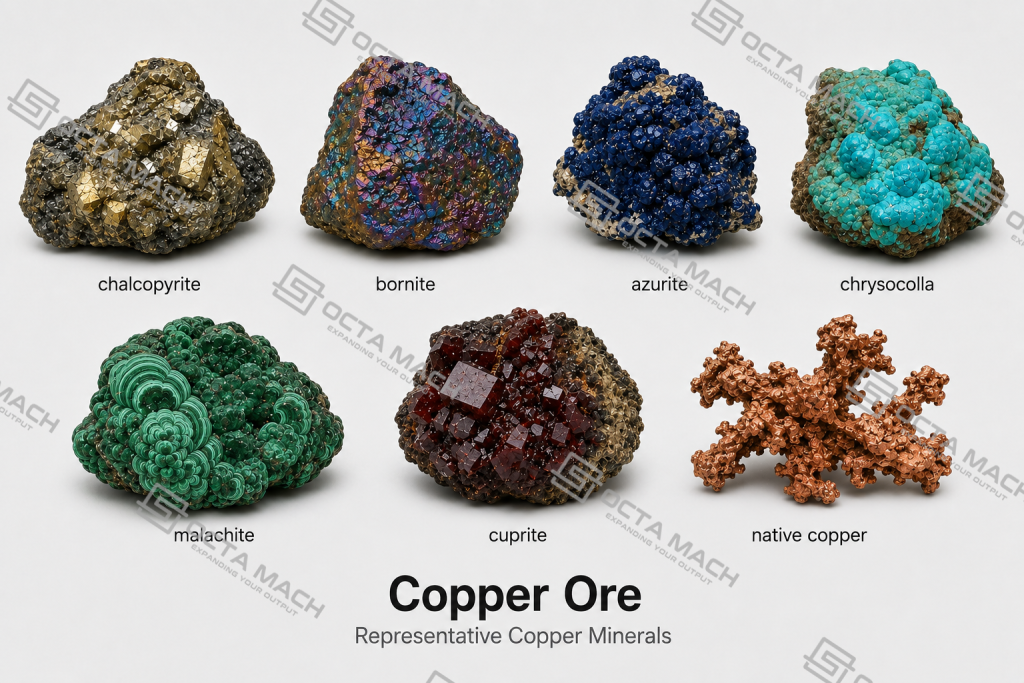
Copper ore is a copper-bearing rock containing copper minerals together with gangue minerals such as quartz, feldspar, carbonates, clay and other host-rock components. It is not one material with one fixed hardness. Chalcopyrite, bornite, chalcocite and covellite are common sulfide copper minerals, while malachite, azurite, chrysocolla and cuprite occur mainly in oxidized zones. The mineral species, host rock and weathering condition together determine how difficult the ore is to crush, grind and separate.
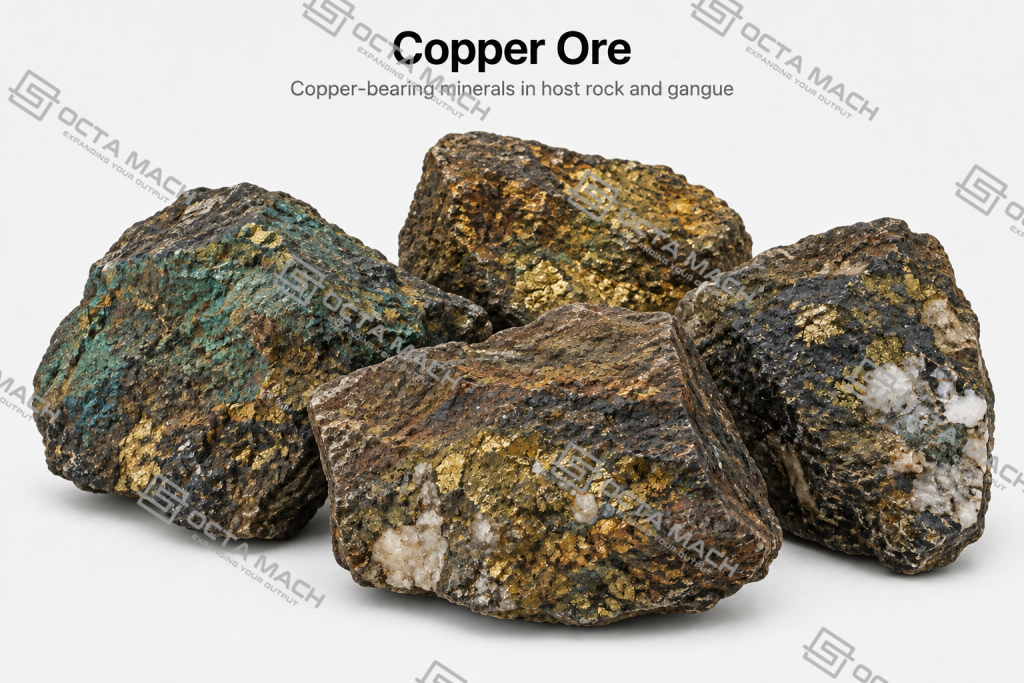
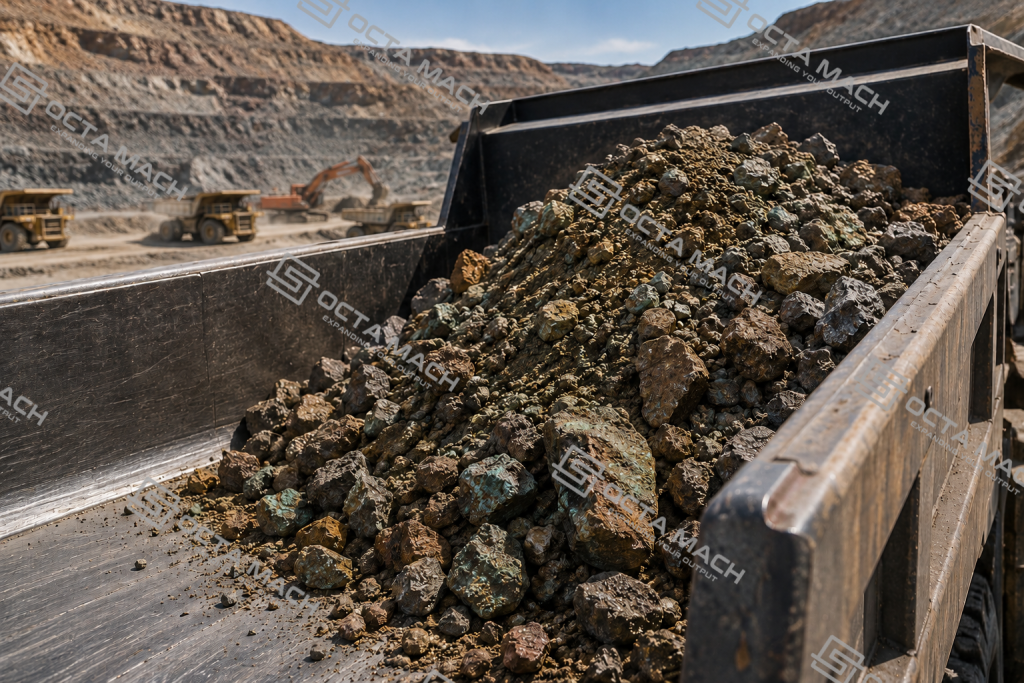
For a preliminary hard-rock crushing plant, run-of-mine copper ore may include fines together with irregular lumps several hundred millimetres in size. A 0–500 mm or 0–600 mm ROM feed range can be used as a practical reference for many jaw-crusher-fed layouts, but it should not be treated as a universal copper ore specification. Actual feed top size depends on mining method, blast fragmentation, ore competency and handling conditions, and larger operations may deliver substantially coarser material. The maximum lump size and feed-size distribution should therefore be confirmed before selecting the jaw crusher feed opening, feeder capacity and downstream crushing stages.
Copper Ore Characteristics Before Crusher Selection
Copper-bearing minerals themselves are often only moderately hard, but this does not mean that copper ore is necessarily easy to crush. The crushing equipment works on the whole rock, including its gangue and host rock. Quartz-rich or competent intrusive host rocks can make a chalcopyrite ore considerably more abrasive than the Mohs hardness of chalcopyrite alone would suggest.
| Copper Ore Group | Representative Minerals | Representative Mineral Hardness | Typical Ore Character | Main Processing Impact |
| Sulfide Copper Ore | Chalcopyrite, bornite, chalcocite, covellite | Approx. Mohs 1.5–4.0 depending on mineral | Frequently disseminated through competent hard rock; may contain quartz, pyrite and other sulfides | Usually requires staged crushing followed by fine grinding and flotation |
| Oxide Copper Ore | Malachite, azurite, chrysocolla, cuprite | Malachite about Mohs 3.5–4; other minerals vary | Often occurs in weathered near-surface zones and may contain clay, fines or carbonate gangue | Pre-screening or washing may be important; leaching or project-specific flotation may follow crushing |
| Mixed Copper Ore | Sulfide + oxide minerals | Variable | Mineral phases and weathering may change through the deposit | Final flowsheet usually requires copper-phase analysis and metallurgical testwork |
Representative mineral hardness values describe the individual copper minerals, not the crushing resistance of the complete ROM rock. Chalcopyrite is about Mohs 3.5–4, bornite about 3.0–3.25, chalcocite about 2.5–3.0 and covellite about 1.5–2.0. Malachite is approximately Mohs 3.5–4.0.
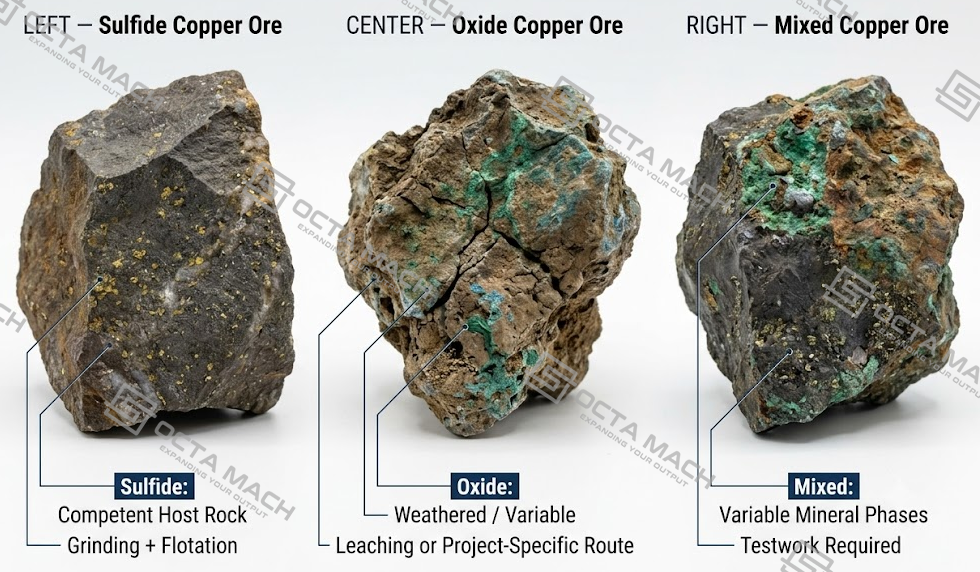
The difference between oxide and sulfide ore also matters downstream. Copper sulfides commonly respond to flotation after mineral liberation, while oxide minerals can require leaching or specialized flotation. Oxide ores can also contain fine particles, clay and complex gangue that change both crushing preparation and beneficiation behaviour.
Typical Copper Ore Feed Size and Crushing Targets
There is no single required copper-ore particle size. Each crushing stage prepares material for the next stage, while the final crushing target is controlled by the grinding, flotation or leaching circuit.
| Processing Position | Indicative Size Range | Engineering Purpose |
| ROM copper ore | About 0–500 / 600 mm for many preliminary jaw-fed layouts | Defines feeder, grizzly and primary crusher opening |
| Primary crushed ore | Commonly around 100–200 mm | Produces manageable feed for secondary crushing or coarse-ore storage |
| Secondary / tertiary crushed ore | Commonly about 10–40 mm | Prepares feed for grinding, HPGR or project-specific leaching preparation |
| Sulfide flotation grinding feed after milling | Commonly in the 0.01–0.10 mm range (10–100 μm), depending on liberation | Liberates copper sulfide minerals before flotation |
| Heap-leach preparation | Normally substantially coarser than flotation grinding | Maintains permeability while exposing oxide copper minerals to leach solution |
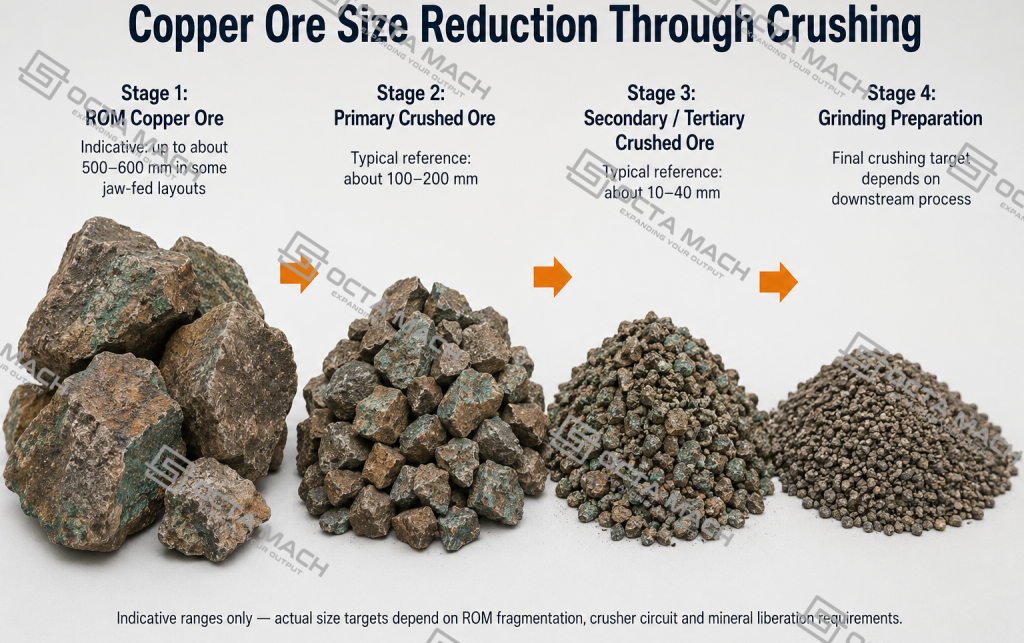
These ranges are design references rather than guaranteed outputs. Real copper concentrators show substantial variation. Actual copper concentrators use different crushing targets depending on ROM size, ore competency and downstream grinding design. Primary crushed ore may remain in the roughly 100–200 mm range, while secondary or tertiary crushing commonly reduces the material further before milling.Historical copper concentrators have also used final crushing products near 13 mm before grinding.
For sulfide copper ore, the final grinding size should be determined by the mineral liberation required for flotation, rather than by a fixed copper-ore specification. In many projects, grinding may reduce the ore to below about 100 μm, but the actual target depends on mineral texture, liberation characteristics, ore grindability and metallurgical testwork.
Copper Ore Crushing Process
A typical hard-rock copper ore crushing circuit uses staged compression rather than attempting the full size reduction in one crusher:
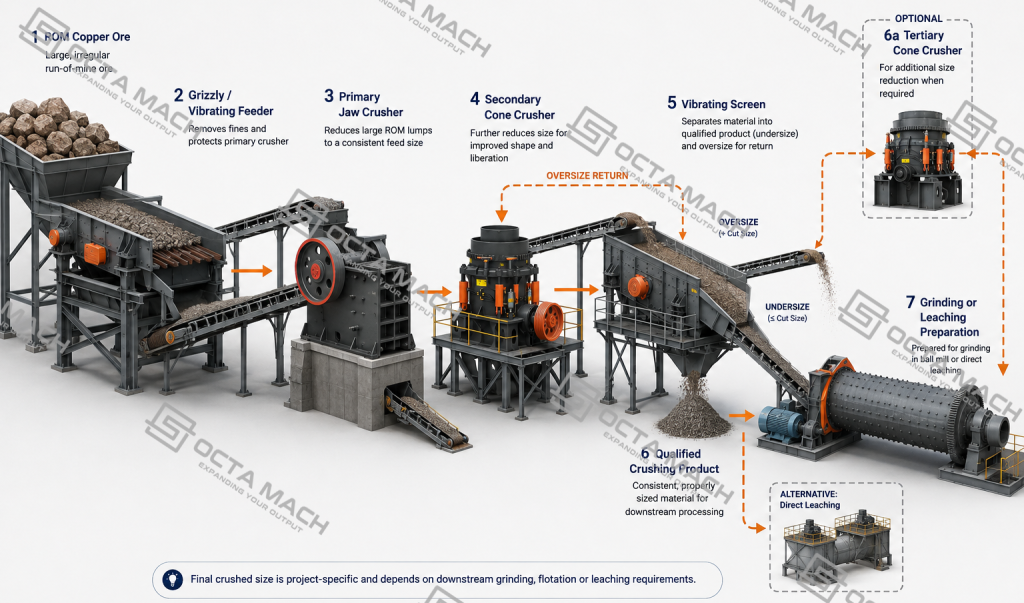
ROM Copper Ore → Feeding / Pre-Screening → Primary Jaw Crushing → Secondary Cone Crushing → Screening → Oversize Return → Optional Tertiary Crushing → Grinding or Leaching Preparation.
Feeding and Pre-Screening
ROM ore first enters a receiving hopper and vibrating or grizzly feeder. Stable feeding protects the primary crusher from large fluctuations in instantaneous load.
When the ROM contains substantial undersize, soil, weathered fines or clay, a grizzly or pre-screen can remove material that does not need primary crushing. Wet or clay-rich oxide ore may require additional washing or desliming rather than simply adding more crushing capacity.
Primary Jaw Crushing
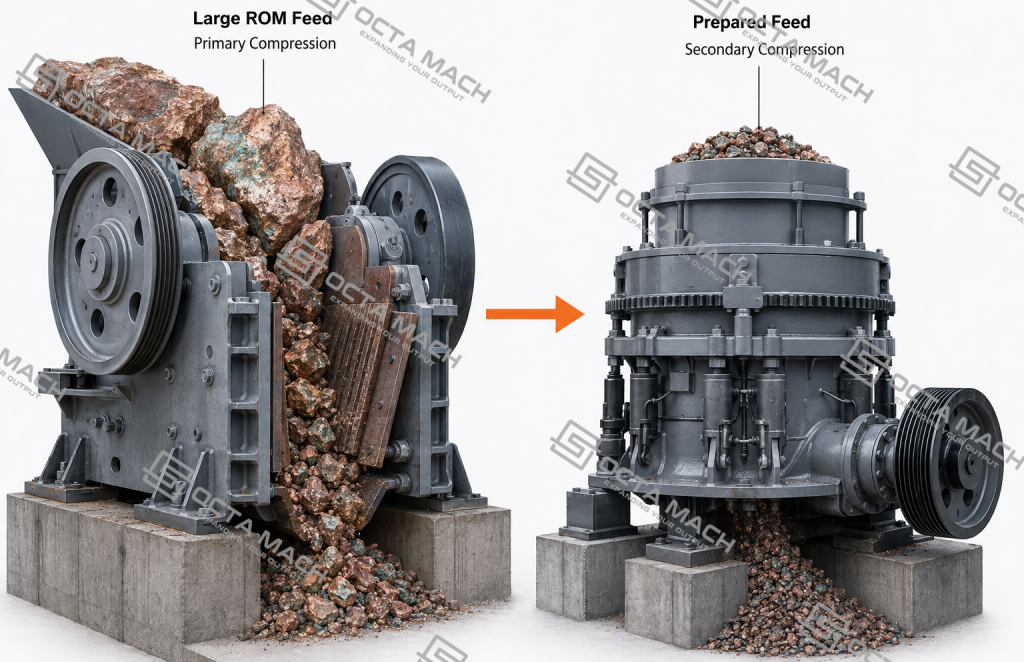
The Jaw Crusher receives the largest irregular ROM lumps and reduces them by compression between the fixed and moving jaw.Its purpose is not to produce the final beneficiation size. The primary stage creates a consistent feed suitable for secondary crushing and conveying.
Crusher selection should therefore start with:
- maximum ROM lump size;
- feed-size distribution;
- ore competency;
- abrasiveness;
- moisture and clay content;
- required primary discharge;
- required plant throughput.
General mineral-processing references describe primary crushing as the first of two or three crushing stages, with jaw and gyratory crushers commonly handling large ROM rock.
Secondary Cone Crushing
After primary reduction, competent copper ore is suitable for continuous compression crushing in a Cone Crusher.
The secondary stage should be selected around the prepared feed size rather than the original ROM size. Important controls include cavity profile, closed-side setting, feed distribution, power demand, liner condition and downstream screen capacity.
For harder or higher-throughput circuits, a Single-Cylinder Cone Crusher can handle an intermediate reduction duty before a Multi-Cylinder Hydraulic Cone Crusher performs the next controlled reduction stage.
Closed-Circuit Crushing and Screening
The crushed ore is classified by a Vibrating Screen. Material below the selected cut size leaves the crushing circuit, while oversize returns to the cone crusher.
Cone Crusher → Vibrating Screen → Oversize Return → Cone Crusher.
This closed circuit prevents oversize particles from entering grinding while avoiding unnecessary re-crushing of already qualified material.
Crusher load in a closed circuit is therefore not equal to fresh plant feed:
Crusher duty = fresh feed + circulating oversize
A narrow CSS does not by itself guarantee a narrow final particle size. Screen aperture, screen efficiency, crusher chamber, feed gradation and circulating load all influence the actual crushing product. Mineral-processing references likewise describe the final crushing stage operating in closed circuit when controlled downstream size is required.
Optional Tertiary Crushing
A third compression-crushing stage can be added when the required mill feed is substantially finer than the secondary crusher can efficiently produce.
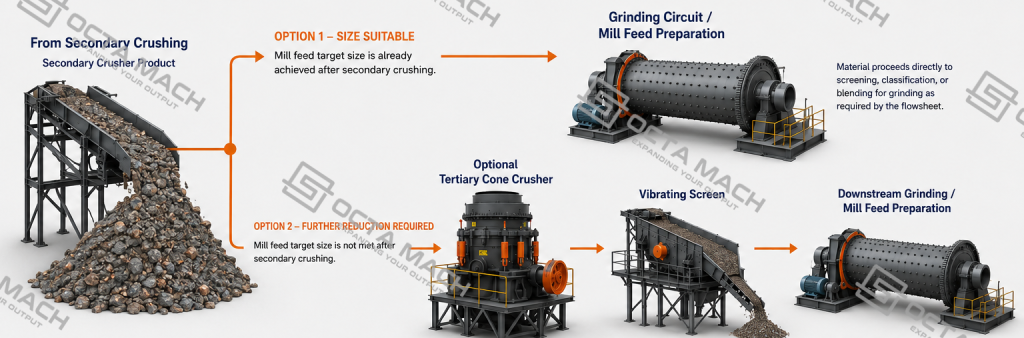
The need for tertiary crushing depends on:
- secondary crusher product;
- target grinding feed;
- ore hardness and competency;
- circulating load;
- grinding circuit design;
- energy distribution between crushing and grinding.
It should not be added automatically to every copper ore plant.
Recommended Crushing Equipment for Copper Ore
| Processing Position | Recommended Equipment | Main Selection Basis |
| ROM feeding | Vibrating / Grizzly Feeder | Maximum lump size, fines, clay, hourly feed |
| Primary crushing | Jaw Crusher | Feed opening, ROM top size, competency, abrasiveness |
| Secondary crushing | Cone Crusher | Primary product size, cavity, CSS, required throughput |
| Intermediate reduction | Single-Cylinder Hydraulic Cone Crusher | Hard-rock reduction, controlled continuous feed |
| High-capacity secondary / tertiary | Multi-Cylinder Hydraulic Cone Crusher | Required top size, circulating load, cavity and plant capacity |
| Classification | Vibrating Screen | Cut size, feed distribution, screen area and circulating load |
| Grinding preparation | Ball Mill or project-specific grinding circuit | F80, target P80, grindability and mineral liberation |
| Relocatable mine crushing | Mobile Jaw + Mobile Cone Crushing | Mine layout, relocation frequency, haul distance and power supply |
The crusher should be selected as part of the complete circuit. A cone crusher with sufficient catalogue capacity can still become overloaded when screen efficiency falls and circulating material rises.
Copper Ore Processing Routes After Crushing
The most important process difference occurs after crushing, because sulfide, oxide and mixed copper ores do not necessarily use the same beneficiation route.
Sulfide Copper Ore
Typical route:
Crushing → Grinding → Classification → Froth Flotation → Thickening / Filtration → Copper Concentrate.
Copper sulfide deposits commonly contain chalcopyrite, bornite, chalcocite and covellite. Crushing exposes fresh mineral surfaces, but fine grinding is normally required before flotation can effectively separate copper minerals from gangue.
For sulfide copper ore, grinding reduces the crushed feed to the mineral liberation size required before flotation. Some ores may require grinding below 100 μm, but the actual target depends on mineral texture, liberation characteristics and metallurgical testwork.
Oxide Copper Ore
Typical route:
Crushing → Sizing / Agglomeration → Leaching → Solvent Extraction → Electrowinning.
For many oxide copper ores, crushing is followed by heap or other acid leaching, solvent extraction and electrowinning (SX-EW). Whether this route is suitable depends on copper mineralogy, gangue composition, acid consumption, particle-size distribution and leach response.
The crushed size for heap leaching is not the same as the grind size for flotation. Leach feed must expose the copper minerals while retaining sufficient heap permeability for solution flow.Carbonate gangue can also increase acid consumption, while clay and fines can reduce permeability, so ore mineralogy remains part of crusher and preparation design.
Mixed Sulfide–Oxide Copper Ore
Mixed ore may require combinations of:
Crushing → Grinding → Sulfide Flotation → Oxide Flotation / Leaching.
or another project-specific route.
There is no universal sulfide-to-oxide ratio that automatically defines the final process. Copper phase distribution, gangue composition, acid consumption, liberation, flotation response and project economics should be established through sampling and metallurgical testwork before the final flowsheet is selected.
Copper Ore Crushing Plant Capacity Configuration
The following configurations are Reference Capacity / Preliminary Configuration ranges. They adapt the staged hard-rock Jaw–Cone–Screen logic to copper ore processing; they are not guaranteed plant throughput values.
| Reference Capacity | Preliminary Copper Ore Configuration | Typical Engineering Logic |
| 150–200 TPH | Feeder → Jaw Crusher → Cone Crusher → Vibrating Screen | Compact two-stage hard-rock circuit |
| 200–300 TPH | Feeder → Jaw Crusher → Single-Cylinder Cone → Multi-Cylinder Cone → Screen | Adds staged compression where harder ore or finer grinding feed is required |
| 400–500 TPH | Grizzly Feeder → European-Type Jaw Crusher → Single-Cylinder Cone → Multi-Cylinder Cone → Screen | Higher feed volume with staged reduction and screening |
| 600–700 TPH | Pre-Screening → Jaw Crusher → Single-Cylinder Cone → Multi-Cylinder Cone → Closed-Circuit Screens | Stronger emphasis on pre-screening and return-load control |
| 700–800 TPH | Pre-Screening → Large Jaw Crusher → Single + Multi-Cylinder Cone Duties → Closed-Circuit Screening | Continuous high-volume hard-rock reference |
| Around 1000 TPH | Large Feeding System → Primary Crushing → Multiple Cone-Crushing Duties → Multiple Screens / Return Conveyors | Parallel or distributed duties instead of relying on one crusher for the entire plant |
At large mine scale, primary crushing can also use gyratory equipment depending on ROM size, required availability and mine layout. Real copper concentrators use both jaw- and gyratory-based primary circuits.Plant throughput must be confirmed from the complete system rather than from one crusher nameplate.
Key Factors Controlling Copper Ore Plant Throughput
| Factor | Effect on Plant | Main Control Point |
| ROM feed size and fragmentation | Oversize or highly variable feed destabilizes primary crushing | Match feeder and crusher opening to actual blast fragmentation |
| Ore competency and abrasiveness | Increases energy demand and liner wear | Crushing tests, power and liner selection |
| Moisture and clay | Causes buildup and reduces screening efficiency | Pre-screening, washing or chute design where required |
| Crusher chamber and CSS | Incorrect cavity or setting restricts reduction and capacity | Match cavity to feed size and target product |
| Screen efficiency | Poor classification increases oversize return | Screen area, aperture and feed distribution |
| Circulating load | Return material adds crusher and conveyor duty | Balance screen cut, crusher discharge and return conveyors |
| Grinding requirement | Finer mill feed can increase crushing duty | Optimize crushing and grinding together |
| Beneficiation route | Flotation and heap leaching require different feed preparation | Design around mineralogy and liberation rather than one fixed size |
The final copper ore plant capacity is therefore a system result:
Feeding + Crushing + Screening + Conveying + Circulating Load + Grinding / Leaching Capacity.
Improving only one crusher does not guarantee the same increase in total plant throughput.
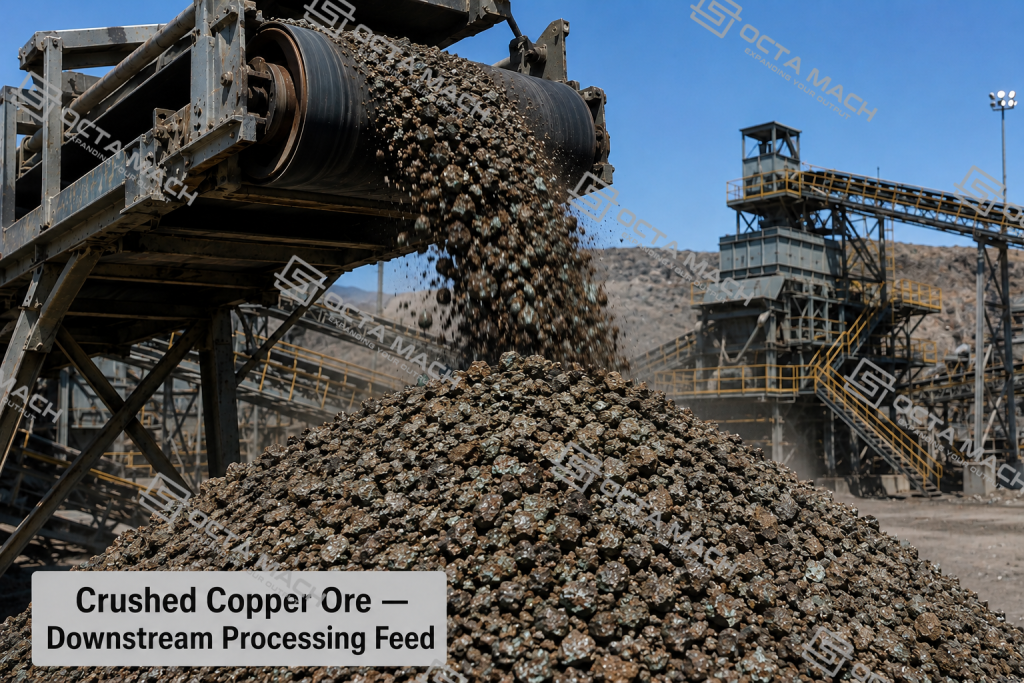
OctaMach Copper Ore Processing Solutions
OctaMach copper ore configurations can combine Jaw Crushers for primary reduction, Single-Cylinder and Multi-Cylinder Cone Crushers for secondary or tertiary crushing, Vibrating Screens for closed-circuit classification, Mobile Crushers for relocatable mine duties, and Ball Mills for downstream grinding preparation.
The equipment arrangement is selected from the actual ore rather than from the material name alone. A useful project definition should include representative ROM samples or fragmentation data, maximum feed size, ore mineralogy, moisture and clay condition, required capacity, target grinding or leach feed, and the intended downstream beneficiation route.
These inputs allow the crushing circuit to be matched to the physical copper-bearing rock and to the process that follows it.
FAQ
Q: What is copper ore?
A: Copper ore is rock containing recoverable copper-bearing minerals together with gangue. Major copper minerals include chalcopyrite, bornite and chalcocite in sulfide ores, and malachite, azurite, chrysocolla and cuprite in oxidized ores.
Q: What is the difference between sulfide and oxide copper ore?
A: Sulfide ores are commonly ground and concentrated by flotation, while oxide ores are frequently prepared for leaching and SX-EW. Mixed ores may require combined treatment based on mineralogical and metallurgical testing.
Q: Which crusher is used for copper ore?
A: Large hard-rock ROM is commonly reduced by a jaw or gyratory primary crusher, followed by cone crushing and screening. The exact stages depend on ROM size, hardness, plant capacity and required downstream feed.
Q: What size should copper ore be before grinding?
A: There is no universal size. Secondary or tertiary crushing commonly prepares ore in approximately the 10–40 mm range for grinding, but the final crushing target should be matched to the selected mill, ore grindability and required mineral liberation.