
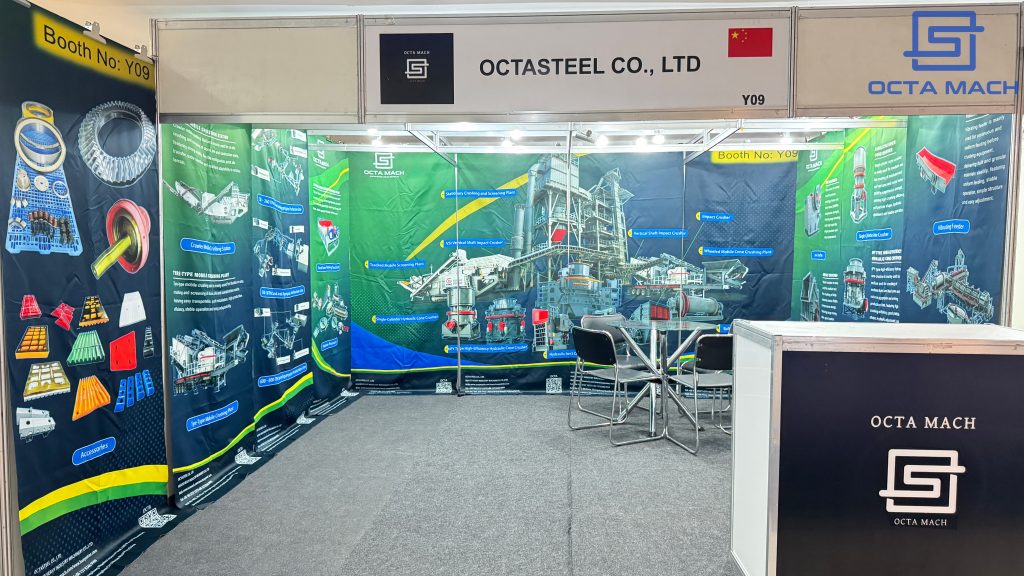
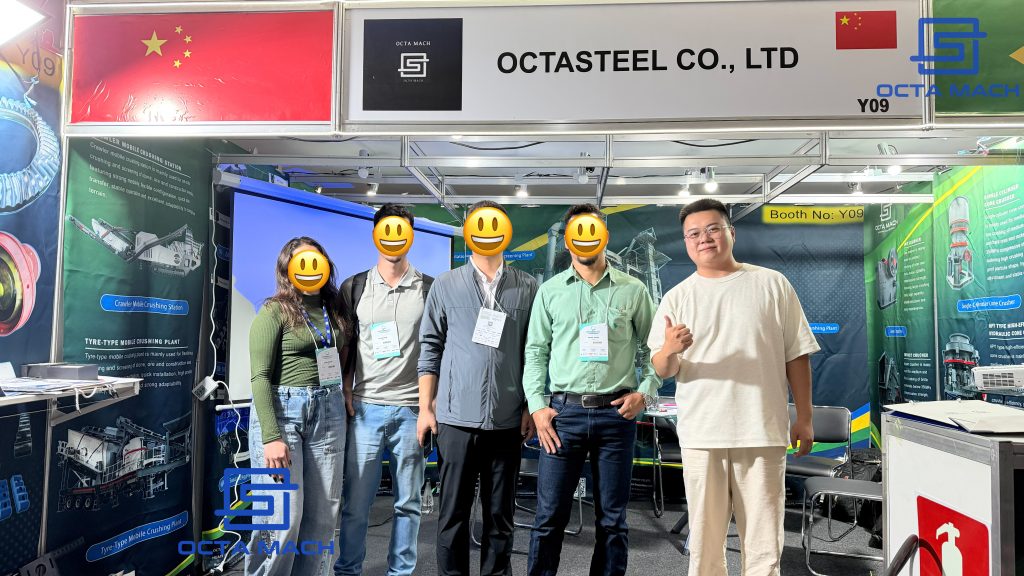
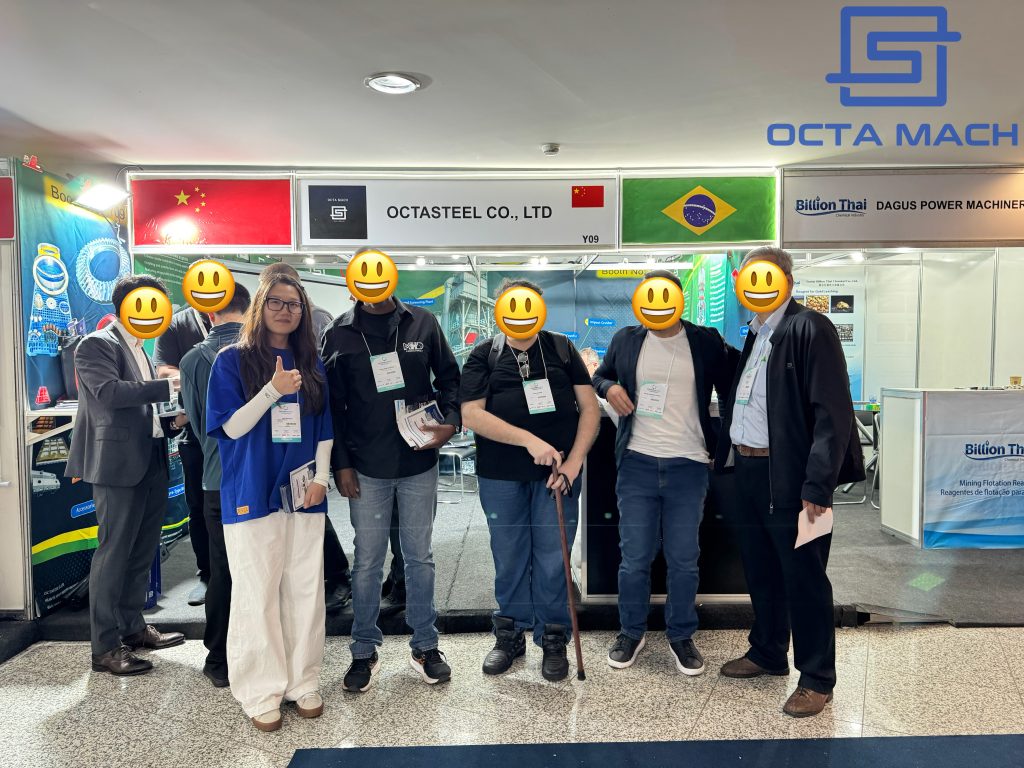
Octa Mach joined EXPOSIBRAM 2026 at Booth Y09 in Belo Horizonte to meet mining operators, project engineers and equipment buyers and discuss how crushing, screening and mineral processing circuits should be configured around actual ore conditions.
Held from August 24 to 27 at Expominas, the event brought together companies and specialists from across the mineral supply chain. Octa Mach’s participation focused on practical equipment-selection questions: feed size, rock strength, abrasivity, moisture, required throughput, target product size and the separation process that follows crushing.
These variables determine whether a project requires a jaw crusher, cone crusher, impact crusher, vibrating screen, mobile plant or complete processing line. Selecting a rock crusher from nominal capacity alone can result in excessive wear, unstable recirculating load or a product that does not meet the requirements of the downstream process.
EXPOSIBRAM 2026 at a Glance
EXPOSIBRAM 2026 was the 2026 edition of the Brazilian Mining Expo & Congress and one of the largest mineral-sector events held in Latin America during the year.
| Event item | Confirmed information |
|---|---|
| Event | Brazilian Mining Expo & Congress — EXPOSIBRAM 2026 |
| Date | August 24–27, 2026 |
| Location | Expominas, Belo Horizonte, Minas Gerais, Brazil |
| Octa Mach booth | Y09 |
| Exhibition area | More than 17,000 m² |
| Exhibition stands | More than 750 |
| Recorded attendance | 106,000 visitors |
| Attendance reported for 2024 | 86,000 visitors |
| Principal subjects | Mining equipment, mineral processing, operational safety, automation, energy efficiency and critical minerals |
The scale of the event provided a useful view of the technical and procurement priorities affecting the Brazil mining industry. Discussions extended beyond machine size and installed power. Operators increasingly need equipment configurations that can be verified against feed characteristics, production targets, energy use, maintenance access and final product requirements.
Technical Discussions Started with the Feed Material
Octa Mach approached the event from the complete processing-circuit perspective. A crusher is only one part of the system. Its performance depends on how consistently material enters the chamber, how the crushed product is classified and what happens to screen oversize and undersize.
The main project inputs discussed during the event included:
- Maximum lump size and complete feed-size distribution
- Dry and wet feed capacity
- Uniaxial compressive strength and fracture characteristics
- Abrasivity and expected wear rate
- Natural moisture and clay content
- Bulk density and material flowability
- Required crusher product size
- Final aggregate fractions or mineral liberation size
- Available electrical power and process water
- Site elevation, climate and dust-control requirements
- Planned operating hours and availability target
- Downstream grinding, gravity separation, flotation or magnetic separation
Two ores with the same commercial name may require different circuits. Weathering, mineral associations, quartz content, clay and fracture patterns can change both crusher performance and screen efficiency. Representative sampling and testwork must therefore come before final equipment selection.
Connecting Crushing with Mineral Processing
Crushing prepares mined material for screening, grinding or coarse separation. It does not complete the entire mineral processing operation.
Primary crushing reduces run-of-mine material to a size that can be transported and handled by secondary equipment. Secondary and tertiary crushing produce a controlled screen feed. Screening then divides the material into products and oversize fractions. Where valuable minerals remain locked in the host rock, grinding reduces the particles further before concentration.
| Circuit stage | Engineering purpose | Typical equipment | Required output data |
|---|---|---|---|
| Feed preparation | Regulate material flow and remove unsuitable fines or clay | Hopper, feeder and grizzly | Stable feed rate and controlled top size |
| Primary crushing | Reduce large run-of-mine material | Jaw crusher or primary gyratory crusher | Crusher product size and dry throughput |
| Secondary crushing | Reduce intermediate feed and control product distribution | Cone crusher or impact crusher | Screen feed with controlled gradation |
| Tertiary crushing | Produce finer material or improve aggregate shape | Cone crusher, impact crusher or VSI | Target product distribution and shape |
| Screening | Separate products at specified cut sizes | Multi-deck vibrating screen | Product fractions and oversize stream |
| Grinding | Reach the required mineral liberation size | Ball mill or other grinding equipment | Product P80 and specific energy |
| Separation | Recover valuable minerals from gangue | Gravity, flotation or magnetic equipment | Concentrate grade and recovery |
| Dewatering | Reduce product or tailings moisture | Thickener, filter or dewatering screen | Final moisture and water return |
In a closed crushing circuit, correctly sized material leaves through the screen product outlets. Only material larger than the selected screen aperture returns to the crusher. This prevents acceptable product from being crushed repeatedly and helps control circulating load, energy use and unnecessary wear.
Equipment Scope Discussed at the Event
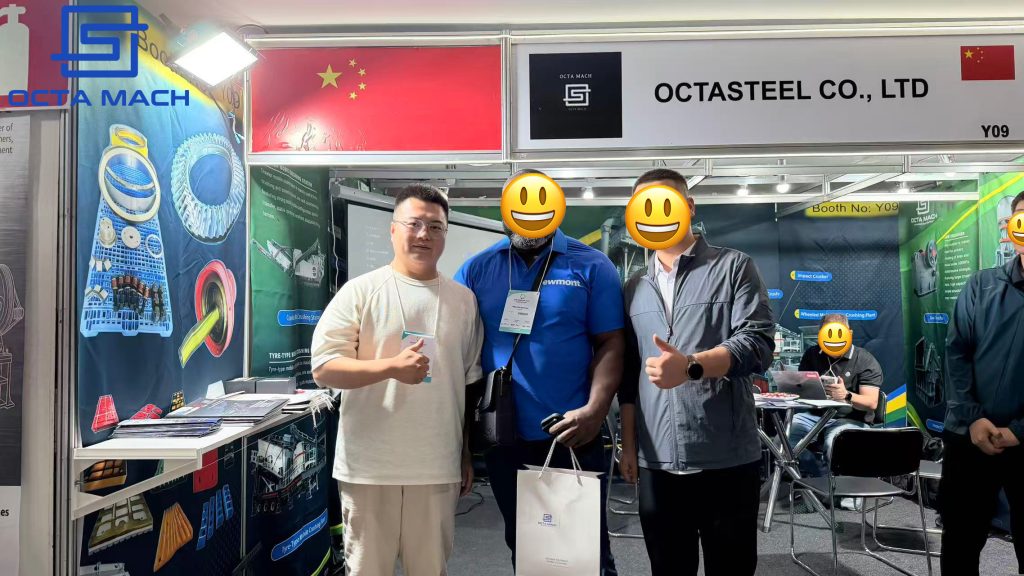
At Booth Y09, Octa Mach discussed equipment configurations for quarrying, aggregate production and ore preparation. The scope covered individual machines as well as connected crushing, screening and beneficiation circuits.
The principal equipment groups included:
- Jaw crushers for primary reduction of hard and irregular feed
- Cone crushers for secondary and tertiary compression crushing
- Impact crushers for lower-abrasivity stone and applications requiring higher reduction
- Vibrating feeders for controlled crusher loading
- Multi-deck vibrating screens for product classification
- Mobile crushing and screening plants for relocatable operations
- Ball mills and classification equipment for controlled grinding
- Gravity, flotation and magnetic equipment for mineral concentration
- Conveyors, hoppers and return circuits for continuous material handling
The correct mining equipment combination depends on the complete flowsheet. Installing a larger crusher will not correct an undersized feeder, restricted transfer chute, insufficient screen area or overloaded return conveyor.
Matching Equipment to Brazilian Materials
The Brazil mining industry processes hard-rock ores, industrial minerals and construction aggregates with substantially different breakage and separation characteristics. Equipment selection must therefore distinguish between aggregate production and metal-ore concentration.
| Material | Main processing concern | Typical front-end route | Test data required |
|---|---|---|---|
| Iron ore | Variable hardness, silica rejection and generation of excessive fines | Crushing and screening, followed by grinding where mineral liberation is required | Feed gradation, mineralogy, hardness, abrasivity and magnetic response |
| Gold-bearing ore | Valuable minerals may remain locked after crushing | Staged crushing, controlled grinding and testwork-defined recovery | Head grade, gold association, liberation size and metallurgical response |
| Manganese ore | Product degradation, clay and loss of saleable lump material | Controlled crushing, screening, washing and possible gravity upgrading | Size-by-size grade, clay, moisture, density and degradation |
| Bauxite | Moisture, clay and material buildup | Sizing, controlled crushing, washing or scrubbing where required | Moisture, clay content, feed size and handling tests |
| Granite and basalt | High strength and potentially high liner wear | Jaw crushing, cone crushing and closed-circuit screening | UCS, abrasivity, top size and target aggregate grading |
| Limestone | Silica content can change crusher wear and process selection | Jaw or impact crushing followed by screening | Silica content, clay, moisture, strength and product specification |
A hard, quartz-rich feed normally favours compression crushing because continuous high-speed impact can accelerate wear. Softer limestone with limited abrasive silica may suit an impact crusher when the required reduction ratio and product shape justify that configuration.
These are engineering tendencies rather than universal rules. Final selection requires representative material testing and confirmation of the required product.


Defining Capacity Before Selecting a Rock Crusher
Published crusher capacity is normally a range, not a guaranteed result for every material. Throughput changes with feed gradation, bulk density, moisture, chamber selection, closed-side setting and the amount of material returned by the screen.
A technically usable capacity requirement should define more than tonnes per hour.
| Capacity input | Required definition | Why it matters |
|---|---|---|
| Throughput | Dry tonnes per hour | Prevents water mass from overstating actual solids capacity |
| Feed top size | F100 or maximum lump size | Determines feed opening and oversize risk |
| Feed distribution | Complete sieve analysis and F80 | Controls chamber loading and expected product gradation |
| Product size | P80 and required passing percentages | Determines crusher setting and screen apertures |
| Moisture | Percentage by mass and expected variation | Affects flowability, screening and chute buildup |
| Recirculating load | Returned screen oversize divided by new feed | Determines the actual load handled by the crusher and screen |
| Operating schedule | Hours per day and days per year | Converts hourly capacity into annual production |
| Availability | Operating time divided by scheduled time | Accounts for maintenance and unplanned stoppages |
Acceptance criteria must be established for a defined feed condition. A capacity test performed with finer, drier or less abrasive material cannot verify performance for a more difficult production feed.
Product Quality Depends on the Screen
The vibrating screen controls which particles leave as final products and which particles require further reduction. Screen selection must account for aperture size, deck area, inclination, vibration characteristics, moisture and the proportion of particles close to the separation size.
A stable screen feed should be distributed across the usable deck width rather than concentrated on one side. Excessive feed depth reduces the opportunity for fine particles to contact the apertures. Wet clay can coat the particles and blind the screen surface, causing undersize material to report incorrectly to the oversize stream.
For aggregate production, screen performance controls the grading of separate commercial products. In metal-ore processing, inaccurate classification can increase grinding load or send incorrectly sized material into gravity, flotation or magnetic separation.
Screen efficiency should therefore be calculated from representative samples of the feed and each product stream. Visual inspection alone cannot confirm separation performance.
What Plant Performance Must Demonstrate
The technical discussions at EXPOSIBRAM 2026 also reinforced the need to evaluate complete circuits rather than isolated machines. A processing line reaches acceptable performance only when throughput, product size, stability, energy use and, where applicable, metallurgical recovery are measured under an agreed feed condition.
| Performance indicator | Reporting basis | Acceptance treatment |
|---|---|---|
| Net throughput | Dry t/h | Compared with the project-specific design or contract value |
| Crusher product | P80 and full sieve analysis | Compared with the specified downstream feed |
| Screen products | Percentage passing each specified aperture | Compared with the required product grading |
| Circulating load | Return flow ÷ new feed × 100% | Used to confirm crusher and screen loading |
| Specific energy | Total applicable power ÷ dry tonnes processed | Compared under the defined feed and operating condition |
| Plant availability | Operating time ÷ scheduled time × 100% | Measured over the agreed test period |
| Concentrate grade | Percentage, g/t or applicable assay unit | Reported together with recovery |
| Metallurgical recovery | Valuable material in concentrate ÷ valuable material in feed × 100% | Confirmed through a complete mass balance |
There is no universal acceptable energy consumption, recovery or availability value for every ore. These targets depend on the deposit, selected process, equipment configuration and contract.
What Octa Mach Took from the Exhibition
Participation in EXPOSIBRAM 2026 provided direct insight into the technical priorities shaping new quarry and mine-development projects in Brazil. The strongest discussions centred on measurable operating outcomes rather than nominal machine size.
Project teams want to know:
- Whether the proposed crusher can accept the actual top-size feed
- How wear will change with quartz and other abrasive minerals
- Whether wet or clay-rich material requires washing or prescreening
- How screen oversize will affect circulating load
- Whether the product is suitable for grinding or concentration
- What power, water and civil works the complete circuit requires
- How performance will be measured during commissioning
- Which operating and maintenance data must be recorded
These questions connect equipment design directly to plant availability, product quality and operating cost. They also show why a complete technical proposal must state the assumptions used to estimate capacity.
Continuing Technical Work after EXPOSIBRAM 2026
Following the event, Octa Mach is continuing discussions on crushing, screening and mineral processing requirements for projects serving the Brazil mining industry and other international markets.
Preliminary equipment selection can begin when a project provides representative feed information, required dry throughput, target product size, available utilities and downstream process requirements. Final configuration should follow material testing, flowsheet development and confirmation of site conditions.
Octa Mach can then assess whether the duty requires an individual rock crusher, a closed crushing and screening circuit, a mobile plant or a broader ore-processing line.
FAQ
Q: What was EXPOSIBRAM 2026?
A: EXPOSIBRAM 2026 was the 2026 Brazilian Mining Expo & Congress, held from August 24 to 27 at Expominas in Belo Horizonte, Brazil.
Q: Where was the Octa Mach booth at EXPOSIBRAM 2026?
A: Octa Mach participated at Booth Y09, where the team discussed crushing, screening and mineral processing requirements with mining operators, engineers and equipment buyers.
Q: What mining equipment did Octa Mach discuss at the event?
A: The equipment scope included jaw, cone and impact crushers, vibrating feeders, screens, mobile crushing plants, grinding equipment and mineral-separation systems.
Q: What data are required before selecting a crusher?
A: Selection requires the maximum lump size, complete feed gradation, dry throughput, rock strength, abrasivity, moisture, bulk density, target product size and downstream process.