
Iron ore is a naturally occurring rock containing economically recoverable iron-bearing minerals, mainly hematite (Fe₂O₃) and magnetite (Fe₃O₄), together with gangue minerals such as silica, alumina and carbonates. Its physical properties vary with mineralogy and weathering: competent hematite and magnetite ores are generally medium-hard to hard, typically around Mohs 5–6.5, while weathered limonitic ores can be softer and contain more moisture, clay and fines. Run-of-mine iron ore is usually delivered as irregular blasted rock ranging from fines to large lumps; in jaw-crusher-based plants, a practical preliminary feed-size range is commonly about 300–800 mm, although the actual maximum size depends on blasting conditions and the selected crusher opening.
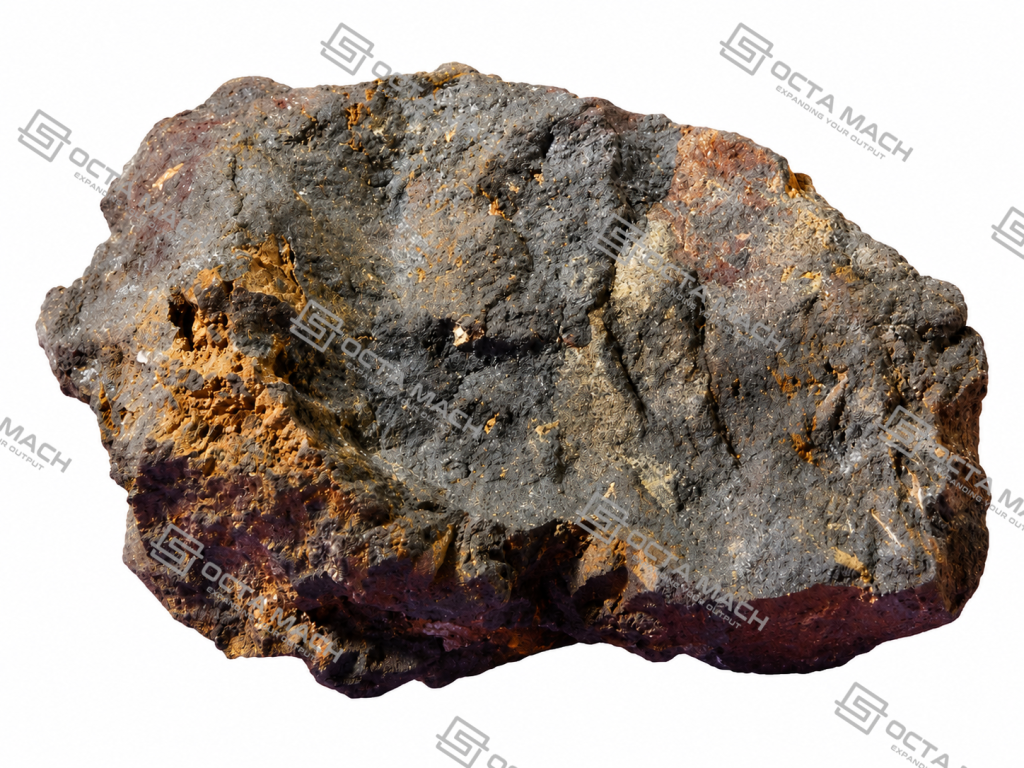
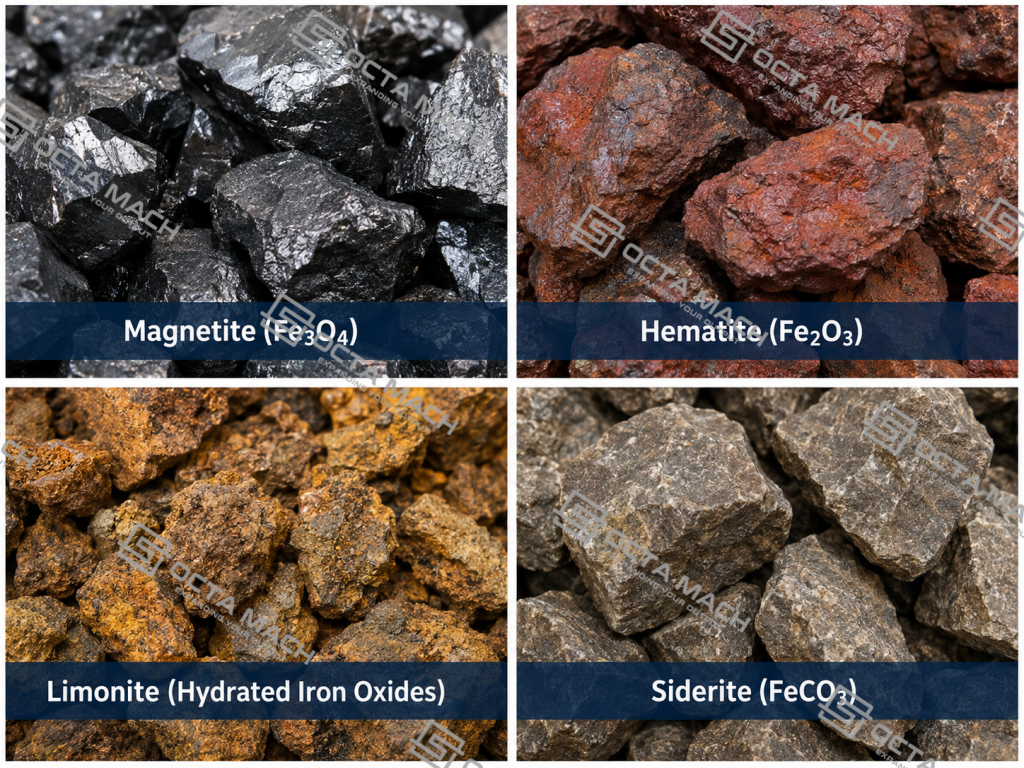
The crushing configuration is determined by ROM feed size, ore hardness, abrasiveness, moisture, clay content, mineralogy, required capacity and target grinding feed size. Hard magnetite and hematite ores generally favor staged compression crushing, while weathered or clay-bearing ores may require additional pre-screening, washing or fines control. The final crushed size is therefore set according to the downstream liberation requirement rather than a fixed aggregate specification.Hematite and magnetite are the two principal iron-bearing minerals in commercial iron ore production. Magnetite is strongly magnetic, while hematite has different separation characteristics; deposits may also contain goethite, limonite, siderite or mixed iron minerals. These mineralogical differences influence the downstream beneficiation route, including magnetic separation, gravity separation or flotation. Iron ore is primarily processed as a raw material for steelmaking, which accounts for about 98% of global iron ore use.
Iron Ore Characteristics That Affect Processing
Iron ore is not a single mineral with one fixed hardness, grade or processing route. A crusher configuration suitable for a competent magnetite ore may not be appropriate for a weathered, clay-bearing hematite or goethite ore.
| Iron-bearing material | Main iron mineral | Formula | Processing significance |
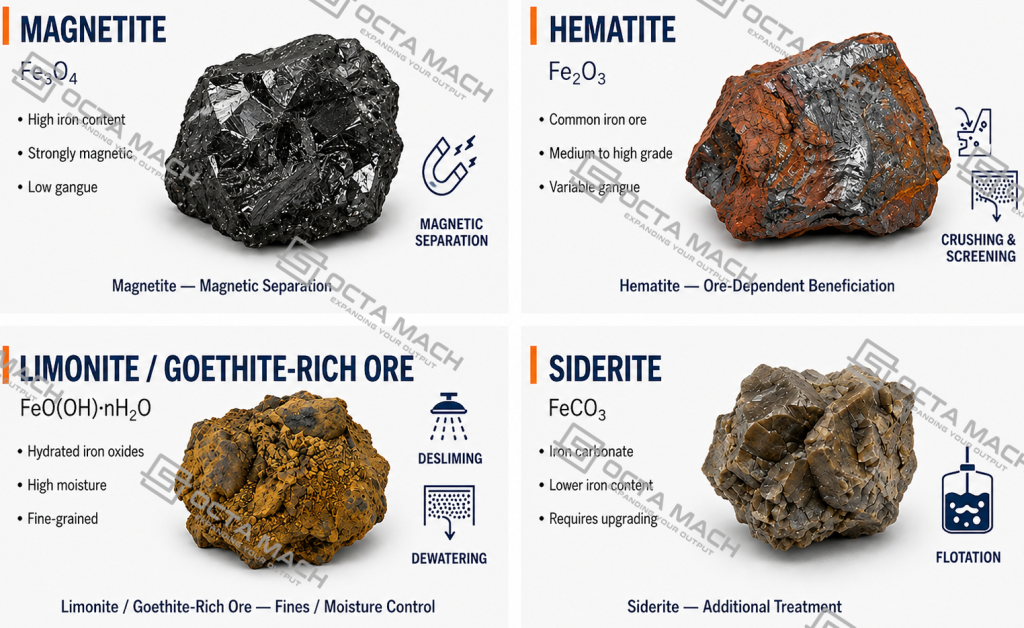
| Magnetite ore | Magnetite | Fe₃O₄ | Strong magnetic response makes magnetic separation particularly important after sufficient liberation |
| Hematite ore | Hematite | Fe₂O₃ | Major commercial iron ore; may be processed by crushing, screening, gravity, magnetic or flotation routes depending on mineralogy |
| Goethite-bearing ore | Goethite | FeO(OH) | Weathering, fines, moisture and clay content can become important handling and screening factors |
| Limonitic ore | Hydrated iron oxides | Variable | Often heterogeneous and moisture-sensitive; washing or desliming may be required before or during beneficiation |
| Siderite ore | Siderite | FeCO₃ | Carbonate iron ore with a different beneficiation and possible thermal-treatment route from oxide ores |
Pure magnetite theoretically contains about 72.4% Fe, while pure hematite contains about 69.9% Fe. These values represent the iron content of the pure minerals rather than the actual grade of run-of-mine ore, which must be confirmed by sampling and assay because gangue minerals reduce the overall Fe content.
How Mineralogy Affects Beneficiation
Ore mineralogy also determines the downstream beneficiation route. Magnetite is commonly associated with magnetic separation, while hematite and mixed iron ores may require gravity separation, high-intensity magnetic separation, flotation, or combined processes depending on mineral liberation and gangue composition. The required liberation size then determines how far the ore must be crushed and ground before separation.
Key Data Required Before Crusher Selection
Iron ore crushing equipment should be selected from actual ore and process data rather than nominal plant capacity alone. The main design inputs include:
- ROM feed size and gradation – maximum lump size and percentage of fines determine feeder and primary crusher selection.
- Ore hardness and abrasiveness – influence crusher type, liner wear and achievable throughput.
- Moisture and clay content – affect feeding stability, screening efficiency and the need for pre-screening or washing.
- Required plant capacity – normal and peak throughput should be evaluated together with feeder, screen and conveyor capacity.
- Target crushed size – secondary and tertiary crushing stages are determined by the required feed size for grinding or beneficiation.
- Mineralogy and beneficiation route – the iron mineral type and gangue composition determine the required liberation size and downstream separation process.
These parameters determine whether the plant can use a relatively simple jaw crusher + cone crusher circuit or requires additional crushing, screening and closed-circuit stages.
Iron Ore Crushing Process
A competent hard-rock iron ore circuit commonly follows this basic route:
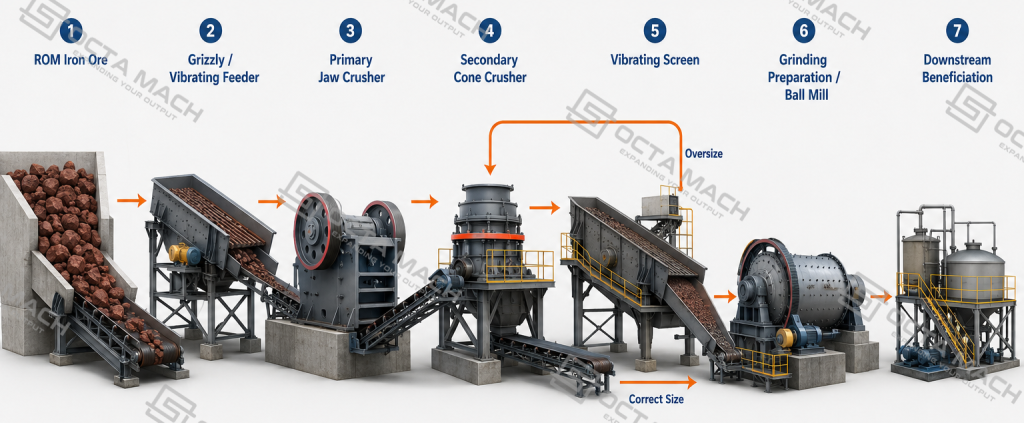
ROM Iron Ore → Grizzly Feeding → Primary Jaw Crushing → Secondary Cone Crushing → Screening → Oversize Return → Optional Tertiary Crushing → Grinding Preparation → Beneficiation.
The exact sequence changes with the ore.
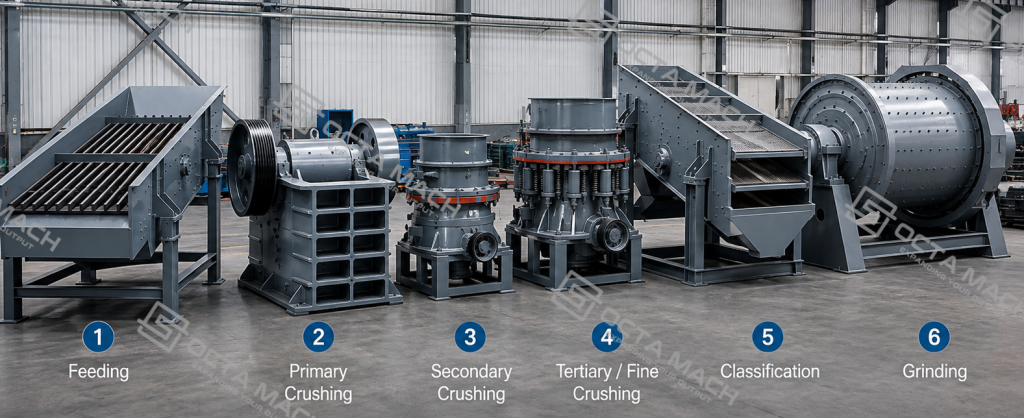
1. Feeding and Pre-Screening
Run-of-mine ore enters a receiving hopper and is transferred by a vibrating or grizzly feeder. Stable feeding prevents large surges from overloading the primary crusher.
Where the ROM feed contains substantial undersize, soil or clay, pre-screening can remove material that does not need primary crushing. Clay-rich material may require a different washing or screening arrangement before the main size-reduction circuit.
2. Primary Crushing with a Jaw Crusher
A Jaw Crusher is normally selected for coarse reduction where large and irregular iron ore must be reduced before entering secondary equipment.
The fixed and moving jaw plates apply compression to the feed. For iron ore service, crusher selection should consider the actual maximum lump size, jaw opening, discharge setting, abrasiveness, jaw-plate wear and the required feed size for the next crusher.
The objective is not to make the final beneficiation product in one step. Primary crushing should produce a stable, manageable feed for the secondary stage. OctaMach currently positions jaw crushers specifically for large ore feed and mining pre-processing, including iron ore.
3. Secondary Crushing with a Cone Crusher
After primary reduction, a Cone Crusher can provide continuous compression crushing between the mantle and concave.
Cone crushing is particularly useful for competent and abrasive ores because the chamber can be selected according to feed size, reduction duty and required discharge range. The resulting product then passes to a vibrating screen.
Oversized screened material is returned to the cone crusher, forming a closed crushing circuit.This return loop matters. The load on the cone crusher is not only the quantity of new ore entering the plant; it also includes circulating oversize from the screen. Screen performance, crusher CSS, feed distribution and return-conveyor capacity therefore have to be evaluated together.
4. Tertiary or Fine Crushing When Required
Not every iron ore project needs the same third crushing stage.Where the target grinding feed is smaller than the secondary cone product, another cone crusher, roll crusher or another project-specific fine-crushing system may be added.
For an iron ore beneficiation plant, this stage is selected to control the feed entering grinding and mineral liberation—not simply to improve the visual shape of the particles.
For this reason, a VSI sand-making stage that is useful in granite, basalt or pebble aggregate production should not automatically be transferred to an iron ore beneficiation flowsheet.
5. Grinding Before Mineral Separation
Crushing exposes and reduces the ore, but many iron ores still require further grinding to liberate the iron mineral from gangue.
A Ball Mill can reduce crushed ore into a controlled fine product before magnetic separation, flotation or other concentration processes. Grinding duty should be based on feed F80, target P80, ore grindability and the liberation requirement rather than a fixed universal particle size.
OctaMach ball mills are positioned downstream of crushing and upstream of magnetic, gravity or flotation circuits, which allows the iron ore page to connect the crushing plant directly with the subsequent mineral-processing stage.
Recommended Crushing Equipment for Iron Ore
| Processing position | Main duty | Recommended equipment | Main selection basis |
| ROM feeding | Regulate mine feed and remove selected undersize | Vibrating / grizzly feeder | Maximum lump size, fines, clay, hourly feed |
| Primary crushing | Reduce large irregular ore | Jaw Crusher | Feed opening, ROM size, abrasiveness, required primary discharge |
| Secondary crushing | Reduce prepared hard ore | Cone Crusher | Feed size, cavity, CSS, capacity, wear condition |
| High-capacity secondary / tertiary | Controlled hard-ore reduction | HP Series Multi-Cylinder Hydraulic Cone Crusher | Cavity profile, circulating load, required top size |
| Intermediate / fine reduction | Project-specific additional reduction | Single-cylinder cone or roll crusher | Required mill feed and previous-stage product |
| Classification | Separate acceptable product from oversize | Vibrating Screen | Cut size, feed distribution, circulating load |
| Grinding | Produce mineral-liberation feed | Ball Mill | Feed F80, target P80, grindability and beneficiation route |
| Relocatable mine crushing | Move crushing closer to the mining face | Mobile Jaw + Mobile Cone Crusher | Mine layout, relocation frequency, haulage and power supply |
Iron Ore Crushing Plant Capacity Configuration
The following configurations provide reference layouts for iron ore crushing plants at different capacity levels. Actual throughput depends on ROM feed size, ore hardness, abrasiveness, moisture, crusher settings, screening efficiency and circulating load, so final equipment selection should be confirmed from the complete process conditions rather than capacity alone.
| Reference capacity | Preliminary iron ore configuration | Suitable engineering direction |
| 150–200 TPH | Feeder → Jaw Crusher → Cone Crusher → Screening | Compact two-stage crushing where one cone stage can achieve the required grinding feed |
| 200–300 TPH | Feeder → Jaw Crusher → Single-Cylinder Cone → Multi-Cylinder Cone → Screening | Additional size reduction and better control of hard, abrasive ore |
| 400–500 TPH | Grizzly Feeder → European Jaw Crusher → Single-Cylinder Cone → Multi-Cylinder Cone → Screening | Higher-feed primary crushing with staged cone reduction |
| 600–700 TPH | Pre-Screening → Jaw Crusher → Single-Cylinder Cone → Multi-Cylinder Cone → Closed-Circuit Screens | Higher-throughput hard-ore line with stronger screening and return-load control |
| 700–800 TPH | Pre-Screening → European Jaw Crusher → Single-Cylinder Cone → Multi-Cylinder Cone → Closed-Circuit Screening | Large continuous mine feed requiring staged compression crushing |
| Around 1000 TPH | Large Feeding System → Jaw Crushing → Multiple Cone-Crushing Duties → Multiple Screens / Return Circuits | Large fixed mine installation requiring parallel equipment and system-level capacity balancing |
These capacity bands come from complete crushing-line configurations rather than isolated crusher catalogue ratings.
For iron ore projects, the original aggregate-size fractions used in a stone-production plant should be replaced by the actual beneficiation feed requirement. A plant may therefore screen at 30 mm, 20 mm, 10 mm or another project-specific cut depending on the grinding and liberation strategy. There is no universal “final iron ore crushing size.”
Iron Ore Processing Routes After Crushing
Not all iron ore follows the same process after crushing. The next step depends mainly on ore grade, mineralogy, gangue content and the required final product.
Some higher-grade iron ores can be processed mainly by crushing, screening and sizing before shipment or further use. In these plants, the main equipment is typically a jaw crusher, cone crusher and vibrating screen.
Lower-grade or more complex iron ores require additional processing because valuable iron minerals are still locked with gangue. After crushing, the ore is ground to a finer liberation size and then concentrated by magnetic separation, gravity separation, flotation or a combined process.
| Processing route | Typical equipment sequence |
| Crushing and sizing only | Feeder → Jaw Crusher → Cone Crusher → Vibrating Screen |
| Crushing + beneficiation | Feeder → Jaw Crusher → Cone Crusher → Screen → Ball Mill → Separation Equipment |
The correct route should therefore be determined from ore testing before selecting the complete processing line. Crushing capacity alone cannot determine whether grinding and beneficiation equipment is required.
Key Factors Controlling Iron Ore Plant Throughput
The rated capacity of a crusher does not equal the continuous output of the complete iron ore plant. Actual throughput is controlled by the interaction between ore properties, feeding, crusher settings, screening and circulating load.
| Factor | Effect on Plant Throughput | Main Control Point |
| ROM feed size and gradation | Oversized or highly variable feed can reduce primary crushing stability | Match feeder and jaw crusher opening to the maximum lump size |
| Ore hardness and abrasiveness | Harder ore requires more crushing energy and increases liner wear | Check ore competency, wear condition and crusher power |
| Moisture and clay content | Wet fines can reduce feeder and screen efficiency or cause material buildup | Use suitable pre-screening, washing or chute design where required |
| Crusher chamber and CSS | Incorrect chamber selection or an overly narrow CSS can restrict throughput | Select the cavity and setting according to feed size and target product |
| Screening efficiency | Poor screening sends excessive oversize back into the crushing circuit | Match screen area and cut size to the required plant capacity |
| Circulating load | Excessive return material increases the actual load on cone crushers and conveyors | Balance crusher discharge, screen cut and return capacity |
| Downstream equipment | Grinding, conveying or beneficiation equipment can limit the whole plant even when crushers have spare capacity | Evaluate the complete processing line rather than one crusher alone |
For this reason, a 200 TPH, 500 TPH or 800 TPH iron ore plant should be configured as a complete system. Crusher capacity, feeder performance, screening area, conveyor capacity and return load must be checked together before the production rate is confirmed.
OctaMach Iron Ore Processing Solutions
OctaMach can configure iron ore crushing and grinding systems according to ROM feed size, ore hardness, required capacity, target crushed size and downstream beneficiation process. Available equipment includes jaw crushers for primary reduction, single-cylinder and multi-cylinder cone crushers for secondary or tertiary crushing, vibrating screens for closed-circuit classification, mobile crushing units for flexible mine-site operation, and ball mills for further grinding before mineral separation.
For hard-rock iron ore projects, OctaMach can combine these machines into complete processing lines ranging from primary crushing to screening and grinding preparation. Depending on the project, the configuration can use a compact jaw crusher + cone crusher circuit or a multi-stage system with additional cone crushing and closed-circuit screening for higher throughput. Plant selection is based on the complete process requirement rather than the rated capacity of a single machine, helping match crushing performance with screening, conveying and downstream beneficiation.
FAQ
Q: What is iron ore called?
A: Iron ore is the industrial term for naturally occurring rocks or minerals from which iron can be economically extracted. Hematite and magnetite are the principal commercial iron-ore minerals, with goethite, limonite and siderite also occurring in mine deposits.
Q: What exactly is iron ore?
A: Iron ore consists of iron-bearing minerals combined with gangue such as silica, alumina, carbonates or other minerals. Industrial processing separates or concentrates the iron-bearing fraction through combinations of crushing, screening, grinding and beneficiation.
Q: Which country has the most iron ore?
A: Australia has the world’s largest identified economic iron ore resources in current Geoscience Australia reporting and is also one of the dominant global producers and exporters. Brazil is another major source of internationally traded iron ore.
Q: Where do you find iron ore?
A: Major iron ore deposits occur in Australia, Brazil and several other mining regions worldwide. Economically important deposits include hematite- and magnetite-rich formations, including many banded iron formations. The geological deposit determines the ore grade, gangue minerals and processing route.