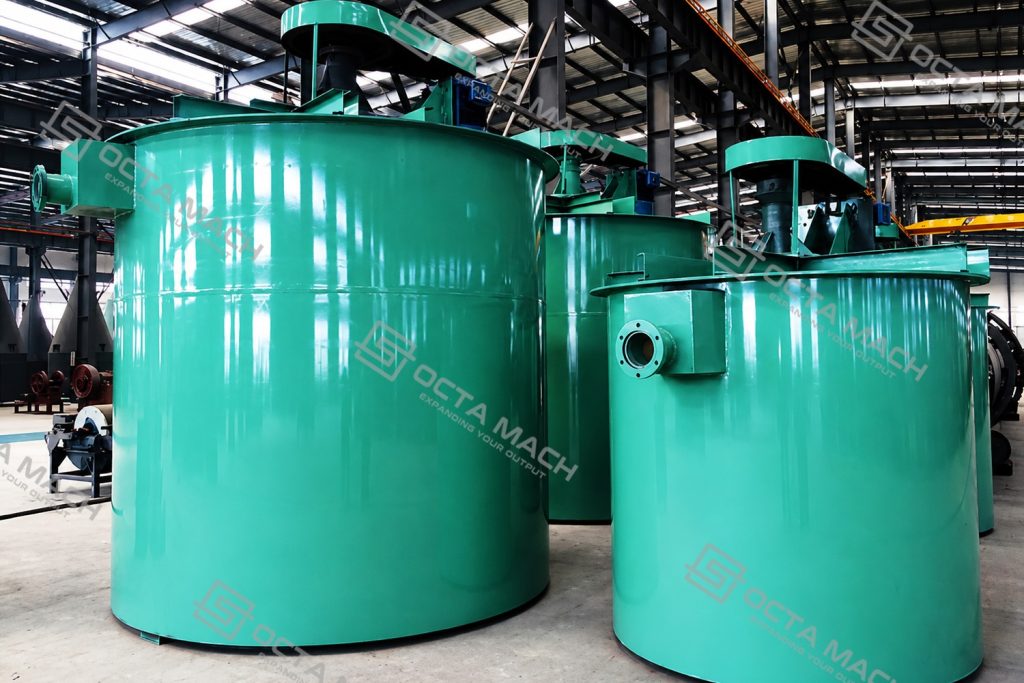
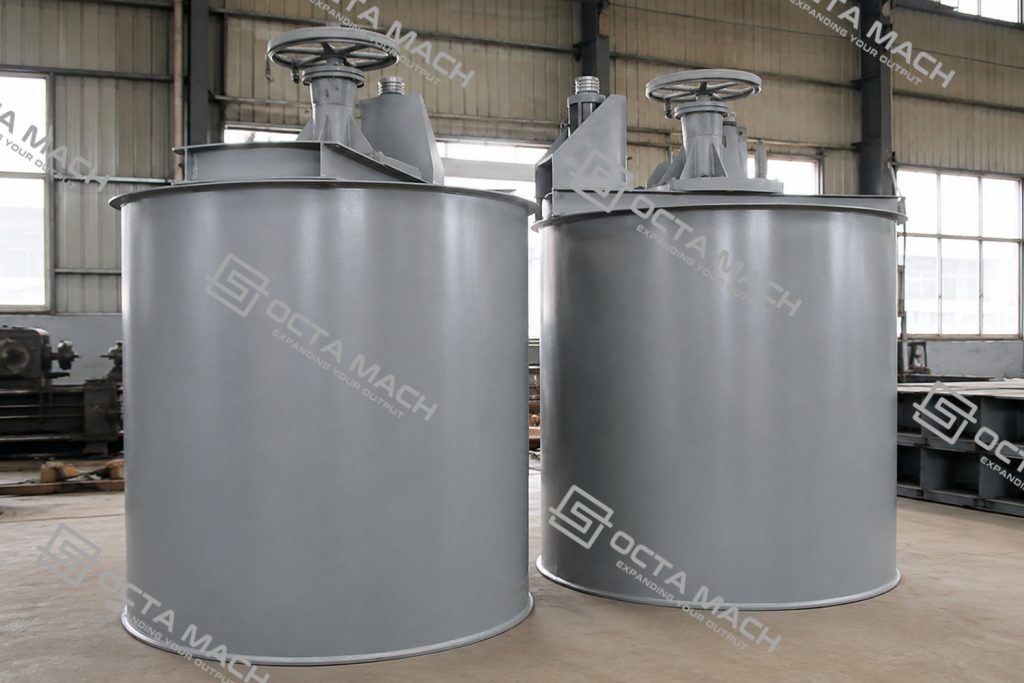
An Agitation Vat is a vertical mineral-processing tank used to mix ore pulp with flotation reagents before the slurry enters the flotation circuit. It consists of a cylindrical steel tank, a vertical agitator shaft, an impeller, a motor and a transmission assembly. During operation, the rotating impeller circulates the slurry, disperses reagents and keeps mineral particles suspended long enough to establish more consistent feed conditions for the flotation cells.
The confirmed XB series covers effective volumes from 0.26 to 30 m³ and installed motor powers from 1.1 to 22 kW. These units are intended primarily for ore-pulp homogenization and flotation conditioning rather than mineral separation inside the tank itself.
Agitation Vat in Flotation
In a conventional mineral-processing circuit, the agitation vat is normally installed after grinding and classification but before the flotation machine.
Grinding → Classification → Agitation Vat → Flotation Machine.
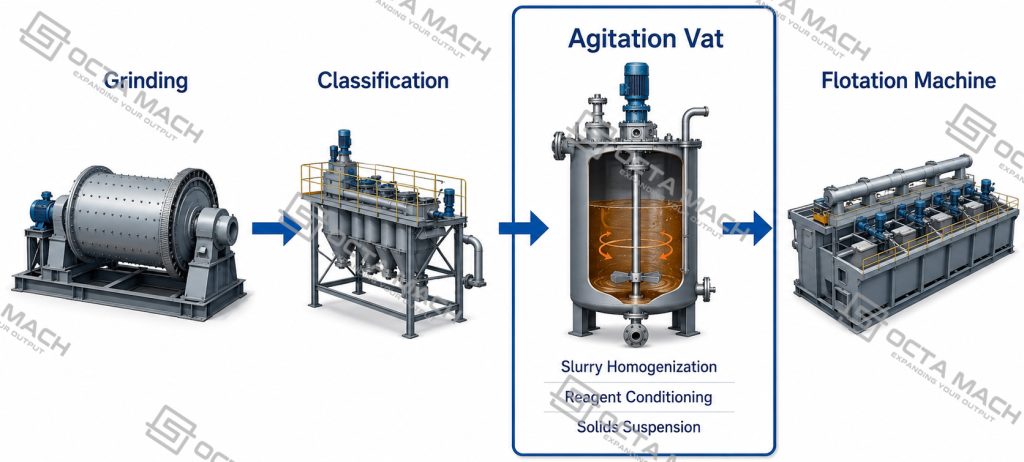
At this stage, the ore has already been reduced toward its required liberation size. The remaining duty is to prepare a stable slurry and provide controlled contact between mineral surfaces and flotation reagents.
A conditioning tank may also reduce short-term variations in slurry feed before flotation. Technical mineral-processing references describe the use of an agitator or conditioning tank between the grinding section and the flotation circuit to condition the feed with initial reagents and smooth minor flow fluctuations.
Agitation Vat Components
The working principle depends on several mechanical components operating as one system.
| Component | Function in the Mixing Process |
| Steel tank | Contains the ore pulp and provides the effective conditioning volume |
| Motor | Supplies the power required to rotate the agitator |
| Transmission assembly | Transfers and adjusts motor output for the selected operating speed |
| Vertical agitator shaft | Transfers torque from the drive assembly to the impeller |
| Impeller | Produces slurry circulation, reagent dispersion and particle suspension |
| Support structure | Supports the drive and maintains shaft alignment |
| Feed connection | Introduces slurry and process reagents into the tank |
| Discharge connection | Transfers conditioned slurry to downstream flotation equipment |
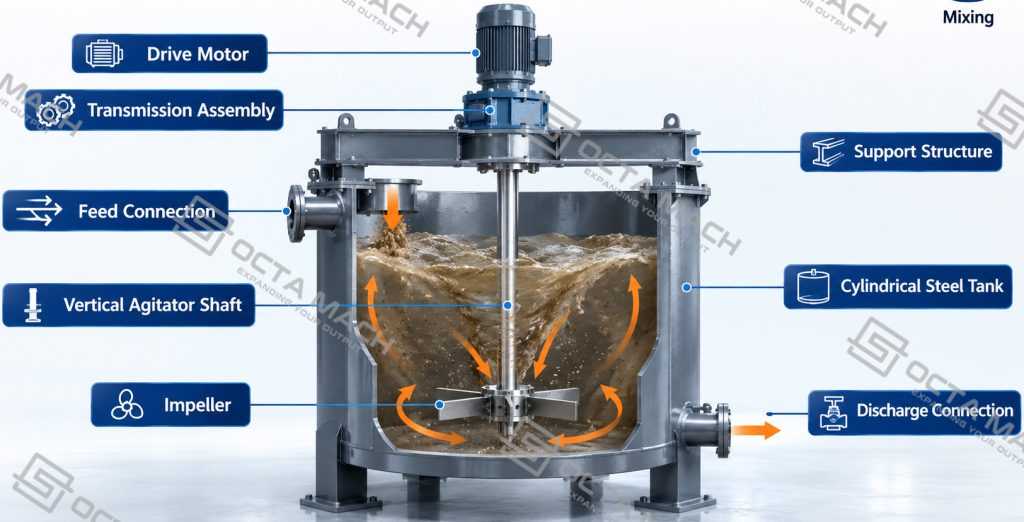
The tank diameter, liquid depth, impeller diameter and rotational speed must be treated as an integrated configuration. Increasing one parameter without considering the others does not automatically improve conditioning.
How an Agitation Vat Works
Slurry and Reagent Entry
Classified ore pulp enters the tank through the feed connection. Collectors, depressants, activators, pH modifiers or other process chemicals may be introduced at designated addition points according to the flotation test program.
The purpose of this stage is not simply to place reagents in the same vessel as the slurry. The chemicals must be distributed through the active volume and brought into contact with the relevant mineral surfaces.
Torque Transmission
The motor drives the vertical shaft through the transmission assembly. The shaft then rotates the impeller inside the slurry.
Motor power must be sufficient for the actual mixing resistance created by slurry density, solids concentration, particle size and liquid depth. Published motor ratings therefore identify the installed configuration of each XB model, but they do not independently define process capacity.
Internal Slurry Circulation
For the XB arrangement described in the supplied product documentation, impeller rotation creates a circulating flow inside the tank. Slurry is drawn downward near the shaft and returned upward along the tank wall.
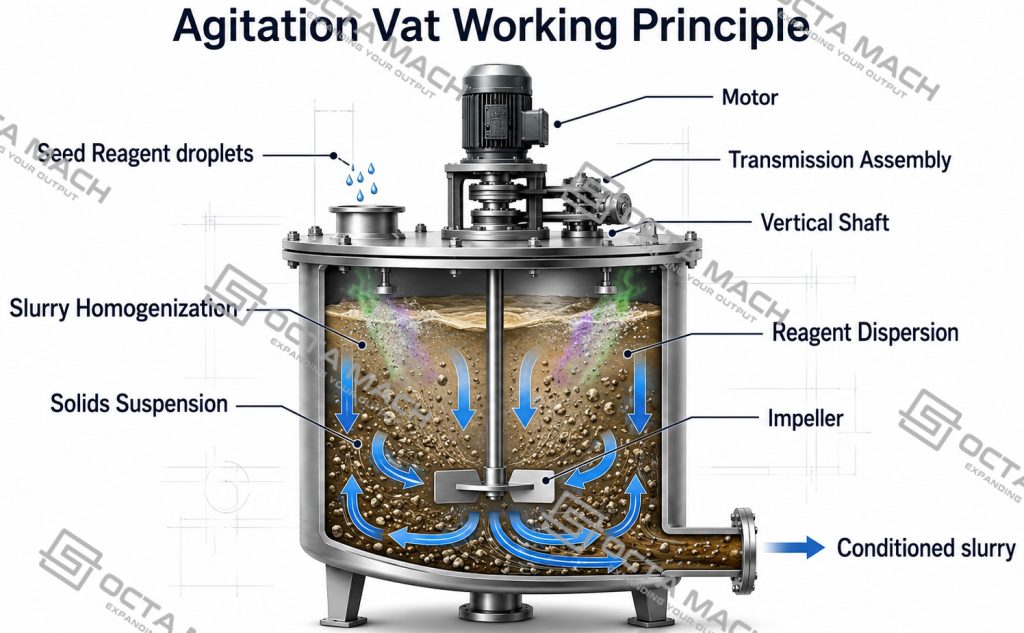
This circulation continually moves solids through the mixing zone instead of allowing the contents to rotate as an unmixed body. The resulting flow performs three connected duties:
- It reduces concentration differences within the tank.
- It limits settlement of mineral particles.
- It distributes flotation reagents through the ore pulp.
Research on mechanical pulp conditioning similarly shows that an impeller supplies the energy needed to establish a suitable flow field, strengthen mass transfer and improve slurry homogeneity before flotation.
Conditioned Slurry Discharge
After the required conditioning period, the slurry leaves through the discharge connection and enters the flotation stage.
The discharge arrangement should maintain the intended operating level without creating excessive short-circuiting between the inlet and outlet. Effective conditioning requires both adequate mixing intensity and sufficient time for reagent–particle interaction.
Agitation Vat Functions Before Flotation
The agitation vat does not create a concentrate and tailings stream. Its job is to prepare the slurry so that the flotation machine receives a more controlled feed.
| Process Duty | Effect Before Flotation |
| Ore-pulp homogenization | Reduces differences in solids concentration and particle distribution |
| Solids suspension | Limits particle settlement and sanding inside the tank |
| Reagent dispersion | Distributes collectors, depressants, activators and modifiers |
| Flotation conditioning | Provides contact time between reagents and mineral surfaces |
| Process buffering | Reduces the effect of short-term upstream feed fluctuations |
| Continuous transfer | Maintains slurry movement toward downstream flotation equipment |
This distinction is important. An agitation vat prepares the slurry, whereas a flotation cell introduces and disperses air to form mineralized bubbles and separate valuable minerals from gangue.
Mixing Duty and Conditioning Time
Mixing intensity should be sufficient to keep particles suspended and distribute reagents throughout the tank, but higher speed is not automatically better. Insufficient agitation can cause solids settling and uneven reagent concentration, while excessive agitation increases power demand, wear and unwanted air entrainment. The required duty must therefore balance slurry circulation with the specified conditioning time.
A preliminary effective volume can be estimated as:
Required effective volume = slurry flow × conditioning time.
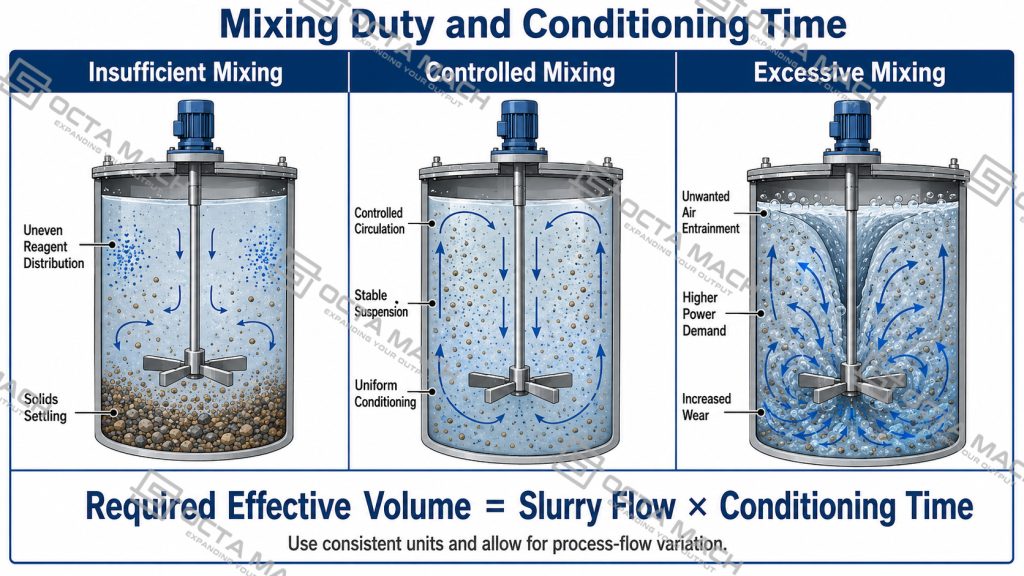
Final sizing must also consider solids concentration, slurry density, particle settling tendency and process-flow variation.
Agitation Process Variables
Slurry Flow Rate
The slurry flow rate determines how much effective volume is required to provide the specified conditioning time. A tank that is too small may allow slurry to pass through before reagent distribution and mineral-surface conditioning are complete.
Solids Concentration
Higher solids concentration can increase slurry viscosity and make circulation more difficult. It may also increase the torque required to maintain solids suspension.
Slurry Density
Slurry density affects impeller load, motor duty and particle settling behaviour. It should be evaluated together with solids concentration rather than treated as a stand-alone value.
Particle Size and Settling Tendency
Coarser or denser mineral particles generally require stronger suspension duty than fine, low-density solids. Off-specification coarse material entering from the classifier may also increase the risk of sanding.
Reagent Addition Points
The number and position of reagent addition points influence how chemicals move through the tank. Some flotation flowsheets require reagents to be introduced separately or in a controlled sequence rather than through one common feed line.
Upstream and Downstream Interfaces
The feed elevation, discharge elevation, pipe size, upstream flow variation and connection to the flotation machine must be confirmed during equipment layout. A suitable tank volume alone does not guarantee a workable installation.
XB Agitation Vat Range
The following figures are the published range from the supplied equipment catalogue.
| Parameter | Confirmed Published Range |
| Equipment type | Vertical Agitation Vat |
| Model range | XB-750 to XB-3500 |
| Tank internal diameter | 750–3,500 mm |
| Tank depth | 750–3,500 mm |
| Effective volume | 0.26–30 m³ |
| Agitator diameter | 240–850 mm |
| Agitator speed | 200–530 r/min |
| Installed motor power | 1.1–22 kW |
| Equipment weight | 228–7,110 kg |
| Main duty | Ore-pulp mixing and flotation conditioning |
These values are intended for preliminary model comparison. Actual selection must also account for slurry flow, required conditioning time, solids percentage, slurry density, particle size, settling rate, reagent dosage and plant arrangement.
Agitation Vat Selection for Flotation
A preliminary XB model can be selected from required effective volume, but the final decision should be based on the complete process duty.
At minimum, confirm:
- slurry flow rate;
- required conditioning time;
- solids concentration;
- slurry density;
- particle-size distribution;
- settling tendency;
- reagent type and dosage;
- number of reagent addition points;
- upstream flow variation;
- downstream flotation-machine interface;
- site voltage and frequency;
- installation and maintenance space.
Octa Mach supplies the XB Agitation Vat as part of mineral-processing systems that may also include ball mills, classifiers, slurry pumps and flotation machines. Equipment selection should be checked against the complete grinding and flotation flowsheet rather than isolated tank dimensions.
FAQ
Where is an agitation vat installed in a flotation plant?
It is normally installed after grinding and classification and before the flotation machine. Its main duty is to homogenize the ore pulp, suspend solids and mix flotation reagents with the slurry.
Is a higher agitator speed always better?
No. The correct speed must produce sufficient circulation and particle suspension without excessive power demand, wear, vortexing or air entrainment. The required duty depends on slurry density, solids concentration and particle characteristics.
How is the required agitation-vat volume estimated?
A preliminary estimate uses slurry flow multiplied by the required conditioning time. Final working volume should also include an allowance for operating fluctuations and the actual usable slurry level.
Can an XB agitation vat be used as a gold-leaching tank?
Not without process confirmation. The published XB series is primarily defined for ore-pulp mixing and flotation conditioning. Gold leaching may require different residence time, corrosion protection, aeration, reagent compatibility and tank configuration.