
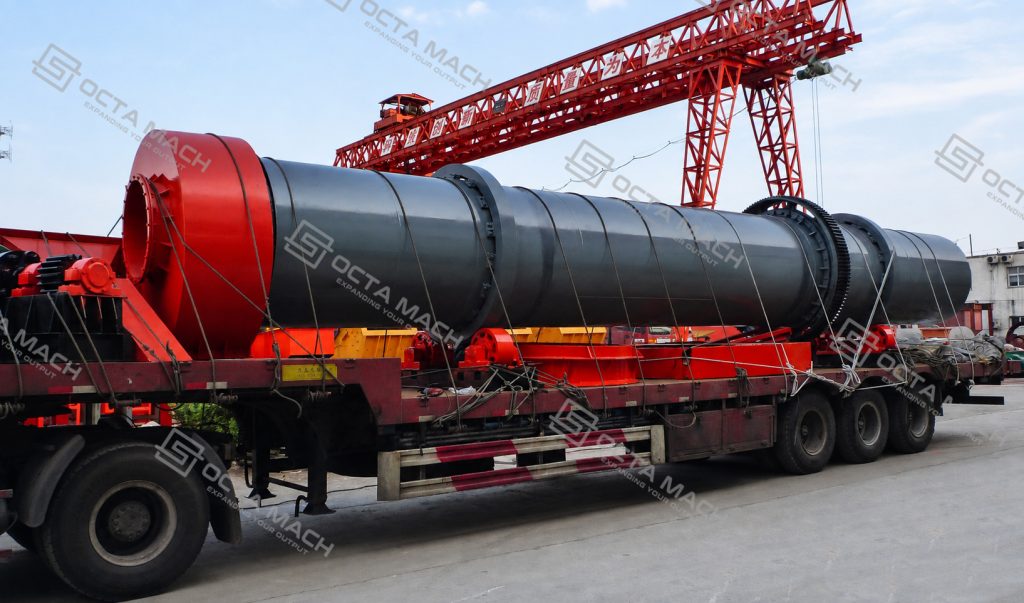
Octa Mach completed a rotary dryer delivery for a silica sand drying project in Indonesia. The supplied Φ2200 × 18000 mm rotary dryer provides a continuous moisture-reduction stage between sand washing and downstream screening and storage.
According to the published model specifications, the dryer has a reference processing capacity of 10–18 t/h, a drum inclination of 3–5%, an adjustable rotational speed of 1.5–6 r/min and a 37 kW installed motor. Its approximate machine weight is 52 tonnes.
The rotary dryer project covered equipment manufacturing, export packing and installation support. Cylinder geometry, support-roller positioning, transmission alignment, internal lifting-flight arrangement and process-system connections were treated as important controls during equipment preparation and site installation.
Indonesia Silica Sand Drying Project Overview
| Project Item | Project Information |
|---|---|
| Project Location | Indonesia |
| Processed Material | Washed Silica Sand |
| Supplied Equipment | Rotary Dryer |
| Model | Φ2200 × 18000 mm |
| Quantity | 1 Set |
| Drum Diameter | 2,200 mm |
| Drum Length | 18,000 mm |
| Drum Inclination | 3–5% |
| Rotational Speed | 1.5–6 r/min |
| Maximum Inlet-Gas Temperature | ≤800°C |
| Installed Motor Power | 37 kW |
| Published Capacity | 10–18 t/h |
| Approximate Machine Weight | 52 t |
| Initial Moisture Content | Approximately 12–15% |
| Target Final Moisture | Below 1% |
| Heat Source | Natural-Gas Hot-Air Furnace |
| Gas-Flow Arrangement | Co-Current Drying |
| Main Process Duty | Moisture Reduction |
| Downstream Stage | Screening and Product Storage |
| Service Scope | Equipment Supply, Export Packing and Installation Support |
The published capacity of 10–18 t/h is a model reference rather than a guaranteed output for every feed material. Actual silica sand throughput depends on initial and target moisture, wet feed rate, particle-size distribution, bulk density, inlet-gas conditions, residence time and available heat input.
The moisture conditions, heat source and process arrangement described in this case should be checked against the final process design and order documents before publication as confirmed project data.
Silica Sand Drying Requirements
Washed silica sand retains surface moisture after washing, classification and mechanical dewatering. Excess moisture may cause particle adhesion, unstable screening and material buildup in conveyors, storage silos or packaging equipment.
The drying stage must remove sufficient moisture without introducing unnecessary fuel consumption, excessive dust carryover or unstable discharge conditions. Consistent drying is particularly important when the final sand must meet controlled moisture requirements for glassmaking, foundry use, construction materials or other industrial applications.
For this project configuration, the silica sand enters the drying system with an assumed moisture content of approximately 12–15%. The target is to reduce the final moisture content to below 1% before screening and product storage.
The selected rotary dryer for material drying uses continuous drum rotation, internal lifting flights and controlled hot-gas flow. As the drum rotates, the flights raise the silica sand and release it through the gas stream, creating a material curtain that increases the available surface area for heat and moisture transfer.
Rotary Dryer Solution for the Indonesia Project
The project uses a Φ2200 × 18000 mm rotary dryer with a published processing capacity of 10–18 t/h. Its main assemblies include the rotating drum, riding rings, support rollers, thrust rollers, transmission system, feed hood, discharge hood, sealing assemblies and internal lifting flights.
A co-current process arrangement was selected for this case. Wet silica sand and hot gas enter from the same end and travel in the same general direction through the drum. The wettest feed therefore contacts the hottest gas near the inlet, while progressively dried material encounters lower gas temperatures toward the discharge end.
The inclined drum and adjustable rotation move the silica sand gradually through the drying chamber. Its published inclination range is 3–5%, while the rotational speed can be adjusted within 1.5–6 r/min according to the required residence time and material movement.
The material route follows this sequence:
Wet Silica Sand → Feeding System → Rotary Dryer → Discharge Conveyor → Screening → Product Storage
The corresponding gas route is:
Natural-Gas Hot-Air Furnace → Rotary Dryer → Dust-Collection System → Exhaust Fan → Stack
The dryer, heat source, feeding system and exhaust equipment must operate as an integrated process. The drum dimensions alone cannot determine final moisture or production capacity. Stable feed, adequate heat input and controlled airflow are equally important.
Industrial Rotary Dryer Structure and Operation
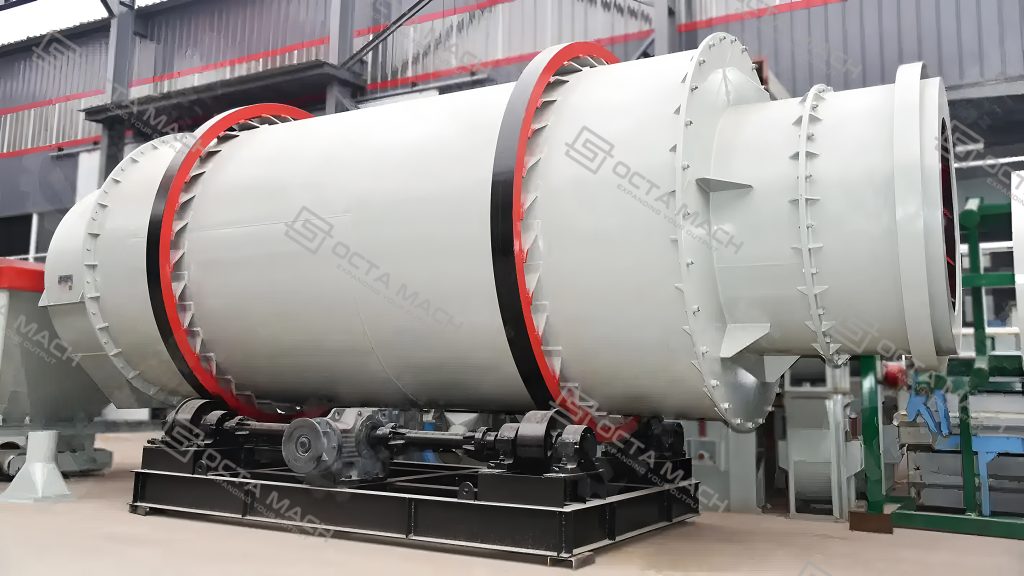
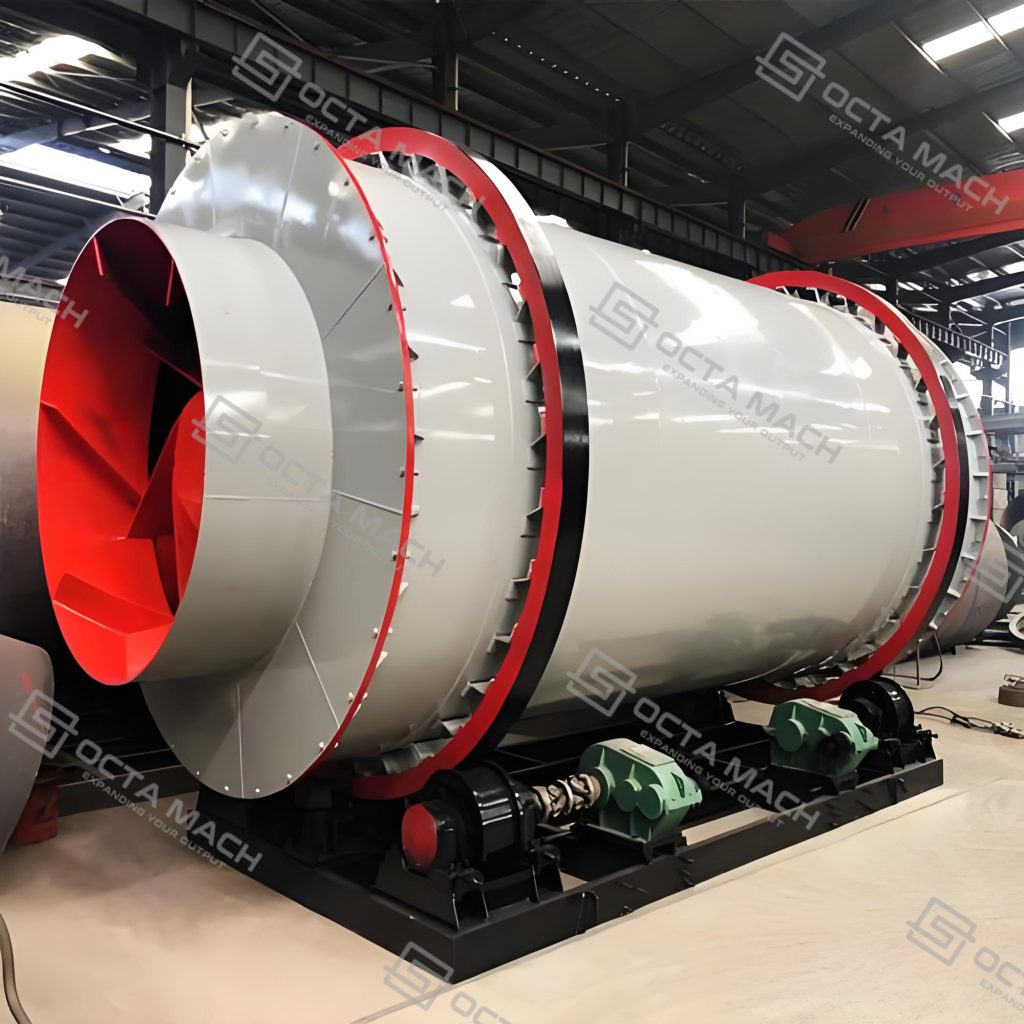
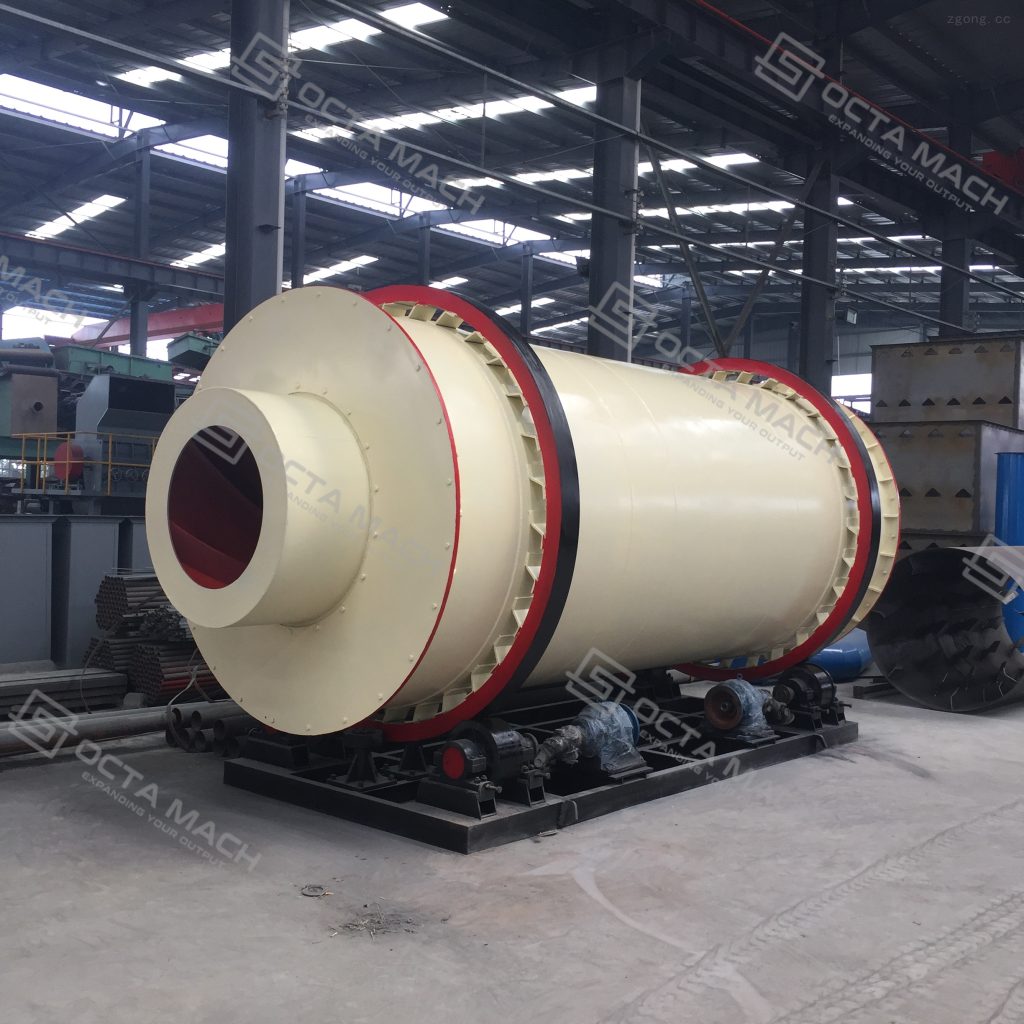
The industrial rotary dryer uses an 18 m steel drum fitted with internal lifting flights. During rotation, the flights repeatedly raise and disperse the silica sand through the hot-gas stream, improving heat transfer and moisture removal.
Support rollers and riding rings carry the drum, while thrust rollers control axial movement. A 37 kW motor drives the drum through the transmission system, with an adjustable rotational speed of 1.5–6 r/min.
Sealing assemblies at the inlet and outlet help control air leakage, heat loss and gas-flow stability. These components work together to maintain continuous material movement and stable drying performance.
Inlet-Gas Temperature and Process Control
The published maximum inlet-gas temperature for this model is ≤800°C. This value represents an equipment limit and should not be interpreted as the required or normal operating temperature for silica sand drying.
The actual inlet temperature must be selected according to:
- Initial and target moisture content
- Wet feed rate
- Particle-size distribution
- Material temperature limitations
- Drum residence time
- Exhaust-gas condition
- Heat-source capacity
- Dust-collection performance
Operating at an unnecessarily high temperature may increase fuel consumption, dust generation and thermal stress. Insufficient temperature, however, may leave the discharged silica sand above its required moisture level.
Inlet temperature, outlet temperature and final product moisture should therefore be evaluated together. Temperature readings alone do not confirm drying performance without representative moisture sampling.
Equipment Manufacturing and Quality Control
Manufacturing the Φ2200 × 18000 mm dryer required controlled fabrication of the drum sections, riding-ring positions, support interfaces, transmission components and end connections.
Drum roundness and longitudinal straightness influence rotational stability and support-roller contact. Dimensional deviations may produce uneven loading, vibration or difficulty during site alignment.
The riding rings were positioned according to the supporting arrangement and checked for their relationship with the drum centerline. Their contact with the support rollers must remain sufficiently uniform to avoid concentrated loads and abnormal wear.
The girth gear and pinion were prepared according to the required transmission geometry. Final tooth contact and backlash still require verification after installation because the operating relationship depends on the installed positions of the drum, support system and drive unit.
Internal lifting flights were arranged for continuous material distribution. Their welded connections must withstand repeated heating, material impact and drum rotation during operation.
Before packing, the main assemblies, transmission components and installation accessories were identified according to their intended positions. These markings helped the receiving team verify the delivered components and organize the site assembly sequence.
Export Packing and Delivery to Indonesia
The rotary dryer delivery included large structural assemblies as well as machined, mechanical and electrical components. Each type required a suitable packing and transportation method.
The drum and major steel assemblies were supported to reduce movement and localized loading during lifting, loading and sea transportation. Machined surfaces and exposed connection points received protection against moisture and corrosion.
Bearings, transmission components, instruments and electrical parts were packed separately to reduce exposure to impact, dust and humidity. Smaller accessories were grouped by function and marked for identification during installation.
Clear package markings and packing records supported cargo inspection after arrival in Indonesia. They also helped the site team locate the required components without opening every package simultaneously.
Rotary Dryer Installation Project in Indonesia
Foundation accuracy was a primary requirement for the rotary dryer installation project. Before positioning the main equipment, the installation team checked the foundation dimensions, reference elevation, dryer centerline and anchor-bolt locations against the installation drawings.
The support rollers were installed and adjusted before the drum was positioned. Their centerlines, relative elevations and contact conditions had to distribute the approximately 52 t machine weight correctly.
After the drum was placed, the riding-ring contact and axial position were checked. The thrust rollers were then adjusted to control axial movement without imposing unnecessary side loading.
The motor, coupling, reducer, pinion and girth gear were aligned along the transmission centerline. Gear backlash and tooth-contact patterns were checked before continuous operation. Incorrect gear engagement may cause abnormal noise, vibration, localized tooth loading and accelerated wear.
The installation team subsequently connected the feeding system, hot-air furnace, discharge conveyor, dust collector, exhaust fan and electrical controls. Sealing conditions, thermal-expansion allowances and protective guards were inspected before commissioning.
Commissioning and Operating Control
Commissioning began with a no-load mechanical trial. The operating team checked:
- Drum rotation direction
- Support-roller contact
- Thrust-roller condition
- Lubrication performance
- Motor current
- Reducer operation
- Gear contact and noise
- Abnormal vibration
After stable mechanical operation was confirmed, the exhaust system and heat source were tested. Controlled airflow was established before wet silica sand entered the drum.
The material feed was introduced progressively. Operators monitored the wet feed rate, inlet and outlet temperatures, drum speed, motor load, exhaust condition and discharged-material moisture.
Feed rate and heat input must be adjusted together. Increasing the feed without providing sufficient drying energy can raise the final moisture content. Excessive heat input may waste fuel and create unstable exhaust conditions.
Drum speed affects material residence time and lifting behavior. Operation within the published range of 1.5–6 r/min should be adjusted according to feed properties and drying performance rather than treated as a fixed setting.
Airflow must also remain within a suitable range. Insufficient airflow restricts moisture removal, while excessive airflow can increase dust carryover and heat loss.
Routine operating records should compare:
- Hourly wet feed rate
- Initial feed moisture
- Final product moisture
- Inlet and outlet temperatures
- Drum rotational speed
- Motor current
- Fuel consumption
- Exhaust and dust-collection conditions
These records provide the basis for adjusting the feed rate, burner output, drum speed and exhaust airflow.
Supporting Silica Sand Processing in Indonesia
The Φ2200 × 18000 mm rotary dryer provides a controlled drying stage between silica sand washing and downstream screening. Reducing the moisture content helps limit particle adhesion and supports more stable screening, conveying, storage and packaging.
Its published 10–18 t/h capacity provides a useful selection reference, but actual project output must be confirmed under representative feed and operating conditions. Changes in initial moisture, sand grading or wet feed rate can significantly alter the required heat duty and achievable throughput.
Stable drying depends on the coordination of the drum, lifting flights, feeding system, heat source, exhaust fan and dust collector. Proper manufacturing, packing, installation and commissioning establish the mechanical and process conditions required for continuous operation.
Octa Mach supported this rotary dryer project through equipment preparation, export delivery and installation coordination. Controlled alignment, clear component identification and progressive commissioning helped prepare the system for continuous silica sand drying under the specified project conditions.
FAQ
Q: What is the capacity of the rotary dryer supplied for this project?
A: The Φ2200 × 18000 mm model has a published capacity of 10–18 t/h. Actual silica sand throughput depends on feed moisture, particle size, heat input, residence time and target final moisture.
Q: Does the maximum inlet temperature of ≤800°C represent the normal operating temperature?
A: No. It is the published maximum inlet-gas limit. The actual operating temperature must be selected according to the material condition, wet feed rate and required final moisture.
Q: Why is the rotary dryer speed adjustable?
A: The 1.5–6 r/min speed range allows operators to adjust material movement, lifting frequency and residence time according to the silica sand feed and drying duty.
Q: What should be checked before heated commissioning begins?
A: Check the foundation, drum alignment, roller contact, gear engagement, lubrication, seals, airflow, safety guards and electrical interlocks. Complete a stable no-load trial before introducing heat and wet material.