
Granite arriving from the quarry face in Nakuru is rarely uniform. One loader bucket may contain large angular blocks, while the next carries smaller fragments and natural fines. Feeding that variation directly into a secondary crusher would cause fluctuating chamber loading, unstable screen circulation and inconsistent aggregate grading.
That operating problem—not a headline capacity figure—determined the layout of this stone crushing plant for hard granite. The line uses a grizzly feeder to regulate the incoming load, a jaw crusher to reduce the largest stone, a cone crusher to control the secondary product and a multi-deck screen to separate four commercial aggregate sizes.
For this Kenyan project, Octa Mach designed the circuit for hard granite and an operating target of 180–220 TPH. Final equipment selection remains tied to representative feed samples because granite strength, abrasiveness and the proportion of fines directly affect crusher power, liner wear and screening efficiency.
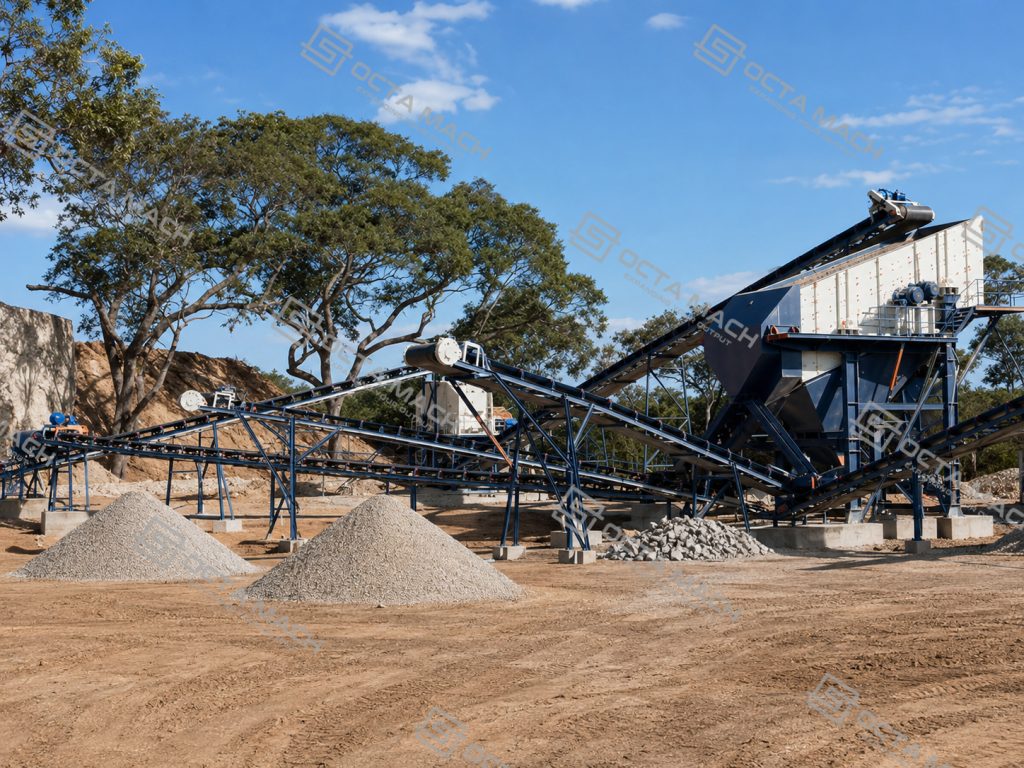
The Production Requirement
The customer planned to supply aggregate for concrete batching, asphalt production and local road construction. These applications required more than a single mixed crusher discharge. Each saleable fraction needed an independent discharge conveyor and stockpile to prevent coarse aggregate from mixing with fine material.
| Project Parameter | Design Basis |
|---|---|
| Location | Nakuru County, Kenya |
| Feed material | Hard quarry granite |
| Target operating capacity | 180–220 TPH |
| Maximum feed size | 600 mm |
| Processing route | Dry crushing and screening |
| Finished fractions | 0–5 mm, 5–10 mm, 10–20 mm and 20–31.5 mm |
| Primary products | Concrete aggregate, asphalt aggregate and road-base material |
| Circuit arrangement | Two-stage crushing with closed-circuit screening |
| Loading method | Wheel loader or dump truck |
| Dust control | Transfer-point enclosures and controlled water spraying |
The capacity range applies when the feed remains within the specified maximum size and the plant receives a continuous, evenly distributed load. Excessive clay, high moisture or a large proportion of oversized blocks would reduce actual output.
Why the Circuit Uses Two Crushing Stages
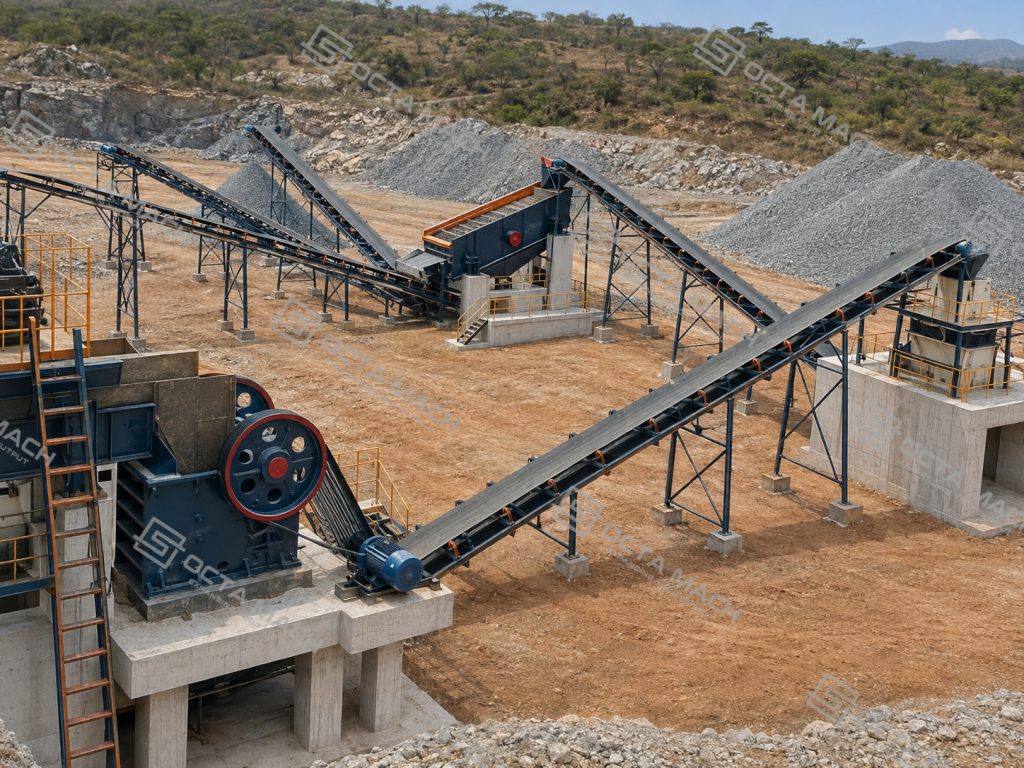
The selected stone crusher plant divides size reduction between two machines instead of forcing one crusher to handle the complete reduction ratio.
The jaw crusher accepts coarse, irregular quarry feed and produces a manageable intermediate size. Its purpose is not to manufacture the finished aggregate directly. Setting the primary crusher excessively tight would increase wear and reduce capacity without providing reliable control of final grading.
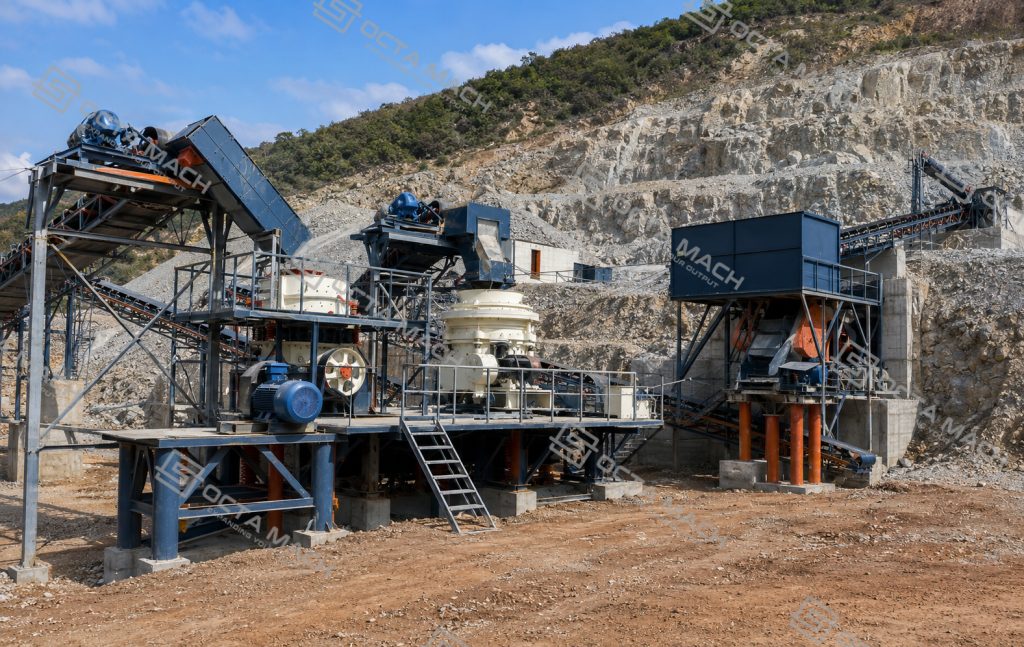
The cone crusher performs secondary reduction. Compression crushing is suitable for hard granite and allows the operator to adjust the discharge setting as liner wear progresses. It also provides a more controlled feed to the vibrating screen than material discharged directly from the primary stage.
The process sequence is:
- The loader places quarry stone into the receiving hopper;
- The vibrating grizzly feeder meters material into the primary crusher;
- Fine material passing through the grizzly bypasses unnecessary primary crushing;
- The jaw crusher reduces the coarse blocks;
- A conveyor transfers the primary product to the cone-crushing section;
- The vibrating screen separates the required aggregate sizes;
- Screen oversize returns to the cone crusher;
- Finished fractions move to independent stockpiles.
Only oversized material returns for additional crushing. The four compliant fractions leave the circuit without passing through the crushers again.
Product Grading and Intended Use
| Finished Size | Typical Project Use | Main Control Point |
|---|---|---|
| 0–5 mm | Crusher fines, blended fine aggregate or road material | Fines content and moisture |
| 5–10 mm | Asphalt mixes and small concrete aggregate | Screen aperture and particle shape |
| 10–20 mm | General concrete production | Stable grading and limited oversize |
| 20–31.5 mm | Road base and larger concrete aggregate | Top-size control |
These applications are indicative rather than automatic product certifications. The customer must confirm grading, cleanliness, particle shape and mechanical properties against the applicable concrete, asphalt or road specification.
Changing a screen panel can alter the nominal product sizes, but it can also change the circulating load. A smaller aperture generally sends more material back to the cone crusher, which may reduce net production if the crusher and screen were not sized for the revised duty.
Main Equipment Selected
| Equipment | Function in the Plant | Selection Consideration |
|---|---|---|
| Receiving hopper | Receives intermittent loader or truck feed | Loading method and required buffer volume |
| Vibrating grizzly feeder | Regulates feed and removes part of the natural fines | Maximum lump size and bar spacing |
| Jaw crusher | Reduces large granite blocks | Feed opening, reduction ratio and liner profile |
| Hydraulic cone crusher | Produces controlled secondary material | Required product curve and recirculating load |
| Multi-deck vibrating screen | Separates four product fractions | Screen area, deck arrangement and aperture size |
| Return conveyor | Carries oversize back to secondary crushing | Maximum expected recirculating load |
| Product conveyors | Build separate aggregate stockpiles | Discharge height and stockpile separation |
| Dust-control system | Controls emissions at transfer points | Water availability and material moisture |
| Electrical control system | Manages sequencing, overloads and interlocks | Motor load, start-up logic and fault protection |
The hard-rock crushing equipment is arranged so that each crusher can be isolated for maintenance without dismantling the entire conveyor system. Walkways provide access to screen decks, lubrication points, drive units and replaceable chute liners.
Screening Controls the Actual Plant Output
Crusher capacity alone does not determine saleable production. The vibrating screen must process both newly crushed material and the oversize returning through the closed circuit.
Uneven feed distribution across the screen reduces usable screening area. Worn or damaged panels allow oversized particles to enter finished stockpiles, while blocked apertures divert acceptable material back to the crusher. Both conditions increase operating cost even if the crushers continue running normally.
Operators should monitor:
- Feed distribution across the full screen width;
- Oversize volume on the return conveyor;
- Blocked, loose or damaged screen panels;
- Segregation within finished stockpiles;
- Cone crusher power and chamber loading;
- Changes in product grading as liners wear.
A rising return load is an operating signal, not simply additional production. It may indicate that the cone crusher setting has opened, the screen is overloaded or the selected product apertures no longer match the intended circuit balance.
Practical Layout Details for the Quarry
The equipment layout leaves sufficient height below crushers and screens for discharge chutes to operate without shallow angles or material buildup. Transfer points handling coarse granite receive replaceable wear liners, while inspection doors provide access without removing entire chute sections.
The design also separates finished stockpiles far enough to limit cross-contamination. Conveyor discharge height must provide useful storage capacity without creating excessive free fall, aggregate degradation or dust.
Additional site provisions include:
- A rock-breaking position near the receiving hopper for occasional oversized blocks;
- Vehicle access that does not cross beneath operating conveyors;
- Drainage around the hopper and primary crusher;
- Safe lifting access for jaw plates and cone crusher liners;
- Space for removing screen panels and drive components;
- Emergency stops along accessible conveyor routes;
- Lighting around service platforms and transfer points.
Wear and Maintenance Control
Hard granite concentrates wear at the feeder discharge, jaw crusher chamber, cone crusher liners, screen feed box and high-impact conveyor transfers. These areas use replaceable wear components so maintenance teams do not have to repair the main supporting structure after every wear cycle.
Wear records should be compared in both operating hours and tonnes processed. Hours alone can be misleading when daily throughput changes. Recording the liner position, crusher setting and product grading at each inspection also helps identify when wear begins to affect circuit performance.
Preparation for Delivery
Large steel structures and conveyors are divided into transportable sections before shipment. Matching marks connect each support, walkway, chute and conveyor section with the corresponding installation drawing.
Motors, instruments and electrical cabinets receive moisture protection, while machined surfaces and shaft ends are coated or wrapped against corrosion. Small fasteners, screen accessories and initial spare parts are packed separately and identified by package number.
Before loading, the delivery team checks:
- Equipment identification against the packing list;
- Match marks on dismantled steel structures;
- Protection of bearings, motors and exposed shafts;
- Loose-part boxes and installation fasteners;
- Lifting points and transport supports;
- Container weight distribution;
- Package photographs for receiving inspection.
FAQ
Q: Why is a cone crusher used for the secondary stage?
A: Hard granite requires a secondary crusher capable of sustained compression crushing. The cone crusher provides adjustable size reduction and works effectively in a closed circuit where screen oversize returns for further processing.
Q: Can this plant process basalt as well as granite?
A: The general jaw crusher and cone crusher arrangement can process basalt, but final machine selection must account for the actual feed size, abrasiveness, strength and required product grading. Basalt should not be substituted without reviewing power demand, liner selection and expected wear.
Q: Can the plant produce manufactured sand?
A: The current circuit produces a fine fraction through crushing and screening, but consistent manufactured sand may require a VSI shaping stage and additional classification. The decision depends on the required particle shape, grading and permissible fines content.
Q: What determines whether the plant reaches 180–220 TPH?
A: Throughput depends on continuous feeding, maximum lump size, material hardness, moisture, crusher settings, screen efficiency and recirculating load. The target range should be assessed under stable operation with representative quarry feed and the specified product split.