
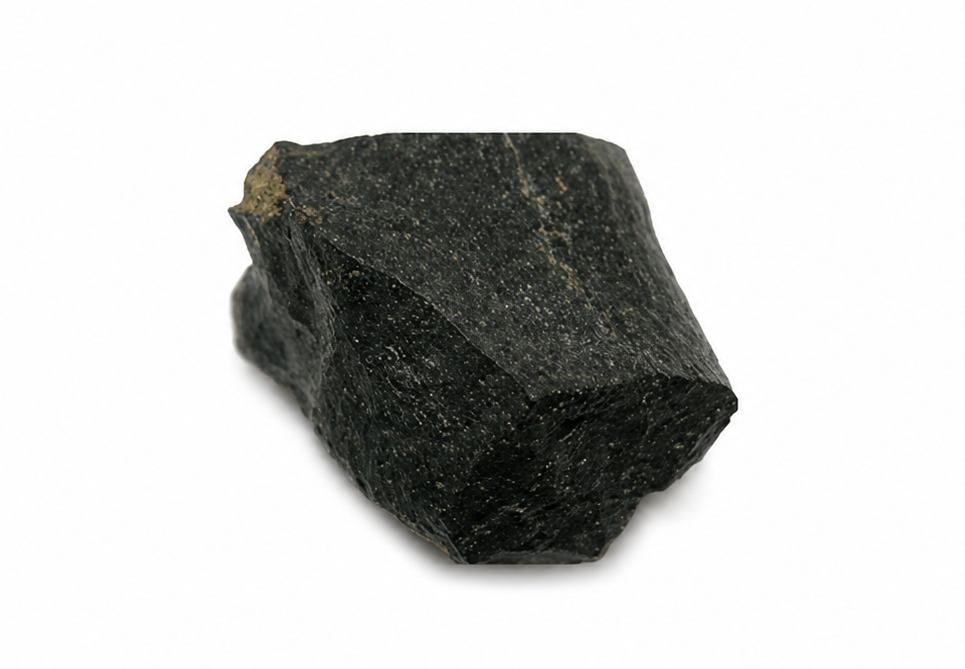
Basalt forms through the rapid cooling of lava at or near the earth’s surface, creating a dense volcanic igneous rock with a fine-grained crystalline structure. Its mineral composition mainly includes plagioclase feldspar, pyroxene, olivine and other volcanic minerals, which form a compact rock matrix with high strength and strong resistance to mechanical wear. Compared with many sedimentary rocks, basalt rock generally features higher density, lower porosity and greater resistance to compression. Typical basalt has a bulk density of approximately 2.80–3.10 g/cm³, a specific gravity of about 2.80–3.10, and a compressive strength commonly ranging from 150–300 MPa depending on mineral composition, weathering condition and geological origin. Its Mohs hardness is generally around 6–7, making it a hard and abrasive material during size reduction.
The dense mineral structure of basalt provides excellent durability for producing basalt aggregate, concrete aggregate, asphalt aggregate, road base and railway ballast. However, these same characteristics also increase crushing resistance and equipment wear during processing. Industrial basalt crushing therefore requires controlled size reduction through primary crushing, secondary compression crushing and screening, with optional shaping stages when improved particle shape or manufactured sand production is required. The complete circuit must balance feed size, crushing force, wear condition, particle shape and final aggregate requirements.
Basalt Properties and Physical Characteristics
The performance of basalt during extraction and processing is mainly determined by its volcanic origin, mineral composition and internal structure. Unlike coarse-grained intrusive rocks, basalt forms through relatively rapid cooling, creating a fine-grained crystalline texture where mineral particles are closely interlocked.
This compact structure provides basalt with high mechanical strength and durability, but it also increases resistance during crushing. The mineral composition and internal structure directly influence rock breakage behavior, abrasion potential and the selection of crushing equipment.
Basalt Composition and Mineral Structure
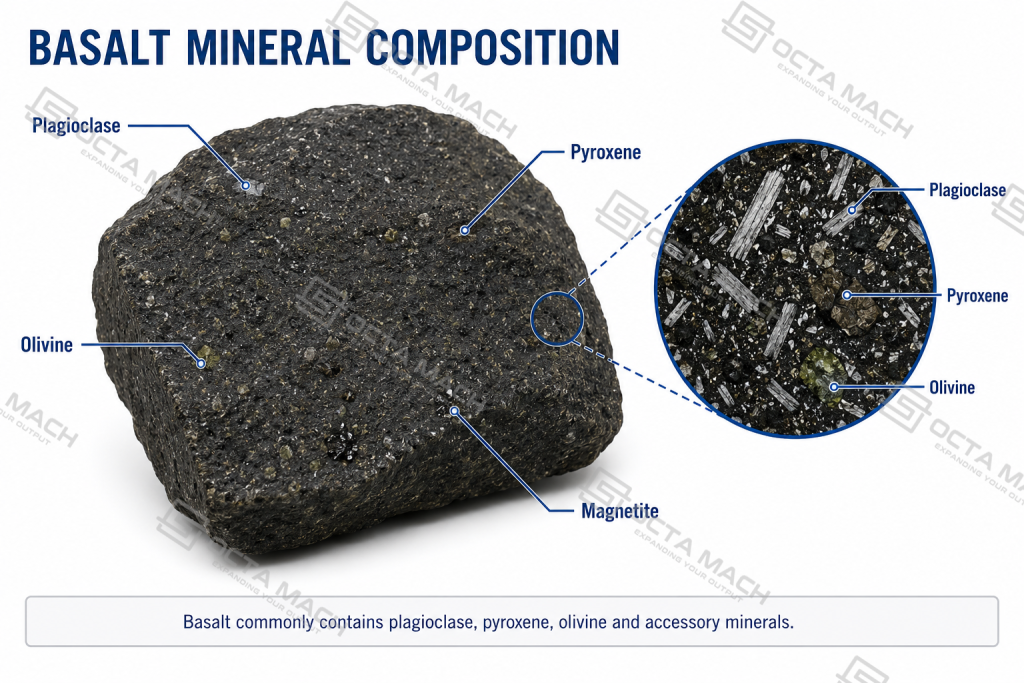
The mineral composition of basalt varies between deposits, but most basalt consists of a combination of feldspar, pyroxene, olivine and accessory minerals. These minerals form a dense crystalline framework that controls the mechanical behavior of the rock.
| Mineral Component | Typical Role in Basalt Structure | Influence on Rock Performance |
|---|---|---|
| Plagioclase Feldspar | Major framework-forming mineral | Contributes to overall strength and crystalline structure |
| Pyroxene | Common dark-colored mineral phase | Improves hardness and abrasion resistance |
| Olivine | Present in some basalt formations | Influences mineral durability and rock strength |
| Magnetite and Accessory Minerals | Minor mineral components | Affect density and overall mineral characteristics |
The mineral proportions vary between deposits, but basalt generally develops a dense crystalline structure with strong mineral interlocking, limited internal void space and good long-term durability. These characteristics contribute to its high density, low porosity and strong mechanical performance. Variations in mineral composition, grain structure and weathering conditions can result in different physical properties between basalt sources.
Typical Basalt Physical Properties
| Property | Typical Range |
|---|---|
| Rock Type | Volcanic igneous rock |
| Main Minerals | Plagioclase, pyroxene, olivine |
| Bulk Density | Approx. 2.80–3.10 g/cm³ |
| Specific Gravity | Approx. 2.80–3.10 |
| Mohs Hardness | Approx. 6–7 |
| Compressive Strength | Approx. 150–300 MPa |
| Porosity | Generally low |
| Water Absorption | Typically low for fresh basalt |
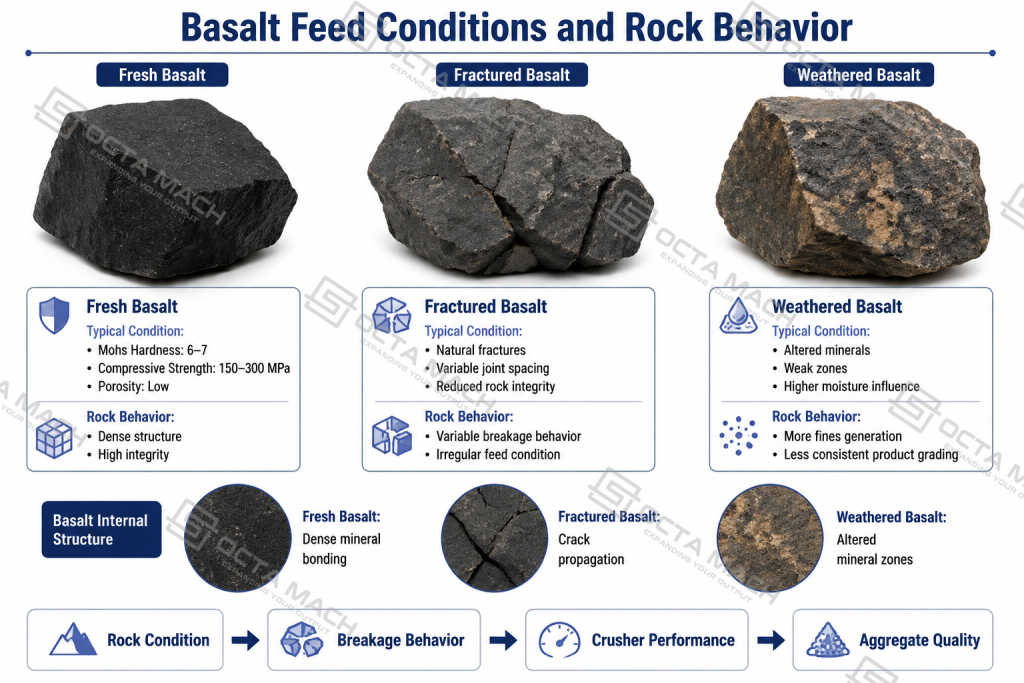
The physical properties of basalt directly reflect its formation environment and internal structure. The combination of high density (2.80–3.10 g/cm³) and low porosity indicates a compact rock matrix with limited internal voids, which contributes to its high durability and resistance to deformation. The compressive strength range of approximately 150–300 MPa shows that basalt can maintain strong structural integrity under heavy loading, while its Mohs hardness of around 6–7 is mainly related to the resistance of mineral grains against mechanical abrasion.
However, these values may vary between basalt sources due to differences in mineral composition, cooling conditions, fractures and weathering degree. Fresh basalt generally maintains higher strength and lower water absorption, while weathered or fractured basalt may contain weaker zones that affect particle breakage behavior and final aggregate quality.
How Basalt Properties Affect Crushing Performance
The main factors influencing basalt processing include:
- Hardness: determines resistance to mechanical breakage.
- Mineral structure: controls crack development during compression.
- Abrasion resistance: affects wear on crusher liners and crushing surfaces.
- Natural fractures: influence fragmentation behavior and particle distribution.
Because basalt is both strong and abrasive, the crushing circuit must achieve sufficient reduction while controlling wear and maintaining stable product quality.
Basalt Crushing Process
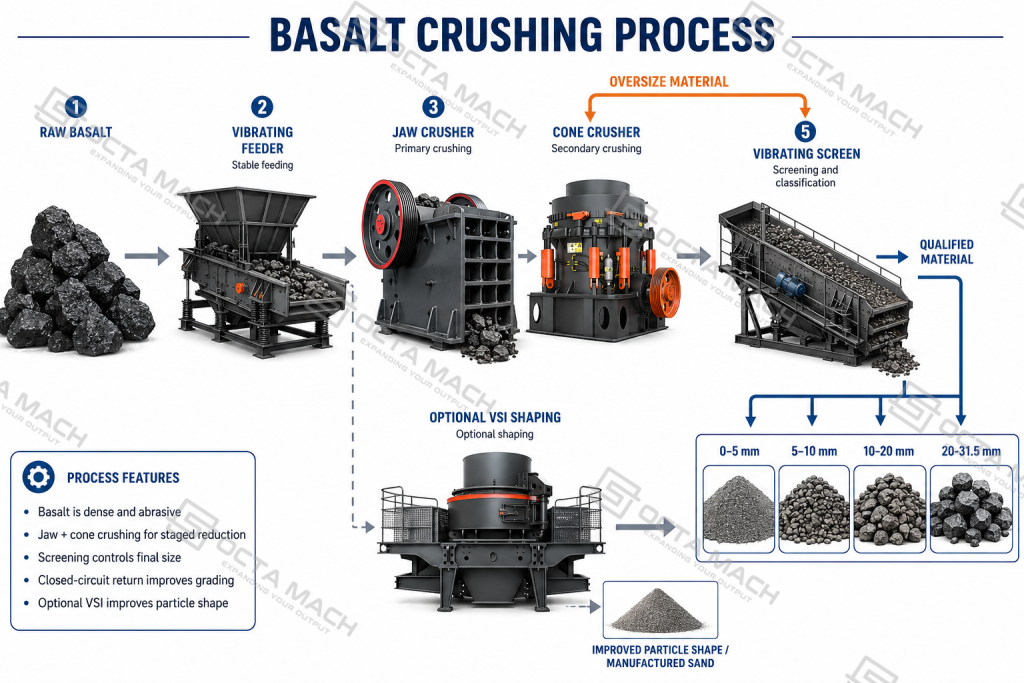
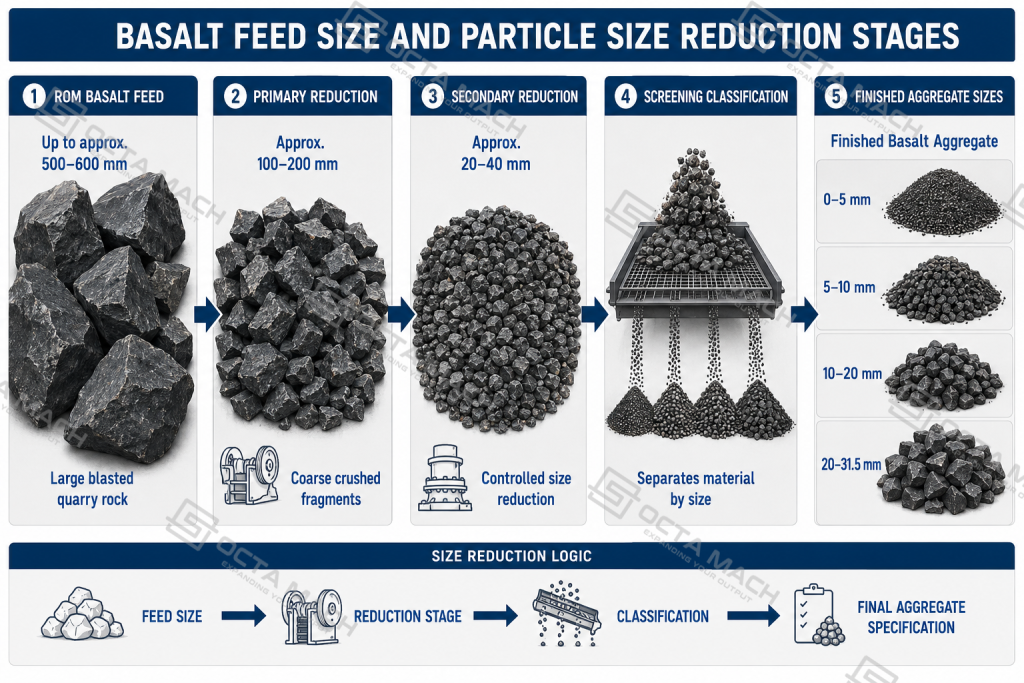
A typical basalt crushing process is designed around the rock’s high density, strong compressive strength and abrasive characteristics. Instead of applying excessive size reduction in a single stage, industrial basalt processing separates reduction, screening and optional shaping duties into different stages. This arrangement allows each crusher to operate within a suitable feed-size range, reduces excessive stress on wear components and provides better control over final aggregate grading. Since basalt is widely used for durable construction materials, the complete circuit must balance crushing efficiency, equipment wear, particle shape and product quality, with closed-circuit screening and optional shaping stages added when projects require consistent aggregate sizes, improved particle shape or manufactured sand production.
A common basalt processing route is:
Raw Basalt → Vibrating Feeder → Jaw Crusher → Cone Crusher → Vibrating Screen → Closed-Circuit Return → Optional VSI → Finished Basalt Aggregate
| Processing Stage | Equipment | Main Function | Key Control Factor |
|---|---|---|---|
| Feeding | Vibrating Feeder | Provides continuous basalt feed | Stable feed rate and material distribution |
| Primary Crushing | Jaw Crusher | Reduces large basalt blocks | Feed opening and reduction ratio |
| Secondary Crushing | Cone Crusher | Further reduces hard basalt | Crusher setting and wear condition |
| Screening | Vibrating Screen | Separates finished products | Screen aperture and grading accuracy |
| Closed Circuit Return | Screen + Crusher Loop | Returns oversize material | Circulating load control |
| Optional Shaping | VSI Crusher | Improves particle shape and produces manufactured sand | Shape requirement and fines control |
Basalt Crusher Selection and Configuration
Selecting a crusher for basalt requires evaluating the relationship between feed condition, reduction duty and final product requirements. Because basalt typically combines high compressive strength, dense structure and strong abrasion resistance, the crushing circuit should distribute size reduction across multiple stages rather than forcing one machine to handle excessive reduction.
The maximum feed size is one of the first factors considered during equipment selection. Fresh quarry basalt may enter the primary stage with ROM sizes commonly reaching 500–600 mm, while downstream crushers normally receive smaller and more controlled feed after primary reduction. The selected equipment must therefore match both the incoming material size and the required final product specification.
| Crushing Duty | Recommended Equipment | Reference Feed Condition | Main Selection Consideration |
|---|---|---|---|
| Primary reduction of large basalt blocks | Jaw Crusher | ROM feed up to approx. 500–600 mm (project dependent) | Feed opening, crushing force and primary reduction capability |
| Secondary reduction of pre-crushed basalt | Cone Crusher | Controlled feed from primary crushing stage | Wear resistance, chamber selection and product grading |
| Particle shape improvement | VSI Crusher | Smaller pre-crushed material, typically after cone crushing | Cubical aggregate requirement and shaping intensity |
| Final size classification | Vibrating Screen | Crushed basalt after reduction stages | Screen aperture, efficiency and size distribution control |
The final basalt crushing configuration should be determined by the combination of maximum feed size, required reduction ratio, production capacity and finished product requirements. For example, concrete aggregate production may require tighter grading and better particle shape control, while railway ballast production may focus more on coarse size retention and particle durability.
Basalt Crushing Plant Capacity and Configuration
The capacity configuration of a basalt crushing plant depends on the matching of feed conditions, crusher selection and screening requirements. For hard and abrasive basalt, increasing output is not achieved only by selecting a larger crusher; the jaw crusher, cone crusher, vibrating screen and related equipment must be properly matched to handle different material flows and maintain stable aggregate quality. As the required capacity increases, the main changes usually include higher feed handling capability, increased secondary crushing duty and expanded screening capacity.
| Reference Capacity | Typical Equipment Configuration | Main Configuration Characteristic |
|---|---|---|
| 150–200 t/h | Jaw Crusher → Cone Crusher → Vibrating Screen | Compact crushing configuration for standard basalt aggregate production |
| 300–500 t/h | Larger Jaw Crusher → Cone Crusher → Screening System | Higher crushing duty with increased feed handling and screening requirements |
| 600–800 t/h | Jaw Crusher → Multiple Cone Crushers → Multi-stage Screening | Distributed crushing load for higher-volume basalt processing |
| Approx. 1,000 t/h | Large Primary Crusher → Parallel Cone Crushers → Multiple Screening Units | Multiple equipment units working together to achieve high-capacity crushing |
The actual capacity of basalt crushing equipment depends on several factors, including maximum feed size, basalt hardness, abrasion characteristics, crusher chamber selection, discharge setting and screening efficiency. Therefore, equipment capacity should be evaluated together with the complete crushing configuration rather than comparing the nominal capacity of a single machine alone.
Crushed Basalt Sizes, Applications and Particle Shape Control
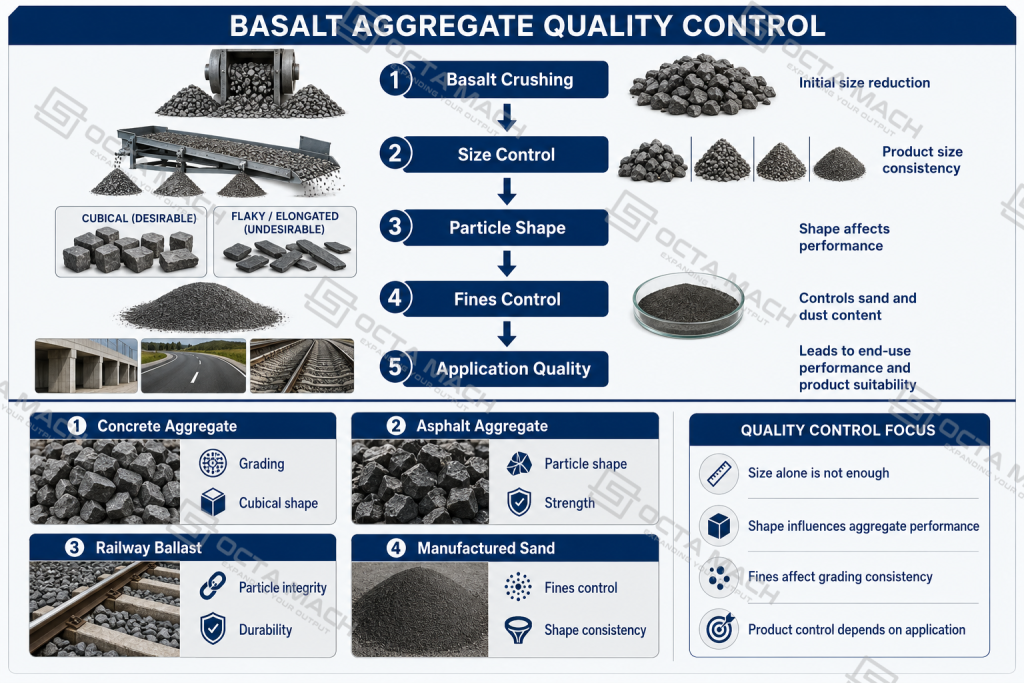
The final crushed basalt products are controlled through crushing stages, screening classification and optional shaping processes. Although product size is an important specification, basalt aggregate quality also depends on particle shape, fines content and grading consistency. Different size fractions are separated through vibrating screens to meet the requirements of concrete aggregate, road construction materials, railway ballast and manufactured sand production.
| Product Size | Application | Main Control |
|---|---|---|
| 0–5 mm | Manufactured sand / fine aggregate | Fines content, grading and particle shape |
| 5–10 mm | Fine aggregate | Size consistency and grading control |
| 10–20 mm | Concrete aggregate | Continuous grading and cubical particle shape |
| 20–31.5 mm | Coarse aggregate | Size distribution, strength and particle integrity |
| Larger fractions | Railway ballast and structural aggregate | Oversize control and rock durability |
The required basalt aggregate sizes depend on the final application rather than a single standard product range. Concrete and asphalt applications usually require controlled grading and a high proportion of well-shaped particles to improve packing performance, while coarse applications such as railway ballast require larger particles with sufficient strength and resistance to breakdown. Therefore, the crushing and screening configuration should be adjusted according to the target product requirements.
Particle Shape Control in Crushed Basalt
The quality of crushed basalt is influenced not only by size distribution but also by particle geometry. Because basalt is a dense and strong volcanic rock, the crushing process must balance size reduction efficiency with shape control. Excessive compression or unsuitable operating conditions may increase flaky and elongated particles, while insufficient shaping may reduce aggregate quality for applications requiring cubical particles.
Particle shape is mainly controlled through the combination of crusher type, crushing stage arrangement, operating settings, screening efficiency and optional shaping processes. Different product requirements require different process adjustments, as shown below.
| Product Requirement | Process Adjustment |
|---|---|
| Better cubical basalt aggregate | Optimize cone crushing operation or add VSI shaping |
| Lower flaky and elongated particles | Adjust crushing stages and operating parameters |
| Increased manufactured sand production | Apply VSI crushing with final screening and fines control |
| Multiple aggregate size requirements | Improve screening configuration and classification control |
For basalt processing, particle shape control should be considered together with production capacity and grading requirements. A suitable crushing configuration should produce the required size distribution while maintaining aggregate shape, fines control and long-term product performance.
OctaMach Basalt Crushing Solutions
OctaMach provides basalt crushing equipment configurations based on material characteristics, feed conditions and final product requirements. The solutions cover primary size reduction, secondary crushing, screening and optional shaping requirements for basalt aggregate and manufactured sand production. Equipment selection and circuit configuration are optimized according to feed size, production capacity and finished product specifications.
FAQ
Q:What are the main properties of basalt rock?
A:Basalt rock is a dense volcanic igneous rock formed from rapidly cooled lava. Its typical properties include a fine-grained crystalline structure, high density of approximately 2.80–3.10 g/cm³, Mohs hardness around 6–7, and compressive strength commonly ranging from 150–300 MPa depending on mineral composition and geological conditions. These properties give basalt high durability but also make it a hard and abrasive material for processing.
Q:Why is basalt harder to crush than limestone?
A:Basalt is generally more difficult to process than limestone because of its higher strength, dense structure and abrasive mineral content. The interlocking crystalline structure and hard minerals such as pyroxene and feldspar increase resistance during crushing, requiring staged reduction with suitable jaw and cone crushing equipment.
Q:What crusher is commonly used for basalt crushing?
A:Basalt crushing commonly uses a combination of jaw crusher for primary reduction, cone crusher for secondary size control and vibrating screen for product classification. When applications require improved cubical aggregate shape or manufactured sand production, an additional shaping stage can be introduced according to final product requirements.
Q:How does basalt crushing control aggregate particle shape?
A:Basalt aggregate shape is controlled by the combination of crusher type, crushing stages, operating settings and screening efficiency. Cone crushing can provide controlled compression reduction, while optional VSI shaping can improve cubical particle shape for applications requiring higher-quality aggregate or manufactured sand.