
Octa Mach designed this 100 TPH gold ore processing plant for a hard-rock mining project in Ghana’s Ashanti Region. The processing circuit reduces quartz-rich run-of-mine material, controls the grinding product at the required liberation size, recovers liberated coarse gold by gravity and concentrates sulfide-associated gold by flotation.
The plant is designed around a dry-feed rate of 100 tonnes per hour. Closed-circuit crushing limits unnecessary fines before grinding, while the gravity and flotation sections divide recovery duty according to how gold occurs in the ore.
The values presented in this project define the engineering design basis. Final equipment sizing, reagent conditions and recovery guarantees must be confirmed through representative mineralogical analysis, comminution testing and locked-cycle beneficiation tests.
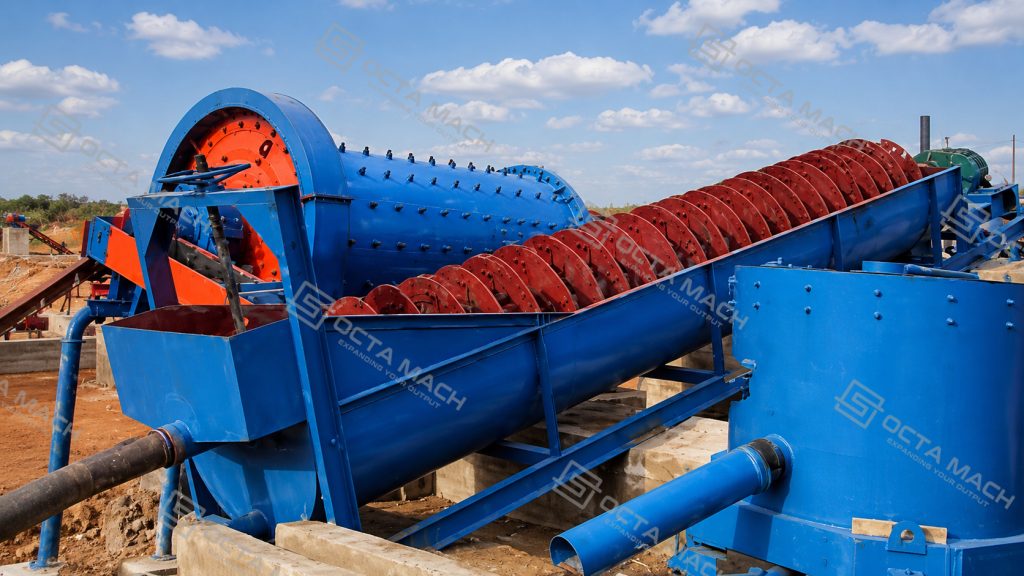
Project Overview
The proposed site is located in Ghana’s Ashanti Region, where hard-rock gold deposits commonly occur in quartz veins and altered host rock. The selected gold ore contains both liberated native gold and fine gold associated with sulfide minerals, particularly pyrite.
This mineralogical combination does not support a simple crushing-and-gravity circuit. Coarse liberated gold can be recovered before flotation, but the sulfide-associated portion must first be ground to an appropriate liberation size.
| Project item | Design basis |
|---|---|
| Project location | Ashanti Region, Ghana |
| Plant application | Hard-rock gold ore beneficiation |
| Nominal dry-feed capacity | 100 t/h |
| Scheduled operating time | 20 h/day |
| Scheduled operating days | 300 days/year |
| Nominal annual feed capacity | 600,000 t/year |
| Maximum ROM lump size | 450 mm |
| Crushing circuit product | P80 ≤12 mm |
| Grinding circuit target | P80 75 µm |
| Primary recovery methods | Gravity separation and flotation |
| Final products | Gravity concentrate and flotation concentrate |
| Tailings handling | Thickening, water recovery and controlled discharge |
The annual capacity is calculated from scheduled operating time rather than calendar time:
| Calculation item | Value |
|---|---|
| Nominal throughput | 100 t/h |
| Operating hours per day | 20 h |
| Operating days per year | 300 days |
| Calculated annual feed | 100 × 20 × 300 |
| Nominal annual capacity | 600,000 t/year |
This figure does not represent guaranteed annual production. Actual output depends on plant availability, ore competency, moisture, clay content, maintenance time and operating discipline.
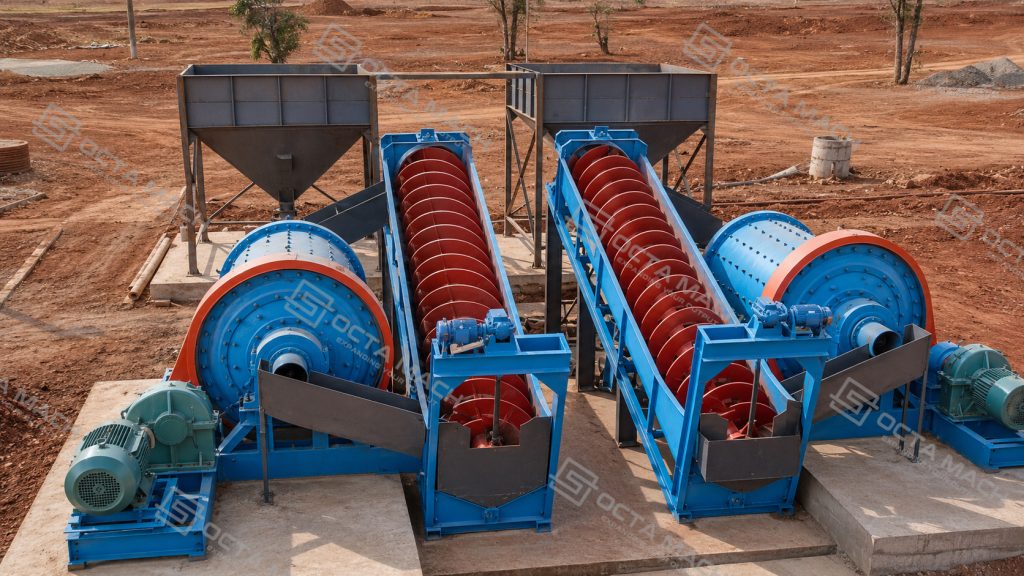
Understanding the Ore Before Selecting Equipment
The processing route was selected from the assumed testwork basis shown below. These figures represent a technically plausible project basis, not universal properties of Ghanaian gold deposits.
| Feed characteristic | Design value or range | Engineering significance |
|---|---|---|
| Maximum feed size | 450 mm | Determines hopper opening and primary crusher feed capacity |
| Feed moisture | 3–5% | Suitable for dry crushing under normal conditions |
| Loose bulk density | 1.65–1.80 t/m³ | Used to size the hopper, feeder and conveyors |
| Solid particle density | 2.70–2.85 t/m³ | Used in slurry and mass-balance calculations |
| Unconfined compressive strength | 120–180 MPa | Indicates hard rock requiring compression crushing |
| Bond Ball Mill Work Index | 16–19 kWh/t | Indicates relatively high grinding energy demand |
| Abrasion Index | 0.35–0.55 | Requires attention to liners and wear materials |
| Head grade | 2.0–3.5 g/t Au | Deposit-specific; must be verified by systematic sampling |
| Sulfur content | 0.8–1.5% | Supports evaluation of sulfide flotation |
| Gravity-recoverable gold | 20–30% of contained gold | Supports installation of a gravity recovery stage |
| Target flotation feed | P80 75 µm | Preliminary liberation target from testwork |
| Process water pH | 6.5–8.0 before conditioning | Establishes the starting condition for reagent control |
The mineralogy of the gold ore determines whether gravity separation, flotation or another recovery method is technically appropriate. Ore color, locality and nominal gold grade are not enough to select a process.
Representative testwork should determine:
- Gold distribution by particle size;
- Free gold particle size and shape;
- Gold association with pyrite, arsenopyrite or other sulfides;
- Cyanide-soluble and refractory gold fractions;
- Sulfur, carbon and clay content;
- Bond Work Index and abrasion characteristics;
- Gravity-recoverable gold content;
- Flotation response at different grind sizes;
- Concentrate grade versus recovery;
- Tailings gold grade under stable test conditions.
Why the Plant Uses Closed-Circuit Crushing
The crushing section prepares a stable feed for the grinding circuit. It does not attempt to produce the final mineral liberation size.
The selected arrangement consists of primary jaw crushing followed by secondary cone crushing and vibrating screening. Oversize material from the screen returns to the cone crusher, while correctly sized material moves to the fine-ore bin.
| Crushing stage | Feed condition | Product requirement | Main control point |
|---|---|---|---|
| Grizzly and feeding | ROM, ≤450 mm | Controlled feed to jaw crusher | Stable feeder rate |
| Primary jaw crushing | ≤450 mm | P80 approximately 100–120 mm | Crusher setting and choke prevention |
| Secondary cone crushing | Primary crusher product | Material suitable for screening | Choke-fed operation |
| Vibrating screening | Mixed secondary product | P80 ≤12 mm to fine-ore bin | Screen aperture and deck loading |
| Oversize return | Material retained above target size | Returned to cone crusher | Recirculating load |
A jaw crusher is selected for primary reduction because it can accept large, irregular feed. The cone crusher performs secondary reduction by compression, which is generally more suitable than repeated impact crushing for hard, abrasive quartz-rich material.
The closed circuit provides several operational advantages:
- It prevents correctly sized material from passing through the crusher repeatedly;
- It controls the top size entering the ball mill;
- It reduces sudden changes in mill power draw;
- It separates crusher capacity from final product-size control;
- It limits excessive production of fines in the dry crushing section;
- It allows screen performance and crusher load to be evaluated separately.
The crusher and screen must be selected together. Installing a larger crusher without adequate screening area can increase circulating load without increasing final throughput.
Equipment Configuration
The plant combines crushing, grinding, gravity recovery, flotation and dewatering equipment. Individual machine sizes should be finalized only after the feed distribution, work index and flotation residence time have been confirmed.
| Process section | Main equipment | Quantity | Design duty |
|---|---|---|---|
| ROM reception | Feed hopper with static grizzly | 1 | Receive loader or truck-fed ore |
| Controlled feeding | Vibrating feeder | 1 | Deliver stable feed to primary crushing |
| Primary crushing | Jaw crusher | 1 | Reduce ≤450 mm ROM material |
| Secondary crushing | Cone crusher | 1 | Produce screenable mill feed |
| Classification | Multi-deck vibrating screen | 1 | Separate ≤12 mm product from oversize |
| Intermediate storage | Fine-ore bin | 1 | Decouple crushing from grinding |
| Grinding | Ball mill | 1 operating line | Produce flotation feed at target P80 |
| Wet classification | Spiral classifier or hydrocyclone cluster | 1 system | Return coarse particles to the mill |
| Gravity recovery | Centrifugal concentrator and cleaning table | 1 line | Recover liberated coarse gold |
| Slurry conditioning | Agitation tanks | 2 or more | Control density, pH and reagent contact |
| Sulfide recovery | Flotation machine bank | 1 circuit | Roughing, scavenging and cleaning |
| Concentrate handling | Thickener and filter | 1 line | Reduce concentrate moisture |
| Tailings handling | Tailings thickener | 1 | Recover process water |
| Water return | Reclaim-water pumps | 1 duty/1 standby | Return clarified water to the plant |
The gold mining equipment is arranged to maintain a continuous material path and provide access for inspection, liner replacement, sampling and routine maintenance. Transfer points require dust control in the dry section, while slurry areas require drainage and spill containment.
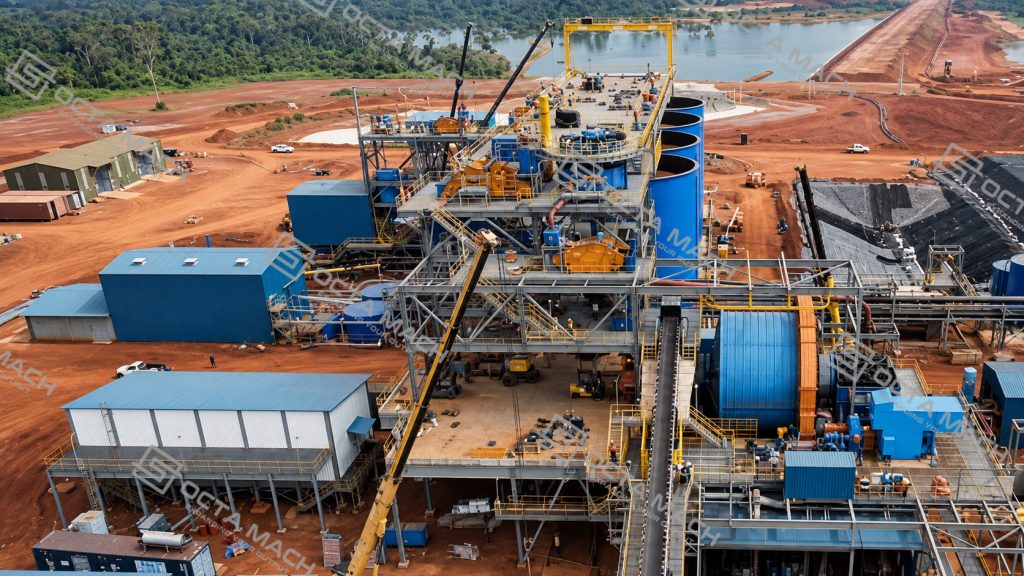
Grinding and Classification
The ball mill receives crushed material from the fine-ore bin and reduces it to the liberation size required by gravity separation and flotation. Stable grinding depends on feed size, ore hardness, circulating load, slurry density and classifier performance.
| Grinding parameter | Initial design target | Acceptance basis |
|---|---|---|
| New feed rate | 100 t/h dry basis | Calibrated belt scale |
| Crushing product | P80 ≤12 mm | Composite screen analysis |
| Mill feed solids | 70–75% by mass | Density measurement |
| Classification product | P80 75 µm | Laboratory particle-size analysis |
| Permitted P80 operating band | 68–83 µm | Approximately ±10% around target |
| Classification overflow solids | 30–35% by mass | Density and moisture correction |
| Indicative circulating load | 200–300% | Calculated from sampled streams |
| Indicative grinding energy | 14–18 kWh/t | Based on feed and product size |
| Specific steel-media consumption | Project-specific | Established during operation |
| Liner wear acceptance | Project-specific | Based on operating hours and tonnes treated |
Grinding finer than the liberation requirement does not automatically improve recovery. Excessive grinding can produce slimes, reduce flotation selectivity, increase energy consumption and accelerate media and liner wear.
The target P80 must therefore be linked to a size-by-size gold recovery test rather than selected from a generic industry value.
Recovering Coarse and Sulfide-Associated Gold
A portion of the classifier underflow is directed through the gravity recovery section before returning to the grinding circuit. This arrangement exposes the high-density stream to gravity concentration and removes liberated coarse gold before it can be overground.
The gravity concentrate is cleaned separately. The remaining classified product enters conditioning tanks and then the flotation circuit.
| Recovery stage | Target material | Typical operating control |
|---|---|---|
| Gravity concentration | Liberated coarse native gold | Stable feed pressure and solids concentration |
| Gravity concentrate cleaning | High-density gold-bearing fraction | Controlled wash water and table settings |
| Rougher flotation | Liberated sulfide minerals carrying gold | Pulp density, air rate, froth depth and reagent addition |
| Scavenger flotation | Remaining floatable gold-bearing sulfides | Sufficient residence time |
| Cleaner flotation | Upgrade rougher concentrate | Controlled mass pull and froth washing where required |
| Concentrate thickening | Combined flotation concentrate | Settling rate and overflow clarity |
| Concentrate filtration | Thickened concentrate | Final moisture set by transport or smelting requirements |
The flotation machine must provide sufficient residence time and controllable air dispersion. Cell volume should not be selected from throughput alone because slurry density, mineral kinetics and the number of rougher, scavenger and cleaner stages all affect the required capacity.
Indicative flotation conditions for preliminary design are shown below. Final values must come from laboratory and pilot-scale testwork.
| Flotation variable | Initial test range | Status |
|---|---|---|
| Flotation feed size | P80 68–83 µm | Testwork required |
| Pulp solids | 30–35% by mass | Indicative engineering range |
| Conditioning time | 3–5 min | Testwork required |
| Total rougher–scavenger residence time | 20–30 min | Testwork required |
| Initial pH range | 8.0–9.0 | Mineralogy-specific |
| Collector dosage | 20–60 g/t | Testwork required |
| Frother dosage | 15–30 g/t | Testwork required |
| Cleaner stages | 1–2 | Concentrate-grade dependent |
Reagent dosage must be adjusted against ore mineralogy and water chemistry. A dosage that performs well on one composite sample may not remain suitable when sulfide content, oxidation or clay content changes.
Water and Power Requirements
Water management is particularly important because the grinding, classification and flotation sections operate as slurry circuits. Thickener overflow should be returned to the process where water quality permits.
| Utility parameter | Preliminary design basis |
|---|---|
| Connected plant power | 2.3–2.8 MW |
| Expected operating demand | 1.8–2.3 MW |
| Total specific energy | 18–24 kWh/t of dry feed |
| Gross process-water demand | 1.2–1.8 m³/t |
| Target process-water recovery | ≥70% |
| Estimated fresh-water makeup | 0.4–0.7 m³/t |
| Electrical frequency | 50 Hz |
| Instrument air pressure | 600–700 kPa |
| Minimum service-water pressure | 300 kPa |
These utility figures are preliminary engineering values. Pump head, pipeline length, site elevation, water quality and final equipment selection can materially change installed power and water demand.
Process Control and Sampling
The plant requires more than individual machine controls. Throughput, particle size, density and metal recovery must be evaluated across the complete circuit.
Recommended measurement points include:
- ROM feeder or primary crusher feed;
- Fine-ore bin discharge;
- Ball mill feed and discharge;
- Classifier overflow and underflow;
- Gravity concentrator feed, concentrate and tailings;
- Flotation feed;
- Rougher concentrate;
- Final flotation concentrate;
- Final tailings;
- Thickener overflow and process-water return.
| Measurement | Minimum routine frequency | Purpose |
|---|---|---|
| Dry-feed rate | Continuous | Control plant throughput |
| Crusher product sizing | Once per shift | Verify mill feed condition |
| Classifier overflow density | Hourly | Stabilize flotation feed |
| Grinding product P80 | Once per shift | Verify liberation size |
| Flotation feed grade | Composite per shift | Calculate metal input |
| Final concentrate grade | Composite per shift | Monitor product quality |
| Final tailings grade | Composite per shift | Identify gold losses |
| Moisture correction | Each mass-balance sample | Convert wet tonnes to dry tonnes |
| Water-flow measurements | Continuous or hourly | Calculate water balance |
| Power consumption | Continuous | Calculate kWh/t |
Automatic samples should cut the full stream at a constant frequency. Hand sampling from the top of a conveyor or the edge of a slurry stream can introduce systematic bias.
Performance Calculation
Plant performance must be calculated from dry mass and contained metal. Wet tonnes should not be used without correcting for moisture.
| Performance indicator | Calculation |
|---|---|
| Dry throughput | Wet feed × (1 − moisture fraction) ÷ test duration |
| Gold in feed | Dry feed mass × feed grade |
| Gold in concentrate | Dry concentrate mass × concentrate grade |
| Mass yield | Dry concentrate mass ÷ dry feed mass × 100 |
| Gold recovery | Gold in concentrate ÷ gold in feed × 100 |
| Specific energy | Total operating energy ÷ dry feed tonnes |
| Water intensity | Fresh-water input ÷ dry feed tonnes |
| Plant availability | Available operating hours ÷ scheduled hours × 100 |
The following example illustrates the calculation method. It is an engineering example, not a reported commissioning result.
| Example calculation item | Value |
|---|---|
| Dry feed treated | 2,000 t |
| Feed grade | 2.50 g/t Au |
| Gold entering plant | 5,000 g |
| Dry combined concentrate | 50 t |
| Combined concentrate grade | 90.0 g/t Au |
| Gold in concentrate | 4,500 g |
| Calculated mass yield | 2.50% |
| Calculated gold recovery | 90.0% |
| Final tailings mass | 1,950 t |
| Calculated tailings grade | 0.256 g/t Au |
| Metal-balance closure | 100.0% |
A higher concentrate grade does not by itself prove better plant performance. Concentrate grade, mass yield, recovery and tailings grade must be evaluated together.
Commissioning and Acceptance Criteria
Performance acceptance should be conducted only after the circuit reaches stable operating conditions. Feed characteristics during the test must remain within the agreed design envelope.
The following values are proposed project acceptance criteria rather than universal gold-processing standards.
| Acceptance item | Proposed project criterion | Verification method |
|---|---|---|
| Dry-feed throughput | ≥100 t/h | Calibrated feed measurement |
| Maximum ROM size | ≤450 mm | Feed inspection and size measurement |
| Crushing product | P80 ≤12 mm | Composite screen analysis |
| Grinding product | P80 68–83 µm | Laboratory sizing |
| Screen efficiency | ≥90% | Size-by-size feed and product samples |
| Mass-balance closure | 98–102% | Dry-mass balance |
| Gold-balance closure | 95–105% | Assayed feed, concentrate and tailings |
| Gold recovery target | ≥88%, subject to agreed test ore | Metallurgical balance |
| Process-water recovery | ≥70% | Calibrated water balance |
| Specific plant energy | ≤24 kWh/t under design feed | Revenue-grade power meter |
| Mechanical availability | ≥92% during agreed test period | Operating log |
| Continuous performance test | 72 h | Signed test procedure |
The gold recovery criterion applies only when feed grade, mineralogy, hardness, oxidation, moisture and particle-size distribution remain within the contractually defined test conditions. No supplier should guarantee a universal recovery rate from the material name alone.
Maintenance Provisions
Hard quartz-rich ore creates substantial wear in crushers, mill liners, grinding media, pumps and slurry pipelines. The layout therefore provides access for liner handling and isolates major equipment for maintenance.
Important maintenance provisions include:
- Replaceable liners in feed chutes and high-impact transfer points;
- Lifting beams or mobile-crane access above crushers and mill components;
- Duty and standby pumps for critical process-water and slurry services;
- Isolation valves around pumps, flotation banks and thickeners;
- Sampling access that does not expose personnel to moving equipment;
- Belt scales and density instruments with calibration access;
- Spare screen media, crusher wear parts and pump wet-end components;
- Local drainage around grinding, flotation and concentrate areas.
Wear-life claims should be based on tonnes processed and measured wear rates. Calendar months alone are not a reliable comparison because abrasive loading changes with throughput and ore composition.
What the Project Delivers
This Ghana gold processing plant is configured to treat hard, quartz-rich feed without relying on a single recovery method. Closed-circuit crushing controls the feed to the mill, gravity separation removes liberated coarse gold, and flotation concentrates gold associated with sulfide minerals.
The main engineering benefits include:
- Nominal dry-feed capacity of 100 t/h;
- Controlled crushing product at P80 no greater than 12 mm;
- Grinding control around a P80 target of 75 µm;
- Separate recovery routes for coarse free gold and sulfide-associated gold;
- Thickener overflow returned as process water;
- Defined sampling points for mass and metallurgical balances;
- Acceptance criteria tied to verified feed conditions;
- Equipment access designed for inspection and wear-part replacement.
The final equipment arrangement should be released for manufacturing only after representative testwork confirms the ore’s work index, abrasion, liberation behavior, gravity response and flotation kinetics.
FAQ
Q: What feed information is required before selecting a gold processing plant?
A: Representative samples must establish maximum lump size, complete particle-size distribution, moisture, bulk density, UCS, abrasion, Bond Work Index, head grade and gold mineralogy. Gravity and flotation tests are also required when the ore contains both free and sulfide-associated gold.
Q: Why does this plant use both gravity separation and flotation?
A: Gravity equipment recovers liberated high-density gold before excessive grinding. Flotation recovers fine gold associated with sulfide minerals. The combined circuit is appropriate only when testwork confirms that both gold populations are present.
Q: Can the plant always process 100 tonnes per hour?
A: The 100 t/h rating applies to dry feed within the stated size, hardness, moisture and abrasion envelope. Harder ore, excessive clay, wet feed, unstable screening or a finer grinding target can reduce actual throughput.
Q: What determines the required ball mill size?
A: Mill sizing depends on dry throughput, feed F80, target P80, Bond Work Index, circulating load and expected operating availability. Selecting a mill from throughput alone can result in insufficient grinding capacity or unnecessary installed power.