
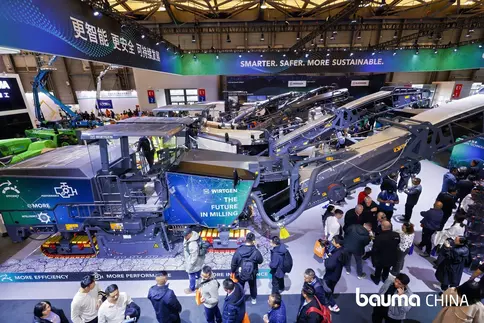
China crusher manufacturers are preparing for bauma CHINA 2026 as mining companies place greater attention on crushing efficiency, equipment automation, wear-part life, and complete plant integration. For international mining buyers, the Shanghai exhibition will provide an important opportunity to evaluate how Chinese crushing equipment is developing for harder ores, higher throughput requirements, and increasingly automated mineral processing plants.
bauma CHINA 2026 will be held across two venues in Shanghai for the first time. The Shanghai World Expo Exhibition & Convention Center will operate from November 23–26, while the Shanghai New International Expo Centre will run from November 24–27, 2026. According to the organizer, the event is expected to bring together more than 4,000 exhibitors across approximately 400,000 m² of exhibition space. OctaMach will also participate in bauma CHINA 2026, presenting its crushing and mineral processing equipment and meeting with mining and aggregate industry professionals during the exhibition.
China Crushing Equipment Is Moving Beyond Individual Machines
Crusher selection in modern mining projects is increasingly based on the performance of the entire crushing circuit, rather than the rated capacity of one machine. Feed size distribution, crusher reduction ratio, screen cut size, circulating load, and downstream grinding requirements all affect how the plant performs as a system.
A typical hard-rock crushing route may include:
ROM Ore → Vibrating Feeder → Jaw Crusher → Cone Crusher → Vibrating Screen → Grinding Preparation
The jaw crusher receives the largest ROM material and performs the first major size reduction. Its feed opening must be matched to the maximum lump size and expected feed distribution; otherwise, oversized rocks or irregular feeding can reduce throughput and cause repeated stoppages at the primary stage.
After primary crushing, the cone crusher receives smaller, pre-crushed material for secondary or tertiary compression crushing. At this stage, chamber selection, closed-side setting, feed gradation, and stable choke feeding influence both capacity and final particle-size distribution. For harder and more abrasive ores, these operating conditions also have a direct effect on liner wear and crushing efficiency.
The vibrating screen then separates material according to the required cut size. Qualified undersize moves toward grinding preparation, while oversize is returned to the cone crusher in a closed circuit. If the screen becomes overloaded or the crusher produces too much oversize, circulating load increases and can reduce the effective capacity of the entire plant.
The feeder, jaw crusher, cone crusher, screen, conveyor, and downstream grinding stage should be selected as one coordinated system. A crusher with a high nominal TPH rating may still fail to deliver the required plant output if feed conditions, screen efficiency, or circulating load are not properly matched.
This applies to iron ore, copper ore, gold ore, granite, and other hard-rock applications, where the crushing circuit must do more than reduce particle size. It should provide a stable, controlled feed for the next processing stage while keeping wear, recirculating load, and operating interruptions within an acceptable range.
Automation Is Becoming More Important for China Crusher Manufacturers
Automation and digital control will remain one of the key themes at bauma CHINA 2026. The exhibition program includes intelligent machinery, remote operation, digital technologies, new energy, and smart mining, alongside equipment for mining, raw-material extraction, material handling, and mineral processing.
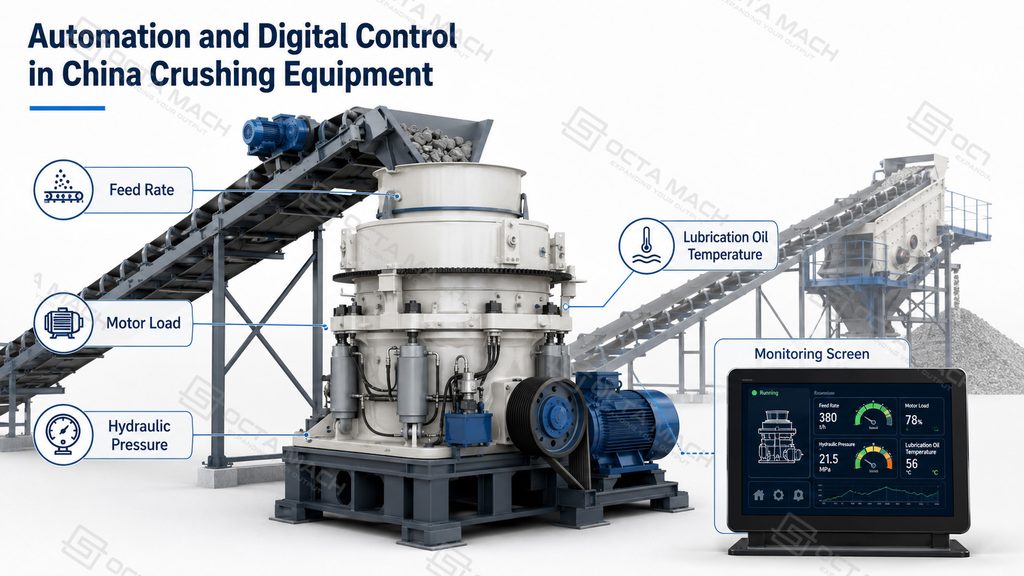
In a crushing plant, automation is mainly used to keep the equipment running within a stable operating range. Crusher load, hydraulic pressure, lubrication status, feed rate, motor load, and discharge settings can all change during production. Continuous monitoring makes these changes easier to detect before they lead to overload, unstable output, or an unplanned shutdown.
Feed control is one of the most practical examples. Irregular feeding can cause the crusher chamber to run alternately underloaded and overloaded, reducing crushing efficiency and accelerating liner wear. When feed rate and crusher load are monitored together, the upstream feeder can be adjusted to keep the chamber more consistently filled.
Hydraulic and lubrication monitoring also plays a direct role in equipment protection. Abnormal pressure, oil temperature, or lubrication conditions can indicate operating problems before serious mechanical damage occurs. Combined with automatic adjustment and alarm functions, these systems help reduce unnecessary stoppages and make daily operation easier to manage.
Automated crusher performance depends on the parameters monitored, the accuracy of the control logic, and coordination with the feeder, screen, and conveyor system. Well-integrated controls help stabilize operating conditions, protect key components, and maintain more consistent material flow through the crushing circuit.
Wear Life Remains a Major Crusher Selection Factor
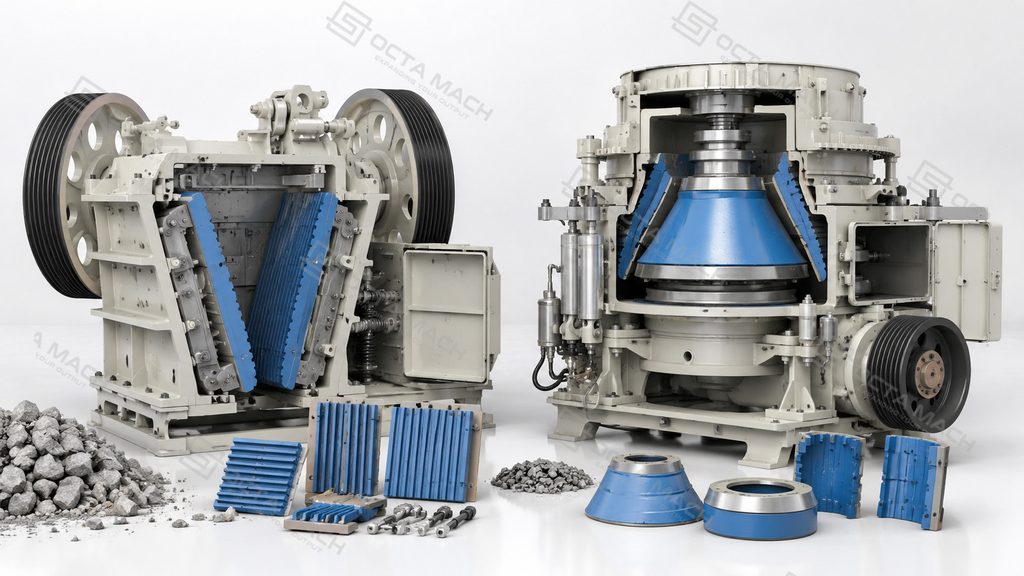
Abrasive rock gradually wears the parts that stay in direct contact with the material. In hard-rock crushing, quartz-rich ore can accelerate wear on jaw plates, mantles, concaves, and liners, especially when feed is uneven or the crusher chamber is not matched to the material.
Two crushers may show similar rated capacity on paper but behave very differently in production. Feed size, chamber profile, liner material, CSS, and maintenance access all influence how often wear parts need to be changed and how much downtime the plant accumulates.
Useful points to check include:
- Maximum feed size and normal operating feed range
- Crusher chamber type and reduction ratio
- Closed-side setting (CSS) range
- Wear-part material and expected replacement cycle
- Hydraulic and lubrication system layout
- Overload and tramp-material protection
- Space and access for routine inspection
- Availability of liners, jaw plates, and other spare parts
A plant can lose output through unstable feeding, worn liners, or long maintenance stops even when the crusher is rated for the required TPH.
What Buyers Should Look for at bauma CHINA 2026
The mining section at bauma CHINA 2026 will cover more than standalone crushers. The official exhibition categories include crushing, screening, sand-making, washing, conveying, mineral processing, and measurement technologies, allowing complete material-processing systems to be viewed within the same exhibition.
At SNIEC, one useful area to watch will be the connection between the crusher and its supporting equipment. A China crusher display can show the crushing chamber and main frame, but the feeder, screen, conveyor, hydraulic system, lubrication unit, wear parts, and process-control components reveal much more about how the machine will operate after installation. The exhibition also includes dedicated categories for wear parts, fluid technology, transmission systems, testing, measurement, and process control, so these components can be compared alongside the main equipment.
The second area is intelligent control. bauma CHINA 2026 has dedicated zones for intelligent equipment and digital solutions, with technologies covering remote control, monitoring systems, IoT, 5G, and digital operation. In crushing equipment, the useful functions are quite specific: monitoring motor load, lubrication oil temperature and pressure, hydraulic pressure, crusher setting, feeder status, and abnormal operating conditions. These signals can also be linked with the feeder or downstream equipment instead of being displayed only on a local control panel.
Mining equipment will also have its own technical program. The New Quality Mining Equipment Innovation & Development Summit is scheduled for November 25 at SWEECC, while live demonstration areas will include 5G remote operation and intelligent equipment technologies. This gives bauma CHINA 2026 a clearer mining-equipment focus than simply displaying newly released machines.
The direction is becoming easier to see: China crushing equipment is being presented increasingly as a combination of the crusher, wear system, hydraulic and lubrication package, monitoring system, and surrounding process equipment. Those are the parts of bauma CHINA 2026 that will be worth following as new China crusher designs and mining systems are introduced.
FAQ
Q1. What information is needed to select the right crusher?
A1:The main inputs are material type, maximum feed size, required TPH, target product size, hardness, abrasiveness, moisture, and downstream process requirements.
Q2. When should a jaw crusher be used instead of a cone crusher?
A2:A jaw crusher is normally used for primary crushing of large ROM material, while a cone crusher is better suited to secondary or tertiary crushing of harder and more abrasive rock.
Q3. What affects crusher wear-part life?
A3:Wear life is influenced by feed size, chamber profile, liner material, CSS, feed stability, and ore abrasiveness. Uneven feeding or incorrect chamber selection can accelerate wear.
Q4. What should buyers check when sourcing a China crusher?
A4:Check the recommended feed range, crusher chamber, CSS adjustment, hydraulic and lubrication systems, wear-part availability, maintenance access, automation functions, and compatibility with the complete crushing circuit.