
Expanding its mobile processing range, Octa Mach has introduced a wheel-mounted mobile crushing and screening plant for secondary and tertiary rock reduction, product sizing and multi-stage aggregate production. The new unit combines the crusher, transfer chutes, inclined vibrating screen, product discharge system, operating platform, mobile chassis and stabilising supports within one coordinated plant.
Unlike a standalone mobile crusher that only reduces feed size, the new mobile crushing plant can classify the crusher discharge and direct each size fraction to the correct downstream route. Material that meets the product specification can leave the circuit, while oversize material can be returned for further crushing when the plant is equipped for closed-circuit operation.
The equipment range supports impact and cone-crusher configurations. This allows the crushing principle, feed opening and production duty to be matched to limestone, granite, basalt, dolerite, river pebble, recycled concrete and selected metal-bearing ores rather than applying one crusher type to every feed material.
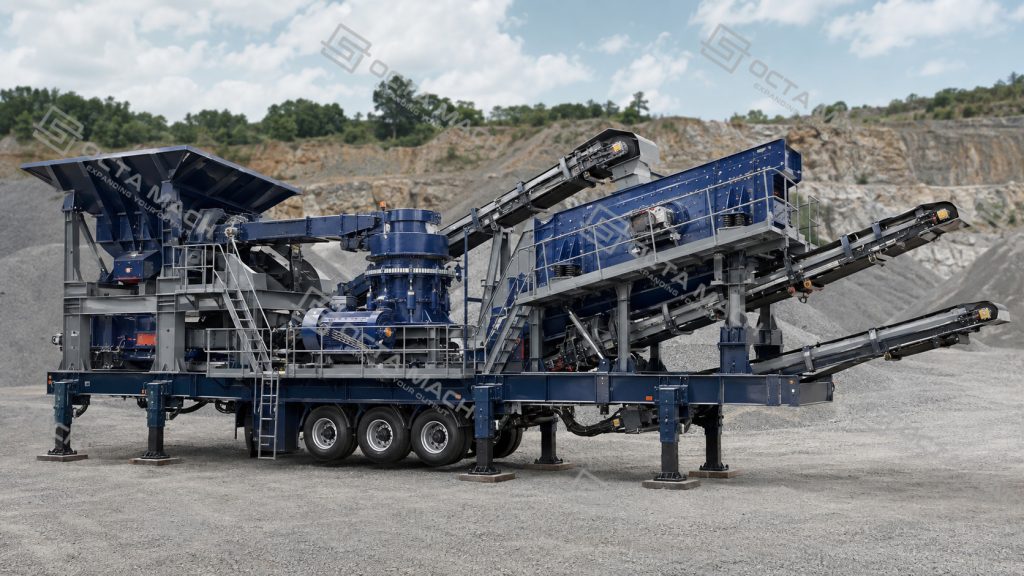
Built Around the Complete Processing Circuit
The plant is designed as an integrated processing station rather than a crusher mounted on a trailer. Its principal operating sections include:
- A receiving and transfer arrangement that delivers material to the crusher at a controlled rate.
- An impact or cone crusher selected according to feed hardness, abrasivity and target product shape.
- An inclined vibrating screen that separates crushed material at the specified deck apertures.
- Independent discharge paths for the required product fractions.
- An optional oversize-return route for closed-circuit production.
- A wheel-mounted chassis for transport between operating locations.
- Stabilising supports that transfer operating loads from the chassis to the prepared foundation area.
- Maintenance platforms and guarded access around the primary operating components.
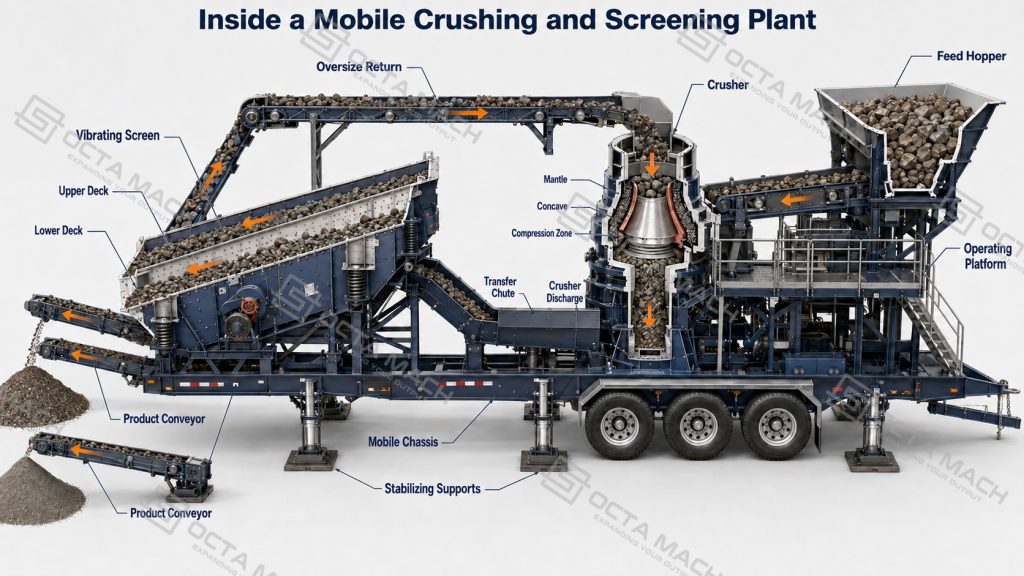
The screen installation angle can be adjusted during plant configuration. This adjustment affects bed depth, material velocity and the time available for particles to encounter the screen apertures. A steeper angle may move material faster, while a lower angle provides more retention time. The final setting must therefore balance throughput against separation accuracy; it should not be treated as a simple capacity control.
Crusher Configurations for Different Feed Conditions
The released range covers impact crushing, compound-cone crushing, single-cylinder cone crushing and multi-cylinder cone crushing. The published feed-size and production figures are listed below.
| Model | Crusher configuration | Maximum feed size | Published production capacity |
|---|---|---|---|
| Z-PF1214 | Impact crusher | ≤300 mm | 90–180 t/h |
| Z-PF1315 | Impact crusher | ≤350 mm | 120–250 t/h |
| Z-CS110 | Compound cone crusher | ≤156 mm | 100–200 t/h |
| Z-CS160 | Compound cone crusher | ≤188 mm | 132–253 t/h |
| Z-CH430 | Single-cylinder cone crusher | ≤90 mm | 115–320 t/h |
| Z-CH440 | Single-cylinder cone crusher | ≤110 mm | 240–550 t/h |
| Z-HP300 | Multi-cylinder cone crusher | ≤150 mm | 85–440 t/h |
| Z-HP400 | Multi-cylinder cone crusher | ≤196 mm | 135–625 t/h |
These figures describe separate configurations within the product family. The largest feed opening and the highest capacity do not belong to the same model and must not be combined into one performance claim.
Published capacity also represents an operating range rather than a guaranteed result for every rock. Final dry throughput depends on the complete feed-size distribution, bulk density, compressive strength, abrasivity, moisture, clay content, crusher setting, screen apertures and recirculating load.
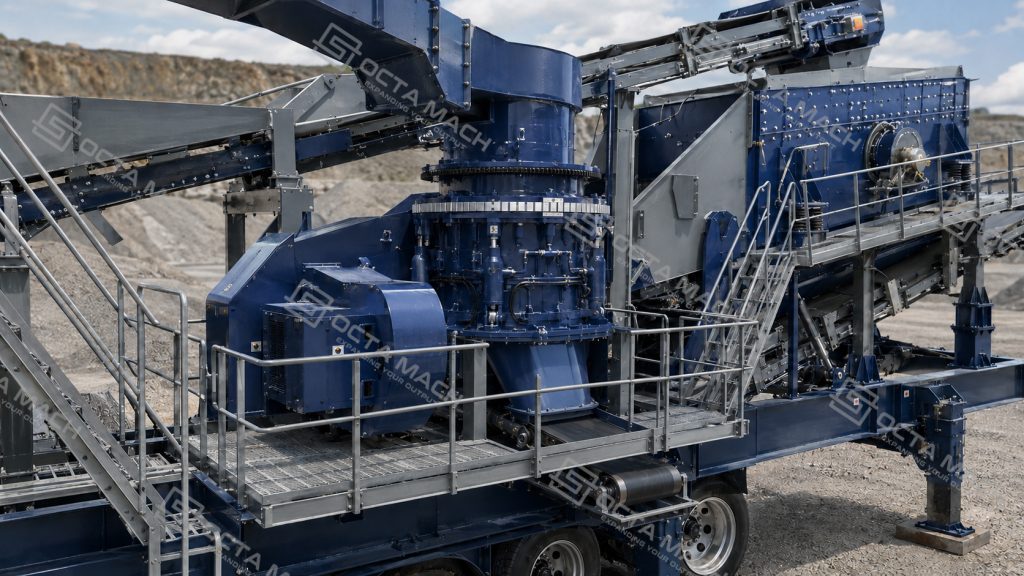
Matching the Crusher to the Material
Impact and cone crushers break material in different ways. Impact crushers accelerate rock against the rotor and impact surfaces, producing a high reduction ratio and potentially more cubical particles. Cone crushers compress material between the mantle and concave, making them more suitable for many hard and abrasive feeds.
| Feed material or duty | Preferred starting configuration | Main reason | Data requiring confirmation |
|---|---|---|---|
| Low-silica limestone | Z-PF impact configuration | High reduction and controlled aggregate shape | Silica content, moisture, clay and required fines |
| Recycled concrete | Z-PF impact configuration | Effective breakage along mortar and aggregate interfaces | Reinforcement removal, contaminants and feed variability |
| Granite and basalt | Z-CS, Z-CH or Z-HP cone configuration | Compression crushing limits unnecessary high-speed impact wear | UCS, quartz content, abrasion index and feed gradation |
| Dolerite and quartzite | Z-CH or Z-HP cone configuration | Suitable for strong and potentially abrasive rock | Liner-wear test, power demand and chamber selection |
| River pebble | Cone configuration followed by screening | Compression crushing is generally better suited to rounded, quartz-rich feed | Mineral composition, particle shape and recirculating load |
| Iron, manganese or chromite ore | Project-selected cone configuration | Controlled reduction before screening, grinding or concentration | Mineralogy, liberation size, ore grade and downstream process |
| Mixed construction material | Testwork-selected impact or cone configuration | Feed composition may change continuously | Steel, wood, soil, asphalt and moisture contamination |
Rock names alone are insufficient for final model selection. Granite from different deposits can vary substantially in quartz content, jointing, weathering and intact strength. Limestone may be relatively easy to break, but a silica-bearing limestone can create much higher wear than its commercial name suggests.
How the Screening Section Controls Product Quality
Crusher discharge normally contains a continuous mixture of coarse particles, near-size material and fines. The vibrating screen separates this stream according to the installed apertures.
Particles smaller than an aperture have repeated opportunities to pass through the deck. Particles larger than the final cut size remain above the applicable deck and move toward the oversize discharge. When a return conveyor is included, only this oversize stream returns to the crusher.
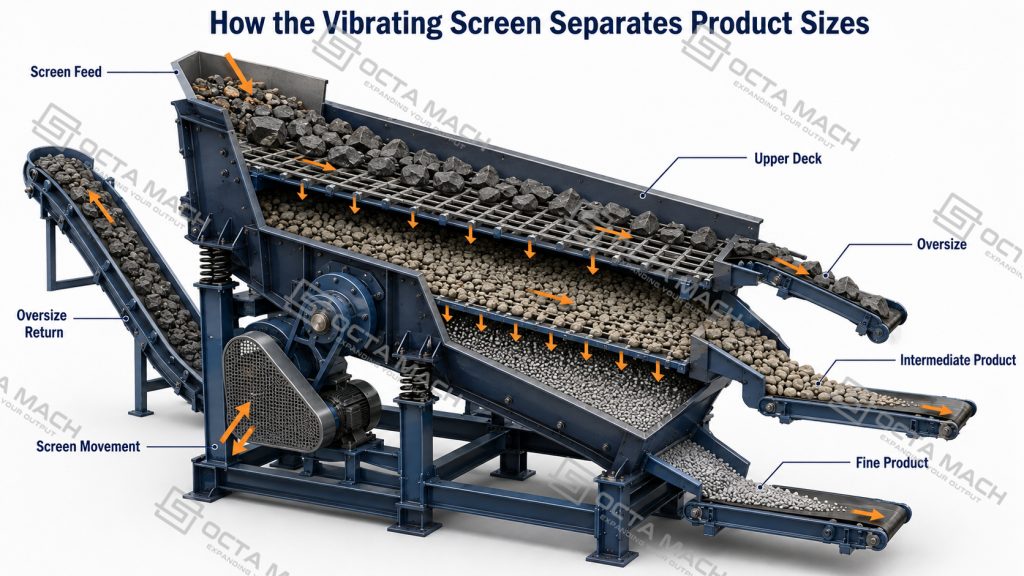
This prevents correctly sized material from being crushed repeatedly and helps control:
- Finished-product top size.
- Production of separate aggregate fractions.
- Recirculating load through the crusher.
- Excessive generation of fines.
- Crusher chamber loading.
- Stockpile contamination by misplaced oversize.
- Feed preparation for grinding or mineral separation.
Effective screening requires more than installing the correct mesh size. Feed must spread across the working width, and the screen area must be sufficient for the actual tonnage, bulk density and percentage of near-size particles. Moist clay, wet fines and uneven feeding can reduce open area, create screen blinding and cause material to enter the wrong product stream.
Measuring Screen Performance
Screen performance should be calculated from representative samples of the screen feed, oversize stream and undersize stream. A single visual check of the product pile cannot establish separation efficiency.
| Performance indicator | Calculation basis | Engineering meaning |
|---|---|---|
| Oversize recovery | True oversize reporting to the oversize stream ÷ true oversize in screen feed × 100% | Confirms whether coarse particles are directed to the correct discharge or return route |
| Undersize recovery | True undersize reporting to the undersize stream ÷ true undersize in screen feed × 100% | Measures how much correctly sized material passes through the applicable deck |
| Overall screen effectiveness | Oversize recovery × undersize recovery ÷ 100 | Combines correct placement of coarse and fine particles |
| Misplaced fines | Undersize material in the oversize stream ÷ oversize-stream mass × 100% | Identifies excessive fines returning to the crusher |
| Misplaced oversize | Oversize material in the undersize stream ÷ undersize-stream mass × 100% | Identifies contamination of the finished product |
| Product grading | Percentage passing each specified sieve | Confirms compliance with the required aggregate or process-feed envelope |
Product grading should be verified by an applicable laboratory sieve-analysis method, such as ASTM C136/C136M-25 for fine and coarse aggregates, together with the governing customer or local product specification. Material finer than the applicable washing threshold requires the corresponding wash test when accurate fine-particle measurement is necessary.
No universal screen-effectiveness percentage should be declared for every material. The acceptance value must be established from the required product curve, screen aperture, feed distribution, moisture and agreed test conditions.
What the Published Capacity Range Means
Capacity must be evaluated for the complete mobile circuit. A crusher may be mechanically capable of processing more material than the screen or return conveyor can handle. In that case, the screen becomes the plant restriction even though the crusher motor is not fully loaded.
| Capacity variable | Required project measurement | Effect on actual output |
|---|---|---|
| Maximum lump size | F100 and oversize frequency | Determines whether the selected feed opening can accept the material safely |
| Feed-size distribution | Complete sieve curve and F80 | Controls chamber loading, reduction duty and crusher product distribution |
| Bulk density | Loose bulk density in t/m³ | Converts volumetric flow into mass throughput |
| Moisture | Mass percentage and operating range | Affects chute flow, screen blinding and dry-basis capacity |
| Clay content | Washing and material-handling test | Determines whether prescreening, scrubbing or washing is required |
| Intact strength | UCS and failure mode | Influences breakage resistance and required crusher duty |
| Abrasivity | Applicable abrasion or wear test | Influences liner selection, wear rate and maintenance cost |
| Crusher setting | Closed-side or applicable discharge setting | Controls crusher product size and circulating load |
| Screen cut sizes | Required product apertures | Determines screen area, deck loading and product fractions |
| Near-size content | Material close to each aperture | Reduces effective screening capacity when present in large proportions |
| Recirculating load | Returned oversize ÷ new feed × 100% | Determines the total internal load handled by the crusher and screen |
The catalogue capacity should therefore be used for preliminary model screening. A contractual throughput guarantee requires a defined feed source, dry-basis calculation, test duration, crusher setting, screen arrangement and product specification.
Commissioning and Acceptance Requirements
Reaching a brief peak output does not demonstrate that the mobile crushing and screening plant is qualified. Acceptance should be based on a stable operating period with representative feed and calibrated measurement equipment.
| Acceptance item | Measurement or test | Minimum acceptable basis |
|---|---|---|
| Feed top size | Measure F100 and inspect incoming oversize | Feed must not exceed the selected model limit |
| Feed condition | Record gradation, moisture, density and material source | Test feed must remain inside the agreed design envelope |
| Dry throughput | Wet throughput × (1 − moisture percentage ÷ 100) | Result must not be below the contractual dry-throughput guarantee |
| Product grading | Laboratory sieve analysis of each product stream | Every fraction must remain within the agreed grading envelope |
| Oversize control | Sample finished product and return stream | Oversize contamination must remain within the project acceptance limit |
| Screen effectiveness | Calculate coarse and fine recovery from mass balance and sieve results | Result must meet the project-specific guaranteed value |
| Recirculating load | Measure new feed and returned oversize separately | Must remain within the crusher, screen and conveyor design basis |
| Specific energy | Total operating energy ÷ dry tonnes processed | Must not exceed the agreed contractual value |
| Operating availability | Actual operating time ÷ scheduled test time × 100% | Must meet the value stated in the acceptance procedure |
| Safety functions | Test guards, emergency stops, alarms, overload protection and interlocks | Every required safety function must pass |
| Mechanical condition | Record vibration, leakage, fasteners, belt tracking and abnormal noise | No unresolved condition affecting safe continuous operation is acceptable |
Design values, catalogue values, contractual guarantees and field measurements must be reported separately. A maximum catalogue capacity is not automatically the contractual guarantee, and an unloaded factory test cannot replace a site test using representative material.
Site Conditions That Affect Deployment
The wheel-mounted chassis allows the plant to be transported to a prepared operating area without constructing a permanent crusher building. However, mobility does not remove the need for suitable site preparation.
Before operation, the supporting area must provide:
- Adequate bearing capacity beneath the stabilising supports.
- Sufficient level tolerance for the crusher, screen and transfer points.
- Safe access for the feeding machine and product-removal equipment.
- Clearance around conveyors, maintenance platforms and screen-deck access.
- Controlled drainage so stormwater does not collect beneath the chassis.
- Dust-control arrangements suited to the material and local requirements.
- Electrical supply or generating capacity matched to the selected configuration.
- Safe isolation points for crusher, screen and conveyor maintenance.
A mobile plant can reduce permanent civil work, but the foundation area must still control settlement and frame distortion. Uneven support can alter conveyor alignment, increase structural vibration and affect the distribution of material across the screen.
Data Required for Final Plant Configuration
Octa Mach configures the plant around the material and required product rather than selecting a model from hourly capacity alone. The project information should include:
- Material name, mineral composition and chemical analysis where applicable.
- Maximum lump size, F80 and complete feed-size distribution.
- Moisture, clay content, bulk density and expected seasonal variation.
- UCS, fracture characteristics and abrasivity results.
- Required dry throughput and operating schedule.
- Target product fractions and applicable grading specification.
- Required open- or closed-circuit arrangement.
- Expected oversize return load.
- Available electrical power and site operating restrictions.
- Feeding method, stockpile arrangement and downstream equipment.
- Transport limits, site access and required relocation frequency.
Where representative data are unavailable, crushing and screening tests should be completed before the final crusher chamber, screen area, deck apertures and conveyor capacities are fixed.
FAQ
Q: How does this plant differ from a standalone mobile crusher?
A: A standalone mobile crusher primarily reduces particle size. This plant integrates crushing with vibrating-screen classification and can discharge separate products or return oversize material for further reduction.
Q: Which configuration is suitable for hard and abrasive rock?
A: Cone-crusher configurations are generally the preferred starting point for granite, basalt, dolerite, quartzite and quartz-rich river pebble. Final selection still requires feed-size, strength, abrasivity and product tests.
Q: Is the published production capacity guaranteed?
A: No. The published range supports preliminary model selection. A guaranteed capacity must be stated on a dry basis and linked to an agreed feed gradation, moisture range, crusher setting, screen configuration and product specification.
Q: How is the finished product accepted?
A: Each product stream should be sampled and tested by sieve analysis. Acceptance requires compliance with the agreed grading envelope, contractual throughput, screen-performance criteria and required safety-function tests.