
Limestone consists primarily of calcium carbonate (CaCO₃), forming a sedimentary carbonate rock in which calcite is typically the dominant mineral. Common accompanying constituents include dolomite, clay, silica, iron oxides and fossil fragments. Limestone is processed into crushed aggregate, road-base material, manufactured sand, cement raw feed and lime feed, so its composition and physical properties directly affect the required processing route and final product quality.
Compared with highly abrasive hard rocks such as quartzite or some granite, many limestone deposits can be reduced effectively by impact or hammer crushing. The process still needs to account for maximum lump size, silica or chert content, moisture, clay, required capacity and final grading. Limestone crushing can therefore use a simplified heavy-hammer circuit or a staged jaw, impact, cone and VSI configuration according to the actual material and product requirement. OctaMach crusher references classify impact crushing for low- to medium-abrasive limestone and hammer crushing for brittle, medium-hard material requiring high reduction.
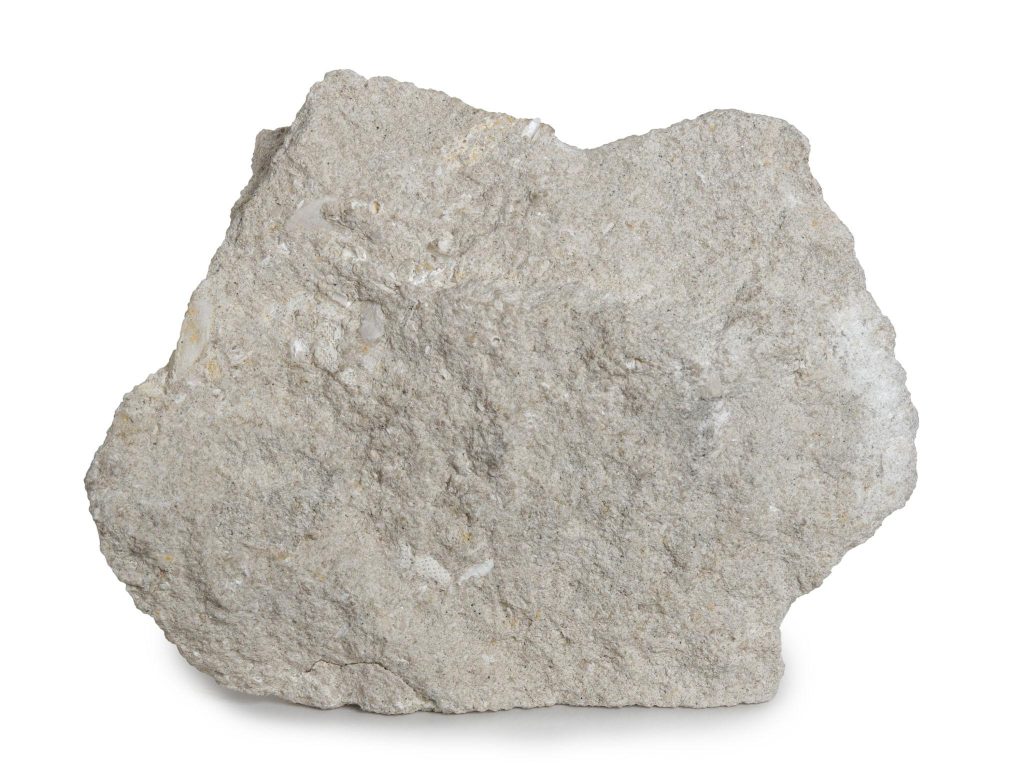
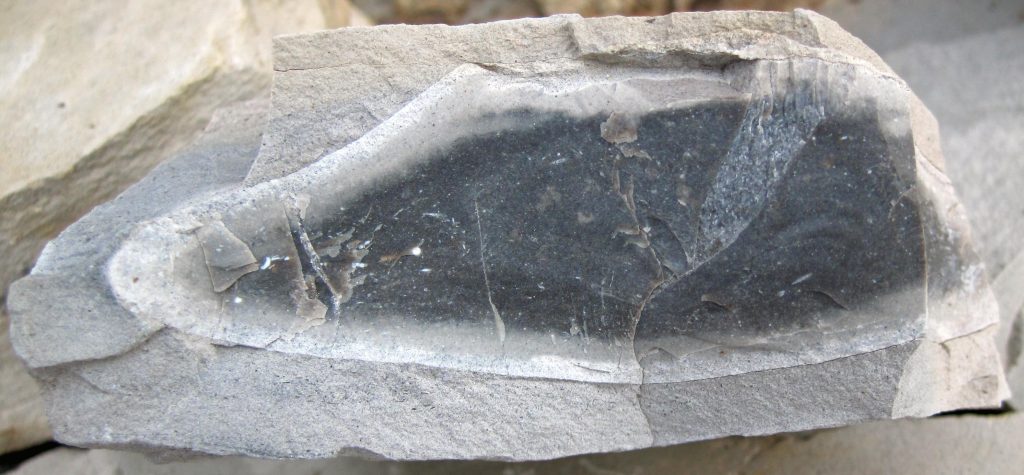
Limestone Characteristics
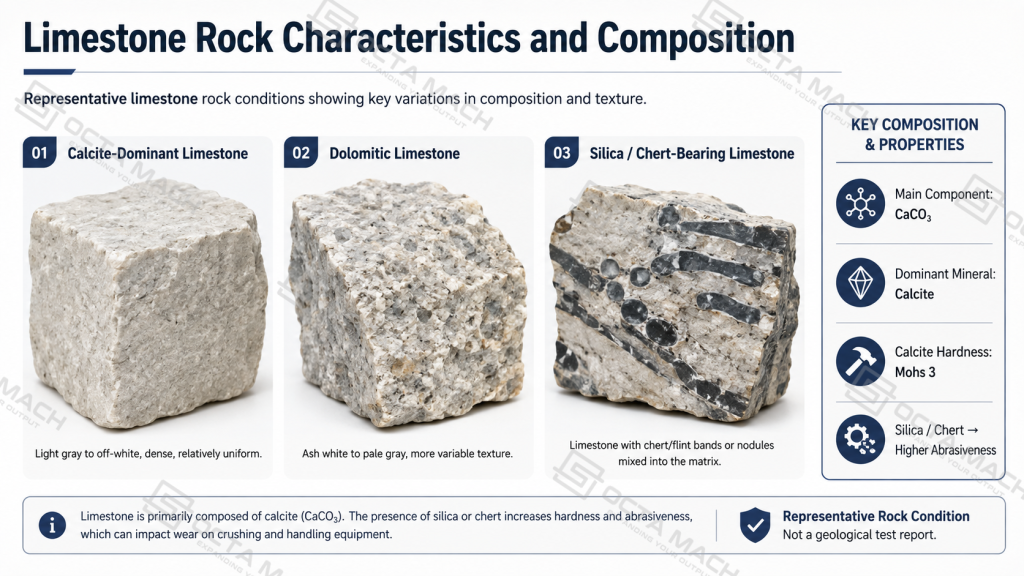
Limestone properties vary between deposits because calcite, dolomite, silica, chert, clay and other non-carbonate constituents occur in different proportions. High-calcium limestone differs from silica-, chert- or clay-rich limestone in hardness, abrasiveness, density and processing behavior, so a single fixed property value does not represent all limestone sources.
| Property | Typical Limestone Characteristic |
|---|---|
| Rock Type | Sedimentary carbonate rock |
| Main Chemical Component | Calcium carbonate, CaCO₃ |
| Principal Mineral | Mainly calcite; dolomite may also occur |
| Carbonate Content | Limestone is composed predominantly of carbonate minerals; high-calcium limestone can contain ≥95% CaCO₃ |
| Mohs Hardness | Calcite reference hardness: Mohs 3; actual rock hardness varies with impurities and mineral composition |
| Typical Density | Approximately 2.60–2.75 g/cm³ for common compact limestone |
| Natural Lump Size | Quarry- and blasting-dependent; there is no universal natural feed-size range |
| Structure | Can range from compact and fine-grained to porous, fossiliferous or chalky |
| Color | Commonly white, cream, gray or yellowish; impurities may produce darker or reddish tones |
| Abrasiveness | Generally low to medium, but may increase significantly where silica or chert is present |
Limestone properties vary with depositional environment, mineral purity and the proportion of non-carbonate constituents. High-calcium limestone is typically denser and chemically more uniform, while dolomitic, siliceous, cherty or clay-bearing limestone shows different hardness, porosity, color and abrasion characteristics. These differences also affect end-use suitability: chemical composition is critical for cement and lime production, while aggregate applications depend more heavily on grading, durability, soundness and mechanical performance.
Limestone Crushing Process
Limestone crushing is organized around feed preparation, staged size reduction, screening and material recirculation. The circuit configuration is controlled by maximum feed size, silica or chert content, abrasiveness, moisture, required throughput and finished-product grading. Brittle, low-abrasive limestone can use a simplified heavy-hammer route, while larger feed, tighter size control or more abrasive material requires separated primary and secondary crushing stages.
| Process Stage | Main Duty | Typical Equipment |
|---|---|---|
| Feeding | Controls feed rate and removes unsuitable natural fines where required | Vibrating Feeder |
| Primary Reduction | Reduces large blasted limestone | Jaw Crusher or suitable Heavy Hammer Crusher |
| Secondary Crushing | Provides additional reduction and particle shaping | Impact Crusher or Cone Crusher |
| Fine Crushing / Sand Making | Produces finer aggregate or manufactured sand where required | VSI Sand Making Machine |
| Classification | Separates finished fractions and returns oversize | Vibrating Screen |
| Material Transfer | Connects crushing, screening, recirculation and stockpiling stages | Belt Conveyor |
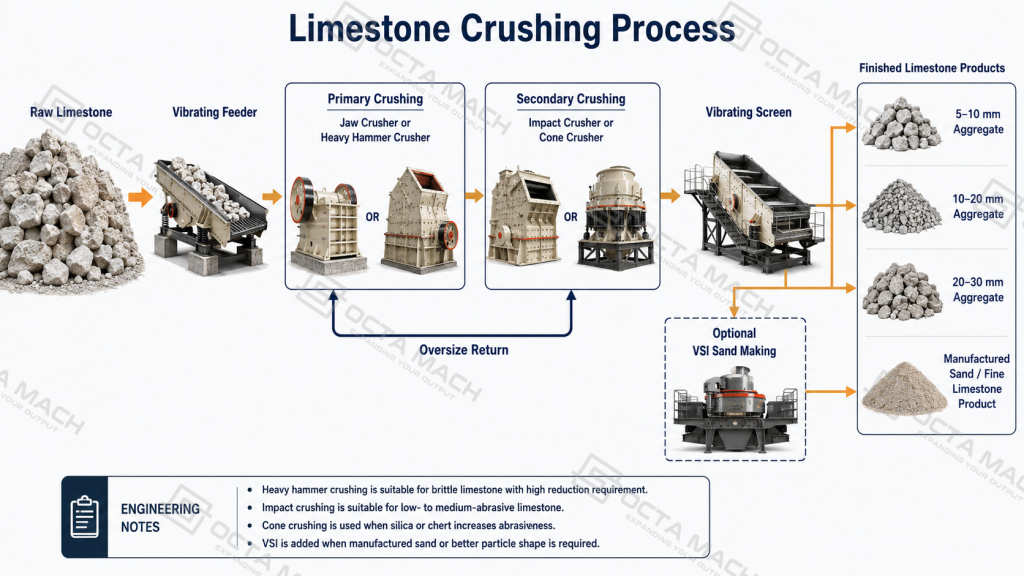
For relatively clean and brittle limestone, a heavy hammer crusher can combine coarse and intermediate reduction in one machine, followed by closed-circuit screening. Larger or more demanding plants may separate the duties into primary jaw crushing and secondary impact or cone crushing. VSI equipment is added only when fine aggregate, manufactured sand or additional particle shaping is required. The crusher category should be matched to feed size, rock strength, abrasiveness and downstream screening rather than selected as an isolated machine.
Limestone Crusher Selection
Limestone crusher selection should be based on the actual rock condition and required finished product rather than on limestone hardness alone. Silica or chert content, maximum feed size, abrasiveness, moisture, required reduction ratio, plant capacity and target product size jointly determine whether the circuit uses impact crushing, heavy hammer crushing, cone crushing or an additional VSI stage.
Key Factors in Limestone Crusher Selection
Relatively pure calcitic limestone generally has low to moderate abrasiveness and responds well to impact or hammer crushing. Limestone containing a higher proportion of silica, chert or other hard mineral inclusions produces greater abrasive wear, while clay and moisture affect feeding and screening stability. Maximum lump size determines the primary crushing duty, and the required finished size determines whether reduction can be completed in one crushing stage or must be distributed across several machines.
The main selection factors are:
- Mineral composition: silica and chert increase abrasiveness.
- Maximum feed size: determines the required primary crusher opening and reduction duty.
- Required product size: controls the number of crushing stages.
- Plant capacity: affects crusher size and the need for parallel equipment.
- Moisture and clay content: influence feeding, screening and fines handling.
- Manufactured-sand requirement: determines whether VSI fine crushing and shaping are required.
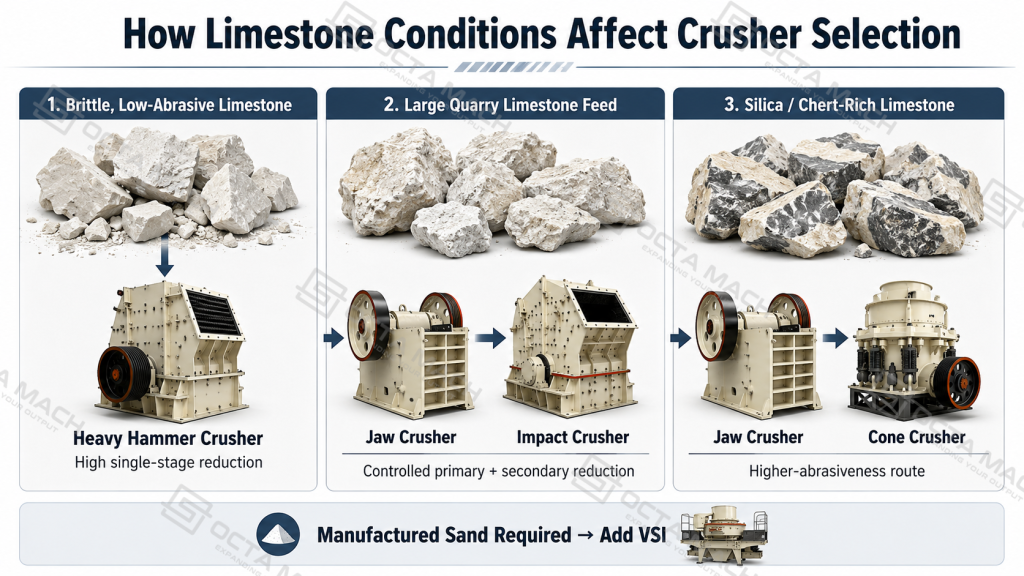
Crushing Routes for Different Limestone Conditions
Different limestone conditions require different combinations of reduction mechanism and crushing stages. Impact and hammer crushing are suitable for brittle, relatively low-abrasive limestone, while compression crushing becomes more relevant as abrasiveness and silica content increase.
| Limestone Condition / Product Requirement | Recommended Crushing Route | Engineering Basis |
|---|---|---|
| Large feed, low- to medium-abrasive limestone | Jaw Crusher → Impact Crusher → Screening | Separates primary reduction from secondary impact crushing and provides controlled aggregate sizing |
| Brittle limestone requiring high reduction | Heavy Hammer Crusher → Screening → Oversize Return | Combines coarse and intermediate reduction in a simplified closed circuit |
| Silica- or chert-rich limestone with higher abrasiveness | Jaw Crusher → Cone Crusher → Screening | Compression crushing reduces continuous impact-wear exposure |
| Fine aggregate or manufactured sand required | Primary / Secondary Crushing → VSI → Screening | Adds fine crushing and particle shaping after the main reduction stages |
For suitable brittle limestone, a single-stage heavy hammer circuit reduces equipment count and transfers size control to the downstream screening system. A multi-stage circuit is used when large feed, tighter product grading, higher abrasiveness or manufactured-sand production requires the reduction duty to be divided between primary, secondary and fine-crushing stages.
Feed Size and Stage Matching
Feed size control between crushing stages is essential for maintaining stable chamber loading, reduction efficiency and downstream throughput. Material leaving one crusher should be reduced and classified to a size distribution that the next machine can accept without excessive oversize, bridging or unstable feed. In multi-stage limestone crushing, proper stage matching also helps distribute the reduction ratio across the circuit and prevents secondary or fine-crushing equipment from carrying unnecessary coarse-feed duty.
| Crushing Equipment | Reference Feed Range / Limit | Position in Limestone Processing |
|---|---|---|
| Impact Crusher | Maximum feed approximately 100–700 mm, model-specific | Primary or secondary crushing depending on model |
| PCZ Heavy Hammer Crusher | Maximum feed approximately 500–1200 mm, model-specific | High-reduction primary / single-stage crushing |
| VSI Sand Making Machine | Optimal feed approximately 35–60 mm for softer material | Fine crushing and shaping after upstream size reduction |
The feed entering each downstream stage should therefore be controlled by the preceding crusher and screening circuit. This stage-by-stage size matching prevents oversize feed from overloading secondary or VSI equipment and keeps the required reduction duty distributed across the crushing line.
Limestone Crushing Plant Configurations by Capacity
Limestone plant capacity should be matched across feeding, crushing and screening rather than determined by the crusher alone. As throughput increases, the feeder must maintain a stable material supply, the heavy hammer crusher must absorb a higher reduction duty, and the screening section must handle both finished-product separation and circulating oversize without creating a downstream bottleneck.
| Reference Capacity | Feeder | Main Crusher | Screening Configuration | Circuit Logic |
|---|---|---|---|---|
| 250–320 t/h | GZD1349 Vibrating Feeder | PCZ1512 Heavy Hammer Crusher | 3YK2460 + 2YK2460 | >30 mm oversize returns to the crusher |
| 400–500 t/h | GZD1560 Vibrating Feeder | PCZ1615 Heavy Hammer Crusher | 3YK3070 + 2YK3070 | Closed-circuit crushing with larger screening area |
| 500–600 t/h | GZD1560 Vibrating Feeder | PCZ1820 Heavy Hammer Crusher | 3YK3280 + 2YK3280 | Higher-throughput hammer crushing with closed-circuit screening |
These heavy-hammer configurations are most suitable for brittle, relatively low-abrasive limestone where a high reduction ratio can be achieved before closed-circuit screening. Continuous plant output is governed by the combined performance of feed gradation, material moisture, crusher loading, screen efficiency and recirculating load; excessive fines, clay or more abrasive limestone can shift the practical capacity away from the nominal configuration range.
Finished Limestone Sizes and Screening
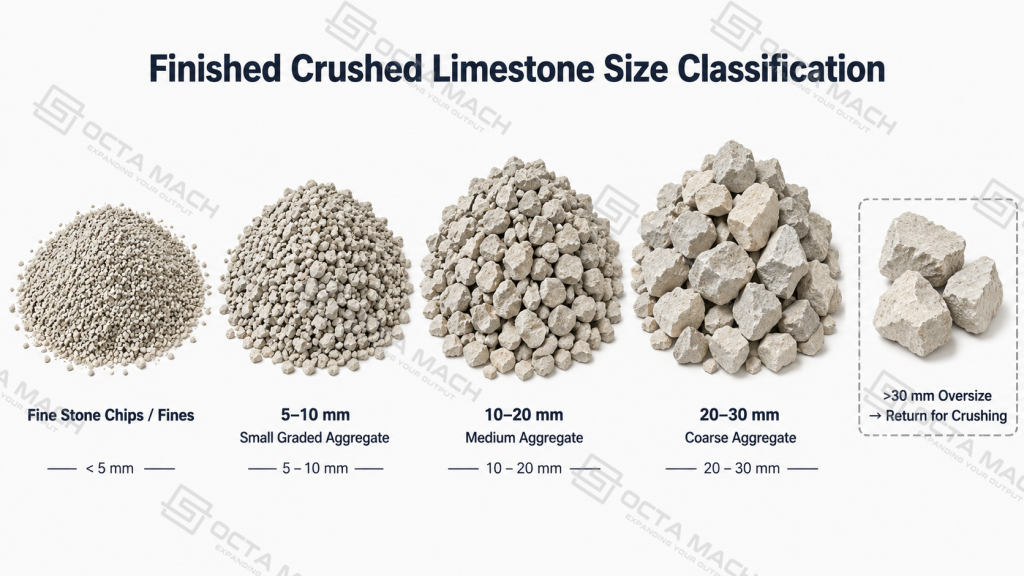
Finished limestone grading is controlled by the interaction between crusher discharge distribution and screen cut points. The crusher determines the range of particle sizes entering classification, while screen aperture, deck arrangement, feed loading and moisture condition determine how accurately each finished fraction is separated and how much oversize remains in circulation.
| Finished Fraction | Typical Product Direction |
|---|---|
| 5–10 mm | Small graded limestone aggregate |
| 10–20 mm | Medium aggregate |
| 20–30 mm | Coarse aggregate |
| Fine stone chips | Fine aggregate or downstream processing feed, depending on specification |
| Stone powder | Fines fraction; use depends on required grading and downstream process |
| >30 mm in the heavy-hammer reference circuit | Returned for additional crushing |
Stable aggregate grading depends on maintaining consistent screen loading and effective separation across each deck. Excessive moisture, clay or near-size particles can reduce screening efficiency and increase recirculating load, while changes in crusher discharge can shift the proportion of material reporting to each product fraction. Screen configuration should therefore be matched to the required end-product grading and the actual size distribution entering the screening section.
Limestone Sand Making and Aggregate Applications
Limestone end use is determined by both physical grading and chemical composition. Aggregate applications require controlled particle-size distribution, cleanliness and mechanical durability, while cement and lime production depend more strongly on CaCO₃ content, impurity levels and consistent feed preparation. The crushing route therefore needs to preserve the product characteristics required by the downstream process rather than focusing on size reduction alone.
| Application | Processed Limestone Product | Key Processing Requirement |
|---|---|---|
| Concrete and Asphalt Aggregate | Crushed and graded limestone aggregate | Controlled particle size, grading, durability and cleanliness for concrete or asphalt mix requirements |
| Road Base and Subbase | Well-graded crushed limestone | Stable coarse-to-fine gradation for compaction, load distribution and pavement-layer performance |
| Manufactured Limestone Sand | Fine limestone sand produced after additional crushing and shaping | Fine reduction, particle-shape control and final screening to achieve the required sand grading |
| Cement Raw Material | Crushed limestone feed for grinding and blending | Consistent CaCO₃ content and control of silica, alumina, iron compounds and other raw-material constituents |
| Lime Production | Sized limestone feed for calcination | Suitable chemical composition and controlled feed size for stable downstream calcination |
The final limestone product specification controls the required degree of crushing, screening and fines management. Aggregate production emphasizes stable gradation and separation efficiency, manufactured sand requires additional fine reduction and shape control, while cement and lime feed preparation places greater importance on chemical consistency and controlled feed size for grinding or calcination.
OctaMach Limestone Crushing Solutions
OctaMach configures limestone crushing plants around the actual limestone composition, feed lump size, required throughput and finished-product grading. The equipment scope can integrate vibrating feeders, jaw crushers, impact crushers, heavy hammer crushers, cone crushers, VSI sand making machines, vibrating screens and belt conveyors, together with closed-circuit return and finished-product routing. This allows a limestone project to use either a simplified heavy-hammer circuit or a staged crushing and sand-making line according to the material condition and required output.
Q: What is limestone mainly made of?
A: Limestone consists predominantly of calcium carbonate (CaCO₃), mainly as calcite. Dolomite, silica, chert, clay and iron-bearing constituents occur in different proportions and influence hardness, abrasiveness and end-use suitability.
Q: When can limestone be crushed in a single stage?
A: Brittle, relatively low-abrasive limestone can use heavy hammer crushing followed by closed-circuit screening when one crusher provides the required reduction and product grading. Larger feed, higher abrasiveness or tighter finished-size requirements favor a multi-stage circuit.
Q: When should a cone crusher be used for limestone?
A: A cone crusher becomes more suitable when limestone contains higher levels of silica, chert or other abrasive minerals, especially in secondary or tertiary crushing. Compression crushing reduces continuous impact exposure compared with relying entirely on impact or hammer crushing.
Q: Does limestone sand making always require a VSI crusher?
A: No. VSI is used when the required product includes manufactured sand or additional particle shaping. A plant producing only qualified graded aggregate can discharge finished fractions after crushing and screening without sending all material through a VSI.