
This crawler mobile crusher project supports a basalt quarry in Kenya that supplies graded aggregate for road construction and concrete work.
As the quarry face moves forward, the distance between the blast area and the original fixed crushing point becomes longer. Excavators must load blasted rock into trucks, which then travel on internal quarry roads before the first crushing stage begins. In wet weather, slower truck movement and uneven delivery to the hopper can affect both daily production and the consistency of crusher feed.
The selected solution combines a tracked jaw crusher, cone crusher and screening plant. By placing the equipment closer to the active working area, the quarry can reduce unnecessary raw-rock transport before crushing while still producing separate aggregate sizes for local customers.
Plant Configuration and Production Plan
| Production Stage | Equipment and Setting | What Happens to the Material | Main Control Point |
|---|---|---|---|
| Feed preparation | Excavator + heavy-duty feeder with pre-screen | Blasted basalt is loaded into the feeder; excess fines are separated where practical before crushing | Typical feed: 300–550 mm; controlled maximum: 650 mm |
| Primary crushing | Crawler mobile jaw crusher; 120 mm discharge setting | Large, irregular basalt is reduced to a size suitable for the next crusher | Creates a steadier feed for cone crushing |
| Secondary crushing | Crawler mobile cone crusher; 24–28 mm discharge setting | Jaw-crusher output is reduced further before final screening | Balances output and required product size |
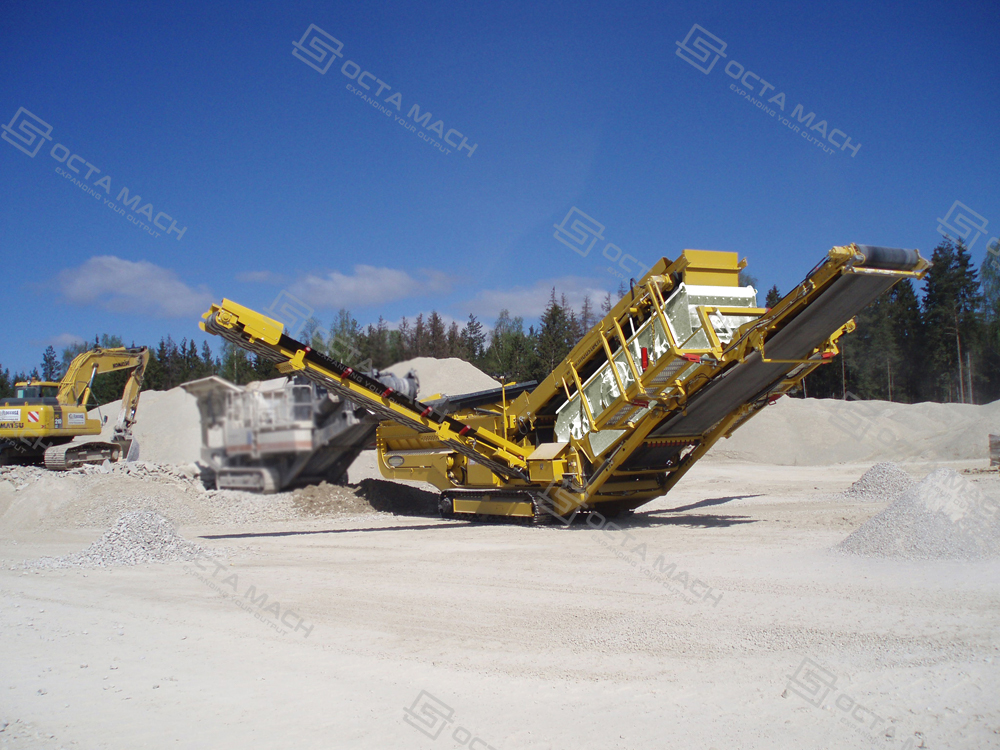
| Screening and return | Three-deck tracked screen + return conveyor | Material is separated by size; larger pieces return for another crushing pass | 0–5 mm, 5–10 mm, 10–20 mm and 20–31.5 mm |
| Stockpiling | Product conveyors and separate stockpile areas | Each finished aggregate size is stored separately for loading | Helps prevent different sizes from mixing |
The plant is planned around a 220 t/h production target. Under normal basalt feed conditions, the expected working range is 185–205 t/h. Actual output will vary with feed size after blasting, fines content, weather, crusher settings and screen condition.
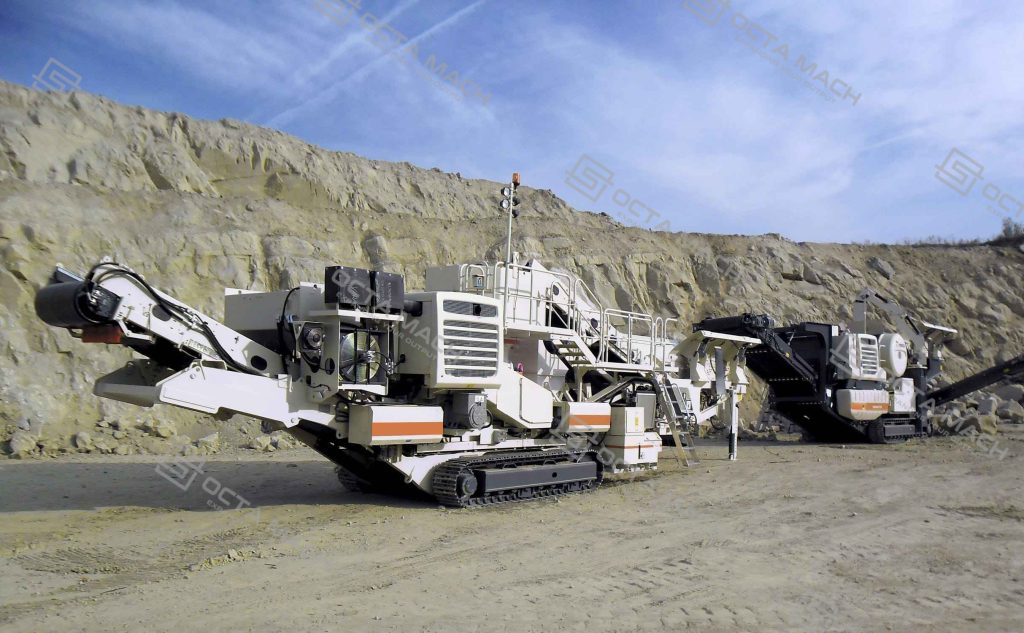
Reducing Internal Haul Distance
The main reason for using this layout is not simply that the machines run on tracks. In a quarry where the working face moves regularly, a crawler type mobile crusher for quarry applications can be relocated to a prepared bench nearer the blast pile.
This changes the material route. Instead of carrying every load of uncrushed basalt over an increasingly long internal road, the excavator can feed the primary crusher close to the source material. Finished aggregate still needs to be stockpiled or loaded for customers, but the quarry reduces the amount of raw rock moved before it has been processed.
The benefit becomes more visible as extraction moves deeper into the site, haul roads become congested, or rain slows truck movement. Before relocation, however, the new operating area must be checked for firm ground, drainage, safe access and sufficient room for refuelling and maintenance.
From Blasted Basalt to Controlled Feed
Basalt from blasting is rarely uniform. One excavator bucket may contain large blocky rock, while the next may include smaller broken stone and fines. The front end of the plant must therefore receive the material evenly and avoid sending oversized rock directly into the crusher.
The heavy-duty feeder spreads material before it reaches the jaw crusher. Rock above the 650 mm controlled feed limit should be broken first, helping avoid blockage and unstable feeding.
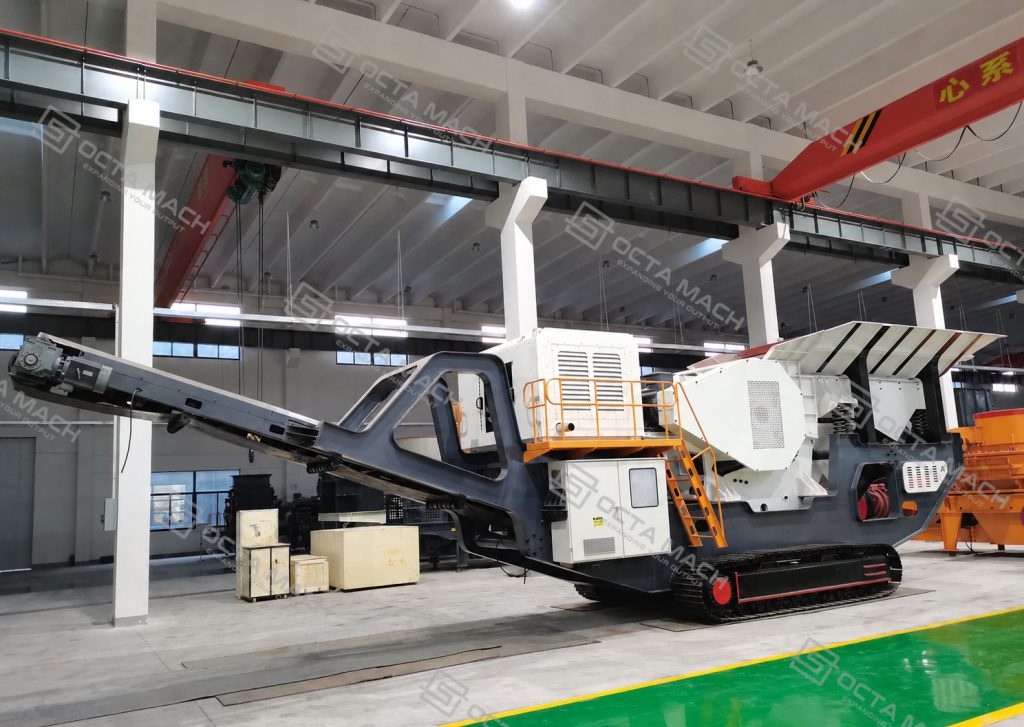
For this hard and abrasive material, the crawler mobile jaw crusher for hard rock performs the first reduction. Its 120 mm discharge setting does not aim to produce finished aggregate. Instead, it reduces large blast rock into a more manageable size for the cone crusher.
Material flow: Excavator → Feeder → Mobile Jaw Crusher → Conveyor → Mobile Cone Crusher → Three-Deck Screen → Finished Aggregate Stockpiles
Oversize return: Material above the required size returns from the screen to the cone crusher for further crushing.
Even feeding at the jaw crusher provides a steadier material flow to the cone crusher and screen, helping maintain consistent output and aggregate sizes.
Producing the Required Aggregate Sizes
After primary crushing, the material travels by conveyor to the cone crusher for further size reduction. The cone crusher uses a 24–28 mm discharge setting, selected to prepare the material for screening while maintaining a practical production rate.
The three-deck screen separates the final products into:
- 0–5 mm fines
- 5–10 mm aggregate
- 10–20 mm aggregate
- 20–31.5 mm aggregate
Material that remains above the selected top size is returned to the cone crusher for another crushing pass. This prevents oversized stone from entering the finished product stockpile and helps maintain more consistent grading.
In this arrangement, the track-mounted mobile crusher for primary crushing is the starting point of the entire production line, while the cone crusher and screen determine how the reduced rock is divided into saleable products.
Keeping the Plant Working as One Line
The three machines cannot be selected or operated as separate units. If the jaw crusher receives too much oversized rock, the cone crusher may receive an uneven flow. If too much material reaches the screen at once, separation becomes less effective. Wet fines can also block screen openings and cause different sizes to mix.
This is why a mobile crushing plant for aggregate production should be considered as one connected process—from excavator loading through to final stockpiling.
For daily operation, the quarry team should focus on a few clear checks:
- Keep feeder loading even.
- Break oversized rock before it enters the jaw crusher.
- Keep conveyor transfer points clean.
- Check screen openings, especially in wet conditions.
- Store each aggregate size separately.
- Inspect crusher wear parts and settings before output drops noticeably.
These are straightforward operating controls, but they have a direct effect on production stability and final aggregate quality.
Operating in Wet and Dry Conditions
During dry weather, dust can build up around the feeder, crusher discharge and conveyor transfer points. Water spray systems can improve visibility and reduce dust around operators.
During wetter months, the priority shifts to the working platform. Although tracked equipment can move over rough quarry ground, it still needs a level area with proper drainage. Soft ground, poor access or limited space around the plant can make relocation slower and affect safe daily operation.
The best location is not always the point closest to the quarry face. The plant should be close enough to reduce unnecessary raw-rock transport, while leaving sufficient room for the excavator, service vehicles, conveyors and maintenance access.
Selection Points for Similar Projects
Before choosing a similar configuration, the customer should confirm actual site data rather than relying on nominal capacity alone:
- Maximum feed size after blasting
- Rock type and abrasiveness
- Amount of fines in the feed
- Required finished aggregate sizes
- Target hourly output and operating hours
- Available stockpile space
- Quarry-road and relocation conditions
- Transport restrictions to the project site
These inputs determine the correct jaw crusher size, cone crusher setting, screen arrangement and conveyor layout.
A Mobile Solution for Basalt Aggregate Supply
This crawler mobile crusher project provides a direct route from blasted basalt to separated aggregate products. Raw rock enters through the feeder, passes through jaw and cone crushing, and is then screened into four required sizes. Oversized material returns for further crushing instead of being mixed into the final stockpile.
For quarries where the extraction area changes regularly, this arrangement can reduce unnecessary internal handling before primary crushing while keeping aggregate production aligned with road and construction demand.
FAQ
Q1: What material is this crawler mobile crusher configuration designed for?
A: This project is based on basalt. A similar jaw-crusher, cone-crusher and screen arrangement can also be considered for granite, dolerite and other hard quarry rock, depending on feed size and required aggregate sizes.
Q2: Why does the plant use both a jaw crusher and a cone crusher?
A: The jaw crusher accepts large blasted rock and completes the first size reduction. The cone crusher reduces that material further so it can be separated into smaller, saleable aggregate sizes.
Q3: Is 220 t/h a guaranteed output?
A: No. It is the planned production target for this configuration. The expected 185–205 t/h working range depends on actual feed material, moisture, crusher settings, screen condition and daily operating practice.
Q4: Can the mobile jaw crusher work alone?
A: Yes. It can be used for primary crushing or certain road-base applications. A cone crusher and screen are normally added when separate aggregate sizes and more consistent grading are required.