
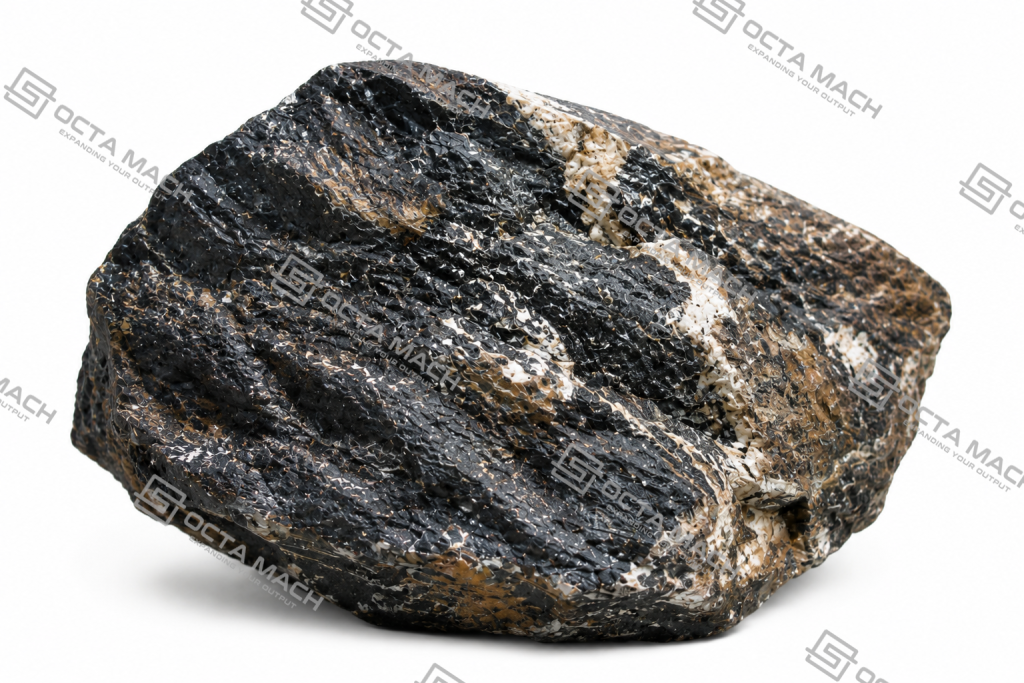
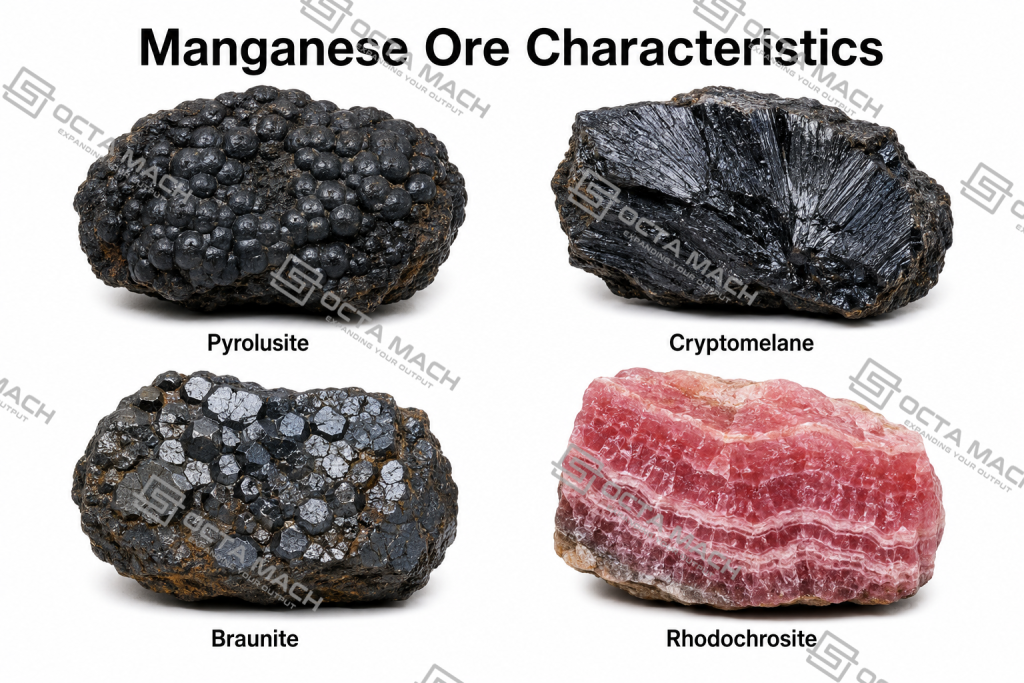
Manganese ore is manganese-bearing rock processed mainly for ferroalloys, steelmaking and selected metallurgical or chemical applications. Important manganese minerals include pyrolusite, cryptomelane, braunite and rhodochrosite, commonly associated with quartz, calcite, clay and iron-bearing gangue. Their hardness varies significantly: massive pyrolusite can be about Mohs 2, crystalline pyrolusite and braunite about 6–6.5, and rhodochrosite about 3.5–4. For preliminary hard-rock processing, ROM manganese ore may contain fragments in the 500–600 mm class, depending on blasting and deposit conditions, so primary reduction is normally handled by a jaw crusher; OctaMach PE600×900 and PE750×1060 models, for example, list maximum feed sizes of 500 mm and 630 mm respectively.
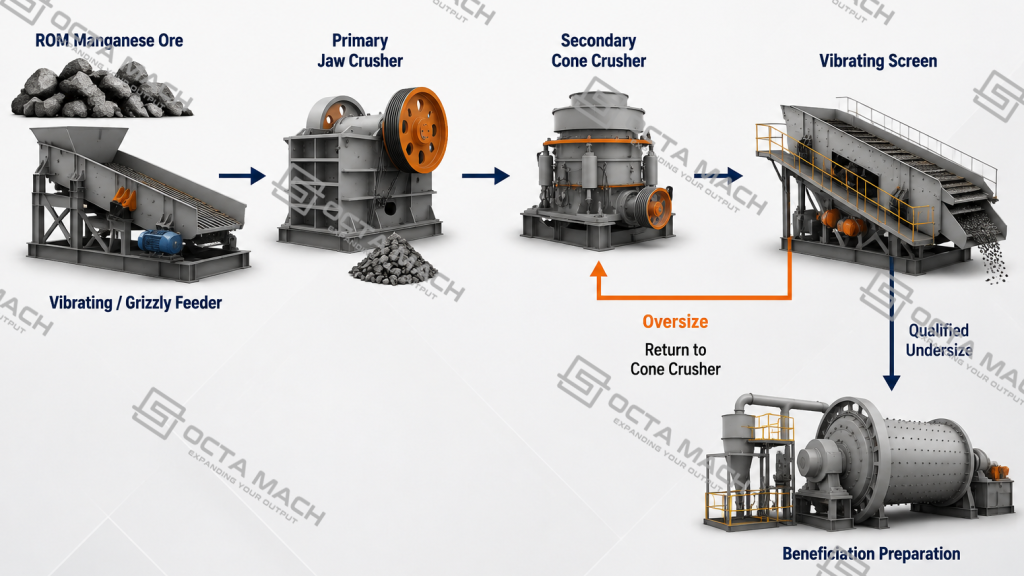
After primary crushing, the smaller ore is transferred to a cone crusher for secondary reduction and then classified by a vibrating screen. Oversize material returns to the cone crusher, while qualified material moves forward to washing, gravity separation, magnetic separation or grinding according to the mineralogy and required liberation size. This gives a typical hard-rock route of feeding → jaw crushing → cone crushing → screening → beneficiation or grinding, with the final process determined by whether the manganese occurs mainly as oxide, carbonate or a more complex intergrowth.
Manganese Ore Characteristics
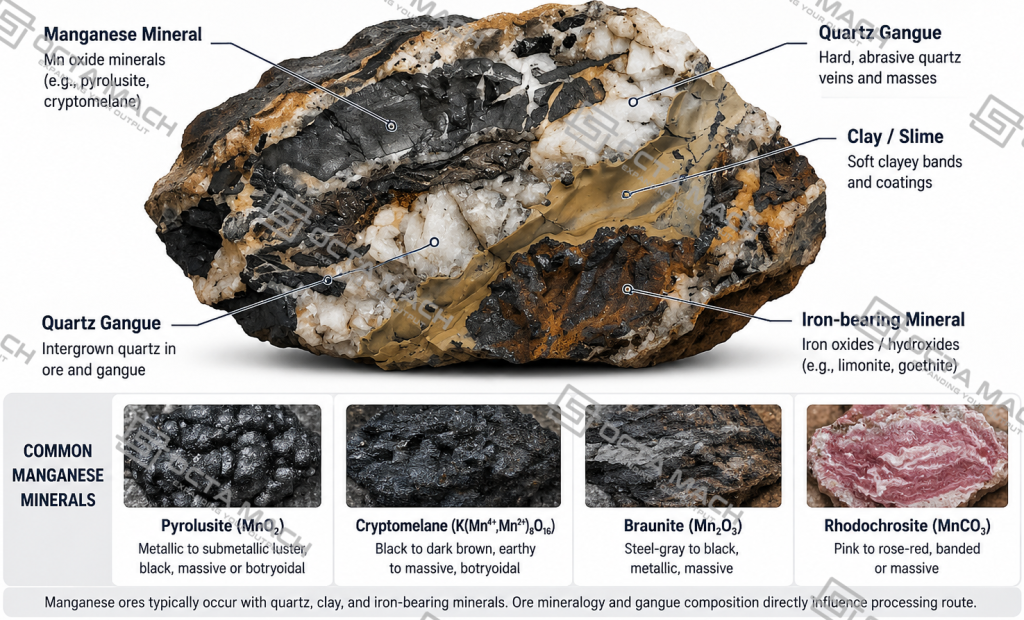
A manganese deposit is rarely a block of pure manganese mineral. Mine feed normally contains manganese-bearing particles mixed with quartz, calcite, clay, iron-bearing minerals and other gangue. Some ores are massive and competent; others are weathered, friable or strongly contaminated with clay and fines. The plant must therefore be designed from the actual ROM material rather than from the chemical symbol Mn alone.
| Mineral | Typical composition | Mohs hardness | Density / specific gravity | Processing significance |
| Pyrolusite | MnO₂ | 2 massive; 6–6.5 crystalline | about 5.04–5.08 | Important oxide manganese mineral; physical behaviour changes strongly with texture |
| Cryptomelane | K-bearing Mn oxide | 5–6.5 | about 4.17–4.41 | Dense oxide mineral that may respond to gravity and high-intensity magnetic treatment |
| Braunite | Mn-bearing oxide-silicate | 6–6.5 | about 4.72–4.83 | Relatively hard mineral; liberation from silicate gangue may require finer crushing or grinding |
| Rhodochrosite | MnCO₃ | 3.5–4 | about 3.7 | Major carbonate manganese mineral with different beneficiation behaviour from oxide ore |
Mineral data show why “hard manganese ore” and “soft manganese ore” cannot be defined only by Mn content. A pyrolusite-rich weathered ore can be soft and earthy, while manganese ore enclosed in quartz-rich competent rock may place substantially higher wear and crushing duty on the plant.
Manganese Oxide Ore
Manganese oxide ore commonly contains pyrolusite, cryptomelane, braunite and related Mn oxides. Many oxide minerals have a relatively high density compared with common gangue, which creates an opportunity for gravity concentration when useful mineral particles are sufficiently liberated. Published beneficiation references place manganese oxide ore density broadly around 3.7–5.0 g/cm³, compared with approximately 2.6–2.9 g/cm³ for common quartz- or calcite-rich gangue.
Oxide ore can still vary significantly. Clay-rich weathered material may need washing and desliming before separation, while dense, siliceous ore may need staged crushing and grinding to expose the manganese mineral.
Manganese Carbonate Ore
Manganese carbonate ore is represented by minerals such as rhodochrosite, MnCO₃. It is chemically and mineralogically different from oxide ore and should not automatically receive the same beneficiation flowsheet.
Rhodochrosite has a Mohs hardness of about 3.5–4 and density around 3.7 g/cm³. Fine intergrowth with calcite, quartz, iron minerals or silicates can reduce the effectiveness of simple coarse gravity separation, making grinding, magnetic separation or flotation more relevant after testwork.
What Determines Manganese Ore Quality?
Mn grade alone does not define whether an ore is suitable for a particular downstream route. Buyers and metallurgical plants also evaluate Fe, SiO₂, Al₂O₃, CaO, MgO, phosphorus, mineral phase and particle size because these components affect beneficiation, slag generation and ferroalloy production.
Commercial manganese ores can differ substantially in grade. One current commercial classification distinguishes exportable material above 25% contained Mn, with ore above 44% Mn described as high grade within that particular supply system. These values are useful market references rather than universal acceptance limits; actual concentrate specifications remain customer- and process-specific.
This is also why a manganese ore beneficiation process should be selected after mineralogical and metallurgical testing. Two ores with the same total Mn assay may need different processes if one contains coarse liberated oxide minerals and the other contains fine carbonate minerals locked with silica or iron-bearing gangue. Modern phase-analysis practice specifically separates oxide, carbonate and silicate manganese forms because they behave differently during beneficiation and metallurgy.
Manganese Ore Crushing and Screening
Manganese ore crushing reduces large ROM rock to a controlled particle size suitable for washing, gravity separation, magnetic separation or grinding. For competent hard-rock ore, the crushing section normally uses staged compression rather than attempting the full size reduction in one machine.
From ROM Ore to Beneficiation Feed
ROM Manganese Ore → Vibrating / Grizzly Feeder → Jaw Crusher → Cone Crusher → Vibrating Screen → Beneficiation Preparation.
Oversize from the screen returns to the cone crusher, creating a closed circuit. Material that meets the required size moves forward to the next processing stage.
1. Controlled Feeding
The vibrating or grizzly feeder regulates the flow of irregular ROM rock before primary crushing. Natural fines can be separated at this point where the feed contains loose soil or undersize material, reducing unnecessary load on the jaw crusher.
2. Primary Size Reduction
Large manganese ore enters the jaw crusher, where compression breaks the ROM rock into smaller fragments suitable for secondary crushing.
For reference, several OctaMach jaw crusher specifications show the scale of this duty:
- PE600×900: maximum feed about 500 mm, discharge 65–160 mm
- PE750×1060: maximum feed about 630 mm
- PE900×1200: maximum feed about 750 mm
These figures describe crusher capability rather than a fixed manganese ore feed specification. Actual crusher selection depends on ROM top size, feed distribution and whole-rock competency.
3. Secondary Cone Crushing
The primary-crushed ore then enters a cone crusher for further reduction. Coarse HP-series cavities on several current configurations accept feed in approximately the 175–265 mm range, while medium and fine cavities require smaller material.
This stage gives the plant more precise control over the feed delivered to screening and downstream beneficiation.
4. Screening and Closed-Circuit Control
The vibrating screen separates the secondary-crushed material into two streams:
Qualified undersize → Beneficiation or Grinding
Oversize → Return to Cone Crusher
The screen therefore determines which material actually leaves the crushing circuit. Crusher discharge setting alone does not define the final product size because feed gradation, screen aperture and circulating oversize also affect the result.
Crushed Size Depends on the Next Process
There is no single final crushing size for manganese ore. Coarsely liberated manganese oxide ore may move directly to washing, screening or gravity concentration, while finely intergrown carbonate or silicate-bearing ore may require additional crushing and grinding before effective separation.
Ore Washing for Clay-Rich Manganese Ore.
Washing is required when clay, mud or strongly weathered fines coat the manganese-bearing particles. Water and mechanical agitation break down these coatings, while screening or classification separates the resulting slime from cleaner coarse ore.
This step has a direct effect on downstream separation. Clay can interfere with jigging, shaking-table separation, screening and slurry handling, so sending heavily contaminated ROM directly into the beneficiation circuit can reduce separation stability. Washing is therefore an ore-condition decision rather than a compulsory stage for every manganese deposit. Washing and screening are also treated as important front-end operations in established manganese beneficiation flowsheets.
Manganese Ore Beneficiation
Manganese ore beneficiation removes gangue and upgrades manganese-bearing material before metallurgical or chemical processing. The process is selected according to mineral phase, liberation size, density contrast, magnetic response, clay content and impurity distribution. Coarse liberated oxide ore may be treated without fine grinding, while carbonate or complex intergrown ore usually requires more intensive liberation before separation.
| Beneficiation Method | How It Works | Best Suited to | Main Limitation |
| Gravity Separation | Separates particles according to density under water flow, pulsation or a shaking surface | Coarsely liberated manganese minerals with clear density contrast from gangue | Efficiency falls when valuable minerals remain finely locked with gangue |
| High-Intensity Magnetic Separation | Uses differences in magnetic susceptibility between manganese-bearing minerals and associated gangue | Weakly magnetic manganese ore after suitable crushing or grinding | Mineral response must be confirmed; low-intensity separation is not suitable for every manganese ore |
| Flotation | Separates minerals through differences in surface chemistry and bubble attachment | Fine or complex ore after sufficient grinding and liberation | Reagent system, grind size and pulp conditions must be determined by testwork |
| Combined Beneficiation | Uses two or more separation methods in sequence | Mixed or complex ore where one method cannot achieve sufficient upgrading | Requires additional classification, material handling and process control |
How Ore Characteristics Change the Beneficiation Route
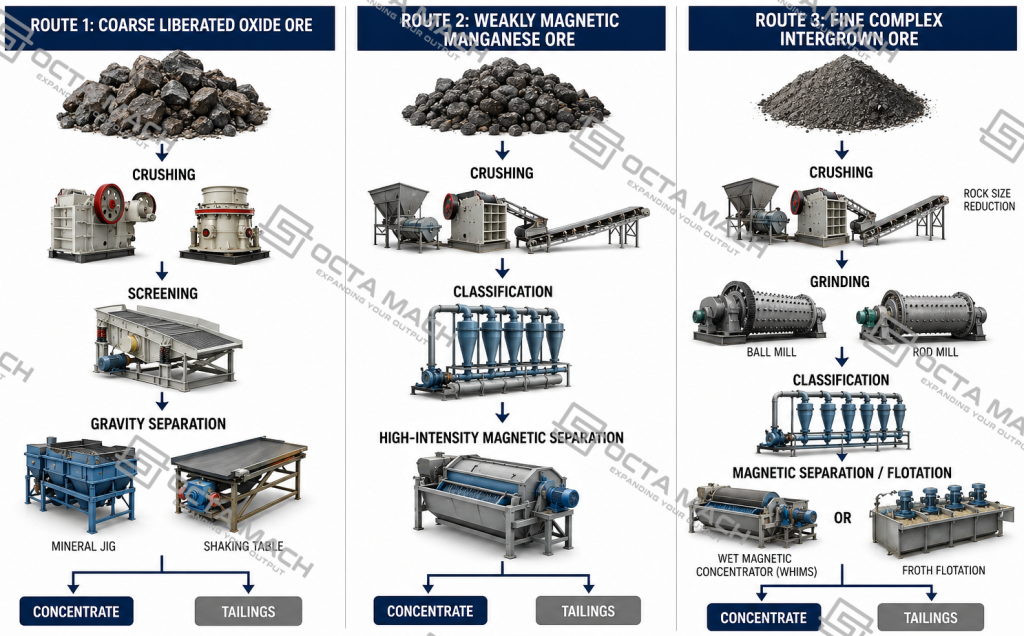
The beneficiation route changes with the way manganese minerals occur in the ore. Coarse liberated oxide ore can often be treated by screening and gravity separation without intensive grinding. Where manganese minerals show a useful magnetic response, high-intensity magnetic separation may be introduced after suitable crushing and classification. If the valuable minerals remain finely locked with quartz, carbonate or silicate gangue, additional grinding is required before magnetic separation or flotation can work effectively.
Feed condition also changes the front end of the plant. Clay-rich or strongly weathered manganese ore may require washing and desliming before separation, while complex ores containing several manganese phases may need a combined gravity, magnetic and flotation route. The final flowsheet should therefore be selected from mineralogy, liberation size, gangue composition and metallurgical testwork, rather than from one standard manganese ore beneficiation process.
Manganese Ore Processing by Ore Type
| Ore condition | Main processing issue | More suitable process direction |
| Coarse liberated oxide ore | Dense Mn minerals separated from lighter gangue | Crushing → Screening → Gravity separation |
| Clay-rich weathered oxide ore | Mud and slime interfere with classification | Washing / Desliming → Screening → Gravity or magnetic separation |
| Weakly magnetic Mn-bearing ore | Density separation alone gives insufficient upgrade | Crushing / Grinding → High-intensity magnetic separation |
| Fine carbonate ore | Mn minerals closely intergrown with gangue | Grinding → Magnetic separation and/or flotation |
| Quartz-rich competent manganese rock | Higher crushing and abrasion duty | Jaw → Cone → Closed-circuit screening → Grinding if required |
| Mixed or complex ore | Multiple Mn phases and impurity hosts | Combined beneficiation based on mineralogical testwork |
This ore-type approach is more useful than applying one fixed manganese ore processing plant to every deposit. It also follows current manganese mineralogical practice, where oxide, carbonate and silicate phases are identified before the beneficiation route is finalized.
Reference Manganese Ore Processing Plant Configuration
For the crushing section, hard-rock production-line architecture can be scaled by installing additional cone crushers, screens and parallel crushing duties as plant throughput increases. The uploaded production-line reference progresses from approximately 150–200 t/h, 200–300 t/h, 400–500 t/h, 600–700 t/h, 700–800 t/h and finally around 1,000 t/h, using increasingly parallel jaw/cone/screen arrangements.
For manganese ore, those values should be treated as reference crushing-section capacities, not manganese plant guarantees:
| Reference throughput | Preliminary crushing arrangement |
| 150–200 t/h | Feeder → Jaw Crusher → Cone Crusher → Screen |
| 200–300 t/h | Feeder → Jaw → Single-Cylinder Cone → Multi-Cylinder Cone → Screening |
| 400–500 t/h | Larger jaw duty → parallel / staged cone crushing → multiple screening points |
| 600–800 t/h | Higher-capacity feed system → jaw → multiple cone crushers → closed-circuit screening |
| Around 1,000 t/h | Parallel high-capacity cone duties and screening circuits after primary crushing |
The original hard-rock layouts include aggregate sizing and, on some lines, VSI shaping. Those parts should not be transferred to a manganese mineral-processing plant. For manganese ore, qualified crushed material should move to washing, gravity separation, magnetic separation or grinding, depending on the ore.
Actual plant throughput changes with ROM top size, hardness, abrasiveness, clay content, crusher CSS, screen efficiency, circulating load and downstream beneficiation capacity. A 500 t/h crusher rating does not mean the complete manganese processing plant will continuously produce 500 t/h of concentrate.
Manganese Ore Processing Equipment
The main manganese ore processing equipment is selected according to the duty of each stage rather than as a fixed machine package.
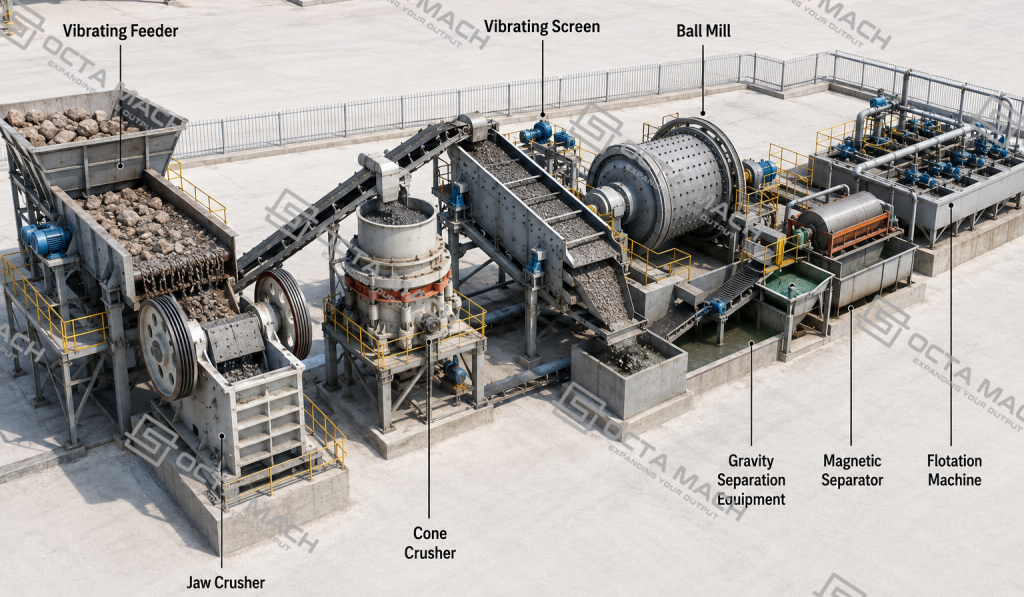
| Equipment | Main duty in manganese processing |
| Vibrating / Grizzly Feeder | Controls ROM feed and removes some natural fines |
| Jaw Crusher | Primary reduction of large manganese rock |
| Single-Cylinder Cone Crusher | Secondary crushing and controlled reduction of hard pre-crushed ore |
| Multi-Cylinder Cone Crusher | Higher-load secondary or fine compression crushing |
| Vibrating Screen | Controls beneficiation feed size and closes the crushing circuit |
| Ball Mill | Grinds ore until manganese minerals are sufficiently liberated |
| Shaking Table | Gravity separation of classified liberated particles |
| Magnetic Separator | Magnetic separation where mineral response and testwork support the route |
| Flotation Machine | Fine mineral separation where flotation is technically appropriate |
A ball mill becomes important only when crushing cannot provide enough liberation. Crushing breaks the rock; grinding breaks mineral intergrowths. The target mill product cannot be specified from manganese ore name alone because liberation is determined by texture and mineral association.
What Is Manganese Ore Used For?
The largest use of manganese remains metallurgy. USGS reports that iron and steel production accounts for about 85–90% of U.S. manganese demand, with ferromanganese and silicomanganese supplying most manganese to steelmaking. Manganese is also used in certain aluminum alloys, batteries and nonmetallurgical products.
For the ore-processing plant, the important point is that different downstream products need different feed chemistry and sizing. High-Mn, low-iron lump ore may be directed toward ferromanganese production, while other manganese ores can be prepared for silicomanganese, chemical processing or further refining. Silica, alumina, iron and other gangue components therefore influence the value of beneficiation just as much as the total Mn assay.
What OctaMach Can Provide
OctaMach can configure the main equipment needed from ROM size reduction through beneficiation preparation:
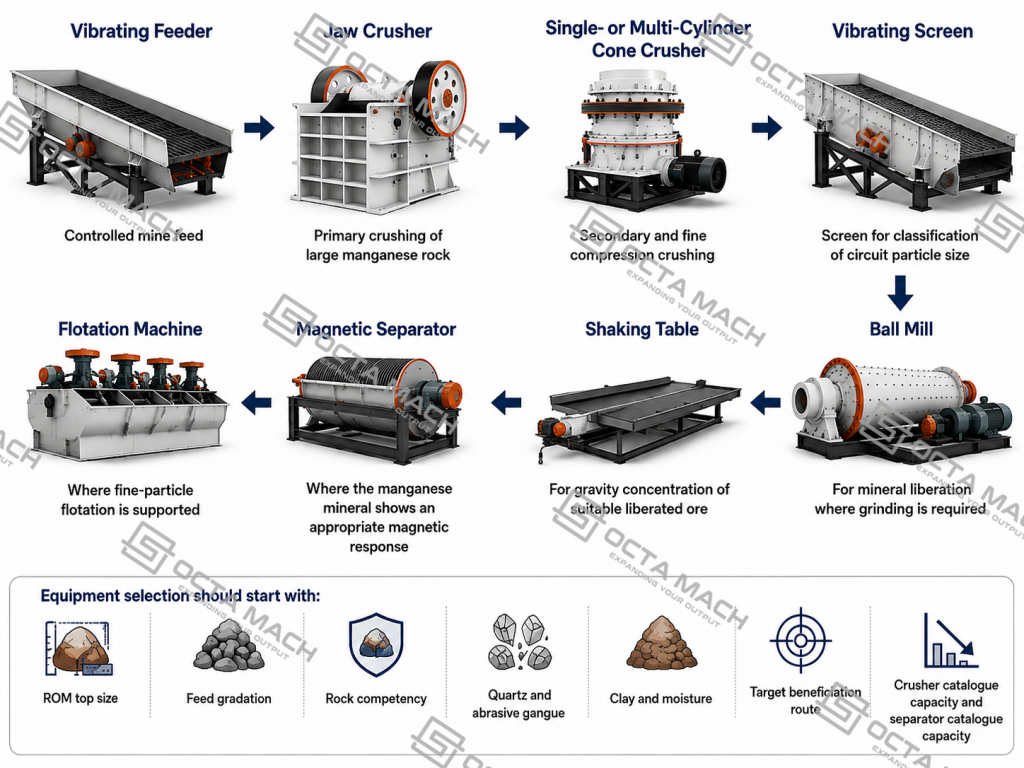
- Vibrating Feeder for controlled mine feed.
- Jaw Crusher for primary crushing of large manganese rock.
- Single- or Multi-Cylinder Cone Crusher for secondary and fine compression crushing.
- Vibrating Screen for closed-circuit particle-size control.
- Ball Mill for mineral liberation where grinding is required.
- Shaking Table for gravity concentration of suitable liberated ore.
- Magnetic Separator where the manganese mineral shows an appropriate magnetic response.
- Flotation Machine where fine-particle flotation is supported by testwork.
Equipment selection should start with ROM top size, feed gradation, whole-rock competency, quartz and abrasive gangue, clay and moisture, target beneficiation size, mineral liberation and the required downstream product. Crusher catalogue capacity and separator catalogue capacity are equipment data; complete-plant performance must be evaluated as one connected system.
FAQ
What are the main ores of manganese?
The main manganese-bearing minerals include pyrolusite, braunite, cryptomelane/psilomelane-type oxide minerals and rhodochrosite. Pyrolusite, MnO₂, is one of the most important manganese ores, while rhodochrosite represents an important carbonate form.
How is manganese ore processed?
A typical route begins with feeding, crushing and screening, followed by washing/desliming where clay is present. Beneficiation may then use gravity separation, high-intensity magnetic separation, grinding and flotation, alone or in combination. The final route depends on mineralogy and liberation rather than ore name alone.
Which crusher is best for manganese ore?
Large ROM manganese rock is normally handled first by a jaw crusher because it accepts larger feed. After primary reduction, a cone crusher is better suited to secondary or fine compression crushing. For example, current OctaMach jaw models cover maximum feeds from hundreds of millimetres up to 1,200 mm, whereas cone-crusher cavities are designed around smaller controlled feed.
Which country is the largest producer of manganese ore?
According to the USGS Mineral Commodity Summaries 2026, South Africa was the largest manganese-ore producer in 2025 on a manganese-content basis, with estimated production of about 7.6 million tonnes of contained manganese, followed by Gabon.