
Lithium ore is lithium-bearing rock that contains minerals from which lithium can be economically concentrated and subsequently extracted. In hard-rock deposits, the most important lithium minerals include spodumene, petalite and lepidolite, commonly occurring in coarse-grained pegmatite together with quartz, feldspar, mica and other gangue minerals. Spodumene has a Mohs hardness of about 6.5–7, petalite about 6–6.5, while lepidolite is considerably softer at approximately 2.5–3. These values describe individual minerals rather than the complete ore: a quartz-rich spodumene pegmatite may behave as a hard and abrasive rock even when softer mica is also present. For preliminary hard-rock crushing layouts, run-of-mine lithium ore may be considered in a reference size range of approximately 0–500/600 mm, with primary crushing reducing the feed to roughly 100–200 mm and secondary or tertiary crushing commonly preparing material in the approximate 10–40 mm range before grinding or coarse beneficiation. Actual feed and product sizes depend on blast fragmentation, ore competency, mineral liberation and the downstream process.
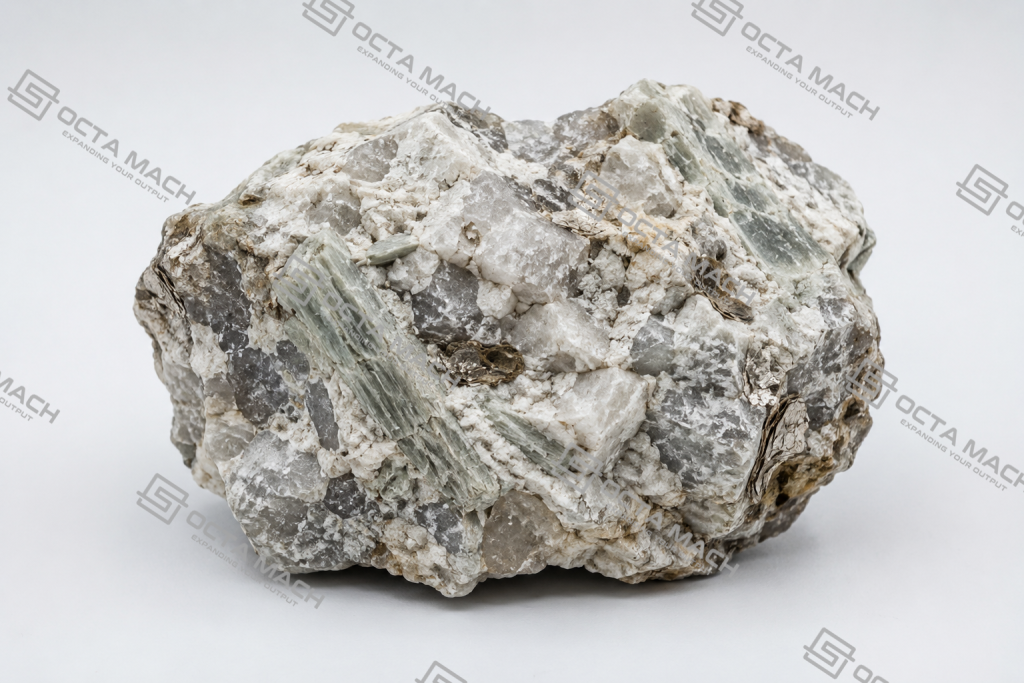
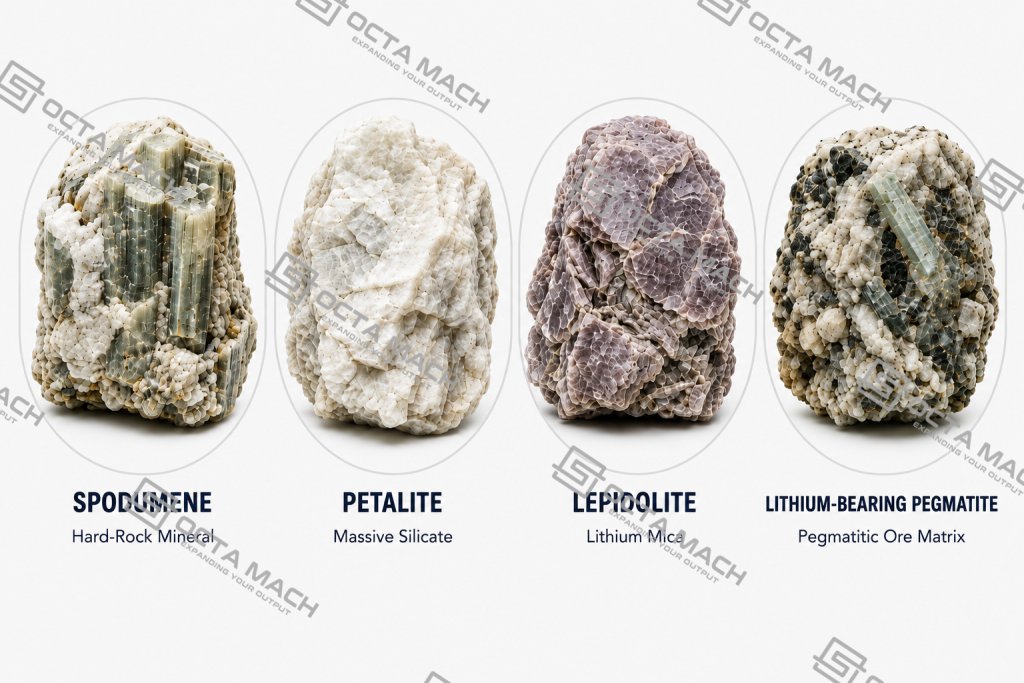
Lithium-bearing hard rock is processed mainly to separate a lithium mineral concentrate from the surrounding gangue. Crushing therefore does not produce lithium metal or battery-grade lithium chemicals. Its purpose is to reduce large mined rock to a controlled particle size so that spodumene or another lithium mineral can be progressively liberated and concentrated. Depending on the mineral texture, processing may then involve ore sorting, dense media separation, grinding, flotation and magnetic separation before a concentrate is sent for downstream thermal and chemical conversion.The actual route is selected from the ore itself rather than from a fixed lithium-processing template.
Main Minerals in Lithium Ore
Lithium ore is not a single mineral with one chemical formula. The term covers rock containing economically relevant lithium-bearing minerals, each with different physical properties and processing behavior.
| Lithium Mineral | Typical Formula | Mohs Hardness | Processing Relevance |
| Spodumene | LiAlSi₂O₆ | 6.5–7 | Principal hard-rock lithium mineral; commonly processed from pegmatite |
| Petalite | LiAlSi₄O₁₀ | 6–6.5 | Hard lithium aluminosilicate occurring in pegmatite |
| Lepidolite | Complex lithium mica | 2.5–3 | Softer mica-type lithium mineral requiring a different treatment approach |
| Amblygonite | LiAlPO₄(F,OH) | Variable | Less common but locally important lithium-bearing phosphate |
| Zinnwaldite | Lithium-bearing mica | Variable | Occurs in some granite- and greisen-related lithium deposits |
Spodumene is currently one of the most important minerals in hard-rock lithium beneficiation because of its widespread occurrence and comparatively high lithium content. However, the concentration route selected for a spodumene ore cannot automatically be applied to lepidolite or petalite ore.
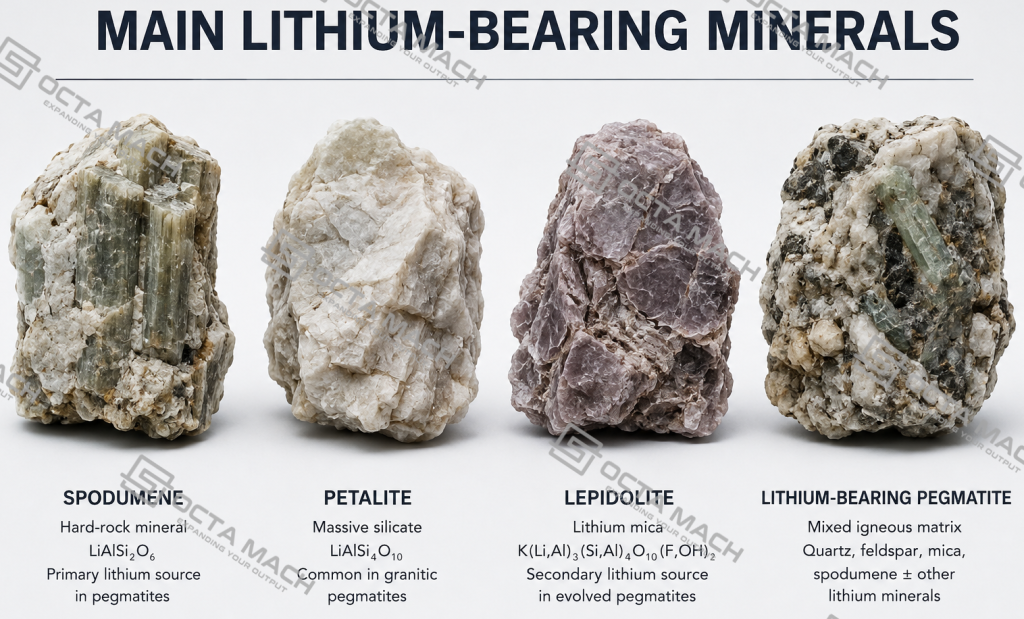
This mineralogical distinction is one of the most important points when evaluating lithium ore processing. A plant must first establish which mineral contains the lithium and how that mineral is interlocked with the surrounding rock.
Lithium Ore Host Rock and Mineralogy
Commercial hard-rock lithium minerals are frequently associated with pegmatite, a very coarse-grained igneous rock formed during the late stages of magma crystallization.
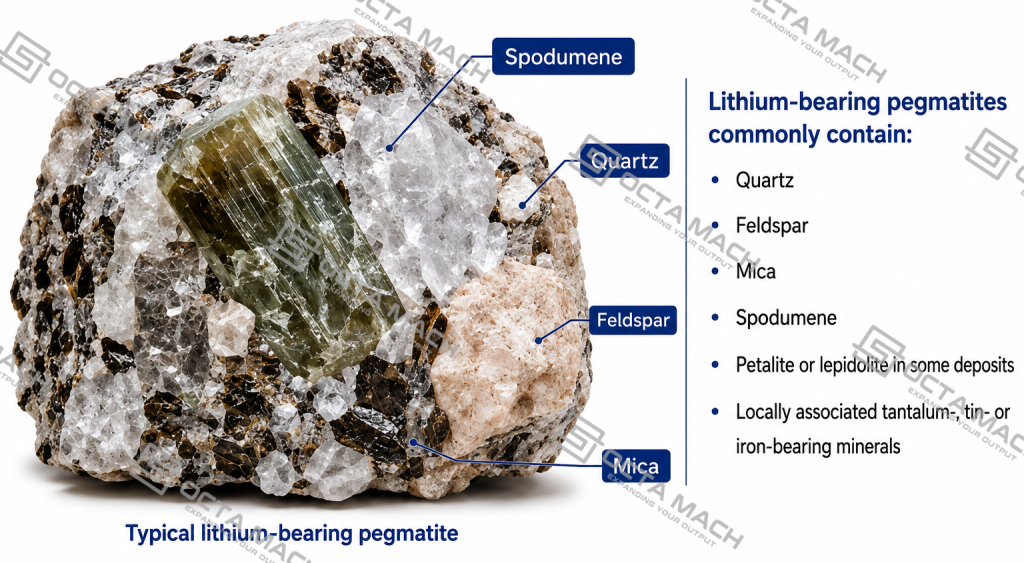
Lithium-bearing pegmatites commonly contain:
- Quartz
- Feldspar
- Mica
- Spodumene
- Petalite or lepidolite in some deposits
- Locally associated tantalum-, tin- or iron-bearing minerals
Pegmatite crystals can be much coarser than those in ordinary granite. This is important for mineral processing because coarse spodumene crystals may become sufficiently liberated at relatively large particle sizes to permit ore sorting or dense media separation before fine grinding.
Conversely, where lithium minerals are finely intergrown with quartz, feldspar or mica, more grinding may be required before an effective separation can be achieved. Hard-rock lithium beneficiation studies consistently identify mineralogy and liberation size as major controls on process selection.
Lithium also occurs in brines and clay-type resources, but those materials use substantially different extraction technologies. The crushing and grinding process described on this page applies primarily to hard-rock lithium ore.
Lithium Ore Hardness and Crushing Characteristics
Using one number to describe the “hardness of lithium ore” is misleading.
Spodumene itself is hard, but a crusher processes whole pieces of pegmatite rather than isolated spodumene crystals. The mechanical behavior of the feed is therefore controlled by the complete rock matrix.
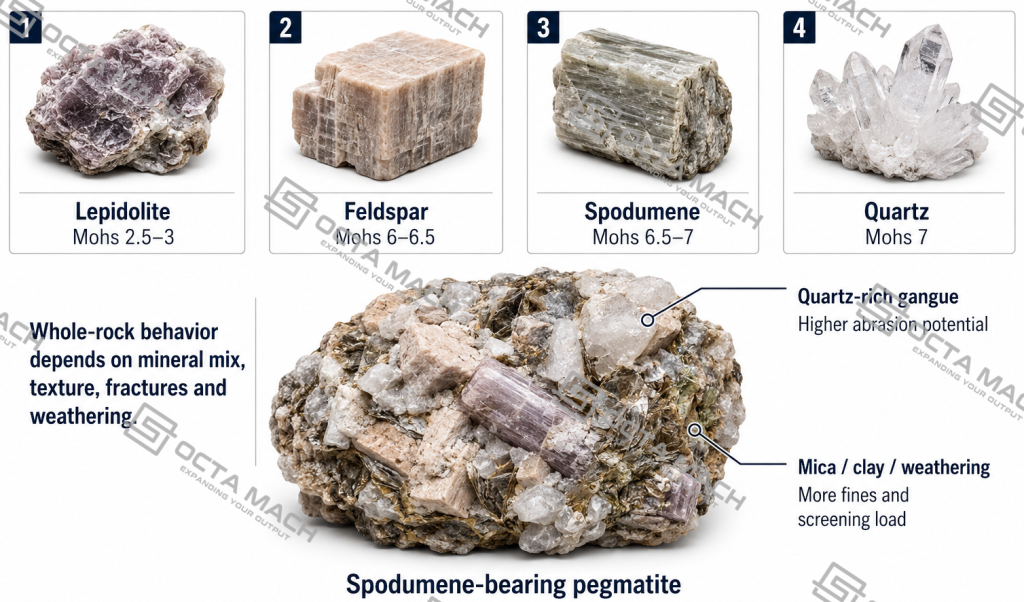
Spodumene
Spodumene has a Mohs hardness of approximately 6.5–7, placing it among the harder common lithium minerals.
Fresh spodumene crystals can therefore contribute to a competent crusher feed.
Quartz
Quartz has a Mohs hardness of 7 and is commonly present in lithium pegmatite.Quartz-rich gangue can increase abrasiveness even when the lithium mineral content itself is modest. Wear-liner selection should therefore consider gangue mineralogy rather than lithium grade alone.
Feldspar
Feldspar commonly falls around Mohs 6–6.5 and forms a major part of many pegmatites.A quartz-feldspar-spodumene assemblage can consequently form a strong hard-rock feed suitable for staged compression crushing.
Mica and Weathered Material
Mica is substantially softer, while weathering can produce clay and fine material.These components may not make the fresh rock easier to process. Instead, excessive mica, clay or moisture can reduce screening efficiency, affect feeding and increase fine-material handling requirements.
The engineering behavior of a lithium ore body should therefore be assessed using:
rock competency + abrasiveness + fracture pattern + mineral grain size + clay/fines + moisture
rather than assigning a single Mohs value to “lithium ore.”
Lithium Ore Size
Lithium ore enters a processing plant over a wide particle-size distribution determined mainly by mining and blasting.There is no worldwide standard specifying that lithium ore must enter or leave a crusher at one exact size.
A useful preliminary size progression for a hard-rock plant is:
| Processing Stage | Indicative Particle Size | Main Purpose |
| Run-of-Mine Lithium Ore | approx. 0–500/600 mm | Mined and blasted hard rock entering the plant |
| Primary Crushed Ore | approx. 100–200 mm | Controlled feed for secondary crushing |
| Secondary / Tertiary Crushed Ore | approx. 10–40 mm | Prepare material for grinding or coarse beneficiation |
| Grinding Feed | Often selected below the upper crushed-product range | Prepare stable mill feed |
| Beneficiation Feed | Project-specific | Determined by spodumene liberation and the selected separation route |
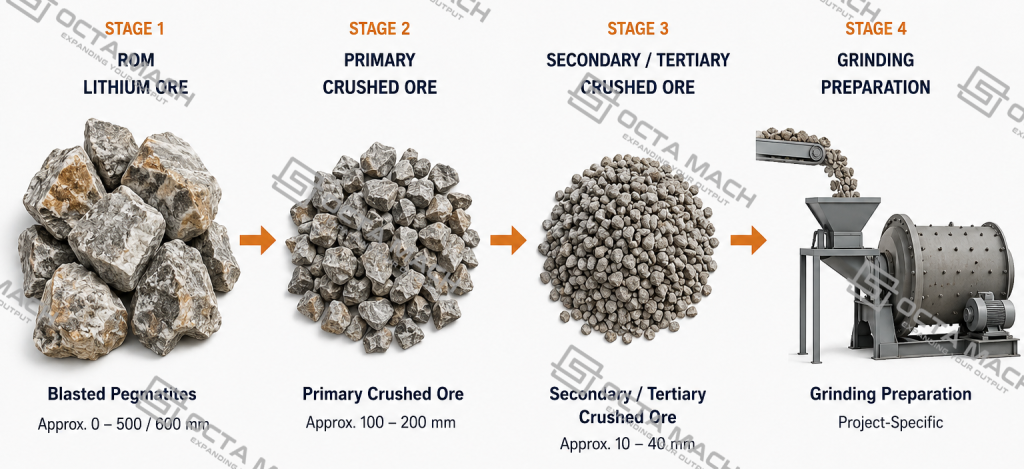
These are reference engineering ranges, not lithium ore specifications.A published spodumene plant, for instance, screens crushed material at approximately 20 mm before ball milling, while another project may use a different size because the mineral texture, mill type or DMS circuit is different.
The correct crushing target is therefore the size required by the next processing stage.
How Lithium Ore Texture Affects Processing
Two ores containing the same lithium mineral may require substantially different flowsheets.
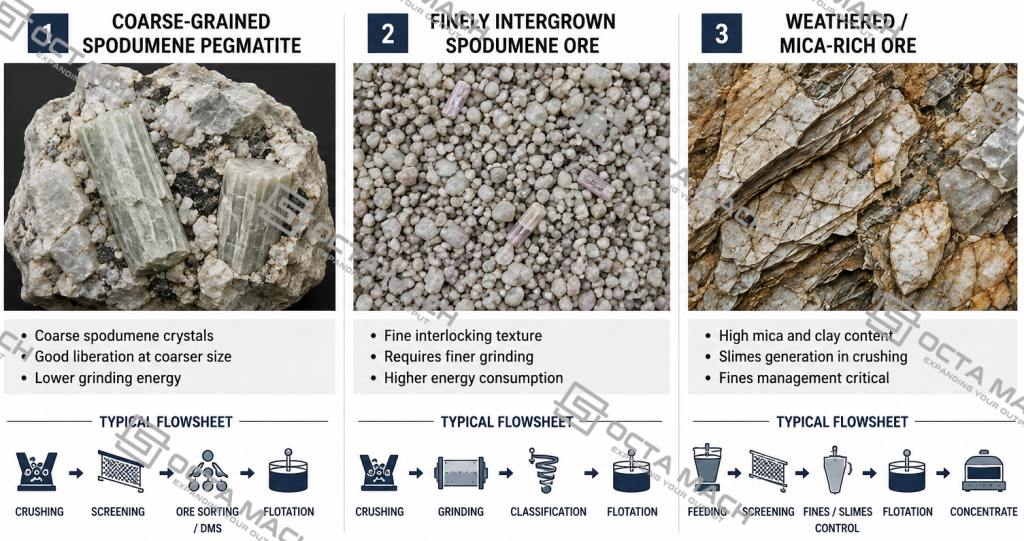
Coarse-Grained Spodumene Pegmatite
Large spodumene crystals can become partly liberated after relatively coarse crushing.
This creates opportunities for:
crushing → screening → sensor sorting and/or DMS.
to reject barren gangue before the full ore stream reaches fine grinding.Reducing the mass sent to a ball mill can reduce unnecessary grinding duty when the mineralogy permits this approach.
Finely Intergrown Spodumene Ore
Where spodumene is closely intergrown with quartz and feldspar, coarse separation becomes less effective.
The ore may require:
crushing → grinding → classification → flotation.
to produce adequate liberation.
Weathered or Mica-Rich Ore
Weathered pegmatite can introduce fines and clay, while mica-rich ores can generate plate-like particles.These conditions influence feeder selection, screen performance, desliming requirements and flotation behavior.
This is why spodumene processing should be based on mineralogical and metallurgical testwork rather than only on the lithium grade of the ROM ore.
Lithium Ore Crushing Process
The crushing section prepares mined hard rock for grinding and beneficiation while controlling oversize material and unnecessary fines.
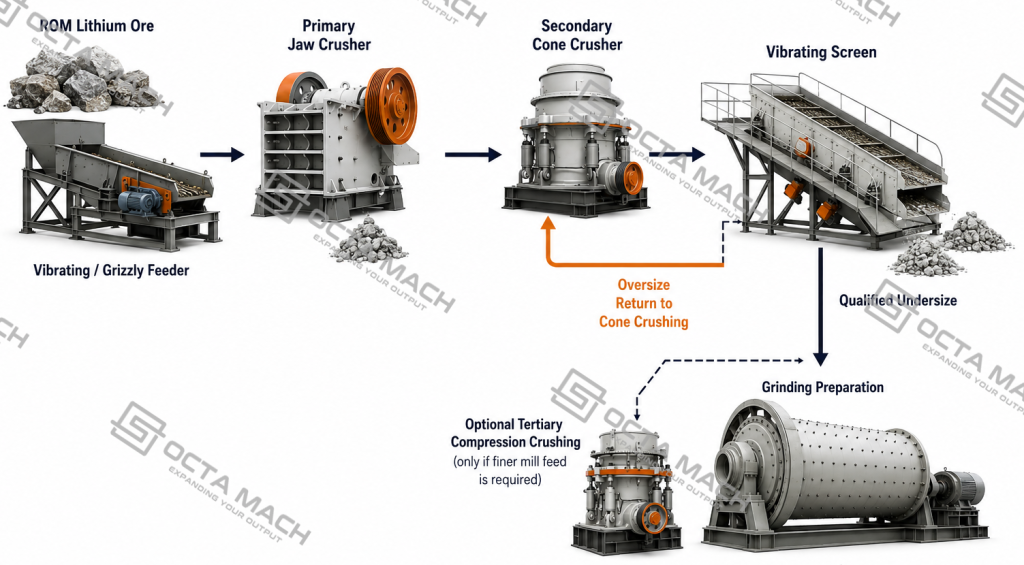
1. Feeding and Pre-Screening
ROM lithium ore is discharged into a receiving hopper and delivered to the crushing circuit through a vibrating or grizzly feeder.The feeder stabilizes the feed rate entering the primary crusher.
Where the ROM material contains natural fines, weathered rock or clay-rich material, pre-screening can remove appropriate undersize before primary crushing. Fresh, clean pegmatite and weathered lithium ore should not automatically use the same front-end configuration.
2. Primary Jaw Crushing
A Jaw Crusher is suitable for coarse reduction of large, irregular hard-rock lithium ore.The crushing chamber applies compression between a fixed and moving jaw, reducing ROM fragments to a size suitable for conveyors and secondary crushing.
For a preliminary circuit using ROM rock in the several-hundred-millimeter range, the primary stage may reduce the material to roughly 100–200 mm, although actual discharge depends on crusher setting and downstream requirements.The primary jaw crusher is not intended to achieve the mineral liberation required for flotation. Its main duty is controlled coarse reduction.
3. Secondary Cone Crushing
After primary crushing, competent spodumene-bearing pegmatite can be reduced further using a Cone Crusher.
Cone crushing is particularly suitable for hard and abrasive feeds containing quartz and feldspar because it provides continuous compression reduction.A Single-Cylinder Hydraulic Cone Crusher may be considered for robust secondary crushing, while an HP Series Multi-Cylinder Hydraulic Cone Crusher can be applied where the circuit requires finer reduction or higher crushing intensity.
The final choice depends on:
- feed size and gradation;
- rock competency;
- abrasiveness;
- required product size;
- circulating load;
- plant throughput.
Lithium grade alone does not determine the cone crusher.
4. Screening and Oversize Return
Crushed lithium ore enters a vibrating screen where material is classified by size.
The circuit should operate according to a simple rule:
Qualified undersize → next processing stage
Oversize → return to the crushing stage
The screen therefore controls the particle size presented to grinding or coarse beneficiation.
Closed-circuit crushing also prevents isolated oversize pieces from reaching the mill while avoiding repeated crushing of material that already meets the target size.This follows the same engineering principle seen in conventional hard-rock crushing layouts: controlled feeding, primary jaw reduction, cone crushing, screening and oversize return. In a lithium plant, however, the accepted material proceeds toward mineral liberation rather than aggregate shaping or finished construction-stone stockpiles.
5. Optional Tertiary Crushing
A third crushing stage may be used when the selected grinding circuit benefits from a finer feed.
It should not be treated as compulsory.
Additional crushing can reduce the size entering a ball mill, but excessive crushing may also produce fines earlier than necessary. Whether tertiary crushing is beneficial depends on ore competency, crusher-to-mill energy distribution and downstream separation requirements.
Grinding Lithium Ore for Mineral Liberation
Crushing reduces rock size, but most hard-rock lithium ores still require grinding before fine beneficiation.
A Ball Mill reduces the crushed feed until spodumene or another target mineral is sufficiently liberated from quartz, feldspar, mica and associated gangue.
Classification separates the ground product:
qualified fine material → beneficiation
coarse material → return to grinding
No single grinding size should be described as the universal spodumene target.
Some individual flotation plants operate around very fine particle-size distributions, while DMS-based circuits deliberately preserve a relatively coarse fraction before fine grinding. Scientific reviews show that liberation, slimes generation and flotation surface chemistry all influence the optimum grinding requirement.Grinding should therefore stop when sufficient liberation has been achieved for the selected beneficiation process, not simply when the smallest possible particle size has been reached.
Spodumene Beneficiation
Spodumene beneficiation separates lithium-bearing mineral from the surrounding pegmatite gangue before downstream lithium extraction.
Dense media separation and flotation are two of the principal methods used for hard-rock lithium ores, with sensor sorting and magnetic separation used where mineralogical conditions support them.
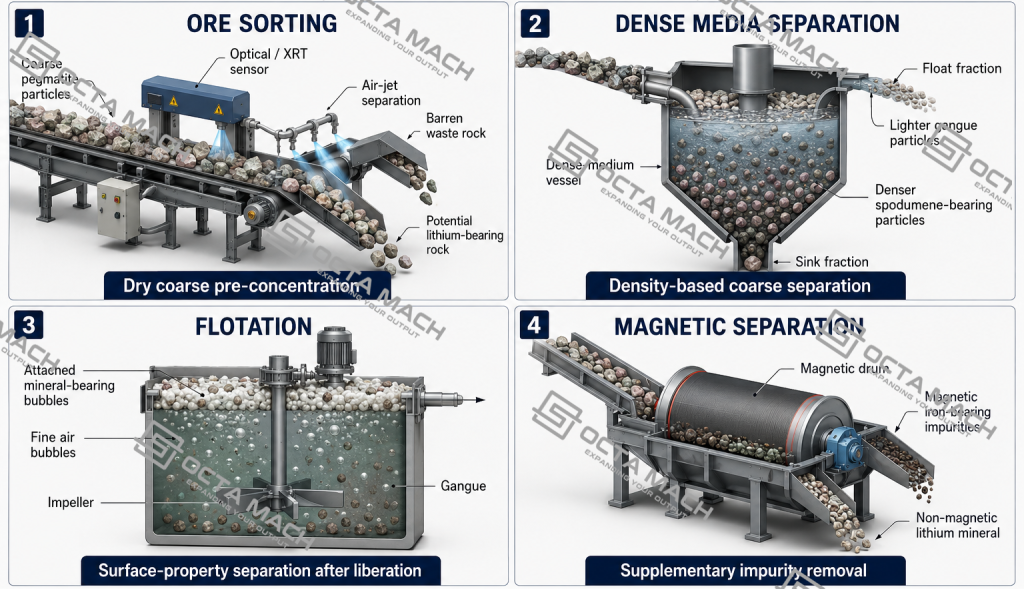
Ore Sorting
Ore sorting is a dry pre-concentration method that detects differences between individual rock particles and separates them before fine grinding. Depending on the ore, sorting systems may use optical, X-ray, laser or other sensor signals to distinguish lithium-bearing rock from barren gangue.
For coarse spodumene pegmatite, ore sorting can remove part of the waste rock early in the process when the valuable and barren material show a reliable detectable difference.This can reduce the amount of material sent to grinding and downstream beneficiation. However, sorting is only suitable when testwork confirms that the selected sensor can consistently distinguish the ore from waste; visible crystal color alone is not sufficient for process design.
Dense Media Separation
Dense Media Separation (DMS) is a gravity-based separation method that sorts mineral particles by density in a controlled high-density medium. Denser particles tend to sink, while lighter gangue particles float and can be removed.
In spodumene processing, DMS can provide coarse pre-concentration when the spodumene has reached sufficient liberation. The process can reject part of the lighter gangue before the remaining material enters fine grinding.DMS is particularly suitable for coarse-grained spodumene pegmatite, where valuable and gangue minerals are already sufficiently separated at a relatively coarse particle size. Fine or closely intergrown material may not respond effectively and may require additional grinding and flotation.
Flotation
Flotation is a mineral separation process that uses differences in surface properties to separate valuable minerals from gangue. Selected reagents make certain mineral particles attach to air bubbles and rise into a froth layer, while other particles remain in the slurry.
In lithium ore processing, flotation is commonly used after finer grinding when spodumene or other lithium minerals must be separated from quartz, feldspar, mica and related silicate gangue.The challenge is that these minerals can have partly similar surface properties.
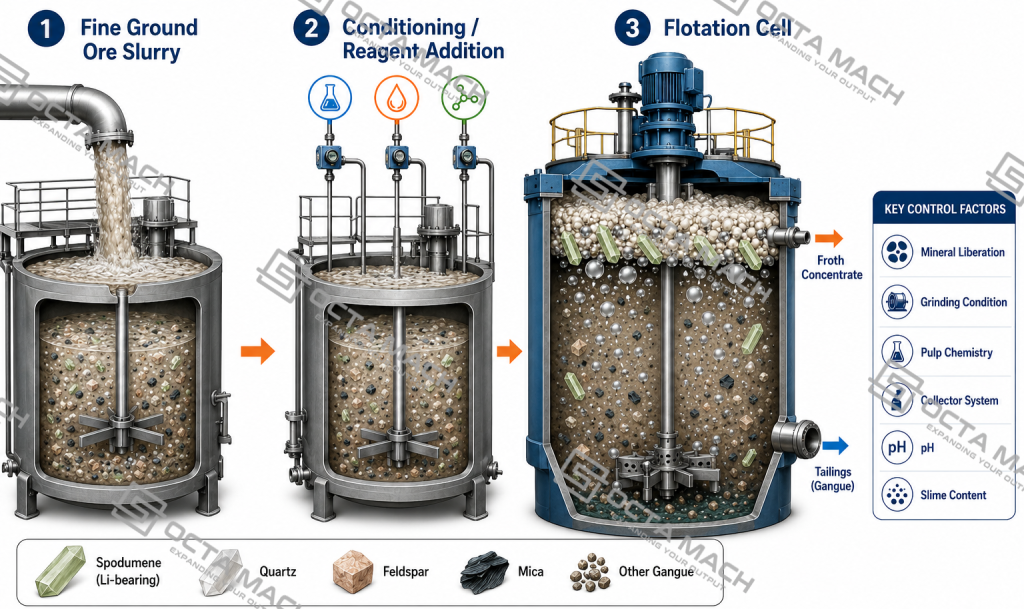
Flotation performance is therefore influenced by:
- mineral liberation;
- grinding condition;
- pulp chemistry;
- collector system;
- pH;
- slime content.
Both direct and reverse flotation approaches can be used for spodumene ores. The actual flowsheet and reagent conditions should be established through metallurgical testing because different pegmatite ores can respond very differently.
Magnetic Separation
Magnetic separation uses differences in magnetic properties to remove or concentrate minerals as the material passes through a magnetic field. Magnetic particles are attracted or deflected, while non-magnetic particles follow a different path.
In lithium ore processing, magnetic separation is mainly used to remove iron-bearing or other magnetic gangue minerals after they have been sufficiently liberated.It is generally a supplementary cleaning or upgrading stage rather than the main spodumene recovery method. Its position in the flowsheet depends on the type of magnetic impurity, particle size and concentrate quality requirement.
Processing Different Lithium Ore Types
Different lithium minerals should not be treated as interchangeable feedstocks.
| Ore / Mineral Type | Main Characteristics | Typical Processing Consideration |
| Spodumene Ore | Hard lithium aluminosilicate, commonly in pegmatite | Crushing, possible coarse pre-concentration, grinding, flotation and/or DMS |
| Petalite Ore | Hard lithium-bearing silicate | Liberation and downstream requirements must be established specifically |
| Lepidolite Ore | Softer lithium mica | Different mineral texture and surface behavior from spodumene |
| Mixed Lithium Pegmatite | Several lithium and gangue minerals | Mineralogical characterization is required before flowsheet selection |
Published industrial reviews examine spodumene, petalite, lepidolite and other lithium minerals separately because their mineral structures and downstream extraction behavior differ significantly.
Equipment for Lithium Ore Processing
Equipment for lithium ore processing should be selected according to the actual duty required by the ore. In a hard-rock lithium plant, the crushing, screening, grinding and beneficiation sections operate together to convert ROM lithium ore into a lithium mineral concentrate, most commonly a spodumene concentrate.
| Process Stage | Equipment | Main Function |
|---|---|---|
| ROM receiving | Hopper | Buffer mined lithium ore |
| Feeding | Vibrating Feeder | Provide stable feed to the crushing circuit |
| Primary crushing | Jaw Crusher | Reduce large ROM hard rock |
| Secondary crushing | Cone Crusher | Reduce hard pre-crushed pegmatite |
| Fine compression crushing | Single-Cylinder / HP Multi-Cylinder Hydraulic Cone Crusher | Further size reduction where required |
| Classification | Vibrating Screen | Separate qualified product and circulating oversize |
| Grinding | Ball Mill | Liberate lithium minerals from gangue |
| Fine beneficiation | Flotation Machine | Separate spodumene where flotation testwork supports the route |
Crushing and screening control particle size, grinding prepares the ore for liberation, and flotation recovers the lithium-bearing mineral where applicable. The product of this section is a lithium mineral concentrate for downstream thermal and chemical conversion rather than lithium carbonate or lithium hydroxide directly from the crushing circuit.
What OctaMach Can Provide
OctaMach can provide the main equipment required for hard-rock lithium ore crushing, screening, grinding and flotation preparation, including:
- Vibrating Feeder — controlled ROM feeding
- Jaw Crusher — primary crushing of large pegmatite rock
- Cone Crusher — secondary and fine crushing
- Vibrating Screen — closed-circuit size control
- Ball Mill — grinding for mineral liberation
- Flotation Machine — spodumene separation where testwork supports flotation
Equipment configuration is selected according to ROM size, ore hardness, abrasiveness, target particle size, mineral liberation and downstream beneficiation requirements.
FAQ
What is lithium ore?
Lithium ore is rock containing lithium-bearing minerals in a form and concentration that may support mining and processing. Important hard-rock lithium minerals include spodumene, petalite and lepidolite.
How hard is lithium ore?
Lithium ore does not have one universal Mohs hardness. Spodumene is about 6.5–7, petalite approximately 6–6.5, and lepidolite roughly 2.5–3. Whole-rock crushing behavior also depends on quartz, feldspar, mica, fractures and weathering.
What size is lithium ore before crushing?
ROM size depends on blast fragmentation and mining conditions. For a preliminary hard-rock crushing layout, material may range from fines up to approximately 500–600 mm, although the actual maximum lump size must be confirmed for each mine.
What rock is lithium found in?
Hard-rock lithium minerals are commonly associated with pegmatite. Spodumene-bearing pegmatites frequently contain quartz, feldspar and mica together with the lithium mineral.
How is spodumene ore processed?
Spodumene ore is typically crushed and screened before coarse pre-concentration and/or grinding. Depending on mineral liberation, beneficiation may include DMS, flotation, sensor sorting and magnetic separation before a spodumene concentrate is produced. The exact flowsheet requires mineralogical and metallurgical testwork.