
Granite forms through the slow cooling of silica-rich magma below the ground, producing a coarse, interlocking crystalline structure composed mainly of quartz, alkali feldspar and plagioclase, with smaller quantities of biotite, muscovite and accessory minerals. Representative granite commonly contains 20–40% quartz, 35–60% alkali feldspar, 10–25% plagioclase and 2–10% mica, although mineral proportions and grain texture vary from one deposit to another. Fresh, sound granite typically has a bulk density of about 2.60–2.75 g/cm³, a specific gravity of 2.60–2.75, and compressive strength commonly around 100–250 MPa, with an overall Mohs hardness of about 6–7. It also tends to show low porosity and low water absorption, which contribute to its durability in construction use. Because of these properties, granite is widely processed into concrete and asphalt aggregate, road base, railway ballast, paving stone and manufactured sand. For crushing applications, its dense crystalline structure and relatively high quartz content mean that granite not only requires staged size reduction, but also tends to impose higher abrasion and liner wear than softer rock types.
Industrial granite crushing therefore relies on controlled stage reduction rather than maximum size reduction in a single machine. Large rock is normally reduced by a jaw crusher, followed by cone crushing for secondary or tertiary reduction. Screens separate finished material from oversize return, while a VSI shaping stage is added when the product requires manufactured sand or tighter particle-shape control. The complete circuit has to balance feed size, granite abrasiveness, target grading, particle shape and plant throughput rather than selecting each crusher independently.
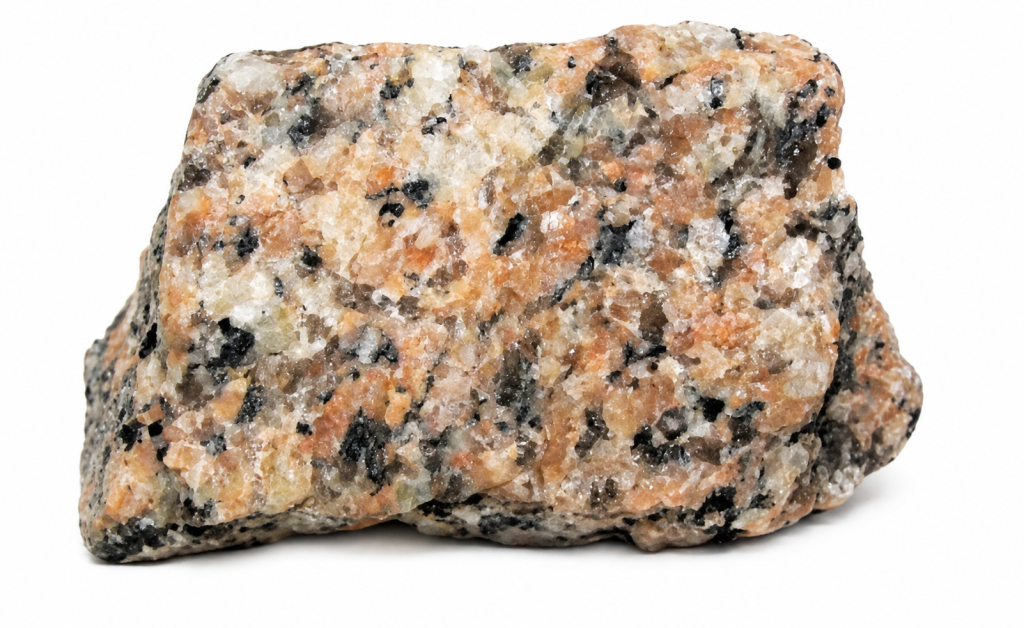
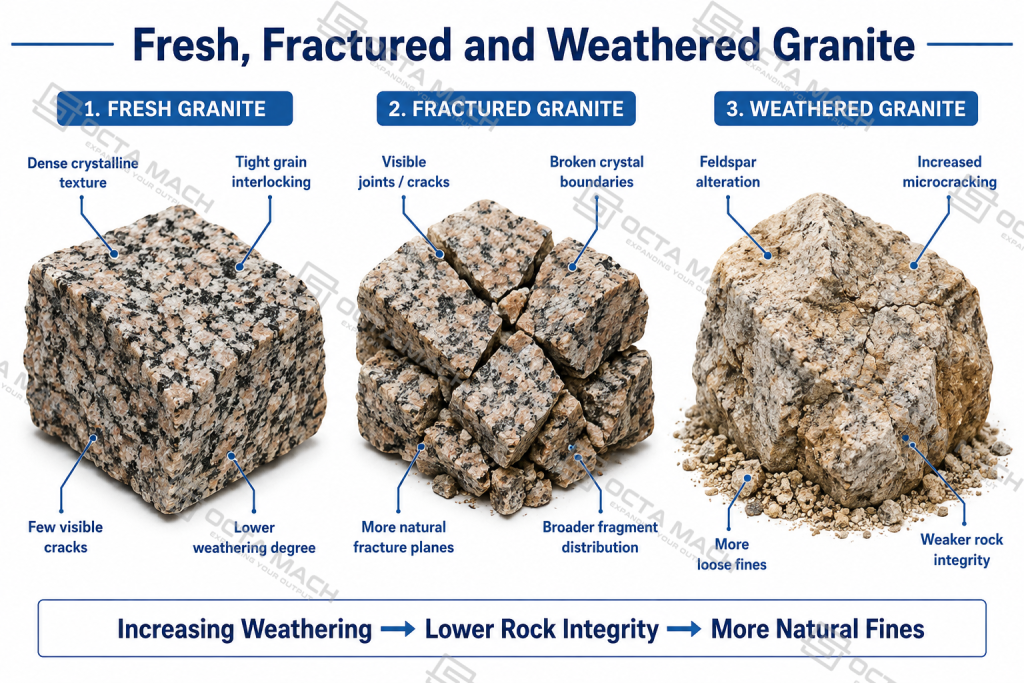
Granite Composition and Physical Properties
Granite develops from slowly cooled magma beneath the Earth’s surface, allowing individual mineral crystals to grow into a visible, interlocking texture. Most granite is light gray, white, pink or reddish, while darker grains usually come from biotite, amphibole or other iron- and magnesium-bearing minerals. Grain size commonly ranges from medium to coarse, although texture and mineral proportions vary considerably between deposits.
The rock consists predominantly of quartz and feldspar, accompanied by smaller quantities of mica and accessory minerals. Quartz contributes much of granite’s hardness and chemical durability, while alkali feldspar and plagioclase form most of its crystalline framework. The relative proportions of these minerals also influence granite color, texture and weathering behavior.
Mineral Composition of Granite
| Mineral Component | Representative Content | Main Characteristics |
|---|---|---|
| Quartz | Approx. 20–40% | Hard, glassy mineral; Mohs hardness about 7; commonly colorless, gray or translucent |
| Alkali Feldspar | Approx. 35–60% | Commonly orthoclase or microcline; often produces white, cream or pink coloration |
| Plagioclase Feldspar | Approx. 10–25% | Usually white to gray; composition ranges through sodium- and calcium-bearing feldspars |
| Mica | Approx. 2–10% | Mainly biotite and muscovite; forms dark or silvery plate-like grains |
| Accessory Minerals | Usually minor / trace amounts | May include amphibole, zircon, apatite, magnetite, tourmaline and other minerals |
These percentages are representative rather than a fixed recipe. Granite bodies formed from different magmas can contain substantially different proportions of quartz, alkali feldspar and plagioclase, while some varieties contain more biotite or amphibole than others.
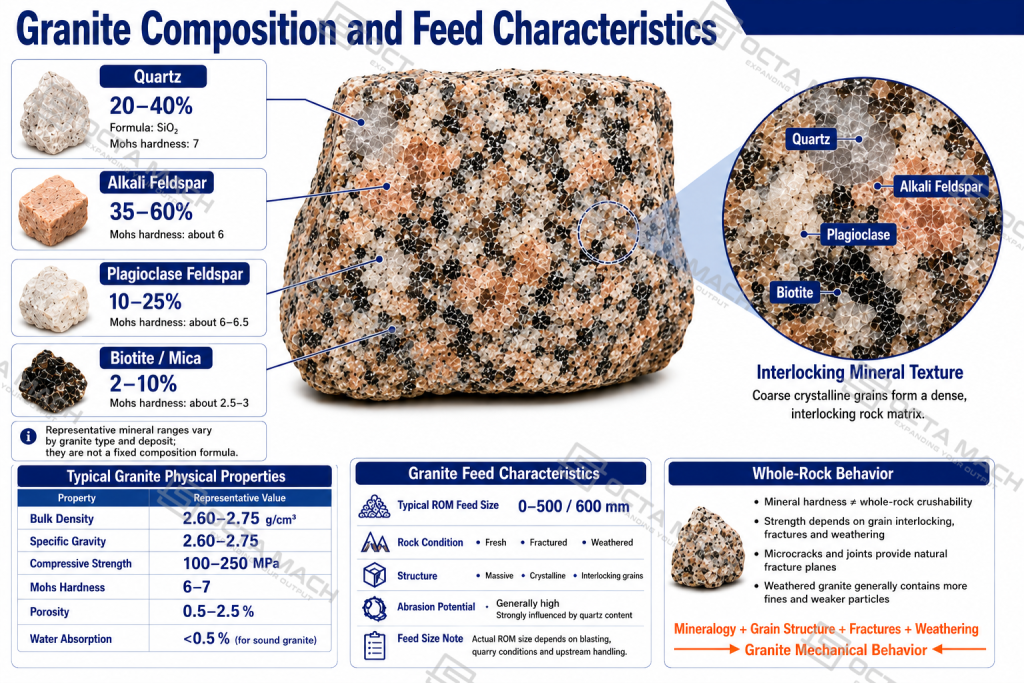
Physical and Mechanical Properties of Granite
Granite combines relatively high density, low porosity and high compressive strength. These properties explain its durability as both a dimension stone and a source rock for construction aggregate. However, values measured from individual quarry samples can vary because of mineralogy, grain size, microcracking, weathering and moisture condition.
| Property | Typical / Representative Range | Engineering Description |
|---|---|---|
| Bulk Density | Approx. 2.60–2.75 g/cm³ | Equivalent to about 2,600–2,750 kg/m³ for sound granite |
| Specific Gravity | Approx. 2.60–2.75 | Varies with mineral composition and alteration |
| Uniaxial Compressive Strength | Commonly about 100–250 MPa | Sound granite can exceed this range; weathered or highly fractured granite can be substantially lower |
| Mohs Hardness | Approx. 6–7 | Represents the combined influence of minerals such as feldspar and quartz; quartz itself has Mohs hardness 7 |
| Porosity | Commonly about 0.5–2.5% | Fresh, compact granite normally has relatively low connected pore space |
| Water Absorption | Commonly below 0.5% for sound dimension-grade granite | Increases where weathering and microcracking are more developed |
| Texture | Medium- to coarse-grained, crystalline | Individual quartz, feldspar and mica grains are normally visible |
| Structure | Massive and interlocking | Jointing, natural fractures and weathering can locally interrupt the massive structure |
Granite should be evaluated as a heterogeneous crystalline rock rather than by any single property value. Its engineering behavior reflects the combined effect of mineral proportions, grain size, crystal interlocking, microcracks, joints and weathering. Fresh, tightly interlocked granite generally maintains higher strength and lower permeability, while alteration of feldspar, grain-boundary cracking and weathering can progressively reduce rock integrity. These variations explain why granite from different deposits can show noticeably different strength, durability and fragmentation behavior even when classified under the same rock name.
Granite Crushing Process
A granite crushing process normally separates coarse reduction, intermediate reduction, screening and optional shaping into different stages. Large quarry feed first requires controlled primary reduction, while the downstream cone-crushing stages progressively reduce the material to a size that can be classified efficiently. Screening then determines which particles leave as finished product, which enter an optional shaping stage and which return for further crushing.
For hard and abrasive granite, a practical process route is feeding → jaw crushing → cone crushing → screening → oversize return → optional VSI shaping → final classification. The exact number of cone crushers, screens and parallel processing lines increases with plant capacity and the required product grading.
| Process Stage | Main Equipment | Material Route | Main Control |
|---|---|---|---|
| Feeding and Pre-Screening | Vibrating Feeder / Grizzly Feeder | Raw granite is fed continuously; soil and natural undersize can be removed before primary crushing when required. | Feed stability, maximum lump size, fines and clay content |
| Primary Crushing | Jaw Crusher | Large granite blocks are reduced to a size acceptable to the secondary stage. | Feed acceptance, lump shape and required primary reduction |
| Secondary Crushing | Single-Cylinder Hydraulic Cone Crusher | Pre-crushed granite undergoes further compression reduction. | Incoming feed size, cavity selection and discharge setting |
| Tertiary / Return Crushing | Multi-Cylinder Hydraulic Cone Crusher | Intermediate material and returned oversize are reduced toward the required screen cuts. | Chamber loading, required grading and return load |
| Screening | Vibrating Screen | Qualified fractions leave the circuit while oversize is redirected for additional crushing. | Screen aperture, incoming grading and screening efficiency |
| Optional Shaping | VSI Crusher | Selected pre-crushed material enters the shaping or manufactured-sand stage when required. | Feed gradation, particle-shape target and fines generation |
| Final Classification | Vibrating Screen | Material is separated into the required finished fractions. | Final product grading and oversize control |
The screen is what converts crusher discharge into defined products. Crusher settings control the size distribution leaving the crushing chamber, but they do not guarantee a finished fraction by themselves. Final grading depends on the interaction between the crusher discharge distribution, screen apertures and the amount of material returned through the closed circuit.
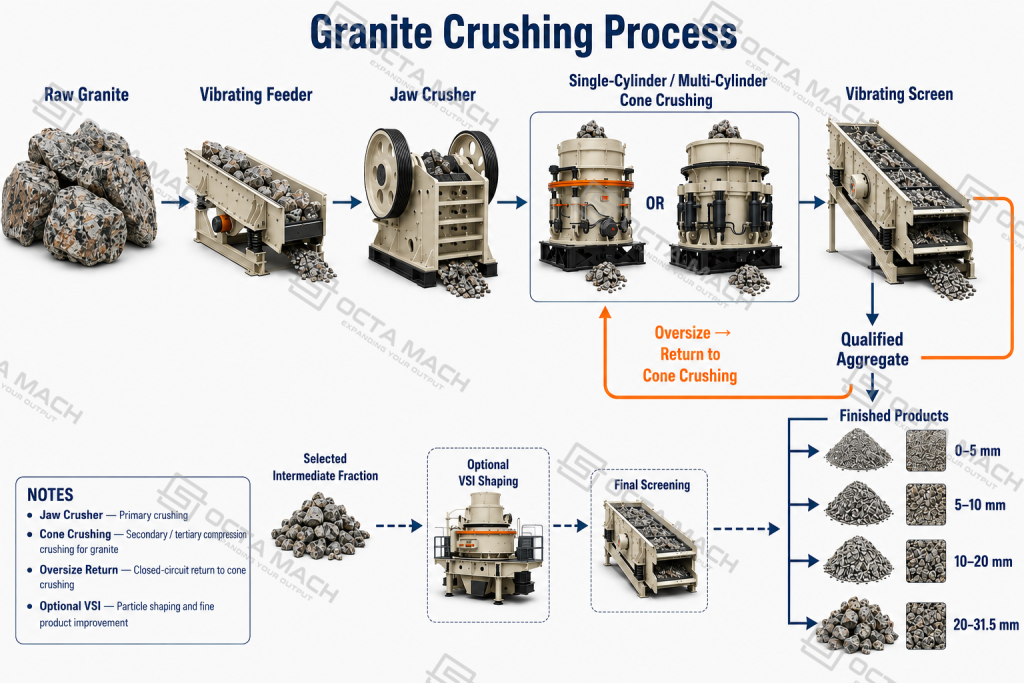
Closed-Circuit Load and Throughput Control
In a closed-circuit granite plant, the cone crusher handles both fresh feed and oversize returned from the vibrating screen. When more material remains above the required screen cut, the return load increases and occupies a larger share of the crusher’s available capacity. In the reference hard-rock circuits, material above 40 mm is commonly routed back for additional cone crushing, while smaller fractions proceed to further classification or optional shaping.
Plant throughput therefore depends on the balance between crusher setting, screen efficiency, product grading and circulating load, not on crusher capacity alone. Higher oversize return increases cone-crusher duty and reduces the capacity available for new feed, while liner wear or changes in feed gradation can further shift this balance. For this reason, crushing and screening capacity should be matched as one closed-circuit system.
Reference Granite Plant Configurations by Capacity
For preliminary plant configuration, granite crushing lines can be divided into capacity ranges from 150–200 t/h to approximately 1,000 t/h. As throughput increases, the circuit normally requires greater secondary and tertiary crushing capacity, additional screening area and, in higher-capacity layouts, parallel cone-crushing units to distribute both fresh feed and recirculating load. Equipment quantity and stage arrangement should therefore be determined by the total circuit duty rather than by scaling up a single crusher.
| Reference Capacity | Crushing and Screening Configuration | Main Configuration Characteristic |
|---|---|---|
| 150–200 t/h | Vibrating Feeder → Jaw Crusher → Cone Crusher → Screening → Optional VSI → Final Screening | Relatively compact closed circuit; intermediate material can enter VSI shaping while oversize returns for crushing |
| 200–300 t/h | Vibrating Feeder → Jaw Crusher → Single-Cylinder Cone → Multi-Cylinder Cone → Screening → Optional VSI | Separates secondary reduction from return-load / finer crushing duty |
| 400–500 t/h | Vibrating Feeder → Large Jaw Crusher → Single-Cylinder Cone → Multiple Multi-Cylinder Cone Units → Screening → Optional VSI | Additional cone capacity handles increased intermediate and circulating load |
| 600–700 t/h | Vibrating Feeder → Jaw Crusher → Single-Cylinder Cone → Multiple Multi-Cylinder Cone Units → Multi-Stage Screening | Higher throughput is distributed across several compression-crushing and screening units |
| 700–800 t/h | Vibrating Feeder → Large Jaw Crusher → Single-Cylinder Cone → Multiple Multi-Cylinder Cone Units → Multi-Stage Screening | Parallel secondary / tertiary capacity becomes more important as circuit load increases |
| Approx. 1,000 t/h | Large Feeding and Jaw-Crushing Stage → Multiple Parallel Cone Units → Multiple Screening Sections | Crushing and classification load is distributed across several machines rather than concentrated in one crusher |
The capacity range of each configuration depends on the actual granite feed and operating conditions. Maximum feed size, feed gradation, rock strength and abrasiveness, crusher settings, screen efficiency and circulating load all influence sustained plant output. Final equipment sizing should be confirmed against the required finished-product grading and expected material balance for the project.
Granite Aggregate Shape Control
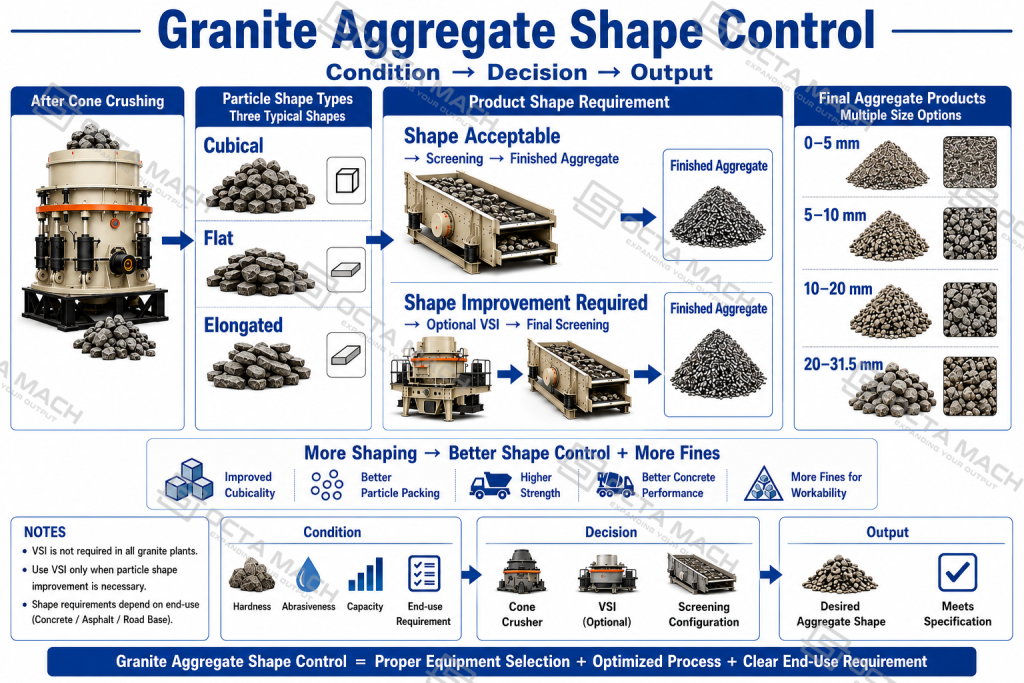
Finished granite aggregate is controlled by both particle size and particle shape. Screening can separate material into fractions such as 5–10 mm or 10–20 mm, but particles within the same size range may still have very different shapes. Some are relatively cubical, while others are flat, elongated or irregular. For concrete aggregate, asphalt aggregate and manufactured sand, the acceptable particle shape depends on the project specification and final use.
Particle shape begins to form during the main crushing stages. A jaw crusher performs the coarse reduction, while the downstream cone crusher has greater influence on the shape of the final aggregate. Stable feeding, suitable chamber selection, proper crusher setting and controlled reduction help produce a more consistent product. If too much size reduction is forced into one stage, the circuit can generate more irregular particles and fines rather than improving the final aggregate.
When cone crushing and screening already meet the required grading and shape, an additional shaping stage is unnecessary. A VSI crusher becomes useful when the project requires more cubical aggregate, fewer flat or elongated particles, or manufactured granite sand. The VSI should therefore be treated as an optional finishing stage for selected pre-crushed material, not as a compulsory machine in every granite crushing plant.
| Product Requirement | Recommended Process Approach |
|---|---|
| General graded aggregate with acceptable particle shape | Jaw Crusher → Cone Crusher → Screening |
| Tighter cubical-shape requirement | Jaw Crusher → Cone Crusher → Screening → Optional VSI |
| Manufactured granite sand | Jaw Crusher → Cone Crusher → VSI → Final Screening |
| Excess flat or elongated particles after cone crushing | Adjust cone operating conditions first; add VSI if further shaping is required |
Particle-shape control should be based on the required final product rather than on a fixed equipment sequence. For standard aggregate, stable cone crushing and screening may already provide acceptable shape; for higher-shape requirements or manufactured sand, an additional VSI stage can be introduced to refine particle morphology. The final process should balance grading, particle shape and fines content so that the finished granite aggregate matches its intended application.
Granite Aggregate Sizes and Applications
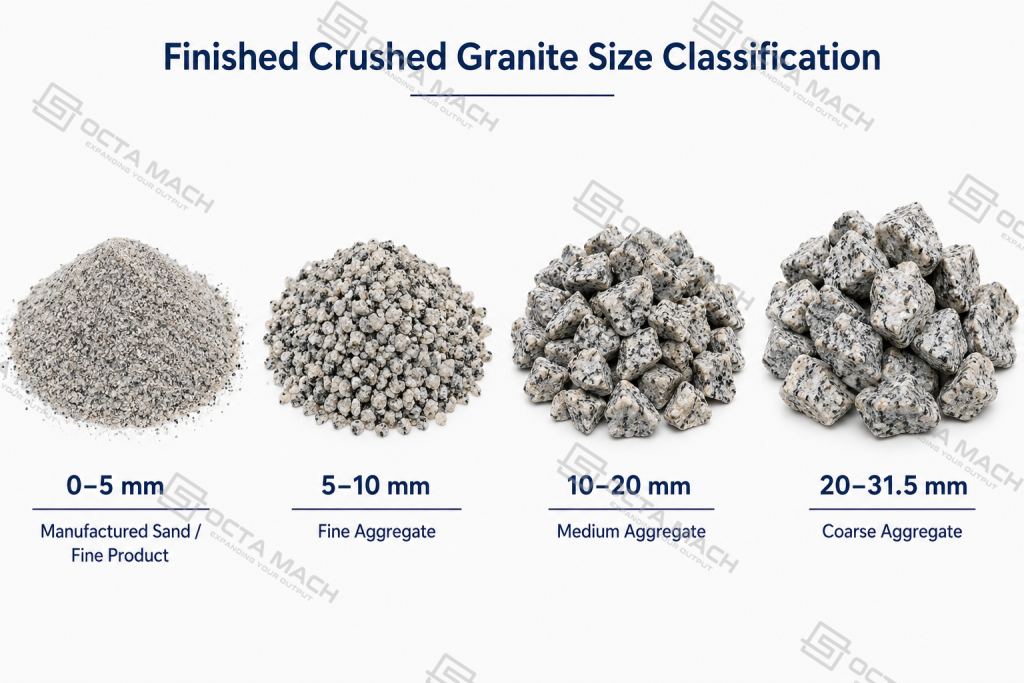
Finished granite aggregate is classified by vibrating screens after the final crushing stage. Reference granite crushing circuits can produce fractions such as 0–5 mm, 5–10 mm, 10–20 mm and 20–31.5 mm, while the actual screen cuts should be selected according to the required product grading and downstream application. Particle size is only one acceptance factor; particle shape, fines content, cleanliness and durability also influence the suitability of the finished aggregate.
| Representative Size | Product Type | Typical Application | Main Quality Control |
|---|---|---|---|
| 0–5 mm | Manufactured sand / granite fines | Concrete sand, mortar sand and blended fine aggregate where specifications permit | Grading, fines content and particle shape |
| 5–10 mm | Fine granite aggregate | Concrete aggregate, asphalt mixtures and graded aggregate blends | Size consistency, cleanliness and particle shape |
| 10–20 mm | Medium granite aggregate | Structural concrete, asphalt aggregate and general construction aggregate | Grading, cubicality and oversize control |
| 20–31.5 mm | Coarse granite aggregate | Concrete, road construction and coarse aggregate blends | Particle integrity, shape and size control |
| Blended Sizes | Graded crushed granite | Road base, sub-base and compacted aggregate layers | Continuous grading, fines proportion and compaction performance |
| Project-Specific Coarse Sizes | Coarse structural aggregate | Railway ballast and other applications requiring larger stone | Dedicated screen cuts, particle strength and shape |
The required application should determine the final screen cuts and product grading. A plant producing manufactured sand, concrete aggregate, road-base material or coarse structural aggregate may use the same basic crushing stages, but the screening arrangement, crusher settings and particle-shape requirements must be adjusted to the finished-product specification.
OctaMach Granite Crushing Solutions
OctaMach configures granite crushing solutions around the actual quarry feed and finished-product requirement rather than applying one fixed equipment sequence to every project. The selection process considers maximum feed size, feed gradation, granite abrasiveness, required throughput, product fractions, particle-shape target, screen cuts and circulating load before individual crusher sizes are confirmed.
Available configurations can combine vibrating feeding, primary jaw crushing, single- or multi-cylinder cone crushing, vibrating screening, closed-circuit return and optional VSI shaping. For larger granite plants, parallel crushing and screening units can be arranged to distribute process load and maintain the required production rate. Stationary or mobile layouts can then be selected according to site conditions, material movement and installation requirements.
FAQ
Q: Why do granite properties vary between different deposits?
A: Granite properties vary because the proportions of quartz, alkali feldspar, plagioclase and mica are not identical in every deposit. Grain size, crystal interlocking, natural joints, microcracks and weathering also change the rock structure, so density, compressive strength, hardness and durability can differ even when the material is all classified as granite.
Q: Does higher quartz content change granite crusher selection?
A: Higher quartz content primarily increases abrasiveness rather than simply making the granite “harder.” It raises wear demand on jaw plates, cone liners and downstream wear surfaces, so crusher type, wear-part selection and maintenance planning should be checked against the actual feed mineralogy and operating duty.
Q: Can 0–5 mm crushed granite be used directly as manufactured sand?
A: Not by size alone. A 0–5 mm fraction still needs to meet the required grading, fines content, particle shape and cleanliness for its intended use. Depending on the product specification, additional VSI shaping, screening or fines control may be required before it is treated as finished manufactured sand.
Q: Why can granite plant throughput be lower than the rated crusher capacity?
A: Crusher capacity describes one machine under defined operating conditions, while plant throughput is controlled by the complete circuit. Feed gradation, screen efficiency, crusher settings and returned oversize determine circulating load; when more material returns for re-crushing, less capacity remains for fresh granite feed.